
Postcard #002: Lonesome Greetings from Burlington, Iowa


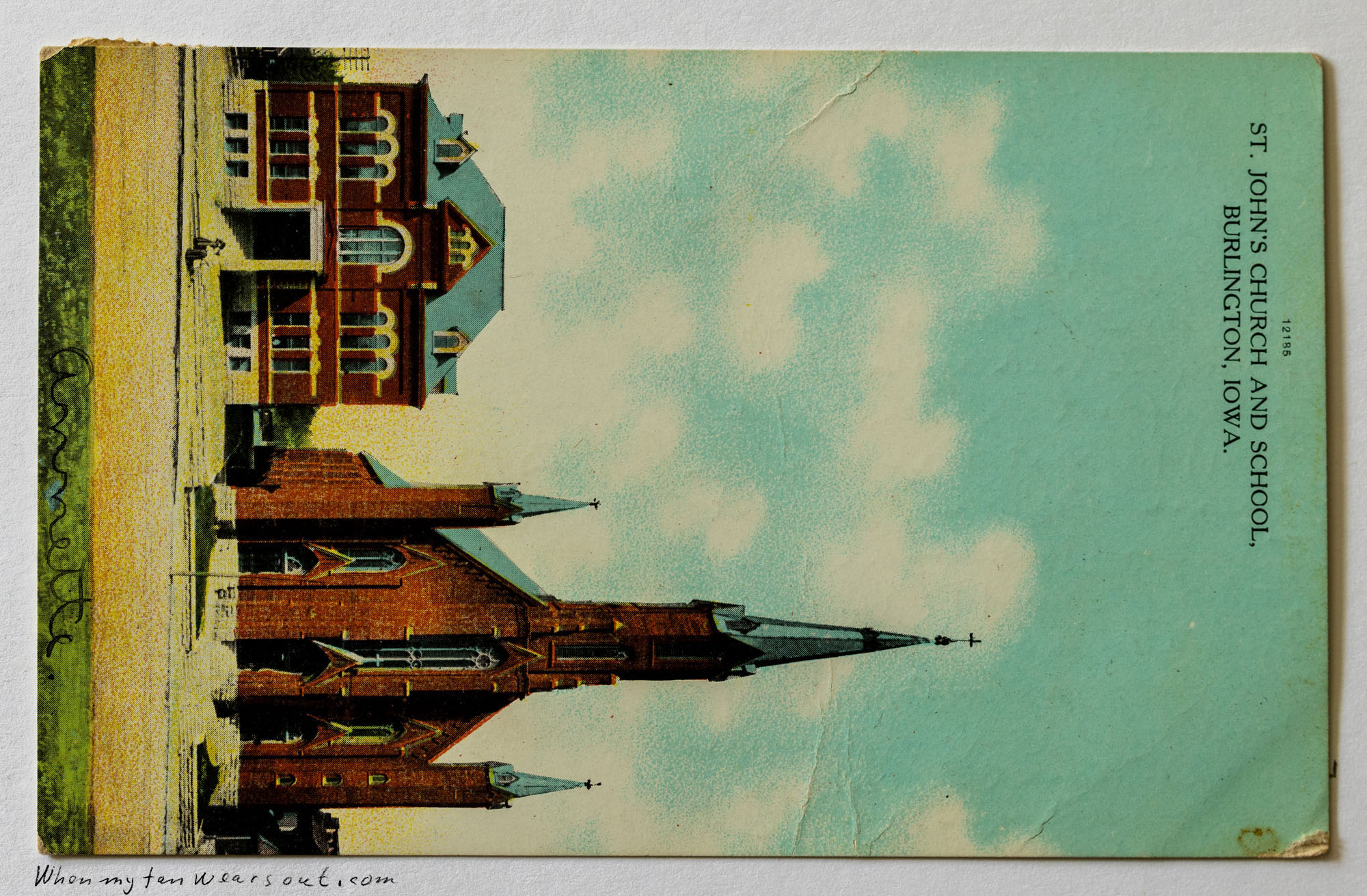
Vintage postcard featuring an upside-down view of St. John's Church, a tall brick building with spires, next to a matching brick school building under a light blue sky with white clouds. Text at the bottom reads
Front — An upside-down view of St. John’s Church and School in Burlington, Iowa, under a cloudy sky.

Postcard Metadata


Handwritten postcard message from
Back — Correspondence from Emma to Miss Pearle Byers

Transcription

Hello Sis: How are you? I am fine and dandy. Vergie, Albert, Mayme, Jim, Ray and I were down to Porters last night had a fine time. Everyone is well and happy but me. ha, ha. I am lonesome. I want to send Hiram a card to day. I suppose you know he and John are in Monmouth. Why don’t you write I haven’t heard from you for ages. Write me soon, your Sis Emma.

Historical & Family Notes

This postcard, sent by Pearl’s sister Emma, provides a charming glimpse into the everyday life and familial connections within the Byers family. Emma, writing from what is inferred to be Burlington, Iowa (based on the front image and “IOWA” postmark), expresses a common sentiment of the era: loneliness and the desire for more frequent communication. Her message highlights the vital role postcards played in maintaining relationships across distances, especially when visits were less frequent.

Emma shares news of a “fine time” at “Porters” with a group of friends or family, listing names like Vergie, Albert, Mayme, Jim, and Ray, illustrating Pearl’s broader social network. The mention of Hiram and John in Monmouth further expands the geographic and relational web, demonstrating how these small missives served as updates on various acquaintances and family members. This card underscores the casual, yet deeply personal, nature of postcard correspondence as sisters shared their daily happenings and emotional states.

The heartfelt plea, “Why don’t you write I haven’t heard from you for ages. Write me soon,” beautifully encapsulates the longing for connection. This exchange between sisters is a testament to the enduring bond between Pearl and her family, setting a personal context for her future relationship with Harvey Sights, who would also become a prolific postcard writer to her.
Continue Reading

Postcard #001: Thanks from Indian Mound Park, Quincy


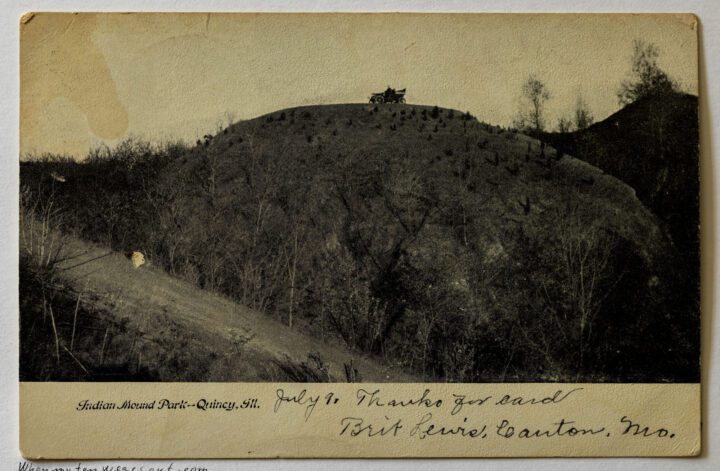
Sepia-toned postcard depicting Indian Mound Park in Quincy, Illinois, with an early 20th-century automobile parked on the summit of a tree-covered mound, overlooking a forested landscape.
Front — A sepia-toned image shows a dirt road winding up a large, tree-covered Indian Mound with an early automobile parked on top.

Postcard Metadata


Handwritten postcard back with a personal message dated July 19 from Brit Lewis in Canton, Missouri, to Miss Pearl Byers in Carthage, Illinois, postmarked Carthage, IL, July 19, 1916, with a one-cent Benjamin Franklin stamp.
Back — Correspondence from Brit Lewis to Miss Pearl Byers

Transcription

Indian Mound Park – Quincy, Ill. July 19. Thanks for card. Brit Lewis, Canton, Mo.

Historical & Family Notes

This early postcard sent to Pearl Byers by Brit Lewis captures a glimpse into her life before she met Harvey Sights. While the sender is not Harvey, the card establishes Pearl’s residence in Carthage, Illinois, a setting that would be central to her early adult life. The image of Indian Mound Park in Quincy, a nearby city, illustrates a regional landmark and popular destination, hinting at the shared experiences and local scenery common to young people in the Midwest at the time.

The casual nature of the message, “Thanks for card,” suggests an ongoing correspondence, painting a picture of Pearl’s social circle and the common practice of exchanging postcards to stay in touch. This card, dated July 19, 1916, precedes Pearl’s eventual marriage to Harvey Sights, offering a historical marker of her life during a period of significant social and technological change, reflected in the early automobile atop the mound.

Although a simple note, the postcard adds to the fabric of Pearl’s story, documenting her connections and the daily exchanges that shaped her world before the central chapter of her life with Harvey began. It grounds her in her community and time, showcasing the widespread use of postcards as a primary mode of communication for personal greetings and sharing visual experiences.

Continue Reading