Postcard #0024: Harvey’s Photo and a Promise to Visit


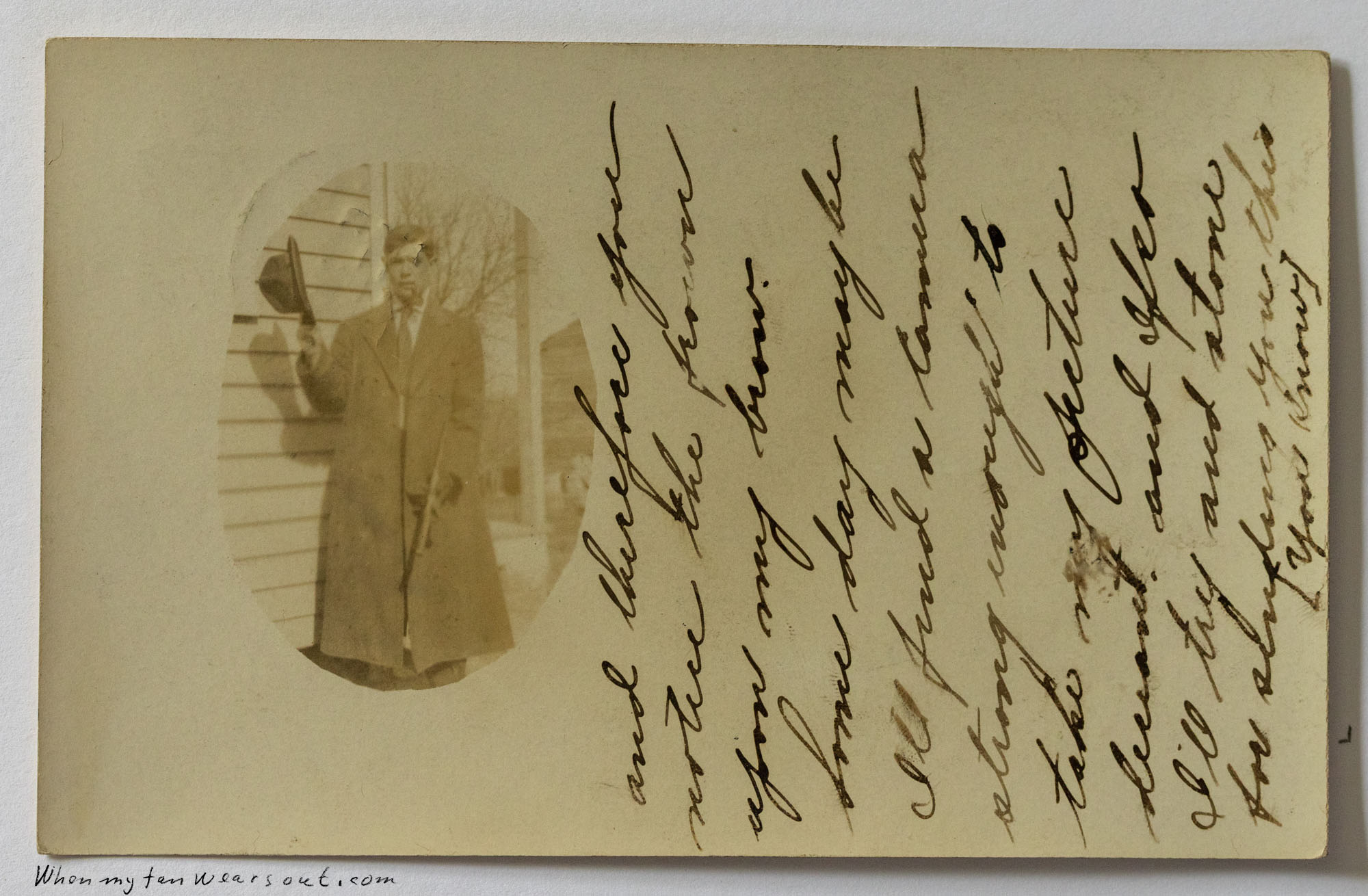
Oval photographic insert featuring a young man in a long coat and hat standing on a porch, with bare trees in the snowy background. Handwritten message on the postcard reads:
Front — Oval photographic insert featuring a young man in a long coat and hat standing on a porch, with bare trees in the background, next to a handwritten message.

Postcard Metadata


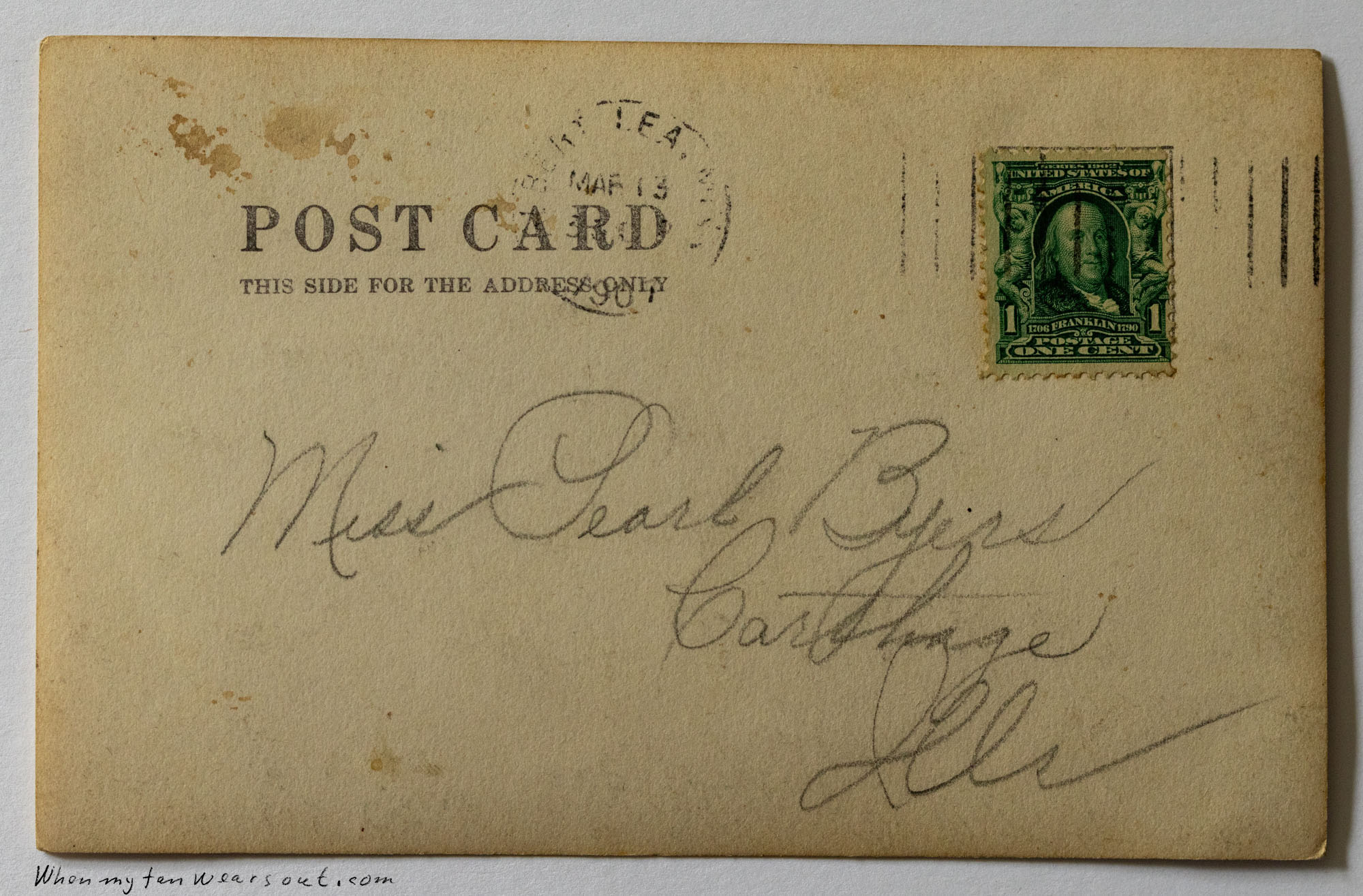
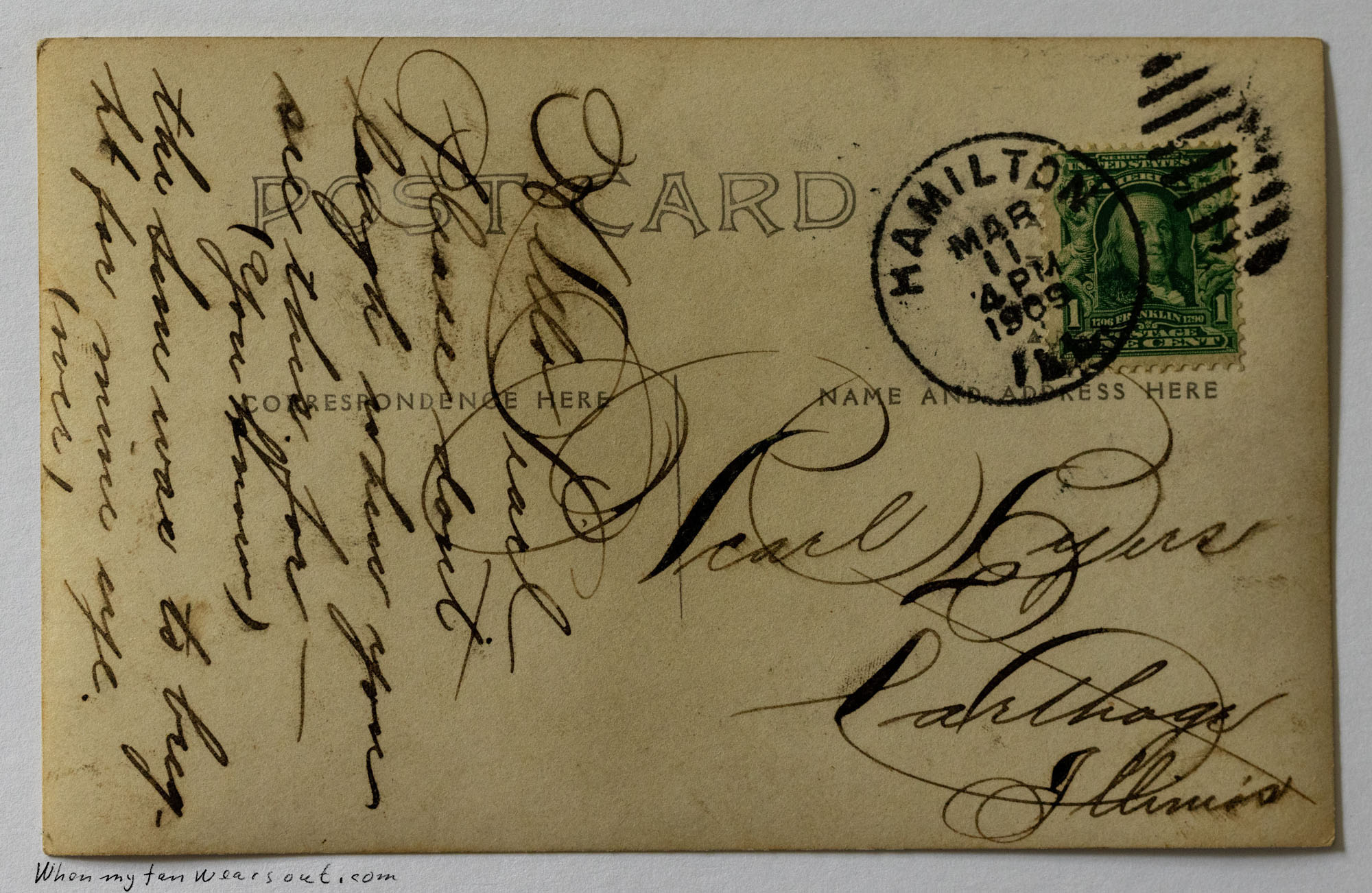
Back of a vintage postcard with a Hamilton, Illinois postmark dated March 11, 1909, a one-cent Franklin stamp, and a handwritten message from Harvey to Miss Pearl Byers in Carthage, Illinois. The message reads:
Back — Correspondence from Harvey Sights to Pearl Byers

Transcription

and that is free and the broom since my May be I will find a camera along with me to take my picture I will try and after this for bring you to the dear your Bery Dear Pearl This leaves me very lonesome this after[text obscured by POST CARD graphic] Harvey

Historical & Family Notes

This postcard, sent by a young Harvey Sights to Pearl Byers, serves as a poignant artifact of their early courtship. Harvey sends a photographic image of himself, possibly his current appearance, and expresses a wish to either take another picture or visit Pearl, stating “I will try and after this for bring you to the dear.” This indicates his desire to see her and deepen their connection, which was common practice during this era of long-distance romance.

The message on the back, though partially obscured, reveals Harvey’s loneliness, starting with “Dear Pearl This leaves me very lonesome this after[…].” This personal touch underscores the emotional intensity of their correspondence. The relatively short distance between Hamilton and Carthage, Illinois, would have made visits plausible, adding anticipation to Harvey’s promise.

This card is a tender snapshot of their relationship before marriage, showing the efforts Harvey made to stay connected and express his feelings, using the popular medium of postcards to bridge the physical distance between them. The slight ambiguity in the sender’s signature on the front (“Bery”) further highlights the informal and intimate nature of their exchanges.
Continue Reading

Postcard #0023: The Home of Mahala in Rural Kansas


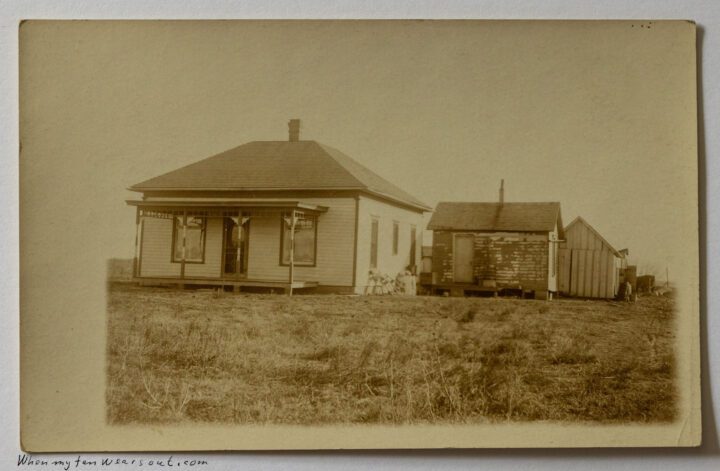
A sepia-toned vintage photograph depicting a modest, single-story wooden house with a front porch and two smaller wooden outbuildings to its right, set in a sparse grassy field under a pale sky.
Front — A sepia-toned photograph of a rural home with a porch and two smaller outbuildings under a clear sky.

Postcard Metadata


The divided back of an old postcard with a handwritten message in cursive, addressed to
Back — Correspondence from Mahala to Miss Pearl Byers

Transcription

Dear Pearl I will send you the picture of the place where we live and thank you for the pretty post cards you sent me. Goodby Mahala.

Historical & Family Notes

This postcard offers a glimpse into Pearl Byers’ wider network of friends and family beyond Harvey Sights, showing her engaging in the common practice of postcard exchange. The sender, Mahala, shares an image of “the place where we live,” indicating a personal connection and a desire to share her current surroundings with Pearl. The picture likely depicts Mahala’s home in Lebanon, Kansas, a simple but sturdy dwelling typical of rural Midwestern life in the early 20th century.

The message reveals Pearl herself was an active sender of postcards, with Mahala thanking her for the “pretty post cards.” This reciprocal exchange highlights the social role of postcards as a primary means of staying connected and sharing snippets of life across distances before the advent of more modern communication technologies. While this specific card is not from Harvey Sights, it nonetheless enriches the narrative of Pearl’s life by illustrating her connections with others during the period when her relationship with Harvey was developing.

Continue Reading

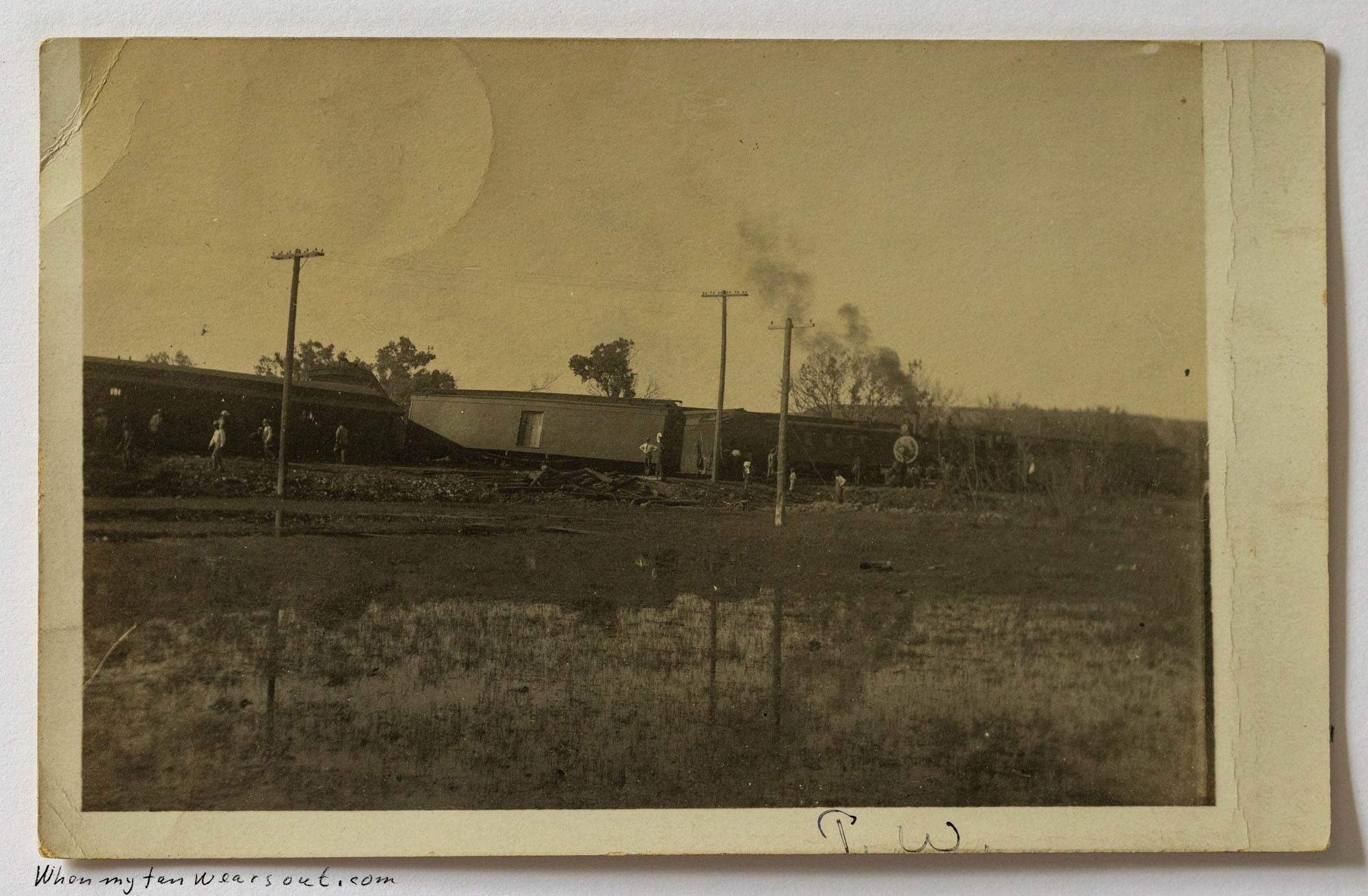
Postcard #0022: Train Wreck in the North End of the Yard


Sepia-toned photograph of a train derailment showing several passenger cars or freight cars overturned or off the tracks, with utility poles stretching across the horizon, a few people inspecting the damage, and a flooded or muddy field in the foreground, with the faint initials
Front — A sepia-toned photograph depicts a train derailment with multiple cars off the tracks and leaning, surrounded by people, utility poles, and muddy ground.

Postcard Metadata


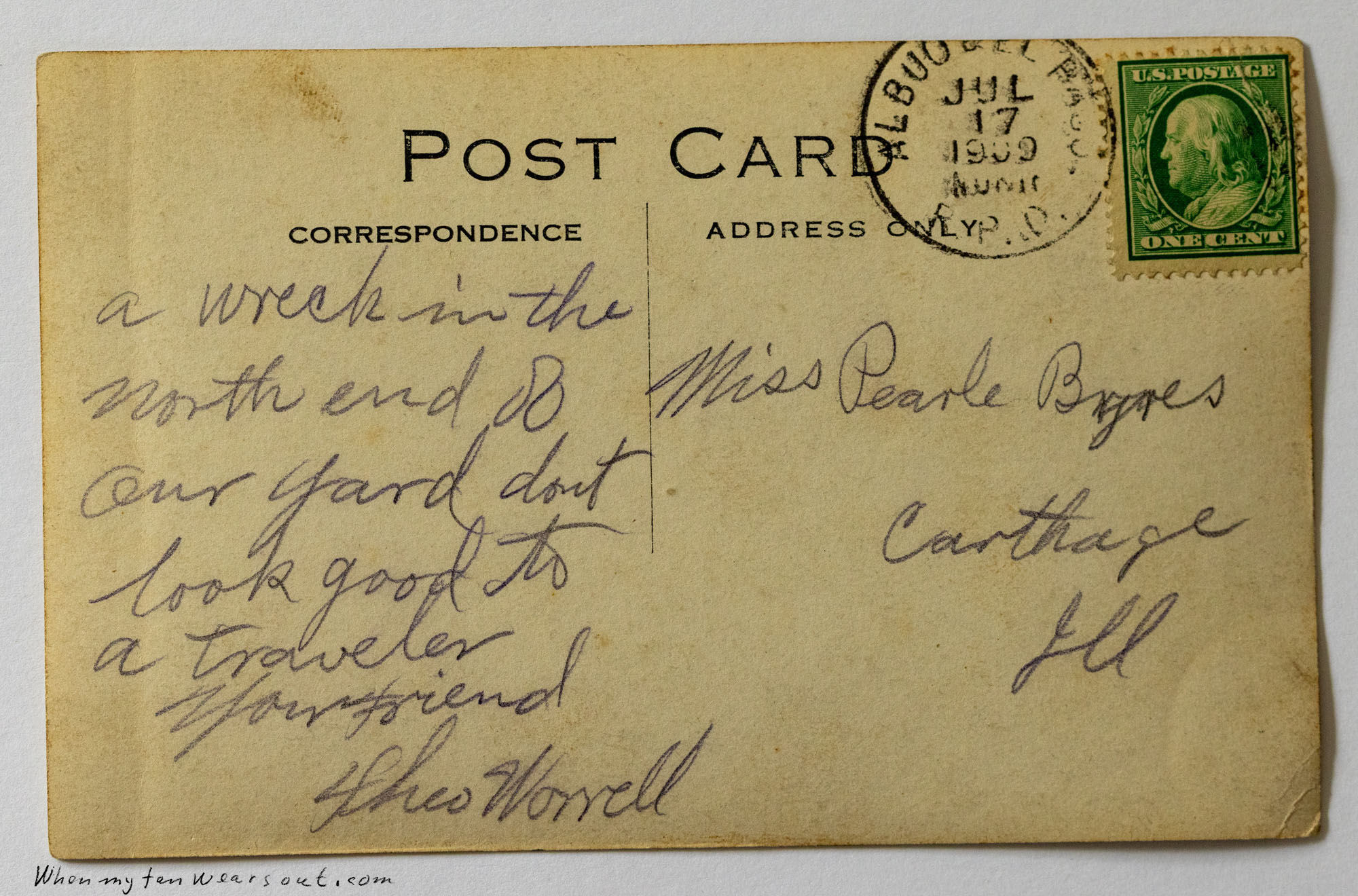
The back of a vintage postcard with a one-cent George Washington U.S. postage stamp postmarked
Back — Correspondence from Theo Worrell to Miss Pearle Byres

Transcription

a wreck in the north end of our yard dont look good to a traveler Your friend Theo Worrell

Historical & Family Notes

This postcard, sent from Quincy, Illinois, by “Theo Worrell” to “Miss Pearle Byres,” offers a stark glimpse into a dramatic, yet seemingly commonplace, event of the era: a train wreck. The sender’s casual observation, “a wreck in the north end of our yard dont look good to a traveler,” suggests that such incidents, while severe, were perhaps not entirely uncommon or were at least a significant local talking point in 1909.

While this specific message doesn’t directly involve Pearl’s future husband, Harvey Sights, it illustrates the network of friends and acquaintances Pearl maintained before their marriage. Postcards served as an essential medium for sharing news and observations across nearby towns, providing immediate, albeit brief, updates on daily life and local happenings.

Carthage, Illinois, where Pearl resided (at 318 N. Fayette Street), is located southeast of Quincy. This card provides a small window into the kind of everyday communication that filled the lives of young people like Pearl and her friends, connecting their worlds through brief written exchanges often accompanied by photographs of local interest.

Continue Reading

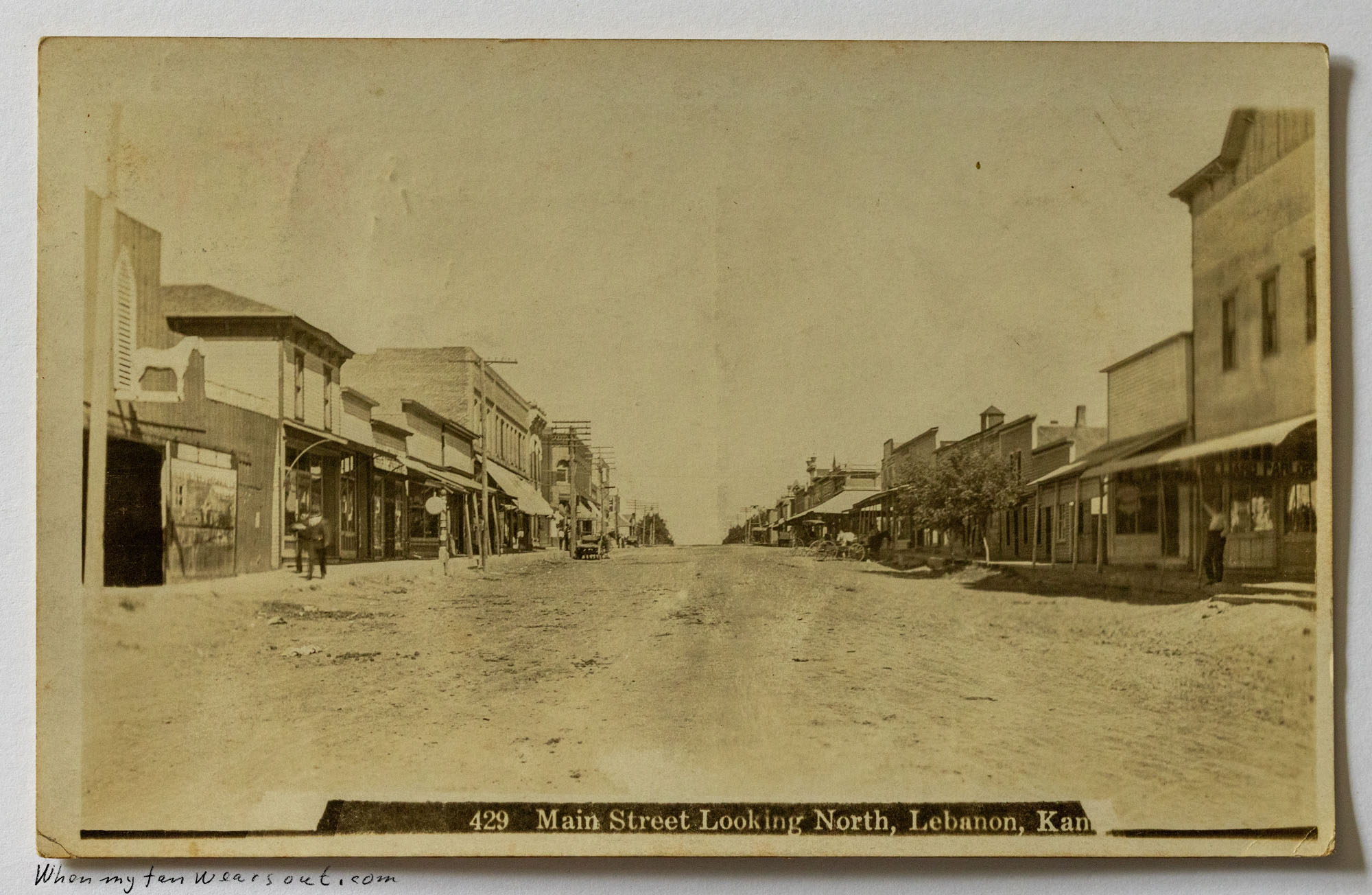
Postcard #0021: Lebanon Kansas Main Street and a Rainy Journey Home


Sepia-toned historical postcard showing a wide, unpaved Main Street in Lebanon, Kansas, looking north. The street is lined with two-story commercial buildings featuring awnings, and a few indistinct figures walk along the dirt street and sidewalks under a bright sky. The caption
Front — A wide, unpaved Main Street in Lebanon, Kansas, looking north, lined with multi-story business buildings.

Postcard Metadata


Back of a sepia-toned postcard with a handwritten message in cursive from Leonard Timberlake to Miss Pearl Byers in Carthage, Illinois. The card is postmarked Topeka, Kansas, October 27, 1909, 6PM, and bears a one-cent green U.S. postage stamp featuring Benjamin Franklin. The manufacturer's details are visible on the left side.
Back — Correspondence from Leonard Timberlake to Miss Pearl Byers

Transcription

Well I guess you thought I was never going to write anything but I finally got around to it. I had swell trip home it rained severall the time after I left Quincy. Leonard Timberlake.

Historical & Family Notes

This postcard, sent to Pearl Byers from Leonard Timberlake, provides a glimpse into her social circle before her eventual marriage to Harvey Sights. The message details Leonard’s “swell trip home” despite rain after leaving Quincy, suggesting Pearl might have been visiting Quincy, Illinois, or that Leonard was visiting Pearl (or nearby) before heading back to his own home, likely in or near Topeka, Kansas, where the card was postmarked.

The existence of correspondence from other individuals like Leonard underscores that Pearl had a vibrant social life and various acquaintances, a common experience for young women of the era. These interactions form part of the broader narrative leading up to her relationship with Harvey Sights, showing the context of her world.

The card’s front, depicting Main Street in Lebanon, Kansas, is a generic scene often found on postcards of the period, chosen by the sender likely for its availability rather than any specific connection to Pearl or Leonard. It highlights the widespread use of postcards for casual correspondence and sharing snippets of daily life or travel.

Continue Reading

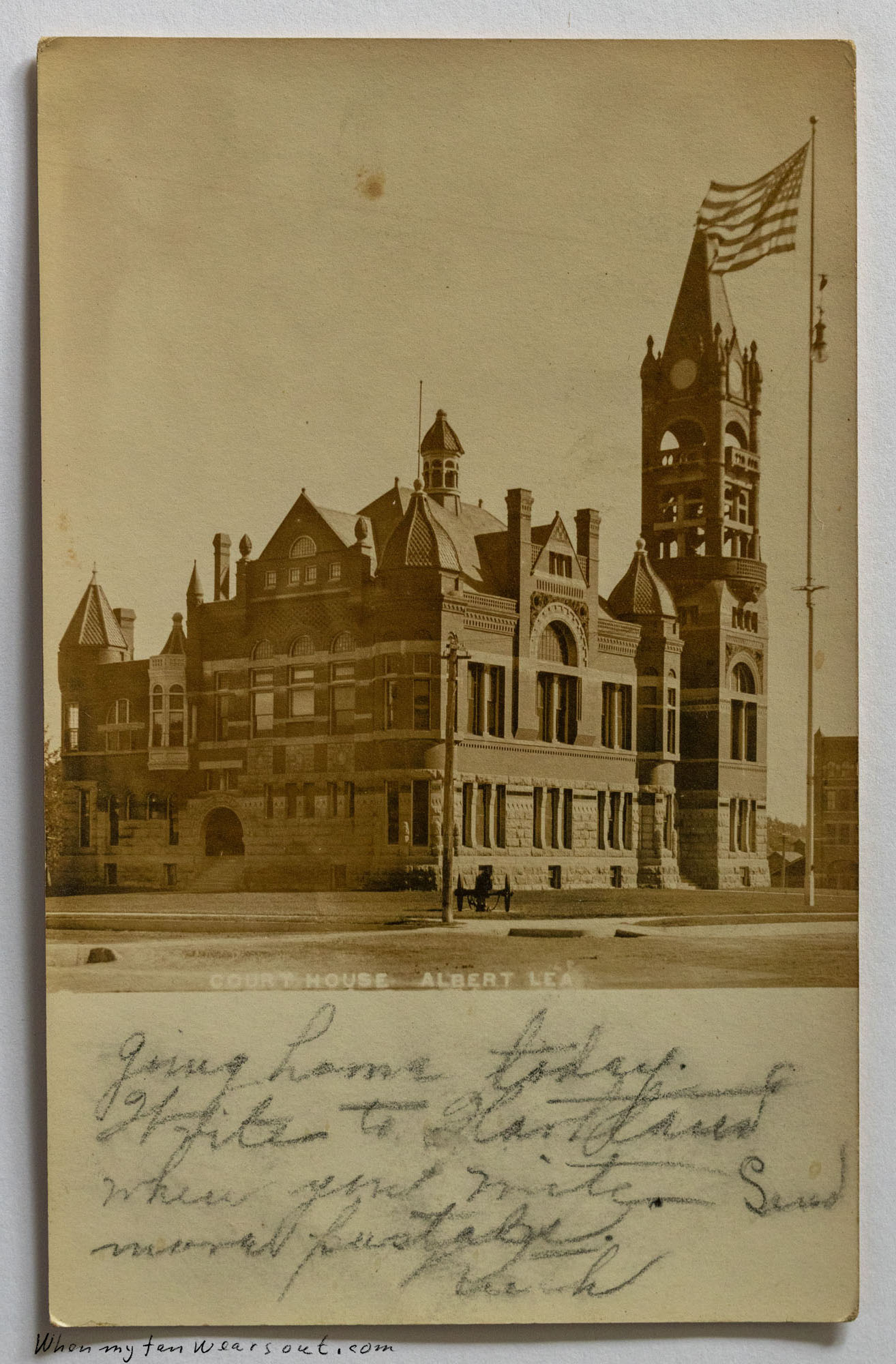
Postcard #0020: Albert Lea Courthouse and the Journey Home


Sepia-toned postcard depicting the grand Albert Lea Court House in Minnesota, a brick and stone building with a prominent clock tower, an American flag flying, and a small horse-drawn carriage on the street in front. Handwritten message is visible below the image.
Front — View of the Albert Lea Court House with a prominent clock tower and American flag.

Postcard Metadata


Sepia-toned back of a postcard with a 1-cent green Benjamin Franklin stamp, an
Back — Correspondence from Harvey Sights to Miss Pearl Byers

Transcription

Going home today. Expect to start from when you get my other postcard. Send me all puss.

Historical & Family Notes

This postcard captures a moment of anticipation as Harvey Sights prepares to return home, presumably to Pearl Byers. Sent from Albert Lea, Minnesota, the message “Going home today” signifies the conclusion of his travels or a temporary stay, and the impending reunion with Pearl. The reference to “my other postcard” suggests an ongoing correspondence, a common method of nurturing their relationship across the miles.

The affectionate closing, “Send me all puss,” underscores the tender and playful nature of their courtship. Such personal and informal expressions reveal a deeper intimacy than standard greetings, hinting at the bond that would eventually lead to their marriage and the start of their family. This card is a tangible piece of their unfolding love story, chronicling the small, daily communications that built their connection.

As a historical artifact, the postcard offers a glimpse into early 20th-century communication and travel. The image of the Albert Lea Court House serves as a backdrop to Harvey’s journey, while the simple yet heartfelt message conveys the human experience of longing and return. It’s a testament to the enduring power of written words to bridge distance and maintain personal connections in a time before instant digital communication.

Continue Reading

Postcard #0019: A Burlington Group Portrait for Pearle


A vintage, sepia-toned photograph showing a large gathering of approximately 25-30 young adult men and women, likely a social group, arranged for a formal portrait. Some individuals are seated in the foreground, while others stand behind them, all dressed in early 20th-century attire, with an ornate patterned wallpaper visible in the background.
Front — A sepia-toned group photograph of many young men and women posed formally indoors.

Postcard Metadata


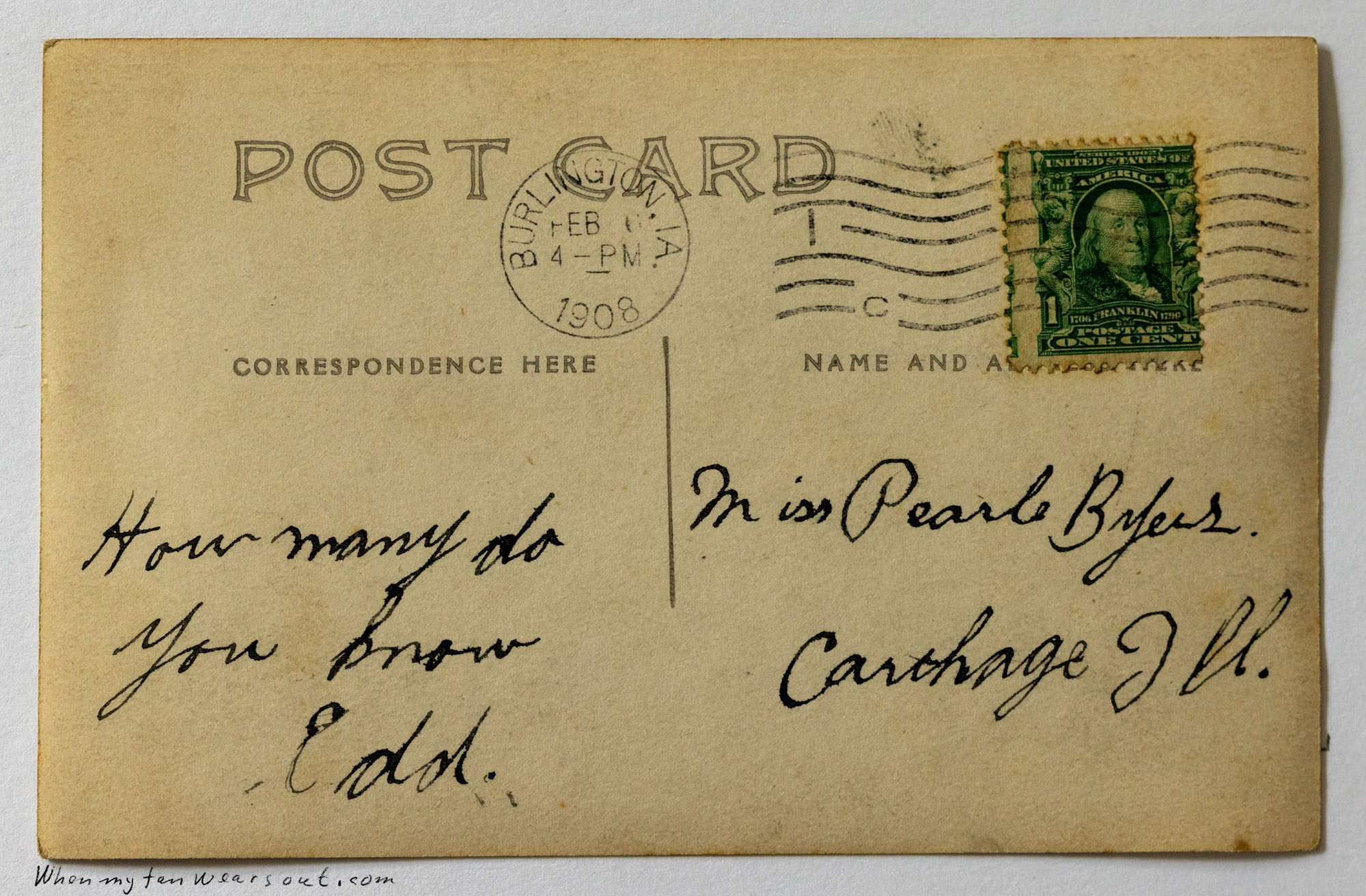
The back of a divided postcard featuring a Burlington, Iowa postmark dated February 4, 1908, a one-cent green Benjamin Franklin stamp, and a handwritten message in cursive reading
Back — Correspondence from Edd to Miss Pearle Byers

Transcription

How many do you know Edd.

Historical & Family Notes

This early postcard, addressed to Pearle Byers in Carthage, Illinois, offers a fascinating glimpse into her social life before her marriage to Harvey Sights. The sender, identified only as “Edd,” challenges Pearle to identify individuals within the large group portrait, suggesting a shared network of acquaintances or perhaps introducing her to a new circle. This informal query highlights the casual nature of correspondence between friends and potential admirers during the early 20th century.

The card’s origin in Burlington, Iowa, a relatively short distance from Carthage, suggests Pearle may have had connections or visited the area, expanding her social sphere beyond her hometown. While Edd’s relationship to Pearle remains a mystery, this card serves as a tangible record of her broader connections and interactions in the years preceding her significant life events.

As an archival piece, this postcard helps to build a more complete picture of Pearle’s youth and the social landscape she navigated. It underscores the importance of visual communication and personal connection in an era when photographs, even mass-produced ones, were cherished objects for sharing experiences and maintaining ties.

Continue Reading

Postcard #0018: G.S. Buch’s Room Corner in Lea, Minnesota


Vintage sepia-toned photograph showing a cozy room interior featuring a wicker sofa with patterned cushions, a large wooden bookshelf filled with books, and walls extensively covered with various small framed photographs and decorative papers. A small, round, white decorative element is visible in the upper left corner of the room.
Front — A vintage sepia-toned photograph of a cozy room corner with a wicker couch, a large bookshelf, and many framed pictures adorning the walls.

Postcard Metadata


The reverse side of a vintage postcard featuring a green one-cent Benjamin Franklin stamp postmarked from Lea, Minnesota on August 7, 1909. The card has a divided back with handwritten cursive text from 'G. S. Buch' to 'Miss Pearl Byers, Carthage, Ills.', where the sender asks Pearl how she likes their room and requests any future letters to be addressed to Hartland.
Back — Correspondence from G. S. Buch to Miss Pearl Byers

Transcription

this is a corner in my room here, how do you like it? write soon to your G. S. Buch. ad. letter to Hartland

Historical & Family Notes

This postcard offers a charming glimpse into a personal space from over a century ago, a common way to share life and surroundings with distant friends or family before the advent of widespread personal photography and social media. The room, with its wicker couch, overflowing bookshelf, and walls covered in an array of small pictures, suggests a comfortable, well-inhabited corner.

While the sender, G. S. Buch, is not Pearl Byers’ future husband, Harvey Sights, this card is part of Pearl’s collection, indicating her broader circle of acquaintances and friendships. The sender’s direct question, “how do you like it?”, suggests a familiar and perhaps intimate relationship, inviting Pearl’s opinion on their private environment.

The instruction “ad. letter to Hartland” (likely an abbreviation for “address letter to Hartland”) provides a more specific location for G. S. Buch at the time. Hartland, Minnesota, like Lea (the postmark location, likely near Albert Lea), is situated in Freeborn County, suggesting the sender was either staying in or had recently moved to this nearby community when sending the card to Pearl in Carthage, Illinois.

Continue Reading

Postcard #0017: Ruth’s Schoolhouse Where She Taught in Atlanta, Illinois


A sepia-toned photograph of a white wooden one-room schoolhouse with a dark roof, featuring multiple windows and a single door. A group of about a dozen children and several adults are standing on the grassy lawn in front of the building. Handwritten cursive text is on the left side of the image.
Front — A group of children and a few adults standing outside a one-room schoolhouse with a handwritten message on the left.

Postcard Metadata


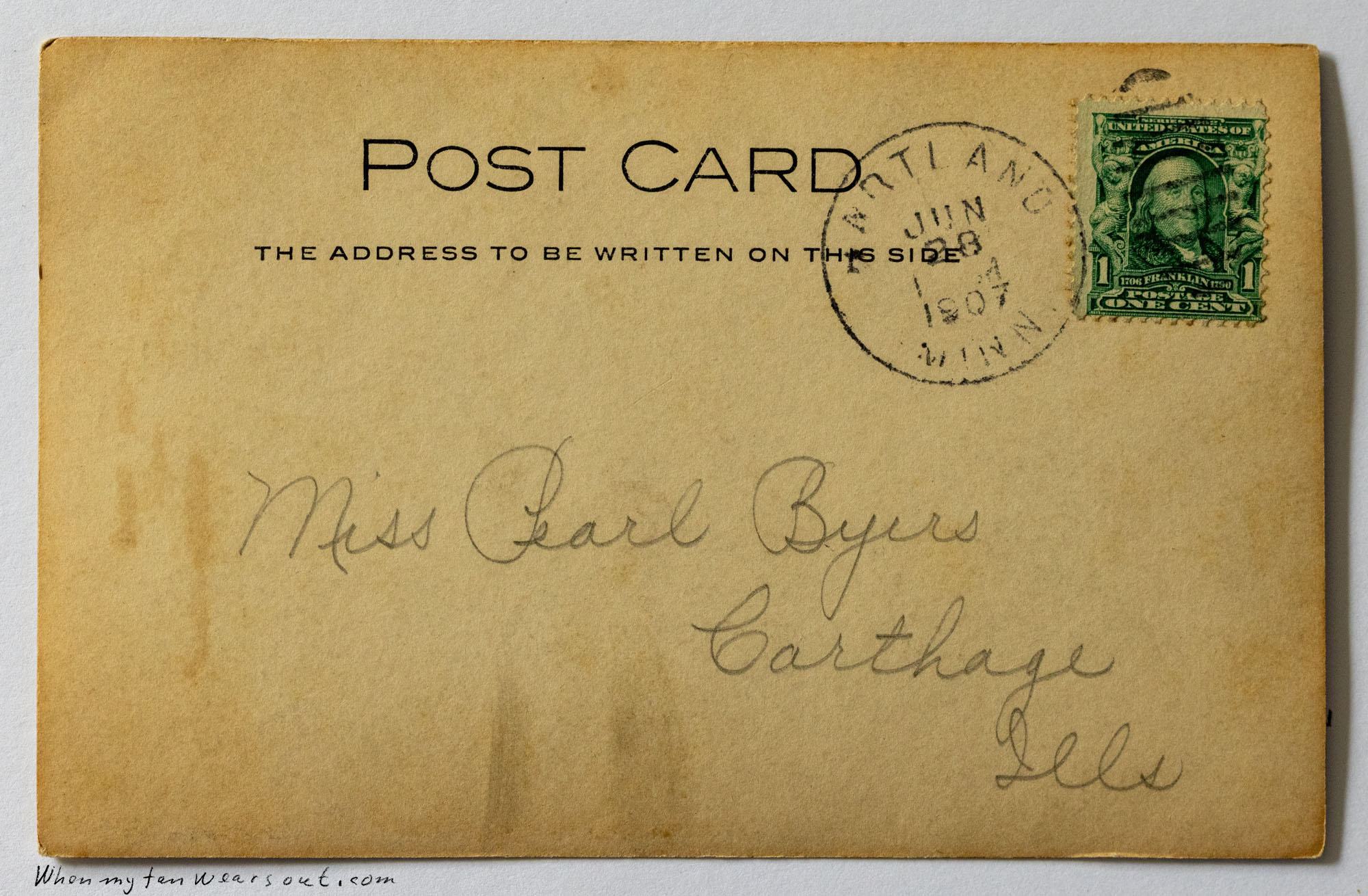
The back of a vintage postcard with
Back — Correspondence from Ruth to Miss Pearl Byers

Transcription

This is where I taught while I was a roof mite. Sorry – Ruth

Historical & Family Notes

This charming postcard, sent by “Ruth” to Pearl Byers, offers a vivid snapshot of early 20th-century rural education, depicting a classic one-room schoolhouse. Ruth’s message, “This is where I taught while I was a roof mite,” is a distinctive and intriguing phrase, likely a self-deprecating or affectionate reference to her youth or small stature during her time as a teacher. The photograph captures a group of children and adults, perhaps the students and their families, gathered outside the humble wooden structure.

Postmarked June 28, 1907, the card is an early example from the Divided Back era, which began just months prior with the Post Card Act of 1907 allowing messages on the address side. Despite the new format, Ruth chose to write her message on the front, a common practice during this transitional period as people adapted to the change. The stamp, featuring Benjamin Franklin, further roots the card in its historical context.

While this card does not directly mention Harvey Sights, it provides valuable insight into Pearl Byers’ social circle and the broader world she inhabited before her eventual marriage to Harvey. Correspondence like this from friends and family helps to paint a fuller picture of Pearl’s life experiences and connections during her youth in Carthage, Illinois.

Continue Reading

Postcard #016: Birthday Greetings to Pearl from Quincy on Her Special Day


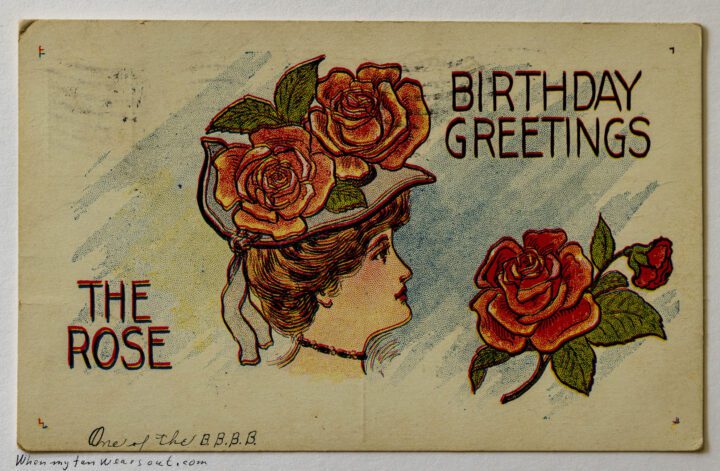
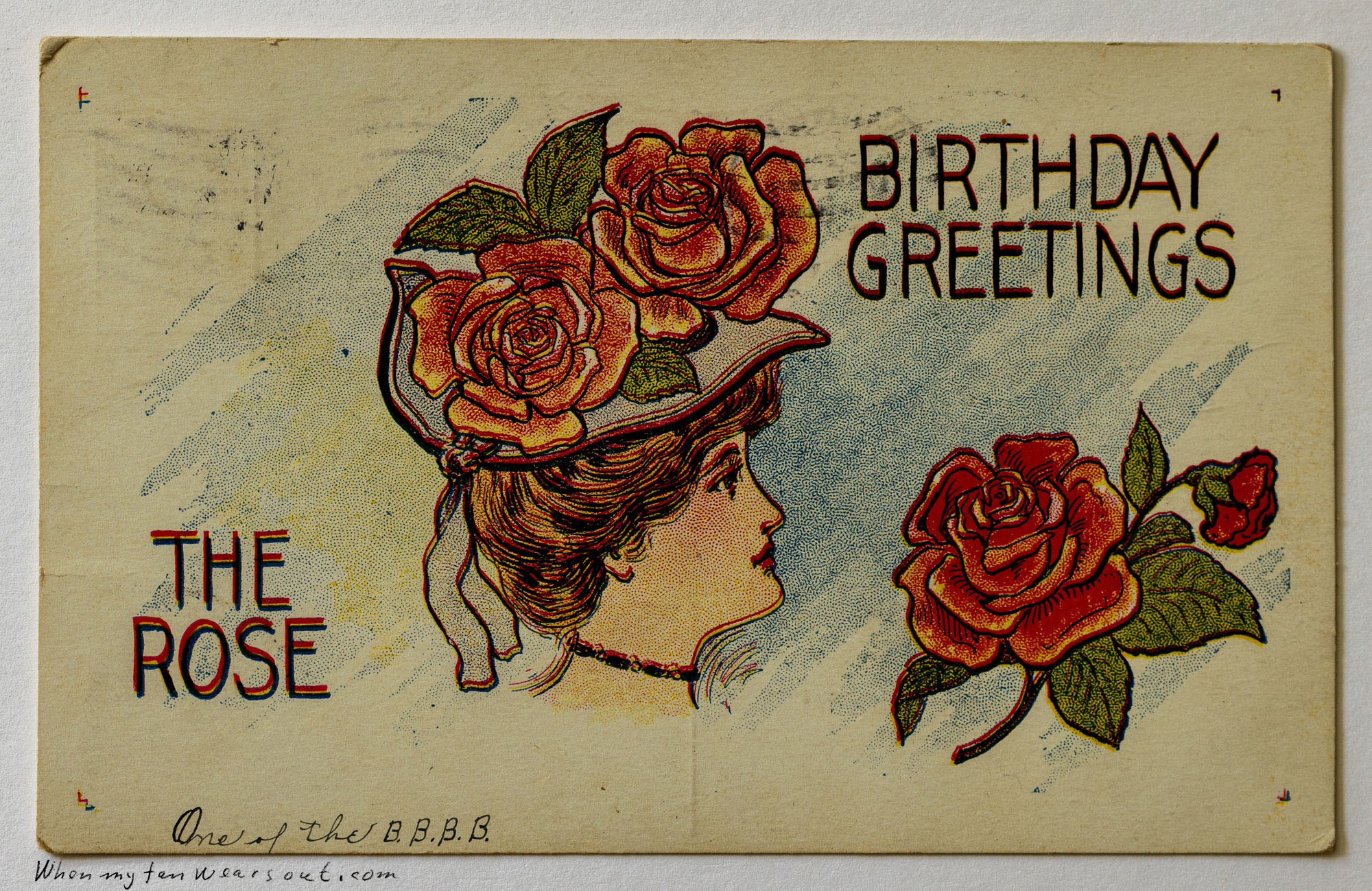
Vintage colorized postcard from 1907, featuring an illustration of a woman in profile wearing a large hat adorned with red and pink roses and green leaves. To the left, the text
Front — A colorized illustration of a woman in a floral hat featuring roses, with additional roses and the text “THE ROSE” and “BIRTHDAY GREETINGS.”

Postcard Metadata


The handwritten reverse side of a 1907 postcard with a one-cent Benjamin Franklin stamp postmarked
Back — Correspondence from Harvey Sights to Miss Pearl Byers

Transcription

Dec. 4 / 07 Dear Friend:- I suppose you know who this is from don’t you? Hope you have a happy birthday. As Ever. address H. L. Burling Gem City Business College. Quincy, Ill.

Historical & Family Notes

This charming birthday postcard marks Pearl Byers’ special day, December 4th, 1907, with a playful message from her future husband, Harvey Sights. Though he doesn’t explicitly sign his name, the teasing query, “I suppose you know who this is from don’t you?” is a clear indicator of a budding romance and familiarity. The sender provides the address for “H. L. Burling” at the Gem City Business College in Quincy, Illinois, likely where Harvey was studying or residing, using it as a return address for discretion in their early courtship.

The card itself features “The Rose,” a classic symbol of affection and beauty, perfectly chosen for a birthday greeting to a young woman. The postmark confirms it was sent from Quincy on Pearl’s actual birthday, suggesting a thoughtful and timely gesture. This card offers a sweet glimpse into the early stages of their relationship, highlighting the gentle humor and personal connection that would eventually lead to their marriage.

The reference to “H.L. Burling” at Gem City Business College offers a unique historical tidbit. Many young people, including those from rural areas, attended business colleges in larger towns like Quincy to acquire skills for office work. It’s plausible that Harvey was a student there, making this postcard a testament to both his personal affections and his efforts towards building a future.

Continue Reading

Postcard #015: Mister Moon Watches Over a Budding Romance


A hand-colored photo postcard depicting a couple from behind, walking arm-in-arm on a dirt path towards a body of water with a town on the far bank, under a dark sky with a large, yellow smiling full moon; text at the bottom reads
Front — A hand-colored photo postcard depicts a couple strolling under a smiling moon with a romantic song lyric.

Postcard Metadata


The back of a postcard with handwritten cursive message on the left side and the address
Back — Correspondence from Harvey Sights to Miss Pearl B.

Transcription

Dear Pearl, How is it you never write to me any more? How are you getting along? I hope you are all well & getting along fine. We are all well. Mr. Sights is with us for a few days. He said to tell you he thinks you are pretty swell. I can tell you he is not a bad fellow in fact I think he is all right. I have just come over to see what kind of a good time you are having. I guess you are having a good time. Tell me what you are doing & how you are getting along. Tell me if you are looking for a young fellow who has a good time for you. What do you think of this, tell me how you think of this. Write to me as soon as you can. Your friend, Harvey Sights.

Historical & Family Notes

This postcard, sent in March 1908, offers a charming glimpse into the early courtship of Pearl Byers and Harvey Sights. The front features a romantic scene of a couple strolling under a smiling moon, accompanied by popular song lyrics of the era, “Everytime you go a strolling / With your lady love, / Mister moon is watching from above.” This sentimental imagery perfectly complements Harvey’s flirtatious message, highlighting the romantic ideals of the time.

Harvey’s message, though a bit playfully convoluted with the reference to “Mr. Sights is with us,” clearly conveys his personal admiration for Pearl. He pointedly asks, “Tell me if you are looking for a young fellow who has a good time for you. What do you think of this, tell me how you think of this,” indicating a direct and earnest pursuit of her affections. Such candid yet sweet overtures were a hallmark of early 20th-century communication, laying the groundwork for many lasting relationships.

This missive from Colmar to Carthage, a short distance across rural Illinois, marks a tender moment in Pearl and Harvey’s romantic journey. It underscores the importance of even small exchanges in fostering deep connections, foreshadowing their eventual marriage and the beginning of their family, including their daughter, Marnelle. The postcard serves as a beautiful testament to the blossoming love between them.

Continue Reading

Postcard #014: 1909 New Year Greetings to Young Harvey Sights


A vintage New Year's postcard for 1909, featuring the numbers
Front — A 1909 New Year greeting card featuring ornate numbers, pine branches, pine cones, and green shamrocks.

Postcard Metadata


The divided back of a vintage postcard featuring a handwritten New Year's message to
Back — Correspondence from Aunt, Hattie, and Uncle Jo to Harvey Sights

Transcription

Happy new year to our dear Boy Harvey From Aunt Hattie and Uncle Jo Be good and that will bring you happiness Harvey Sights La Harpe Ills Made in Germany. Serie 75

Historical & Family Notes

This early New Year’s card provides a charming glimpse into Harvey Sights’ childhood, dating from December 1908, just before the turn of 1909. Addressed to “our dear Boy Harvey” from his Aunt, Hattie, and Uncle Jo, the message “Be good and that will bring you happiness” suggests he was still quite young, perhaps a pre-teen or early teenager, receiving guidance from his loving family members. This card predates his eventual courtship and marriage to Pearl Byers, offering a foundational look at his upbringing and family ties.

The postcard’s origin from “Made in Germany” highlights the significant role German printers played in the Golden Age of Postcards, known for their high-quality lithography and vibrant designs. Sent from Cairo, Illinois, in the southern tip of the state, to La Harpe in western Illinois, it demonstrates the widespread use of postcards for connecting families across distances, even relatively short ones, in the early 20th century.

This card is a valuable piece in understanding Harvey Sights’ family context before he embarked on his life with Pearl. It paints a picture of a well-loved young boy, receiving well wishes and gentle admonitions from his extended family, laying the groundwork for the man he would become.

Continue Reading

Postcard #013: Good Luck and Best Wishes from Kansas City


Vintage postcard featuring an embossed golden horseshoe framing a colorful rural landscape with a red-roofed house, trees, and a winding path. Blue forget-me-nots, a green four-leaf clover, and an orange butterfly adorn the foreground. Red script text reads
Front — An embossed golden horseshoe framing a rural landscape with forget-me-nots, a clover, and a butterfly, featuring the text “Good Luck AND BEST WISHES.”

Postcard Metadata


The back of a 1903 postcard with a green one-cent George Washington stamp and a Kansas City, MO postmark dated September 22, 1903. Handwritten cursive message in black ink from Harvey Sights to Miss Pearl Byers in Carthage, Illinois. The card has an undivided back design with
Back — Correspondence from Harvey Sights to Miss Pearl Byers

Transcription

Dear Pearl How are you? I am well. I saw George Murray and his girl last night. We went to the show, and then went to a party. They are sweethearts aren’t they. I wish you would come over some time. How are you and Chas.? I am at the chancelo and working like I was. My arm is not well. Good bye Love Harvey Sights

Historical & Family Notes

This postcard, sent from Kansas City by Harvey Sights to Pearl Byers in Carthage, Illinois, captures a fleeting moment of early courtship. The “Good Luck” sentiment on the front, while generic, gains a personal touch from Harvey’s longing message. His mention of seeing “George Murray and his girl” at a show and party, followed by the observation, “They are sweethearts aren’t they,” could subtly allude to his own hopes for a similar relationship with Pearl.

Harvey’s casual yet intimate closing, “Love Harvey Sights,” suggests an affectionate bond already forming between the two, despite the distance. His desire for Pearl to “come over some time” clearly expresses a wish for closer connection. The reference to his injured arm (“My arm is not well”) offers a glimpse into his daily life, adding a personal detail that would resonate with Pearl.

The card serves as an early document in Pearl and Harvey’s enduring love story, hinting at the affections that would eventually lead to their marriage and the birth of their daughter, Marnelle. It showcases the charming, informal communication style of the early 20th century, where simple postcards carried heartfelt messages across miles.

Continue Reading

Postcard #012: Martha Asks Pearle About Getting Married Amidst Calf Branding Scene


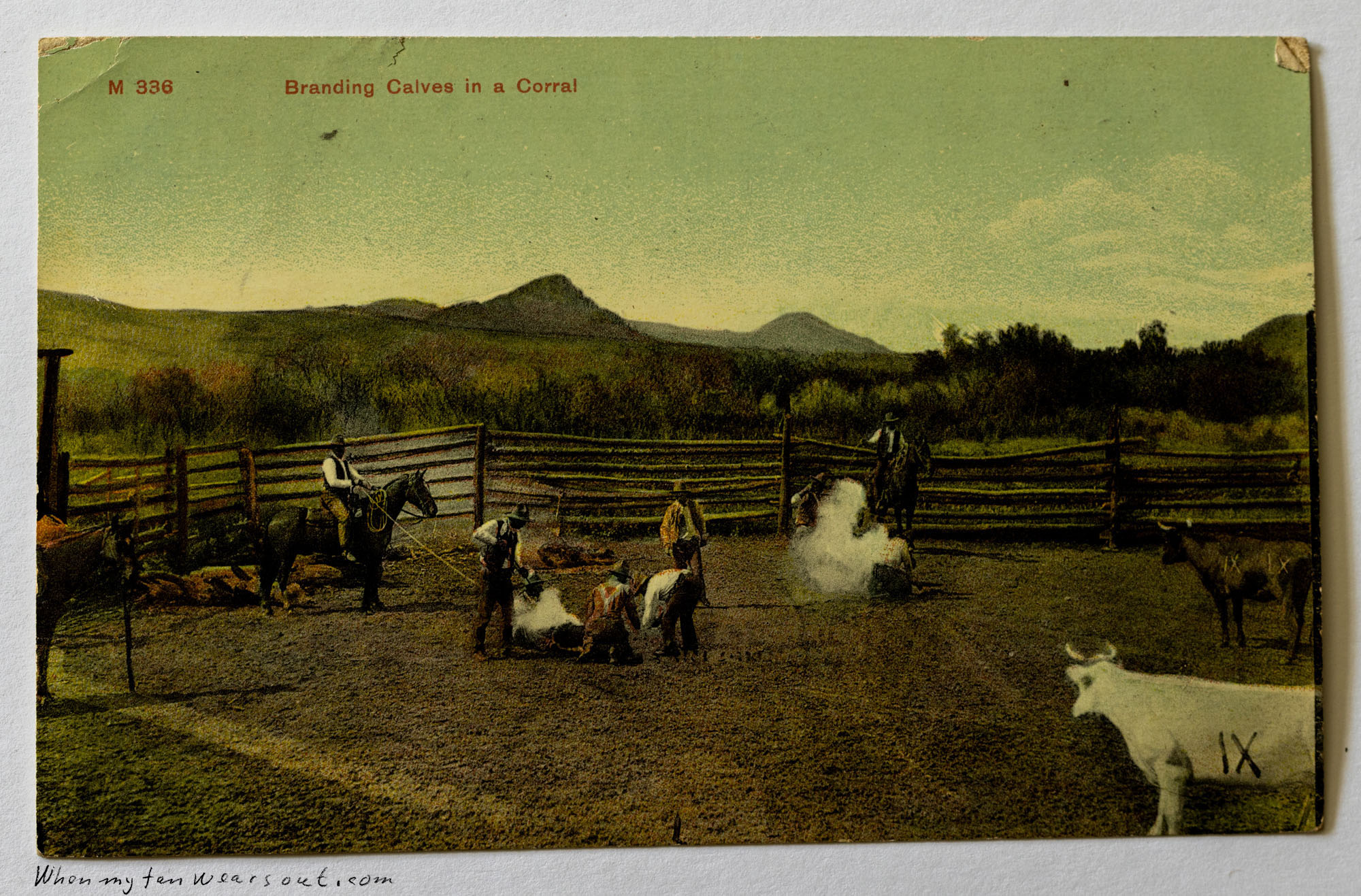
Hand-tinted vintage postcard depicting a group of cowboys and ranch hands branding calves in a dusty outdoor corral. Several men are on horseback, while others are on foot, wrestling calves to the ground. Smoke rises from hot branding irons. A large white cow with the brand 'IX' on its side is visible in the foreground. Rolling hills and distant mountains are in the background under a blue-green sky.
Front — A vintage hand-tinted postcard showing cowboys branding calves in a rustic corral with mountains in the background.

Postcard Metadata


The back of an old postcard with a handwritten message in cursive ink from 'Martha' to 'Miss Pearle Byers' in Carthage, Illinois. The message discusses news, marriage, and friendly chiding. A green one-cent Benjamin Franklin U.S. postage stamp is affixed in the upper right corner, partially obscured by a round postmark from Chinook, Montana, dated August 26, 1910. The card is a divided back postcard with 'POST CARD' printed at the top.
Back — Correspondence from Martha to Miss Pearle Byers

Transcription

Dear Kid. well I like that you tell me to write when I’ve written you long ago. Just get busy now and drop me a line. Am very busy just now as I have the debumaker here. Weather just like summer here. I got your card some time ago. How are the boys? So your going to get married? Well I hope to get an invitation. will do likewise well I hadnt be good to your self. If I don’t hear from you soon will write. Loving by Martha.

Historical & Family Notes

This postcard offers a glimpse into Pearle Byers’ life before her marriage to Harvey Sights, hinting at the social expectations and personal developments of the era. Martha’s lighthearted yet direct inquiry about Pearle “getting married” suggests that Pearle was of marrying age and that such news might have been anticipated or rumored within their social circle, setting a significant context for her eventual union.

The message from Chinook, Montana, contrasts sharply with the rustic ranching scene on the card’s front, demonstrating the widespread use of postcards for maintaining distant friendships across vast American landscapes. While the card doesn’t mention Harvey directly, it frames Pearle’s life at a pivotal time when discussions of marriage would have been common, providing a subtle precursor to her future with Harvey.

The sender, Martha, playfully chides Pearle for not writing back sooner, indicating a close, informal relationship. Her closing remarks, “well I hadnt be good to your self. If I don’t hear from you soon will write,” reinforce the bond and the casual but consistent nature of their correspondence, a testament to the role postcards played in connecting people across vast distances in the early 20th century.

Continue Reading

Postcard #011: Get Busy, I Am Waiting For That Letter


A yellow
Front — A yellow “Telegraph Post-Card” with a graphic of a running messenger and a brief handwritten message.

Postcard Metadata


The back of a 1907 yellow postcard with a one-cent Benjamin Franklin stamp postmarked Quincy, Illinois, addressed to Miss Pearle Byers in Carthage, Illinois, with a handwritten message from Angus B.
Back — Correspondence from Angus B. to Miss Pearle Byers

Transcription

Nº31 Time Sent ____ Oct 27 1907 I am waiting for that letter get Busy M. S. POST CARD Write Message Here Say Pearle I was cer-tainly glad to hear from you. I shot the earth had swallowed you. You certainly sent me a dandy postal. Such I have never seen be-fore. Am well at present hope you are the same. Are hav-ing fine weather. Now Ans-wer soon. The same Old Chump Angus B.

Historical & Family Notes

This early postcard to Pearle Byers features an intriguing dual message. The front, formatted as a “Telegraph Post-Card,” bears a brief, direct note signed “M. S.” with the seemingly urgent instruction, “I am waiting for that letter get Busy.” The date “Oct 27 1907” is handwritten on the front, creating a slight anomaly as the card was postmarked from Quincy, Illinois, on October 26, 1907. This could indicate the handwritten date was a future reminder, or simply a discrepancy in dating.

The reverse side carries a longer, friendly message from “Angus B.,” clearly responding to a previous communication from Pearle: “I was cer-tainly glad to hear from you. I shot the earth had swallowed you. You certainly sent me a dandy postal.” The two distinct messages and signatures on one card suggest it might have been a collaborative effort, or that Angus included a note from a companion. Given that Harvey Sights is a primary character in Pearle’s life story, it is plausible that “M. S.” could be an initialed message from Harvey, possibly M. for a middle name or a playful alias, lending an early glimpse into their developing dynamic.

Angus’s sign-off as “The same Old Chump” adds a touch of affectionate familiarity, suggesting a close relationship, perhaps a cousin or family friend. The card’s early date places it firmly in the courtship period for Pearle, with various individuals sending her notes. The short, demanding “get Busy” from “M. S.” contrasts with Angus’s more jovial tone, hinting at the different relationships Pearle maintained.

Continue Reading