Front — A group of store employees or proprietors pose with a display case of umbrellas.
Postcard Metadata
Postmarked: Not Visible
Sent From: None
Sent To: None
Distance Traveled: None
Postage: Not visible (no stamp)
Card Details: Divided Back, Real Photo Postcard (RPPC) with “A Z O” stamp box (circa 1907-1920s).
Back — A list of names
Transcription
Fred Peasley Waldo Mason Miss Erbroidt Miss Osborn Tom Roberts Carrie Campbell Maude Biggs Mabel Roberto
Mason Dry Goods Store, La Harpe
Historical & Family Notes
This charming real photo postcard, likely dating to the early 20th century, captures a slice of small-town commerce, possibly the very store where Harvey Sights worked or visited. The image presents a bustling scene with employees, a counter, and umbrellas for sale, suggesting a dry goods or department store.
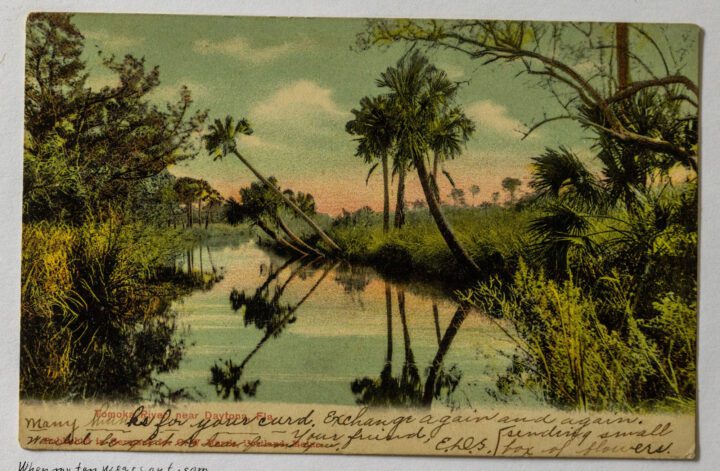
Front — A scenic view of palm trees and other tropical foliage reflected in a tranquil body of water under a colorful sky, labeled “Ormond Key near Daytona.”
Postcard Metadata
Postmarked: Lady Lake, Florida — March 10, 1906
Sent From: Lady Lake, Florida
Sent To: Miss Pearle Byers, Carthage, Ill.
Distance Traveled: Approximately 970 miles (1560 km)
Postage: One cent United States stamp featuring Benjamin Franklin, green.
Card Details: Undivided back, typical for postcards sent before March 1, 1907.
Back — Correspondence from C.H.S. to Miss Pearle Byers
Transcription
Ormond Key near Daytona. Many thanks for your card, exchange again and again. Your friend C.H.S. Send me a small novel not complicated with love something of your own. Box of flowers.
Historical & Family Notes
This early postcard, dating from 1906, shows the sender, C.H.S., corresponding with Pearl Byers from sunny Florida. The reference to “Ormond Key near Daytona” places the sender on what was then a popular winter resort destination, indicating some travel or leisure activities. The message, though brief, hints at a warm and continuous exchange, stating “exchange again and again.”
The most intriguing part of the message is the playful postscript: “Send me a small novel not complicated with love something of your own. Box of flowers.” While signed simply “Your friend C.H.S.,” the initials “H.S.” align with Harvey Sights, Pearl’s future husband. The request for a novel “not complicated with love” could be a teasing remark between two individuals who are perhaps just beginning to navigate the complexities of their own budding affections, subtly hinting at an interest beyond mere friendship. The mention of “Box of flowers” further adds to this gentle flirtation.
This card provides a charming glimpse into the early stages of communication between Pearl and her circle, potentially even with Harvey Sights himself, before their relationship fully blossomed. The request for a personalized “novel” suggests an intimate understanding and shared sense of humor between the correspondent and Pearl, laying groundwork for a deeper connection in the years to come.
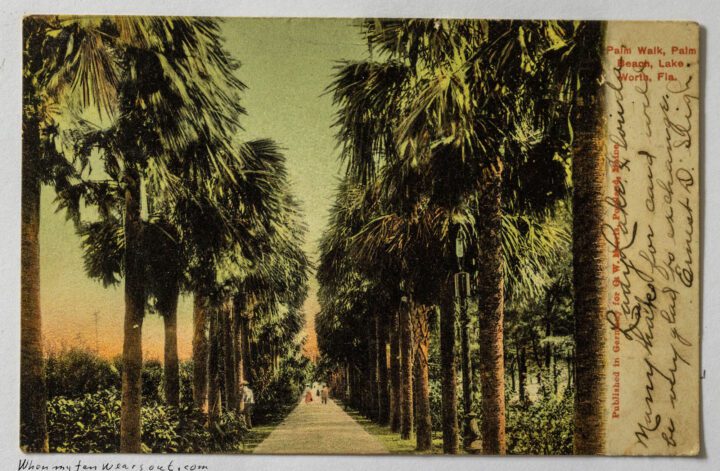
Front — A serene, sun-drenched palm-lined avenue with pedestrians strolling, labeled “Palm Walk, Palm Beach, Lake Worth, Fla.”
Postcard Metadata
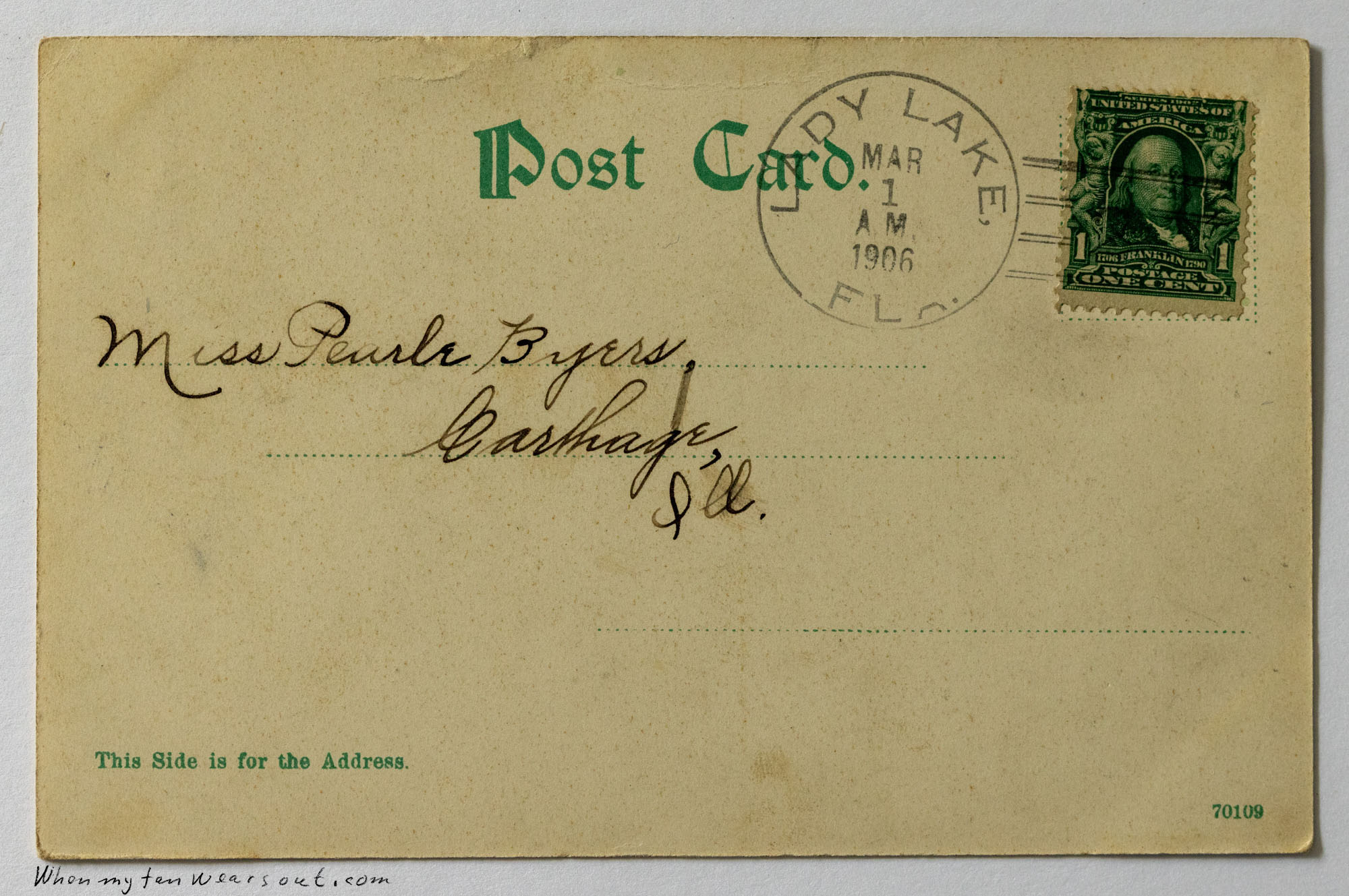
Postmarked: Lady Lake, Florida — March 1, 1906
Sent From: Lady Lake, Florida
Sent To: Miss Pearle Byers, Carthage, Ill.
Distance Traveled: Approximately 955 miles
Postage: One-cent Benjamin Franklin stamp (green)
Card Details: Early Divided Back (postmarked 1906, before official US domestic authorization in 1907; sender utilized both address and message sections for correspondence)
Back — Correspondence from Ernest D. Sh. to Miss Pearle Byers
Transcription
Published in Ger. for Geo. R. Lawrence. Palm Walk, Palm Beach, Lake Worth, Fla. Merry Xmas for exchanging cards with Mr. Sights. Ernest D. Sh.
Historical & Family Notes
This postcard, sent from sunny Florida in 1906, provides an intriguing glimpse into Pearl Byers’ social sphere before her marriage to Harvey Sights. The message from Ernest D. Sh. explicitly mentions “exchanging cards with Mr. Sights,” suggesting that Harvey was already a known figure within Pearl’s wider network of acquaintances and that social correspondence was a common practice. This early mention, even if indirect, foreshadows the deeper connection that would eventually develop between Pearl and Harvey.
The card itself, an early example of a divided back design postmarked a year before its official authorization for U.S. domestic mail, reflects the evolving nature of postcard communication. The sender’s decision to write the message across both the designated message and address portions of the card highlights a charming disregard for strict postal conventions, prioritizing the full message over proper formatting.
Such exchanges served as vital threads connecting individuals across distances in the early 20th century, fostering relationships and maintaining social ties. For Pearl and Harvey, this postcard from a faraway destination underscores the broad geographical and social contexts that shaped their lives before they became central to each other’s.
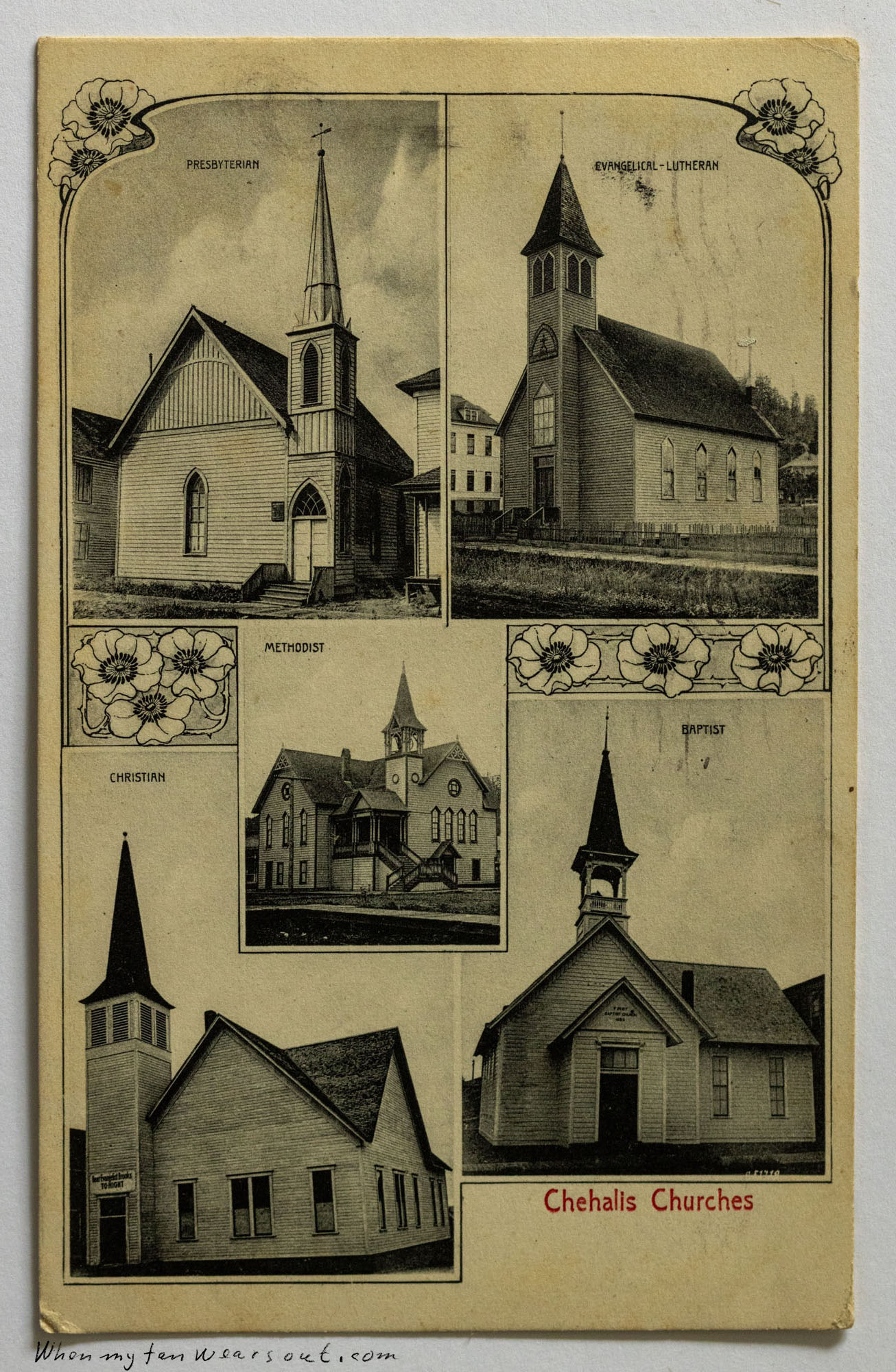
Front — A multi-panel collage showcasing five different church buildings in Chehalis, Washington, including Presbyterian, Evangelical-Lutheran, Methodist, Christian, and Baptist.
Postcard Metadata
Postmarked: Chehalis, Washington — May 2, 1908
Sent From: Chehalis, Washington
Sent To: Miss Pearl Rogers, Carthage Ill.
Distance Traveled: Approximately 1850 miles
Postage: One Cent Benjamin Franklin stamp
Card Details: Divided Back era postcard, Made in Germany
Back — Correspondence from Marguerite G. Lattler (likely) to Miss Pearl Rogers
Transcription
A friend Pearl, I believe one you an answer excuse me for the delay but I thought I had answered. How are you I wish I knew you personally. I have finished school and am working in the Bank in Chehalis. I like it fine.
Historical & Family Notes
This postcard, while part of the Pearl Byers collection, is explicitly addressed to “Miss Pearl Rogers.” Given the project’s primary focus on Pearl Byers of Carthage, Illinois, this discrepancy in the recipient’s surname presents an intriguing genealogical question. It may suggest a previous family name, a different recipient, or a common addressing variation of the era, inviting further research into its precise connection to Pearl Byers’ personal archives.
The sender, likely Marguerite G. Lattler from Chehalis, Washington, apologizes for a delayed reply, indicating a pre-existing correspondence between the two. Her message provides a snapshot of life in the early 20th century, sharing personal news of finishing school and beginning a new job at a local bank in Chehalis. The expression “I wish I knew you personally” suggests their relationship might have been primarily through letters or distant acquaintance, rather than close physical proximity.
The significant distance between Chehalis, Washington, and Carthage, Illinois, highlights the importance of postcards as a primary means of long-distance communication and maintaining social connections during this period. The card offers a glimpse into the sender’s new career path and general well-being, sharing a common theme of personal updates exchanged across vast geographical divides.
Front — A view of the Chanute Public Library in Chanute, Kansas, with a handwritten note “Miss Pearl 3.5.08” at the top.
Postcard Metadata
Postmarked: Chanute, Kansas — November 23, 1907
Sent From: Chanute, Kansas
Sent To: Miss Pearl Byers Carthage Ill.
Distance Traveled: Approximately 410 miles
Postage: One Cent U.S. Franklin stamp, green
Card Details: Divided Back Era (1907-1915)
Back — Correspondence from Harvey Sights to Miss Pearl Byers
Transcription
Dear Pearl, Was glad to hear from you. We are having nice weather here this week. Had a good rain yesterday. I wish I was there to spend my birthday with you. Your Harvey
Historical & Family Notes
In this heartfelt message, Harvey Sights sends an early birthday wish to Pearl Byers, lamenting his absence for her December 4th celebration. The postcard, postmarked November 23, 1907, captures the anticipation of Pearl’s special day from afar, as Harvey expresses his desire to be with her. The front of the card depicts the Chanute Public Library in Kansas, where Harvey was at the time, offering a glimpse into the locale from which he sent his affections.
This card perfectly illustrates the challenges of courtship across distances in the early 20th century, relying on the postal service to bridge the miles between Chanute, Kansas, and Carthage, Illinois. The sentiment “I wish I was there to spend my birthday with you” speaks volumes about the growing bond between Harvey and Pearl, hinting at the romantic connection that would eventually lead to their marriage.
The small, handwritten note “Miss Pearl 3.5.08” on the front of the postcard appears to be a later annotation, possibly by Pearl herself or a collector, indicating a date that doesn’t align with the 1907 postmark but might mark a significant memory associated with the card. It further solidifies the postcard’s personal significance within Pearl’s collection.
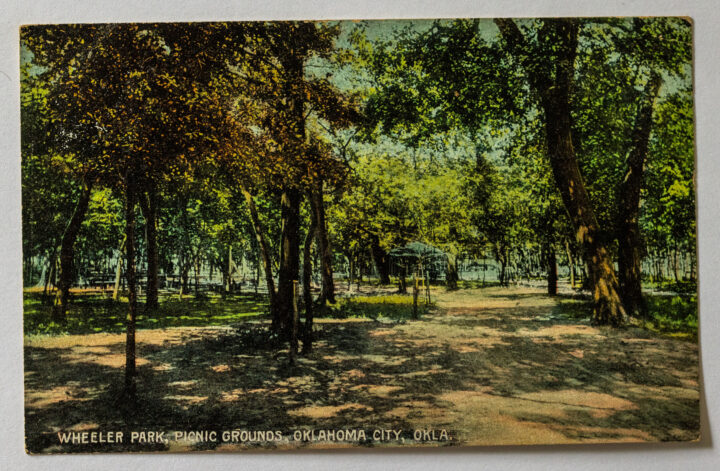
Front — A hand-colored image of the Wheeler Park Picnic Grounds in Oklahoma City, Oklahoma, showing a tree-lined path.
Postcard Metadata
Postmarked: Oklahoma City, Okla. — AUG 11 8-PM 19 09
Sent From: Oklahoma City, Oklahoma
Sent To: Miss Pearl Byers, 318 N. Fayette Street, Carthage, Illinois
Distance Traveled: Approximately 540 miles
Postage: U.S. Postage, One Cent, George Washington green stamp
Card Details: Divided Back era (c. 1907-1915), Published by Sadler & Pennington, Oklahoma City, Okla., Made in Germany.
Back — Correspondence from Harvey Sights to Miss Pearl Byers
Transcription
I guess you hardly expect to hear from me again but I waited until I got home to write. I would love to hear from you. My address is 218 East 10 St. Okla.
Historical & Family Notes
This postcard, sent from Harvey Sights in Oklahoma City to Pearl Byers in Carthage, Illinois, offers a glimpse into their early correspondence, hinting at a dynamic courtship. Harvey’s opening line, “I guess you hardly expect to hear from me again,” suggests a pause in their communication or perhaps a period of uncertainty, which he quickly aims to remedy by sending this note from his home address. The sentiment “I would love to hear from you” clearly indicates his desire to continue their connection despite any prior gaps.
The fact that Harvey waited until he was home to write suggests a personal touch to his message, reinforcing the emerging bond between them. As Pearl and Harvey’s story unfolds towards marriage, these early postcards become precious artifacts, chronicling the subtle emotional currents that shaped their relationship. His providing a specific address, “218 East 10 St. Okla.”, underscores his eagerness for a response and to cement their line of communication.
The image of the picnic grounds on the front, with its inviting paths and dappled sunlight, could subtly reflect the pleasant anticipation of future shared moments, even as their correspondence traversed hundreds of miles across the Midwest. The postcard serves as a tangible reminder of the effort and intention invested in building their relationship from afar, a common scenario in an era when such written exchanges were vital for maintaining long-distance connections.
Front — An embossed illustration of a holly sprig with red berries above a winter landscape scene and “A MERRY CHRISTMAS” message.
Postcard Metadata
Postmarked: Perris, California — December 22 (Year unreadable, likely early 1910s based on stamp and card type)
Sent From: Perris, California
Sent To: Miss Pearl Byers Carthage Ill.
Distance Traveled: Approximately 1,900 miles
Postage: U.S. Postage, One Cent, green Benjamin Franklin stamp
Card Details: Divided Back Era (post-1907)
Back — Correspondence from Harvey Sights to Miss Pearl Byers
Transcription
H.S.
Historical & Family Notes
This Christmas postcard, adorned with festive holly and a serene winter scene, carries a simple but significant message from Harvey Sights to Pearl Byers. The solitary “H.S.” initial, penned vertically on the correspondence side, speaks volumes about the growing connection between them, despite the vast geographical distance separating Perris, California, from Carthage, Illinois. The journey of nearly 1,900 miles underscores Harvey’s effort to reach Pearl during the holiday season, a time traditionally associated with warmth and connection.
The absence of a longer message might suggest a burgeoning relationship where a simple acknowledgment was enough, or perhaps a more private communication was shared via other means. This card serves as a tangible link in the evolving story of Pearl and Harvey, capturing a moment when their paths, though physically distant, were drawing closer. It’s a testament to the enduring tradition of holiday greetings and the personal touch postcards offered in an era before instant communication.
As an archival piece, this postcard not only documents a festive exchange but also subtly hints at the dedication involved in maintaining a long-distance connection during the early 20th century. For Pearl, receiving this Christmas wish from Harvey, even if brief, would have been a cherished reminder of his thoughts for her, further cementing their bond that would eventually lead to marriage and their daughter, Marnelle.
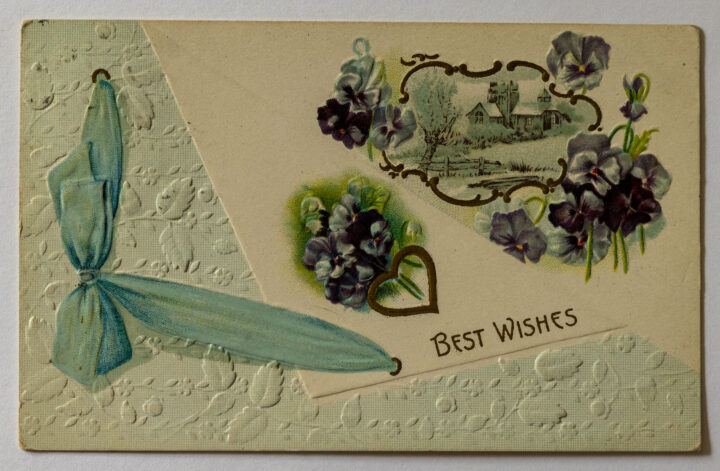
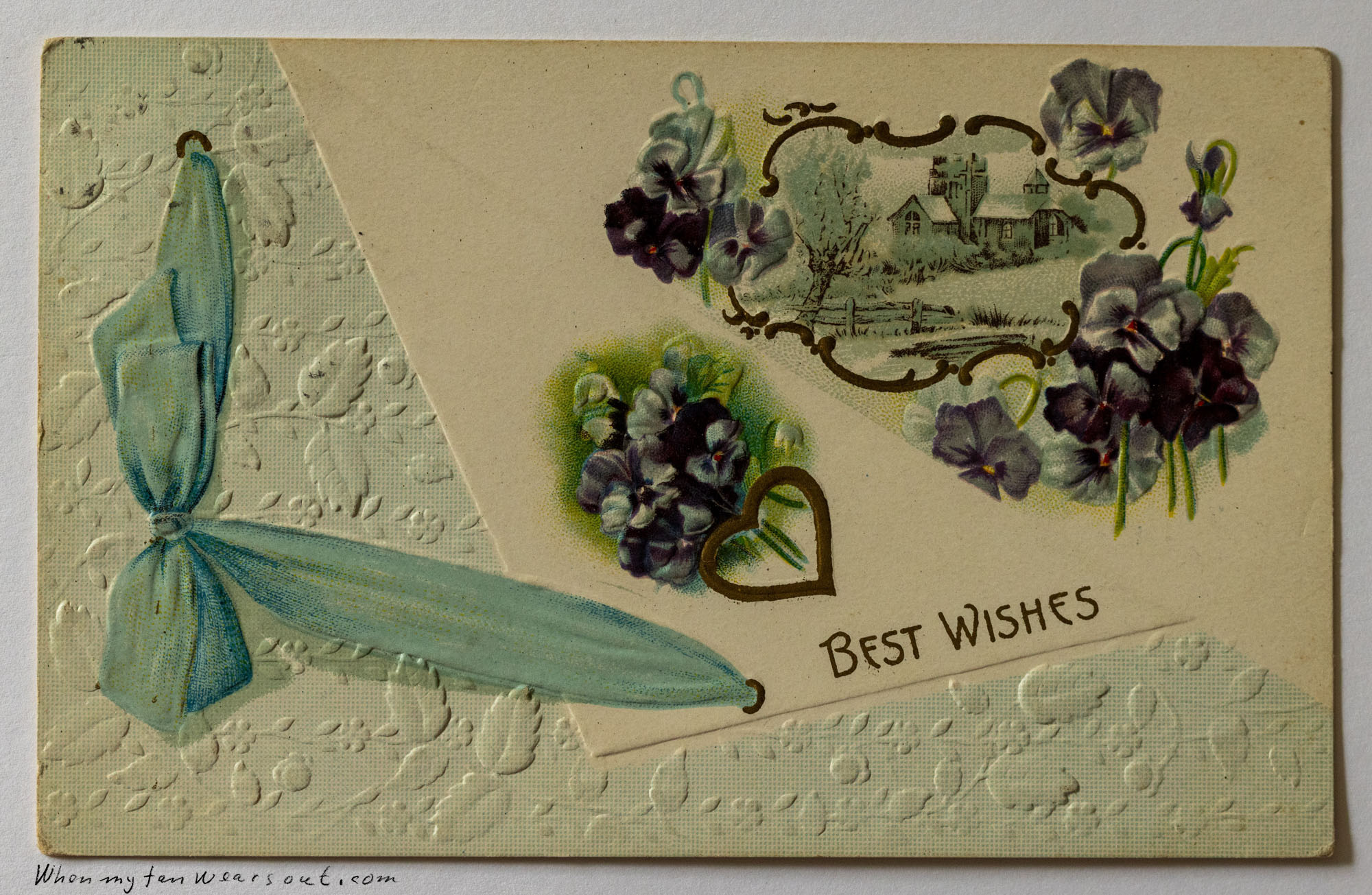
Front — A “Best Wishes” postcard featuring purple pansies, an embossed blue ribbon, and a framed rural farm scene.
Postcard Metadata
Postmarked: Carthage, Illinois — September 7, 1909
Sent From: Carthage, Illinois
Sent To: Mr. Harvey Sights, La Harpe Ill
Distance Traveled: Approximately 16 miles
Postage: U.S. Postage, One Cent (George Washington portrait)
Card Details: Divided Back postcard, popular from 1907 onwards, featuring embossed details.
Back — Correspondence from E.P.B. (Pearl Byers) to Harvey Sights
Transcription
Carthage Ill. Sept. 7-09. Rec’d card this morning as I came to work. Thanks “awfully.” It is dandy. E.P.B. Mr. Harvey Sights La Harpe Ill
Historical & Family Notes
This postcard offers a charming glimpse into the early courtship between Pearl Byers and Harvey Sights. Pearl, writing from Carthage, Illinois, expresses her thanks to Harvey for a card she received earlier that morning, playfully stating it was “dandy.” This exchange highlights their regular correspondence despite living a mere sixteen miles apart, indicating a blossoming romance through the daily ritual of postcard mail.
The sender’s initials “E.P.B.” are almost certainly Pearl Byers, aligning with the family’s identity rules and the ongoing narrative of their relationship. The card was sent on September 7, 1909, a significant period in their courtship before their eventual marriage and the birth of their daughter, Marnelle.
The message’s casual and affectionate tone—”Thanks ‘awfully'”—suggests a comfort and familiarity between Pearl and Harvey, showcasing a delightful snapshot of their everyday interactions and the simple pleasures of receiving mail from a loved one in the early 20th century.
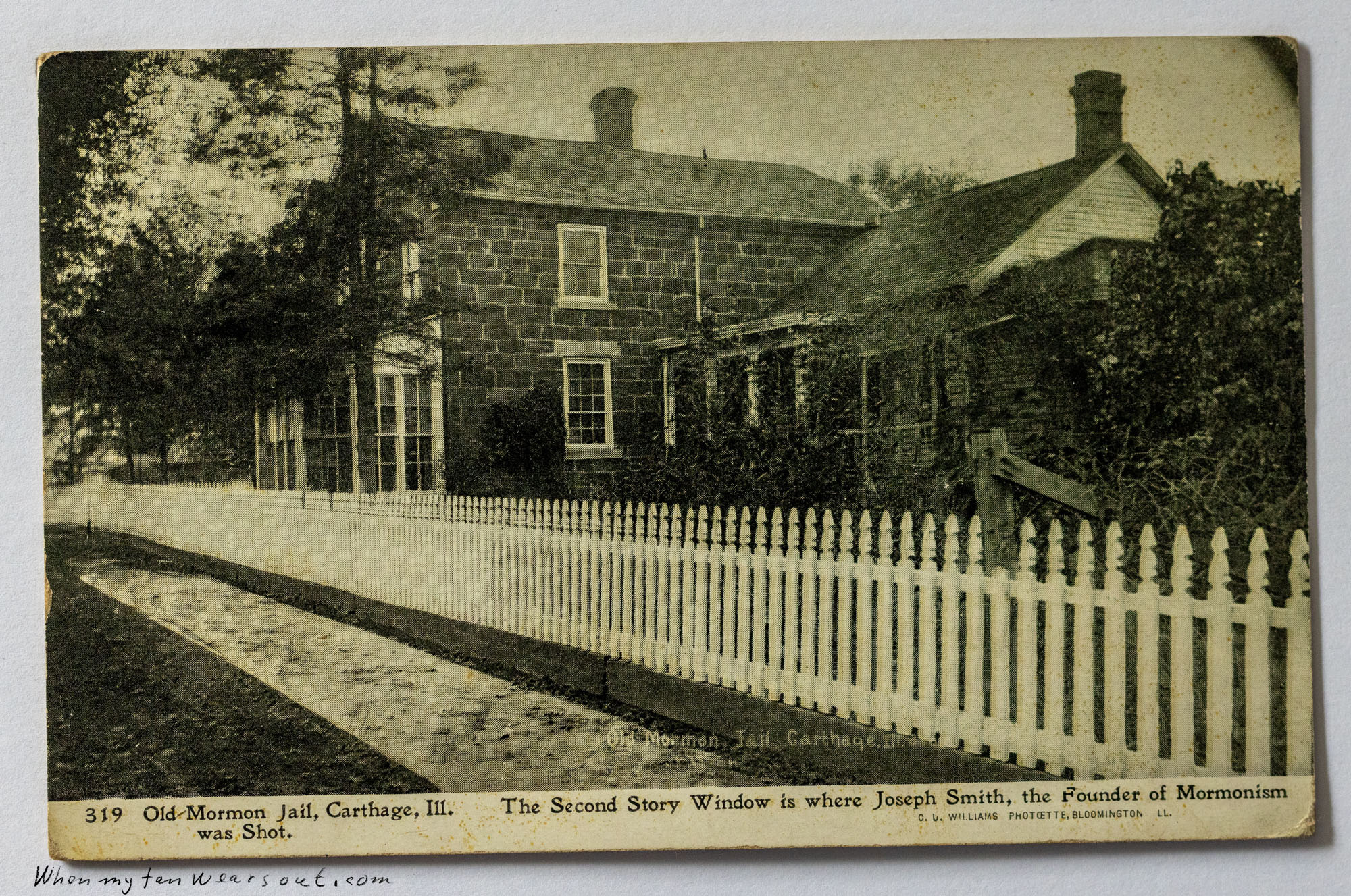
Front — A sepia-toned image of the Old Mormon Jail in Carthage, Illinois, with a white picket fence.
Postcard Metadata
Postmarked: Iowa City, Iowa — July 8, 1908, 9 PM
Sent From: Iowa City, Iowa
Sent To: Mr Harvey Sightes, La Harpe, Ill.
Distance Traveled: Approximately 95 miles
Postage: 1 Cent U.S. Postage (Benjamin Franklin)
Card Details: Divided Back era (1907-1915)
Back — Correspondence from an unknown sender to Mr Harvey Sights
Transcription
Vanmeter Hotel Be good to you. Hello dad!- (Once upon a time) How are you, I am fine, got here about 1 o’clock mon night, having fine time. You adds this some day to fun address my E. M. Collars General Delived Iowa City, Io
Historical & Family Notes
This postcard, postmarked in Iowa City in 1908, is addressed to Harvey Sights, who would later marry Pearl Byers. The message, though informal and from an unidentified sender, offers a glimpse into the casual communications of the era, reporting on travel and a “fine time” to a father figure. The sender provides a return address for “my E. M. Collars” at General Delivery in Iowa City, suggesting either a temporary stay or a traveling companion.
The front of the postcard features the historically significant Old Mormon Jail in Carthage, Illinois, where Joseph Smith, the founder of Mormonism, was killed. This landmark in Carthage holds particular relevance as it is the town where Pearl Byers resided and where she and Harvey Sights would eventually build their life together.
While not a direct communication between Pearl and Harvey, this postcard to Harvey connects to the broader geographical and historical context of their lives. It captures a moment in time when travel was an adventure, and postcards served as brief, tangible links between people across distances, even if just to share a historical site or a simple update on one’s well-being.
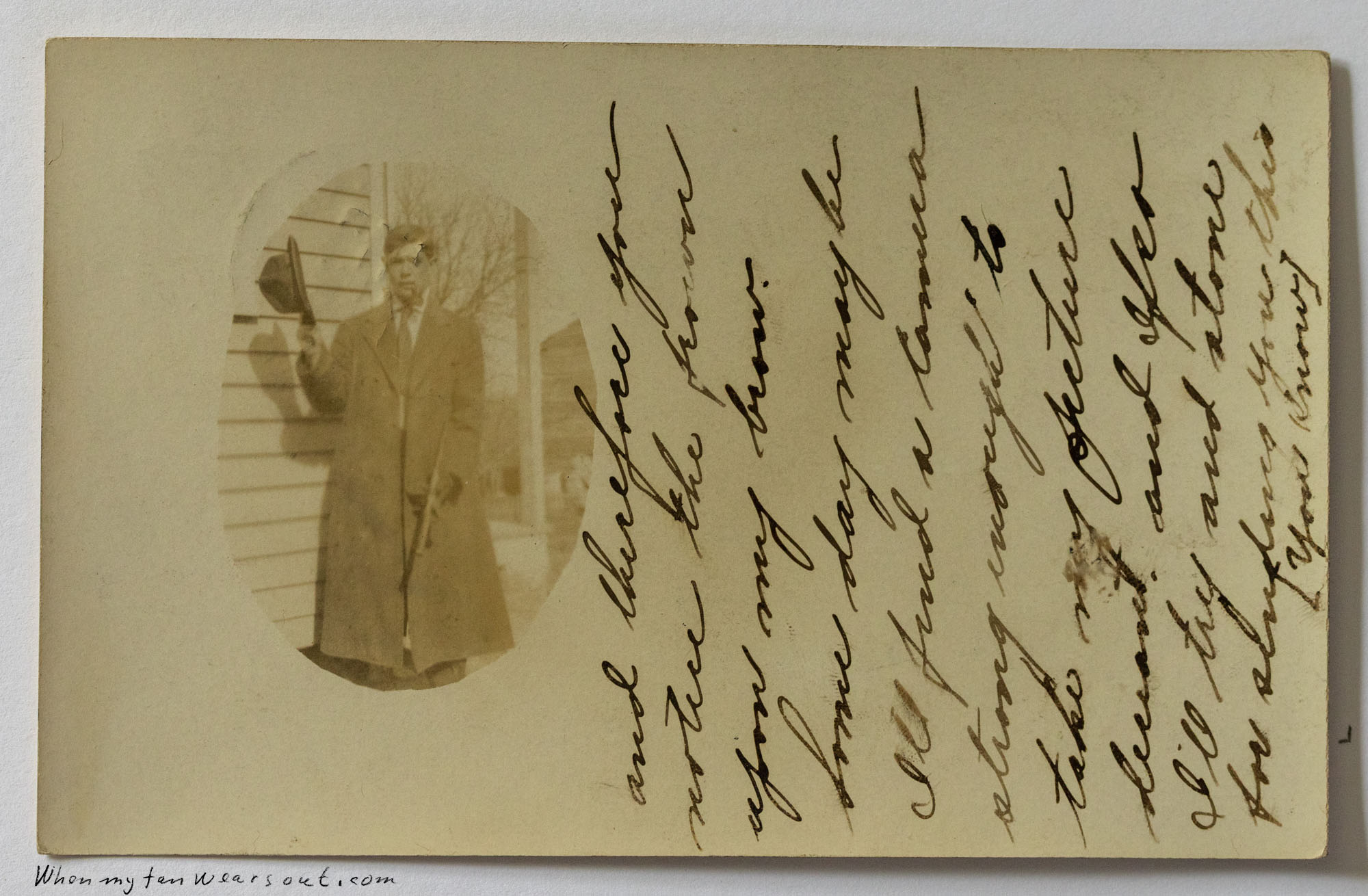
Front — Oval photographic insert featuring a young man in a long coat and hat standing on a porch, with bare trees in the background, next to a handwritten message.
Postcard Metadata
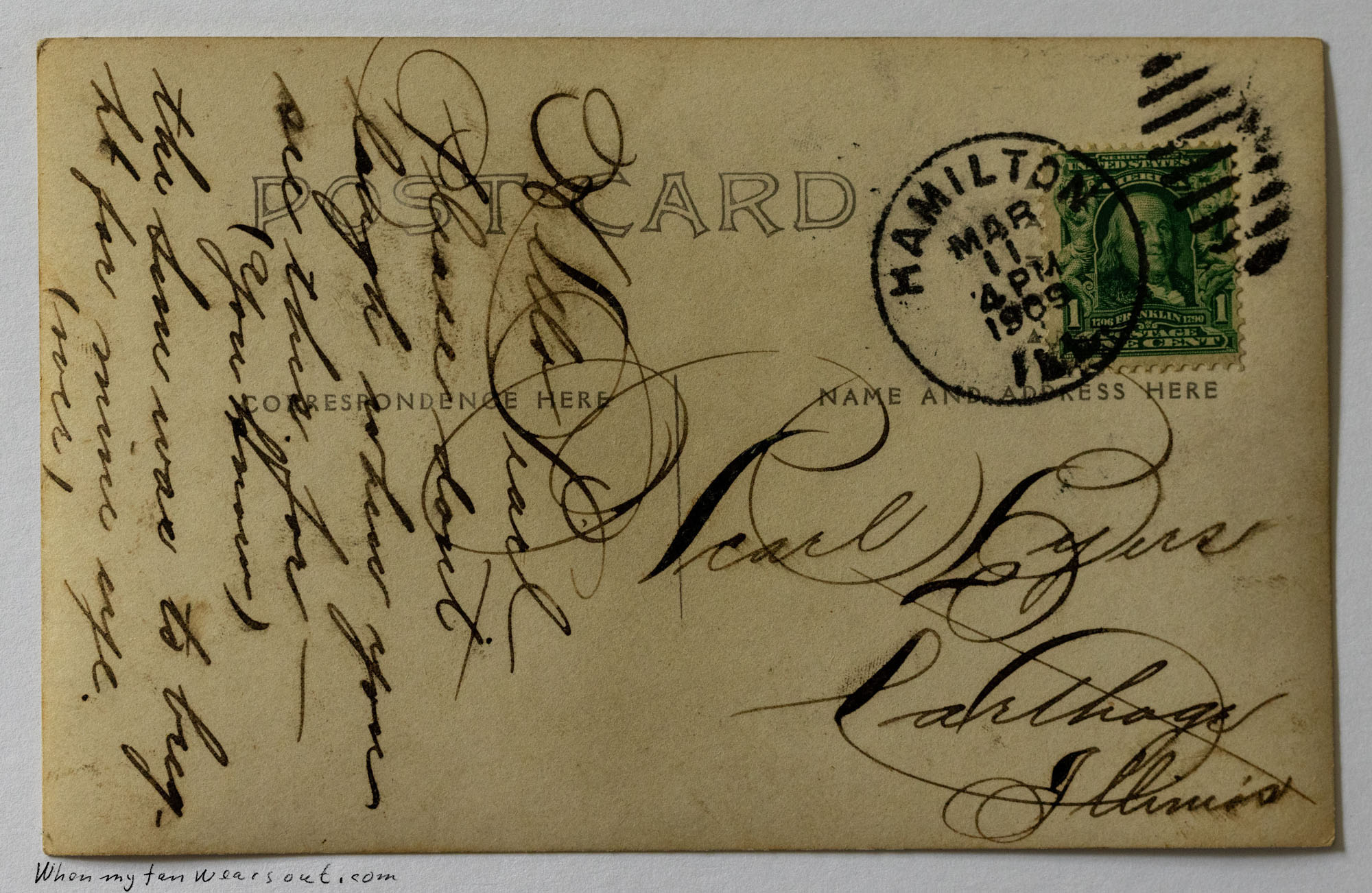
Postmarked: Hamilton, Illinois — March 11, 1909
Sent From: Hamilton, Illinois
Sent To: Miss Pearl Byers, Carthage, Illinois
Distance Traveled: Approximately 18 miles
Postage: One Cent U.S. Postage, Franklin profile (green stamp)
Card Details: Divided Back era (1907-1915)
Back — Correspondence from Harvey Sights to Pearl Byers
Transcription
and that is free and the broom since my May be I will find a camera along with me to take my picture I will try and after this for bring you to the dear your Bery Dear Pearl This leaves me very lonesome this after[text obscured by POST CARD graphic] Harvey
Historical & Family Notes
This postcard, sent by a young Harvey Sights to Pearl Byers, serves as a poignant artifact of their early courtship. Harvey sends a photographic image of himself, possibly his current appearance, and expresses a wish to either take another picture or visit Pearl, stating “I will try and after this for bring you to the dear.” This indicates his desire to see her and deepen their connection, which was common practice during this era of long-distance romance.
The message on the back, though partially obscured, reveals Harvey’s loneliness, starting with “Dear Pearl This leaves me very lonesome this after[…].” This personal touch underscores the emotional intensity of their correspondence. The relatively short distance between Hamilton and Carthage, Illinois, would have made visits plausible, adding anticipation to Harvey’s promise.
This card is a tender snapshot of their relationship before marriage, showing the efforts Harvey made to stay connected and express his feelings, using the popular medium of postcards to bridge the physical distance between them. The slight ambiguity in the sender’s signature on the front (“Bery”) further highlights the informal and intimate nature of their exchanges.
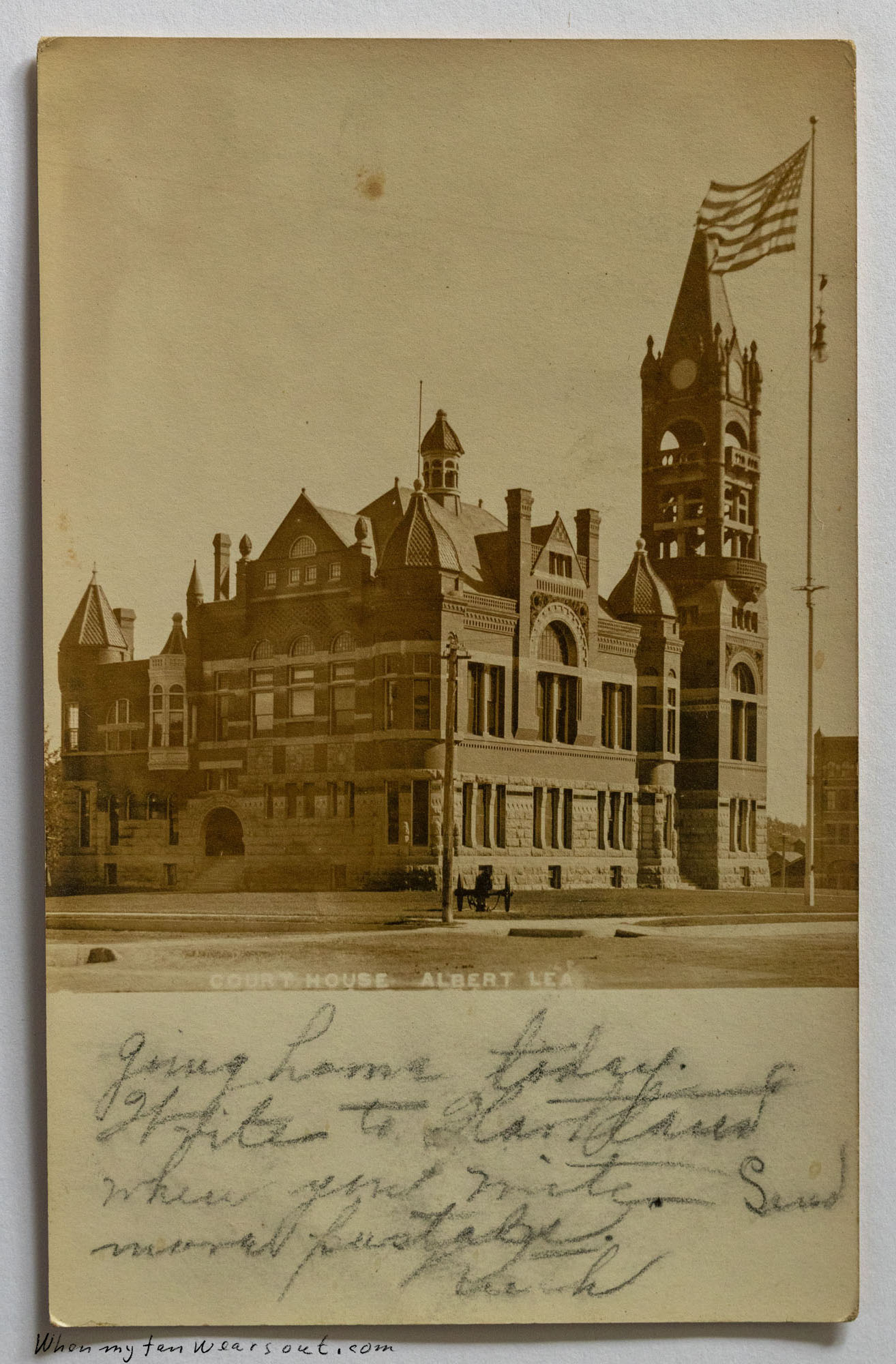
Front — View of the Albert Lea Court House with a prominent clock tower and American flag.
Postcard Metadata
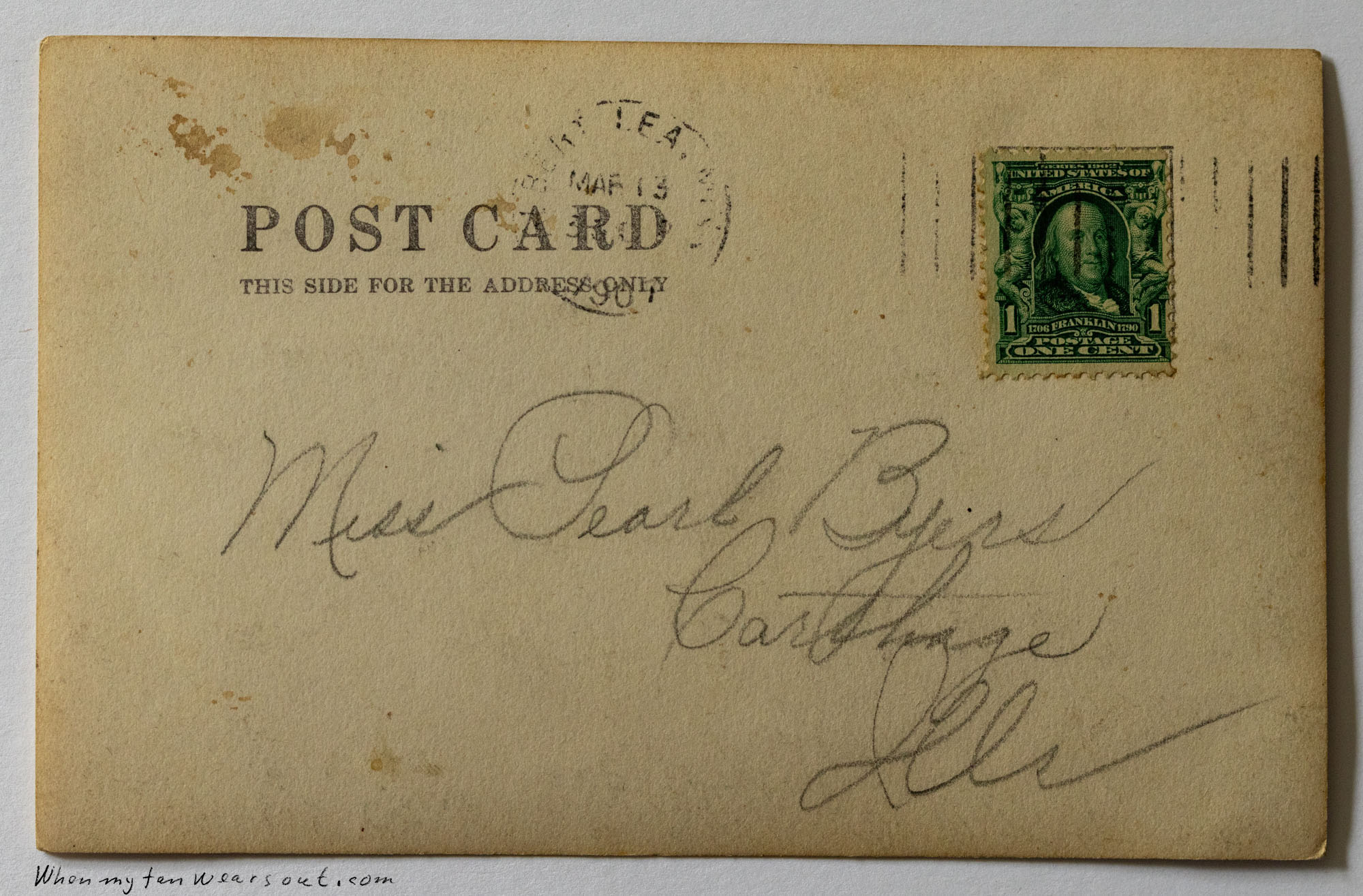
Postmarked: Albert Lea, Minnesota — March 13 (Year not visible, likely post-1907)
Sent From: Albert Lea, Minnesota
Sent To: Miss Pearl Byers, 318 N. Fayette Street, Carthage, Illinois
Distance Traveled: Approximately 390 miles
Postage: 1 Cent U.S. Postage (Benjamin Franklin, green stamp)
Card Details: Divided Back Era (Introduced March 1, 1907)
Back — Correspondence from Harvey Sights to Miss Pearl Byers
Transcription
Going home today. Expect to start from when you get my other postcard. Send me all puss.
Historical & Family Notes
This postcard captures a moment of anticipation as Harvey Sights prepares to return home, presumably to Pearl Byers. Sent from Albert Lea, Minnesota, the message “Going home today” signifies the conclusion of his travels or a temporary stay, and the impending reunion with Pearl. The reference to “my other postcard” suggests an ongoing correspondence, a common method of nurturing their relationship across the miles.
The affectionate closing, “Send me all puss,” underscores the tender and playful nature of their courtship. Such personal and informal expressions reveal a deeper intimacy than standard greetings, hinting at the bond that would eventually lead to their marriage and the start of their family. This card is a tangible piece of their unfolding love story, chronicling the small, daily communications that built their connection.
As a historical artifact, the postcard offers a glimpse into early 20th-century communication and travel. The image of the Albert Lea Court House serves as a backdrop to Harvey’s journey, while the simple yet heartfelt message conveys the human experience of longing and return. It’s a testament to the enduring power of written words to bridge distance and maintain personal connections in a time before instant digital communication.
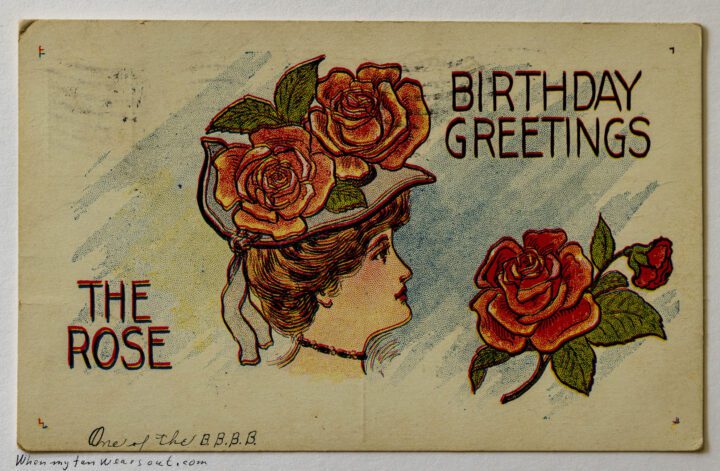
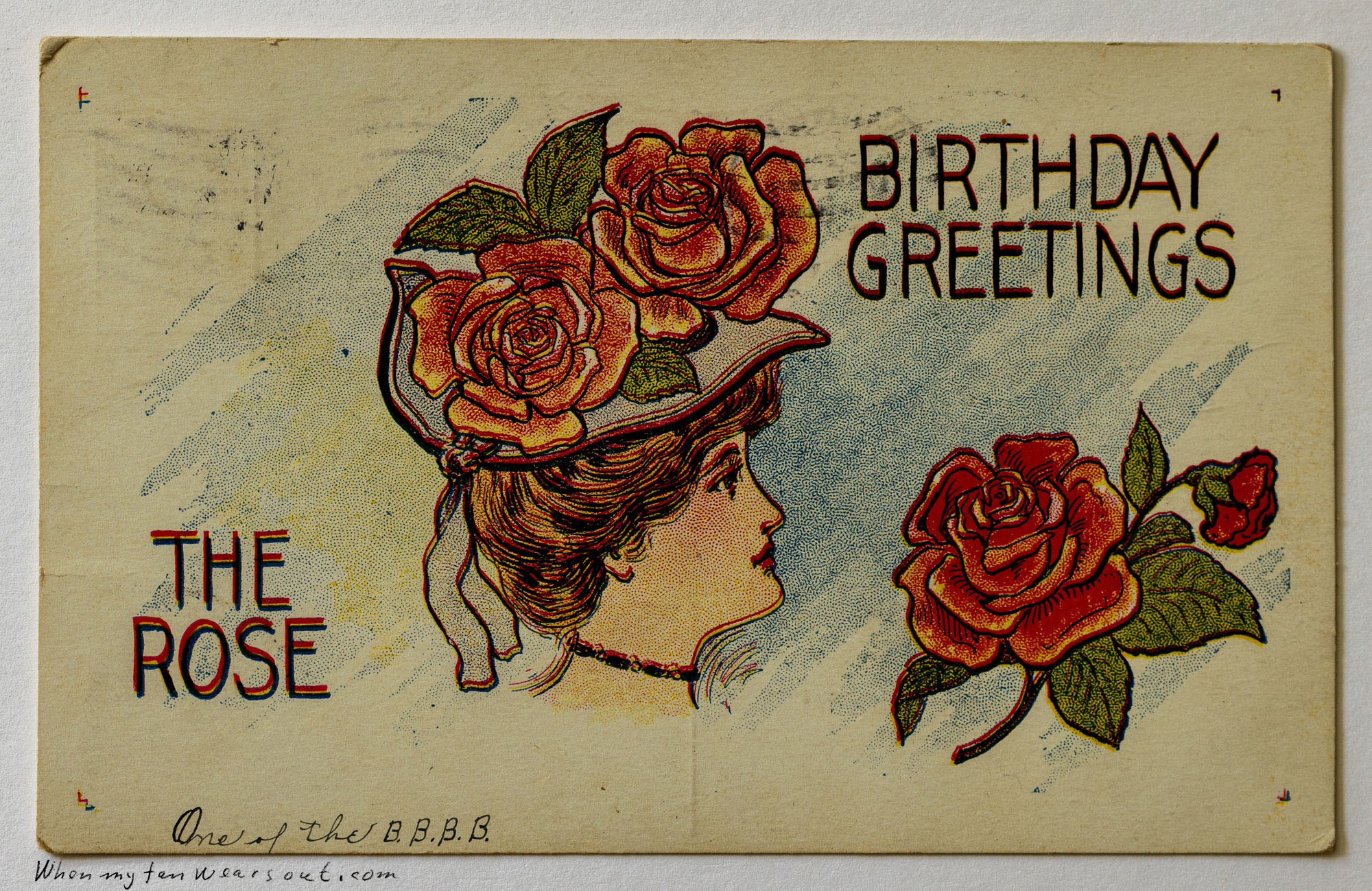
Front — A colorized illustration of a woman in a floral hat featuring roses, with additional roses and the text “THE ROSE” and “BIRTHDAY GREETINGS.”
Postcard Metadata
Postmarked: Quincy, Ill. — December 4, 1907
Sent From: Quincy, Illinois
Sent To: Miss Pearl Byers, Carthage, Ill.
Distance Traveled: Approximately 33 miles
Postage: U.S. Postage One Cent (Benjamin Franklin green stamp)
Card Details: Divided Back era (message on left, address on right, introduced in the U.S. in March 1907)
Back — Correspondence from Harvey Sights to Miss Pearl Byers
Transcription
Dec. 4 / 07 Dear Friend:- I suppose you know who this is from don’t you? Hope you have a happy birthday. As Ever. address H. L. Burling Gem City Business College. Quincy, Ill.
Historical & Family Notes
This charming birthday postcard marks Pearl Byers’ special day, December 4th, 1907, with a playful message from her future husband, Harvey Sights. Though he doesn’t explicitly sign his name, the teasing query, “I suppose you know who this is from don’t you?” is a clear indicator of a budding romance and familiarity. The sender provides the address for “H. L. Burling” at the Gem City Business College in Quincy, Illinois, likely where Harvey was studying or residing, using it as a return address for discretion in their early courtship.
The card itself features “The Rose,” a classic symbol of affection and beauty, perfectly chosen for a birthday greeting to a young woman. The postmark confirms it was sent from Quincy on Pearl’s actual birthday, suggesting a thoughtful and timely gesture. This card offers a sweet glimpse into the early stages of their relationship, highlighting the gentle humor and personal connection that would eventually lead to their marriage.
The reference to “H.L. Burling” at Gem City Business College offers a unique historical tidbit. Many young people, including those from rural areas, attended business colleges in larger towns like Quincy to acquire skills for office work. It’s plausible that Harvey was a student there, making this postcard a testament to both his personal affections and his efforts towards building a future.
Front — A hand-colored photo postcard depicts a couple strolling under a smiling moon with a romantic song lyric.
Postcard Metadata
Postmarked: Colmar, Illinois — March 1908
Sent From: Colmar, Illinois
Sent To: Miss Pearl B. Carthage Illinois
Distance Traveled: ~12 miles
Postage: U.S. Postage One Cent (green George Washington stamp)
Card Details: Divided Back, Photo Postcard, “Illustrated Song Serie No. 142B”, Printed in Germany, Photo only copyrighted 1907 by De Witt C. Wheeler, Lyrics by permission of The York Music Co., New York City.
Back — Correspondence from Harvey Sights to Miss Pearl B.
Transcription
Dear Pearl, How is it you never write to me any more? How are you getting along? I hope you are all well & getting along fine. We are all well. Mr. Sights is with us for a few days. He said to tell you he thinks you are pretty swell. I can tell you he is not a bad fellow in fact I think he is all right. I have just come over to see what kind of a good time you are having. I guess you are having a good time. Tell me what you are doing & how you are getting along. Tell me if you are looking for a young fellow who has a good time for you. What do you think of this, tell me how you think of this. Write to me as soon as you can. Your friend, Harvey Sights.
Historical & Family Notes
This postcard, sent in March 1908, offers a charming glimpse into the early courtship of Pearl Byers and Harvey Sights. The front features a romantic scene of a couple strolling under a smiling moon, accompanied by popular song lyrics of the era, “Everytime you go a strolling / With your lady love, / Mister moon is watching from above.” This sentimental imagery perfectly complements Harvey’s flirtatious message, highlighting the romantic ideals of the time.
Harvey’s message, though a bit playfully convoluted with the reference to “Mr. Sights is with us,” clearly conveys his personal admiration for Pearl. He pointedly asks, “Tell me if you are looking for a young fellow who has a good time for you. What do you think of this, tell me how you think of this,” indicating a direct and earnest pursuit of her affections. Such candid yet sweet overtures were a hallmark of early 20th-century communication, laying the groundwork for many lasting relationships.
This missive from Colmar to Carthage, a short distance across rural Illinois, marks a tender moment in Pearl and Harvey’s romantic journey. It underscores the importance of even small exchanges in fostering deep connections, foreshadowing their eventual marriage and the beginning of their family, including their daughter, Marnelle. The postcard serves as a beautiful testament to the blossoming love between them.
Front — An embossed golden horseshoe framing a rural landscape with forget-me-nots, a clover, and a butterfly, featuring the text “Good Luck AND BEST WISHES.”
Postcard Metadata
Postmarked: Kansas City, MO — September 22, 1903
Sent From: Kansas City, MO
Sent To: Miss Pearl Byers Carthage Ill.
Distance Traveled: Approximately 250 miles
Postage: U.S. Postage, One Cent, green George Washington stamp
Card Details: Undivided Back era (1901-1907), with design copyrighted 1903 by H.W. Connelley.
Back — Correspondence from Harvey Sights to Miss Pearl Byers
Transcription
Dear Pearl How are you? I am well. I saw George Murray and his girl last night. We went to the show, and then went to a party. They are sweethearts aren’t they. I wish you would come over some time. How are you and Chas.? I am at the chancelo and working like I was. My arm is not well. Good bye Love Harvey Sights
Historical & Family Notes
This postcard, sent from Kansas City by Harvey Sights to Pearl Byers in Carthage, Illinois, captures a fleeting moment of early courtship. The “Good Luck” sentiment on the front, while generic, gains a personal touch from Harvey’s longing message. His mention of seeing “George Murray and his girl” at a show and party, followed by the observation, “They are sweethearts aren’t they,” could subtly allude to his own hopes for a similar relationship with Pearl.
Harvey’s casual yet intimate closing, “Love Harvey Sights,” suggests an affectionate bond already forming between the two, despite the distance. His desire for Pearl to “come over some time” clearly expresses a wish for closer connection. The reference to his injured arm (“My arm is not well”) offers a glimpse into his daily life, adding a personal detail that would resonate with Pearl.
The card serves as an early document in Pearl and Harvey’s enduring love story, hinting at the affections that would eventually lead to their marriage and the birth of their daughter, Marnelle. It showcases the charming, informal communication style of the early 20th century, where simple postcards carried heartfelt messages across miles.