Postcard #0027: Snowy Northern Minnesota Lumber Camp


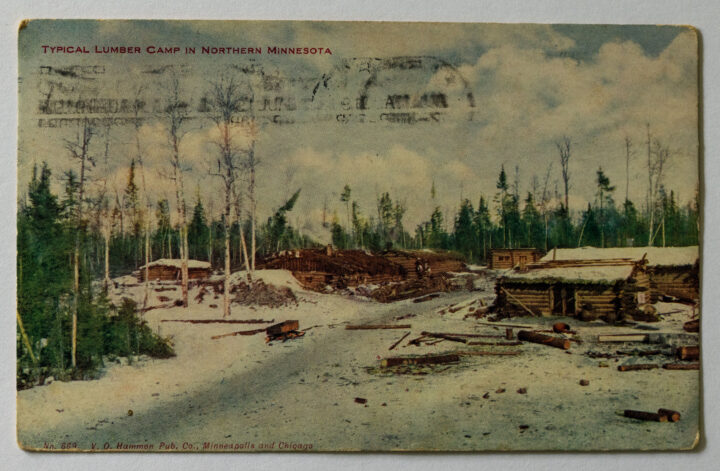
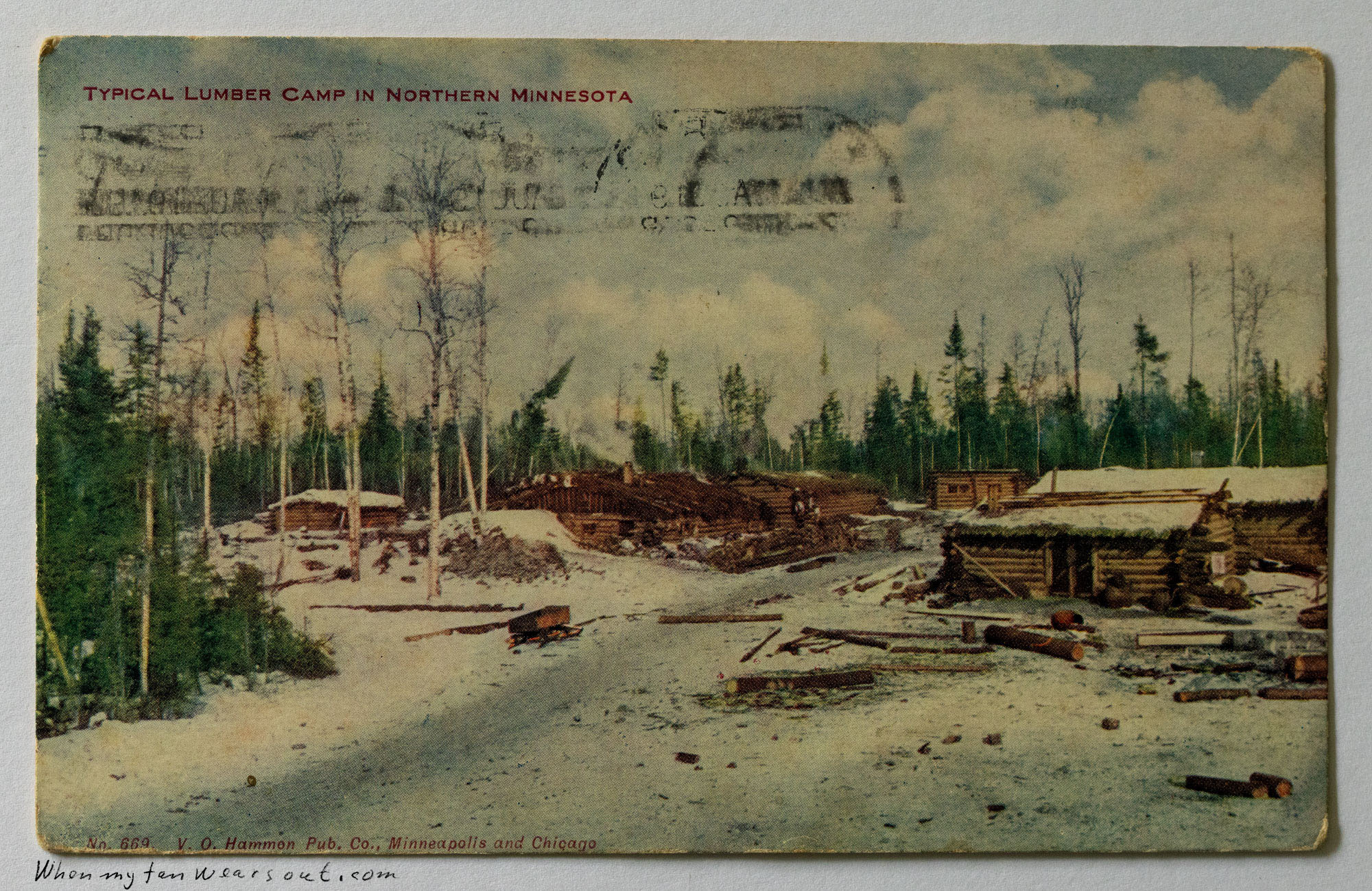
Hand-colored postcard depicting a snowy lumber camp in Northern Minnesota with log cabins, stacked timber, and bare trees under a cloudy sky, titled
Front — A snowy scene of a typical lumber camp in Northern Minnesota with log cabins and felled trees.

Postcard Metadata


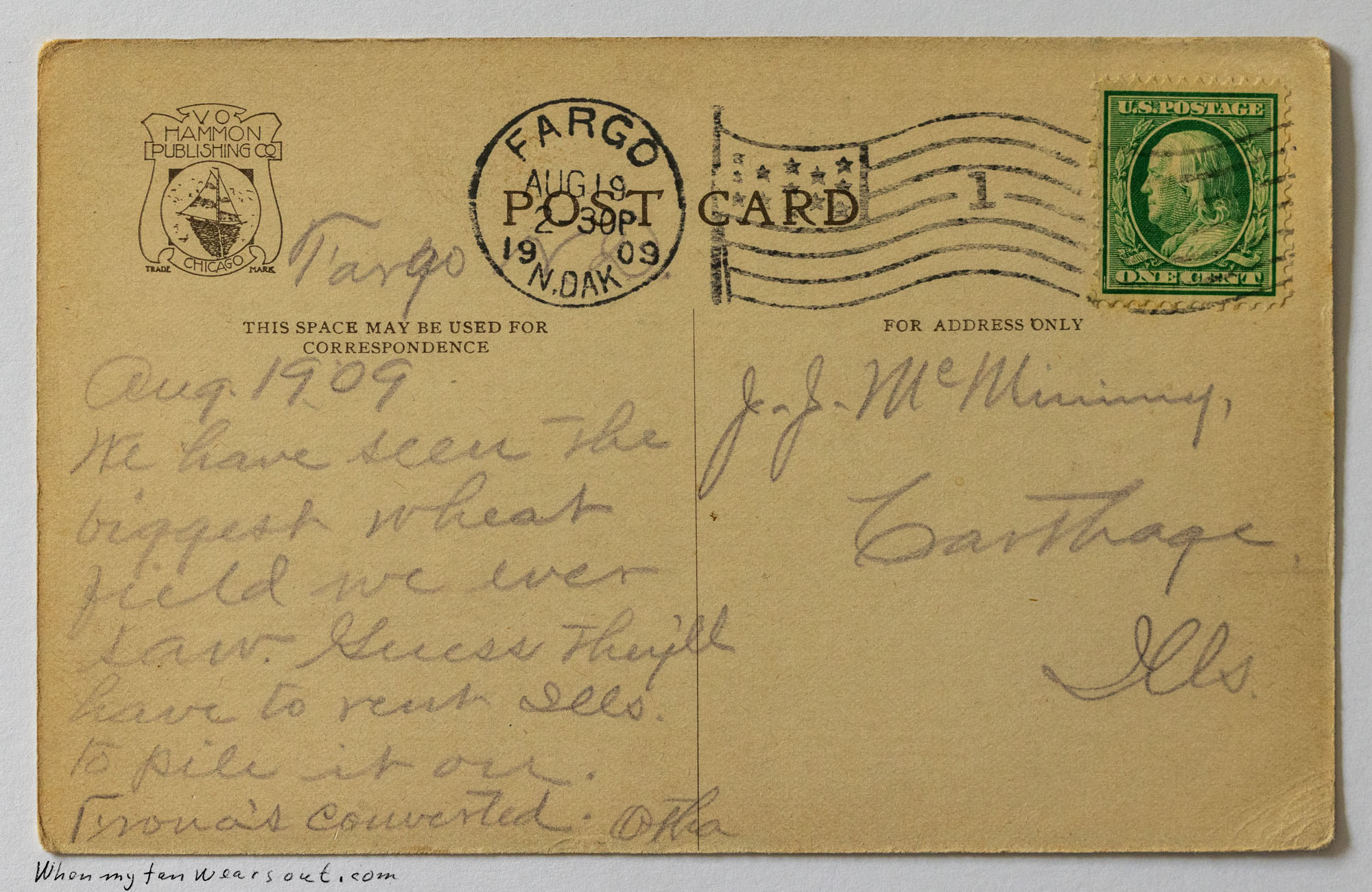
The back of the postcard features a Fargo, North Dakota postmark from August 19, 1909, a green one-cent Benjamin Franklin stamp, and a handwritten message about seeing a large wheat field and
Back — Correspondence from (unknown sender) to J. F. McMinnimy

Transcription

Aug. 19. 09. We have seen the biggest wheat field we ever saw. Guess they’ll have to rent silos to pile it on. Trona’s converted. O.K.

Historical & Family Notes

This postcard offers a glimpse into early 20th-century travel and industry, depicting a harsh winter scene from a Northern Minnesota lumber camp. While the postcard itself showcases an industrial snapshot, the message on the reverse speaks of agricultural abundance in North Dakota, noting an impressively large wheat field and the sender’s amusement at its size.

Notably, this particular postcard is not addressed to Pearl Byers or Harvey Sights, unlike many others in the collection. Instead, it is sent to J. F. McMinnimy in Carthage, Illinois, suggesting it was acquired into the family collection through means other than direct correspondence between Pearl and Harvey. This card likely entered the collection as an artifact of broader family connections or local historical interest.

The message’s casual tone, “Trona’s converted. O.K.”, hints at an ongoing personal narrative or shared understanding between the sender and recipient, a common feature of informal postcard exchanges of the era, conveying news that would have been significant to the immediate circle.

Continue Reading

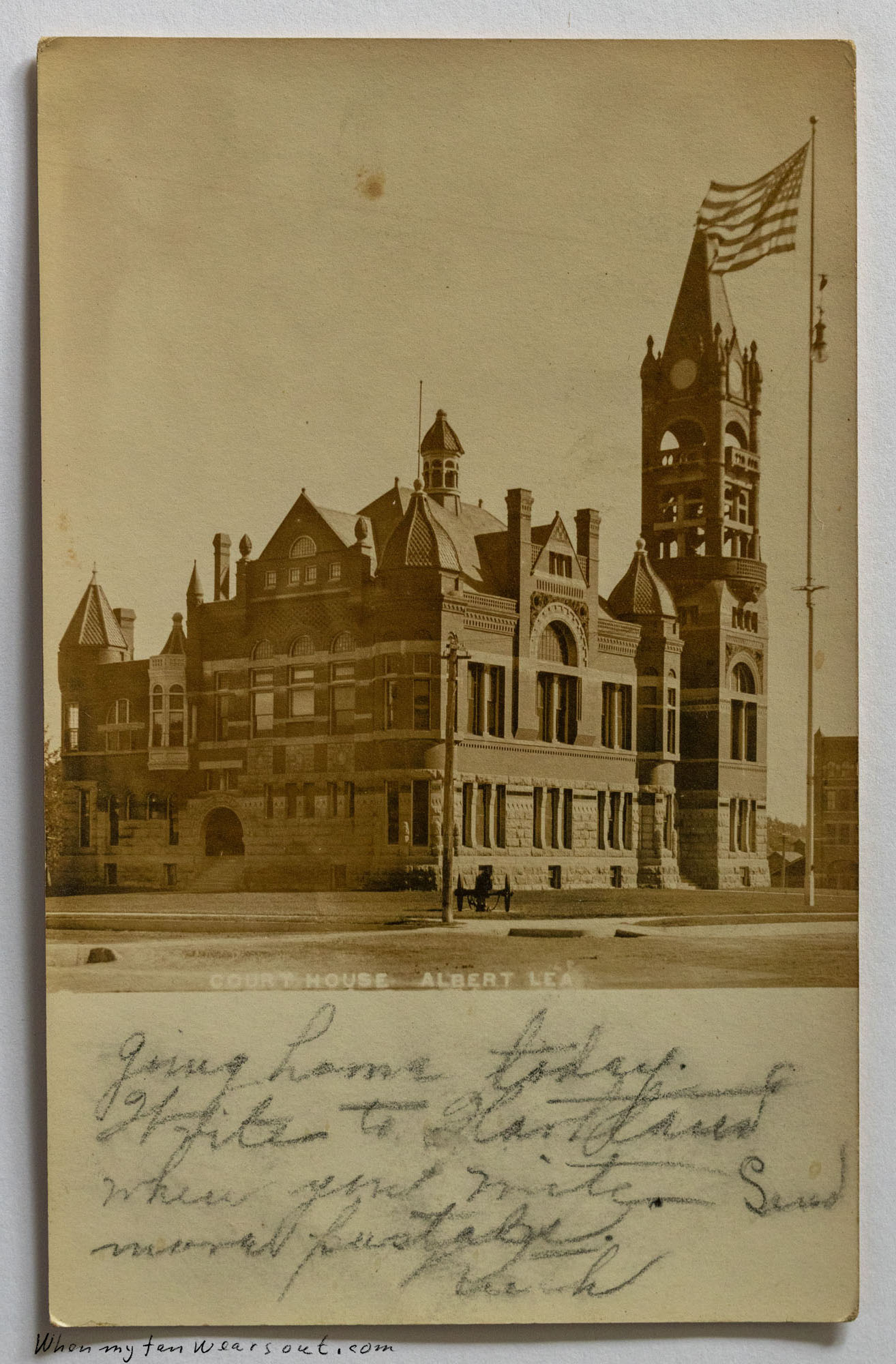
Postcard #0020: Albert Lea Courthouse and the Journey Home


Sepia-toned postcard depicting the grand Albert Lea Court House in Minnesota, a brick and stone building with a prominent clock tower, an American flag flying, and a small horse-drawn carriage on the street in front. Handwritten message is visible below the image.
Front — View of the Albert Lea Court House with a prominent clock tower and American flag.

Postcard Metadata


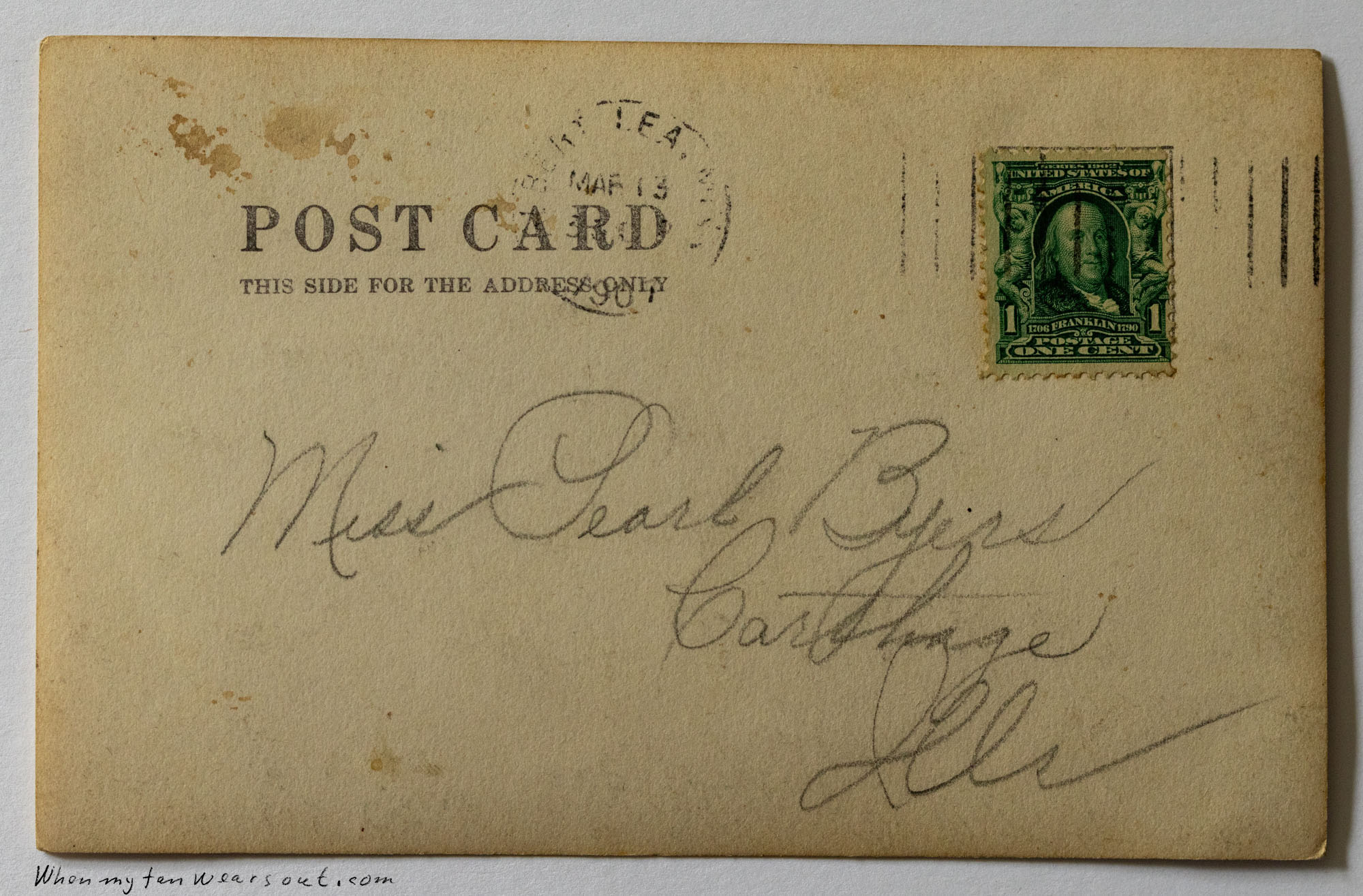
Sepia-toned back of a postcard with a 1-cent green Benjamin Franklin stamp, an
Back — Correspondence from Harvey Sights to Miss Pearl Byers

Transcription

Going home today. Expect to start from when you get my other postcard. Send me all puss.

Historical & Family Notes

This postcard captures a moment of anticipation as Harvey Sights prepares to return home, presumably to Pearl Byers. Sent from Albert Lea, Minnesota, the message “Going home today” signifies the conclusion of his travels or a temporary stay, and the impending reunion with Pearl. The reference to “my other postcard” suggests an ongoing correspondence, a common method of nurturing their relationship across the miles.

The affectionate closing, “Send me all puss,” underscores the tender and playful nature of their courtship. Such personal and informal expressions reveal a deeper intimacy than standard greetings, hinting at the bond that would eventually lead to their marriage and the start of their family. This card is a tangible piece of their unfolding love story, chronicling the small, daily communications that built their connection.

As a historical artifact, the postcard offers a glimpse into early 20th-century communication and travel. The image of the Albert Lea Court House serves as a backdrop to Harvey’s journey, while the simple yet heartfelt message conveys the human experience of longing and return. It’s a testament to the enduring power of written words to bridge distance and maintain personal connections in a time before instant digital communication.

Continue Reading

Postcard #0018: G.S. Buch’s Room Corner in Lea, Minnesota


Vintage sepia-toned photograph showing a cozy room interior featuring a wicker sofa with patterned cushions, a large wooden bookshelf filled with books, and walls extensively covered with various small framed photographs and decorative papers. A small, round, white decorative element is visible in the upper left corner of the room.
Front — A vintage sepia-toned photograph of a cozy room corner with a wicker couch, a large bookshelf, and many framed pictures adorning the walls.

Postcard Metadata


The reverse side of a vintage postcard featuring a green one-cent Benjamin Franklin stamp postmarked from Lea, Minnesota on August 7, 1909. The card has a divided back with handwritten cursive text from 'G. S. Buch' to 'Miss Pearl Byers, Carthage, Ills.', where the sender asks Pearl how she likes their room and requests any future letters to be addressed to Hartland.
Back — Correspondence from G. S. Buch to Miss Pearl Byers

Transcription

this is a corner in my room here, how do you like it? write soon to your G. S. Buch. ad. letter to Hartland

Historical & Family Notes

This postcard offers a charming glimpse into a personal space from over a century ago, a common way to share life and surroundings with distant friends or family before the advent of widespread personal photography and social media. The room, with its wicker couch, overflowing bookshelf, and walls covered in an array of small pictures, suggests a comfortable, well-inhabited corner.

While the sender, G. S. Buch, is not Pearl Byers’ future husband, Harvey Sights, this card is part of Pearl’s collection, indicating her broader circle of acquaintances and friendships. The sender’s direct question, “how do you like it?”, suggests a familiar and perhaps intimate relationship, inviting Pearl’s opinion on their private environment.

The instruction “ad. letter to Hartland” (likely an abbreviation for “address letter to Hartland”) provides a more specific location for G. S. Buch at the time. Hartland, Minnesota, like Lea (the postmark location, likely near Albert Lea), is situated in Freeborn County, suggesting the sender was either staying in or had recently moved to this nearby community when sending the card to Pearl in Carthage, Illinois.

Continue Reading