Front — A group of store employees or proprietors pose with a display case of umbrellas.
Postcard Metadata
Postmarked: Not Visible
Sent From: None
Sent To: None
Distance Traveled: None
Postage: Not visible (no stamp)
Card Details: Divided Back, Real Photo Postcard (RPPC) with “A Z O” stamp box (circa 1907-1920s).
Back — A list of names
Transcription
Fred Peasley Waldo Mason Miss Erbroidt Miss Osborn Tom Roberts Carrie Campbell Maude Biggs Mabel Roberto
Mason Dry Goods Store, La Harpe
Historical & Family Notes
This charming real photo postcard, likely dating to the early 20th century, captures a slice of small-town commerce, possibly the very store where Harvey Sights worked or visited. The image presents a bustling scene with employees, a counter, and umbrellas for sale, suggesting a dry goods or department store.
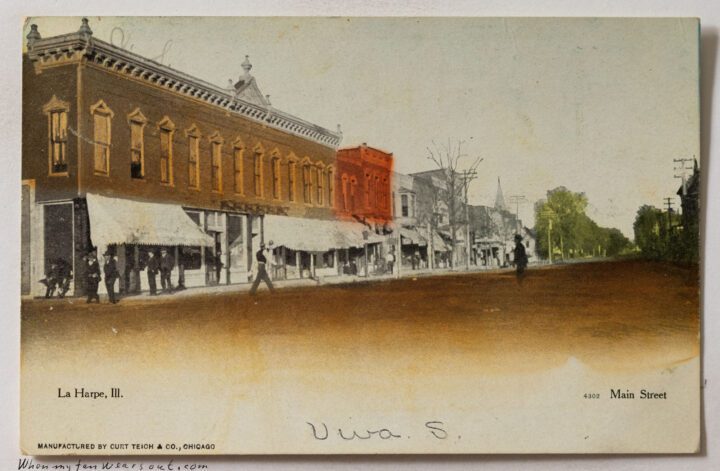
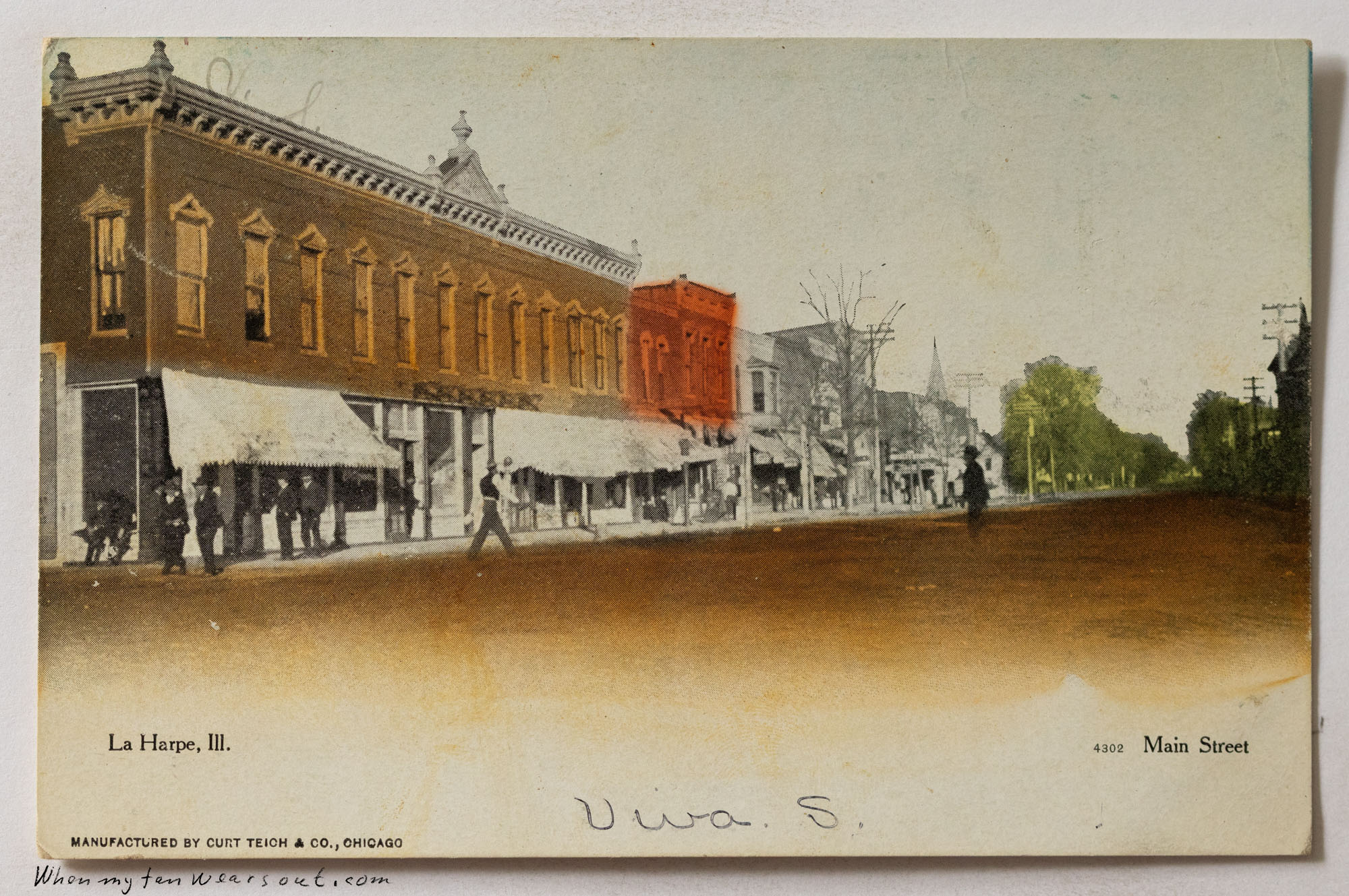
Front — A bustling view of Main Street in La Harpe, Illinois, featuring storefronts with awnings and a partially colorized brick building.
Postcard Metadata
Postmarked: Burnside, IL — June 20, 1907
Sent From: Burnside, Illinois
Sent To: Miss Pearle Byers, Carthage, Ill.
Distance Traveled: Approximately 11 miles
Postage: U.S. One Cent (Franklin)
Card Details: Undivided Back era (1901-1907), manufactured by Curt Teich & Co., Chicago
Back — Correspondence from Viwa S. to Miss Pearle Byers
Transcription
Viwa. S.
Historical & Family Notes
This early postcard, sent to the young Miss Pearle Byers, offers a quick glimpse into her social world during her formative years. The card features a common street scene of the era from nearby La Harpe, Illinois, a familiar type of imagery used for brief communications. The message, simply “Viwa. S.” on the front of the card, is characteristic of the concise messages exchanged on undivided back postcards where space for writing was limited.
Originating from Burnside, a mere 11 miles from Carthage, this card likely came from a local acquaintance or friend, Viwa S., whose brief greeting is preserved in this collection. These everyday interactions paint a picture of Pearl’s life before her marriage to Harvey Sights, highlighting the connections she maintained within her immediate community.
The postcard itself is an excellent example of the transitional period in postcard history. Though postmarked in June 1907, after divided backs were permitted, its layout with “NOTHING BUT THE ADDRESS ON THIS SIDE” firmly places it stylistically within the Undivided Back era, suggesting an older card still in circulation.
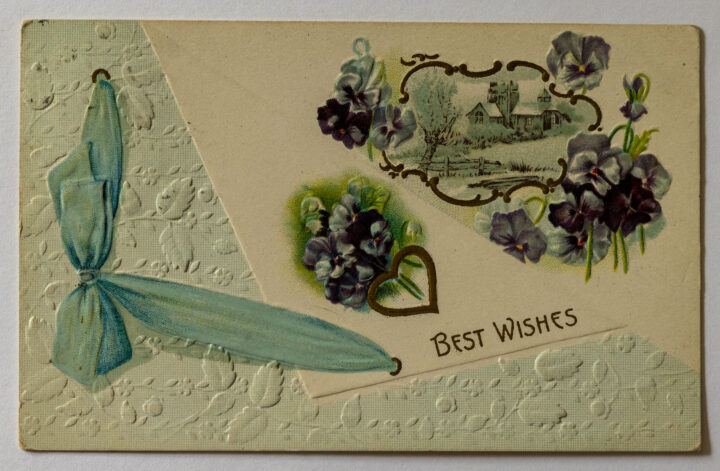
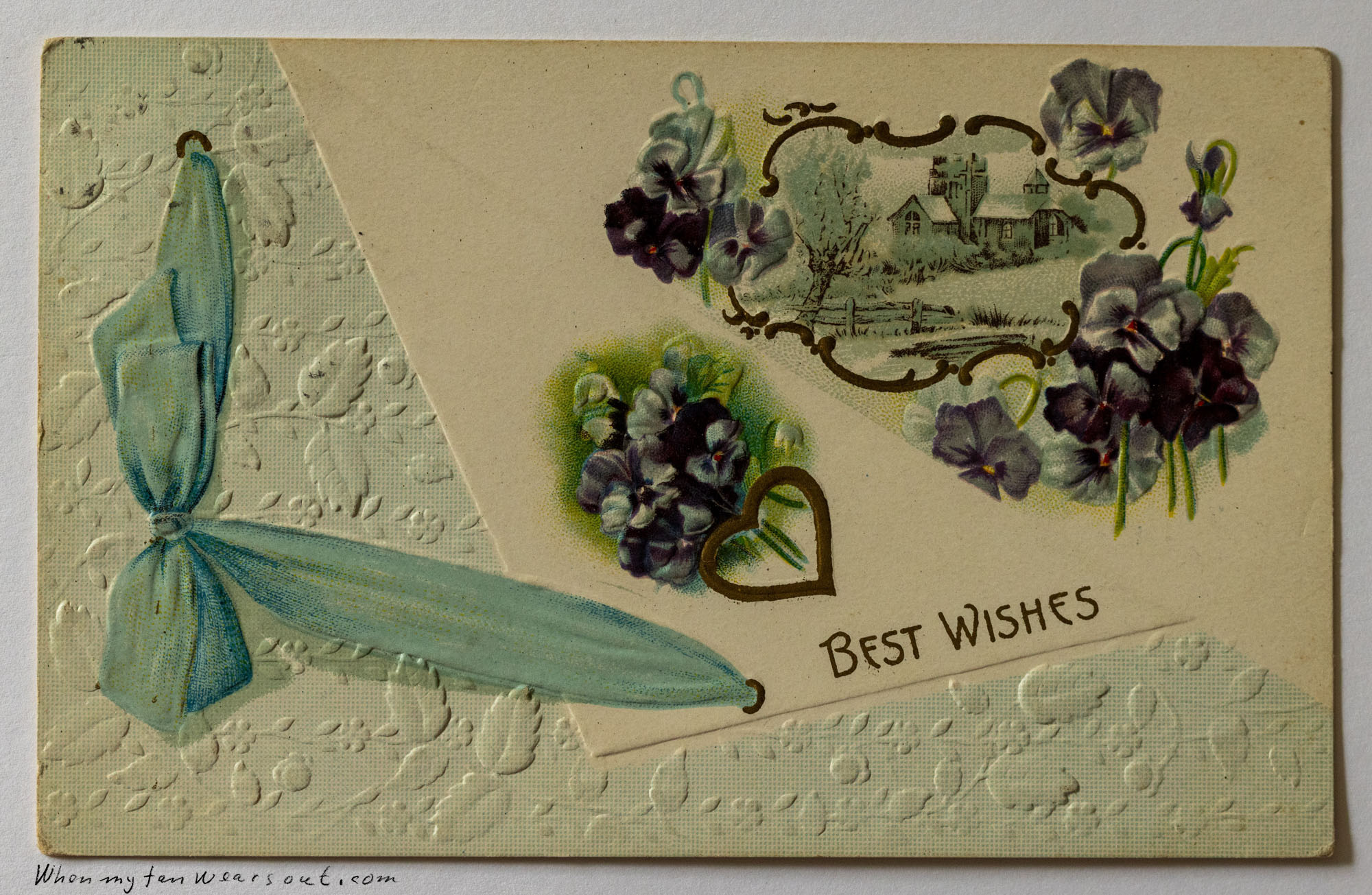
Front — A “Best Wishes” postcard featuring purple pansies, an embossed blue ribbon, and a framed rural farm scene.
Postcard Metadata
Postmarked: Carthage, Illinois — September 7, 1909
Sent From: Carthage, Illinois
Sent To: Mr. Harvey Sights, La Harpe Ill
Distance Traveled: Approximately 16 miles
Postage: U.S. Postage, One Cent (George Washington portrait)
Card Details: Divided Back postcard, popular from 1907 onwards, featuring embossed details.
Back — Correspondence from E.P.B. (Pearl Byers) to Harvey Sights
Transcription
Carthage Ill. Sept. 7-09. Rec’d card this morning as I came to work. Thanks “awfully.” It is dandy. E.P.B. Mr. Harvey Sights La Harpe Ill
Historical & Family Notes
This postcard offers a charming glimpse into the early courtship between Pearl Byers and Harvey Sights. Pearl, writing from Carthage, Illinois, expresses her thanks to Harvey for a card she received earlier that morning, playfully stating it was “dandy.” This exchange highlights their regular correspondence despite living a mere sixteen miles apart, indicating a blossoming romance through the daily ritual of postcard mail.
The sender’s initials “E.P.B.” are almost certainly Pearl Byers, aligning with the family’s identity rules and the ongoing narrative of their relationship. The card was sent on September 7, 1909, a significant period in their courtship before their eventual marriage and the birth of their daughter, Marnelle.
The message’s casual and affectionate tone—”Thanks ‘awfully'”—suggests a comfort and familiarity between Pearl and Harvey, showcasing a delightful snapshot of their everyday interactions and the simple pleasures of receiving mail from a loved one in the early 20th century.
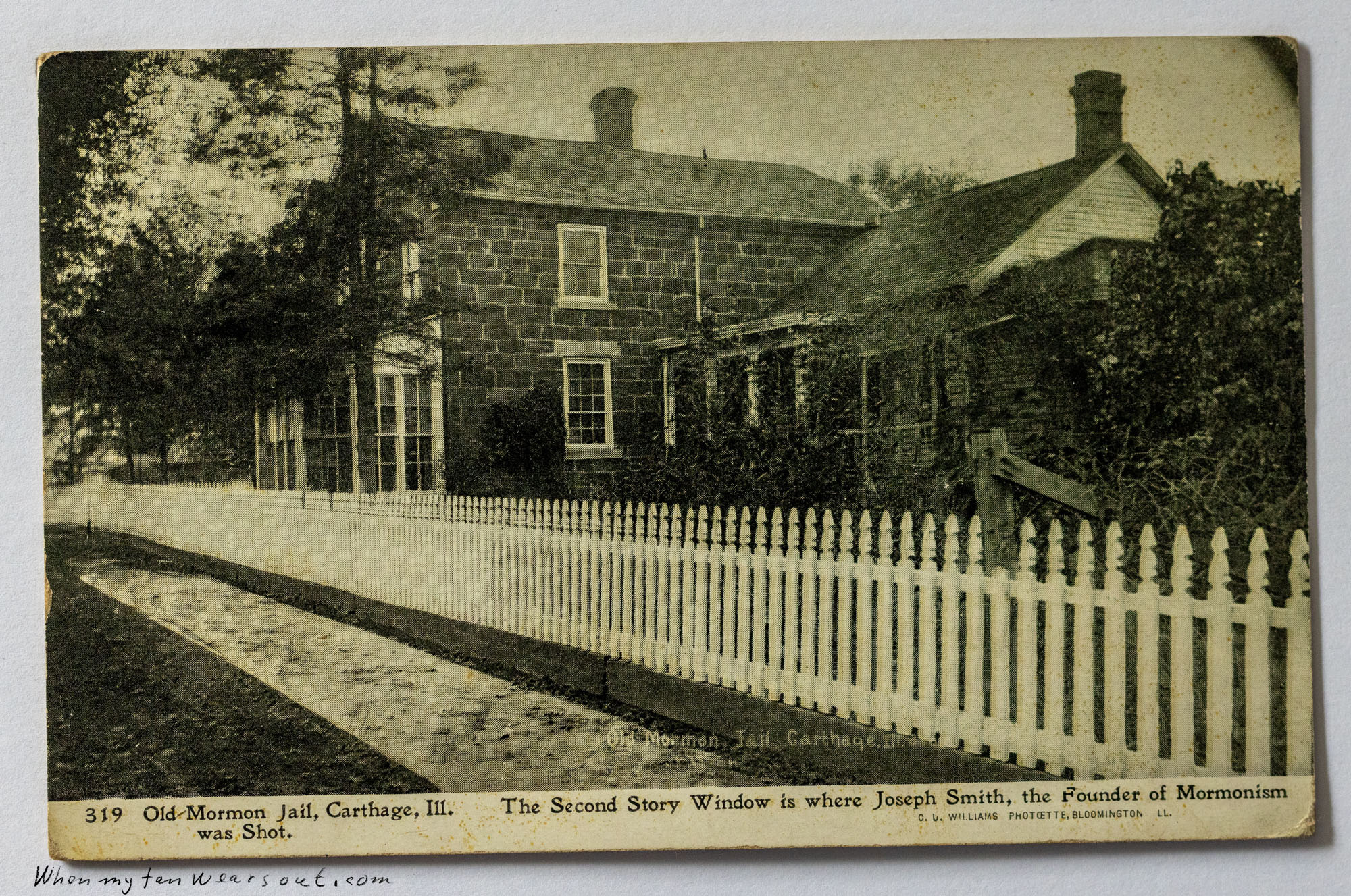
Front — A sepia-toned image of the Old Mormon Jail in Carthage, Illinois, with a white picket fence.
Postcard Metadata
Postmarked: Iowa City, Iowa — July 8, 1908, 9 PM
Sent From: Iowa City, Iowa
Sent To: Mr Harvey Sightes, La Harpe, Ill.
Distance Traveled: Approximately 95 miles
Postage: 1 Cent U.S. Postage (Benjamin Franklin)
Card Details: Divided Back era (1907-1915)
Back — Correspondence from an unknown sender to Mr Harvey Sights
Transcription
Vanmeter Hotel Be good to you. Hello dad!- (Once upon a time) How are you, I am fine, got here about 1 o’clock mon night, having fine time. You adds this some day to fun address my E. M. Collars General Delived Iowa City, Io
Historical & Family Notes
This postcard, postmarked in Iowa City in 1908, is addressed to Harvey Sights, who would later marry Pearl Byers. The message, though informal and from an unidentified sender, offers a glimpse into the casual communications of the era, reporting on travel and a “fine time” to a father figure. The sender provides a return address for “my E. M. Collars” at General Delivery in Iowa City, suggesting either a temporary stay or a traveling companion.
The front of the postcard features the historically significant Old Mormon Jail in Carthage, Illinois, where Joseph Smith, the founder of Mormonism, was killed. This landmark in Carthage holds particular relevance as it is the town where Pearl Byers resided and where she and Harvey Sights would eventually build their life together.
While not a direct communication between Pearl and Harvey, this postcard to Harvey connects to the broader geographical and historical context of their lives. It captures a moment in time when travel was an adventure, and postcards served as brief, tangible links between people across distances, even if just to share a historical site or a simple update on one’s well-being.
Front — A 1909 New Year greeting card featuring ornate numbers, pine branches, pine cones, and green shamrocks.
Postcard Metadata
Postmarked: Cairo, Illinois — December 30, 1908
Sent From: Cairo, Illinois
Sent To: Harvey Sights La Harpe Ills
Distance Traveled: Approximately 280 miles
Postage: 1 Cent United States of America, Benjamin Franklin stamp
Card Details: Divided Back Era (1907-1915), “Made in Germany”
Back — Correspondence from Aunt, Hattie, and Uncle Jo to Harvey Sights
Transcription
Happy new year to our dear Boy Harvey From Aunt Hattie and Uncle Jo Be good and that will bring you happiness Harvey Sights La Harpe Ills Made in Germany. Serie 75
Historical & Family Notes
This early New Year’s card provides a charming glimpse into Harvey Sights’ childhood, dating from December 1908, just before the turn of 1909. Addressed to “our dear Boy Harvey” from his Aunt, Hattie, and Uncle Jo, the message “Be good and that will bring you happiness” suggests he was still quite young, perhaps a pre-teen or early teenager, receiving guidance from his loving family members. This card predates his eventual courtship and marriage to Pearl Byers, offering a foundational look at his upbringing and family ties.
The postcard’s origin from “Made in Germany” highlights the significant role German printers played in the Golden Age of Postcards, known for their high-quality lithography and vibrant designs. Sent from Cairo, Illinois, in the southern tip of the state, to La Harpe in western Illinois, it demonstrates the widespread use of postcards for connecting families across distances, even relatively short ones, in the early 20th century.
This card is a valuable piece in understanding Harvey Sights’ family context before he embarked on his life with Pearl. It paints a picture of a well-loved young boy, receiving well wishes and gentle admonitions from his extended family, laying the groundwork for the man he would become.
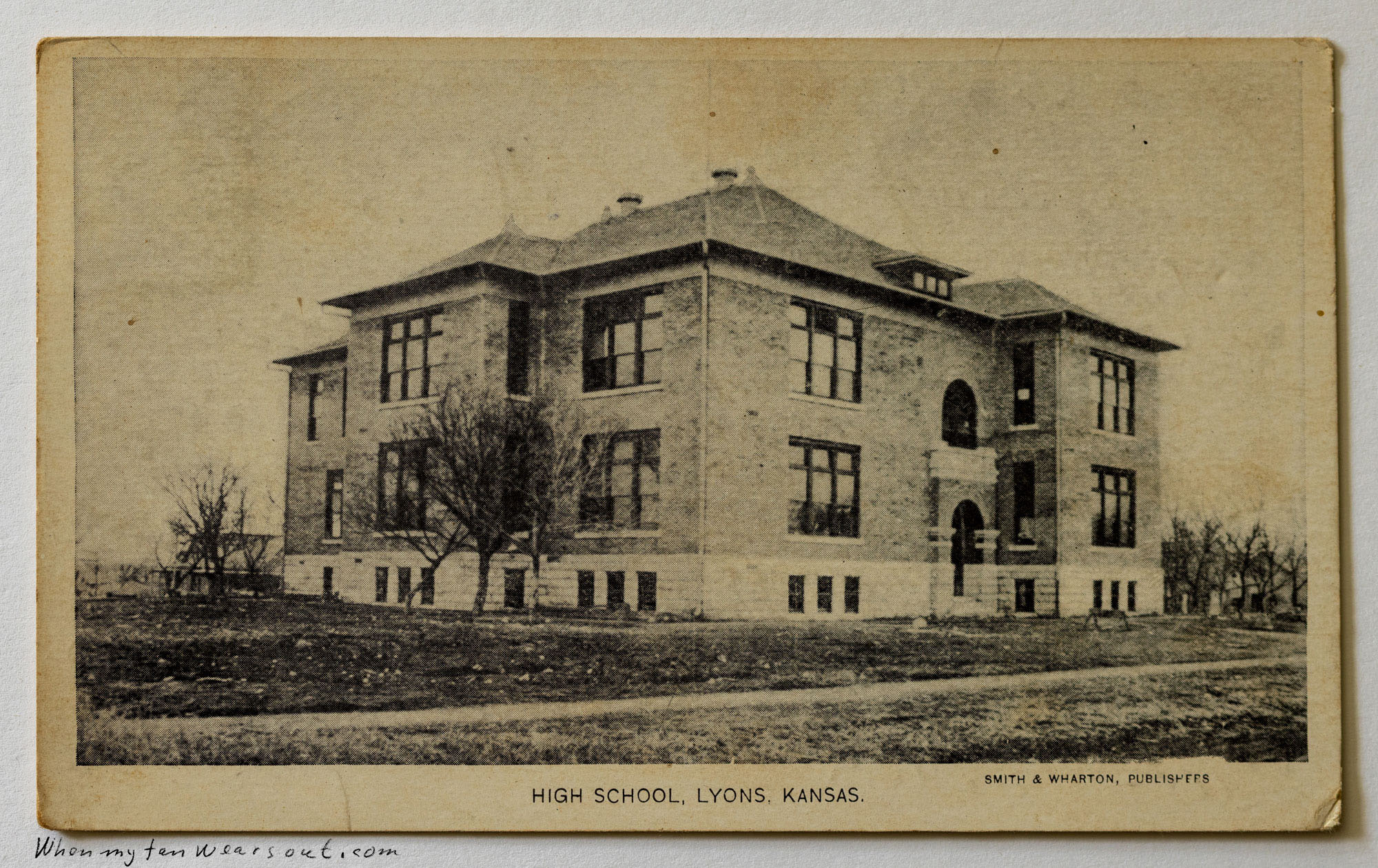
Front — A large brick high school building in Lyons, Kansas, with “SMITH & WHARTON, PUBLISHERS” noted.
Postcard Metadata
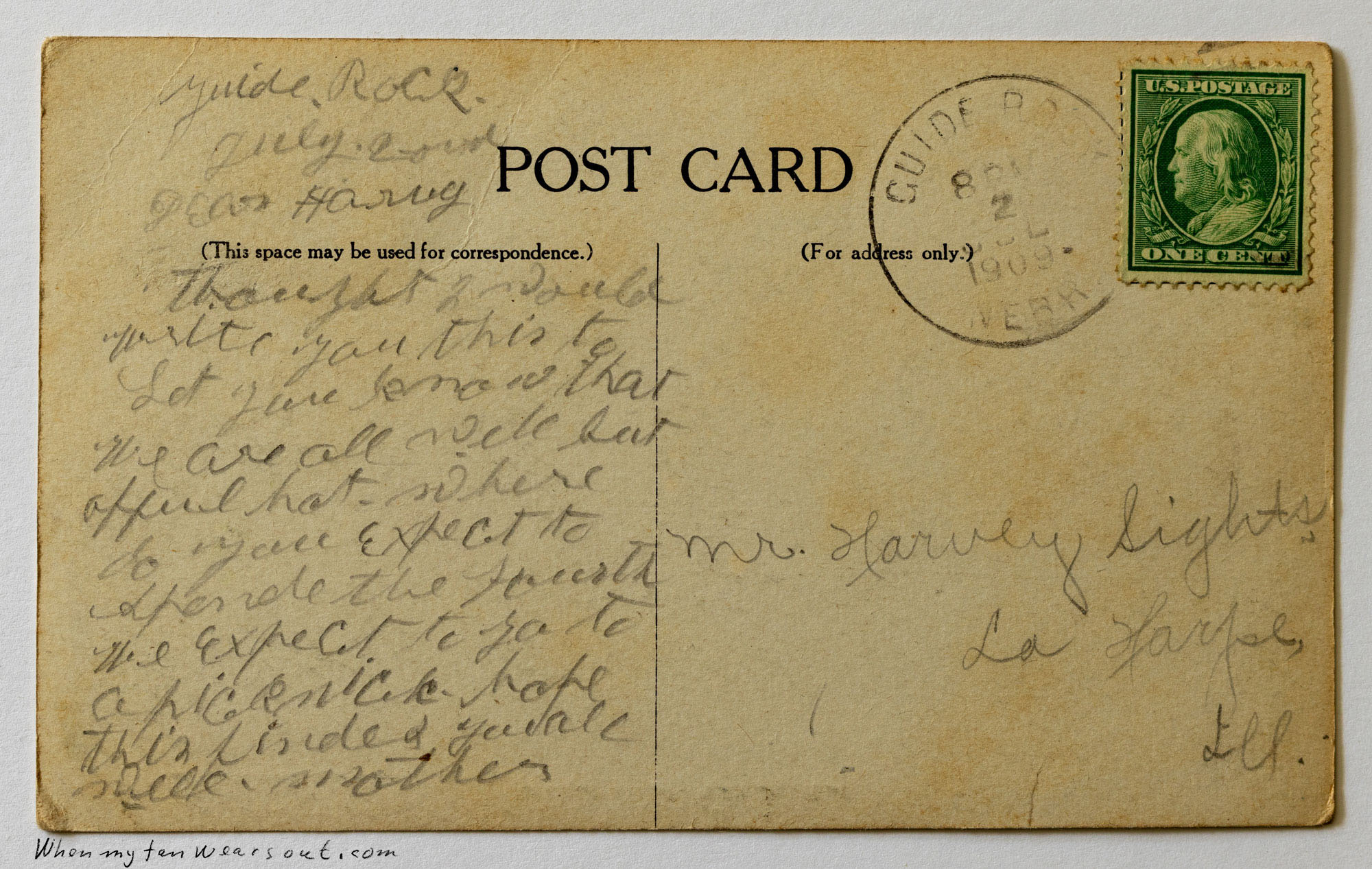
Postmarked: Guide Rock, Nebraska — July 2, 1909
Sent From: Guide Rock, Nebraska
Sent To: mr. Harvey Sights, La Harpe, Ill.
Distance Traveled: Approximately 320 miles
Postage: One Cent U.S. Postage (Green George Washington)
Card Details: Divided Back Era (1907-Present)
Back — Correspondence from Mother (Harvey Sights’ Mother) to Harvey Sights
Transcription
Guide Rock. July 2nd 1909 Dear Harvey Thought I would write you this to let you know that We are all well but awful hot where do you expect to spend the fourth We expect to go to a picnic hope this finds you all well. Mother
Historical & Family Notes
This postcard offers a personal glimpse into Harvey Sights’ life just a few years before he would meet and marry Pearl Byers. Sent by his mother from Guide Rock, Nebraska, to Harvey in La Harpe, Illinois, it paints a picture of everyday family correspondence, discussing the weather (“awful hot”) and Fourth of July plans. This card is significant as it establishes Harvey’s family background and geographical context, showing him as a young man still connected to his roots.
The message, brief and warm, highlights the simple pleasures and concerns of the time, such as summer heat and holiday picnics. While Pearl is not mentioned, understanding Harvey’s familial ties and his life prior to their relationship enriches the overall narrative of their eventual romance and the family they would build together. It’s a fragment of his world, hinting at the life experiences he brought into his future with Pearl.
The generic image of a high school in Lyons, Kansas, suggests this was a common type of postcard available across regions, used for personal messages regardless of the scene’s direct relevance to the sender or recipient’s location. This underscores the widespread use of postcards as a primary form of communication in the early 20th century, connecting families across growing distances.