Postcard #0091: THE METROPOLITAN, Wever, IA — R. H. / H. R. S to Pearl, June 1908

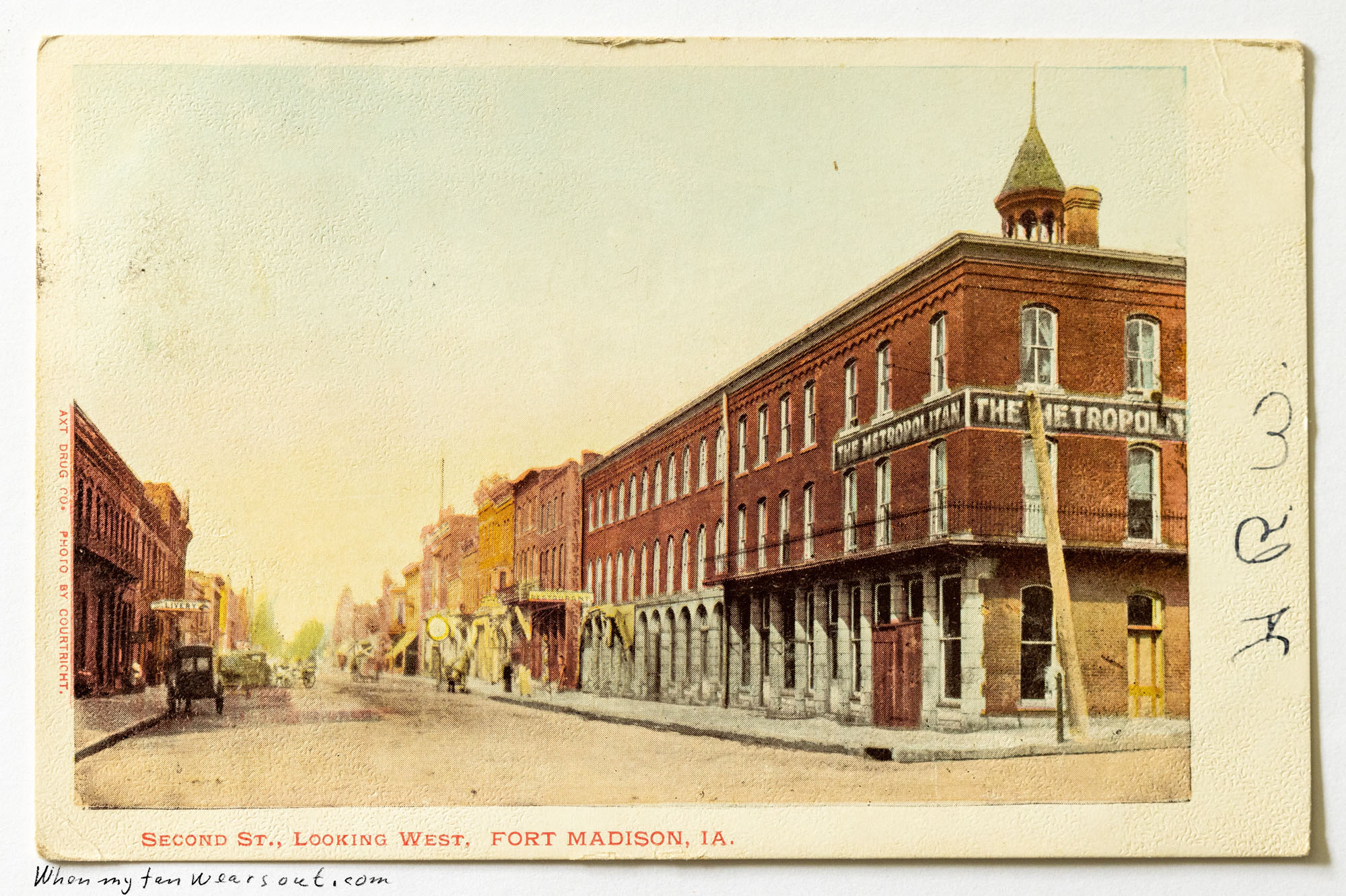
Front of postcard #0091: Color postcard depicting a street scene of Second Street looking west in Fort Madison, Iowa. On the right side of the st

Transcription

Front — ] H. R. S.

Back — ] R. H.

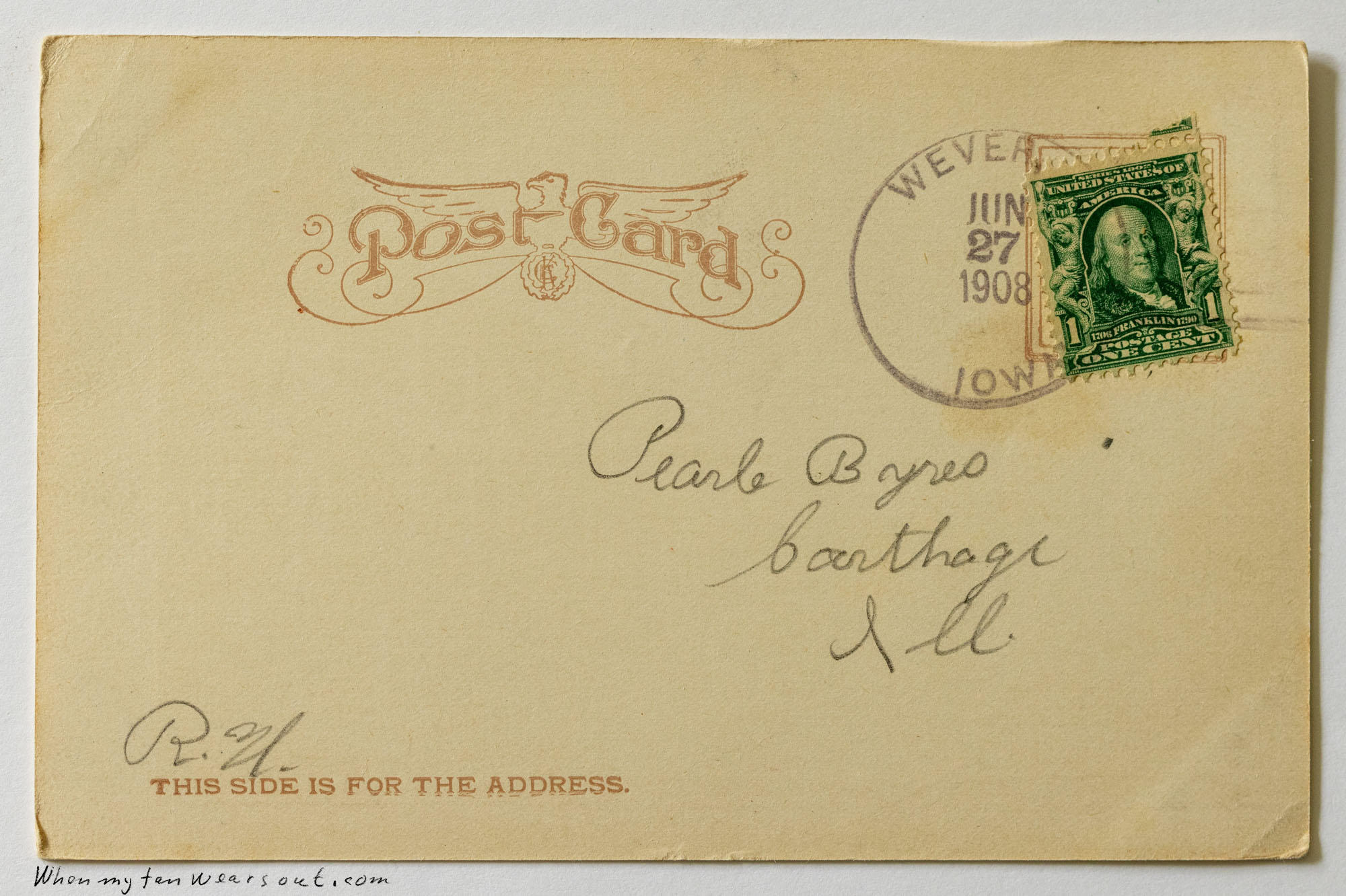
Back of postcard #0091

Postcard Information

  • Postmark: Wever, Iowa, JUN 27 1908
  • Sent To: Carthage IL
  • Era: Undivided Back (Pre-1907)
  • Publisher: Axt Drug Co., Fort Madison, Iowa
  • Stamp:
  • Distance Traveled: ~30 miles

About This Card

Second Street in Fort Madison, looking west past the brick storefronts, shows the commercial center of a city that was in the middle of its industrial prime. The postcard was sent from Wever, Iowa — a small community about twenty miles upriver — and signed “H.R.S.” on the front and “R.H.” on the back. The initials H.R.S. suggest Harvey R. Sights, and if so, this card — sent in June 1908, about two years before Harvey and Pearl’s wedding — is one of several in the collection that track Harvey’s movements around the Lee County area while working on the railroad.

Continue Reading

Postcard #1086: Old Methodist Church, Burlington, IA — Pearl to Pearl, July 1909

Front of postcard #1086: Hand-colored illustration of the Old Methodist Church in Carthage, Illinois. The building is a large orange-brick struct

Transcription

Back — Arrived all ok Roy missed me but we found the place all right Have had a fine time but am all in down & out. Hiram & [illegible] are going to stay here tonight. Saw H.U. D.M. & La Harpe operator was on the train & [illegible] [illegible] on the train & went [?] with me to Dallas Pearle

Back of postcard #1086

Postcard Information

  • Postmark: BURLINGTON, IOWA, JUL 6 1909
  • Sent To: Carthage IL
  • Era: Golden Age (1907–1915)
  • Publisher: Ed. Hoch, Carthage, Illinois
  • Print Origin: Printed in Germany
  • Stamp: 1¢ — Features a profile of Benjamin Franklin.
  • Distance Traveled: ~30 miles
  • Notes: Postmark includes "TRANS. CLK." (Transit Clerk). Mention of a "La Harpe operator" and a trip to "Dallas" (likely Dallas City, Illinois).

About This Card

The Old Methodist Church in Carthage — the earlier building replaced by the large brick structure shown in the linen-era card — represented the congregation’s first permanent home in the city. Carthage was settled in the 1830s and its Protestant congregations organized quickly; the Methodist and Presbyterian churches were among the first institutions the settlers established. Pearl sending this card from Burlington suggests she was traveling and found a card of her own neighborhood church at a store — or that someone mailed it to her while she was away.
Continue Reading

Postcard #1085: Methodist Church, Carthage, IL — Pearl to Pearl, March 1921

Front of postcard #1085: Linen postcard showing the Methodist Church in Carthage, Illinois. The church is a large masonry building with a promine

Transcription

Back — Am at Elva’s till Sat P.M. If you think I had better come home phone me after 7. Marnelle can. Got moms card last night. John D leaves for camp next week. No time for more now. Am sewing for Elva. Go back to Guys [?] Sat then home Sun. P.M. is plan now. Pearle.

Back of postcard #1085

Postcard Information

  • Postmark: Carthage, ILL., MAR 21 [year illegible]
  • Sent To: Chicago IL
  • Era: Linen (1930–1945)
  • Publisher: NICHOLS BOOK STORE, Carthage, Ill.
  • Stamp:
  • Distance Traveled: ~250 miles
  • Notes: Reference to "camp" likely refers to a military camp during WWII. Address includes a postal zone number (23).

About This Card

The Methodist Church in Carthage, Illinois — shown here in a linen-era postcard — was a large brick building with a prominent tower that anchored the residential neighborhood where Pearl lived at 318 N. Fayette Street. Pearl sent this card herself, which suggests she was either sending it to someone who’d asked about the church, or simply documenting the neighborhood she lived in for someone far away. The church building visible here dates from the late nineteenth century and remained the center of the Methodist congregation Pearl would have known throughout her years in Carthage.

Continue Reading

Postcard #0078: Pine Street looking south in Fort Madison, Wever, IA — Violet to Pearl, June 1908

Front of postcard #0078: Color illustration of Pine Street looking south in Fort Madison, Iowa, featuring a prominent brick building with a conic

Transcription

Front — ] mayme.

Back — ] "Better late than never" but I would have answered sooner if I’d had any cards. I haven’t as pretty a card to send as the one I rec’d from you, for that violet postal was certainly pretty. I liked it fine. Don’t you think all had a fairly good time yesterday afternoon, at least what we done kept us pretty busy. How is the Children’s Day exercises. I’ve got a job today I don’t like very well – helping Mamma pick up cherries. Ans. soon as ever. – Violet.
Back of postcard #0078

Postcard Information

  • Postmark: Wever, Iowa, JUN 8 1908
  • Sent To: Carthage IL
  • Era: Undivided Back (Pre-1907)
  • Publisher: Axt Drug Co., Fort Madison, Iowa
  • Stamp:
  • Distance Traveled: ~25 miles
  • Notes: Hand-drawn dividing line on back, message written on front margin

About This Card

Pine Street in Fort Madison, looking south from this vantage, shows the kind of small-city commercial vitality that characterized river towns along the upper Mississippi in the early twentieth century. Fort Madison had grown up around an early American fort — the original Fort Madison, the first U.S. military post in what would become Iowa, was destroyed and abandoned in 1813 after repeated Sauk attacks during the War of 1812. The town that took its name later that century had no direct connection to the military installation; it simply kept the name. Five years after Violet sent this card, Walter Sheaffer would open his pen factory nearby, and Pine Street’s commercial character would begin to shift.

Continue Reading

Postcard #0077: Lee County Court House, Fort Madison, IA — Caroline to Pearl, October 1920

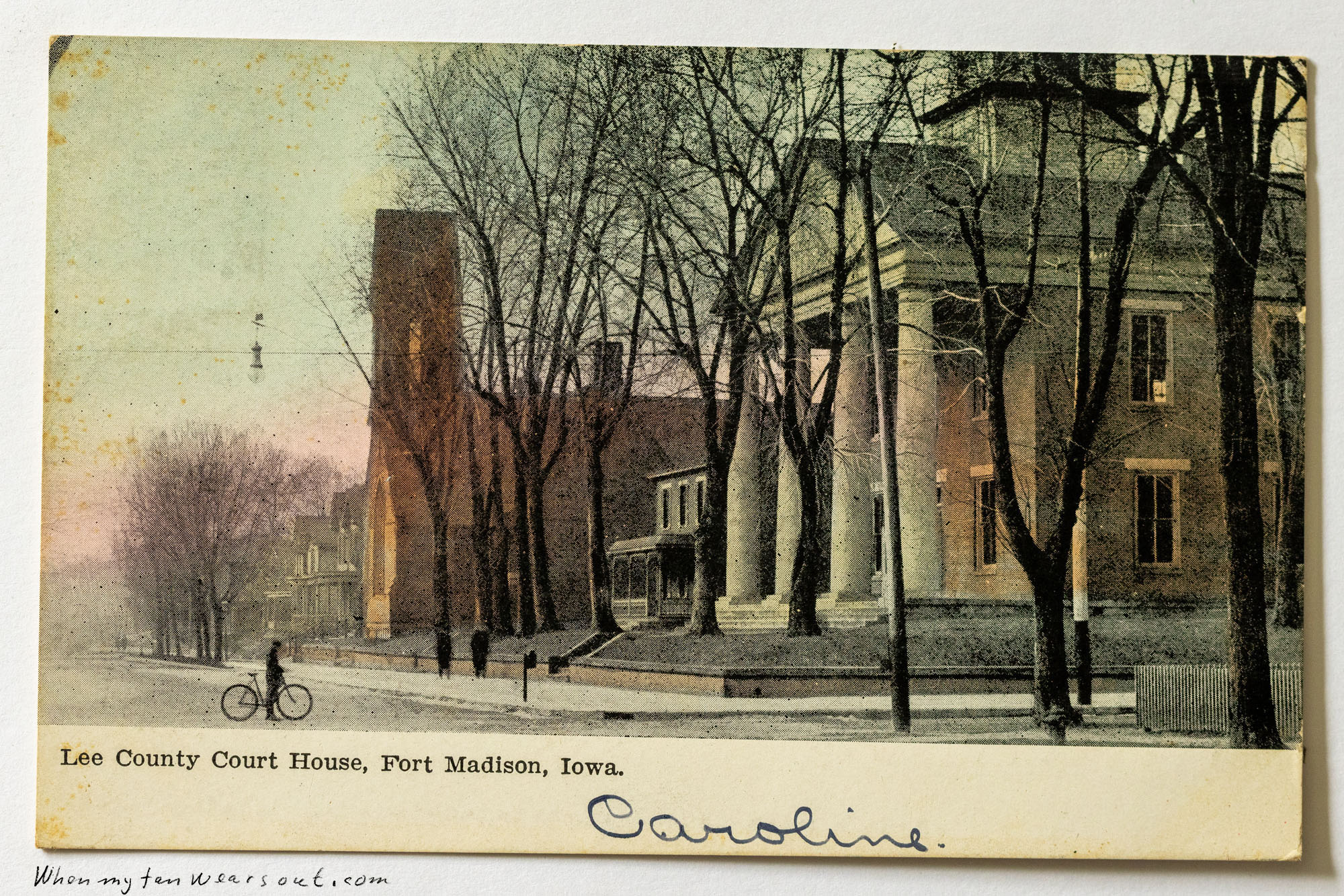
Front of postcard #0077: Colorized postcard depicting the Lee County Court House in Fort Madison, Iowa, featuring its prominent white columns. Ba

Transcription

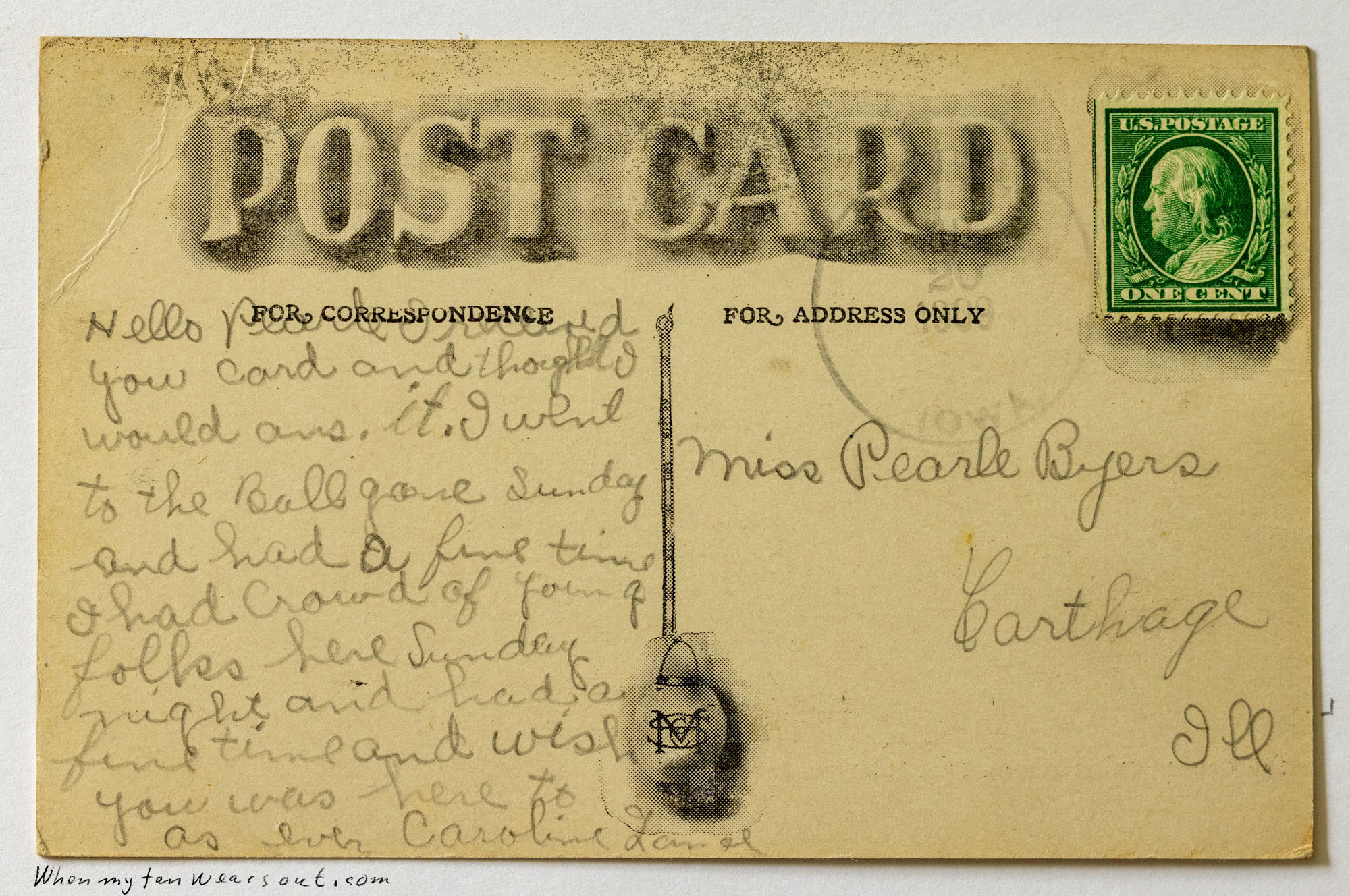
Back — Hello Pearl Received you card and thought I would ans. it. I went to the Ball game Sunday and had a fine time I had crowd of four of folkes here Sunday night and had a fine time and wish you was here to [?] as ever Caroline [illegible] ] Caroline.

Back of postcard #0077

Postcard Information

  • Postmark: Fort Madison, Iowa, OCT 20 [illegible]
  • Sent To: Carthage IL
  • Era: White Border (1915–1930)
  • Stamp:
  • Distance Traveled: ~25 miles

About This Card

The Lee County Courthouse in Fort Madison stands on a prominent corner downtown, its white columns visible for some distance along the approaches from the river. Fort Madison sits on a sharp bend of the Mississippi, and the view from the courthouse steps takes in a wide sweep of water. Caroline, writing from Fort Madison in autumn, doesn’t mention the courthouse — she’s writing about a ball game and promising to answer Pearl’s card. The building is background, not subject.

Continue Reading

Postcard #0062: Washington Park, Quincy — Allie to Pearl, August 1908

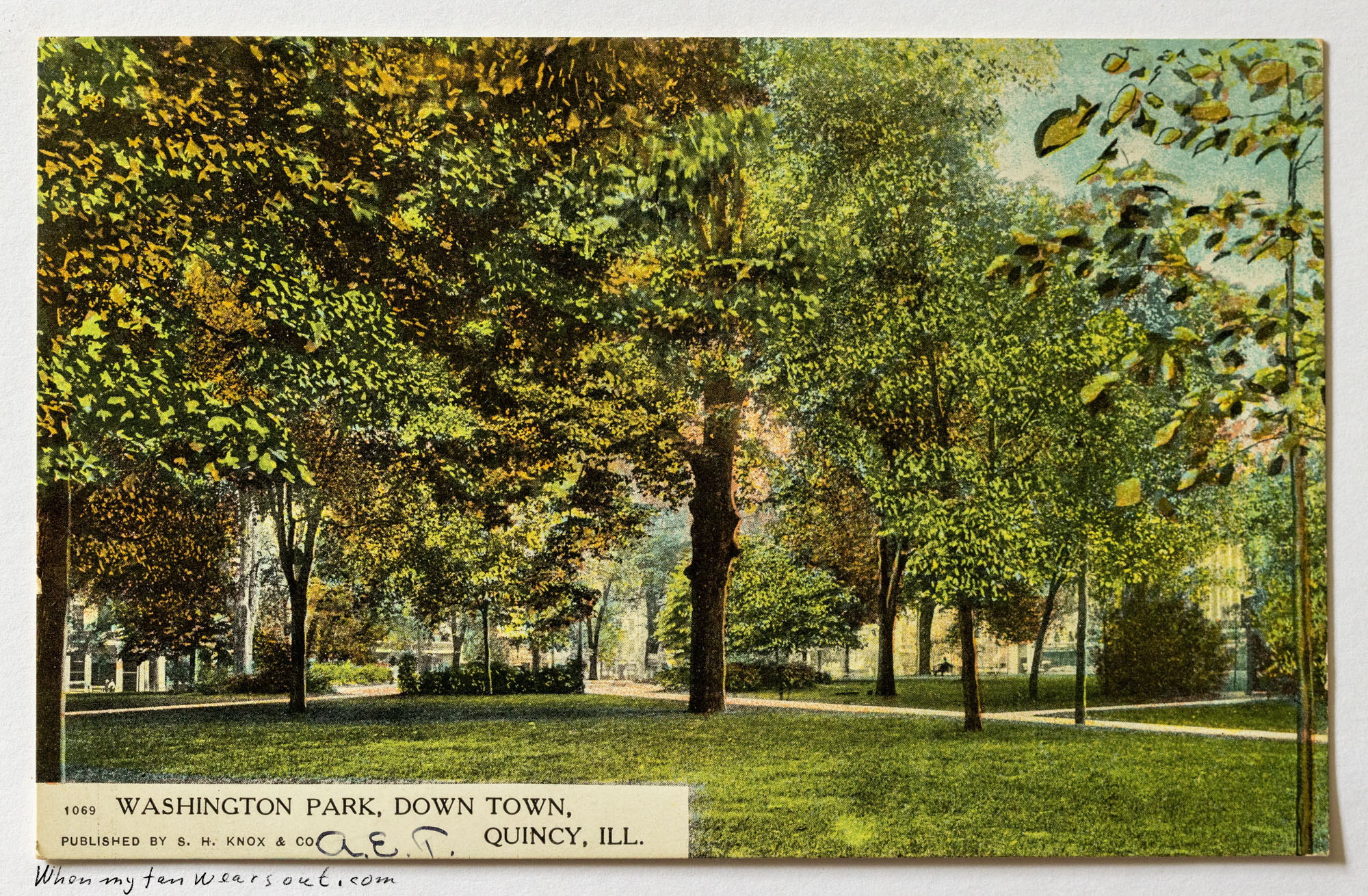
Front of postcard #0062: A colorized postcard depicting Washington Park in downtown Quincy, Illinois, featuring a spacious green lawn shaded by m

Transcription

Back — We were good girls and went to S. S. this morning. The girl student from India is in our class. We have only two blocks to go to church. Saw Roy Coleman. Haven’t seen Wade. Allie.

Back of postcard #0062

Postcard Information

  • Postmark: QUINCY, NOT VISIBLE, AUG 31 1908
  • Sent To: Carthage IL
  • Era: Golden Age (1907–1915)
  • Publisher: S. H. Knox & Co. / T. C. Co. (Curt Teich), Quincy, Illinois / Chicago, Illinois
  • Stamp:
  • Distance Traveled: ~35 miles

About This Card

Washington Park in downtown Quincy, Illinois is where the sixth Lincoln-Douglas debate was held on October 13, 1858. An estimated 12,000 people gathered to hear Abraham Lincoln and Senator Stephen Douglas argue over slavery and the future of the Union — the largest crowd of any of the seven debates. Illinois voters returned Douglas to the Senate that November, but Lincoln won the Republican nomination for president two years later. The park has marked the debate site ever since.

Continue Reading