Postcard #0058: Casual Greetings from Indian Mound Park, Quincy


A vintage, hand-tinted postcard showing a verdant landscape of Indian Mound Park in Quincy, Illinois, with rolling grassy hills, a prominent mound with steps, and scattered trees under a light sky, overlooking the distant Mississippi River.
Front — A hand-tinted postcard featuring a scenic view of Indian Mound Park in Quincy, Illinois, overlooking the Mississippi River.

Postcard Metadata


The back of a 1908 divided-back postcard with a green one-cent U.S. Franklin stamp, featuring a handwritten message in dark blue ink from
Back — Correspondence from Elva to Miss Pearl Byers

Transcription

Hello kids! Got here p.m. sound. Have a dandy room. Will have to write before long. Elva 438 N. 8th st.

Historical & Family Notes

This postcard offers a glimpse into Pearl Byers’ social circle before her eventual marriage to Harvey Sights. The sender, Elva, is likely a friend or relative, providing a quick update from Quincy, Illinois. The casual tone and simple message, “Hello kids! Got here p.m. sound. Have a dandy room,” reflect the common use of postcards for brief, informal communication in the early 20th century, a time when such exchanges were cherished links between distant friends and family.

The card’s front depicts Indian Mound Park in Quincy, a notable local landmark with its historic earthworks and scenic views of the Mississippi River. Such picturesque views were popular subjects for postcards, allowing senders to share a bit of their travels or local attractions with recipients back home. Even a relatively short trip to a nearby town like Quincy would have been an occasion worth noting and sharing with friends like Pearl in Carthage.

While Harvey Sights isn’t directly mentioned in this particular correspondence, this postcard beautifully illustrates the rich tapestry of relationships Pearl maintained. These frequent, small exchanges kept her connected to a broad community of friends and family, forming the supportive network that would surround her as she eventually married Harvey and started her own family, enriching the Sights’ family legacy.

Continue Reading

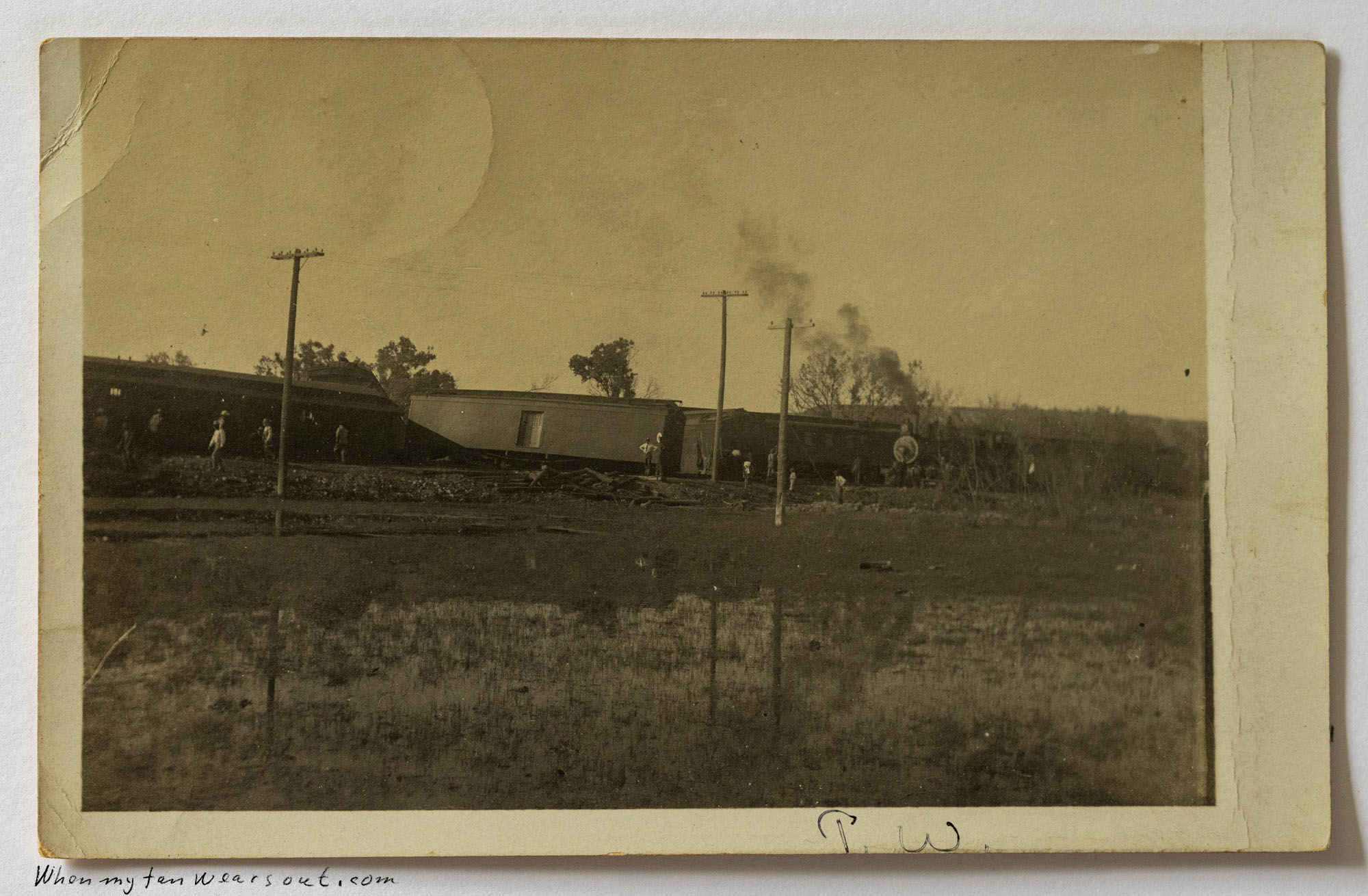
Postcard #0022: Train Wreck in the North End of the Yard


Sepia-toned photograph of a train derailment showing several passenger cars or freight cars overturned or off the tracks, with utility poles stretching across the horizon, a few people inspecting the damage, and a flooded or muddy field in the foreground, with the faint initials
Front — A sepia-toned photograph depicts a train derailment with multiple cars off the tracks and leaning, surrounded by people, utility poles, and muddy ground.

Postcard Metadata


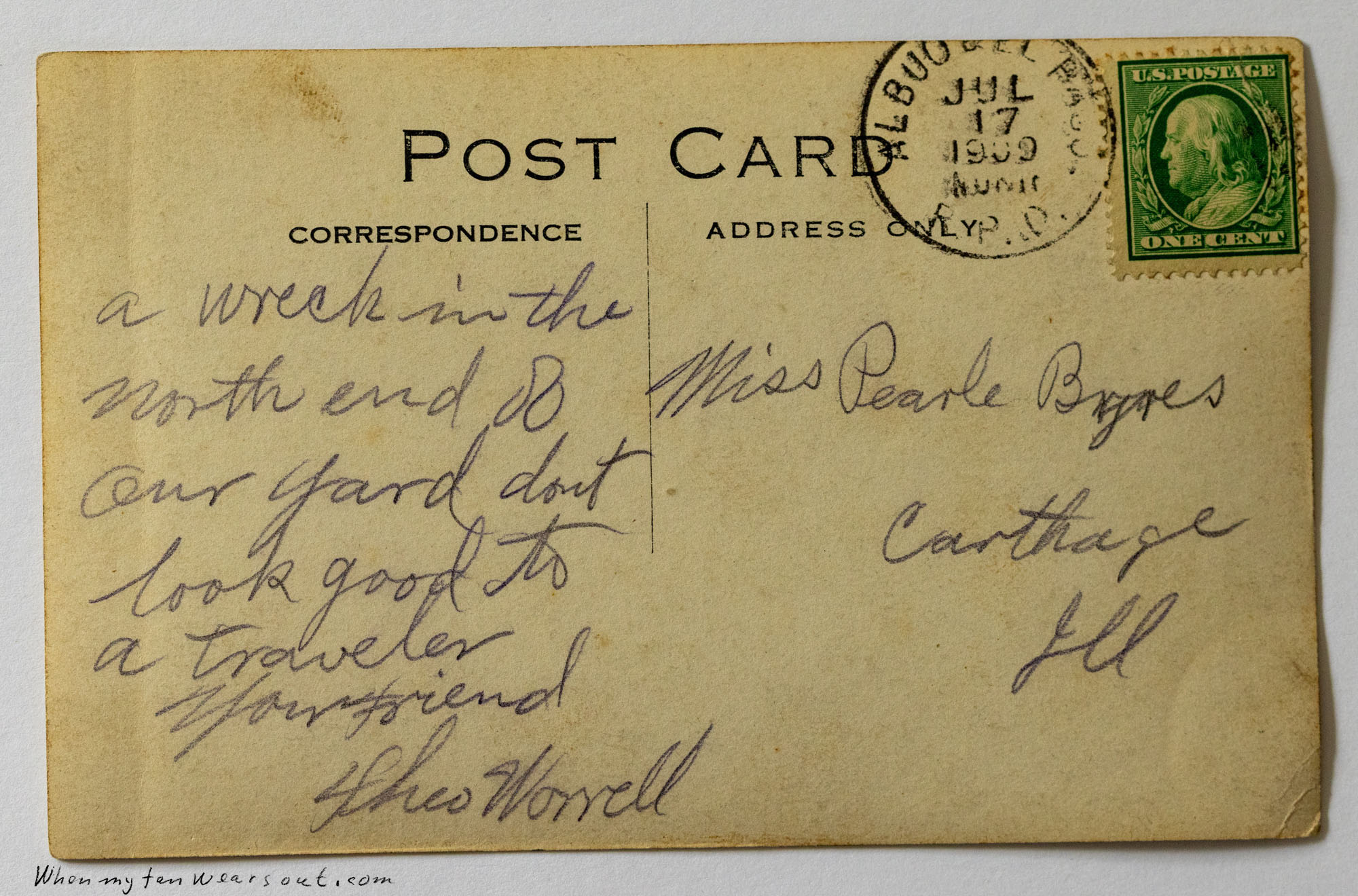
The back of a vintage postcard with a one-cent George Washington U.S. postage stamp postmarked
Back — Correspondence from Theo Worrell to Miss Pearle Byres

Transcription

a wreck in the north end of our yard dont look good to a traveler Your friend Theo Worrell

Historical & Family Notes

This postcard, sent from Quincy, Illinois, by “Theo Worrell” to “Miss Pearle Byres,” offers a stark glimpse into a dramatic, yet seemingly commonplace, event of the era: a train wreck. The sender’s casual observation, “a wreck in the north end of our yard dont look good to a traveler,” suggests that such incidents, while severe, were perhaps not entirely uncommon or were at least a significant local talking point in 1909.

While this specific message doesn’t directly involve Pearl’s future husband, Harvey Sights, it illustrates the network of friends and acquaintances Pearl maintained before their marriage. Postcards served as an essential medium for sharing news and observations across nearby towns, providing immediate, albeit brief, updates on daily life and local happenings.

Carthage, Illinois, where Pearl resided (at 318 N. Fayette Street), is located southeast of Quincy. This card provides a small window into the kind of everyday communication that filled the lives of young people like Pearl and her friends, connecting their worlds through brief written exchanges often accompanied by photographs of local interest.

Continue Reading

Postcard #016: Birthday Greetings to Pearl from Quincy on Her Special Day


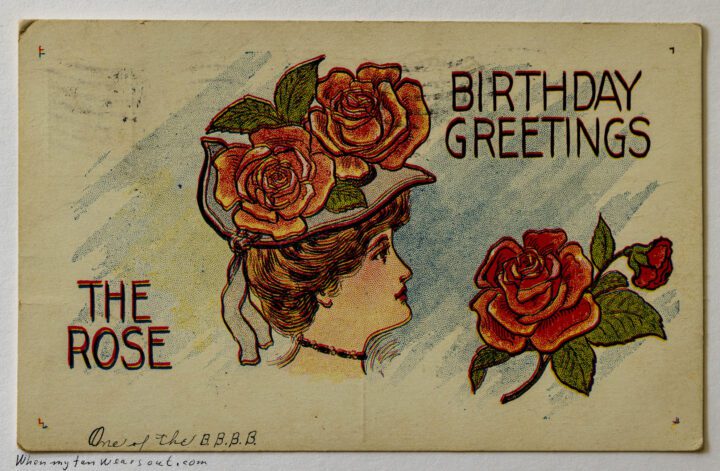
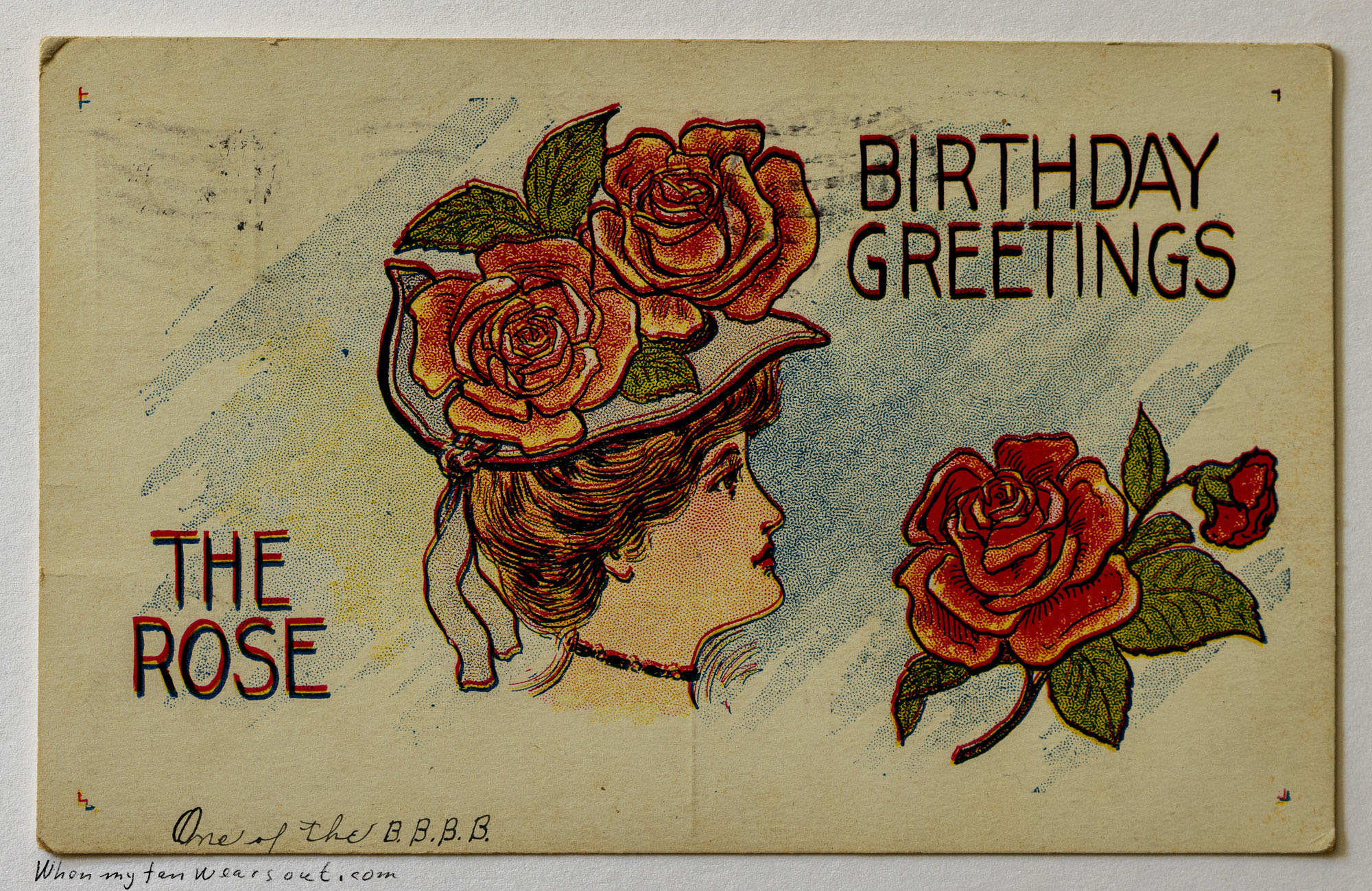
Vintage colorized postcard from 1907, featuring an illustration of a woman in profile wearing a large hat adorned with red and pink roses and green leaves. To the left, the text
Front — A colorized illustration of a woman in a floral hat featuring roses, with additional roses and the text “THE ROSE” and “BIRTHDAY GREETINGS.”

Postcard Metadata


The handwritten reverse side of a 1907 postcard with a one-cent Benjamin Franklin stamp postmarked
Back — Correspondence from Harvey Sights to Miss Pearl Byers

Transcription

Dec. 4 / 07 Dear Friend:- I suppose you know who this is from don’t you? Hope you have a happy birthday. As Ever. address H. L. Burling Gem City Business College. Quincy, Ill.

Historical & Family Notes

This charming birthday postcard marks Pearl Byers’ special day, December 4th, 1907, with a playful message from her future husband, Harvey Sights. Though he doesn’t explicitly sign his name, the teasing query, “I suppose you know who this is from don’t you?” is a clear indicator of a budding romance and familiarity. The sender provides the address for “H. L. Burling” at the Gem City Business College in Quincy, Illinois, likely where Harvey was studying or residing, using it as a return address for discretion in their early courtship.

The card itself features “The Rose,” a classic symbol of affection and beauty, perfectly chosen for a birthday greeting to a young woman. The postmark confirms it was sent from Quincy on Pearl’s actual birthday, suggesting a thoughtful and timely gesture. This card offers a sweet glimpse into the early stages of their relationship, highlighting the gentle humor and personal connection that would eventually lead to their marriage.

The reference to “H.L. Burling” at Gem City Business College offers a unique historical tidbit. Many young people, including those from rural areas, attended business colleges in larger towns like Quincy to acquire skills for office work. It’s plausible that Harvey was a student there, making this postcard a testament to both his personal affections and his efforts towards building a future.

Continue Reading

Postcard #011: Get Busy, I Am Waiting For That Letter


A yellow
Front — A yellow “Telegraph Post-Card” with a graphic of a running messenger and a brief handwritten message.

Postcard Metadata


The back of a 1907 yellow postcard with a one-cent Benjamin Franklin stamp postmarked Quincy, Illinois, addressed to Miss Pearle Byers in Carthage, Illinois, with a handwritten message from Angus B.
Back — Correspondence from Angus B. to Miss Pearle Byers

Transcription

Nº31 Time Sent ____ Oct 27 1907 I am waiting for that letter get Busy M. S. POST CARD Write Message Here Say Pearle I was cer-tainly glad to hear from you. I shot the earth had swallowed you. You certainly sent me a dandy postal. Such I have never seen be-fore. Am well at present hope you are the same. Are hav-ing fine weather. Now Ans-wer soon. The same Old Chump Angus B.

Historical & Family Notes

This early postcard to Pearle Byers features an intriguing dual message. The front, formatted as a “Telegraph Post-Card,” bears a brief, direct note signed “M. S.” with the seemingly urgent instruction, “I am waiting for that letter get Busy.” The date “Oct 27 1907” is handwritten on the front, creating a slight anomaly as the card was postmarked from Quincy, Illinois, on October 26, 1907. This could indicate the handwritten date was a future reminder, or simply a discrepancy in dating.

The reverse side carries a longer, friendly message from “Angus B.,” clearly responding to a previous communication from Pearle: “I was cer-tainly glad to hear from you. I shot the earth had swallowed you. You certainly sent me a dandy postal.” The two distinct messages and signatures on one card suggest it might have been a collaborative effort, or that Angus included a note from a companion. Given that Harvey Sights is a primary character in Pearle’s life story, it is plausible that “M. S.” could be an initialed message from Harvey, possibly M. for a middle name or a playful alias, lending an early glimpse into their developing dynamic.

Angus’s sign-off as “The same Old Chump” adds a touch of affectionate familiarity, suggesting a close relationship, perhaps a cousin or family friend. The card’s early date places it firmly in the courtship period for Pearle, with various individuals sending her notes. The short, demanding “get Busy” from “M. S.” contrasts with Angus’s more jovial tone, hinting at the different relationships Pearle maintained.

Continue Reading

Postcard #009: Merry Christmas Lilies and a Skating P.M.


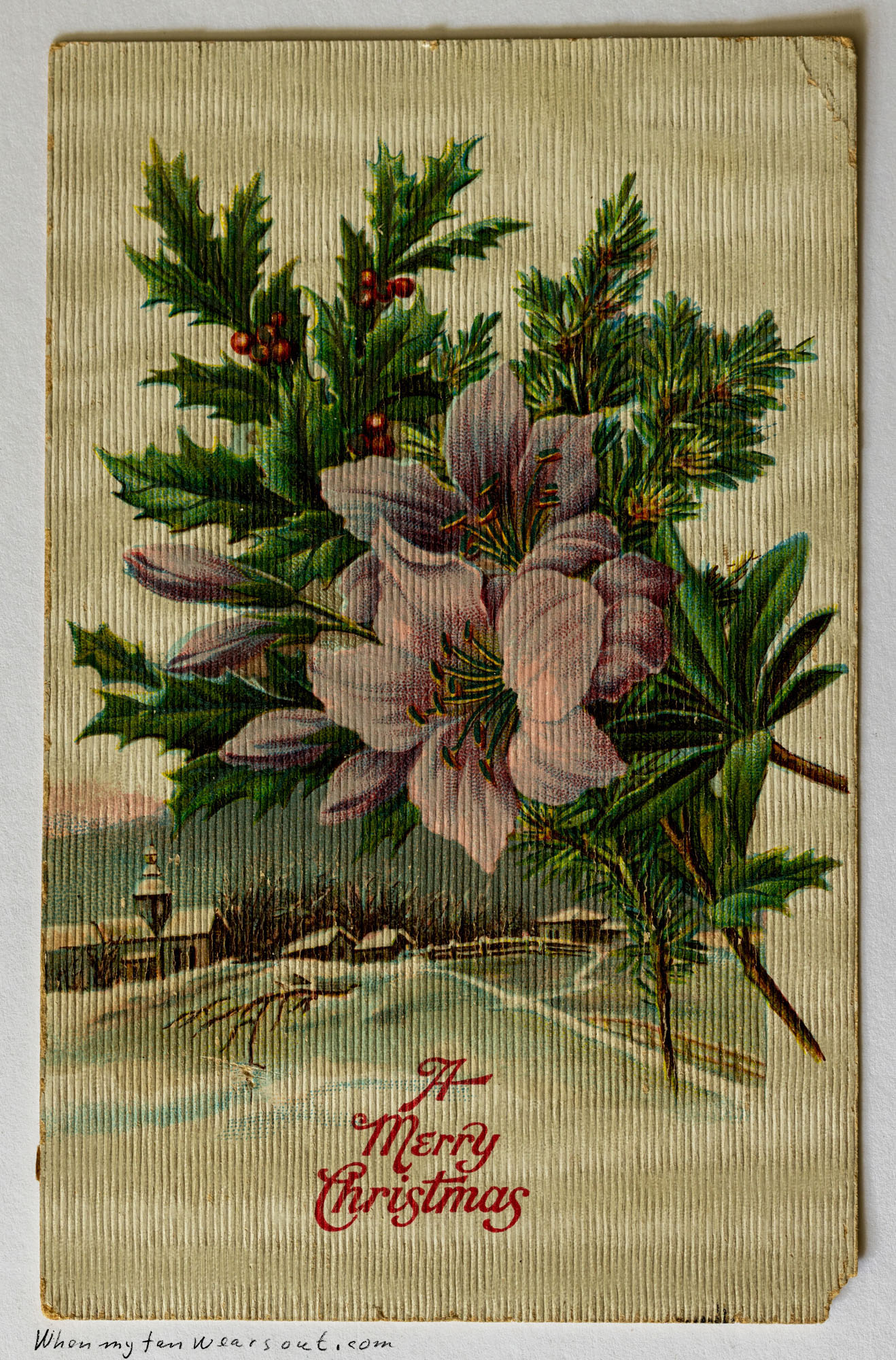
A vintage Merry Christmas postcard featuring a vibrant central arrangement of pink lilies with prominent green stamens, surrounded by dark green holly leaves with red berries, and deep green pine needles. In the soft, blurred background, a winter landscape with a bare tree and distant snow-covered buildings is visible. The words
Front — An illustration of pink lilies, holly, and pine branches, with “Merry Christmas” script, superimposed on a faint winter landscape.

Postcard Metadata


The back of a vintage postcard with a postmark from Quincy, Illinois, dated December 20, 1908. A green one-cent Benjamin Franklin U.S. postage stamp is affixed in the upper right corner. The left half contains a handwritten cursive message in purple ink from
Back — Correspondence from Harvey Sights to Pearle Byers

Transcription

Dec. 20. 08 We were all down to illard Fri. night We were about 30 there. Hello Sis. Wish I had a fine time. Merry Christmas and Happy New Year! How are you? Why in the world dont you write. This was received today. I was skating this P.M. Verna said you never answered her card and so did Bertha. No news around here. There is a Xmas tree in room. How come. And soon. Your true friend Harvey

Historical & Family Notes

This festive Christmas postcard from December 1908 catches Harvey Sights playfully chiding Pearl Byers for her lack of correspondence. His query, “Why in the world don’t you write,” hints at a burgeoning flirtation and the desire for more frequent communication during their early courtship phase. He shares snippets of his life, mentioning a social gathering and an afternoon of skating, painting a picture of typical Midwestern winter activities.

The reference to Verna and Bertha, likely mutual friends or relatives, suggests a shared social circle and adds a layer of community to their interactions, further binding Pearl and Harvey together within their small-town world. The mention of a “Xmas tree in room” and “How come. And soon.” leaves a hint of anticipation, perhaps for a future meeting or further holiday tidings.

This card captures a tender moment in their relationship, framed by the holiday season and the charming impatience of a suitor eager for a response. It’s a sweet, authentic glimpse into the early stages of the connection that would eventually lead to their marriage and the birth of their daughter, Marnelle.

Continue Reading

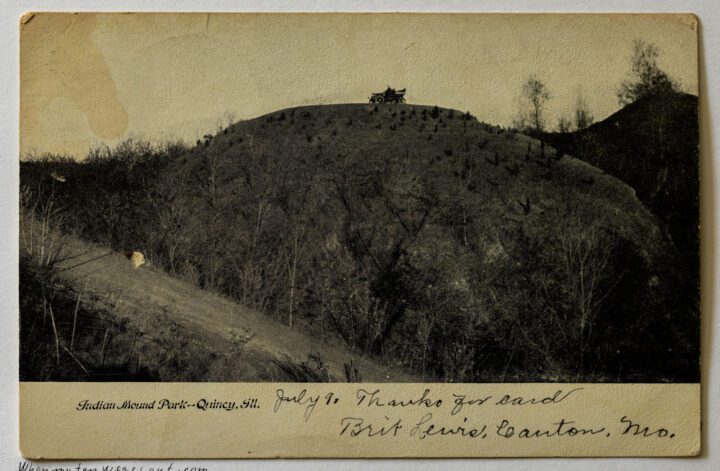
Postcard #001: Thanks from Indian Mound Park, Quincy


Sepia-toned postcard depicting Indian Mound Park in Quincy, Illinois, with an early 20th-century automobile parked on the summit of a tree-covered mound, overlooking a forested landscape.
Front — A sepia-toned image shows a dirt road winding up a large, tree-covered Indian Mound with an early automobile parked on top.

Postcard Metadata


Handwritten postcard back with a personal message dated July 19 from Brit Lewis in Canton, Missouri, to Miss Pearl Byers in Carthage, Illinois, postmarked Carthage, IL, July 19, 1916, with a one-cent Benjamin Franklin stamp.
Back — Correspondence from Brit Lewis to Miss Pearl Byers

Transcription

Indian Mound Park – Quincy, Ill. July 19. Thanks for card. Brit Lewis, Canton, Mo.

Historical & Family Notes

This early postcard sent to Pearl Byers by Brit Lewis captures a glimpse into her life before she met Harvey Sights. While the sender is not Harvey, the card establishes Pearl’s residence in Carthage, Illinois, a setting that would be central to her early adult life. The image of Indian Mound Park in Quincy, a nearby city, illustrates a regional landmark and popular destination, hinting at the shared experiences and local scenery common to young people in the Midwest at the time.

The casual nature of the message, “Thanks for card,” suggests an ongoing correspondence, painting a picture of Pearl’s social circle and the common practice of exchanging postcards to stay in touch. This card, dated July 19, 1916, precedes Pearl’s eventual marriage to Harvey Sights, offering a historical marker of her life during a period of significant social and technological change, reflected in the early automobile atop the mound.

Although a simple note, the postcard adds to the fabric of Pearl’s story, documenting her connections and the daily exchanges that shaped her world before the central chapter of her life with Harvey began. It grounds her in her community and time, showcasing the widespread use of postcards as a primary mode of communication for personal greetings and sharing visual experiences.

Continue Reading