
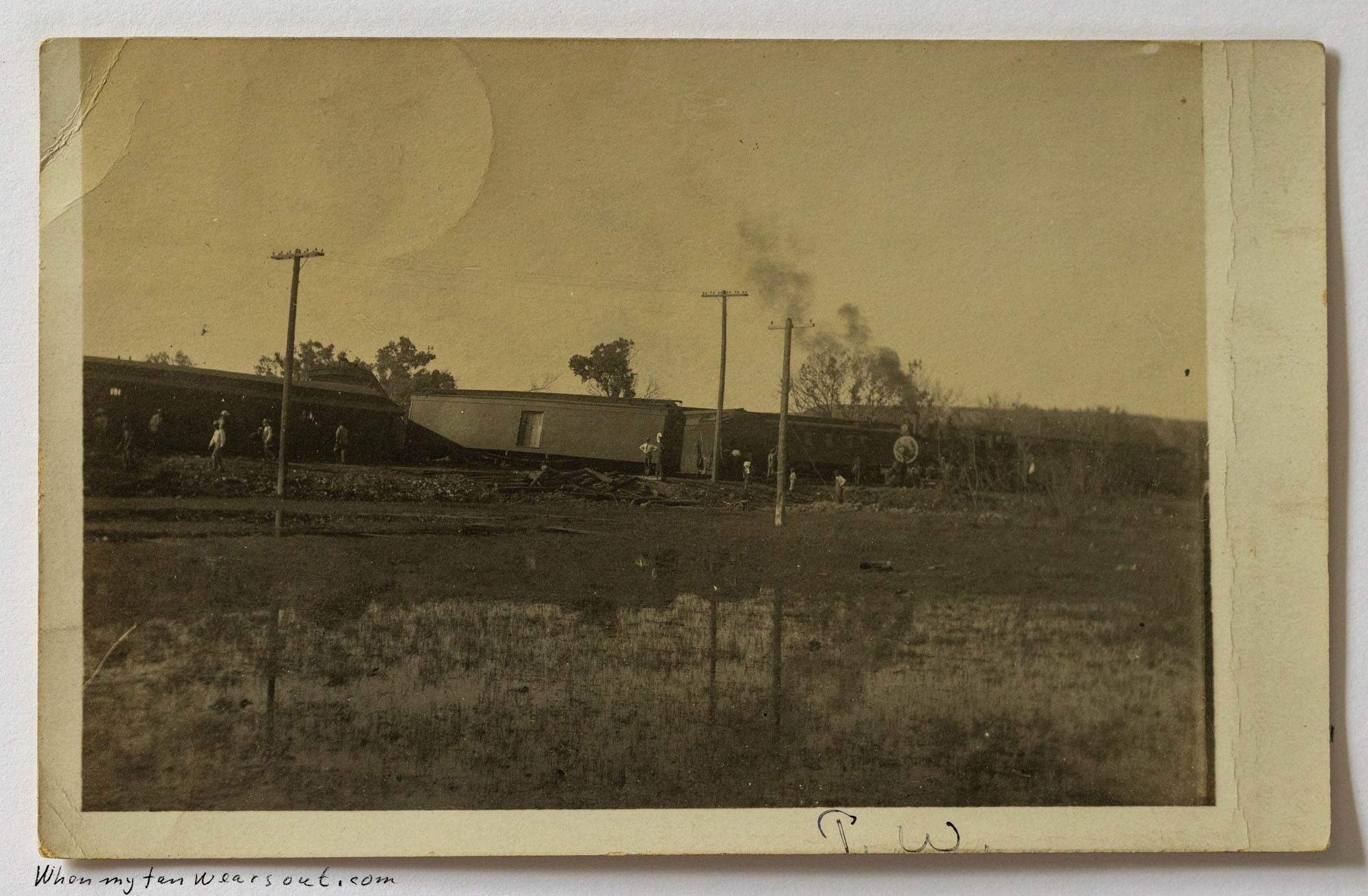
Postcard #0022: Train Wreck in the North End of the Yard


Sepia-toned photograph of a train derailment showing several passenger cars or freight cars overturned or off the tracks, with utility poles stretching across the horizon, a few people inspecting the damage, and a flooded or muddy field in the foreground, with the faint initials
Front — A sepia-toned photograph depicts a train derailment with multiple cars off the tracks and leaning, surrounded by people, utility poles, and muddy ground.

Postcard Metadata


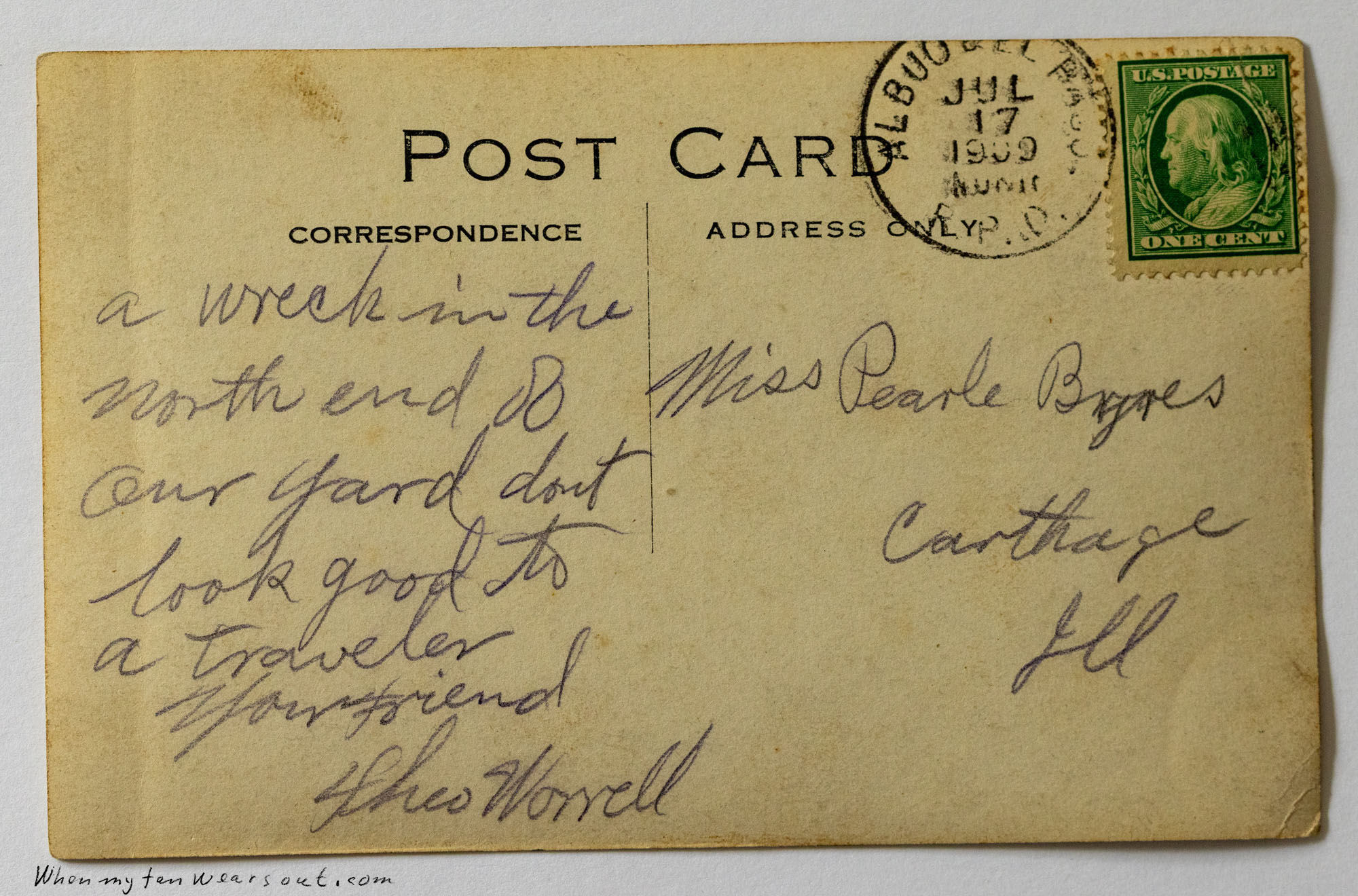
The back of a vintage postcard with a one-cent George Washington U.S. postage stamp postmarked
Back — Correspondence from Theo Worrell to Miss Pearle Byres

Transcription

a wreck in the north end of our yard dont look good to a traveler Your friend Theo Worrell

Historical & Family Notes

This postcard, sent from Quincy, Illinois, by “Theo Worrell” to “Miss Pearle Byres,” offers a stark glimpse into a dramatic, yet seemingly commonplace, event of the era: a train wreck. The sender’s casual observation, “a wreck in the north end of our yard dont look good to a traveler,” suggests that such incidents, while severe, were perhaps not entirely uncommon or were at least a significant local talking point in 1909.

While this specific message doesn’t directly involve Pearl’s future husband, Harvey Sights, it illustrates the network of friends and acquaintances Pearl maintained before their marriage. Postcards served as an essential medium for sharing news and observations across nearby towns, providing immediate, albeit brief, updates on daily life and local happenings.

Carthage, Illinois, where Pearl resided (at 318 N. Fayette Street), is located southeast of Quincy. This card provides a small window into the kind of everyday communication that filled the lives of young people like Pearl and her friends, connecting their worlds through brief written exchanges often accompanied by photographs of local interest.
Continue Reading

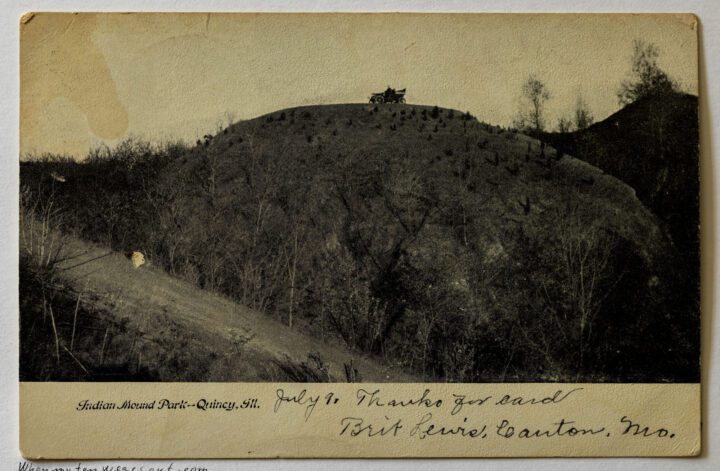
Postcard #001: Thanks from Indian Mound Park, Quincy


Sepia-toned postcard depicting Indian Mound Park in Quincy, Illinois, with an early 20th-century automobile parked on the summit of a tree-covered mound, overlooking a forested landscape.
Front — A sepia-toned image shows a dirt road winding up a large, tree-covered Indian Mound with an early automobile parked on top.

Postcard Metadata


Handwritten postcard back with a personal message dated July 19 from Brit Lewis in Canton, Missouri, to Miss Pearl Byers in Carthage, Illinois, postmarked Carthage, IL, July 19, 1916, with a one-cent Benjamin Franklin stamp.
Back — Correspondence from Brit Lewis to Miss Pearl Byers

Transcription

Indian Mound Park – Quincy, Ill. July 19. Thanks for card. Brit Lewis, Canton, Mo.

Historical & Family Notes

This early postcard sent to Pearl Byers by Brit Lewis captures a glimpse into her life before she met Harvey Sights. While the sender is not Harvey, the card establishes Pearl’s residence in Carthage, Illinois, a setting that would be central to her early adult life. The image of Indian Mound Park in Quincy, a nearby city, illustrates a regional landmark and popular destination, hinting at the shared experiences and local scenery common to young people in the Midwest at the time.

The casual nature of the message, “Thanks for card,” suggests an ongoing correspondence, painting a picture of Pearl’s social circle and the common practice of exchanging postcards to stay in touch. This card, dated July 19, 1916, precedes Pearl’s eventual marriage to Harvey Sights, offering a historical marker of her life during a period of significant social and technological change, reflected in the early automobile atop the mound.

Although a simple note, the postcard adds to the fabric of Pearl’s story, documenting her connections and the daily exchanges that shaped her world before the central chapter of her life with Harvey began. It grounds her in her community and time, showcasing the widespread use of postcards as a primary mode of communication for personal greetings and sharing visual experiences.

Continue Reading