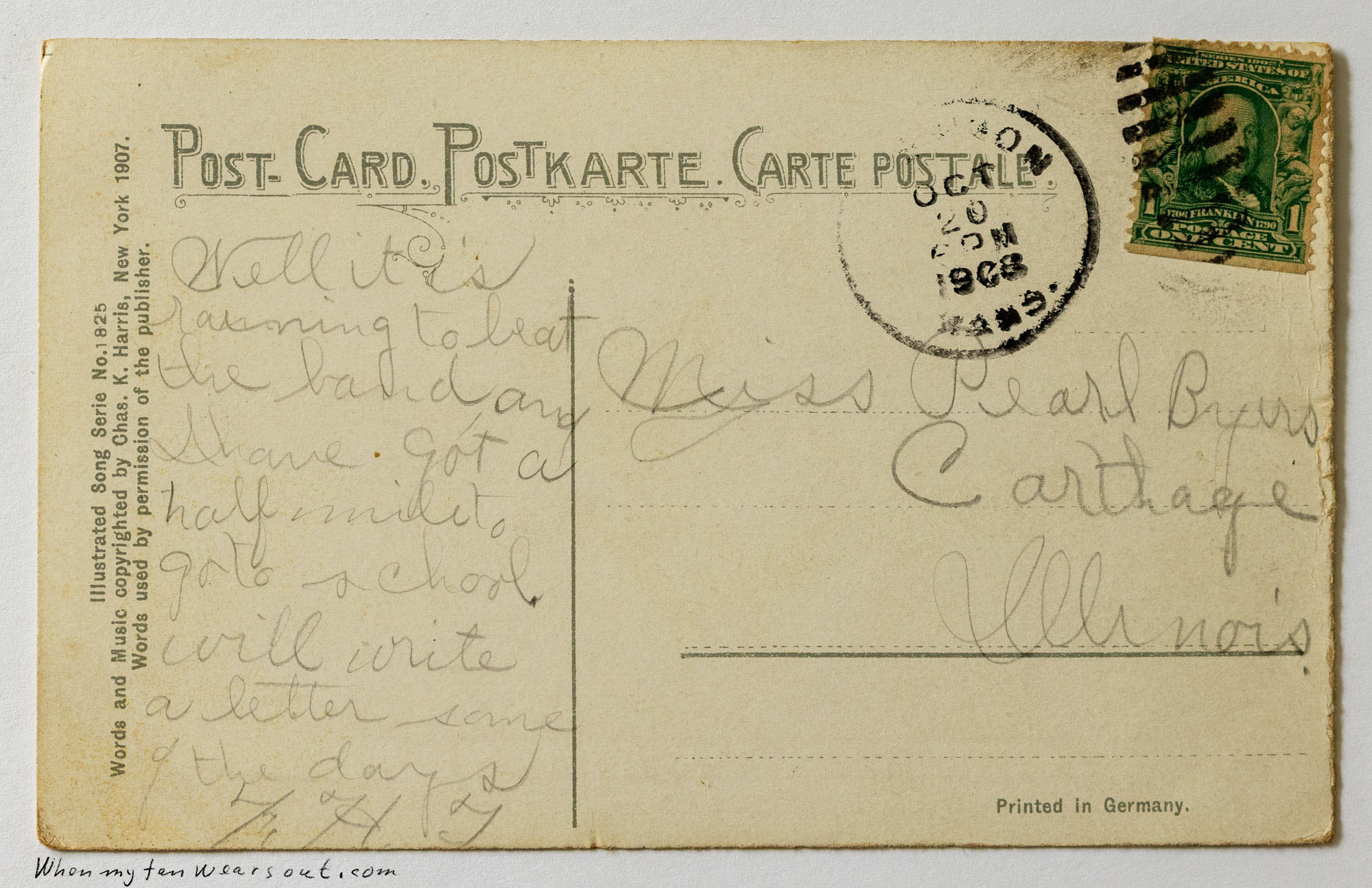
Back — Write [main message:] I suppose you thought I would never send the rest of these cards. we beat Red Cloud 8 to 4 [?] in the foot ball Friday. H H T
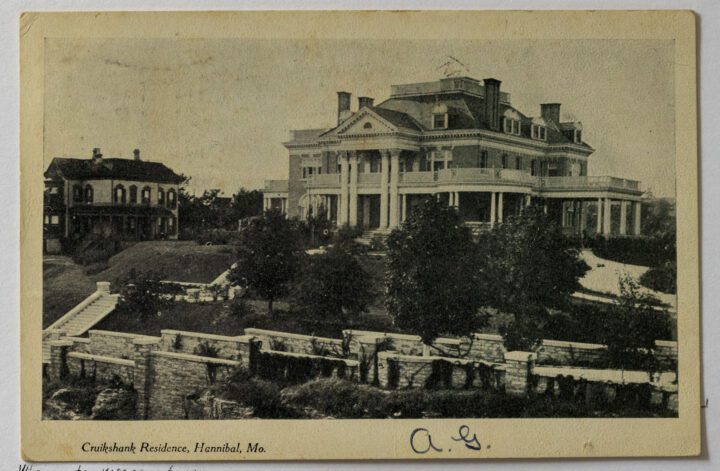
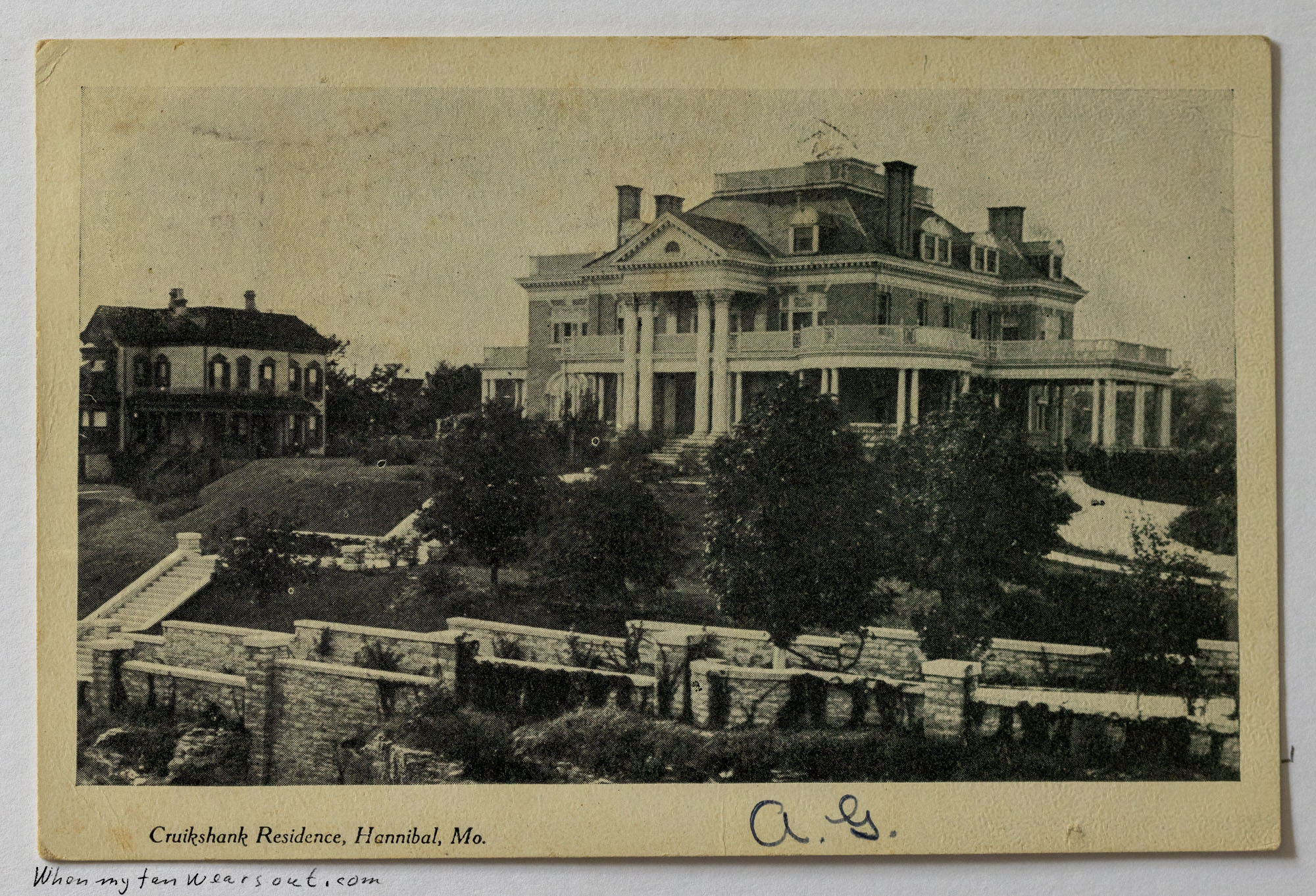
Front — A large, stately Cruikshank Residence mansion with a smaller house beside it, surrounded by manicured grounds.
Postcard Metadata
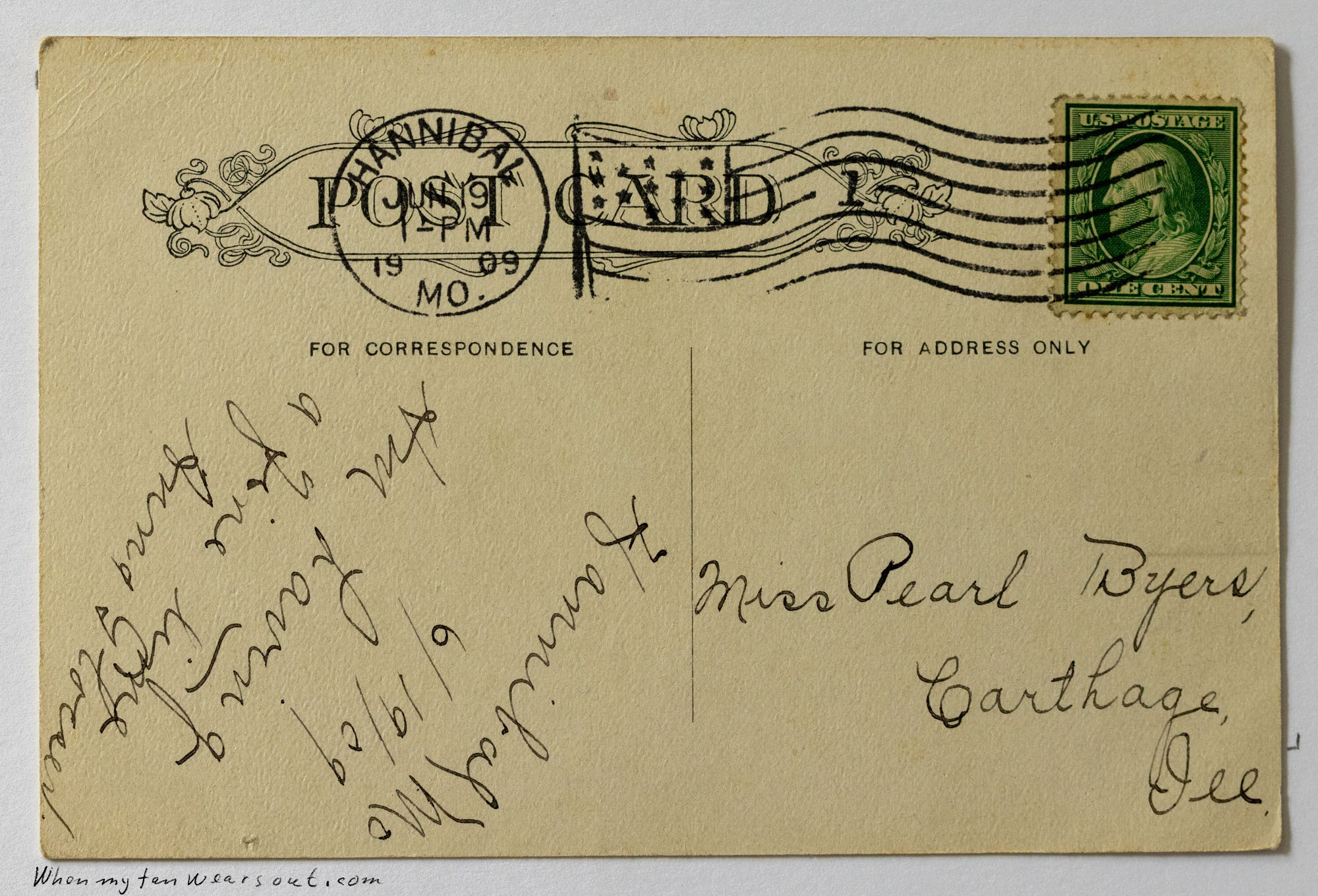
Postmarked: Hannibal, MO — Sep 9, 1909
Sent From: Hannibal, MO
Sent To: Miss Pearl Byers, Carthage, Ill.
Distance Traveled: Approximately 40 miles
Postage: U.S. POSTAGE ONE CENT (Green Benjamin Franklin)
Card Details: Divided Back era postcard
Back — Correspondence from Lavina Byrd to Miss Pearl Byers
Transcription
Am from Hannibal, Mo. 9/10/09 a fine time. Lavina Byrd. Miss Pearl Byers, Carthage, Ill.
Historical & Family Notes
This postcard offers a charming glimpse into Pearl Byers’ social life in 1909, years before her eventual marriage to Harvey Sights. Sent by her friend Lavina Byrd from Hannibal, Missouri—a city famously associated with Mark Twain and its Mississippi River heritage—it captures a simple update of enjoying a “fine time” during a visit. The image of the grand Cruikshank Residence speaks to the architectural prosperity of the era and the types of impressive landmarks travelers would share with friends back home.
The brief message reflects the common use of postcards for quick social connections, serving as a tangible record of Pearl’s friendships and daily interactions. These snippets from her past provide valuable context for her life before and during her early courtship, illustrating the social landscape she navigated as a young woman in the early 20th century. While Harvey Sights is not mentioned, this card rounds out the picture of Pearl’s world, highlighting her network of friends and their shared experiences.
The card’s details, from the postmark date of September 9, 1909, to the one-cent postage, are authentic markers of its time. It’s a small, personal artifact that connects Pearl to a broader historical moment, showcasing how friendships were maintained through the simple act of sending a picture and a few words across the Midwestern landscape.
Front — An embossed golden horseshoe framing a rural landscape with forget-me-nots, a clover, and a butterfly, featuring the text “Good Luck AND BEST WISHES.”
Postcard Metadata
Postmarked: Kansas City, MO — September 22, 1903
Sent From: Kansas City, MO
Sent To: Miss Pearl Byers Carthage Ill.
Distance Traveled: Approximately 250 miles
Postage: U.S. Postage, One Cent, green George Washington stamp
Card Details: Undivided Back era (1901-1907), with design copyrighted 1903 by H.W. Connelley.
Back — Correspondence from Harvey Sights to Miss Pearl Byers
Transcription
Dear Pearl How are you? I am well. I saw George Murray and his girl last night. We went to the show, and then went to a party. They are sweethearts aren’t they. I wish you would come over some time. How are you and Chas.? I am at the chancelo and working like I was. My arm is not well. Good bye Love Harvey Sights
Historical & Family Notes
This postcard, sent from Kansas City by Harvey Sights to Pearl Byers in Carthage, Illinois, captures a fleeting moment of early courtship. The “Good Luck” sentiment on the front, while generic, gains a personal touch from Harvey’s longing message. His mention of seeing “George Murray and his girl” at a show and party, followed by the observation, “They are sweethearts aren’t they,” could subtly allude to his own hopes for a similar relationship with Pearl.
Harvey’s casual yet intimate closing, “Love Harvey Sights,” suggests an affectionate bond already forming between the two, despite the distance. His desire for Pearl to “come over some time” clearly expresses a wish for closer connection. The reference to his injured arm (“My arm is not well”) offers a glimpse into his daily life, adding a personal detail that would resonate with Pearl.
The card serves as an early document in Pearl and Harvey’s enduring love story, hinting at the affections that would eventually lead to their marriage and the birth of their daughter, Marnelle. It showcases the charming, informal communication style of the early 20th century, where simple postcards carried heartfelt messages across miles.
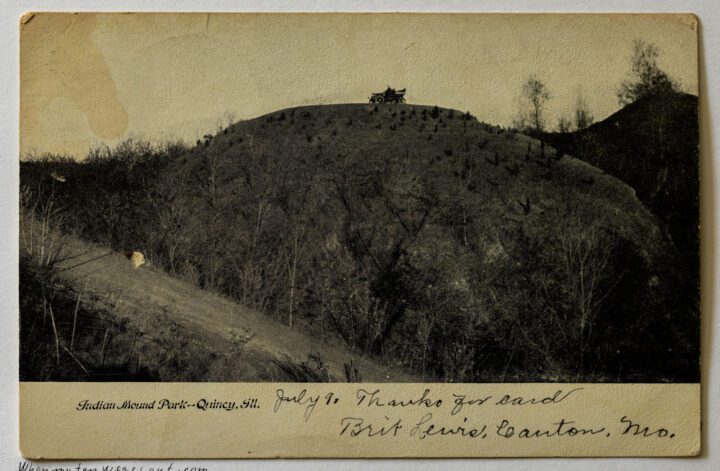
Front — A sepia-toned image shows a dirt road winding up a large, tree-covered Indian Mound with an early automobile parked on top.
Postcard Metadata
Postmarked: Carthage, Illinois — July 19, 1916
Sent From: Canton, Missouri
Sent To: Miss Pearl Byers, Carthage, Ill.
Distance Traveled: Approximately 32 miles
Postage: US 1-cent green Benjamin Franklin stamp (Scott #405)
Card Details: Divided Back era (post-1907)
Back — Correspondence from Brit Lewis to Miss Pearl Byers
Transcription
Indian Mound Park – Quincy, Ill. July 19. Thanks for card. Brit Lewis, Canton, Mo.
Historical & Family Notes
This early postcard sent to Pearl Byers by Brit Lewis captures a glimpse into her life before she met Harvey Sights. While the sender is not Harvey, the card establishes Pearl’s residence in Carthage, Illinois, a setting that would be central to her early adult life. The image of Indian Mound Park in Quincy, a nearby city, illustrates a regional landmark and popular destination, hinting at the shared experiences and local scenery common to young people in the Midwest at the time.
The casual nature of the message, “Thanks for card,” suggests an ongoing correspondence, painting a picture of Pearl’s social circle and the common practice of exchanging postcards to stay in touch. This card, dated July 19, 1916, precedes Pearl’s eventual marriage to Harvey Sights, offering a historical marker of her life during a period of significant social and technological change, reflected in the early automobile atop the mound.
Although a simple note, the postcard adds to the fabric of Pearl’s story, documenting her connections and the daily exchanges that shaped her world before the central chapter of her life with Harvey began. It grounds her in her community and time, showcasing the widespread use of postcards as a primary mode of communication for personal greetings and sharing visual experiences.