Postcard #0057: Woodbury Falls Thanks and Greetings


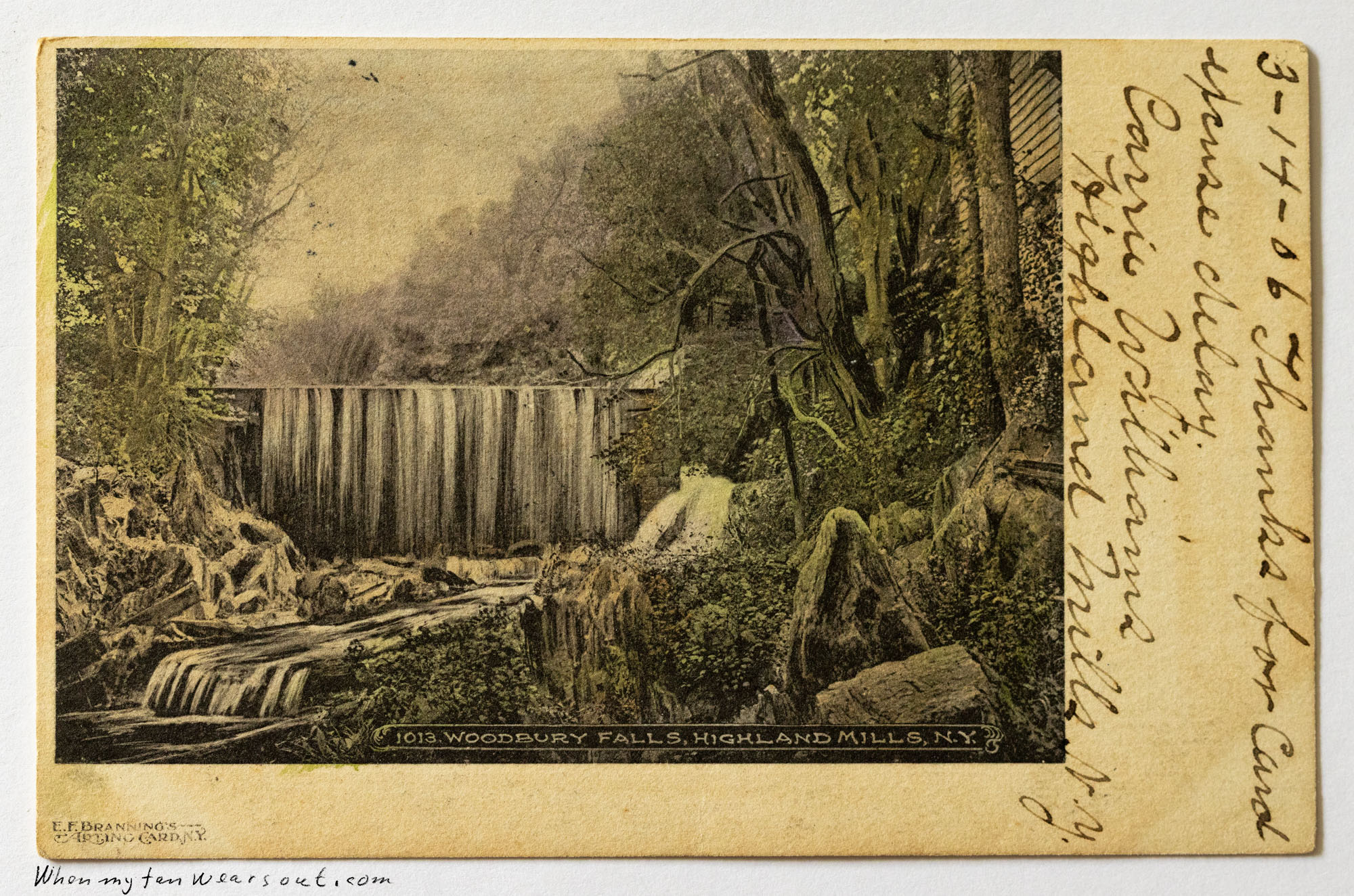
A hand-tinted postcard image of Woodbury Falls, Highland Mills, New York, showing a wide waterfall cascading over rocks into a stream below, surrounded by lush green trees and foliage. A handwritten message is visible on the right border with the date 3-14-06 and signed by Carrie.
Front — A serene depiction of Woodbury Falls in Highland Mills, New York, with a short message on the right.

Postcard Metadata


The back of an undivided postcard with a 1-cent Benjamin Franklin stamp postmarked Newburgh, NY, March 14, 1906, at 6:45 PM. It is addressed in cursive to
Back — Correspondence from Carrie to Pearle Byers

Transcription

3 – 14 – 06 Thanks for card Was glad to hear from you Carrie Write soon P.S. Highland Mills N.Y.

Historical & Family Notes

This postcard, sent to Pearle Byers in March 1906, offers a charming glimpse into her early social life, long before her eventual marriage to Harvey Sights. The sender, Carrie, clearly a friend, expresses gratitude for a previous card and encourages further correspondence, highlighting the personal nature of such exchanges. The simple, heartfelt message, “Was glad to hear from you,” underscores the role of postcards in maintaining friendships and connections across distances in the early 20th century.

The card itself features a picturesque view of Woodbury Falls in Highland Mills, New York, a location mentioned by Carrie in her postscript, suggesting a personal connection to the scene. While not directly related to Pearl and Harvey’s courtship, such cards reveal the typical ways young women like Pearl engaged with their friends and world, building a network of social ties that would have been an integral part of her life.

The swift two-day delivery from Newburgh, New York, to Carthage, Illinois, demonstrates the remarkable efficiency of the U.S. postal service at the time. This allowed friends such as Carrie and Pearle to share news and greetings across vast geographical spans with relative ease, contributing to the rich tapestry of Pearl’s life story before she became Mrs. Sights.
Continue Reading

Postcard #0053: Florida Palms and a Request for a “Novel Not Complicated with Love”


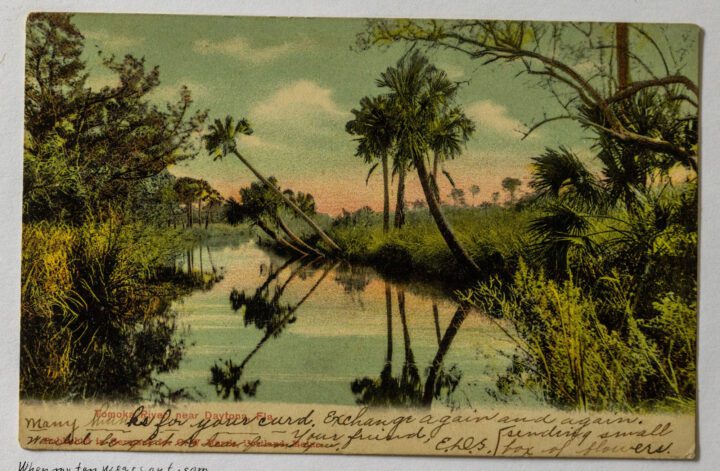
A vintage postcard depicting a lush Florida landscape with tall palm trees and dense green foliage along the banks of a reflective stream. The scene is bathed in the warm light of sunrise or sunset, with a vibrant orange and green sky. The water perfectly mirrors the trees and sky. Text on the bottom left reads
Front — A scenic view of palm trees and other tropical foliage reflected in a tranquil body of water under a colorful sky, labeled “Ormond Key near Daytona.”

Postcard Metadata


The back of a vintage undivided postcard with a green one-cent Benjamin Franklin stamp postmarked
Back — Correspondence from C.H.S. to Miss Pearle Byers

Transcription

Ormond Key near Daytona. Many thanks for your card, exchange again and again. Your friend C.H.S. Send me a small novel not complicated with love something of your own. Box of flowers.

Historical & Family Notes

This early postcard, dating from 1906, shows the sender, C.H.S., corresponding with Pearl Byers from sunny Florida. The reference to “Ormond Key near Daytona” places the sender on what was then a popular winter resort destination, indicating some travel or leisure activities. The message, though brief, hints at a warm and continuous exchange, stating “exchange again and again.”

The most intriguing part of the message is the playful postscript: “Send me a small novel not complicated with love something of your own. Box of flowers.” While signed simply “Your friend C.H.S.,” the initials “H.S.” align with Harvey Sights, Pearl’s future husband. The request for a novel “not complicated with love” could be a teasing remark between two individuals who are perhaps just beginning to navigate the complexities of their own budding affections, subtly hinting at an interest beyond mere friendship. The mention of “Box of flowers” further adds to this gentle flirtation.

This card provides a charming glimpse into the early stages of communication between Pearl and her circle, potentially even with Harvey Sights himself, before their relationship fully blossomed. The request for a personalized “novel” suggests an intimate understanding and shared sense of humor between the correspondent and Pearl, laying groundwork for a deeper connection in the years to come.

Continue Reading

Postcard #0052: Anthony’s Nose on the Hudson River


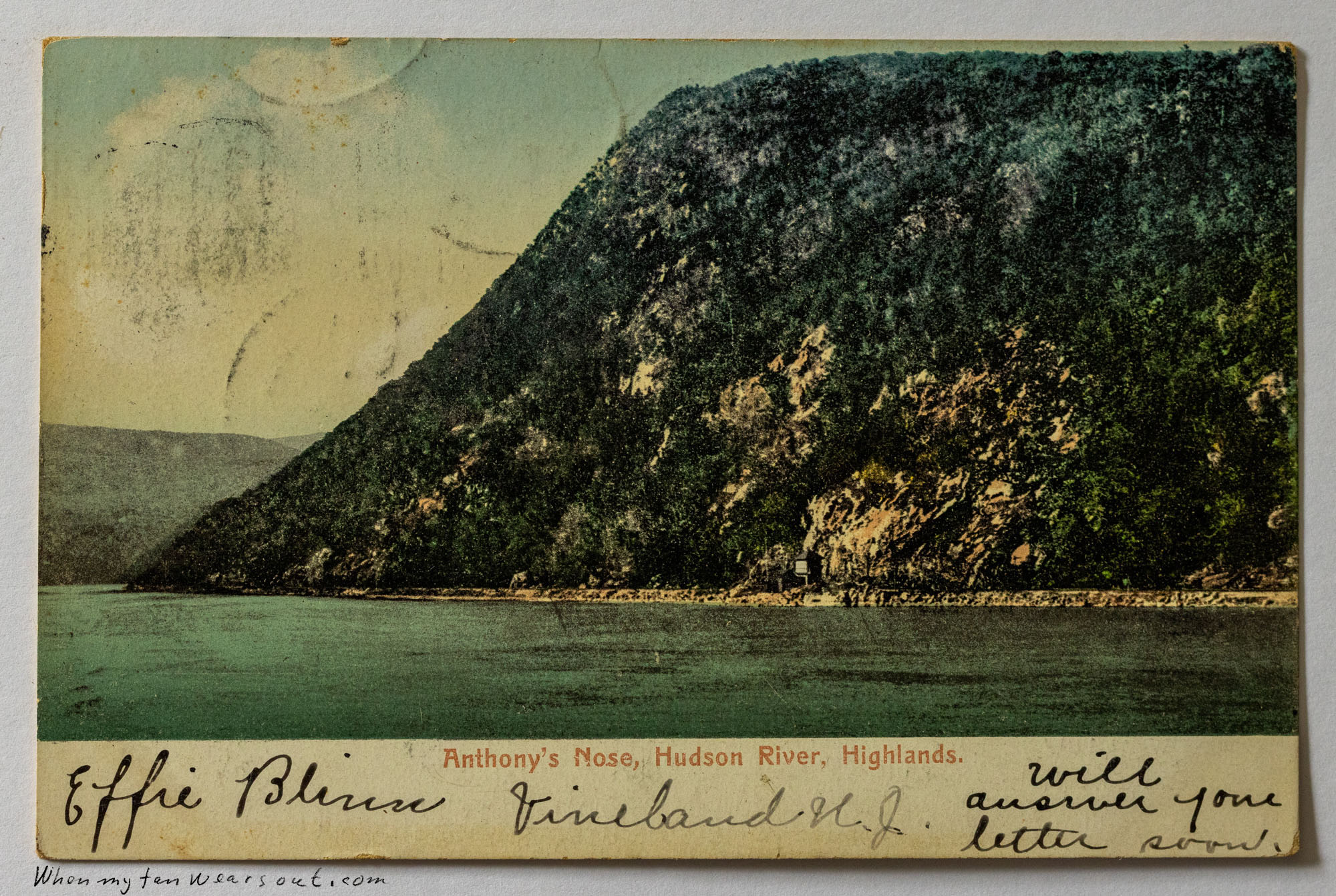
Vintage postcard illustration of Anthony's Nose mountain, covered in dense green trees, steeply descending into the calm, teal-colored Hudson River under a pale sky. A small structure is visible at the base of the mountain by the water's edge, with the card's caption and a handwritten message in white at the bottom left.
Front — A view of Anthony’s Nose, a forested mountain along the Hudson River in the New York Highlands.

Postcard Metadata


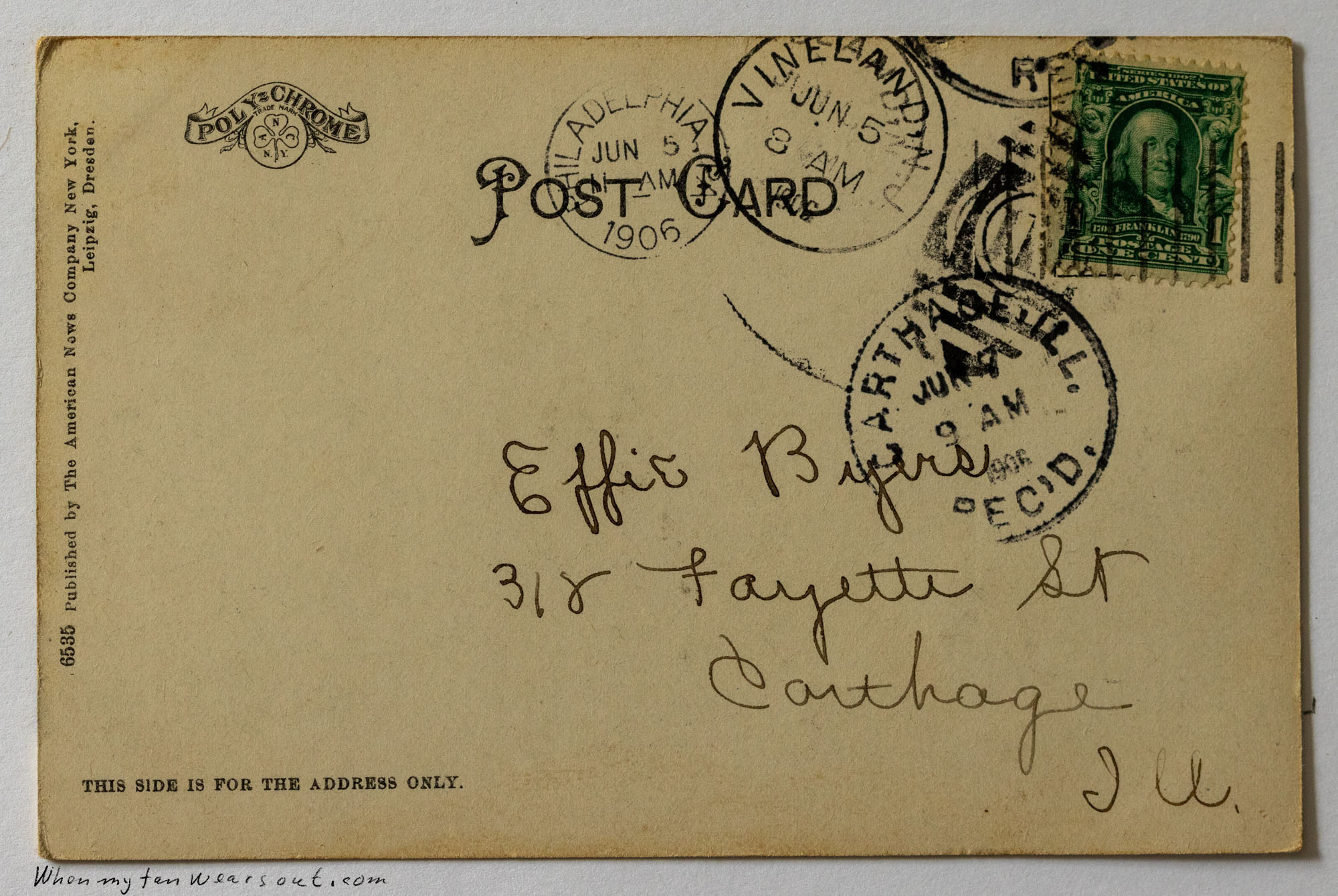
The back of an undivided postcard with a cream-colored surface, featuring a green 1-cent Benjamin Franklin stamp in the upper right. Multiple circular postmarks are present:
Back — Correspondence from Effie Blinn to Effie Byers

Transcription

Effie Blinn will answer your letter soon!

Historical & Family Notes

This early 20th-century postcard captures the majestic scenery of Anthony’s Nose overlooking the Hudson River in the New York Highlands. Sent by Effie Blinn from Vineland, New Jersey, it assures the recipient, Effie Byers of Carthage, Illinois, that a letter is forthcoming. The simple message, “will answer your letter soon!”, suggests an ongoing correspondence between the two.

Given that this postcard is addressed to Effie Byers at the same Carthage address as Pearl Byers, it’s highly probable that Effie Byers is a close family member, perhaps Pearl’s mother or sister. This card offers a glimpse into the broader network of family and friends surrounding the main characters of the collection, documenting their connections and the common practice of sharing travel experiences through postcards.

The card’s “Undivided Back” design, typical for postcards predating 1907, means the entire back was reserved for the address, pushing the message to the front alongside the image. The 1-cent postage for domestic delivery was standard at the time, allowing for wide circulation of these early photographic travel mementos.

Continue Reading

Postcard #0051: Palm Walk in Florida and a Card Exchange with Mr. Sights


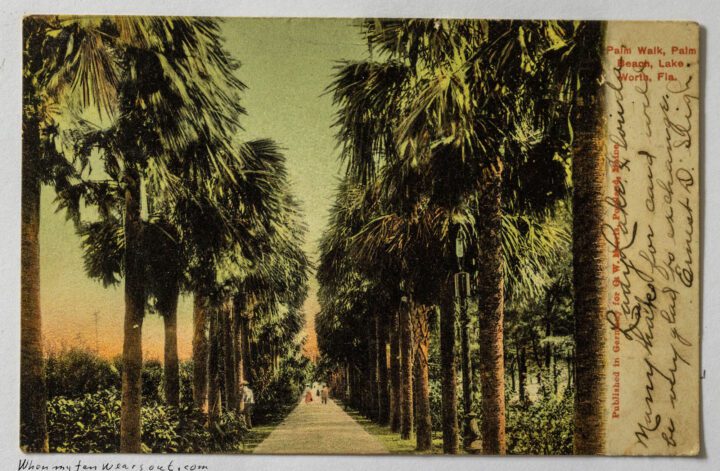
Vintage postcard illustration depicting a picturesque tree-lined avenue with numerous tall palm trees, creating a shaded pathway. The scene is bathed in a warm, golden-orange light at the horizon, transitioning to a greenish-yellow sky above. Several people are visible strolling along the path.
Front — A serene, sun-drenched palm-lined avenue with pedestrians strolling, labeled “Palm Walk, Palm Beach, Lake Worth, Fla.”

Postcard Metadata


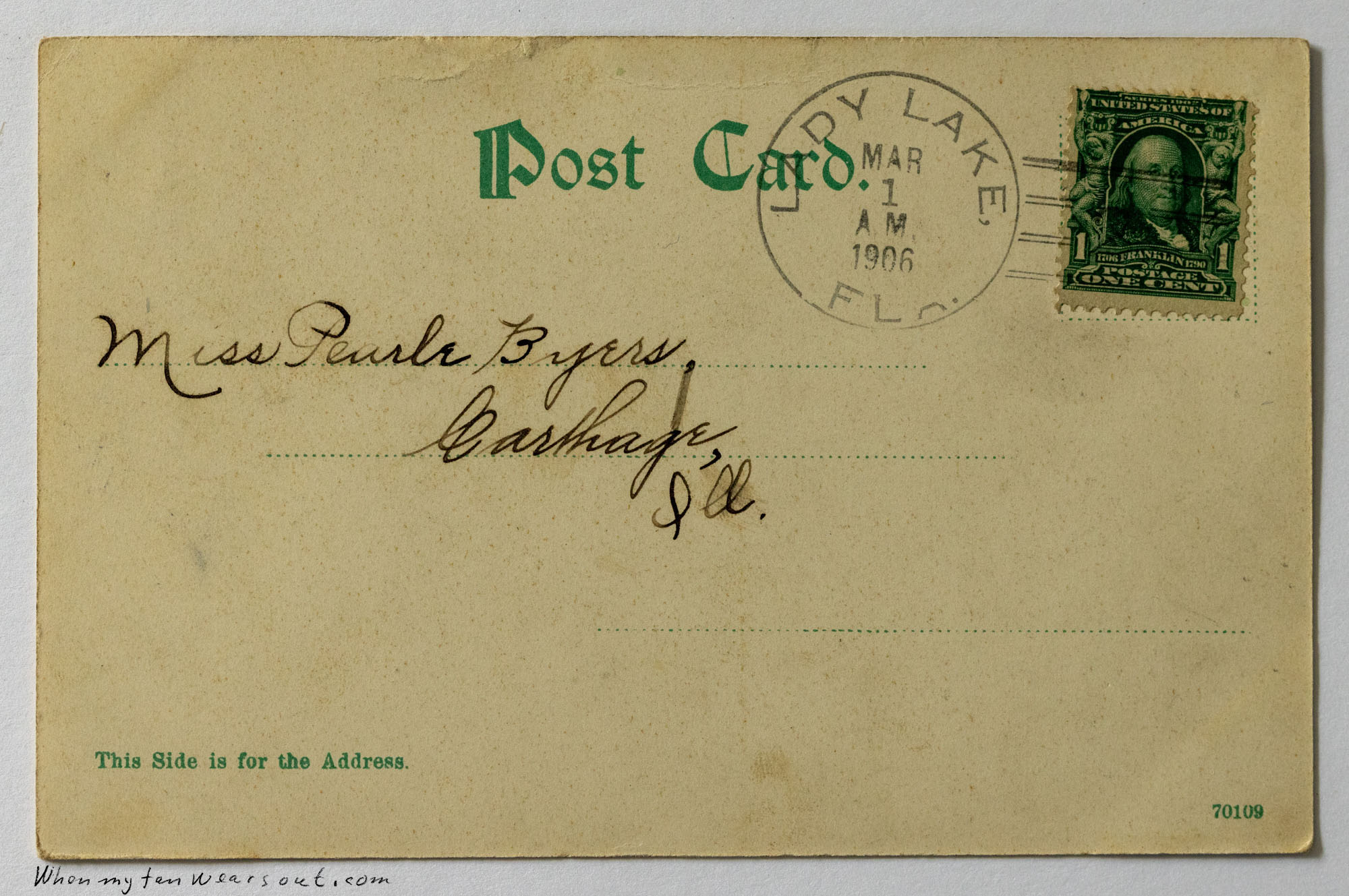
The back of a vintage postcard features a one-cent green Benjamin Franklin stamp from the United States, cancelled with a
Back — Correspondence from Ernest D. Sh. to Miss Pearle Byers

Transcription

Published in Ger. for Geo. R. Lawrence. Palm Walk, Palm Beach, Lake Worth, Fla. Merry Xmas for exchanging cards with Mr. Sights. Ernest D. Sh.
Historical & Family Notes

This postcard, sent from sunny Florida in 1906, provides an intriguing glimpse into Pearl Byers’ social sphere before her marriage to Harvey Sights. The message from Ernest D. Sh. explicitly mentions “exchanging cards with Mr. Sights,” suggesting that Harvey was already a known figure within Pearl’s wider network of acquaintances and that social correspondence was a common practice. This early mention, even if indirect, foreshadows the deeper connection that would eventually develop between Pearl and Harvey.
The card itself, an early example of a divided back design postmarked a year before its official authorization for U.S. domestic mail, reflects the evolving nature of postcard communication. The sender’s decision to write the message across both the designated message and address portions of the card highlights a charming disregard for strict postal conventions, prioritizing the full message over proper formatting.

Such exchanges served as vital threads connecting individuals across distances in the early 20th century, fostering relationships and maintaining social ties. For Pearl and Harvey, this postcard from a faraway destination underscores the broad geographical and social contexts that shaped their lives before they became central to each other’s.

Continue Reading

Postcard #0050: Mountain Railway Vista from Mt. Lowe R.R.


A vintage colorized postcard depicting a dramatic mountain landscape with a railway track curving along the left side. Tall pine trees frame the left and right, with some dead trees in the center adding to the rugged scene. Distant mountain peaks are visible under a light blue and yellow sky. The foreground shows the train tracks receding into the lush green forest.
Front — A colorful illustration of a mountain railway track curving through a forest with distant peaks under a vibrant sky.

Postcard Metadata


The back of a vintage postcard with a brown paper texture. On the left side, handwritten cursive script in black ink reads
Back — Correspondence from E. Allan Banks to Mr Harvey Sights

Transcription

Redondo, Cal April 30/08. How do you like This for a scene? E. Allan Banks.

Historical & Family Notes

This postcard offers an intriguing glimpse into Harvey Sights’ life before his courtship with Pearl Byers. Sent by a friend, E. Allan Banks, from Redondo, California, it features a scenic view from the famous Mt. Lowe Railway. The message, “How do you like This for a scene?”, suggests a shared appreciation for natural beauty or travel between Harvey and his friend. While the message is dated April 30, 1908, the postmark clearly shows May 3, 1909, indicating a likely clerical error in the year written by the sender.

The Mt. Lowe Railway, located in the San Gabriel Mountains near Los Angeles, was a popular tourist attraction known for its breathtaking views and engineering marvels. This card hints at Harvey’s social circle and interests, receiving correspondence from friends who traveled or lived in distant, picturesque locations. It’s an interesting piece showing the world Harvey inhabited before Pearl became the central figure in his correspondence.

While this card isn’t from Pearl, it contributes to the broader narrative by painting a picture of Harvey’s life and connections prior to his significant relationship. It’s a reminder that even future spouses had their own lives, friends, and experiences before their paths intertwined, adding depth to their eventual shared history captured in this collection.

Continue Reading

Postcard #0049: Picnic Trip on the Ocklawaha River, Florida


Black and white postcard image depicting two people in a small rowboat navigating a narrow section of the Ocklawaha River in Florida. The riverbanks are heavily forested with tall cypress trees draped in Spanish moss, creating a dense canopy. The water is calm, reflecting the trees and sky. The printed caption at the bottom reads
A scenic view of two people in a rowboat on the Ocklawaha River, Florida, surrounded by cypress trees draped with Spanish moss.

Postcard Metadata


The undivided back of a vintage postcard featuring a green one-cent Benjamin Franklin postage stamp in the upper right corner. The main postmark reads
Back — Correspondence from Ernest Bligh to Miss Pearle Byers

Transcription

Off for the picnic How would you like this trip— Ernest Bligh.

Historical & Family Notes

This postcard, sent to Pearl Byers in May 1906, offers a glimpse into her social life before her marriage to Harvey Sights. The sender, Ernest Bligh, describes a picnic on the scenic Ocklawaha River in Florida, asking Pearl if she would enjoy such a trip. This suggests a friendly relationship, perhaps a travel companion or an admirer, highlighting Pearl’s wider connections before settling down.
The Ocklawaha River, famous for its lush landscapes and cypress swamps draped in Spanish moss, was a popular tourist destination in the early 20th century. This postcard captures the allure of such natural beauty and the burgeoning trend of travel and leisure, with postcards serving as a common way to share experiences from afar.

While this card is not from Harvey, it enriches Pearl’s personal narrative, painting a picture of a young woman receiving mail from various acquaintances and experiencing life’s adventures, even if vicariously through postcards. The Carthage postmark indicates receipt on the same day as dispatch from Florida, a common yet intriguing postal anomaly for the era, suggesting a rapid journey or perhaps a timestamp discrepancy.

Continue Reading

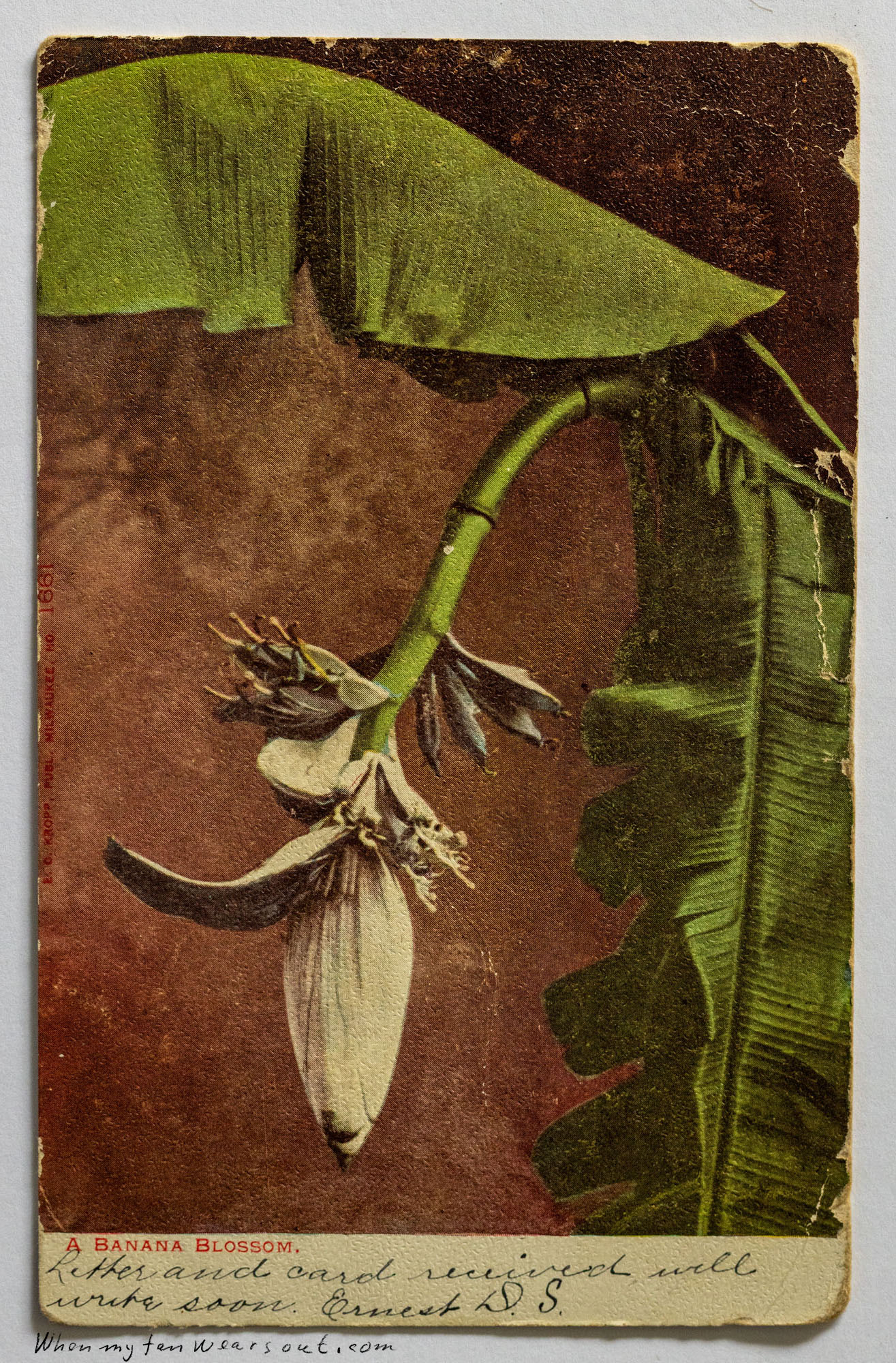
Postcard #0048: A Banana Blossom from Ernest D. S.


A colorized vintage postcard showing a large, cream-colored banana blossom hanging from a green banana tree stalk, with small green bananas starting to form at the top of the blossom. The background is a warm, mottled brown. Printed text
Front — A vibrant illustration of a banana tree’s large, pendulous blossom with emerging fruit.

Postcard Metadata


The back of a vintage postcard with a light tan surface. A green one-cent U.S. Postage stamp with Benjamin Franklin's portrait is affixed to the upper right. Two circular postmarks are present: one from
Back — Correspondence from Ernest D. S. to Miss Pearle Byers

Transcription

Letters and card received will write soon. Ernest D. S.

Historical & Family Notes

This postcard, sent from a warmer climate in Florida, offers a glimpse into the diverse correspondence Pearl Byers received. While not from her eventual husband, Harvey Sights, it confirms Pearl was an active recipient of mail, maintaining connections with various friends and family members across the country. The sender, Ernest D. S., acknowledges previous correspondence, indicating an ongoing exchange.

The postcard’s depiction of a banana blossom highlights an exotic fruit for many Midwesterners at the turn of the 20th century. Such imagery provided a window into distant lands and unfamiliar flora, a common theme for postcards intended to transport recipients beyond their immediate surroundings. This particular card showcases the aesthetic appeal of nature photography combined with the practical function of postal communication during a burgeoning era of travel and correspondence.

Continue Reading

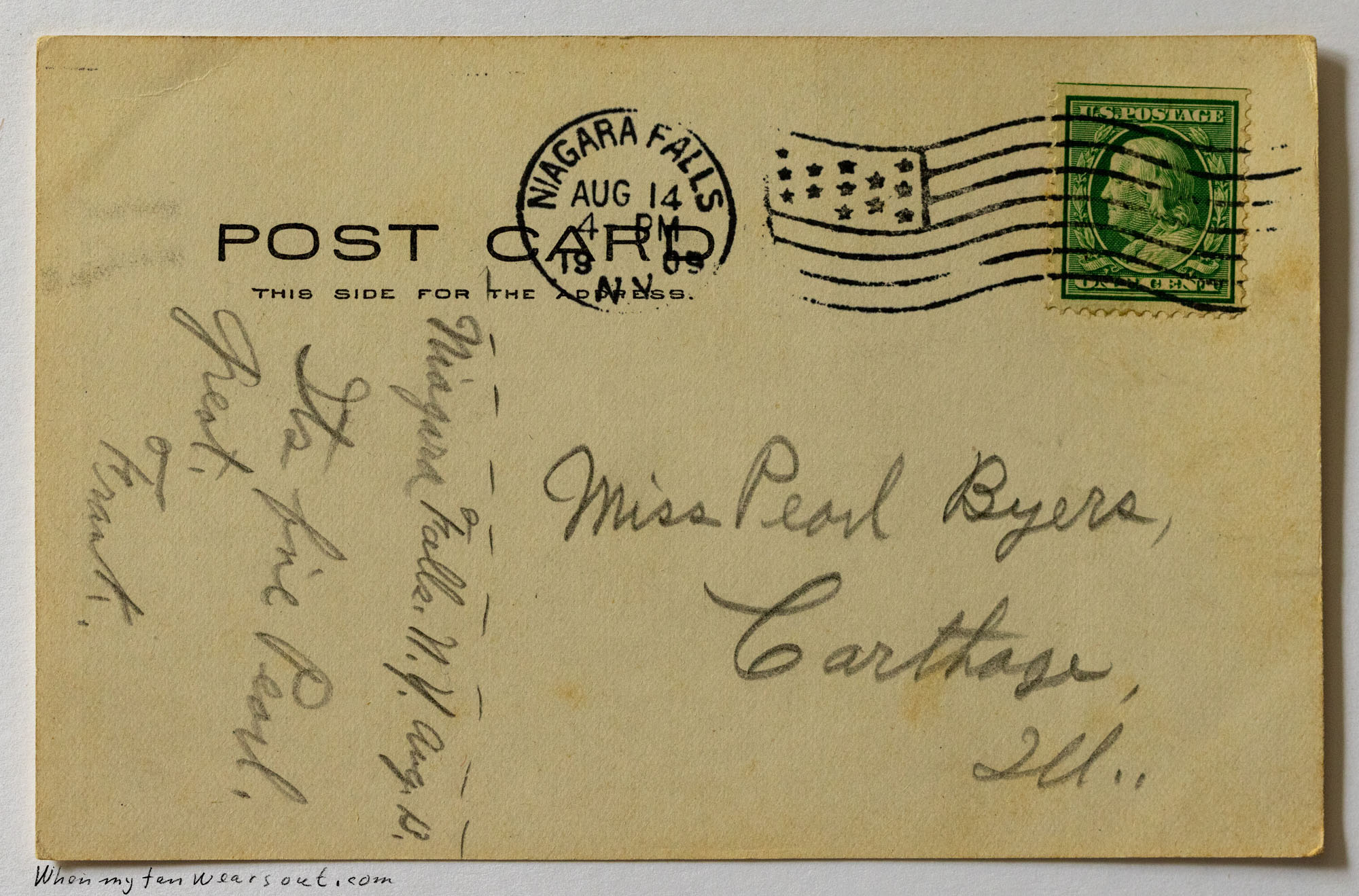
Postcard #0042: Niagara Falls Greetings to “Fine Pearl”


Vintage postcard showing the American Falls at Niagara Falls, New York, with a large steel arch bridge spanning the Niagara River above the falls. Mist rises from the powerful waterfall, and a few small figures of people are visible on a pathway on Goat Island in the foreground. The image has a sepia tone, indicative of early 20th-century photography.
Front — A scenic view of the American Falls at Niagara Falls, New York, with the Upper Steel Arch Bridge and tourists on Goat Island.

Postcard Metadata


The back of a vintage postcard featuring a divided back for message and address. Handwriting in cursive reads
Back — Correspondence from Frank to Miss Pearl Byers

Transcription

Niagara Falls, N.Y. Aug. 14. To fine Pearl, Great. Frank.

Historical & Family Notes

This postcard from Niagara Falls to Miss Pearl Byers in Carthage, Illinois, provides a glimpse into Pearl’s social circle before her eventual marriage to Harvey Sights. Sent by a sender simply identified as “Frank” on August 14, 1909, the brief message, “To fine Pearl, Great,” suggests a casual yet warm acquaintance. Niagara Falls, then as now, was a quintessential destination for scenic wonder, often associated with romantic getaways and honeymoons, though Pearl was still a young, unmarried woman at the time of this correspondence.
The simplicity of the message, a common characteristic of early 20th-century postcards, doesn’t reveal the nature of Pearl’s relationship with Frank. He could be a friend, a family member, or perhaps even a suitor before Harvey Sights entered her life more prominently. Regardless, the card serves as a charming piece of ephemera, documenting a moment in time when Pearl was receiving greetings from various individuals and locations, contributing to the rich tapestry of her personal history.

Continue Reading

Postcard #0031: A Merry Christmas with Holly and Berries from Perris


Vintage Christmas postcard from the early 1900s featuring an embossed sprig of green holly leaves with vibrant red berries at the top. Below the holly, a watercolor illustration depicts a snow-covered winter landscape with a small house, bare trees, and a wooden fence at sunset or sunrise. The text
Front — An embossed illustration of a holly sprig with red berries above a winter landscape scene and “A MERRY CHRISTMAS” message.

Postcard Metadata


The back of a vintage postcard with a divided back design. The left side is labeled
Back — Correspondence from Harvey Sights to Miss Pearl Byers

Transcription

H.S.

Historical & Family Notes

This Christmas postcard, adorned with festive holly and a serene winter scene, carries a simple but significant message from Harvey Sights to Pearl Byers. The solitary “H.S.” initial, penned vertically on the correspondence side, speaks volumes about the growing connection between them, despite the vast geographical distance separating Perris, California, from Carthage, Illinois. The journey of nearly 1,900 miles underscores Harvey’s effort to reach Pearl during the holiday season, a time traditionally associated with warmth and connection.

The absence of a longer message might suggest a burgeoning relationship where a simple acknowledgment was enough, or perhaps a more private communication was shared via other means. This card serves as a tangible link in the evolving story of Pearl and Harvey, capturing a moment when their paths, though physically distant, were drawing closer. It’s a testament to the enduring tradition of holiday greetings and the personal touch postcards offered in an era before instant communication.

As an archival piece, this postcard not only documents a festive exchange but also subtly hints at the dedication involved in maintaining a long-distance connection during the early 20th century. For Pearl, receiving this Christmas wish from Harvey, even if brief, would have been a cherished reminder of his thoughts for her, further cementing their bond that would eventually lead to marriage and their daughter, Marnelle.

Continue Reading

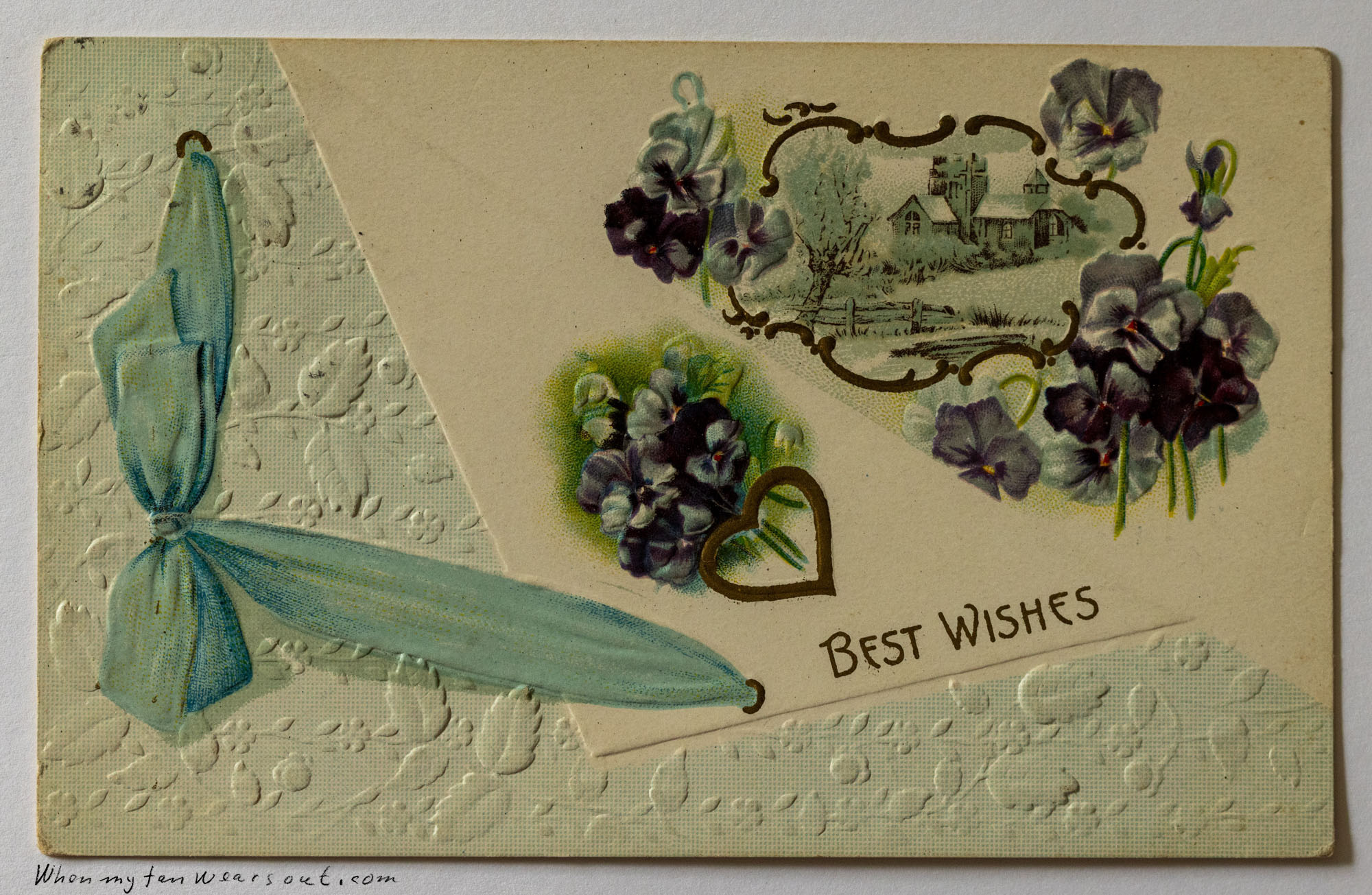
Postcard #0030: Best Wishes with Pansies and a Midwest Farm Scene


Vintage postcard with a teal blue satin ribbon bow and flowing ribbon on the left side, over an embossed background pattern. The right side features two clusters of purple and blue pansies, and a central framed vignette depicting a quaint rural farm scene with a house, trees, and fence. The text
Front — A “Best Wishes” postcard featuring purple pansies, an embossed blue ribbon, and a framed rural farm scene.

Postcard Metadata


The back of a vintage postcard featuring a handwritten message in black cursive ink. The sender is E.P.B. and the recipient is Mr. Harvey Sights, La Harpe, Illinois. A Carthage, Illinois postmark dated September 7, 1909, is visible along with a green one-cent U.S. Postage stamp with George Washington's portrait. The card has a vertical dividing line and an embossed floral pattern.
Back — Correspondence from E.P.B. (Pearl Byers) to Harvey Sights

Transcription

Carthage Ill. Sept. 7-09. Rec’d card this morning as I came to work. Thanks “awfully.” It is dandy. E.P.B. Mr. Harvey Sights La Harpe Ill

Historical & Family Notes

This postcard offers a charming glimpse into the early courtship between Pearl Byers and Harvey Sights. Pearl, writing from Carthage, Illinois, expresses her thanks to Harvey for a card she received earlier that morning, playfully stating it was “dandy.” This exchange highlights their regular correspondence despite living a mere sixteen miles apart, indicating a blossoming romance through the daily ritual of postcard mail.

The sender’s initials “E.P.B.” are almost certainly Pearl Byers, aligning with the family’s identity rules and the ongoing narrative of their relationship. The card was sent on September 7, 1909, a significant period in their courtship before their eventual marriage and the birth of their daughter, Marnelle.

The message’s casual and affectionate tone—”Thanks ‘awfully'”—suggests a comfort and familiarity between Pearl and Harvey, showcasing a delightful snapshot of their everyday interactions and the simple pleasures of receiving mail from a loved one in the early 20th century.

Continue Reading

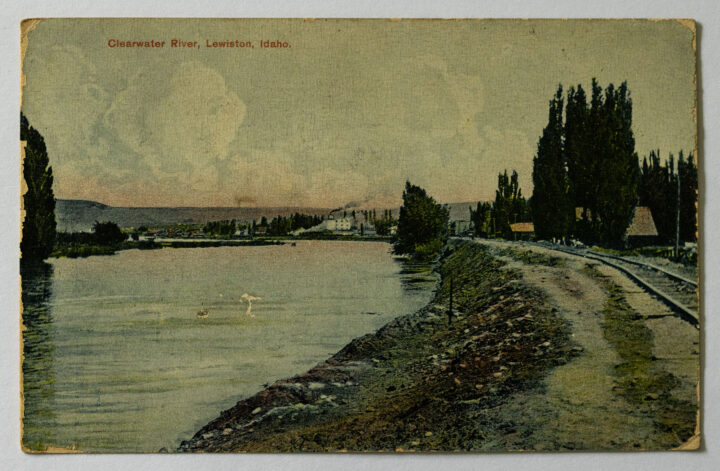
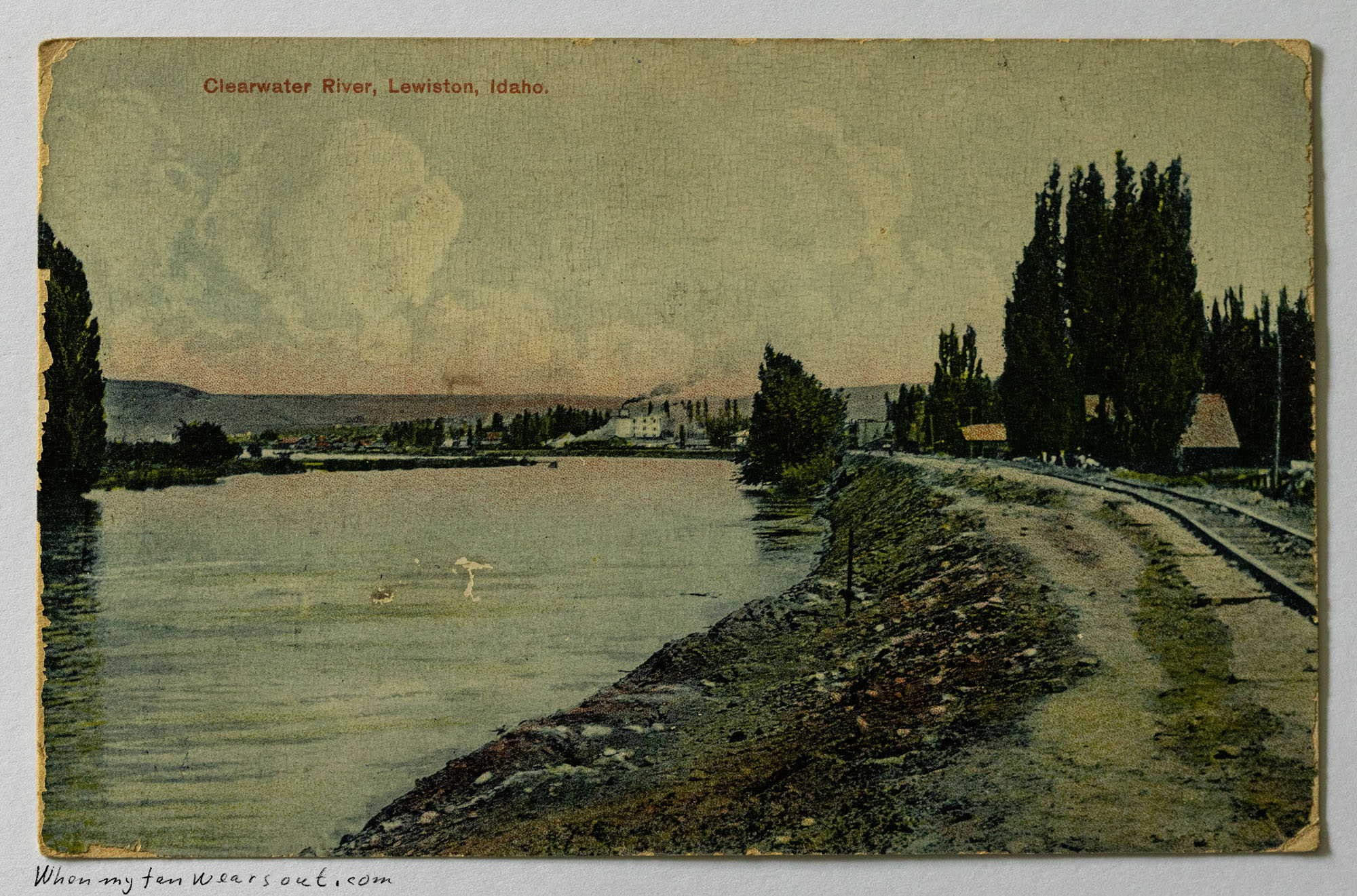
Postcard #0028: Clearwater River, Lewiston with Merry Christmas 1908 Greetings


A vintage postcard depicting the Clearwater River in Lewiston, Idaho. The river dominates the foreground with calm, reflective water. Along the right bank, a raised railroad track runs parallel to the river, with tall, slender trees lining its side. In the background, across the river, lies the town of Lewiston nestled against distant hills under a cloudy sky. The sky above is a mix of pale blues and whites, with a hint of warm colors from the postcard's printing process. The title
Front — A postcard view of the Clearwater River in Lewiston, Idaho, with a railroad track running alongside the water and a town visible in the distance.

Postcard Metadata


The divided back of a postcard, featuring handwritten cursive text on the left side and an address on the right. A green one-cent U.S. Franklin stamp is affixed in the upper right corner. A clear circular postmark indicates
Back — Correspondence from O.W. and Aunt Clara to J.J. McMenamy

Transcription

Merry Xmas and Happy 1908 From your nephew O.W. and Niece Aunt Clara

Historical & Family Notes

While this postcard features a beautiful early 20th-century landscape of the Clearwater River in Idaho, its primary interest for this collection lies in its connection to Carthage, Illinois—the hometown of Pearl Byers. Uniquely, this card is not addressed to Pearl or Harvey, but to J.J. McMenamy, a resident of Carthage. The senders, identified as “nephew O.W. and Aunt Clara,” extend simple holiday wishes for Christmas 1908.

The presence of this card in a collection primarily focused on Pearl Byers and Harvey Sights suggests a possible familial or community tie within Carthage, perhaps indicating that the McMenamy family was known to the Byers or Sights, or that the card was later acquired and added to the collection for its local historical relevance. It offers a glimpse into broader social connections within Carthage during the early 1900s, even if not directly part of Pearl and Harvey’s personal correspondence.

This holiday greeting provides a brief snapshot of seasonal communication at the turn of the century, sent across a vast distance from Idaho to Illinois. It captures the simple charm of period postcards, serving as a reminder of distant relations and the enduring tradition of sharing good wishes during the festive season.

Continue Reading

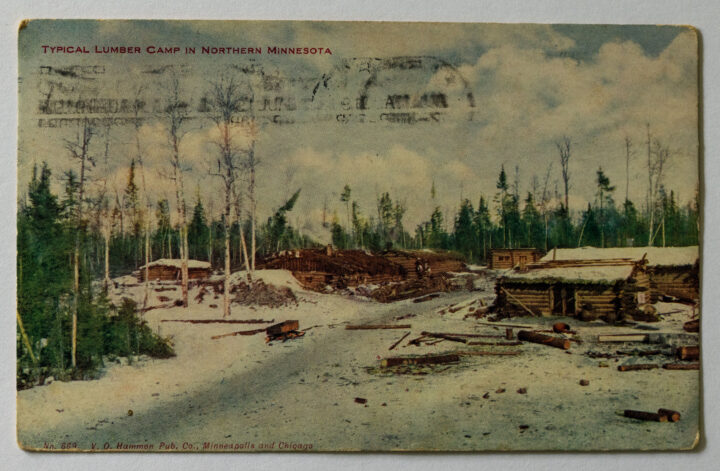
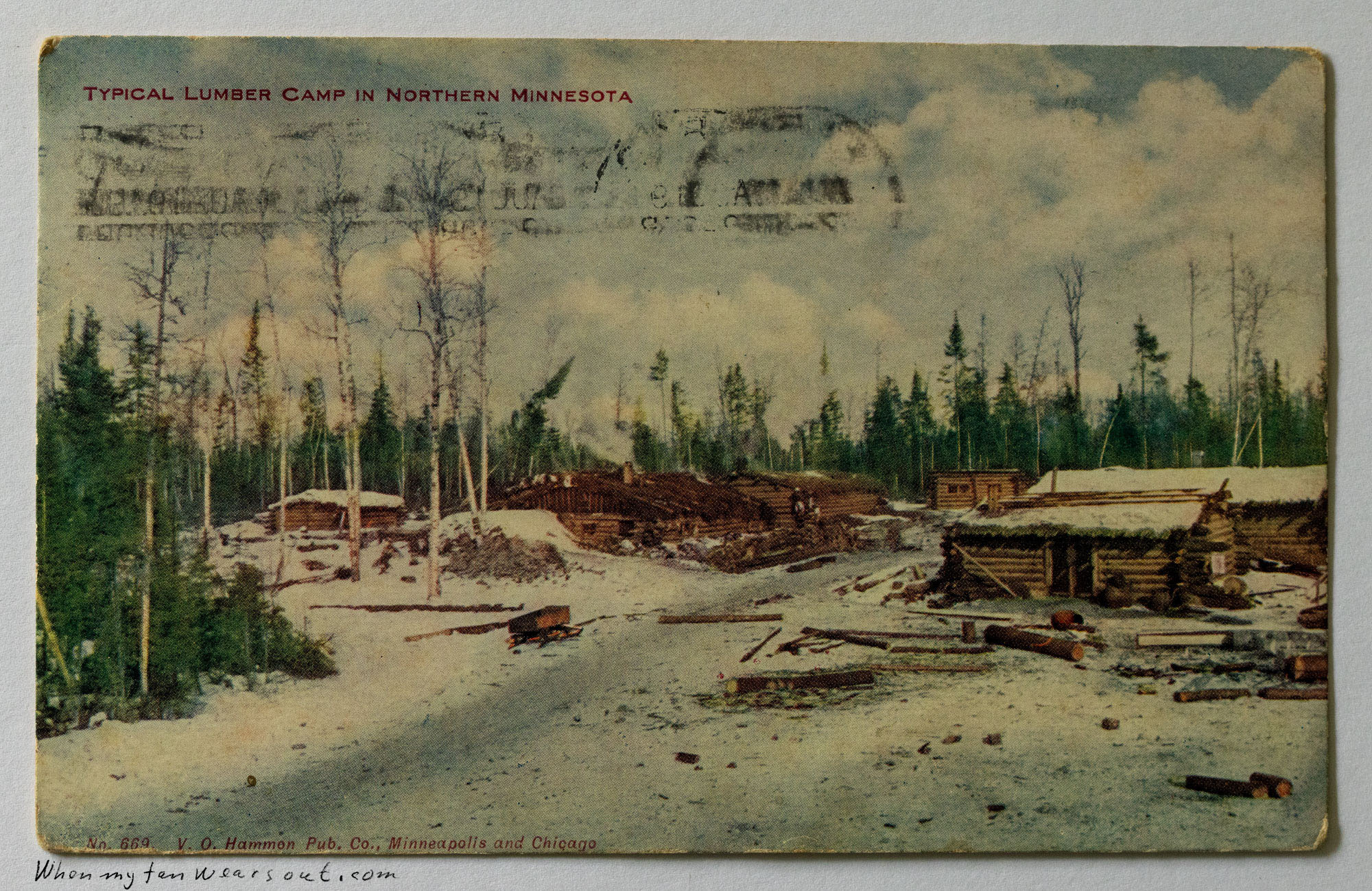
Postcard #0027: Snowy Northern Minnesota Lumber Camp


Hand-colored postcard depicting a snowy lumber camp in Northern Minnesota with log cabins, stacked timber, and bare trees under a cloudy sky, titled
Front — A snowy scene of a typical lumber camp in Northern Minnesota with log cabins and felled trees.

Postcard Metadata


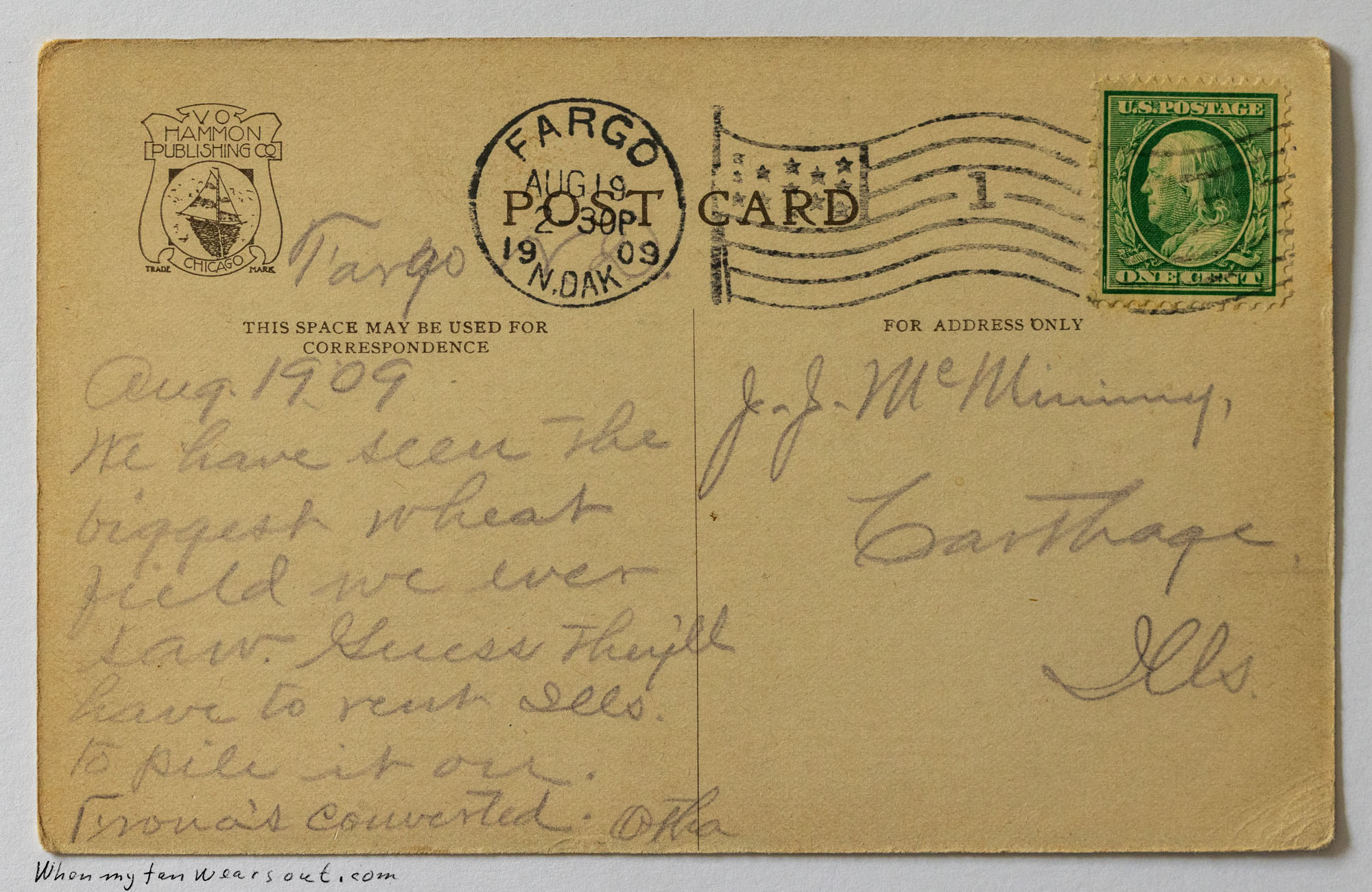
The back of the postcard features a Fargo, North Dakota postmark from August 19, 1909, a green one-cent Benjamin Franklin stamp, and a handwritten message about seeing a large wheat field and
Back — Correspondence from (unknown sender) to J. F. McMinnimy

Transcription

Aug. 19. 09. We have seen the biggest wheat field we ever saw. Guess they’ll have to rent silos to pile it on. Trona’s converted. O.K.

Historical & Family Notes

This postcard offers a glimpse into early 20th-century travel and industry, depicting a harsh winter scene from a Northern Minnesota lumber camp. While the postcard itself showcases an industrial snapshot, the message on the reverse speaks of agricultural abundance in North Dakota, noting an impressively large wheat field and the sender’s amusement at its size.

Notably, this particular postcard is not addressed to Pearl Byers or Harvey Sights, unlike many others in the collection. Instead, it is sent to J. F. McMinnimy in Carthage, Illinois, suggesting it was acquired into the family collection through means other than direct correspondence between Pearl and Harvey. This card likely entered the collection as an artifact of broader family connections or local historical interest.

The message’s casual tone, “Trona’s converted. O.K.”, hints at an ongoing personal narrative or shared understanding between the sender and recipient, a common feature of informal postcard exchanges of the era, conveying news that would have been significant to the immediate circle.

Continue Reading

Postcard #0023: The Home of Mahala in Rural Kansas


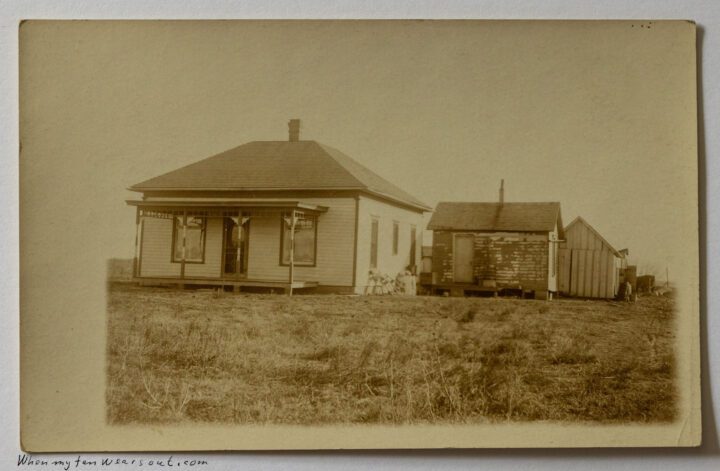
A sepia-toned vintage photograph depicting a modest, single-story wooden house with a front porch and two smaller wooden outbuildings to its right, set in a sparse grassy field under a pale sky.
Front — A sepia-toned photograph of a rural home with a porch and two smaller outbuildings under a clear sky.

Postcard Metadata


The divided back of an old postcard with a handwritten message in cursive, addressed to
Back — Correspondence from Mahala to Miss Pearl Byers

Transcription

Dear Pearl I will send you the picture of the place where we live and thank you for the pretty post cards you sent me. Goodby Mahala.

Historical & Family Notes

This postcard offers a glimpse into Pearl Byers’ wider network of friends and family beyond Harvey Sights, showing her engaging in the common practice of postcard exchange. The sender, Mahala, shares an image of “the place where we live,” indicating a personal connection and a desire to share her current surroundings with Pearl. The picture likely depicts Mahala’s home in Lebanon, Kansas, a simple but sturdy dwelling typical of rural Midwestern life in the early 20th century.

The message reveals Pearl herself was an active sender of postcards, with Mahala thanking her for the “pretty post cards.” This reciprocal exchange highlights the social role of postcards as a primary means of staying connected and sharing snippets of life across distances before the advent of more modern communication technologies. While this specific card is not from Harvey Sights, it nonetheless enriches the narrative of Pearl’s life by illustrating her connections with others during the period when her relationship with Harvey was developing.

Continue Reading

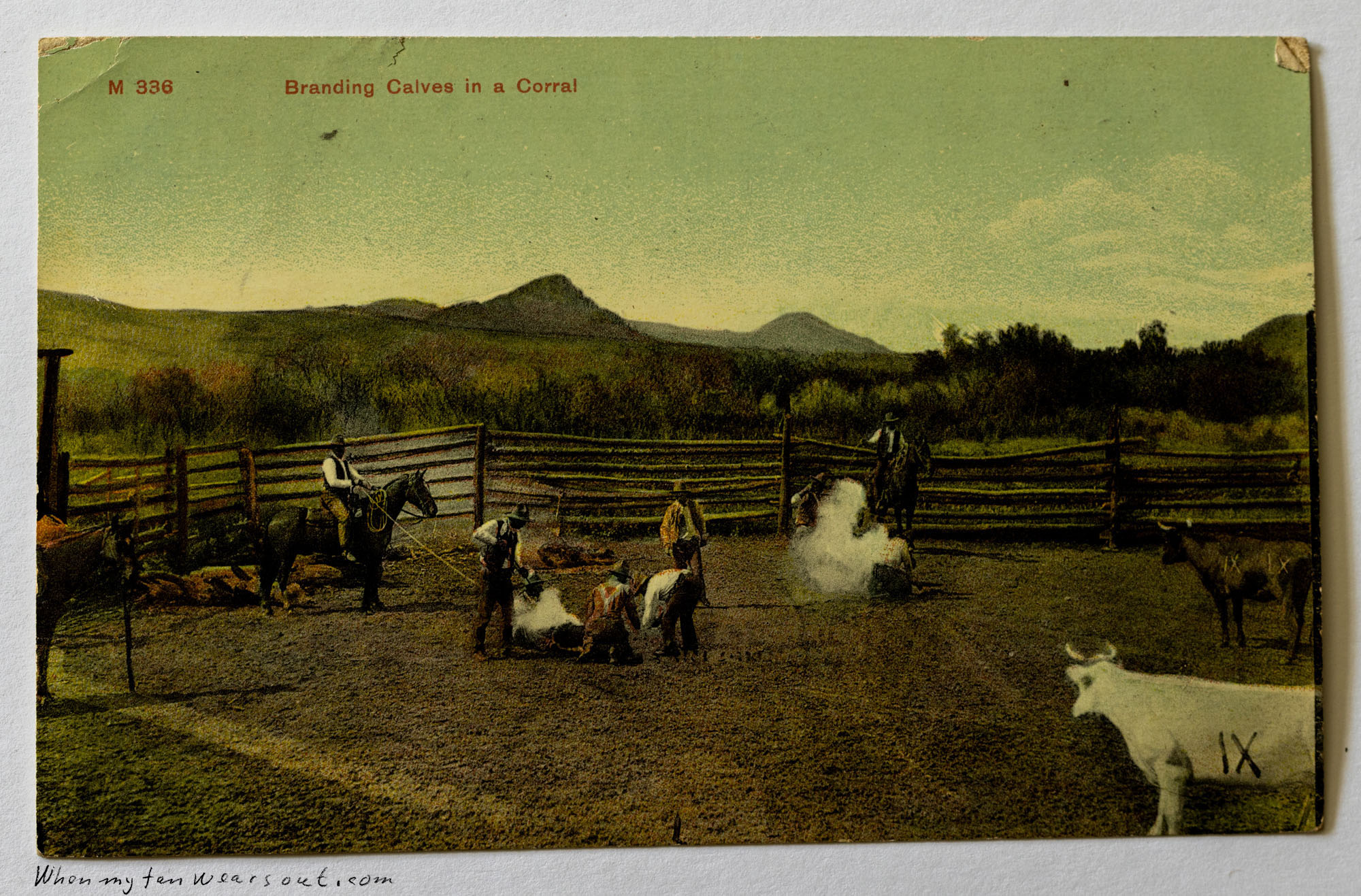
Postcard #012: Martha Asks Pearle About Getting Married Amidst Calf Branding Scene


Hand-tinted vintage postcard depicting a group of cowboys and ranch hands branding calves in a dusty outdoor corral. Several men are on horseback, while others are on foot, wrestling calves to the ground. Smoke rises from hot branding irons. A large white cow with the brand 'IX' on its side is visible in the foreground. Rolling hills and distant mountains are in the background under a blue-green sky.
Front — A vintage hand-tinted postcard showing cowboys branding calves in a rustic corral with mountains in the background.

Postcard Metadata


The back of an old postcard with a handwritten message in cursive ink from 'Martha' to 'Miss Pearle Byers' in Carthage, Illinois. The message discusses news, marriage, and friendly chiding. A green one-cent Benjamin Franklin U.S. postage stamp is affixed in the upper right corner, partially obscured by a round postmark from Chinook, Montana, dated August 26, 1910. The card is a divided back postcard with 'POST CARD' printed at the top.
Back — Correspondence from Martha to Miss Pearle Byers

Transcription

Dear Kid. well I like that you tell me to write when I’ve written you long ago. Just get busy now and drop me a line. Am very busy just now as I have the debumaker here. Weather just like summer here. I got your card some time ago. How are the boys? So your going to get married? Well I hope to get an invitation. will do likewise well I hadnt be good to your self. If I don’t hear from you soon will write. Loving by Martha.

Historical & Family Notes

This postcard offers a glimpse into Pearle Byers’ life before her marriage to Harvey Sights, hinting at the social expectations and personal developments of the era. Martha’s lighthearted yet direct inquiry about Pearle “getting married” suggests that Pearle was of marrying age and that such news might have been anticipated or rumored within their social circle, setting a significant context for her eventual union.

The message from Chinook, Montana, contrasts sharply with the rustic ranching scene on the card’s front, demonstrating the widespread use of postcards for maintaining distant friendships across vast American landscapes. While the card doesn’t mention Harvey directly, it frames Pearle’s life at a pivotal time when discussions of marriage would have been common, providing a subtle precursor to her future with Harvey.

The sender, Martha, playfully chides Pearle for not writing back sooner, indicating a close, informal relationship. Her closing remarks, “well I hadnt be good to your self. If I don’t hear from you soon will write,” reinforce the bond and the casual but consistent nature of their correspondence, a testament to the role postcards played in connecting people across vast distances in the early 20th century.

Continue Reading