Postcard #0027: Snowy Northern Minnesota Lumber Camp


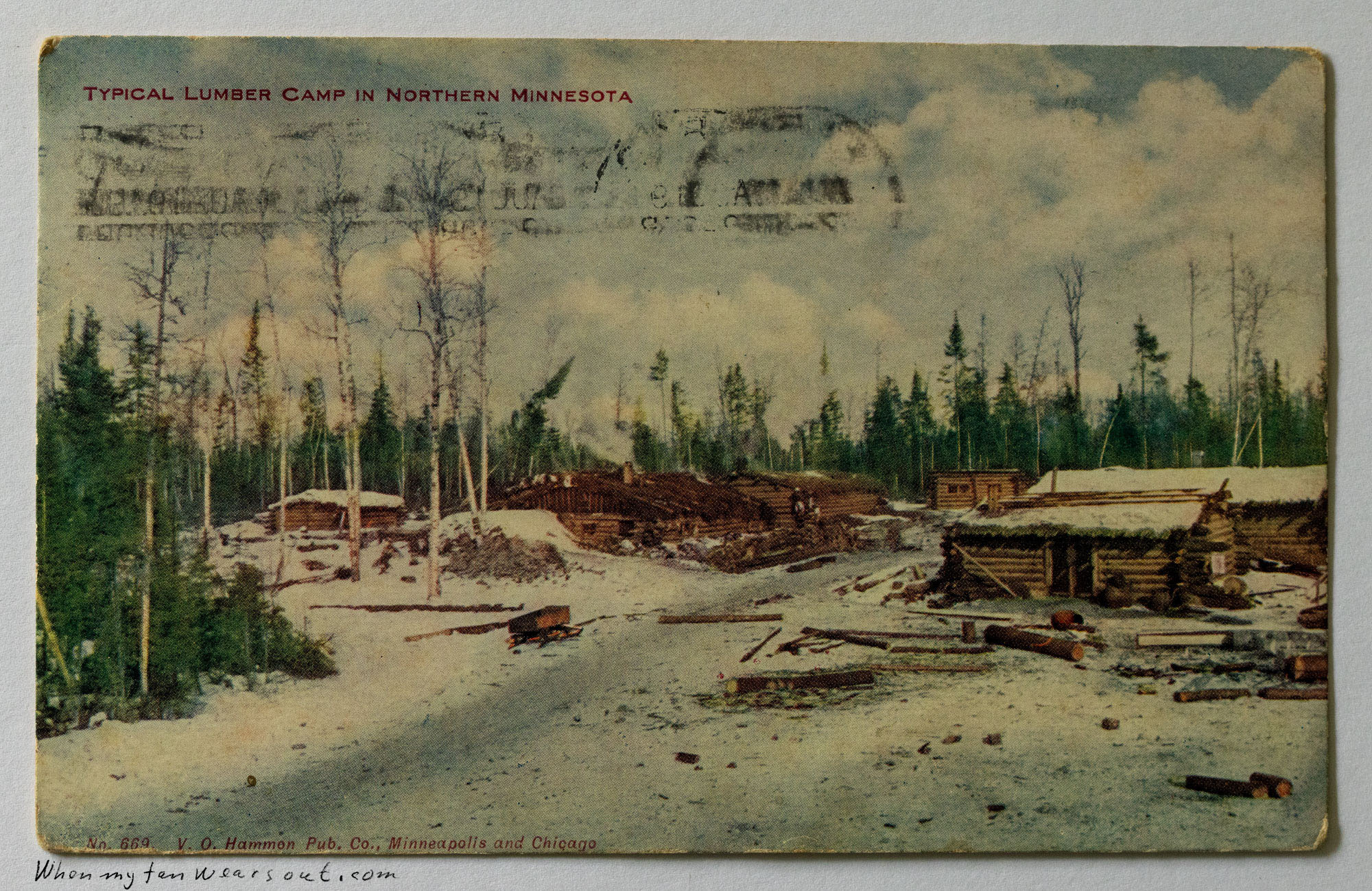
Hand-colored postcard depicting a snowy lumber camp in Northern Minnesota with log cabins, stacked timber, and bare trees under a cloudy sky, titled
Front — A snowy scene of a typical lumber camp in Northern Minnesota with log cabins and felled trees.

Postcard Metadata


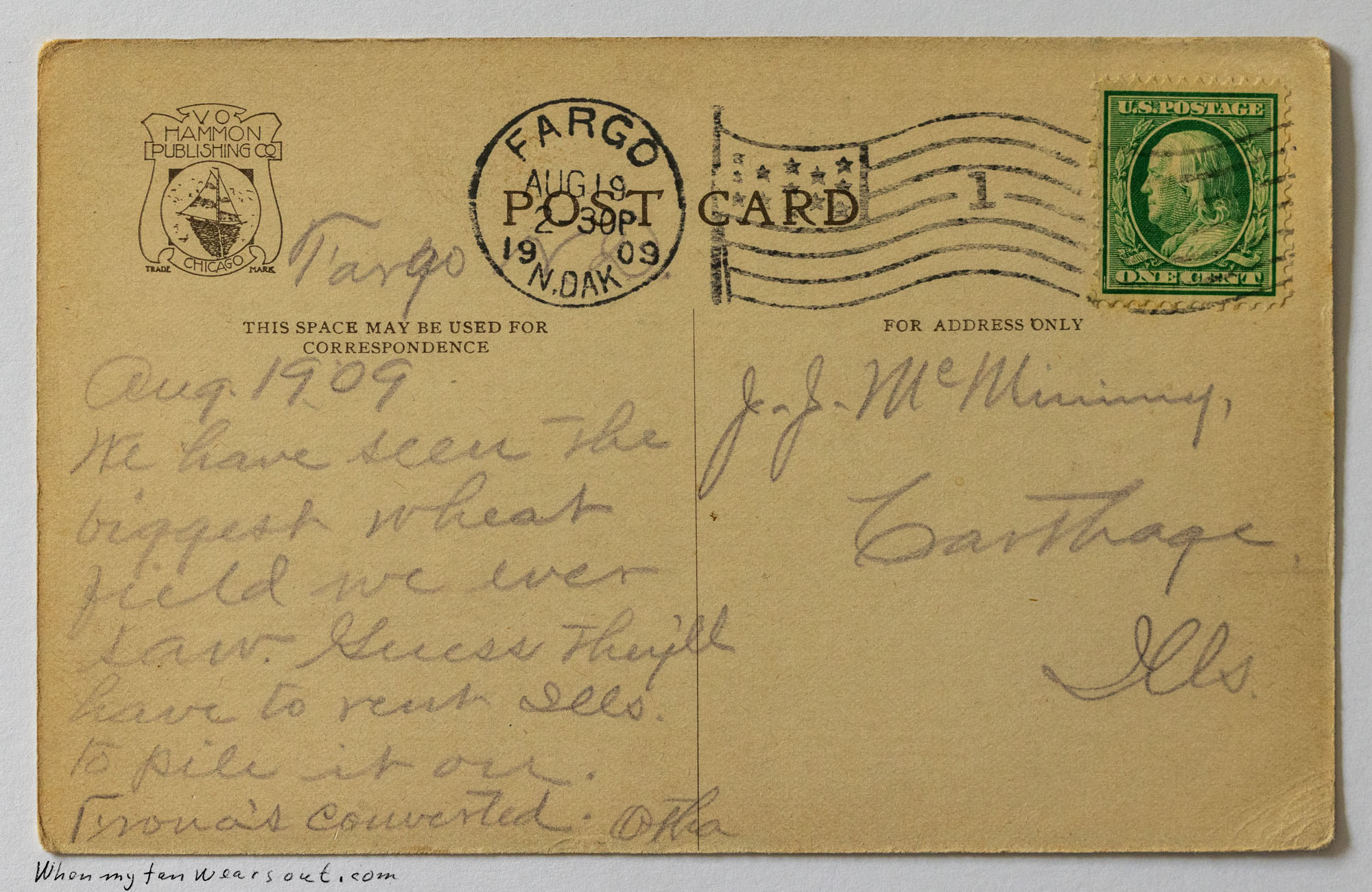
The back of the postcard features a Fargo, North Dakota postmark from August 19, 1909, a green one-cent Benjamin Franklin stamp, and a handwritten message about seeing a large wheat field and
Back — Correspondence from (unknown sender) to J. F. McMinnimy

Transcription

Aug. 19. 09. We have seen the biggest wheat field we ever saw. Guess they’ll have to rent silos to pile it on. Trona’s converted. O.K.

Historical & Family Notes

This postcard offers a glimpse into early 20th-century travel and industry, depicting a harsh winter scene from a Northern Minnesota lumber camp. While the postcard itself showcases an industrial snapshot, the message on the reverse speaks of agricultural abundance in North Dakota, noting an impressively large wheat field and the sender’s amusement at its size.

Notably, this particular postcard is not addressed to Pearl Byers or Harvey Sights, unlike many others in the collection. Instead, it is sent to J. F. McMinnimy in Carthage, Illinois, suggesting it was acquired into the family collection through means other than direct correspondence between Pearl and Harvey. This card likely entered the collection as an artifact of broader family connections or local historical interest.

The message’s casual tone, “Trona’s converted. O.K.”, hints at an ongoing personal narrative or shared understanding between the sender and recipient, a common feature of informal postcard exchanges of the era, conveying news that would have been significant to the immediate circle.

Continue Reading

Postcard #0026: Roosevelt’s Cabin and a Baptism Reminder from Fargo


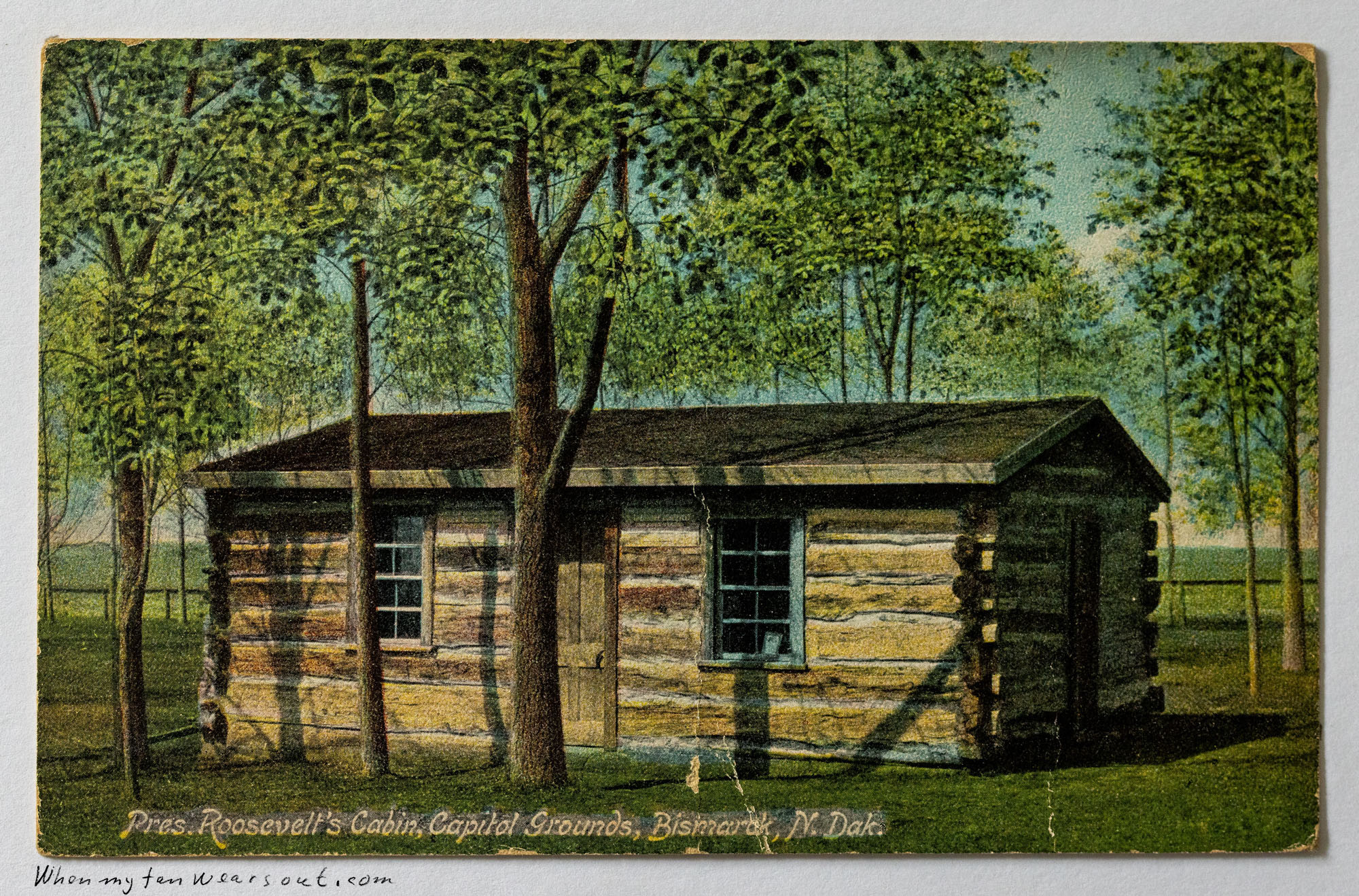
A vintage colorized postcard showing President Theodore Roosevelt's log cabin on the Capitol Grounds in Bismarck, North Dakota. The rustic cabin is made of horizontal logs with two windows and a door, nestled among numerous green trees under a bright blue sky.
Front — A colorized postcard image of President Theodore Roosevelt’s log cabin on the Capitol Grounds in Bismarck, North Dakota, surrounded by trees.

Postcard Metadata


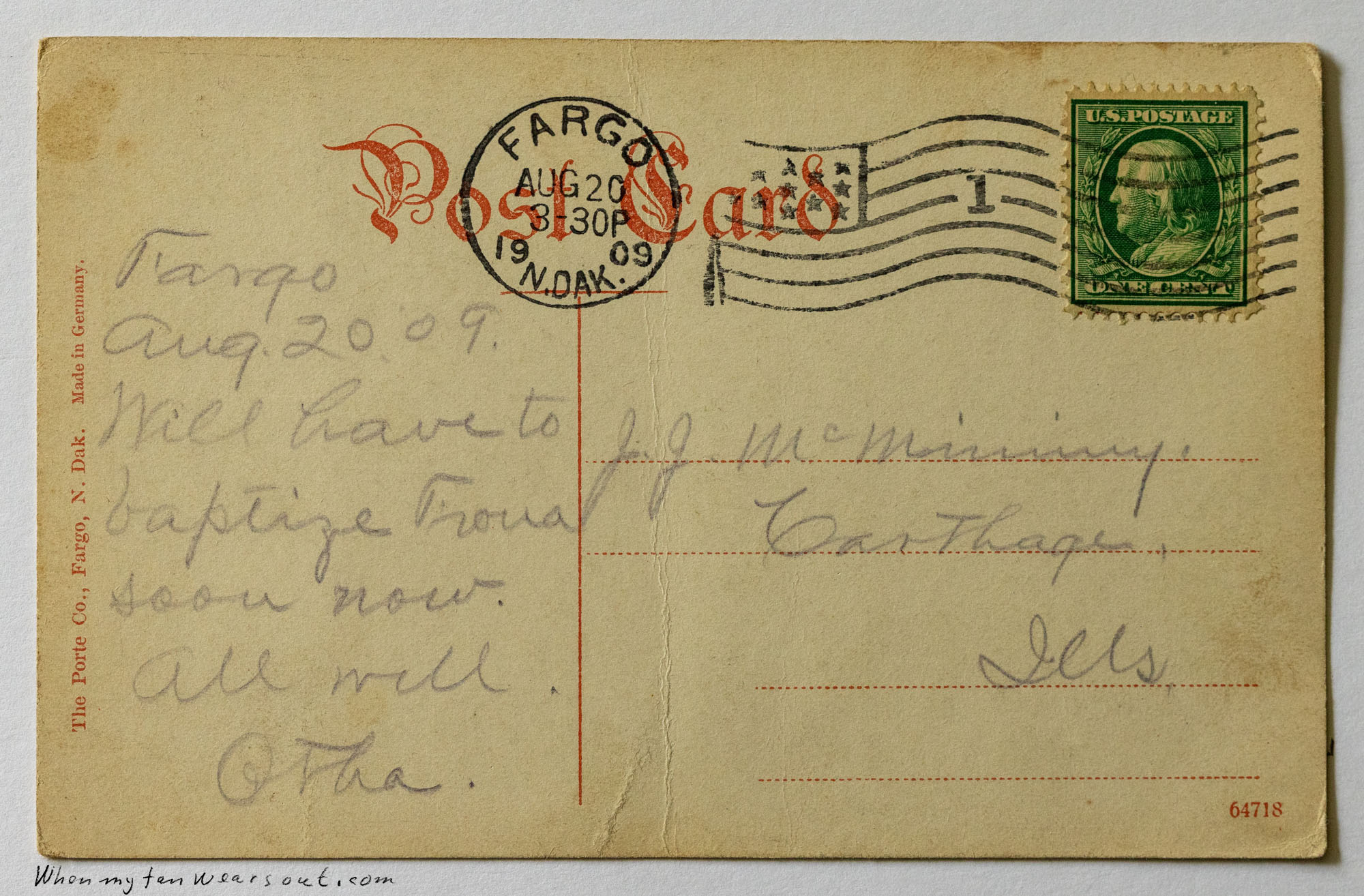
The back of a 1909 divided-back postcard with a green one-cent George Washington stamp postmarked Fargo, North Dakota, August 20, 1909. Handwritten in cursive is a message from 'Otha' to 'Miss J.D. McMinniny' in Carthage, Illinois, discussing a baptism.
Back — Correspondence from Otha to Miss J.D. McMinniny

Transcription

Fargo Aug. 20. 09. Will have to baptize Fronna soon now. All well. OTha.

Historical & Family Notes

This postcard, sent from Fargo, North Dakota, by “Otha” to Miss J.D. McMinniny in Carthage, Illinois, offers a snapshot of life in 1909. While the recipient is not Pearl Byers, the destination of Carthage, Illinois, links this card to Pearl’s hometown, suggesting a potential connection through extended family or shared acquaintances within her community. The brief message hints at an upcoming family event, stating, “Will have to baptize Fronna soon now,” indicating a significant personal or religious occasion.

The front of the postcard features a popular historical landmark, President Theodore Roosevelt’s cabin on the Capitol Grounds in Bismarck, North Dakota. Roosevelt’s deep ties to North Dakota through his ranching days made this a recognizable and popular image for early 20th-century postcards, showcasing the historical significance and natural beauty of the region.

The card’s “Made in Germany” notation underscores the global nature of postcard production at the time, with many high-quality, colorized cards being printed abroad for the American market. Such cards provided an efficient way for people to send quick updates and maintain connections across distances, as demonstrated by Otha’s concise but meaningful message.

Continue Reading