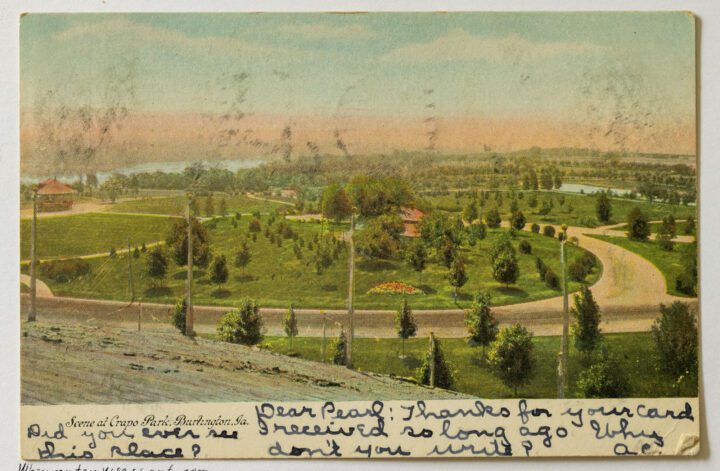
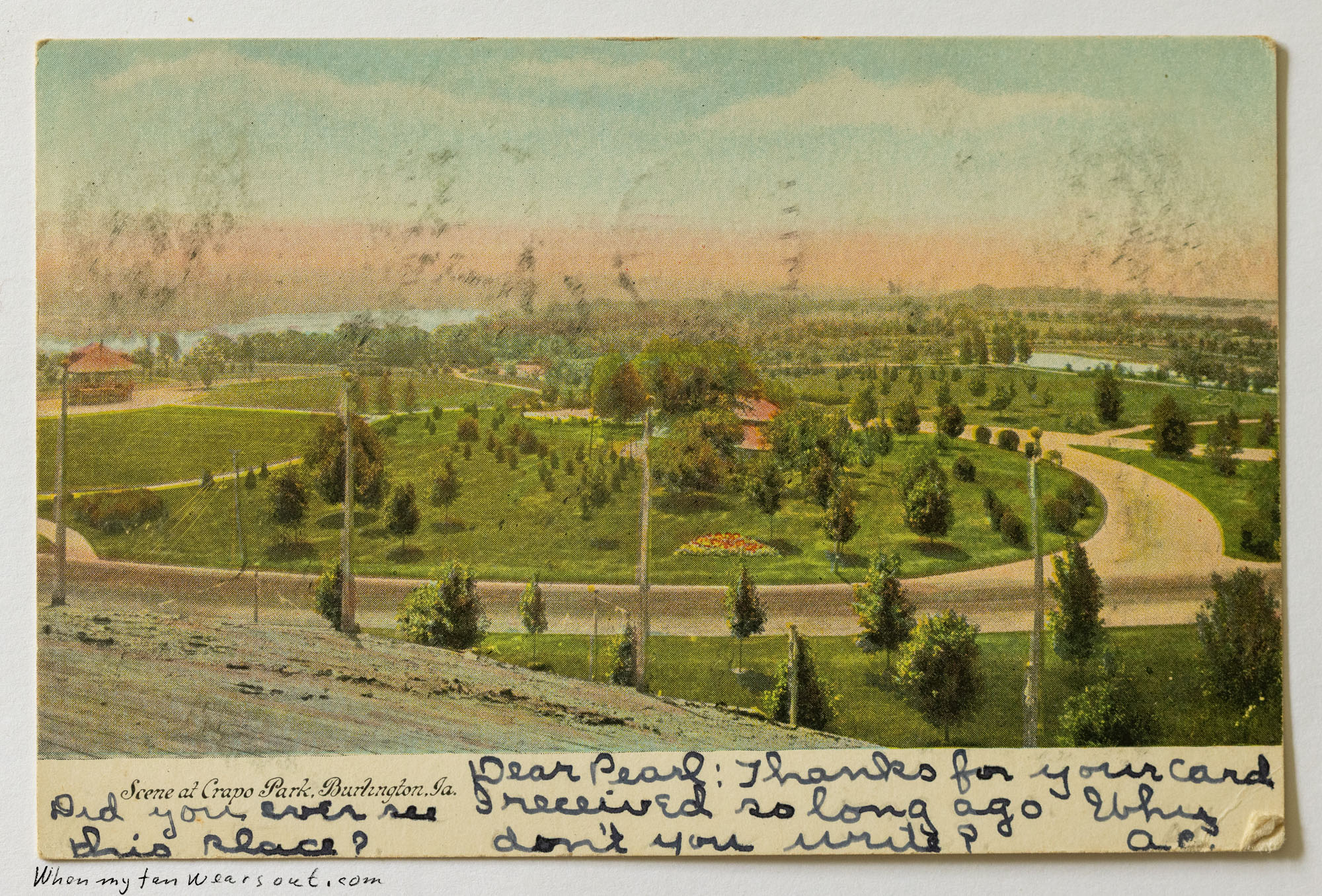
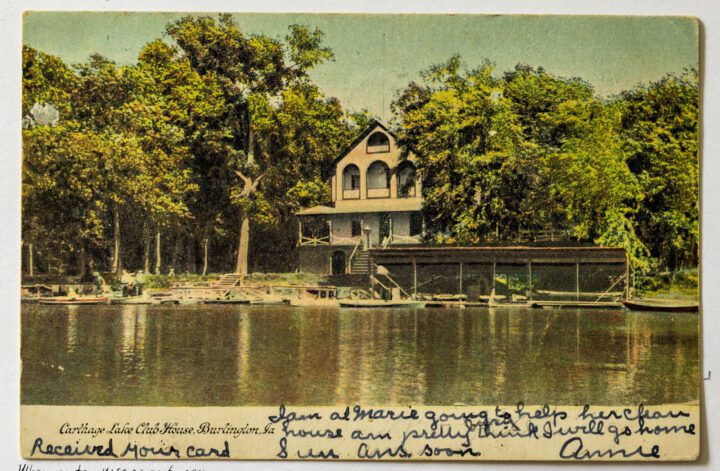
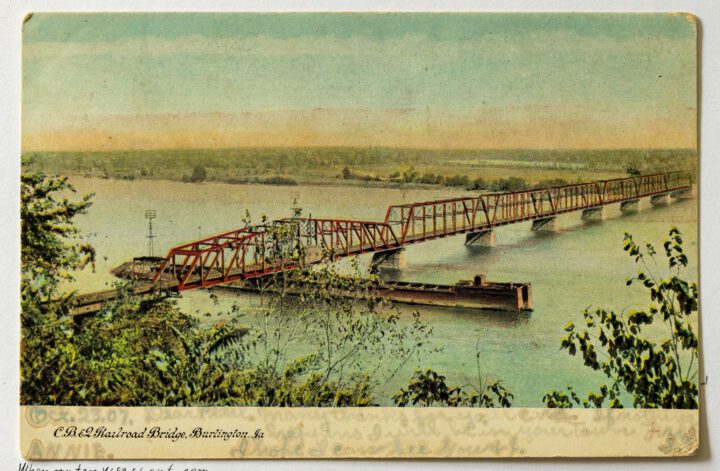
Front — Did you ever see this place? Dear Pearl: Thanks for your card received so long ago Why don’t you write? A C.
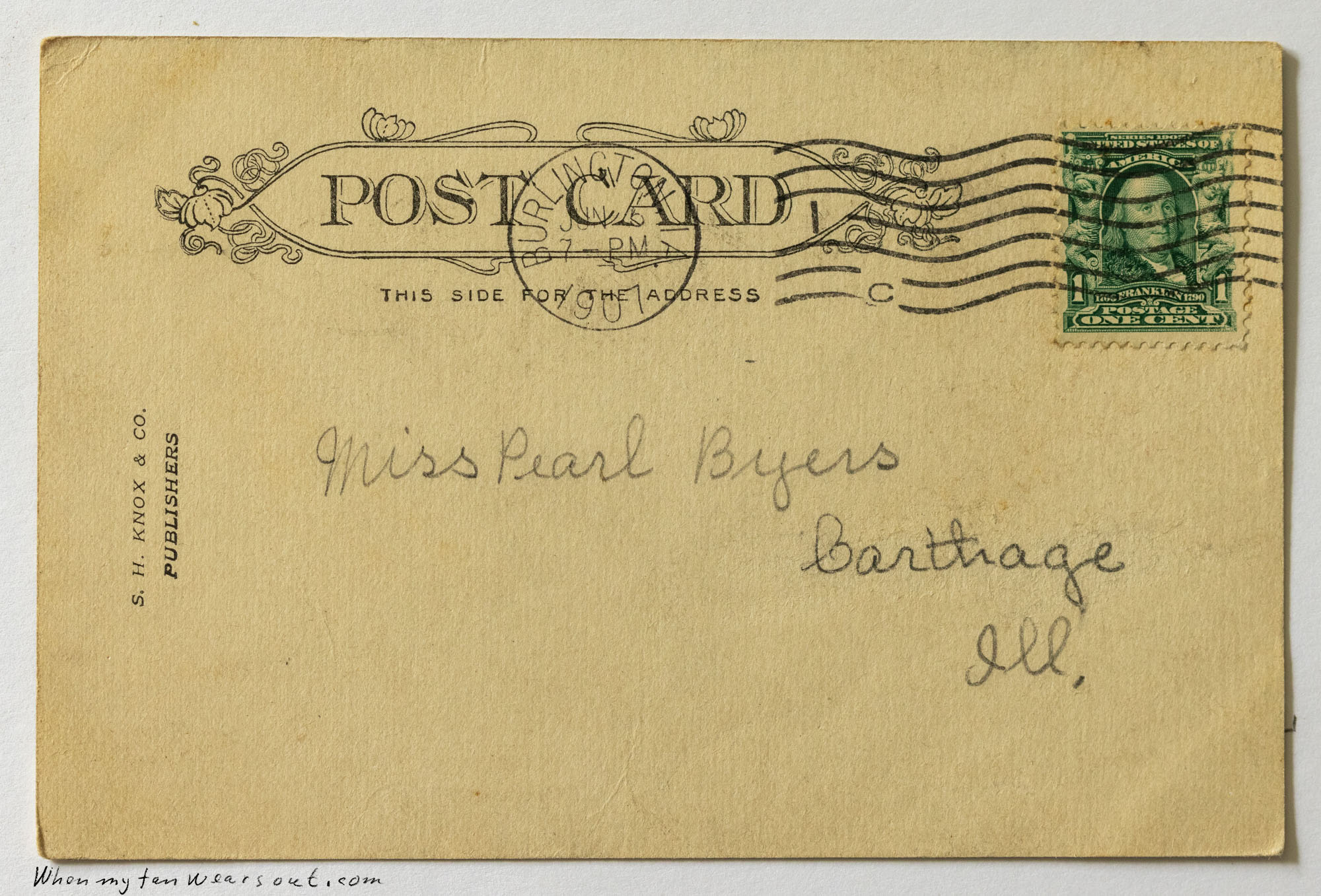
Postcard Information
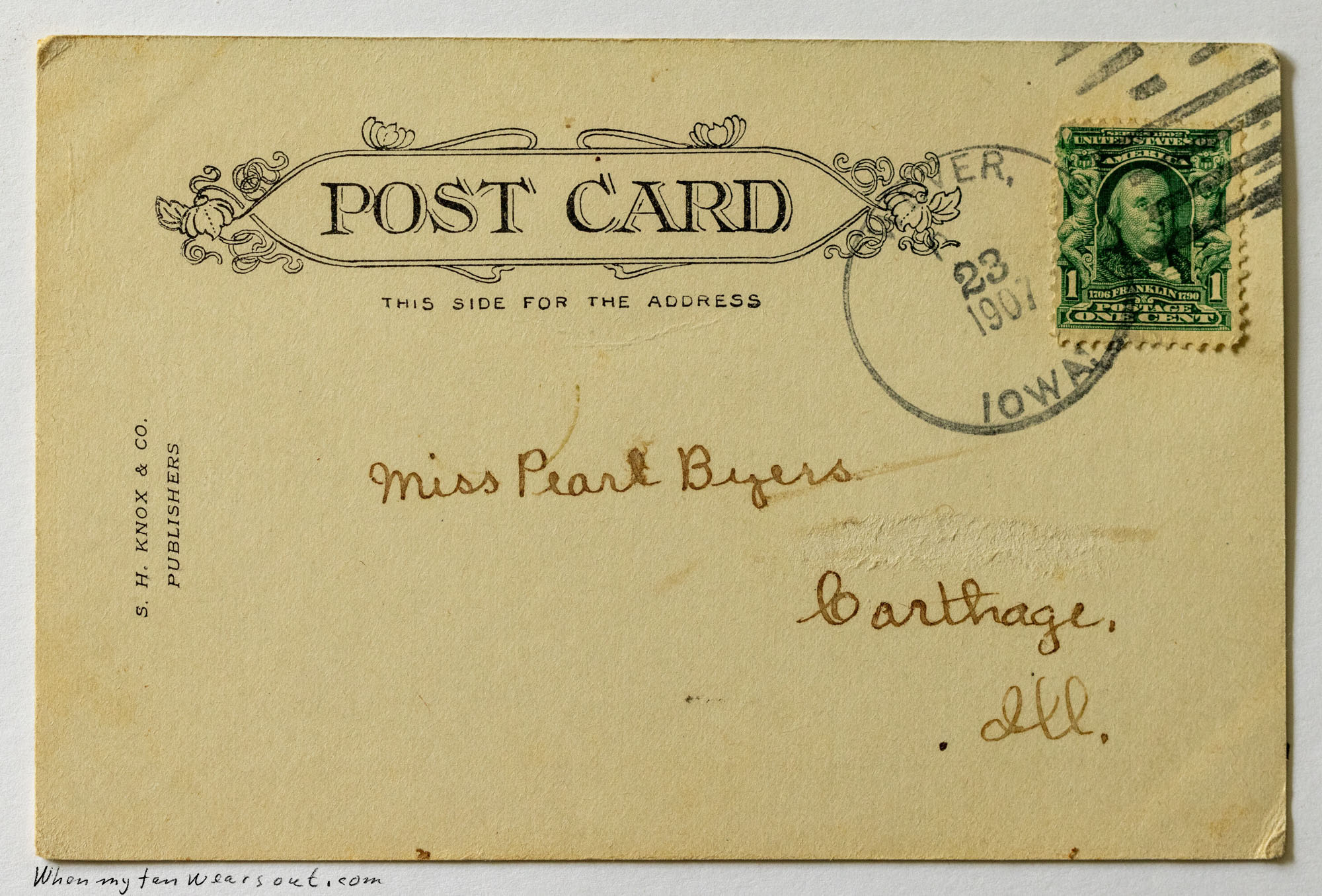
Postmark: Burlington, IA., JUL 27 1907
Sent To: Carthage IL
Era: Undivided Back (Pre-1907)
Publisher: S. H. KNOX & CO.
Stamp: 1¢
Distance Traveled: ~30 miles
Notes: message written on front instead of back
About This Card
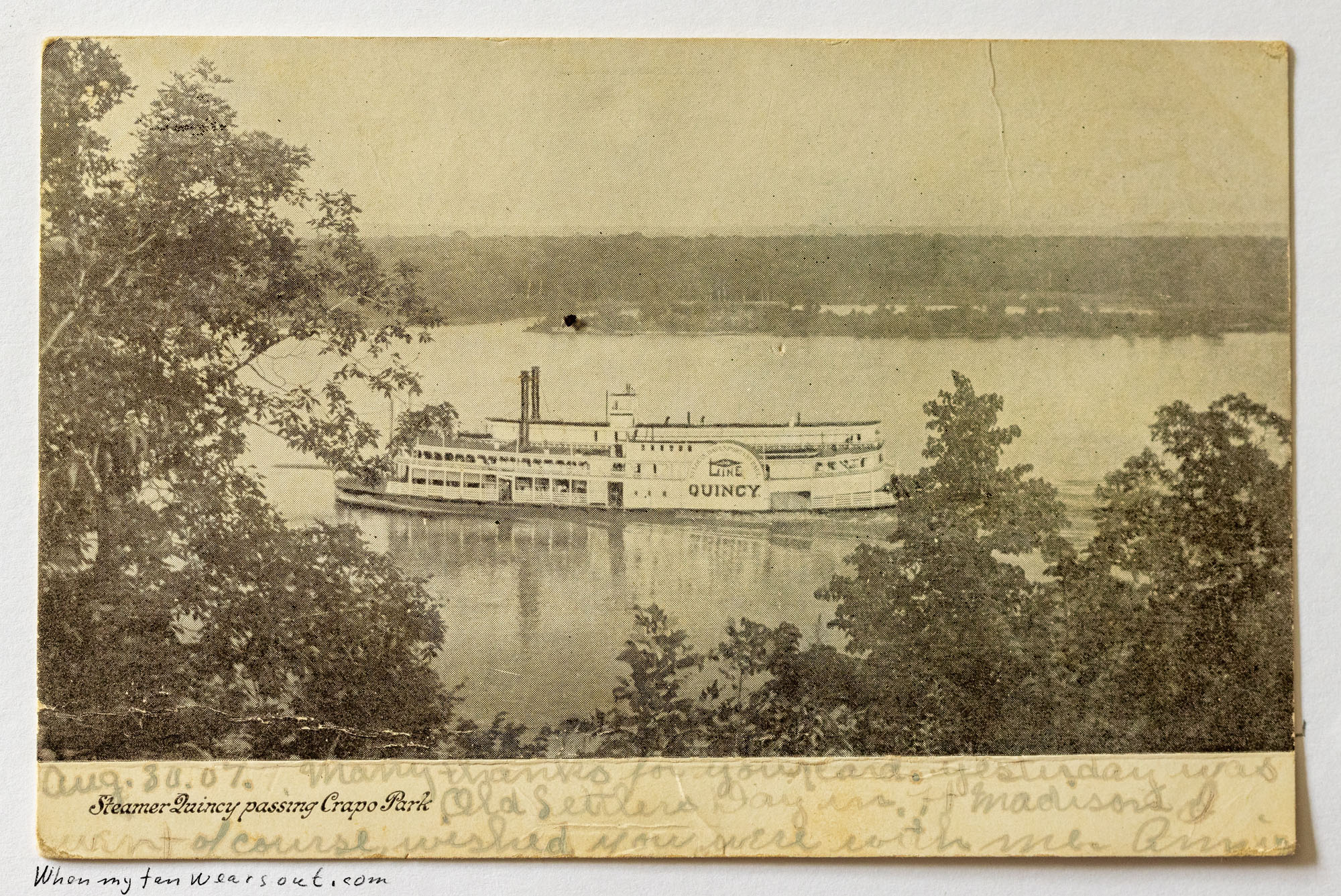
Crapo Park in Burlington, Iowa was donated to the city by the family of Michigan Governor Henry Howland Crapo in the 1890s, developed from land along the bluffs above the Mississippi. By the time A.C. sent this card in July 1907, Crapo Park was already considered one of the finest municipal parks on the upper Mississippi — a winding drive through mature trees above the river, with pavilions, a small zoo, and Black Hawk Spring, a natural spring with a storied Sauk history. Burlington had been a prosperous railroad and manufacturing city since the Civil War, and the park was an expression of that prosperity.
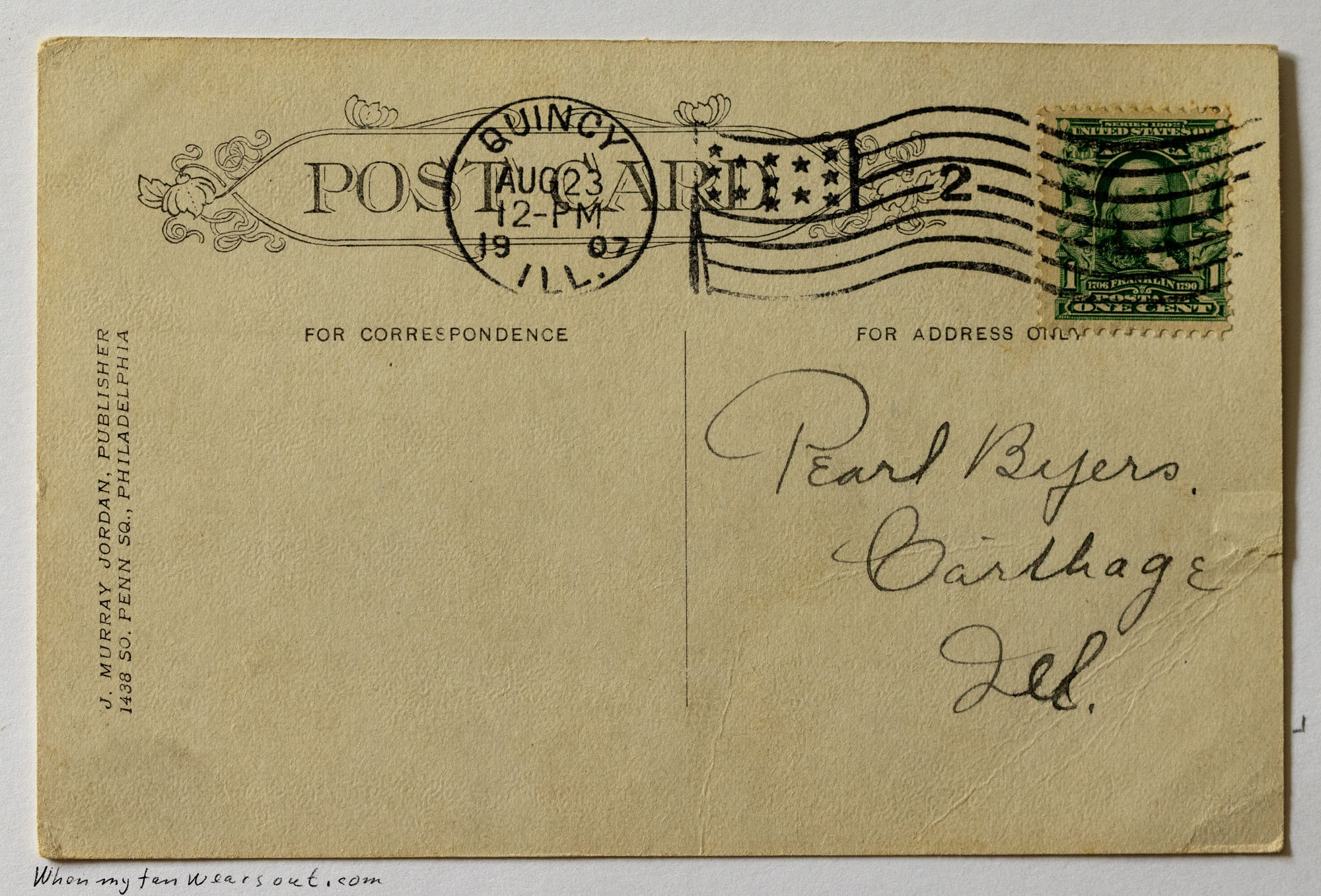
Publisher: J. Murray Jordan, Philadelphia, Pennsylvania
Stamp: 1¢
Distance Traveled: ~35 miles
About This Card
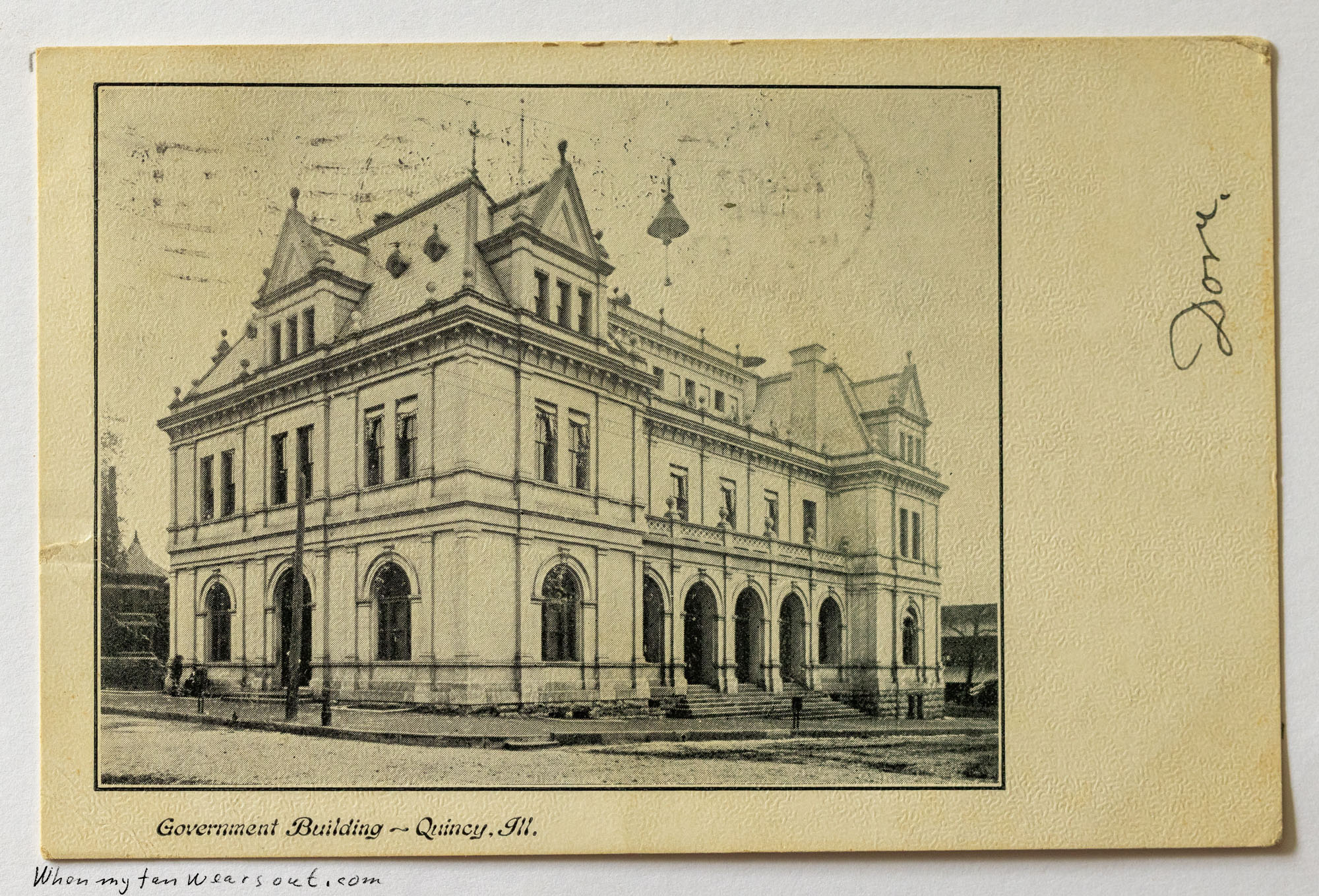
The Government Building on Maine Street in Quincy — serving as both post office and federal courthouse — was completed in 1888 and represented one of the most substantial federal investments in the region. Quincy’s position on the Mississippi River had made it an important commercial center since the 1840s, but by 1907 the railroads had long since reorganized traffic patterns and the city’s relative importance had begun to decline.
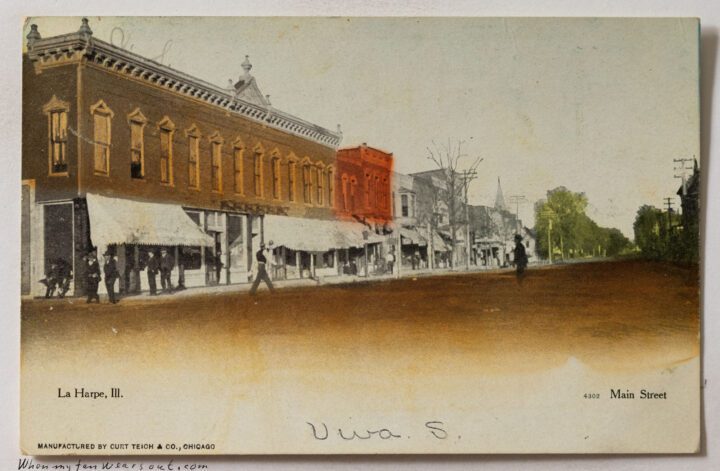
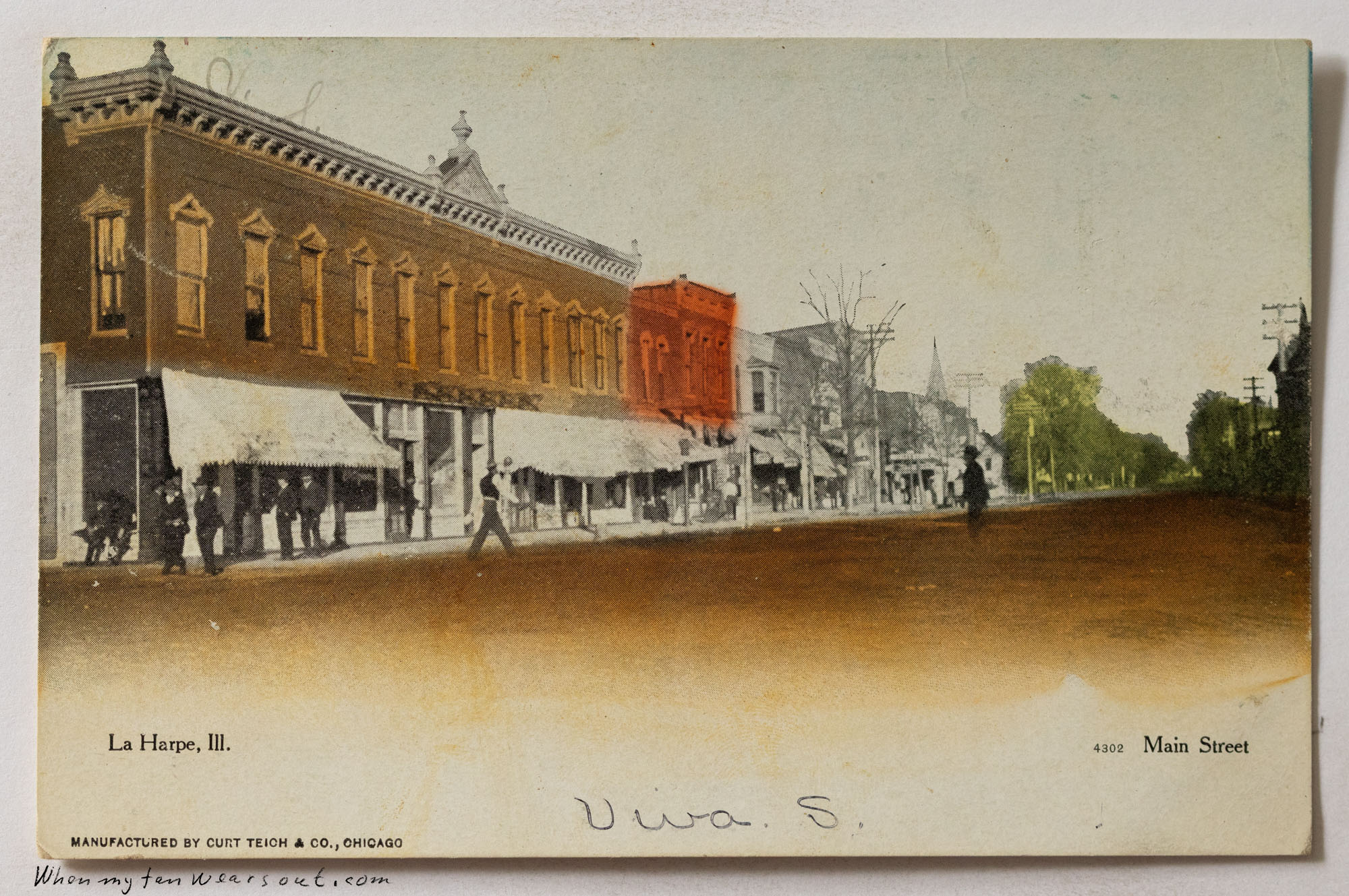
Front — A bustling view of Main Street in La Harpe, Illinois, featuring storefronts with awnings and a partially colorized brick building.
Postcard Metadata
Postmarked: Burnside, IL — June 20, 1907
Sent From: Burnside, Illinois
Sent To: Miss Pearle Byers, Carthage, Ill.
Distance Traveled: Approximately 11 miles
Postage: U.S. One Cent (Franklin)
Card Details: Undivided Back era (1901-1907), manufactured by Curt Teich & Co., Chicago
Back — Correspondence from Viwa S. to Miss Pearle Byers
Transcription
Viwa. S.
Historical & Family Notes
This early postcard, sent to the young Miss Pearle Byers, offers a quick glimpse into her social world during her formative years. The card features a common street scene of the era from nearby La Harpe, Illinois, a familiar type of imagery used for brief communications. The message, simply “Viwa. S.” on the front of the card, is characteristic of the concise messages exchanged on undivided back postcards where space for writing was limited.
Originating from Burnside, a mere 11 miles from Carthage, this card likely came from a local acquaintance or friend, Viwa S., whose brief greeting is preserved in this collection. These everyday interactions paint a picture of Pearl’s life before her marriage to Harvey Sights, highlighting the connections she maintained within her immediate community.
The postcard itself is an excellent example of the transitional period in postcard history. Though postmarked in June 1907, after divided backs were permitted, its layout with “NOTHING BUT THE ADDRESS ON THIS SIDE” firmly places it stylistically within the Undivided Back era, suggesting an older card still in circulation.
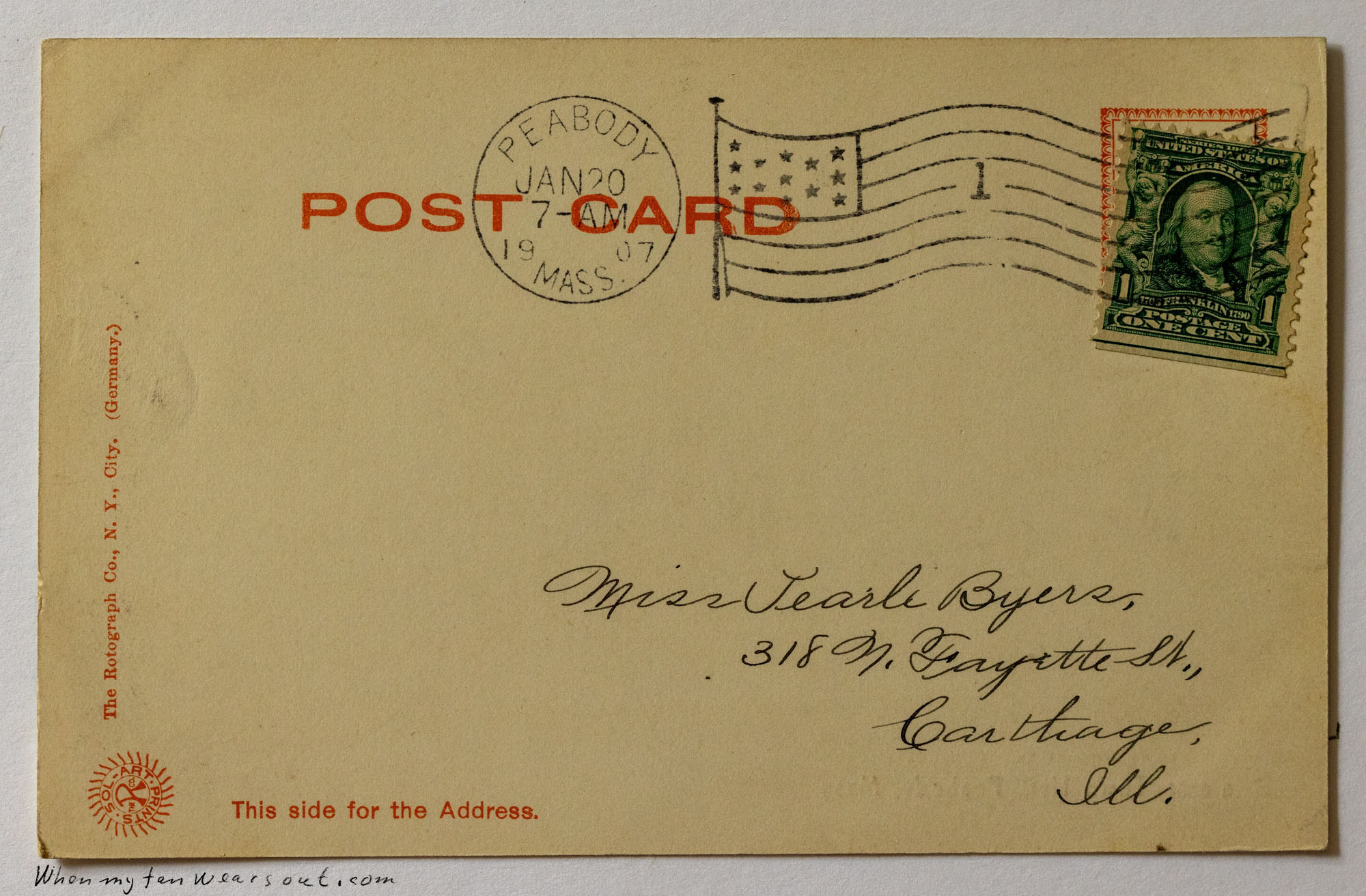
Front — A hand-colored postcard depicting the brick Town Hall of Peabody, Massachusetts, with a large tree on the left.
Postcard Metadata
Postmarked: Peabody, Massachusetts — January 20, 1907
Sent From: Peabody, Massachusetts
Sent To: Miss Pearle Byers, 318 N. Fayette St., Carthage, Ill.
Distance Traveled: Approximately 1,050 miles
Postage: One Cent U.S. Postage, Franklin (green)
Card Details: Divided Back Era (produced by The Rotograph Co., N. Y., City, Germany; postmarked before the widespread domestic Divided Back adoption in March 1907)
Back — Correspondence from M. M. Powers to Miss Pearle Byers
Transcription
1-18-’07 M. M. Powers.
Historical & Family Notes
This early postcard, dated January 18, 1907, and postmarked January 20, 1907, presents a hand-colored image of the Town Hall in Peabody, Massachusetts. Sent by M. M. Powers to Pearle Byers in Carthage, Illinois, it is unusual in that the only handwritten message beyond the address is the sender’s signature and the date on the front of the card. This suggests a very brief, perhaps casual or purely demonstrative, exchange.
The card is a product of The Rotograph Co., based in New York City but with manufacturing noted as “Germany.” This highlights the significant role of German printers in the early postcard boom in the United States. Its “divided back” design, with a dedicated space for the message and address, was officially sanctioned in the U.S. for domestic postcards starting March 1, 1907. This card, postmarked slightly before that date, indicates it was likely an imported card using the divided back format already popular in Europe, predating the American regulation.
Although the sender isn’t Harvey Sights, this postcard adds another piece to Pearle’s growing collection of correspondence, showcasing her connections across different parts of the country. It captures a moment in her life just a few years before her eventual marriage to Harvey, documenting the diverse array of people who communicated with her during her youth in Carthage.
Front — A hand-colored image depicting the elegant Zwingerhof palace and gardens in Dresden, Germany.
Postcard Metadata
Postmarked: Lebanon, Kansas — January 24, 1907
Sent From: Lebanon, Kansas
Sent To: Pearle Bryers, Carthage, Illinois
Distance Traveled: Approximately 370 miles
Postage: One Cent, Benjamin Franklin (U.S. Series of 1902)
Card Details: Divided Back era (early example, pre-dating the official U.S. divided back standard of March 1, 1907)
Back — Correspondence from Frankie to Pearle Bryers
Transcription
Postkarte. Card and letter recd. will write soon Frankie
Historical & Family Notes
This postcard offers a glimpse into Pearl Byers’s broader social network prior to her marriage to Harvey Sights, as she receives a brief acknowledgment from a sender named Frankie. The early 20th century saw a boom in postcard popularity, with people often sending quick notes like this one rather than full letters. This card, postmarked just over a month before the official start of the Divided Back era in the U.S., showcases an early adoption of the format, allowing for both address and message on the back.
The exotic image of the Zwingerhof in Dresden, Germany, provides a stark contrast to the everyday, concise message from Kansas. It reflects a common practice of the time: using scenic or international cards for purely domestic, informal communication, bridging vast geographical and cultural distances through a simple piece of mail.
While this card doesn’t directly mention Harvey Sights, it helps to paint a more complete picture of Pearl’s life and her connections before her romance with Harvey blossomed. It shows her as a recipient of regular correspondence, illustrating the everyday communication practices of young women in rural America at the turn of the century.
Front — A group of children and a few adults standing outside a one-room schoolhouse with a handwritten message on the left.
Postcard Metadata
Postmarked: Atlanta, Illinois — June 28, 1907
Sent From: Atlanta, Illinois
Sent To: Miss Pearl Byers, Carthage, Ills.
Distance Traveled: Approximately 100 miles (161 km)
Postage: One Cent, U.S. Franklin stamp
Card Details: Divided Back Era (Post Card Act of 1907), message written on front.
Back — Correspondence from Ruth to Miss Pearl Byers
Transcription
This is where I taught while I was a roof mite. Sorry – Ruth
Historical & Family Notes
This charming postcard, sent by “Ruth” to Pearl Byers, offers a vivid snapshot of early 20th-century rural education, depicting a classic one-room schoolhouse. Ruth’s message, “This is where I taught while I was a roof mite,” is a distinctive and intriguing phrase, likely a self-deprecating or affectionate reference to her youth or small stature during her time as a teacher. The photograph captures a group of children and adults, perhaps the students and their families, gathered outside the humble wooden structure.
Postmarked June 28, 1907, the card is an early example from the Divided Back era, which began just months prior with the Post Card Act of 1907 allowing messages on the address side. Despite the new format, Ruth chose to write her message on the front, a common practice during this transitional period as people adapted to the change. The stamp, featuring Benjamin Franklin, further roots the card in its historical context.
While this card does not directly mention Harvey Sights, it provides valuable insight into Pearl Byers’ social circle and the broader world she inhabited before her eventual marriage to Harvey. Correspondence like this from friends and family helps to paint a fuller picture of Pearl’s life experiences and connections during her youth in Carthage, Illinois.
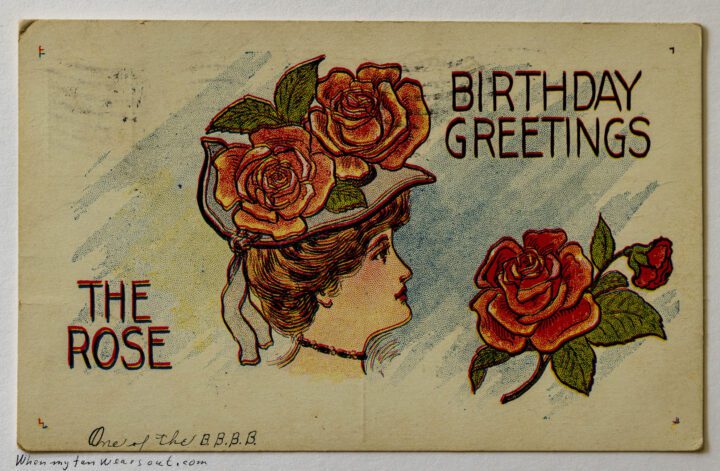
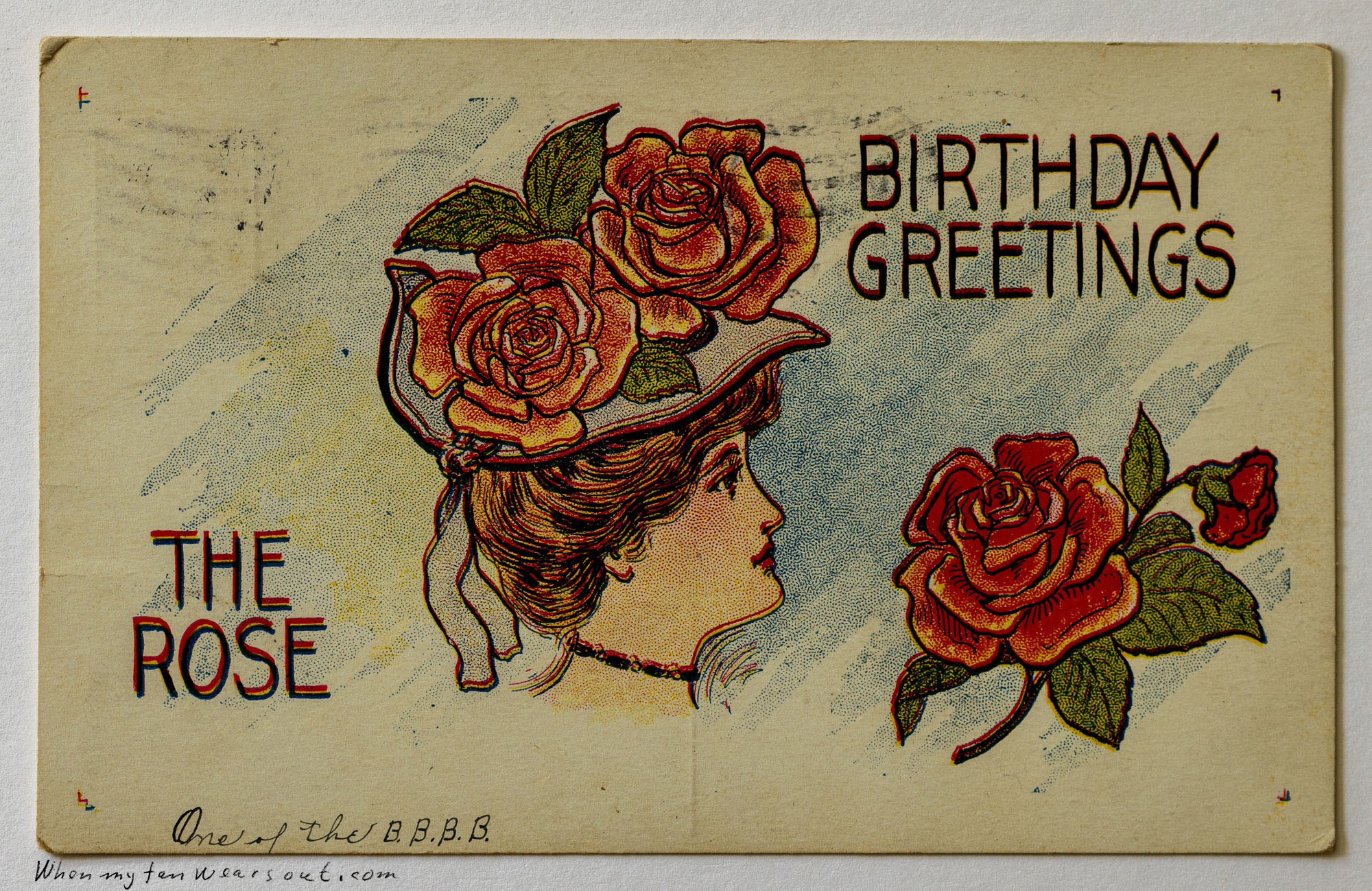
Front — A colorized illustration of a woman in a floral hat featuring roses, with additional roses and the text “THE ROSE” and “BIRTHDAY GREETINGS.”
Postcard Metadata
Postmarked: Quincy, Ill. — December 4, 1907
Sent From: Quincy, Illinois
Sent To: Miss Pearl Byers, Carthage, Ill.
Distance Traveled: Approximately 33 miles
Postage: U.S. Postage One Cent (Benjamin Franklin green stamp)
Card Details: Divided Back era (message on left, address on right, introduced in the U.S. in March 1907)
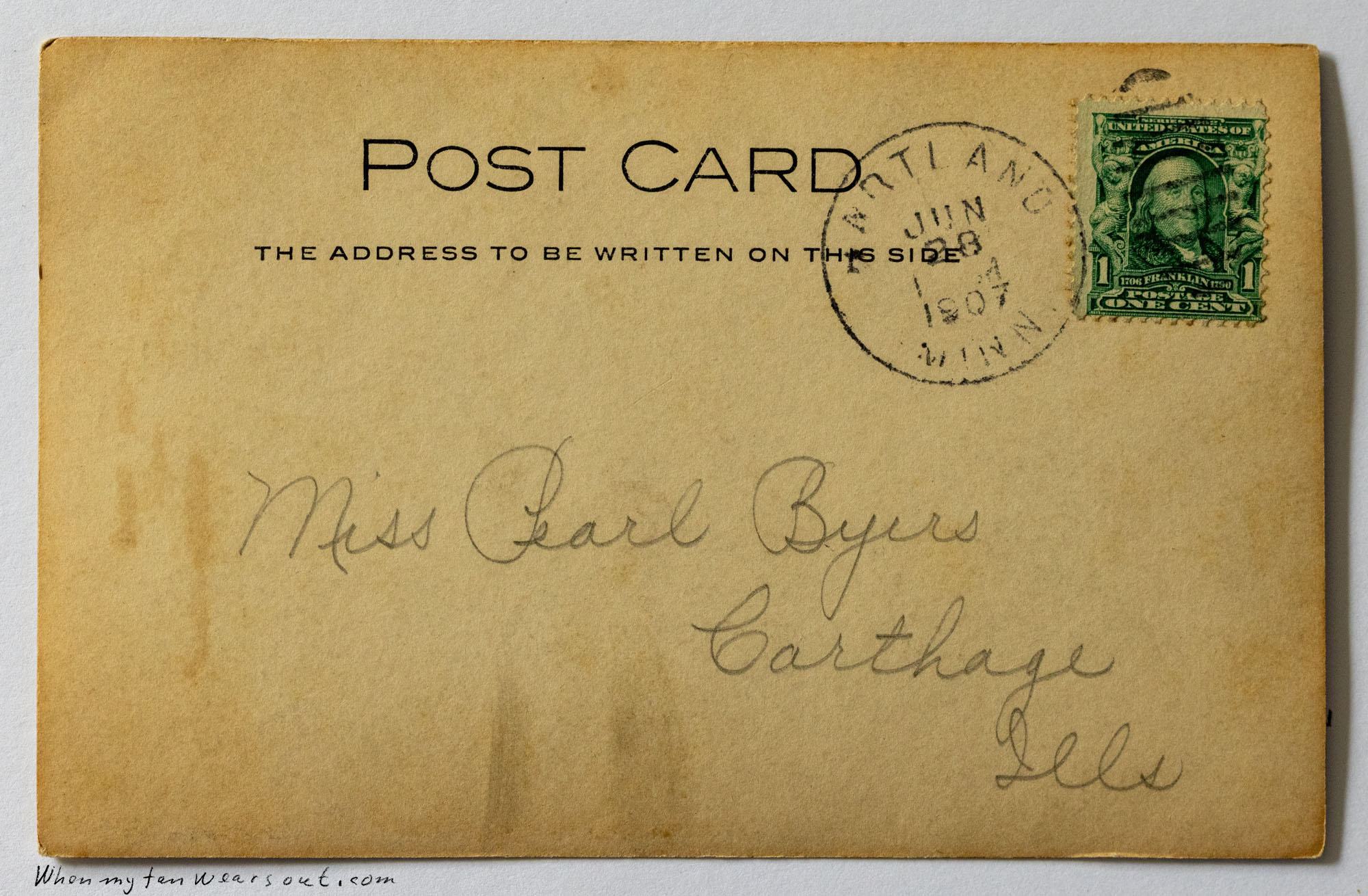
Back — Correspondence from Harvey Sights to Miss Pearl Byers
Transcription
Dec. 4 / 07 Dear Friend:- I suppose you know who this is from don’t you? Hope you have a happy birthday. As Ever. address H. L. Burling Gem City Business College. Quincy, Ill.
Historical & Family Notes
This charming birthday postcard marks Pearl Byers’ special day, December 4th, 1907, with a playful message from her future husband, Harvey Sights. Though he doesn’t explicitly sign his name, the teasing query, “I suppose you know who this is from don’t you?” is a clear indicator of a budding romance and familiarity. The sender provides the address for “H. L. Burling” at the Gem City Business College in Quincy, Illinois, likely where Harvey was studying or residing, using it as a return address for discretion in their early courtship.
The card itself features “The Rose,” a classic symbol of affection and beauty, perfectly chosen for a birthday greeting to a young woman. The postmark confirms it was sent from Quincy on Pearl’s actual birthday, suggesting a thoughtful and timely gesture. This card offers a sweet glimpse into the early stages of their relationship, highlighting the gentle humor and personal connection that would eventually lead to their marriage.
The reference to “H.L. Burling” at Gem City Business College offers a unique historical tidbit. Many young people, including those from rural areas, attended business colleges in larger towns like Quincy to acquire skills for office work. It’s plausible that Harvey was a student there, making this postcard a testament to both his personal affections and his efforts towards building a future.
Front — A yellow “Telegraph Post-Card” with a graphic of a running messenger and a brief handwritten message.
Postcard Metadata
Postmarked: Quincy, Illinois — Oct 26, 1907, 10 A.M.
Sent From: Quincy, Illinois
Sent To: Miss Pearle Byers, 318 N. Fayette St., Carthage, Ill.
Distance Traveled: Approximately 50 miles (80 km)
Postage: One Cent, Benjamin Franklin, green stamp
Card Details: Divided Back era (1907)
Back — Correspondence from Angus B. to Miss Pearle Byers
Transcription
Nº31 Time Sent ____ Oct 27 1907 I am waiting for that letter get Busy M. S. POST CARD Write Message Here Say Pearle I was cer-tainly glad to hear from you. I shot the earth had swallowed you. You certainly sent me a dandy postal. Such I have never seen be-fore. Am well at present hope you are the same. Are hav-ing fine weather. Now Ans-wer soon. The same Old Chump Angus B.
Historical & Family Notes
This early postcard to Pearle Byers features an intriguing dual message. The front, formatted as a “Telegraph Post-Card,” bears a brief, direct note signed “M. S.” with the seemingly urgent instruction, “I am waiting for that letter get Busy.” The date “Oct 27 1907” is handwritten on the front, creating a slight anomaly as the card was postmarked from Quincy, Illinois, on October 26, 1907. This could indicate the handwritten date was a future reminder, or simply a discrepancy in dating.
The reverse side carries a longer, friendly message from “Angus B.,” clearly responding to a previous communication from Pearle: “I was cer-tainly glad to hear from you. I shot the earth had swallowed you. You certainly sent me a dandy postal.” The two distinct messages and signatures on one card suggest it might have been a collaborative effort, or that Angus included a note from a companion. Given that Harvey Sights is a primary character in Pearle’s life story, it is plausible that “M. S.” could be an initialed message from Harvey, possibly M. for a middle name or a playful alias, lending an early glimpse into their developing dynamic.
Angus’s sign-off as “The same Old Chump” adds a touch of affectionate familiarity, suggesting a close relationship, perhaps a cousin or family friend. The card’s early date places it firmly in the courtship period for Pearle, with various individuals sending her notes. The short, demanding “get Busy” from “M. S.” contrasts with Angus’s more jovial tone, hinting at the different relationships Pearle maintained.