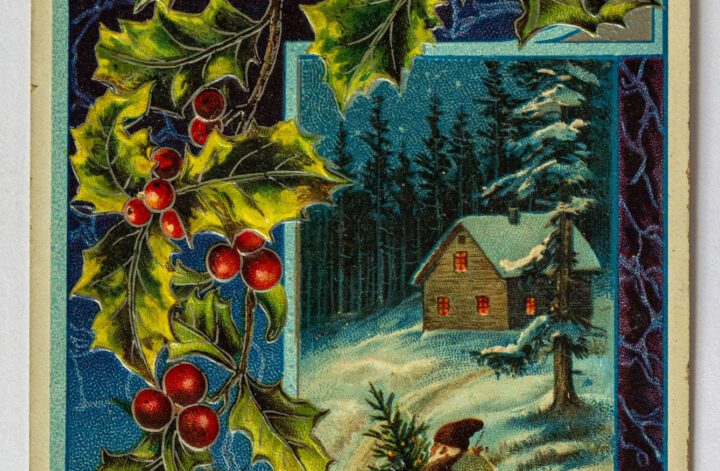
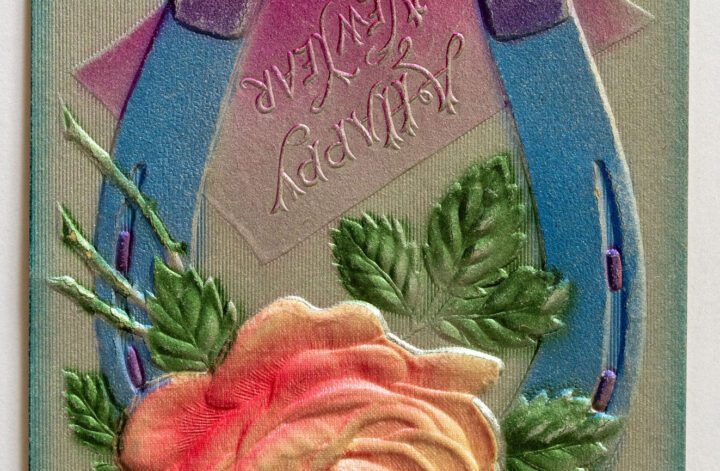
Back — Am mailing you a package now and will mail the other as soon as it comes. Had to order it "dont you, know". This is not a "toast" but heres to hoping the week and Sat night Jan 8 will find Hallie and I on our way to the big city E P B.
Postcard Information
Postmark: Carthage, ILL., DEC 31 1909
Sent To: La Harpe IL
Era: Golden Age (1907–1915)
Stamp: 1¢
Distance Traveled: ~15 miles
Notes: New Year card, handwritten number "#55" on back.
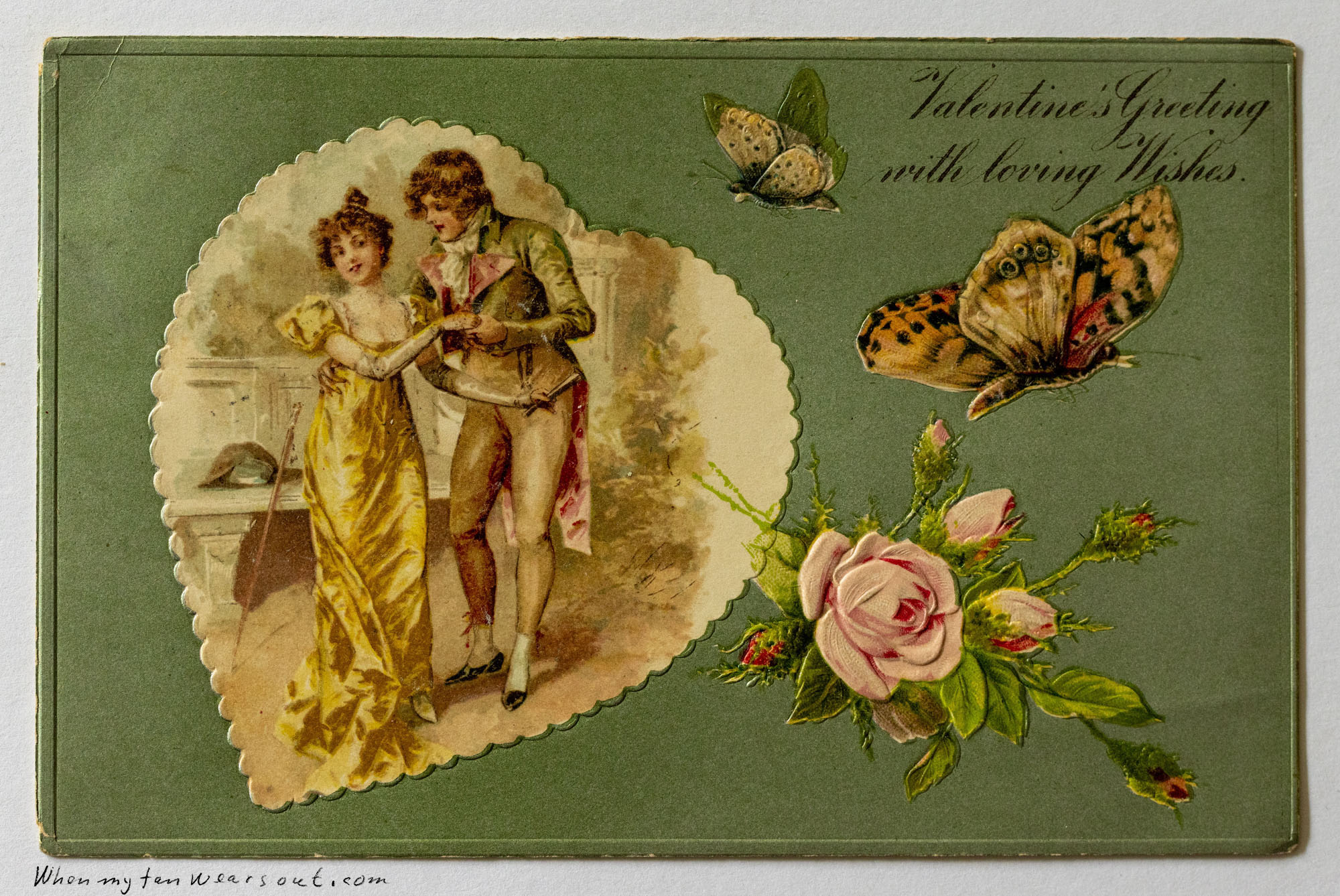
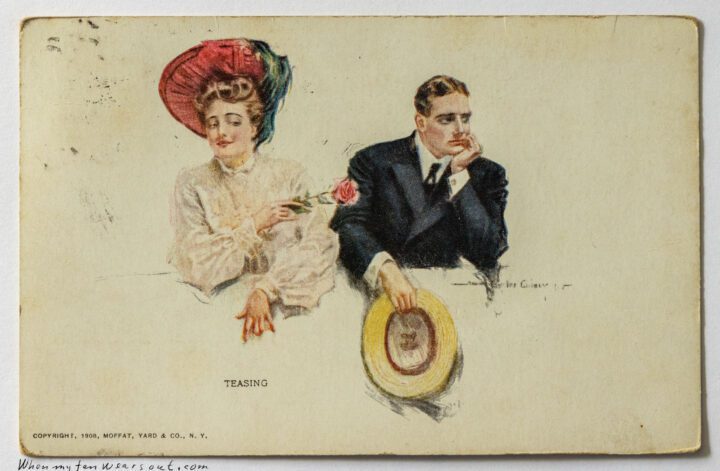
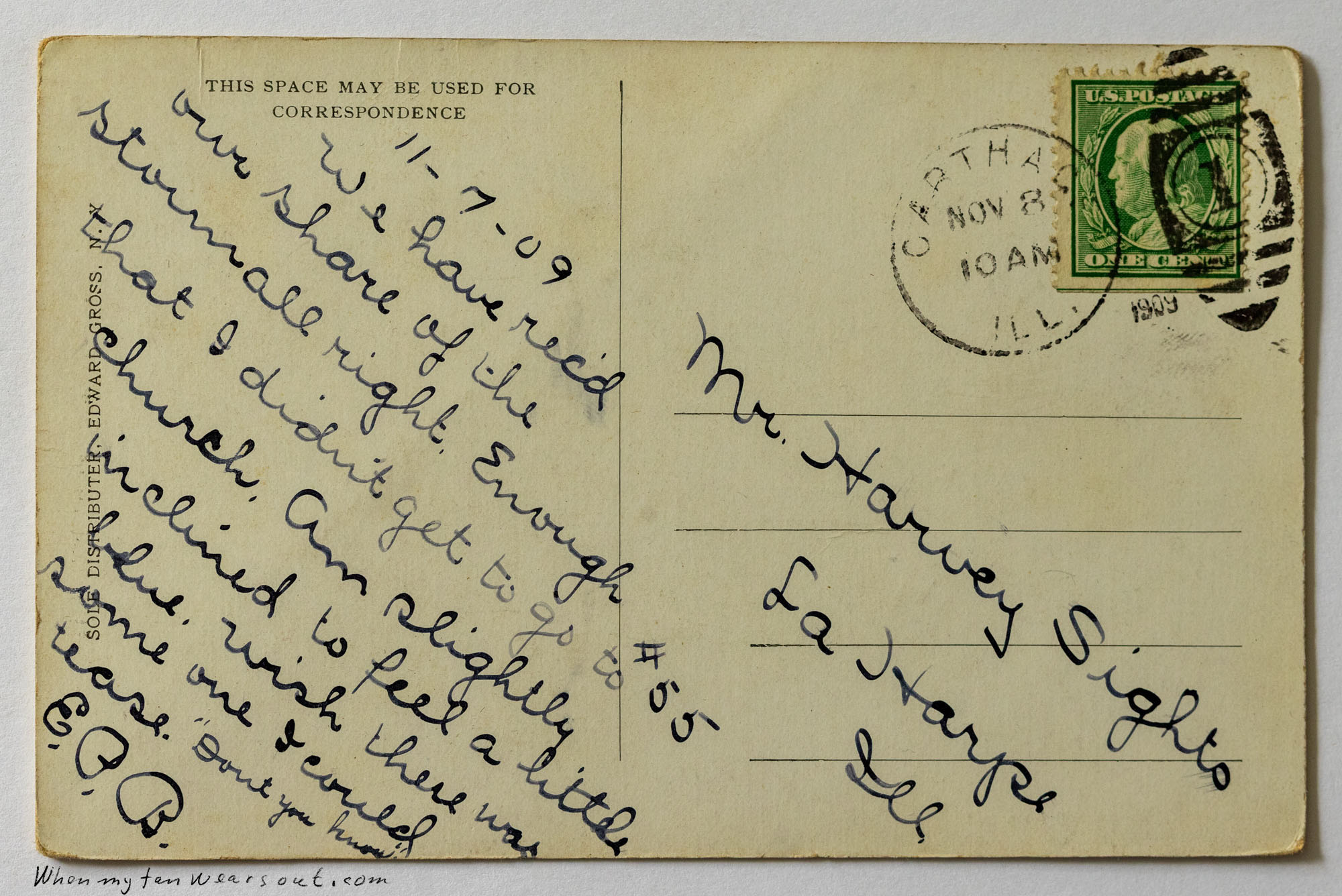
Back — 11-7-09 We have recd our share of the storm all right. Enough that I didn’t get to go to # 55 church, Am slightly blue, wish there was some one I could tease. "Dont you know" E. P. B.
Postcard Information
Postmark: CARTHAGE, ILL., NOV 8 1909
Sent To: La Harpe IL
Era: Golden Age (1907–1915)
Publisher: EDWARD GROSS / MOFFAT, YARD & CO., N. Y.
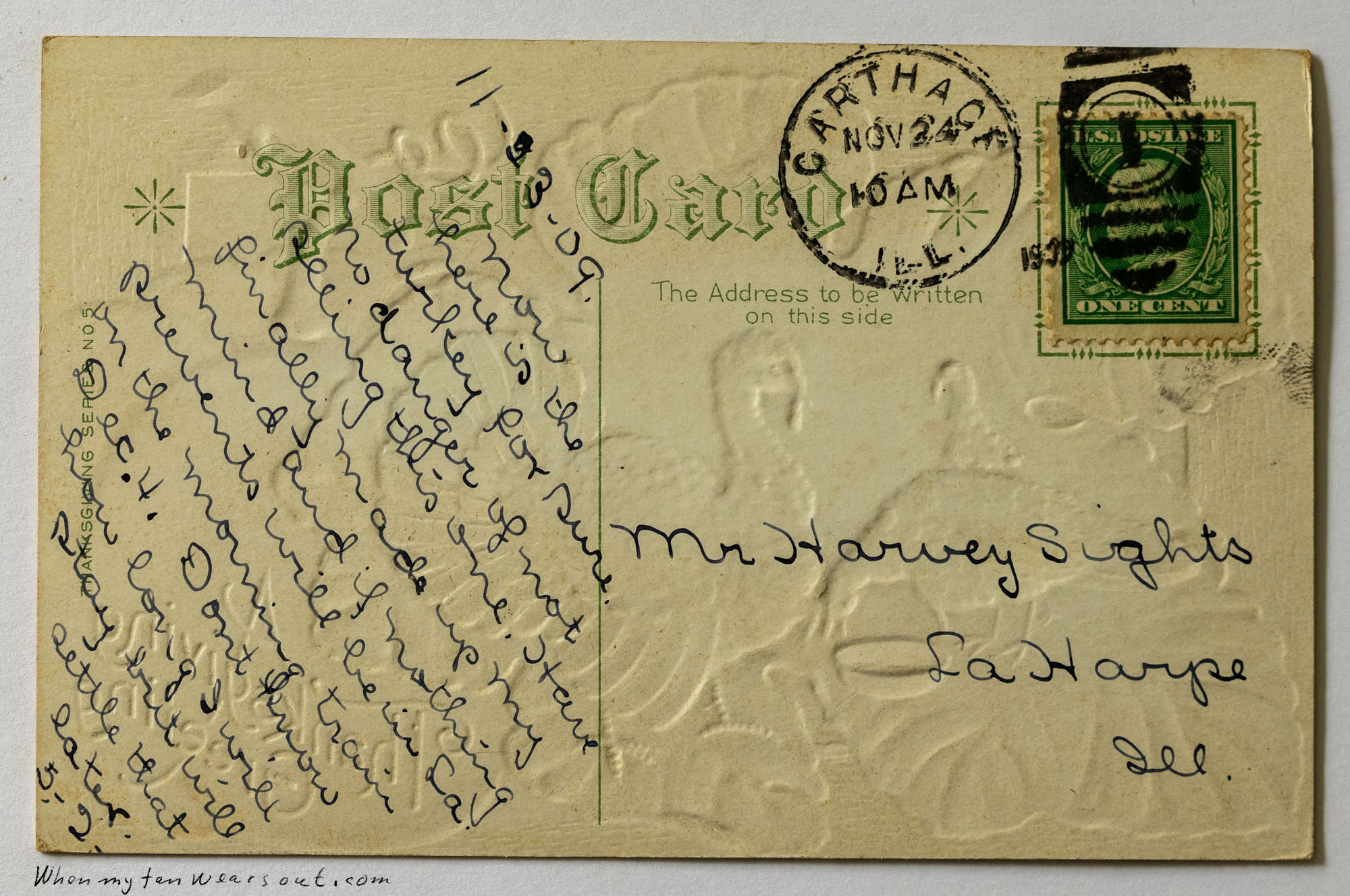
Back — 11-23-09. Well here is the turkey for sure. no danger of not being [?] this one. Have finally made up my mind and if nothing prevents will be in La on the morning train Wed. Dont know how long I will stay but will settle that later. E. [?]
Back — Lyd & I will be down to-night. You need not meet us as we will come on our wagon. Will bring fruit. Has Marg [?] got her paper. Berk.
Postcard Information
Postmark: CARTHAGE, ILL., AUG 17 1912
Sent To: Carthage IL
Era: Golden Age (1907–1915)
Stamp: 1¢
Distance Traveled: ~15 miles
About This Card
North Side Square in Carthage, Illinois shows the commercial district that surrounded the Hancock County Courthouse — the shops, banks, and professional offices that a county seat of Carthage’s size supported in the early twentieth century. Berk sent this real photo postcard from Carthage, the image capturing a specific moment in the square’s life: specific storefronts, specific automobiles at the curb, a specific Saturday afternoon. Carthage was Pearl’s town; she knew every business on this square.
Back — Seeing lots of old friends at Homecoming going to Picnic to morrow then back to Chicago. Had a big storm here last night. love from Grandma
Postcard Information
Postmark: CARTHAGE, ILL., AUG 8 1938
Sent To: Chicago IL
Era: White Border (1915–1930)
Publisher: NICHOLS’ BOOK STORE / C. T. AMERICAN ART BLUE-SKY (TEICH CO.), Carthage, Illinois / Chicago, Illinois
Stamp: 1¢
Distance Traveled: ~240 miles
About This Card
The Carthage Jail was built in 1839 and became, on June 27, 1844, the site of the murder of Joseph Smith, founder of the Church of Jesus Christ of Latter-day Saints, and his brother Hyrum. A mob stormed the jail, where Smith was being held on charges of treason, and shot both men. The LDS Church acquired the building in 1903 and has operated it as a historic site ever since. Grandma sent this hand-colored postcard during Homecoming in August 1938, saw lots of old friends, and mentioned a big storm the night before. The jail she photographed or purchased a card of had been standing for nearly a century and had housed the most consequential prisoner in American religious history.
Back — Just about time to hit the trail Have seen Docs. Harris & Ed Cutlers W. Nichols. Ran or Marnel & Neal just left Ray & E. Ethel got run over by a car and was in to see Dr. but he was not in they are coming back to morrow to pick up Mr. B. Horace is taking me to Guys to morrow Eve all are comfortable here well [?] but Lizzie is not any to good just now. tell you more when I get home. Love Harve
Postcard Information
Postmark: CARTHAGE, ILL., MAY 3 1944
Sent To: Carthage IL
Era: White Border (1915–1930)
Stamp: 1¢
Distance Traveled: ~15 miles
Notes: Real Photo Postcard (RPPC). Postmark date (1944) is much later than the typical Divided Back era. Message mentions daughter Marnelle ("Marnel") and mentions an acquaintance, Ethel, being run over by a car.
About This Card
The Stone Inn in Carthage, Illinois was a two-story stone building on or near the town square — one of the older commercial structures in the city, built from the local limestone that defined early Carthage construction before brick became the dominant material. Harvey sent this real photo postcard, signing it “Love Harve.” Harvey had grown up in La Harpe and moved to Carthage when he and Pearl married in October 1910; the Stone Inn was part of the commercial geography of the town he adopted. The building’s stone construction set it apart from the later brick commercial blocks that surrounded it.
Back — Am at Elva’s till Sat P.M. If you think I had better come home phone me after 7. Marnelle can. Got moms card last night. John D leaves for camp next week. No time for more now. Am sewing for Elva. Go back to Guys [?] Sat then home Sun. P.M. is plan now. Pearle.
Postcard Information
Postmark: Carthage, ILL., MAR 21 [year illegible]
Sent To: Chicago IL
Era: Linen (1930–1945)
Publisher: NICHOLS BOOK STORE, Carthage, Ill.
Stamp: 1¢
Distance Traveled: ~250 miles
Notes: Reference to "camp" likely refers to a military camp during WWII. Address includes a postal zone number (23).
About This Card
The Methodist Church in Carthage, Illinois — shown here in a linen-era postcard — was a large brick building with a prominent tower that anchored the residential neighborhood where Pearl lived at 318 N. Fayette Street. Pearl sent this card herself, which suggests she was either sending it to someone who’d asked about the church, or simply documenting the neighborhood she lived in for someone far away. The church building visible here dates from the late nineteenth century and remained the center of the Methodist congregation Pearl would have known throughout her years in Carthage.
Back — Carthage Ill. 10-13-09 Hello Pearle. What do you know about this? Hope you will get this card safe. am glad you are having a good time only wish the weather was better. never mind the weather. Ask Harvey if he Dares me. Better not. Hallie.
Postcard Information
Postmark: CARTHAGE, ILL., OCT 13 1909
Sent To: La Harpe IL
Era: Golden Age (1907–1915)
Stamp: 1¢
Distance Traveled: ~15 miles
About This Card
The interior of the Presbyterian Church in Carthage, Illinois shows the characteristic worship space of a mainline Protestant congregation in a small county seat: pale walls, wooden pews, a central pulpit, colored glass in the windows. Hallie sent this real photo postcard from Carthage — the kind of postcard a congregation member might send to a friend who had moved away, showing what the church looked like inside. Carthage’s Presbyterian congregation was established in the early years of the town’s settlement and remained one of the city’s significant institutions.