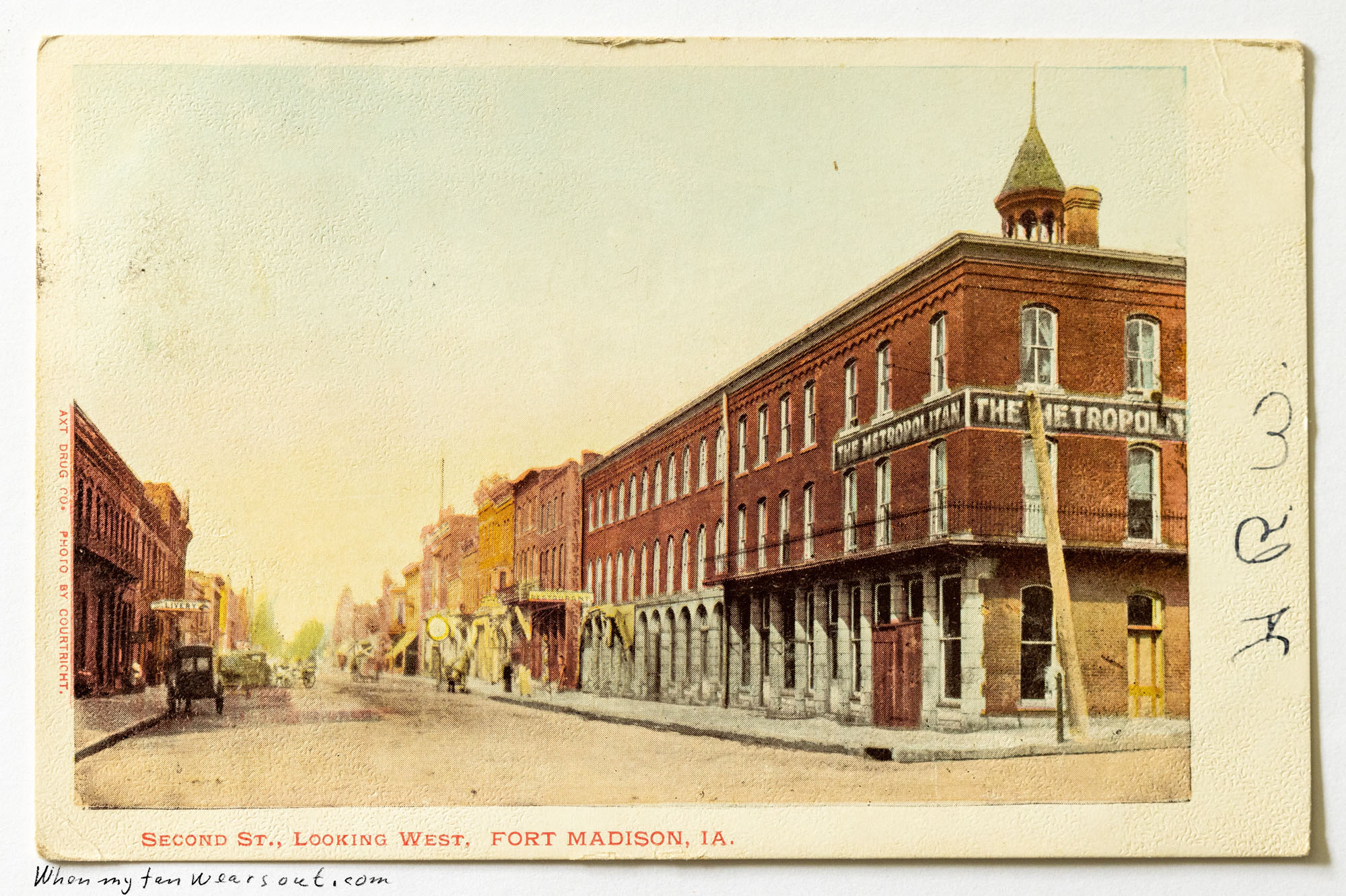
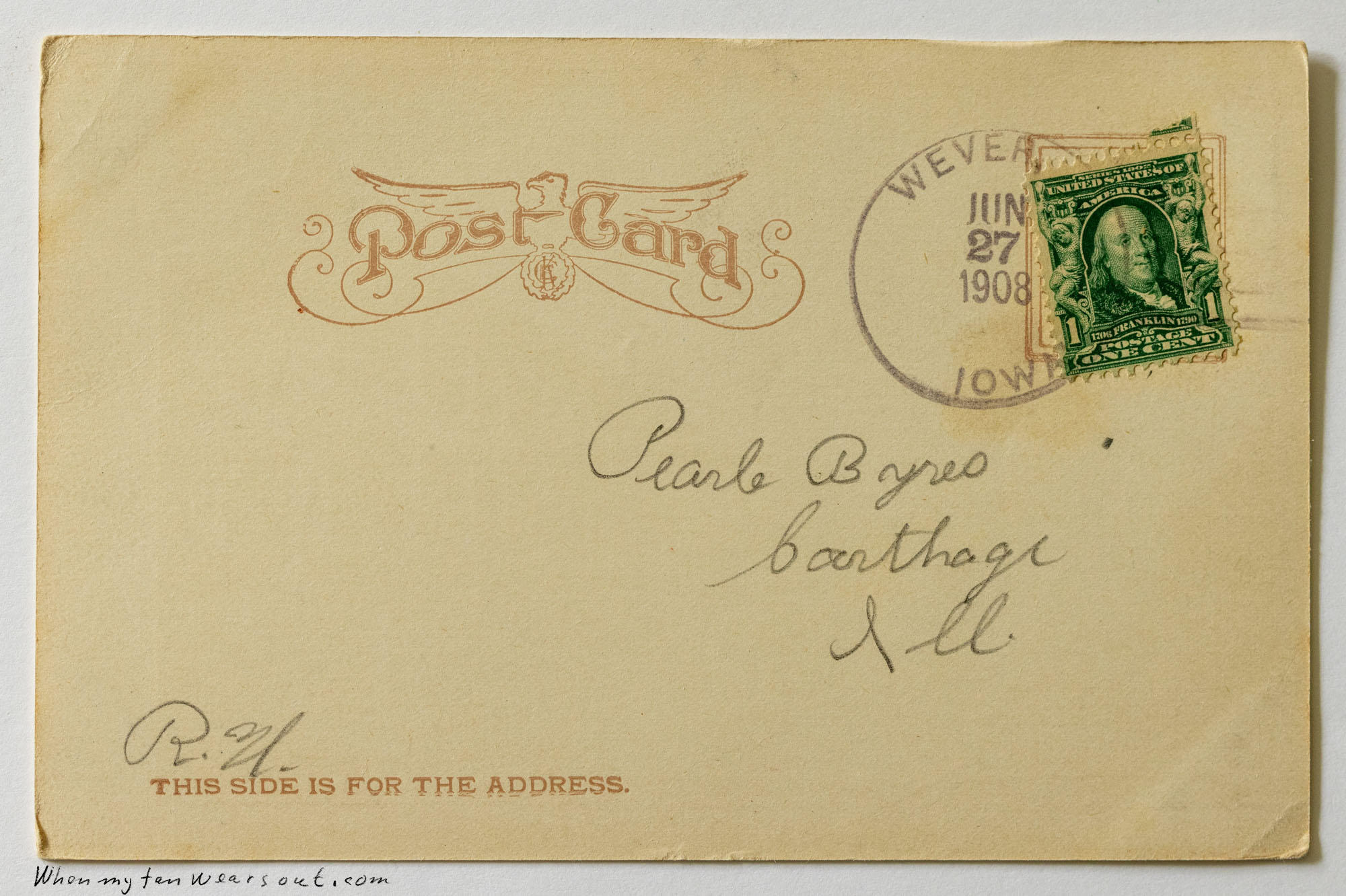
Second Street in Fort Madison, looking west past the brick storefronts, shows the commercial center of a city that was in the middle of its industrial prime. The postcard was sent from Wever, Iowa — a small community about twenty miles upriver — and signed “H.R.S.” on the front and “R.H.” on the back. The initials H.R.S. suggest Harvey R. Sights, and if so, this card — sent in June 1908, about two years before Harvey and Pearl’s wedding — is one of several in the collection that track Harvey’s movements around the Lee County area while working on the railroad.
The Corse Statue in Burlington, Iowa commemorates Brigadier General John Murray Corse, a Burlington native who commanded troops at the Battle of Allatoona in 1864 and received the famous signal “Hold the Fort” from Sherman. He held it. The equestrian monument stands near the northern entrance to Crapo Park. Julia sent this card in September 1908 and signed only her first name on the front — “Julia.” — with a separate signature on the back identifying herself as Mrs. Chesnut.
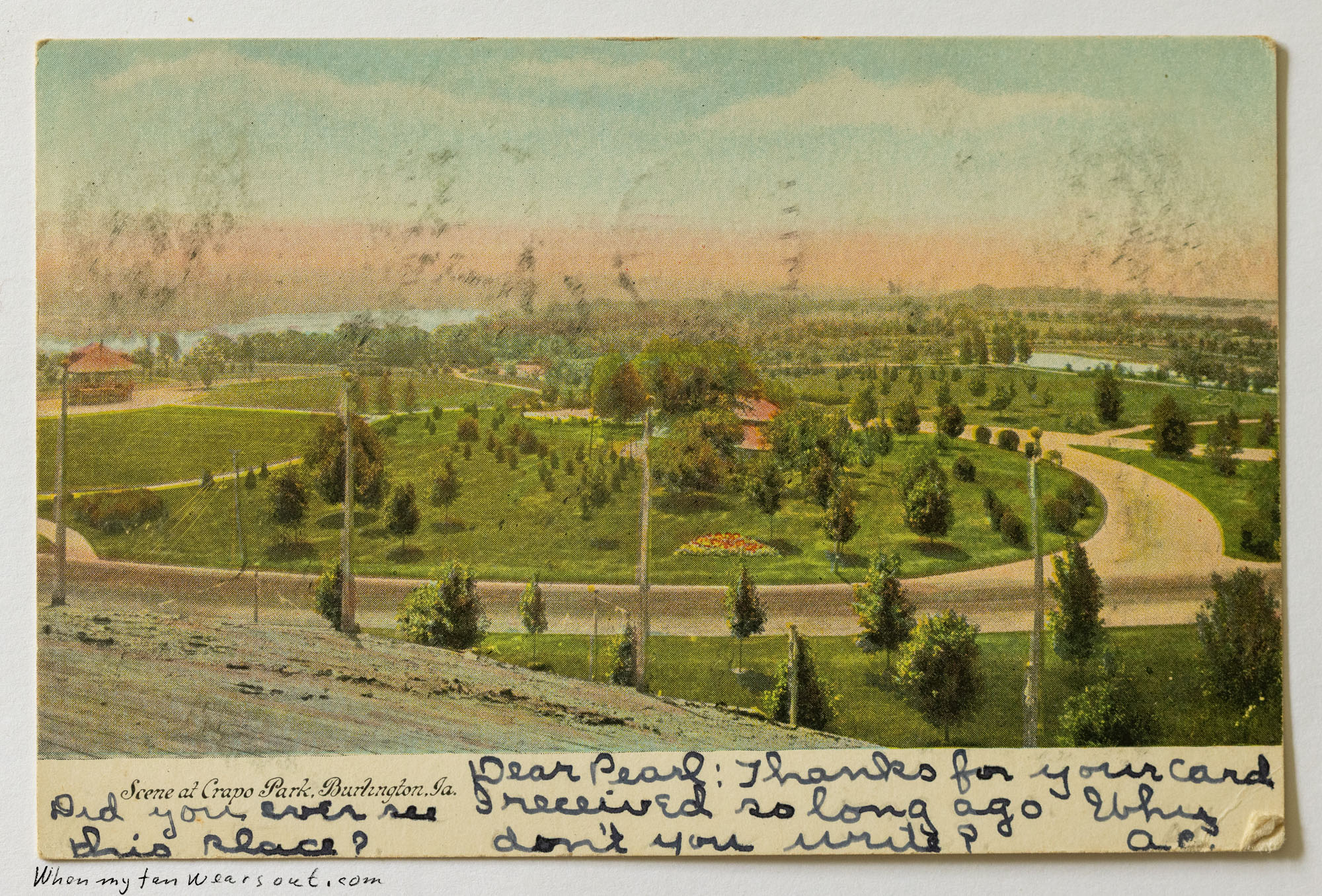
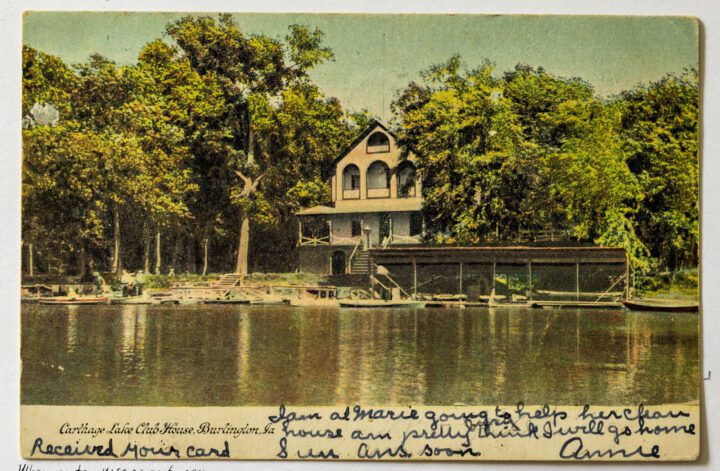
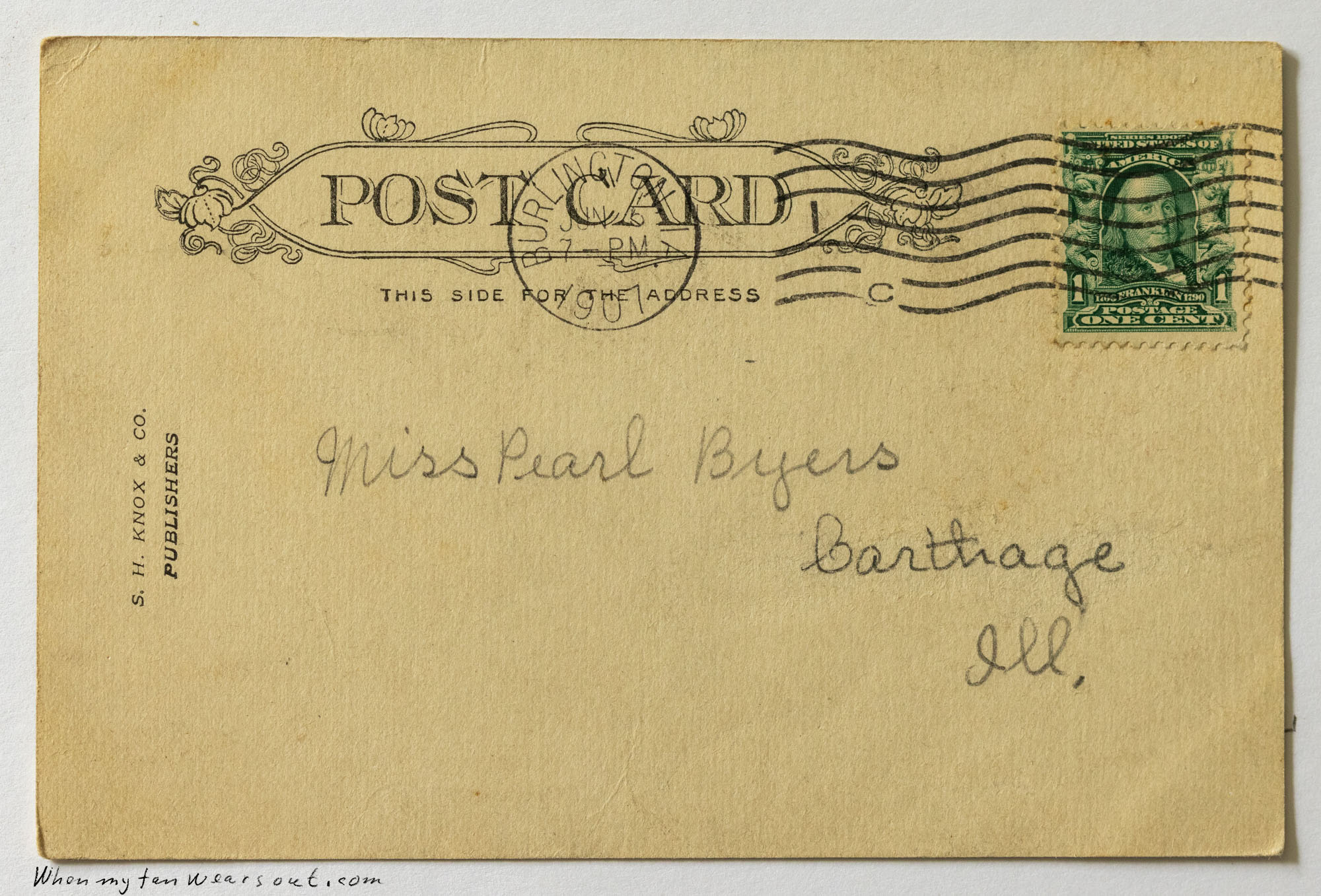
Front — Did you ever see this place? Dear Pearl: Thanks for your card received so long ago Why don’t you write? A C.
Postcard Information
Postmark: Burlington, IA., JUL 27 1907
Sent To: Carthage IL
Era: Undivided Back (Pre-1907)
Publisher: S. H. KNOX & CO.
Stamp: 1¢
Distance Traveled: ~30 miles
Notes: message written on front instead of back
About This Card
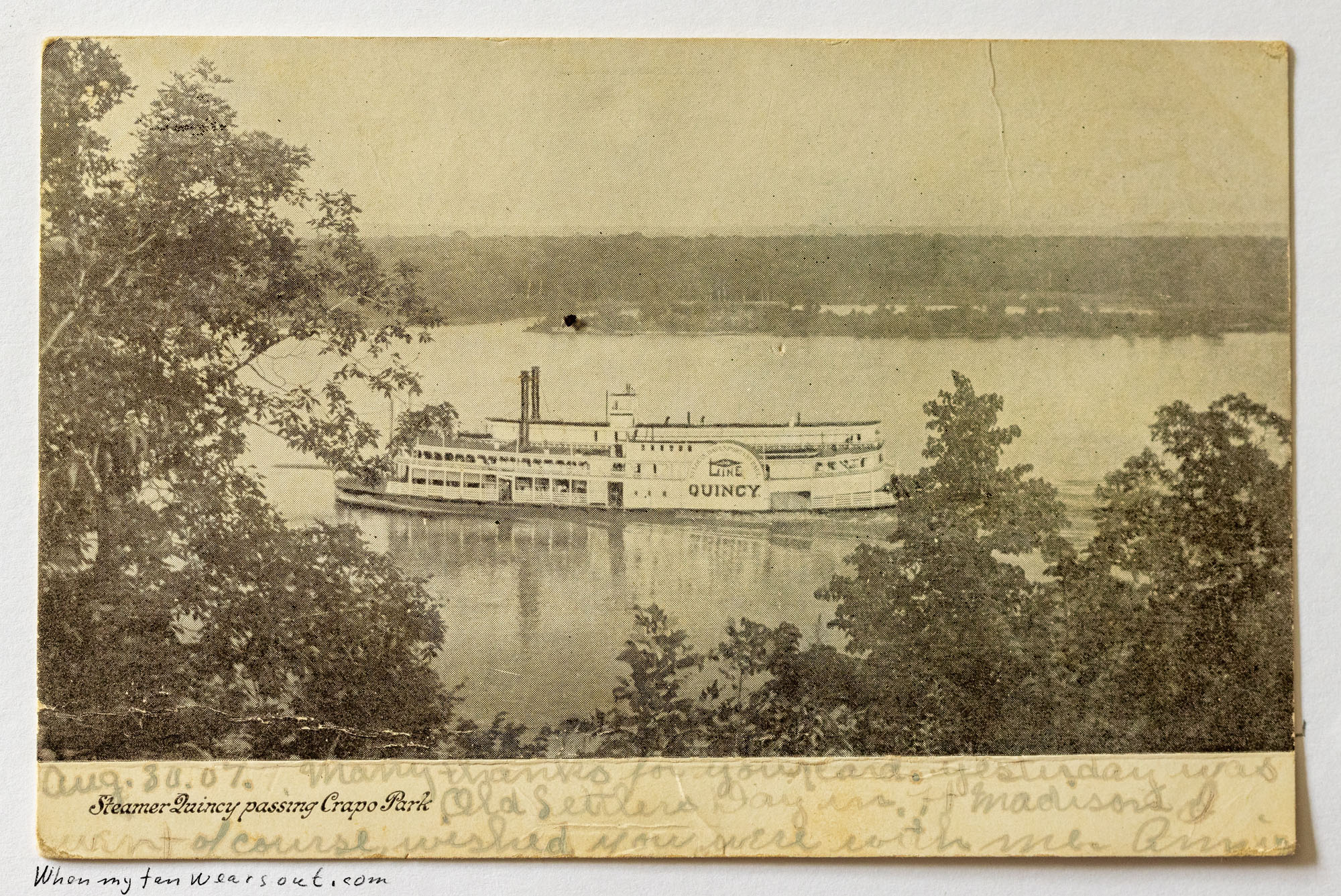
Crapo Park in Burlington, Iowa was donated to the city by the family of Michigan Governor Henry Howland Crapo in the 1890s, developed from land along the bluffs above the Mississippi. By the time A.C. sent this card in July 1907, Crapo Park was already considered one of the finest municipal parks on the upper Mississippi — a winding drive through mature trees above the river, with pavilions, a small zoo, and Black Hawk Spring, a natural spring with a storied Sauk history. Burlington had been a prosperous railroad and manufacturing city since the Civil War, and the park was an expression of that prosperity.
Back — ] "Better late than never" but I would have answered sooner if I’d had any cards. I haven’t as pretty a card to send as the one I rec’d from you, for that violet postal was certainly pretty. I liked it fine. Don’t you think all had a fairly good time yesterday afternoon, at least what we done kept us pretty busy. How is the Children’s Day exercises. I’ve got a job today I don’t like very well – helping Mamma pick up cherries. Ans. soon as ever. – Violet.
Postcard Information
Postmark: Wever, Iowa, JUN 8 1908
Sent To: Carthage IL
Era: Undivided Back (Pre-1907)
Publisher: Axt Drug Co., Fort Madison, Iowa
Stamp: 1¢
Distance Traveled: ~25 miles
Notes: Hand-drawn dividing line on back, message written on front margin
About This Card
Pine Street in Fort Madison, looking south from this vantage, shows the kind of small-city commercial vitality that characterized river towns along the upper Mississippi in the early twentieth century. Fort Madison had grown up around an early American fort — the original Fort Madison, the first U.S. military post in what would become Iowa, was destroyed and abandoned in 1813 after repeated Sauk attacks during the War of 1812. The town that took its name later that century had no direct connection to the military installation; it simply kept the name. Five years after Violet sent this card, Walter Sheaffer would open his pen factory nearby, and Pine Street’s commercial character would begin to shift.
Publisher: Ed. Hoch, Importer and Publisher, Carthage, Ill.
Print Origin: Printed in Germany
Stamp: 1¢ — Two identical 1¢ stamps.
Distance Traveled: Local mail
Notes: Two 1¢ stamps used on a single card; card is an undivided back style design despite being mailed in 1909; contains a handwritten pencil note "Before 1910" at the top of the back which appears to be a later addition.
About This Card
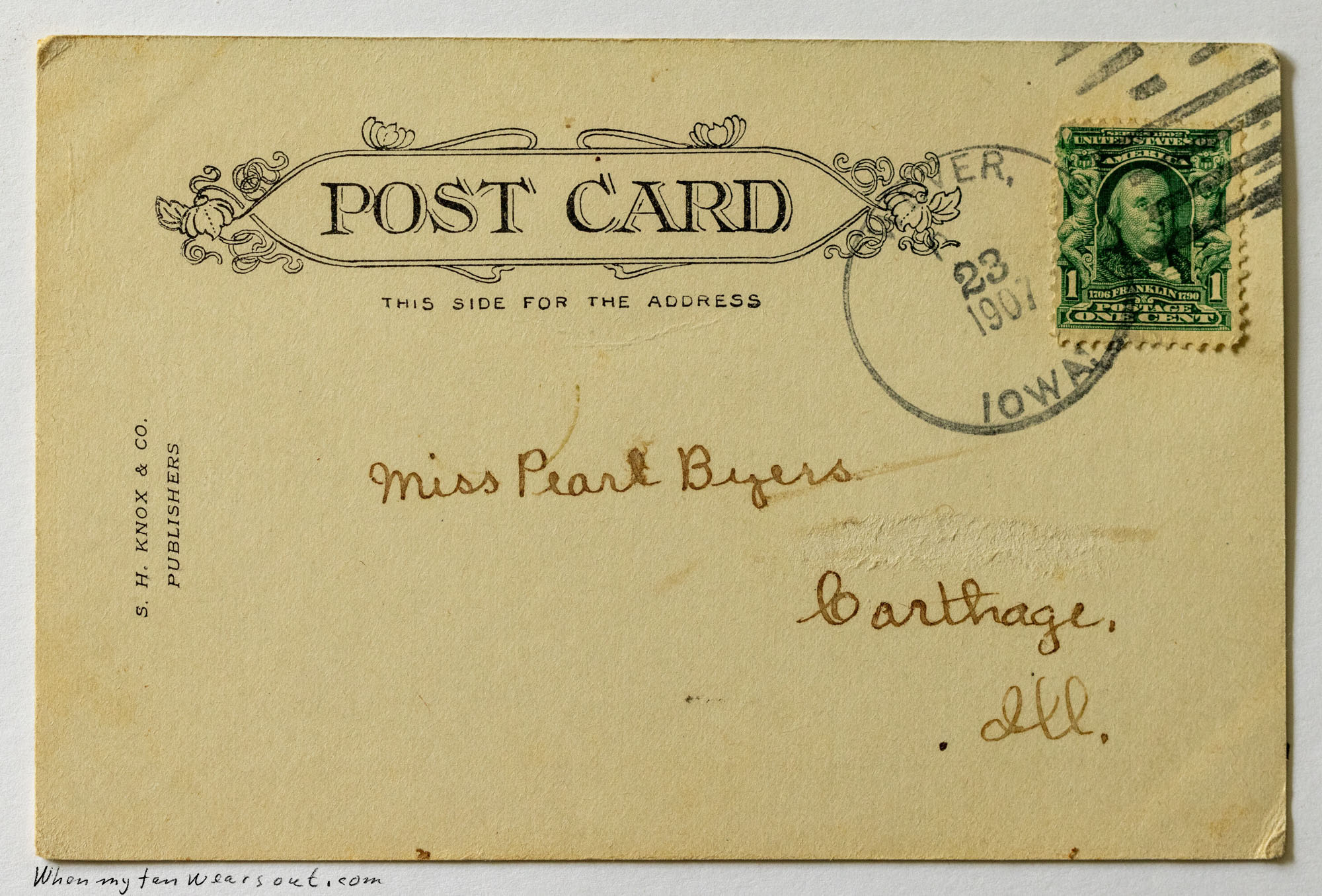
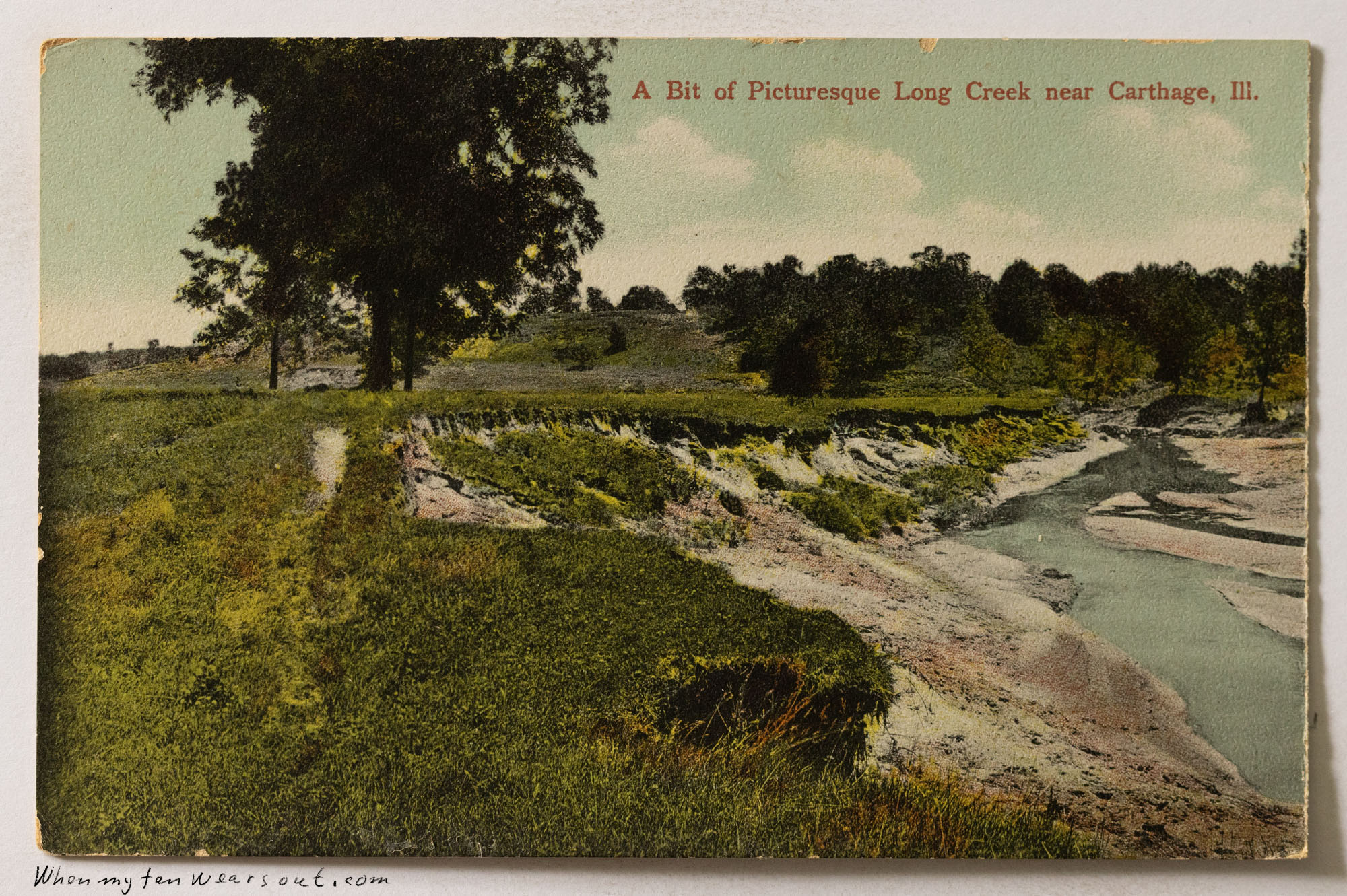
Long Creek near Carthage appears in the collection multiple times across different decades — Harvey sending a card of it from La Harpe before their wedding, Pearl’s mother sending a view later, and now this hand-colored landscape postmarked from Carthage in the linen era. Long Creek was the natural feature closest to both of their hometowns: it ran through the farm country between Carthage and La Harpe, and it was the kind of creek people knew by name because they crossed it regularly. This unsigned card was sent by an unsigned sender — the creek speaks for itself.
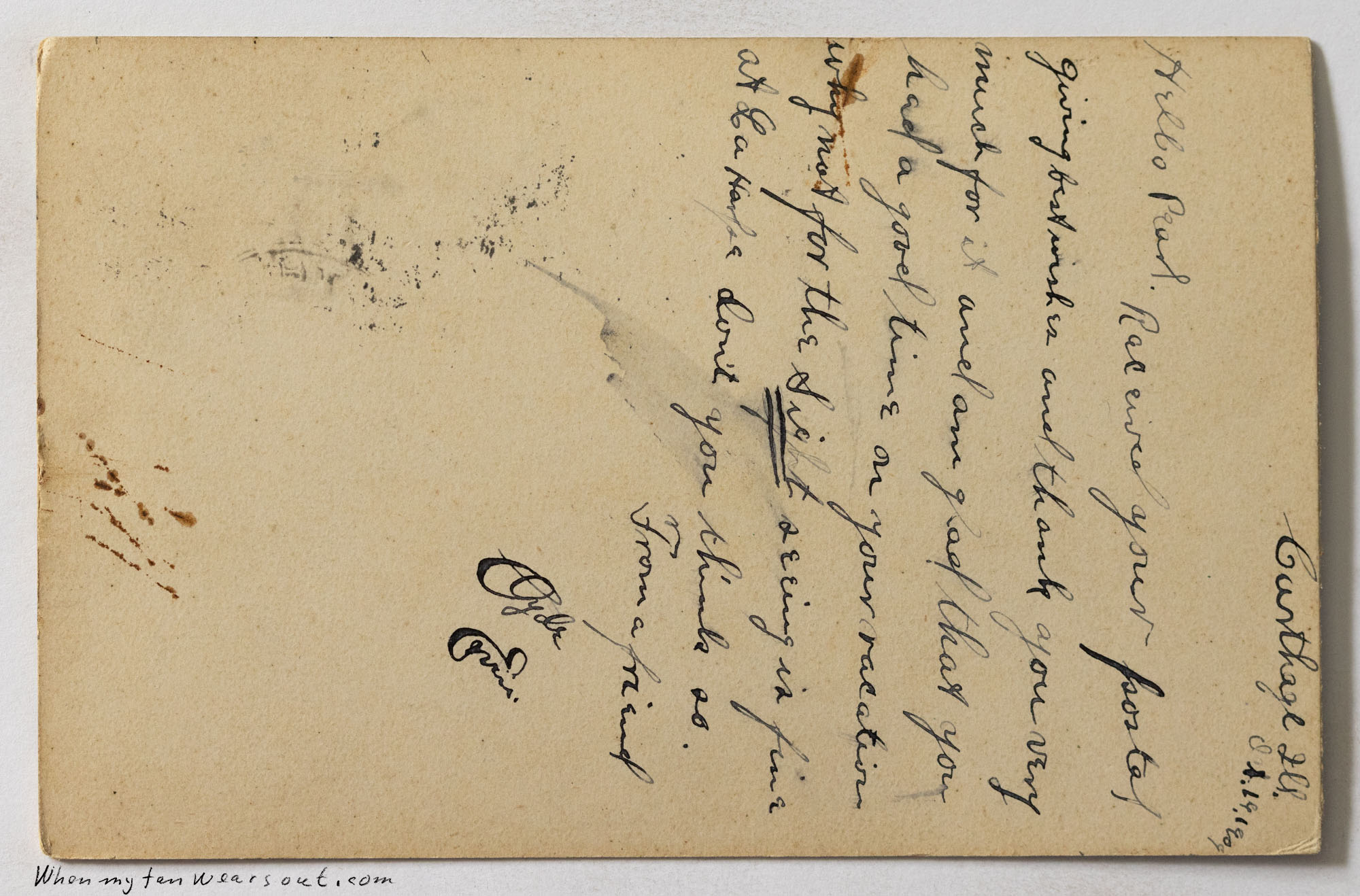
Back — Carthage Ill. Oct. 19. 1909 Hello Pearl. Received your postal giving best wishes and thank you very much for it and am glad that you had a good time on your vacation why not for the sight seeing is fine at La Harpe don’t you think so. From a friend Clyde [illegible]
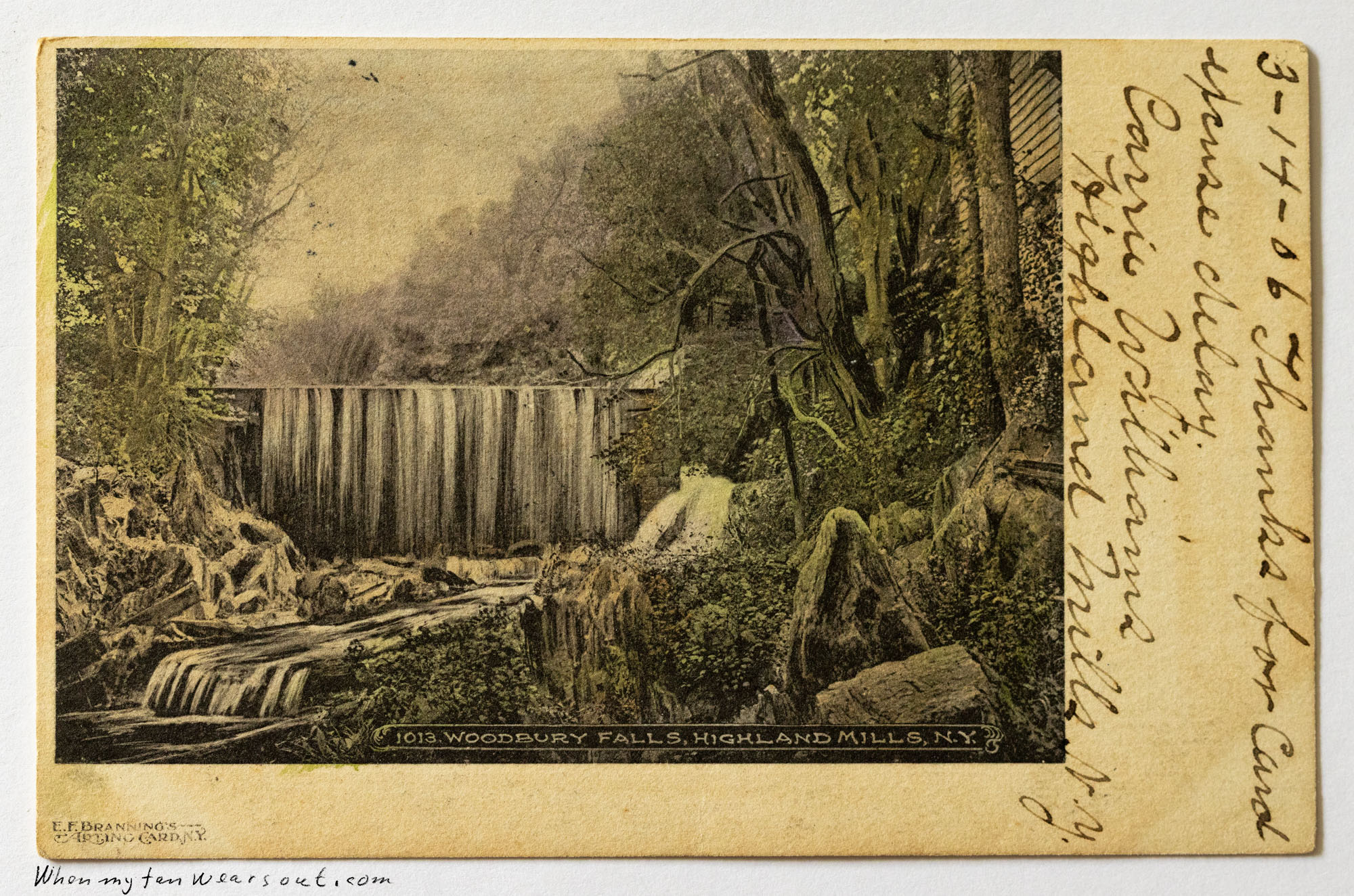
Front — A serene depiction of Woodbury Falls in Highland Mills, New York, with a short message on the right.
Postcard Metadata
Postmarked: Newburgh, NY — March 14, 1906
Sent From: Newburgh, NY
Sent To: Pearle Byers Fayette St Carthage, Ill. Box 611
Distance Traveled: Approximately 830 miles
Postage: U.S. 1-cent Benjamin Franklin stamp
Card Details: Undivided Back era (1901-1907)
Back — Correspondence from Carrie to Pearle Byers
Transcription
3 – 14 – 06 Thanks for card Was glad to hear from you Carrie Write soon P.S. Highland Mills N.Y.
Historical & Family Notes
This postcard, sent to Pearle Byers in March 1906, offers a charming glimpse into her early social life, long before her eventual marriage to Harvey Sights. The sender, Carrie, clearly a friend, expresses gratitude for a previous card and encourages further correspondence, highlighting the personal nature of such exchanges. The simple, heartfelt message, “Was glad to hear from you,” underscores the role of postcards in maintaining friendships and connections across distances in the early 20th century.
The card itself features a picturesque view of Woodbury Falls in Highland Mills, New York, a location mentioned by Carrie in her postscript, suggesting a personal connection to the scene. While not directly related to Pearl and Harvey’s courtship, such cards reveal the typical ways young women like Pearl engaged with their friends and world, building a network of social ties that would have been an integral part of her life.
The swift two-day delivery from Newburgh, New York, to Carthage, Illinois, demonstrates the remarkable efficiency of the U.S. postal service at the time. This allowed friends such as Carrie and Pearle to share news and greetings across vast geographical spans with relative ease, contributing to the rich tapestry of Pearl’s life story before she became Mrs. Sights.
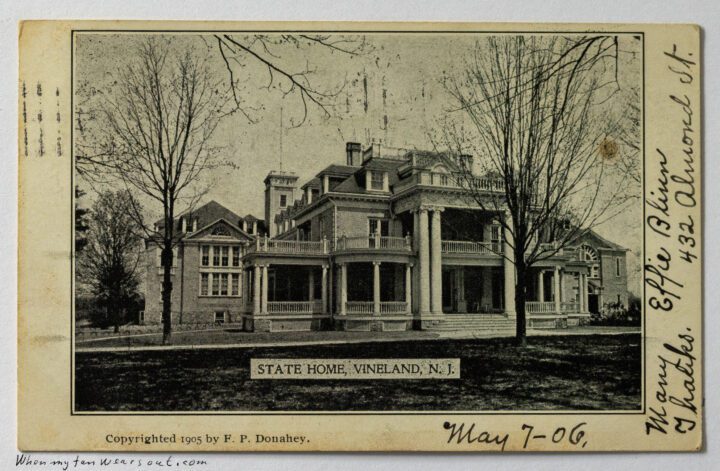
Front — A grand, multi-story brick building, labeled “STATE HOME, VINELAND, N. J.” with trees in the foreground.
Postcard Metadata
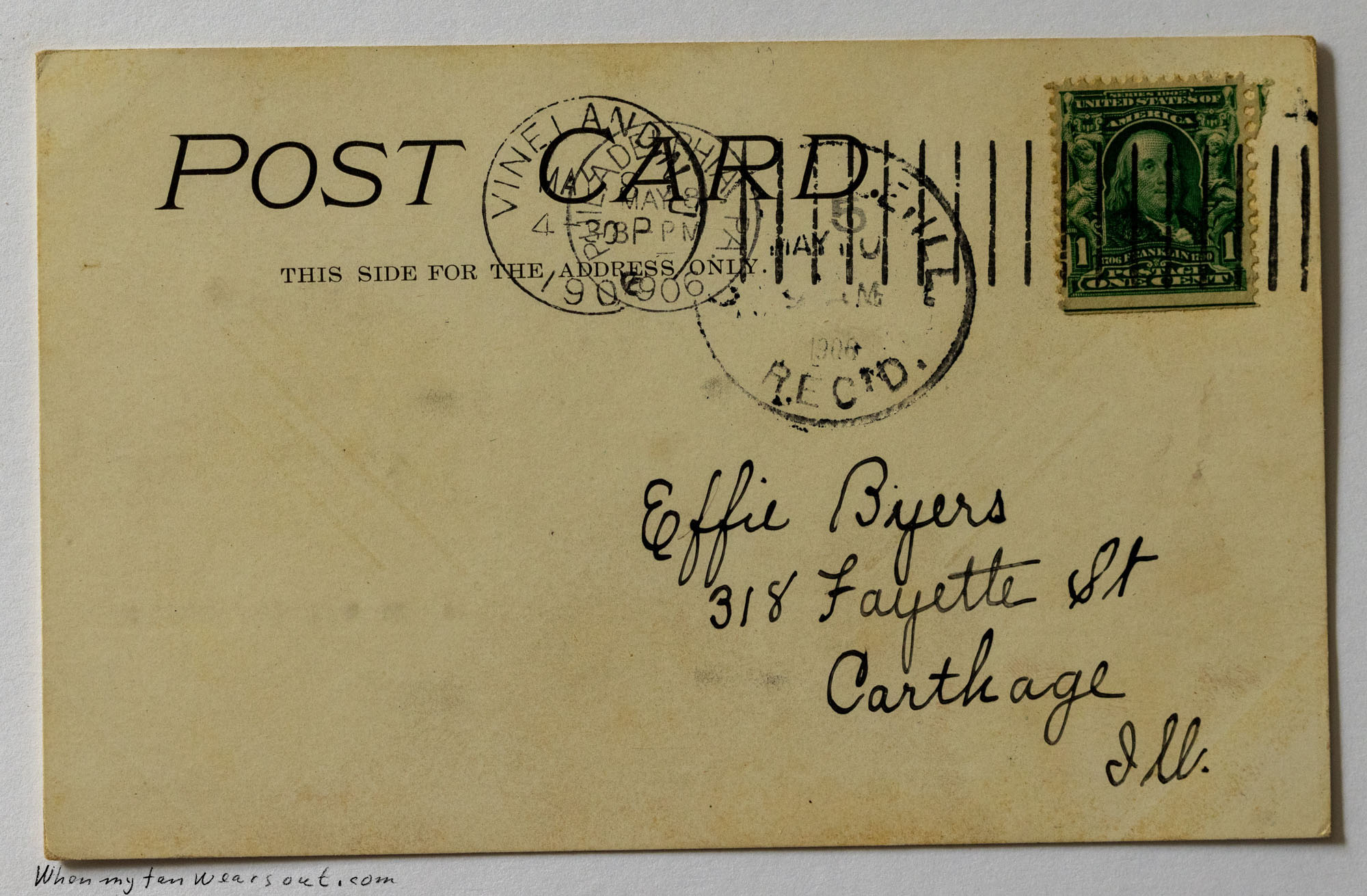
Postmarked: Vineland, New Jersey — May 7, 1906, 4:30 PM
Sent From: Vineland, New Jersey
Sent To: Effie Byers, 318 Fayette St, Carthage, Ills.
Distance Traveled: ~870 miles
Postage: US One Cent Benjamin Franklin stamp
Card Details: Undivided Back postcard, “Copyrighted 1905 by F. P. Donahey.”
Back — Correspondence from Effie Bhien to Effie Byers
Transcription
Many thanks. May 7-06. Effie Bhien 432 Almond St.
Historical & Family Notes
This early postcard, dated May 1906, offers a glimpse into the Byers family’s extended network before Pearl’s extensive correspondence with Harvey Sights. Addressed to Effie Byers at 318 Fayette Street in Carthage, Illinois—the very home Pearl would share with her family—it establishes a foundational timeline for the Byers household. While not sent directly to Pearl, the card reinforces the consistent location of her family home, a place that would later feature prominently in her personal story and eventual courtship.
The image on the front depicts the “State Home, Vineland, N. J.,” historically known as the New Jersey Training School for Feeble-Minded Girls and Boys. This institution was a significant, albeit complex, part of early 20th-century social history, pioneering research in intellectual disabilities while also becoming entangled in the eugenics movement. The postcard’s image provides a window into the types of public institutions and social structures that existed during Pearl’s formative years.
The brief message, “Many thanks,” penned by “Effie Bhien” from nearby 432 Almond Street, suggests a simple, everyday acknowledgment. Such concise notes were common on undivided back postcards, where space for correspondence was limited. This card, a tangible artifact from 1906, predates the more romantic and detailed letters Pearl would later exchange with Harvey, yet it subtly grounds their story within the broader social and familial context of the early 20th century.