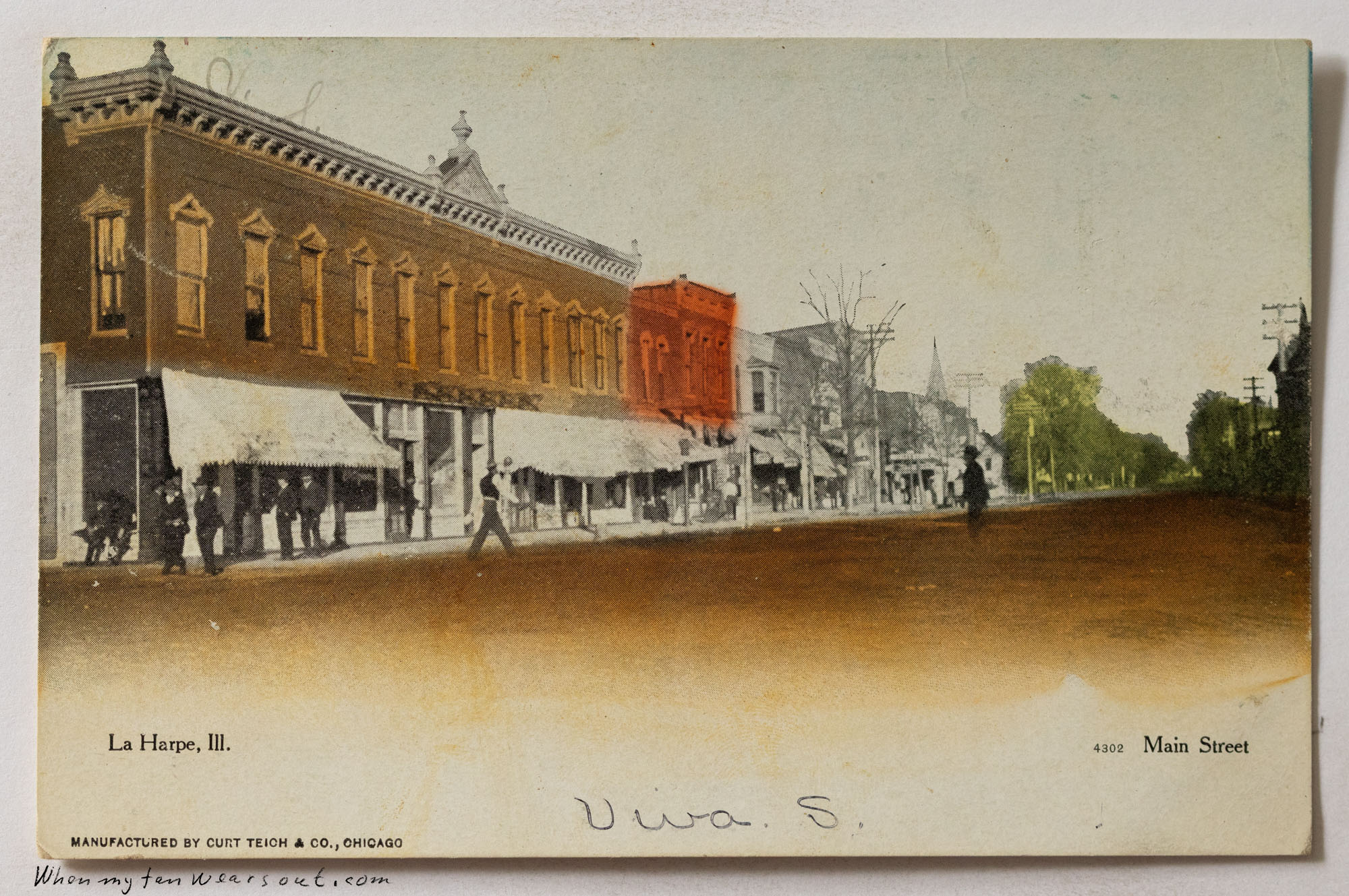
Postcard #1073: A Brief ‘Viwa. S.’ from La Harpe’s Main Street


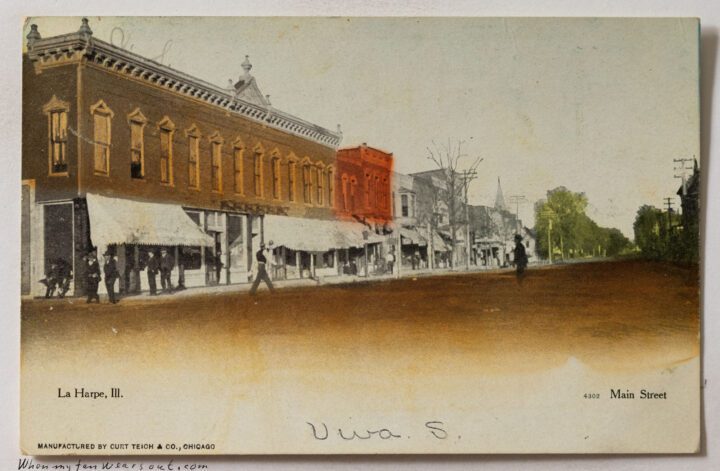
A vintage postcard depicting a lively Main Street in La Harpe, Illinois, circa early 1900s. The street is lined with multi-story brick buildings, some featuring striped awnings over ground-level shops. People are visible walking on the sidewalks and in the street. A prominent three-story brick building, partially hand-colored in red, stands further down the street. The sky is light, and trees are visible in the distance. The bottom left corner reads
Front — A bustling view of Main Street in La Harpe, Illinois, featuring storefronts with awnings and a partially colorized brick building.

Postcard Metadata


The reverse side of the postcard features the standard
Back — Correspondence from Viwa S. to Miss Pearle Byers

Transcription

Viwa. S.

Historical & Family Notes

This early postcard, sent to the young Miss Pearle Byers, offers a quick glimpse into her social world during her formative years. The card features a common street scene of the era from nearby La Harpe, Illinois, a familiar type of imagery used for brief communications. The message, simply “Viwa. S.” on the front of the card, is characteristic of the concise messages exchanged on undivided back postcards where space for writing was limited.

Originating from Burnside, a mere 11 miles from Carthage, this card likely came from a local acquaintance or friend, Viwa S., whose brief greeting is preserved in this collection. These everyday interactions paint a picture of Pearl’s life before her marriage to Harvey Sights, highlighting the connections she maintained within her immediate community.

The postcard itself is an excellent example of the transitional period in postcard history. Though postmarked in June 1907, after divided backs were permitted, its layout with “NOTHING BUT THE ADDRESS ON THIS SIDE” firmly places it stylistically within the Undivided Back era, suggesting an older card still in circulation.

Continue Reading

Postcard #0031: A Merry Christmas with Holly and Berries from Perris


Vintage Christmas postcard from the early 1900s featuring an embossed sprig of green holly leaves with vibrant red berries at the top. Below the holly, a watercolor illustration depicts a snow-covered winter landscape with a small house, bare trees, and a wooden fence at sunset or sunrise. The text
Front — An embossed illustration of a holly sprig with red berries above a winter landscape scene and “A MERRY CHRISTMAS” message.

Postcard Metadata


The back of a vintage postcard with a divided back design. The left side is labeled
Back — Correspondence from Harvey Sights to Miss Pearl Byers

Transcription

H.S.

Historical & Family Notes

This Christmas postcard, adorned with festive holly and a serene winter scene, carries a simple but significant message from Harvey Sights to Pearl Byers. The solitary “H.S.” initial, penned vertically on the correspondence side, speaks volumes about the growing connection between them, despite the vast geographical distance separating Perris, California, from Carthage, Illinois. The journey of nearly 1,900 miles underscores Harvey’s effort to reach Pearl during the holiday season, a time traditionally associated with warmth and connection.

The absence of a longer message might suggest a burgeoning relationship where a simple acknowledgment was enough, or perhaps a more private communication was shared via other means. This card serves as a tangible link in the evolving story of Pearl and Harvey, capturing a moment when their paths, though physically distant, were drawing closer. It’s a testament to the enduring tradition of holiday greetings and the personal touch postcards offered in an era before instant communication.

As an archival piece, this postcard not only documents a festive exchange but also subtly hints at the dedication involved in maintaining a long-distance connection during the early 20th century. For Pearl, receiving this Christmas wish from Harvey, even if brief, would have been a cherished reminder of his thoughts for her, further cementing their bond that would eventually lead to marriage and their daughter, Marnelle.

Continue Reading

Postcard #0030: Best Wishes with Pansies and a Midwest Farm Scene


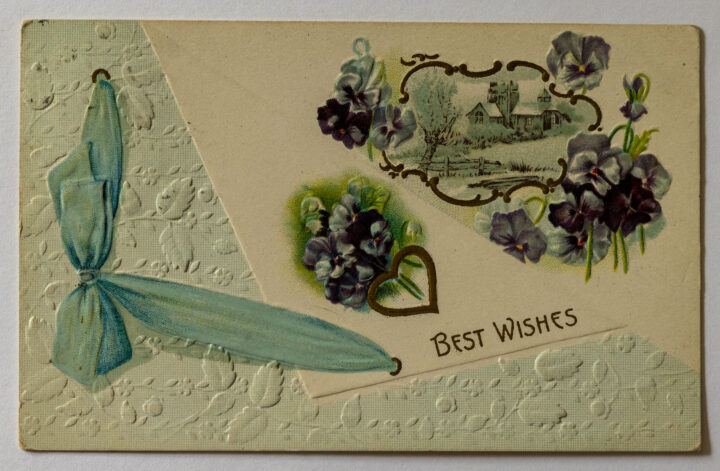
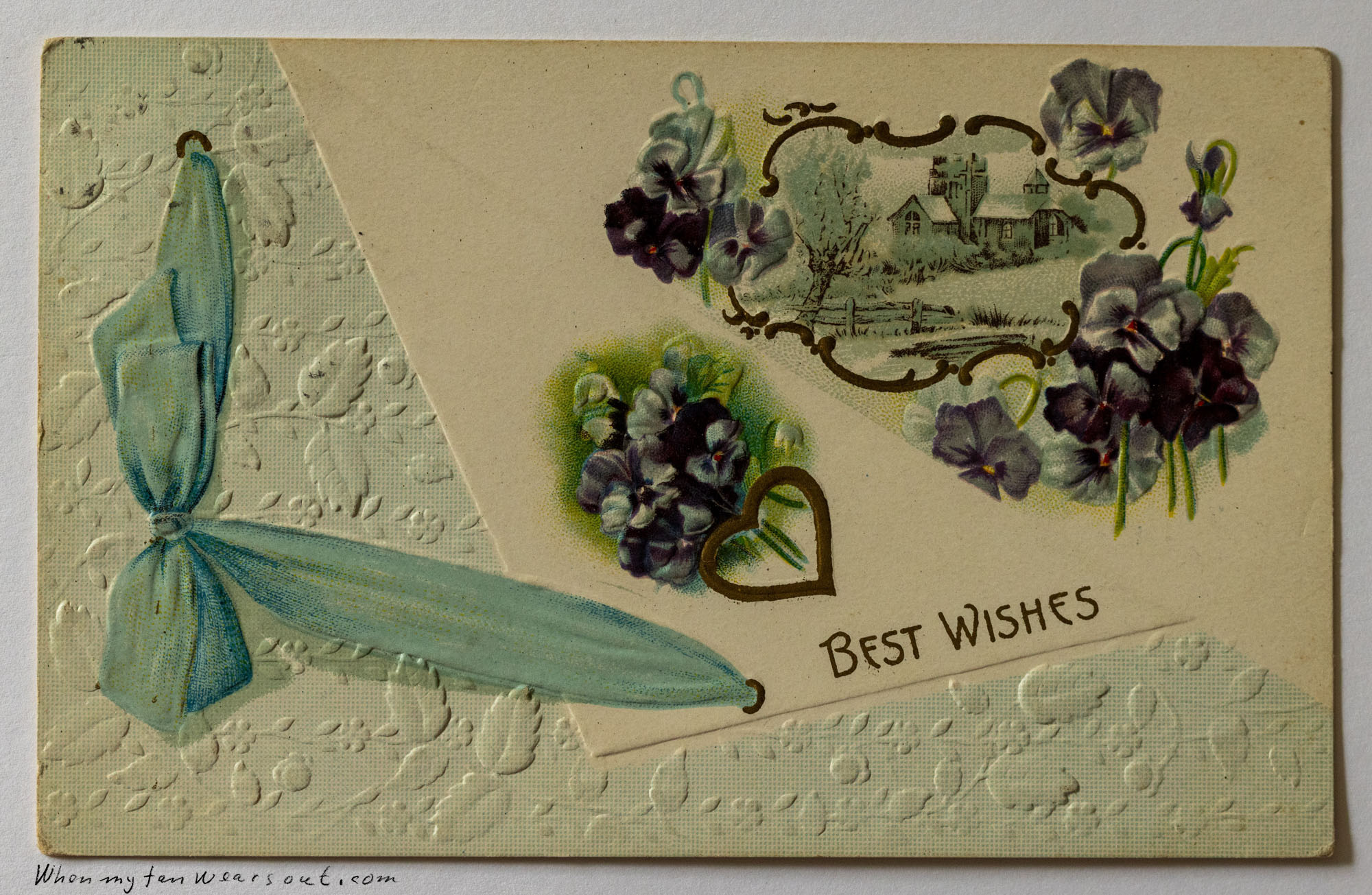
Vintage postcard with a teal blue satin ribbon bow and flowing ribbon on the left side, over an embossed background pattern. The right side features two clusters of purple and blue pansies, and a central framed vignette depicting a quaint rural farm scene with a house, trees, and fence. The text
Front — A “Best Wishes” postcard featuring purple pansies, an embossed blue ribbon, and a framed rural farm scene.

Postcard Metadata


The back of a vintage postcard featuring a handwritten message in black cursive ink. The sender is E.P.B. and the recipient is Mr. Harvey Sights, La Harpe, Illinois. A Carthage, Illinois postmark dated September 7, 1909, is visible along with a green one-cent U.S. Postage stamp with George Washington's portrait. The card has a vertical dividing line and an embossed floral pattern.
Back — Correspondence from E.P.B. (Pearl Byers) to Harvey Sights

Transcription

Carthage Ill. Sept. 7-09. Rec’d card this morning as I came to work. Thanks “awfully.” It is dandy. E.P.B. Mr. Harvey Sights La Harpe Ill

Historical & Family Notes

This postcard offers a charming glimpse into the early courtship between Pearl Byers and Harvey Sights. Pearl, writing from Carthage, Illinois, expresses her thanks to Harvey for a card she received earlier that morning, playfully stating it was “dandy.” This exchange highlights their regular correspondence despite living a mere sixteen miles apart, indicating a blossoming romance through the daily ritual of postcard mail.

The sender’s initials “E.P.B.” are almost certainly Pearl Byers, aligning with the family’s identity rules and the ongoing narrative of their relationship. The card was sent on September 7, 1909, a significant period in their courtship before their eventual marriage and the birth of their daughter, Marnelle.

The message’s casual and affectionate tone—”Thanks ‘awfully'”—suggests a comfort and familiarity between Pearl and Harvey, showcasing a delightful snapshot of their everyday interactions and the simple pleasures of receiving mail from a loved one in the early 20th century.

Continue Reading

Postcard #012: Martha Asks Pearle About Getting Married Amidst Calf Branding Scene


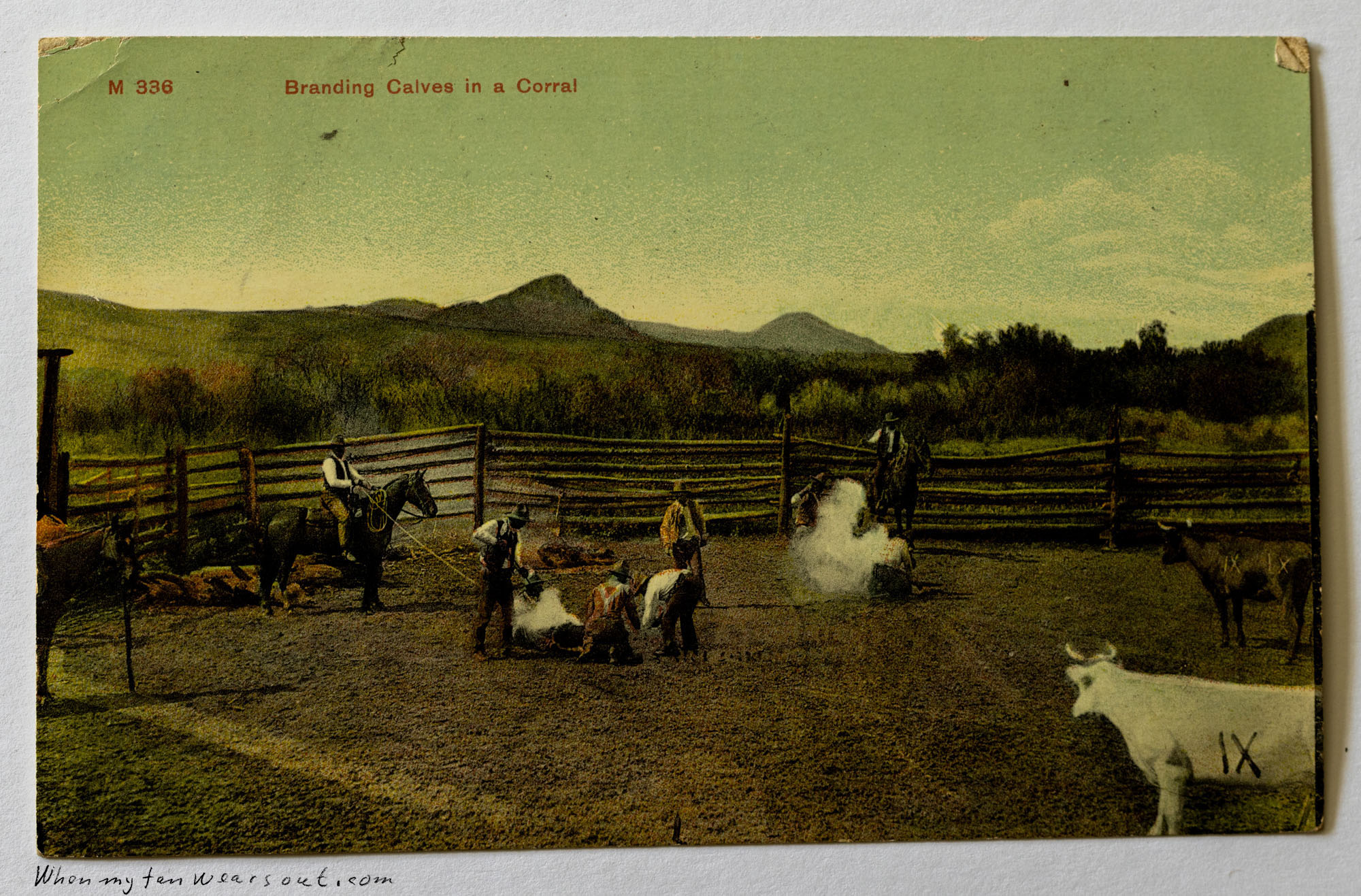
Hand-tinted vintage postcard depicting a group of cowboys and ranch hands branding calves in a dusty outdoor corral. Several men are on horseback, while others are on foot, wrestling calves to the ground. Smoke rises from hot branding irons. A large white cow with the brand 'IX' on its side is visible in the foreground. Rolling hills and distant mountains are in the background under a blue-green sky.
Front — A vintage hand-tinted postcard showing cowboys branding calves in a rustic corral with mountains in the background.

Postcard Metadata


The back of an old postcard with a handwritten message in cursive ink from 'Martha' to 'Miss Pearle Byers' in Carthage, Illinois. The message discusses news, marriage, and friendly chiding. A green one-cent Benjamin Franklin U.S. postage stamp is affixed in the upper right corner, partially obscured by a round postmark from Chinook, Montana, dated August 26, 1910. The card is a divided back postcard with 'POST CARD' printed at the top.
Back — Correspondence from Martha to Miss Pearle Byers

Transcription

Dear Kid. well I like that you tell me to write when I’ve written you long ago. Just get busy now and drop me a line. Am very busy just now as I have the debumaker here. Weather just like summer here. I got your card some time ago. How are the boys? So your going to get married? Well I hope to get an invitation. will do likewise well I hadnt be good to your self. If I don’t hear from you soon will write. Loving by Martha.

Historical & Family Notes

This postcard offers a glimpse into Pearle Byers’ life before her marriage to Harvey Sights, hinting at the social expectations and personal developments of the era. Martha’s lighthearted yet direct inquiry about Pearle “getting married” suggests that Pearle was of marrying age and that such news might have been anticipated or rumored within their social circle, setting a significant context for her eventual union.

The message from Chinook, Montana, contrasts sharply with the rustic ranching scene on the card’s front, demonstrating the widespread use of postcards for maintaining distant friendships across vast American landscapes. While the card doesn’t mention Harvey directly, it frames Pearle’s life at a pivotal time when discussions of marriage would have been common, providing a subtle precursor to her future with Harvey.

The sender, Martha, playfully chides Pearle for not writing back sooner, indicating a close, informal relationship. Her closing remarks, “well I hadnt be good to your self. If I don’t hear from you soon will write,” reinforce the bond and the casual but consistent nature of their correspondence, a testament to the role postcards played in connecting people across vast distances in the early 20th century.

Continue Reading