Front — A group of store employees or proprietors pose with a display case of umbrellas.
Postcard Metadata
Postmarked: Not Visible
Sent From: None
Sent To: None
Distance Traveled: None
Postage: Not visible (no stamp)
Card Details: Divided Back, Real Photo Postcard (RPPC) with “A Z O” stamp box (circa 1907-1920s).
Back — A list of names
Transcription
Fred Peasley Waldo Mason Miss Erbroidt Miss Osborn Tom Roberts Carrie Campbell Maude Biggs Mabel Roberto
Mason Dry Goods Store, La Harpe
Historical & Family Notes
This charming real photo postcard, likely dating to the early 20th century, captures a slice of small-town commerce, possibly the very store where Harvey Sights worked or visited. The image presents a bustling scene with employees, a counter, and umbrellas for sale, suggesting a dry goods or department store.
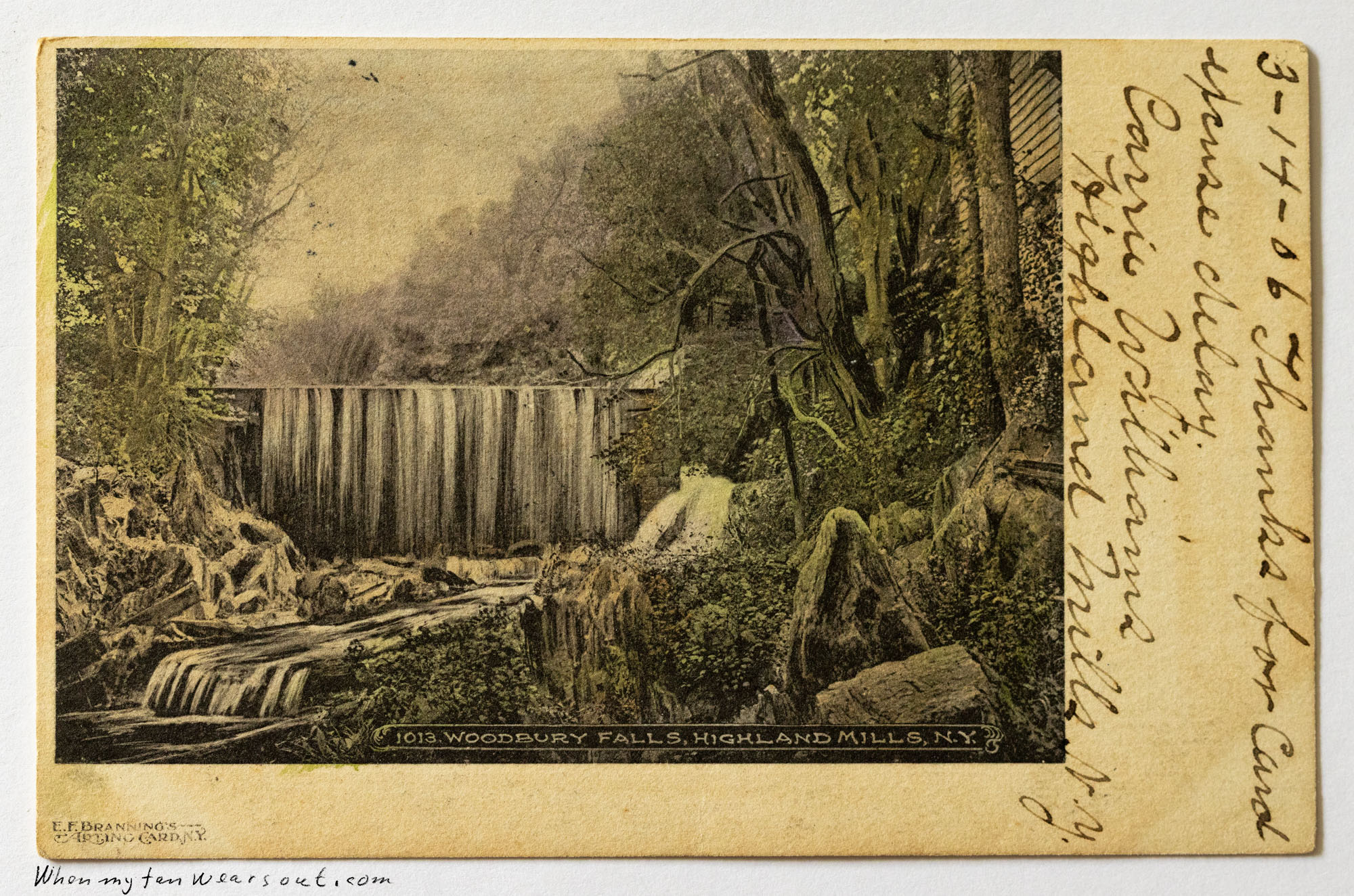
Front — A serene depiction of Woodbury Falls in Highland Mills, New York, with a short message on the right.
Postcard Metadata
Postmarked: Newburgh, NY — March 14, 1906
Sent From: Newburgh, NY
Sent To: Pearle Byers Fayette St Carthage, Ill. Box 611
Distance Traveled: Approximately 830 miles
Postage: U.S. 1-cent Benjamin Franklin stamp
Card Details: Undivided Back era (1901-1907)
Back — Correspondence from Carrie to Pearle Byers
Transcription
3 – 14 – 06 Thanks for card Was glad to hear from you Carrie Write soon P.S. Highland Mills N.Y.
Historical & Family Notes
This postcard, sent to Pearle Byers in March 1906, offers a charming glimpse into her early social life, long before her eventual marriage to Harvey Sights. The sender, Carrie, clearly a friend, expresses gratitude for a previous card and encourages further correspondence, highlighting the personal nature of such exchanges. The simple, heartfelt message, “Was glad to hear from you,” underscores the role of postcards in maintaining friendships and connections across distances in the early 20th century.
The card itself features a picturesque view of Woodbury Falls in Highland Mills, New York, a location mentioned by Carrie in her postscript, suggesting a personal connection to the scene. While not directly related to Pearl and Harvey’s courtship, such cards reveal the typical ways young women like Pearl engaged with their friends and world, building a network of social ties that would have been an integral part of her life.
The swift two-day delivery from Newburgh, New York, to Carthage, Illinois, demonstrates the remarkable efficiency of the U.S. postal service at the time. This allowed friends such as Carrie and Pearle to share news and greetings across vast geographical spans with relative ease, contributing to the rich tapestry of Pearl’s life story before she became Mrs. Sights.
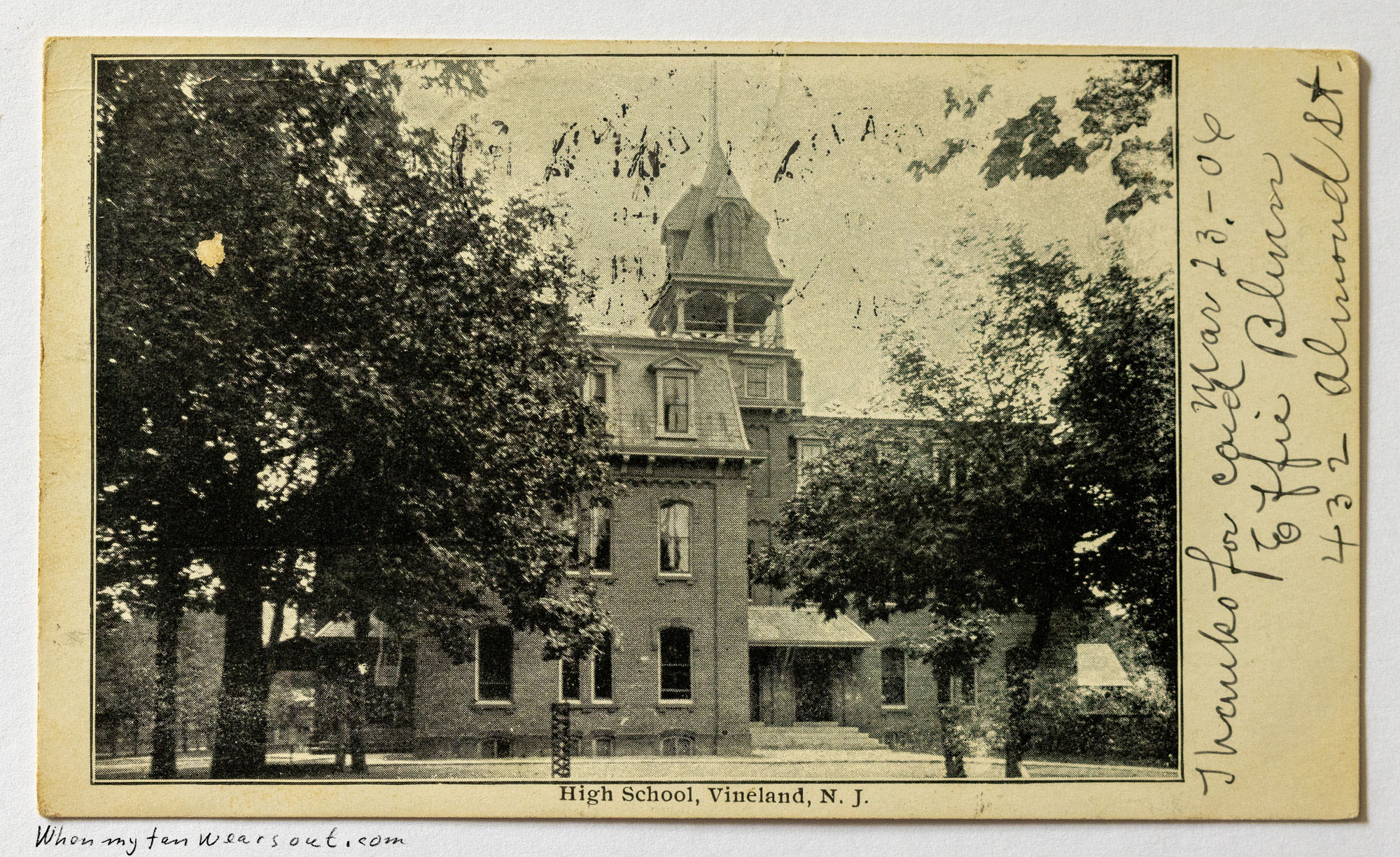
A brick high school building with a prominent central tower is surrounded by large, leafy trees in Vineland, New Jersey.
Postcard Metadata
Postmarked: Vineland, New Jersey — March 23, 1908
Sent From: Vineland, New Jersey
Sent To: Effie P. Byers 318 Lafayette St Carthage Ill.
Distance Traveled: Approximately 940 miles
Postage: One-cent green Franklin stamp
Card Details: Divided Back era (1907-1915)
Back — Correspondence from Effie Blinn to Effie P. Byers
Transcription
Thanks for card. Mar 23 – 08 Effie Blinn 433 Almond St
Historical & Family Notes
This postcard, sent from Vineland, New Jersey, captures a polite thank you note from Effie Blinn to Effie P. Byers, likely Pearl Byers’ mother or another close relative residing at the family home in Carthage, Illinois. The consistent address of 318 Lafayette Street in Carthage underscores the enduring family connection to this location, a central hub for the Byers family.
The communication, though brief, highlights the era’s common practice of using postcards for everyday greetings and short messages, predating more immediate forms of communication. The swift delivery, reaching Carthage the very next day, also showcases the efficiency of the early 20th-century postal service for cross-state mail.
While not directly featuring Pearl or Harvey, this card provides a glimpse into the broader family network surrounding Pearl Byers before her eventual marriage to Harvey Sights. It helps establish the social context and communication patterns within which their own courtship would unfold.
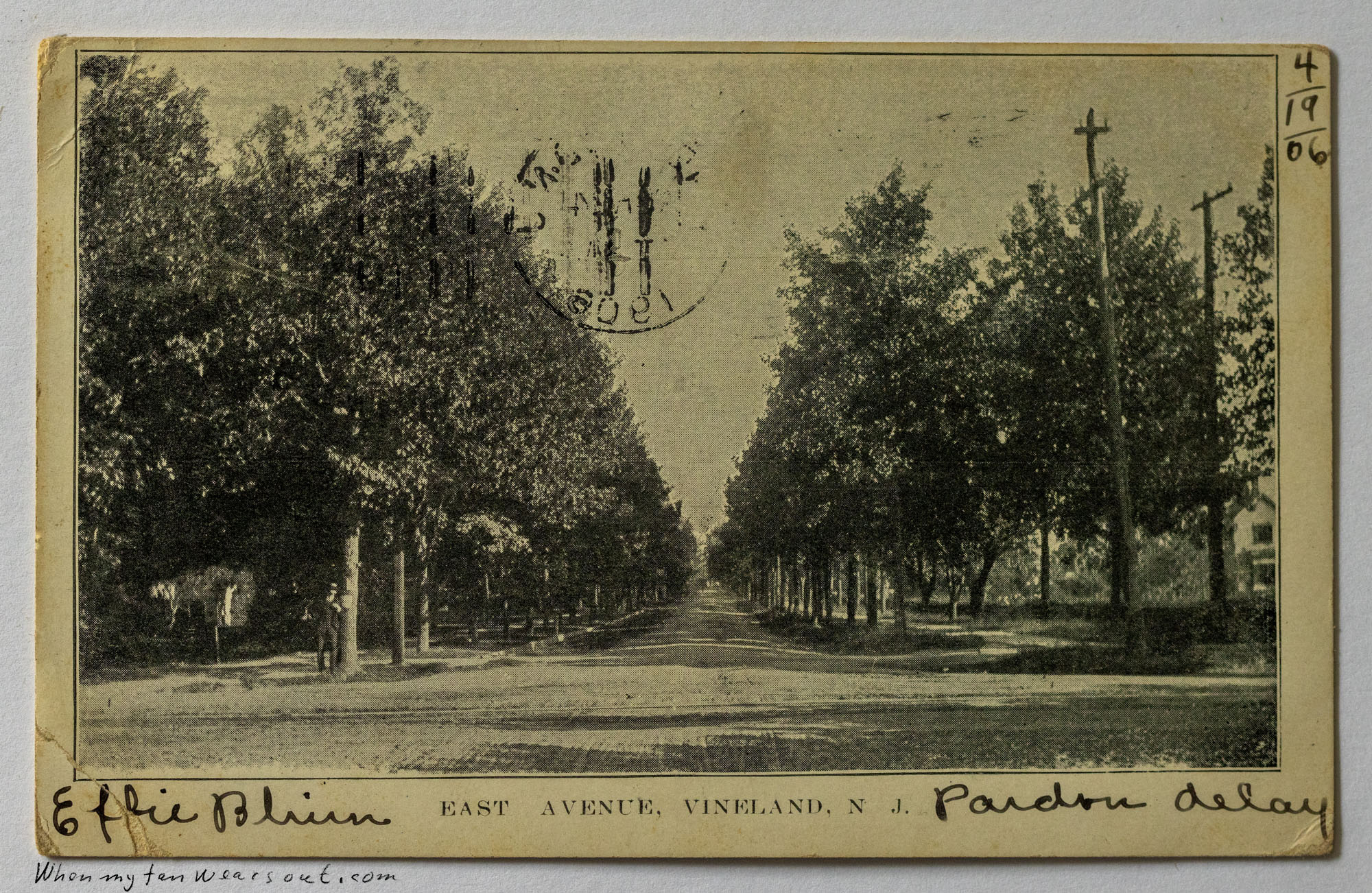
Front — A tree-lined East Avenue in Vineland, New Jersey, featuring a path flanked by utility poles.
Postcard Metadata
Postmarked: Vineland, New Jersey — April 24, 1906
Sent From: Vineland, New Jersey
Sent To: Effie Byers, 318 Fayette st, Carthage, Ill.
Distance Traveled: Approximately 830 miles
Postage: One cent US Postage stamp, George Washington
Card Details: An early example of a Divided Back card, predating the official March 1, 1907, postal regulation.
Back — Correspondence from Effie Blinn to Effie Byers
Transcription
Effie Blinn Pardon delay
Historical & Family Notes
This early 20th-century postcard captures a serene tree-lined street in Vineland, New Jersey, a common subject for postcards of the era. The brief message “Pardon delay” suggests a simple, informal exchange, perhaps between friends or family. The card is addressed to Effie Byers in Carthage, Illinois, indicating a connection to the Byers family collection, although it’s not directly addressed to Pearl Byers, the primary recipient of this archive. It’s plausible Effie Byers was a relative, such as a sister or mother, in Carthage, broadening the familial scope of the collection.
The sender, Effie Blinn, likely a friend or acquaintance, took 17 days for this postcard to travel from Vineland, New Jersey to Carthage, Illinois, arriving on May 11, 1906. This travel time was typical for mail delivery across states in the early 1900s. The card itself is noteworthy as an early example of a “divided back” postcard, a design that allowed both the address and a written message on the back, even though the official postal regulation permitting this for domestic mail began nearly a year later in March 1907.
While this specific card doesn’t directly feature Pearl Byers or Harvey Sights, its presence in the collection offers a glimpse into the broader network of friends and family connected to the Byers household in Carthage, Illinois. These small, everyday communications paint a picture of daily life and relationships that would eventually intertwine with Pearl and Harvey’s own story.
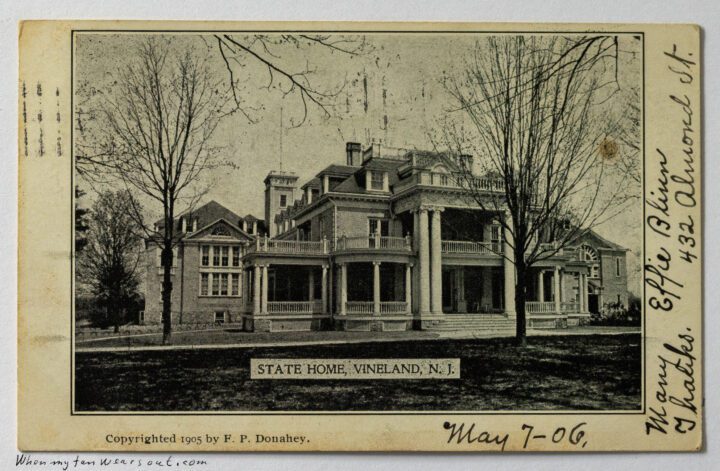
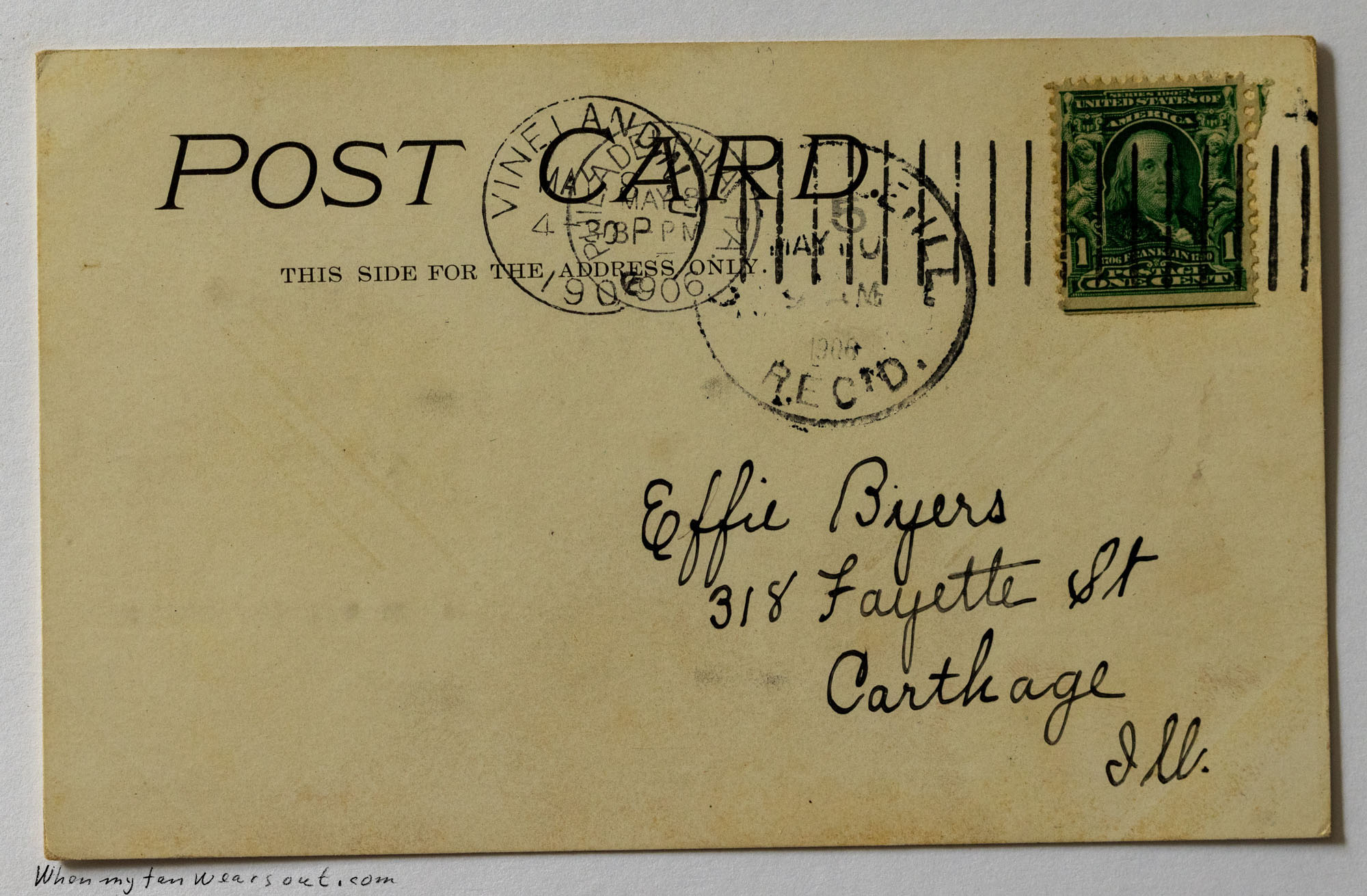
Front — A grand, multi-story brick building, labeled “STATE HOME, VINELAND, N. J.” with trees in the foreground.
Postcard Metadata
Postmarked: Vineland, New Jersey — May 7, 1906, 4:30 PM
Sent From: Vineland, New Jersey
Sent To: Effie Byers, 318 Fayette St, Carthage, Ills.
Distance Traveled: ~870 miles
Postage: US One Cent Benjamin Franklin stamp
Card Details: Undivided Back postcard, “Copyrighted 1905 by F. P. Donahey.”
Back — Correspondence from Effie Bhien to Effie Byers
Transcription
Many thanks. May 7-06. Effie Bhien 432 Almond St.
Historical & Family Notes
This early postcard, dated May 1906, offers a glimpse into the Byers family’s extended network before Pearl’s extensive correspondence with Harvey Sights. Addressed to Effie Byers at 318 Fayette Street in Carthage, Illinois—the very home Pearl would share with her family—it establishes a foundational timeline for the Byers household. While not sent directly to Pearl, the card reinforces the consistent location of her family home, a place that would later feature prominently in her personal story and eventual courtship.
The image on the front depicts the “State Home, Vineland, N. J.,” historically known as the New Jersey Training School for Feeble-Minded Girls and Boys. This institution was a significant, albeit complex, part of early 20th-century social history, pioneering research in intellectual disabilities while also becoming entangled in the eugenics movement. The postcard’s image provides a window into the types of public institutions and social structures that existed during Pearl’s formative years.
The brief message, “Many thanks,” penned by “Effie Bhien” from nearby 432 Almond Street, suggests a simple, everyday acknowledgment. Such concise notes were common on undivided back postcards, where space for correspondence was limited. This card, a tangible artifact from 1906, predates the more romantic and detailed letters Pearl would later exchange with Harvey, yet it subtly grounds their story within the broader social and familial context of the early 20th century.
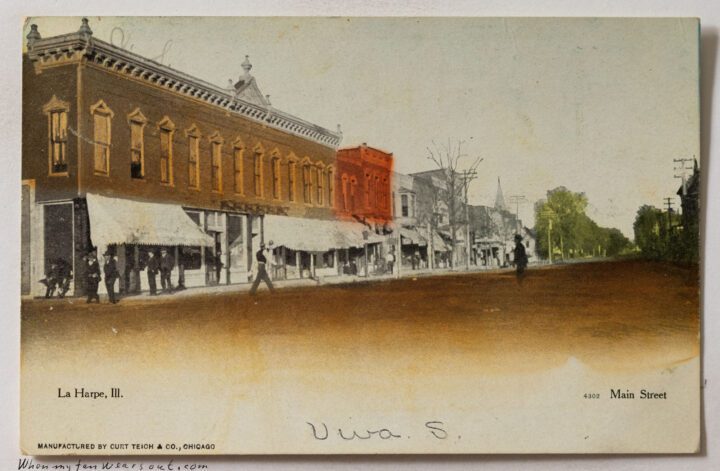
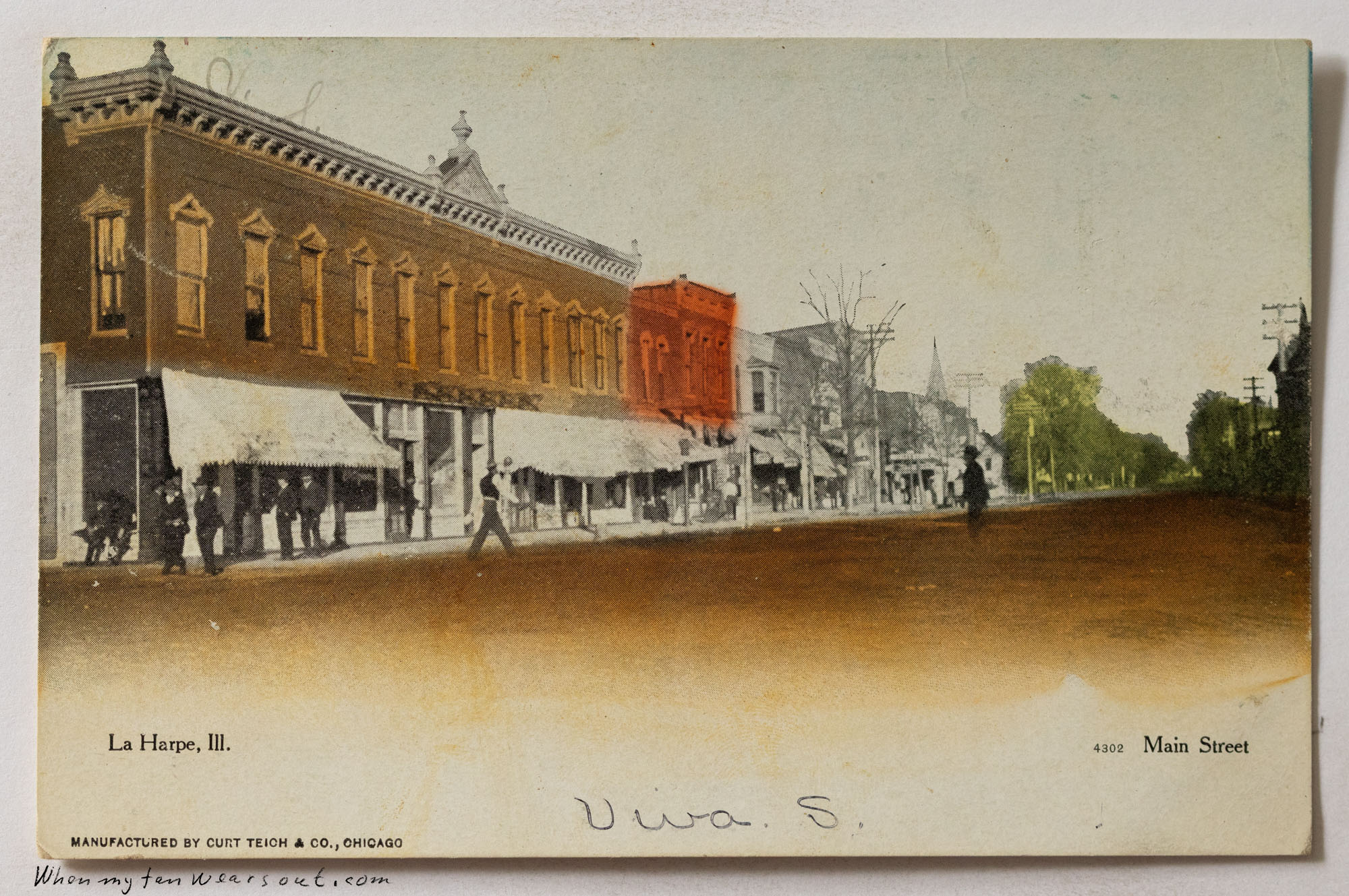
Front — A bustling view of Main Street in La Harpe, Illinois, featuring storefronts with awnings and a partially colorized brick building.
Postcard Metadata
Postmarked: Burnside, IL — June 20, 1907
Sent From: Burnside, Illinois
Sent To: Miss Pearle Byers, Carthage, Ill.
Distance Traveled: Approximately 11 miles
Postage: U.S. One Cent (Franklin)
Card Details: Undivided Back era (1901-1907), manufactured by Curt Teich & Co., Chicago
Back — Correspondence from Viwa S. to Miss Pearle Byers
Transcription
Viwa. S.
Historical & Family Notes
This early postcard, sent to the young Miss Pearle Byers, offers a quick glimpse into her social world during her formative years. The card features a common street scene of the era from nearby La Harpe, Illinois, a familiar type of imagery used for brief communications. The message, simply “Viwa. S.” on the front of the card, is characteristic of the concise messages exchanged on undivided back postcards where space for writing was limited.
Originating from Burnside, a mere 11 miles from Carthage, this card likely came from a local acquaintance or friend, Viwa S., whose brief greeting is preserved in this collection. These everyday interactions paint a picture of Pearl’s life before her marriage to Harvey Sights, highlighting the connections she maintained within her immediate community.
The postcard itself is an excellent example of the transitional period in postcard history. Though postmarked in June 1907, after divided backs were permitted, its layout with “NOTHING BUT THE ADDRESS ON THIS SIDE” firmly places it stylistically within the Undivided Back era, suggesting an older card still in circulation.
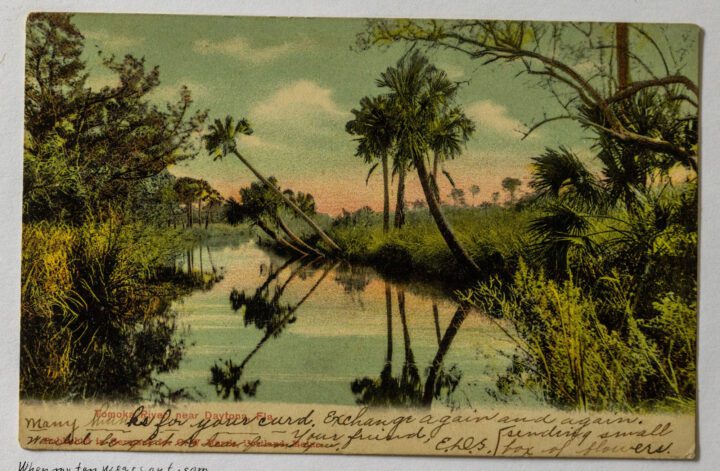
Front — A scenic view of palm trees and other tropical foliage reflected in a tranquil body of water under a colorful sky, labeled “Ormond Key near Daytona.”
Postcard Metadata
Postmarked: Lady Lake, Florida — March 10, 1906
Sent From: Lady Lake, Florida
Sent To: Miss Pearle Byers, Carthage, Ill.
Distance Traveled: Approximately 970 miles (1560 km)
Postage: One cent United States stamp featuring Benjamin Franklin, green.
Card Details: Undivided back, typical for postcards sent before March 1, 1907.
Back — Correspondence from C.H.S. to Miss Pearle Byers
Transcription
Ormond Key near Daytona. Many thanks for your card, exchange again and again. Your friend C.H.S. Send me a small novel not complicated with love something of your own. Box of flowers.
Historical & Family Notes
This early postcard, dating from 1906, shows the sender, C.H.S., corresponding with Pearl Byers from sunny Florida. The reference to “Ormond Key near Daytona” places the sender on what was then a popular winter resort destination, indicating some travel or leisure activities. The message, though brief, hints at a warm and continuous exchange, stating “exchange again and again.”
The most intriguing part of the message is the playful postscript: “Send me a small novel not complicated with love something of your own. Box of flowers.” While signed simply “Your friend C.H.S.,” the initials “H.S.” align with Harvey Sights, Pearl’s future husband. The request for a novel “not complicated with love” could be a teasing remark between two individuals who are perhaps just beginning to navigate the complexities of their own budding affections, subtly hinting at an interest beyond mere friendship. The mention of “Box of flowers” further adds to this gentle flirtation.
This card provides a charming glimpse into the early stages of communication between Pearl and her circle, potentially even with Harvey Sights himself, before their relationship fully blossomed. The request for a personalized “novel” suggests an intimate understanding and shared sense of humor between the correspondent and Pearl, laying groundwork for a deeper connection in the years to come.
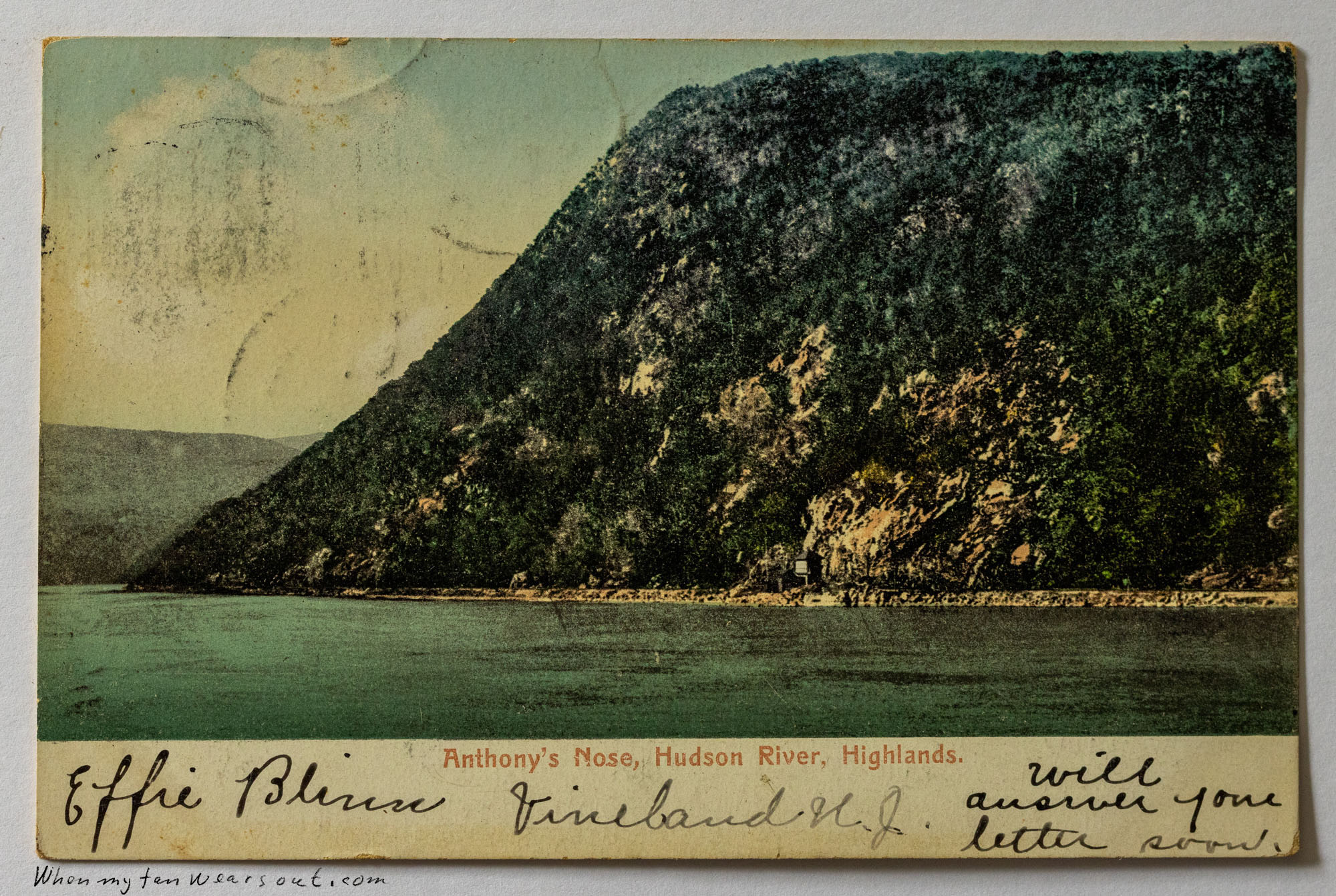
Front — A view of Anthony’s Nose, a forested mountain along the Hudson River in the New York Highlands.
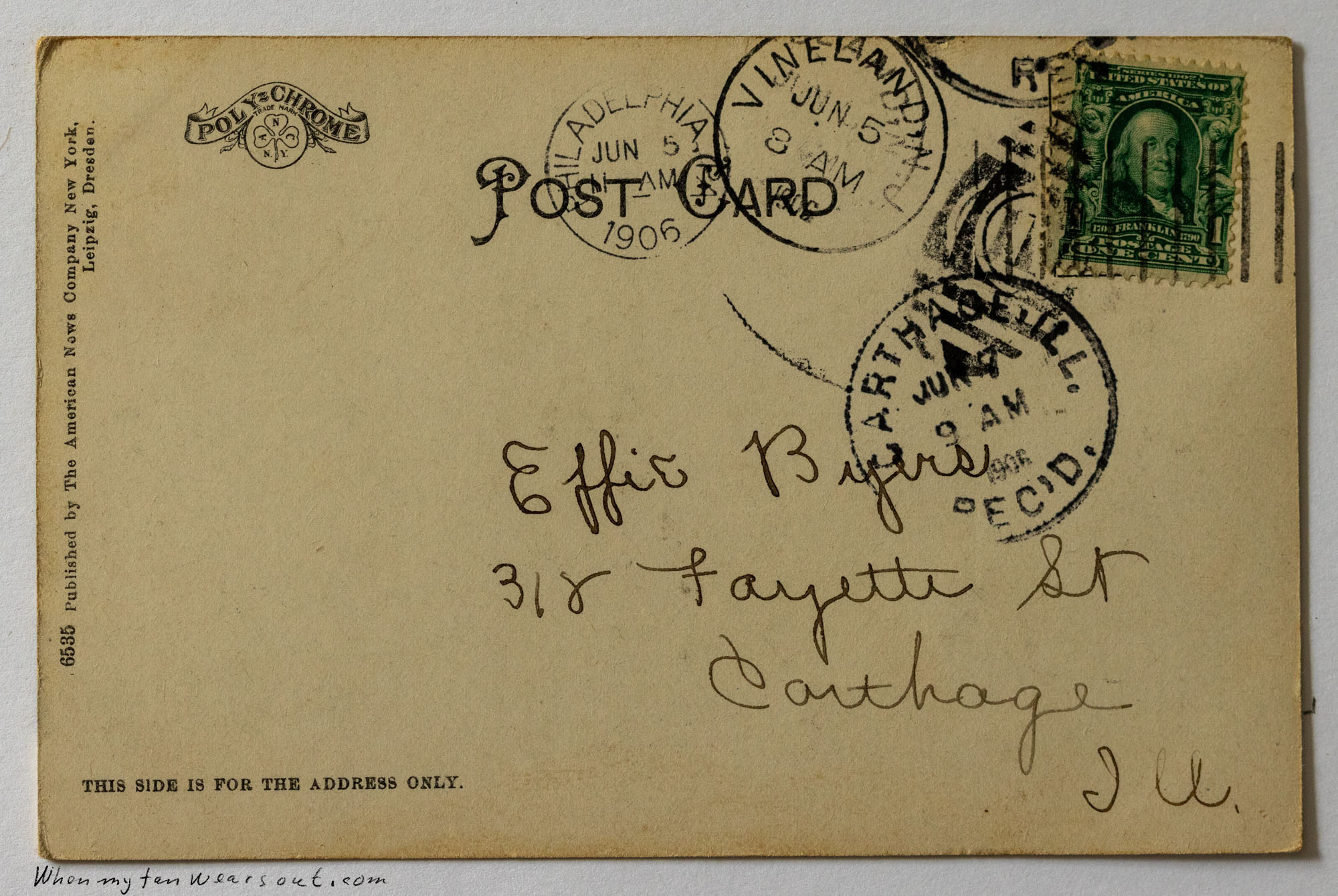
Postcard Metadata
Postmarked: Vineland, NJ — June 5, 1906
Sent From: Vineland, New Jersey
Sent To: Effie Byers, 318 Fayette St, Carthage, Ill.
Distance Traveled: Approximately 900 miles
Postage: 1-cent Benjamin Franklin stamp
Card Details: Undivided Back postcard, published by The American News Company, Leipzig, Dresden.
Back — Correspondence from Effie Blinn to Effie Byers
Transcription
Effie Blinn will answer your letter soon!
Historical & Family Notes
This early 20th-century postcard captures the majestic scenery of Anthony’s Nose overlooking the Hudson River in the New York Highlands. Sent by Effie Blinn from Vineland, New Jersey, it assures the recipient, Effie Byers of Carthage, Illinois, that a letter is forthcoming. The simple message, “will answer your letter soon!”, suggests an ongoing correspondence between the two.
Given that this postcard is addressed to Effie Byers at the same Carthage address as Pearl Byers, it’s highly probable that Effie Byers is a close family member, perhaps Pearl’s mother or sister. This card offers a glimpse into the broader network of family and friends surrounding the main characters of the collection, documenting their connections and the common practice of sharing travel experiences through postcards.
The card’s “Undivided Back” design, typical for postcards predating 1907, means the entire back was reserved for the address, pushing the message to the front alongside the image. The 1-cent postage for domestic delivery was standard at the time, allowing for wide circulation of these early photographic travel mementos.
A scenic view of two people in a rowboat on the Ocklawaha River, Florida, surrounded by cypress trees draped with Spanish moss.
Postcard Metadata
Postmarked: Lady Lake, Florida — May 11, 1906
Sent From: Lady Lake, Florida
Sent To: Miss Pearle Byers. Carthage, Ill.
Distance Traveled: Approximately 988 miles
Postage: One Cent, U.S. Postage, Benjamin Franklin stamp
Card Details: Undivided Back era (pre-1907), Address only on right side. Publisher: No. 1219. Frank Huld, Publisher, New York.
Back — Correspondence from Ernest Bligh to Miss Pearle Byers
Transcription
Off for the picnic How would you like this trip— Ernest Bligh.
Historical & Family Notes
This postcard, sent to Pearl Byers in May 1906, offers a glimpse into her social life before her marriage to Harvey Sights. The sender, Ernest Bligh, describes a picnic on the scenic Ocklawaha River in Florida, asking Pearl if she would enjoy such a trip. This suggests a friendly relationship, perhaps a travel companion or an admirer, highlighting Pearl’s wider connections before settling down.
The Ocklawaha River, famous for its lush landscapes and cypress swamps draped in Spanish moss, was a popular tourist destination in the early 20th century. This postcard captures the allure of such natural beauty and the burgeoning trend of travel and leisure, with postcards serving as a common way to share experiences from afar.
While this card is not from Harvey, it enriches Pearl’s personal narrative, painting a picture of a young woman receiving mail from various acquaintances and experiencing life’s adventures, even if vicariously through postcards. The Carthage postmark indicates receipt on the same day as dispatch from Florida, a common yet intriguing postal anomaly for the era, suggesting a rapid journey or perhaps a timestamp discrepancy.
Front — A view of the Chanute Public Library in Chanute, Kansas, with a handwritten note “Miss Pearl 3.5.08” at the top.
Postcard Metadata
Postmarked: Chanute, Kansas — November 23, 1907
Sent From: Chanute, Kansas
Sent To: Miss Pearl Byers Carthage Ill.
Distance Traveled: Approximately 410 miles
Postage: One Cent U.S. Franklin stamp, green
Card Details: Divided Back Era (1907-1915)
Back — Correspondence from Harvey Sights to Miss Pearl Byers
Transcription
Dear Pearl, Was glad to hear from you. We are having nice weather here this week. Had a good rain yesterday. I wish I was there to spend my birthday with you. Your Harvey
Historical & Family Notes
In this heartfelt message, Harvey Sights sends an early birthday wish to Pearl Byers, lamenting his absence for her December 4th celebration. The postcard, postmarked November 23, 1907, captures the anticipation of Pearl’s special day from afar, as Harvey expresses his desire to be with her. The front of the card depicts the Chanute Public Library in Kansas, where Harvey was at the time, offering a glimpse into the locale from which he sent his affections.
This card perfectly illustrates the challenges of courtship across distances in the early 20th century, relying on the postal service to bridge the miles between Chanute, Kansas, and Carthage, Illinois. The sentiment “I wish I was there to spend my birthday with you” speaks volumes about the growing bond between Harvey and Pearl, hinting at the romantic connection that would eventually lead to their marriage.
The small, handwritten note “Miss Pearl 3.5.08” on the front of the postcard appears to be a later annotation, possibly by Pearl herself or a collector, indicating a date that doesn’t align with the 1907 postmark but might mark a significant memory associated with the card. It further solidifies the postcard’s personal significance within Pearl’s collection.
Front — A hand-colored postcard depicting the brick Town Hall of Peabody, Massachusetts, with a large tree on the left.
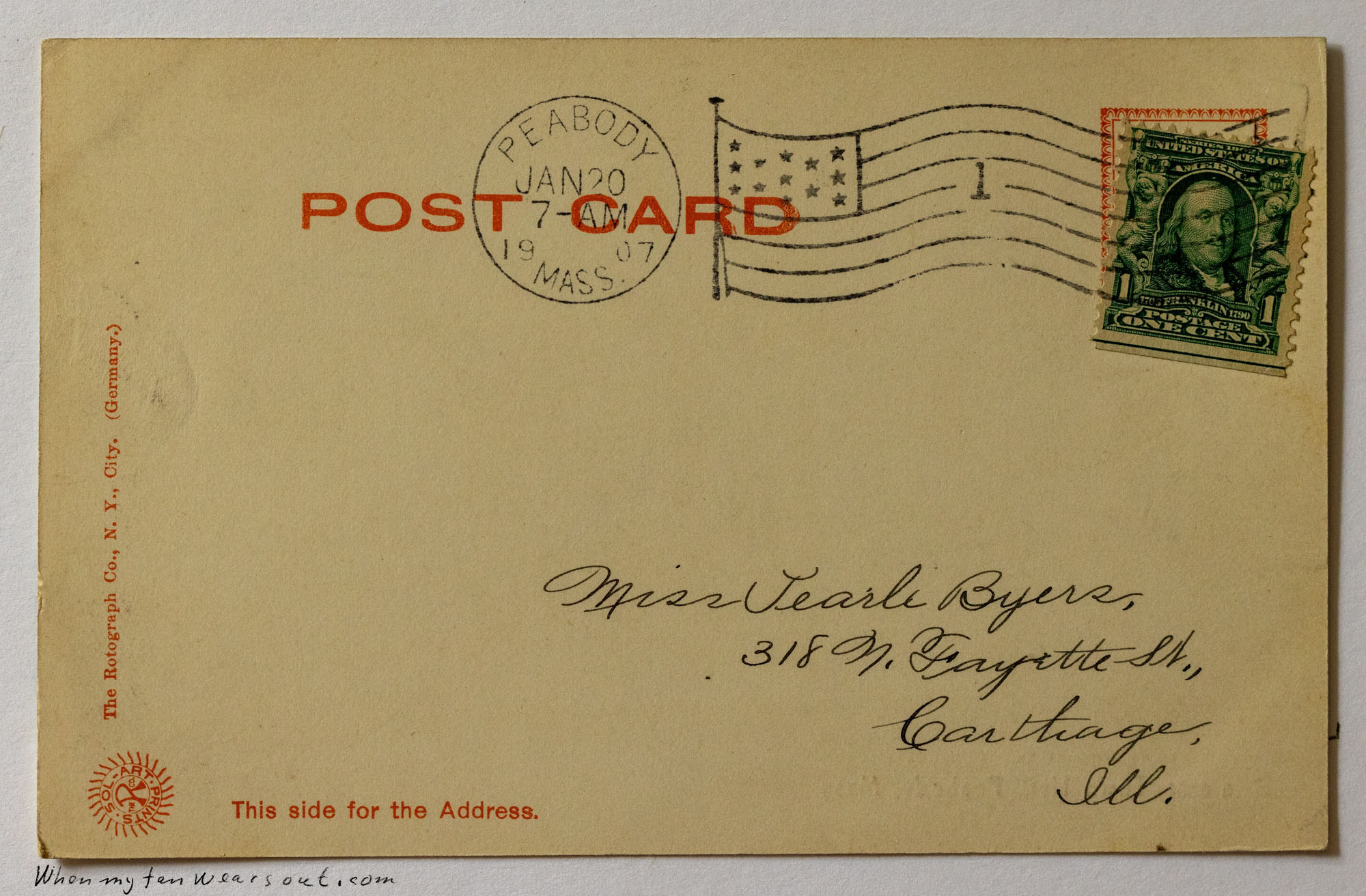
Postcard Metadata
Postmarked: Peabody, Massachusetts — January 20, 1907
Sent From: Peabody, Massachusetts
Sent To: Miss Pearle Byers, 318 N. Fayette St., Carthage, Ill.
Distance Traveled: Approximately 1,050 miles
Postage: One Cent U.S. Postage, Franklin (green)
Card Details: Divided Back Era (produced by The Rotograph Co., N. Y., City, Germany; postmarked before the widespread domestic Divided Back adoption in March 1907)
Back — Correspondence from M. M. Powers to Miss Pearle Byers
Transcription
1-18-’07 M. M. Powers.
Historical & Family Notes
This early postcard, dated January 18, 1907, and postmarked January 20, 1907, presents a hand-colored image of the Town Hall in Peabody, Massachusetts. Sent by M. M. Powers to Pearle Byers in Carthage, Illinois, it is unusual in that the only handwritten message beyond the address is the sender’s signature and the date on the front of the card. This suggests a very brief, perhaps casual or purely demonstrative, exchange.
The card is a product of The Rotograph Co., based in New York City but with manufacturing noted as “Germany.” This highlights the significant role of German printers in the early postcard boom in the United States. Its “divided back” design, with a dedicated space for the message and address, was officially sanctioned in the U.S. for domestic postcards starting March 1, 1907. This card, postmarked slightly before that date, indicates it was likely an imported card using the divided back format already popular in Europe, predating the American regulation.
Although the sender isn’t Harvey Sights, this postcard adds another piece to Pearle’s growing collection of correspondence, showcasing her connections across different parts of the country. It captures a moment in her life just a few years before her eventual marriage to Harvey, documenting the diverse array of people who communicated with her during her youth in Carthage.
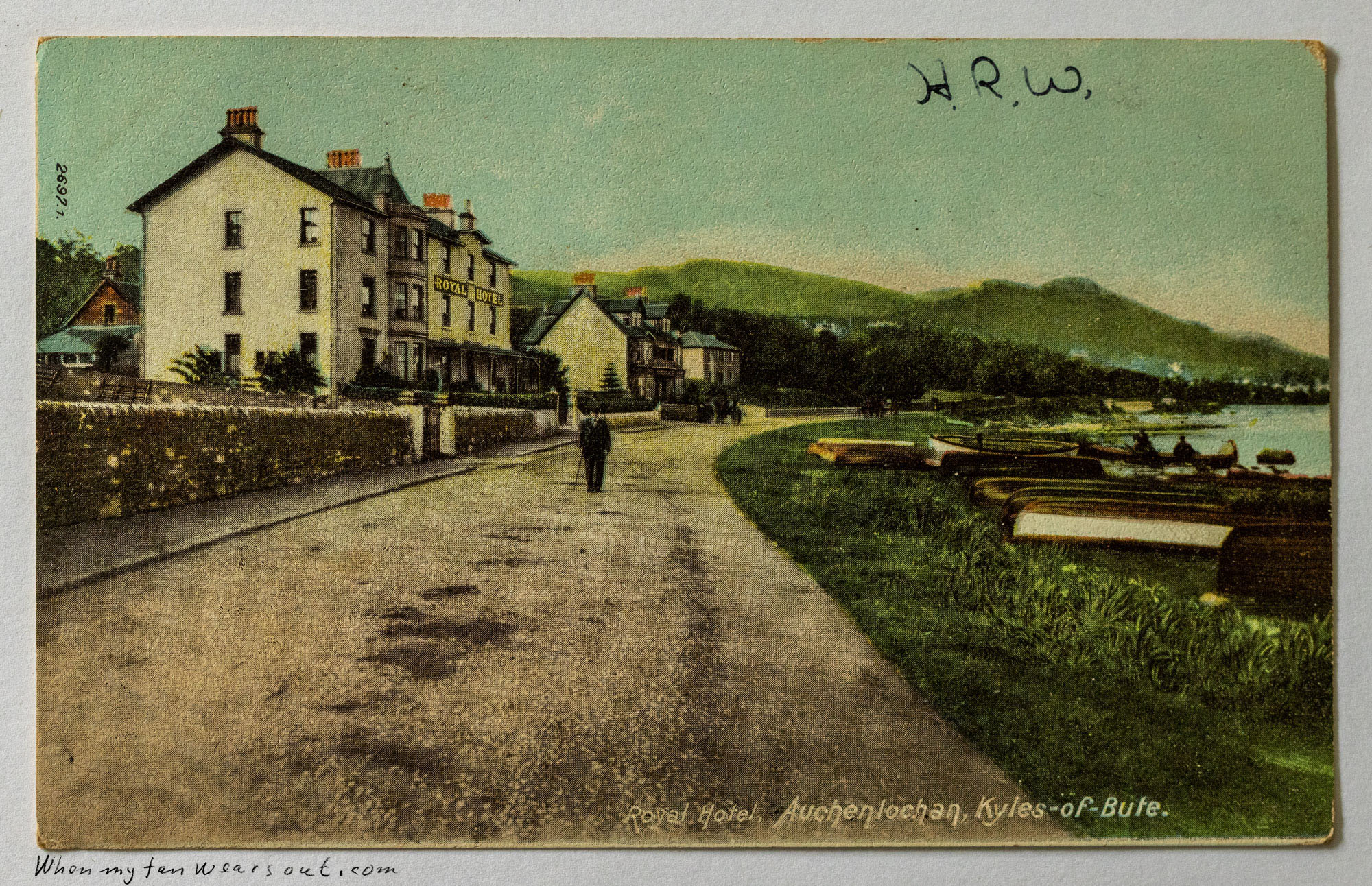
Front — A hand-tinted postcard depicting the Royal Hotel and a coastal road in Auchterlochan, Kyles-of-Bute, Scotland, with a lone figure walking and boats moored by the shore.
Postcard Metadata
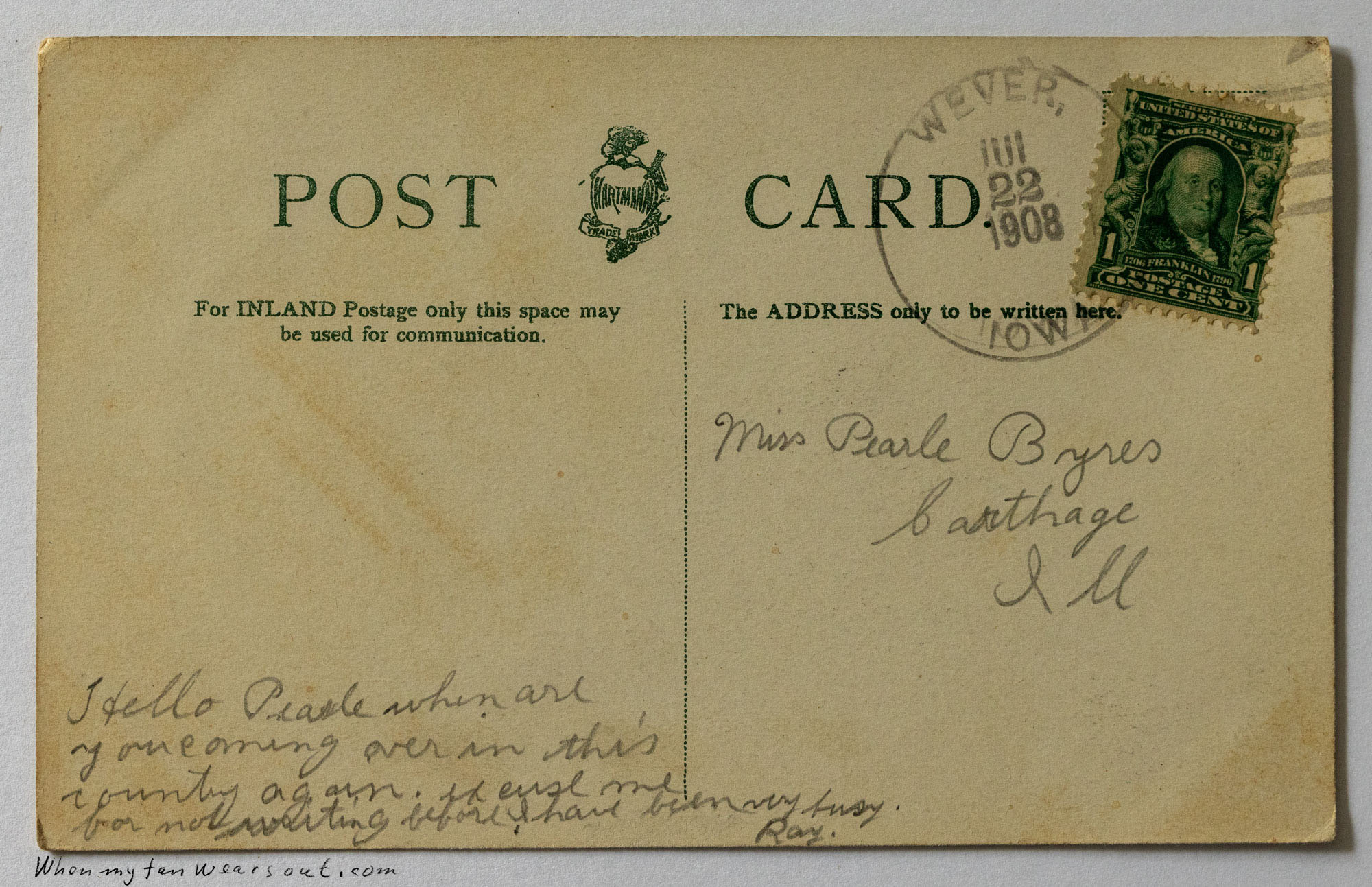
Postmarked: Wever, Iowa — JUL 22 1908
Sent From: Wever, Iowa
Sent To: Miss Pearle B. Byers, Carthage, Illinois
Distance Traveled: Approximately 23 miles
Postage: United States of America, One Cent (Benjamin Franklin stamp)
Card Details: Divided Back Era (post-1907)
Back — Correspondence from Ray to Miss Pearle B. Byers
Transcription
Hello Pearle when are you coming over in this country again. I expect me from not waiting before I have biansy two. Ray.
Historical & Family Notes
This postcard, featuring a picturesque scene of the Royal Hotel in Auchterlochan, Kyles-of-Bute, Scotland, offers a glimpse into Pearl Byers’ social connections prior to her marriage to Harvey Sights. Despite the Scottish imagery on the front, the card was postmarked from Wever, Iowa, and sent to Pearl in Carthage, Illinois. The sender, identified only as “Ray,” asks Pearl, “when are you coming over in this country again,” implying Pearl may have been traveling or was expected to visit Ray’s locale.
The message suggests a friendly, familiar relationship, possibly with a relative or close friend who lived a short distance away in Iowa. The casual nature of the message, despite the exotic foreign scene, highlights the common practice of using any available postcard stock for correspondence, regardless of its pictorial content, focusing primarily on the message itself.
This card is a small testament to Pearl’s life and relationships before she became Pearl Sights, showcasing her network of acquaintances and the broader world she navigated through correspondence, even as simple as a postcard sent across a short regional distance.
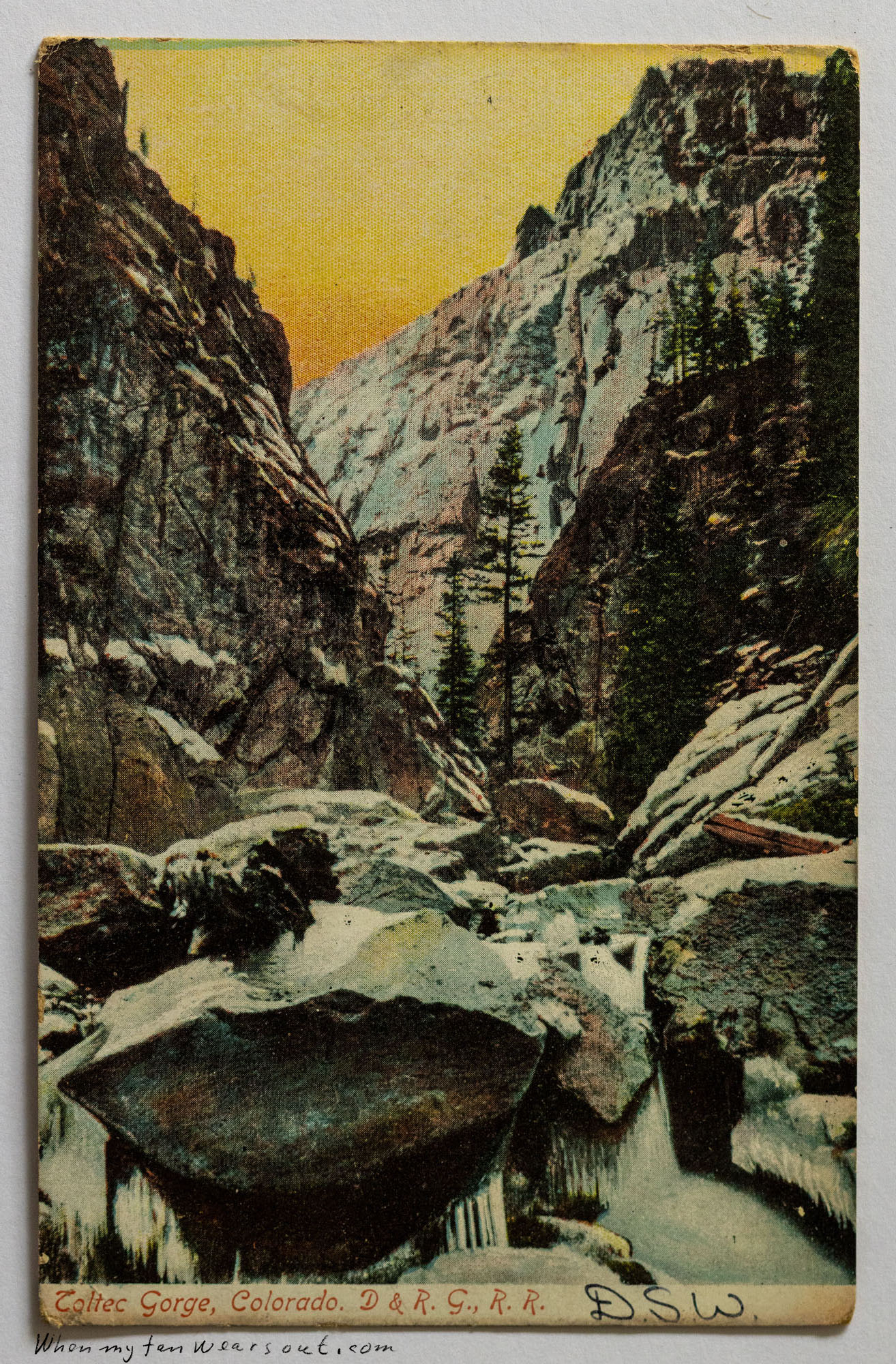
Front — A vibrant, hand-colored view of the Toltec Gorge in Colorado, with a river flowing through snow-dusted rocks and steep, pine-covered cliffs under a golden sky.
Postcard Metadata
Postmarked: S.A. Denver, Colo. — June 25, 1908
Sent From: Denver, Colorado
Sent To: Miss Pearl Byers, Carthage, Ill.
Distance Traveled: Approximately 715 miles
Postage: U.S. POSTAGE ONE CENT (Green George Washington stamp)
Card Details: Divided Back postcard, Litho-Chrome by Leipzig, Berlin, published by The Colorado News Company, Denver, Colo.
Back — Correspondence from D.S.W. to Pearl Byers
Transcription
June. 25.08 Miss Byers. Just returned from trips to mountains and was pleased to find card awaiting me, From july 1st I will have intern in the electric business in San Marciali. weather down here is too warm, & it is very dry for this time of year your friend D.S.W.
Historical & Family Notes
This postcard, sent to Pearl Byers in 1908, offers a glimpse into a potential early admirer or friend, D.S.W., before her eventual marriage to Harvey Sights. The sender shares news of recent mountain excursions and an upcoming “intern” position in the “electric business in San Marciali,” likely referring to San Marcial, New Mexico, a significant railroad town known for its engineering activities. The mention of the weather being “too warm” and “very dry” for the time of year provides a vivid, if brief, snapshot of the conditions in the American Southwest over a century ago.
While the sender is not explicitly Harvey Sights, this card is part of a collection leading to Pearl and Harvey’s story. It’s plausible that this correspondence represents a friendship Pearl maintained, or perhaps even an early professional contact for Harvey, who was known for his engineering work and travels. The timing predates much of the known extensive correspondence between Pearl and Harvey, suggesting a period when Pearl was cultivating various relationships.
The card’s front, depicting the dramatic Toltec Gorge, captures the adventurous spirit of the sender’s mountain trips. This kind of scenic postcard was very popular during the Divided Back era, allowing for both a picture and a personal message to be shared across vast distances, connecting people like D.S.W. and Pearl Byers, even as their lives unfolded in different regions of the country.
Front — A hand-colored image depicting the elegant Zwingerhof palace and gardens in Dresden, Germany.
Postcard Metadata
Postmarked: Lebanon, Kansas — January 24, 1907
Sent From: Lebanon, Kansas
Sent To: Pearle Bryers, Carthage, Illinois
Distance Traveled: Approximately 370 miles
Postage: One Cent, Benjamin Franklin (U.S. Series of 1902)
Card Details: Divided Back era (early example, pre-dating the official U.S. divided back standard of March 1, 1907)
Back — Correspondence from Frankie to Pearle Bryers
Transcription
Postkarte. Card and letter recd. will write soon Frankie
Historical & Family Notes
This postcard offers a glimpse into Pearl Byers’s broader social network prior to her marriage to Harvey Sights, as she receives a brief acknowledgment from a sender named Frankie. The early 20th century saw a boom in postcard popularity, with people often sending quick notes like this one rather than full letters. This card, postmarked just over a month before the official start of the Divided Back era in the U.S., showcases an early adoption of the format, allowing for both address and message on the back.
The exotic image of the Zwingerhof in Dresden, Germany, provides a stark contrast to the everyday, concise message from Kansas. It reflects a common practice of the time: using scenic or international cards for purely domestic, informal communication, bridging vast geographical and cultural distances through a simple piece of mail.
While this card doesn’t directly mention Harvey Sights, it helps to paint a more complete picture of Pearl’s life and her connections before her romance with Harvey blossomed. It shows her as a recipient of regular correspondence, illustrating the everyday communication practices of young women in rural America at the turn of the century.