Front — A group of store employees or proprietors pose with a display case of umbrellas.
Postcard Metadata
Postmarked: Not Visible
Sent From: None
Sent To: None
Distance Traveled: None
Postage: Not visible (no stamp)
Card Details: Divided Back, Real Photo Postcard (RPPC) with “A Z O” stamp box (circa 1907-1920s).
Back — A list of names
Transcription
Fred Peasley Waldo Mason Miss Erbroidt Miss Osborn Tom Roberts Carrie Campbell Maude Biggs Mabel Roberto
Mason Dry Goods Store, La Harpe
Historical & Family Notes
This charming real photo postcard, likely dating to the early 20th century, captures a slice of small-town commerce, possibly the very store where Harvey Sights worked or visited. The image presents a bustling scene with employees, a counter, and umbrellas for sale, suggesting a dry goods or department store.
Front — An engraving depicts the Old Gittings Seminary in Laharpe, Illinois, noted as having burned on January 13, 1889.
Postcard Metadata
Postmarked: N/A
Sent From: N/A (Laharpe, Illinois implied by subject matter)
Sent To: (Address lines are blank on the card)
Distance Traveled: N/A (No addresses for calculation)
Postage: No stamp visible
Card Details: Undivided Back (common pre-1907), manufactured by A.T.F. Co. Chicago.
Back — Correspondence from Unidentified to Implied Recipient: Pearl Byers
Transcription
Show where the present F. A. Nelson home is.
Historical & Family Notes
This postcard offers a glimpse into local Illinois history, featuring an engraving of the Old Gittings Seminary in Laharpe, a town approximately 20 miles north of Carthage. The front explicitly notes the seminary’s destruction by fire on January 13, 1889, placing the card’s publication sometime after this event. The Undivided Back design suggests it predates 1907, aligning with the early courtship years of Pearl Byers and Harvey Sights.
The back of the card, while lacking a clear sender or recipient address, contains a brief, almost enigmatic message: “Show where the present F. A. Nelson home is.” This laconic note implies a shared local knowledge between the sender and the intended recipient, characteristic of correspondence between friends or family members within a close-knit community. It’s easy to imagine a young Harvey or Pearl sending such a card to the other, perhaps during one of their brief separations, sharing a point of interest known only to them.
The card serves as a tangible piece of the era, illustrating how local landmarks and everyday observations found their way into personal communications. While not a direct love letter, its inclusion in Pearl’s collection suggests it held some personal significance, possibly marking a location they visited or discussed, further knitting the fabric of their early relationship within the familiar landscapes of Hancock County, Illinois.
Front — A hand-tinted postcard featuring a scenic view of Indian Mound Park in Quincy, Illinois, overlooking the Mississippi River.
Postcard Metadata
Postmarked: Quincy, Ill. — AUG 25 4 PM 1908
Sent From: Quincy, Illinois
Sent To: Miss Pearl Byers, Carthage, Ill.
Distance Traveled: Approximately 32 miles
Postage: One Cent U.S. Franklin stamp, green.
Card Details: Divided back postcard, printed by “Leipzig Berlin Dresden Litho-Chrome”, trademark indicates “Printed in Germany”.
Back — Correspondence from Elva to Miss Pearl Byers
Transcription
Hello kids! Got here p.m. sound. Have a dandy room. Will have to write before long. Elva 438 N. 8th st.
Historical & Family Notes
This postcard offers a glimpse into Pearl Byers’ social circle before her eventual marriage to Harvey Sights. The sender, Elva, is likely a friend or relative, providing a quick update from Quincy, Illinois. The casual tone and simple message, “Hello kids! Got here p.m. sound. Have a dandy room,” reflect the common use of postcards for brief, informal communication in the early 20th century, a time when such exchanges were cherished links between distant friends and family.
The card’s front depicts Indian Mound Park in Quincy, a notable local landmark with its historic earthworks and scenic views of the Mississippi River. Such picturesque views were popular subjects for postcards, allowing senders to share a bit of their travels or local attractions with recipients back home. Even a relatively short trip to a nearby town like Quincy would have been an occasion worth noting and sharing with friends like Pearl in Carthage.
While Harvey Sights isn’t directly mentioned in this particular correspondence, this postcard beautifully illustrates the rich tapestry of relationships Pearl maintained. These frequent, small exchanges kept her connected to a broad community of friends and family, forming the supportive network that would surround her as she eventually married Harvey and started her own family, enriching the Sights’ family legacy.
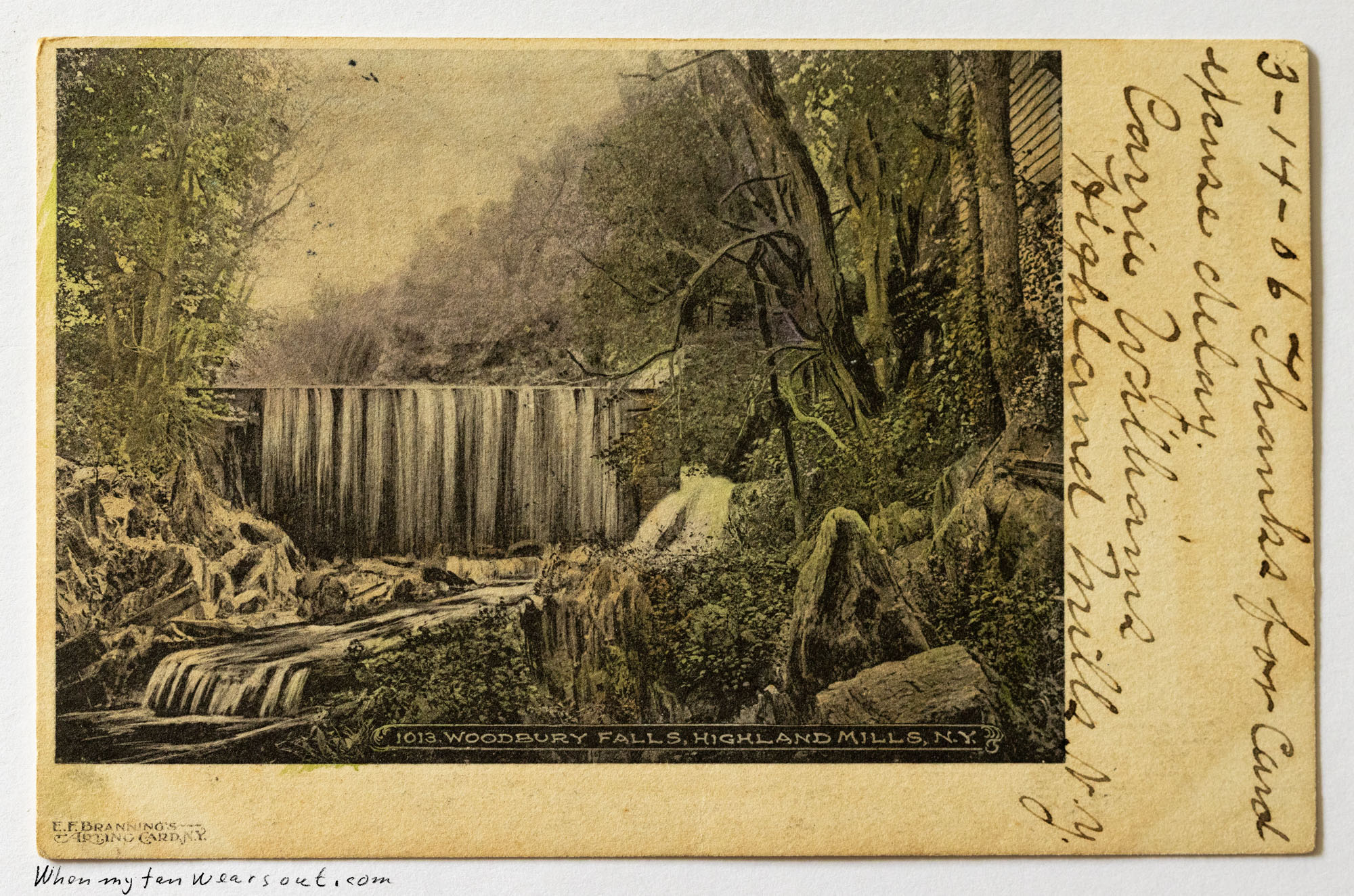
Front — A serene depiction of Woodbury Falls in Highland Mills, New York, with a short message on the right.
Postcard Metadata
Postmarked: Newburgh, NY — March 14, 1906
Sent From: Newburgh, NY
Sent To: Pearle Byers Fayette St Carthage, Ill. Box 611
Distance Traveled: Approximately 830 miles
Postage: U.S. 1-cent Benjamin Franklin stamp
Card Details: Undivided Back era (1901-1907)
Back — Correspondence from Carrie to Pearle Byers
Transcription
3 – 14 – 06 Thanks for card Was glad to hear from you Carrie Write soon P.S. Highland Mills N.Y.
Historical & Family Notes
This postcard, sent to Pearle Byers in March 1906, offers a charming glimpse into her early social life, long before her eventual marriage to Harvey Sights. The sender, Carrie, clearly a friend, expresses gratitude for a previous card and encourages further correspondence, highlighting the personal nature of such exchanges. The simple, heartfelt message, “Was glad to hear from you,” underscores the role of postcards in maintaining friendships and connections across distances in the early 20th century.
The card itself features a picturesque view of Woodbury Falls in Highland Mills, New York, a location mentioned by Carrie in her postscript, suggesting a personal connection to the scene. While not directly related to Pearl and Harvey’s courtship, such cards reveal the typical ways young women like Pearl engaged with their friends and world, building a network of social ties that would have been an integral part of her life.
The swift two-day delivery from Newburgh, New York, to Carthage, Illinois, demonstrates the remarkable efficiency of the U.S. postal service at the time. This allowed friends such as Carrie and Pearle to share news and greetings across vast geographical spans with relative ease, contributing to the rich tapestry of Pearl’s life story before she became Mrs. Sights.
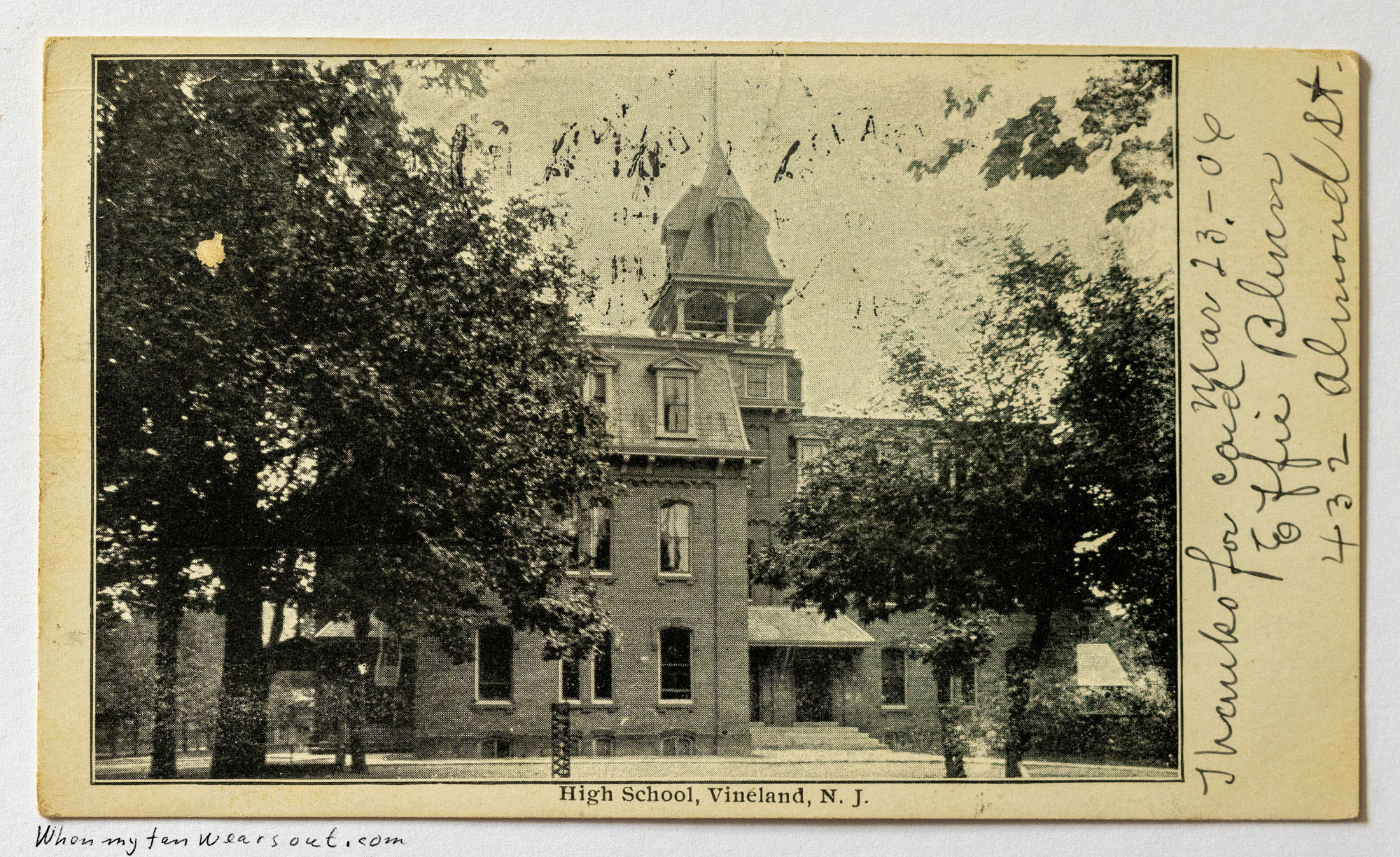
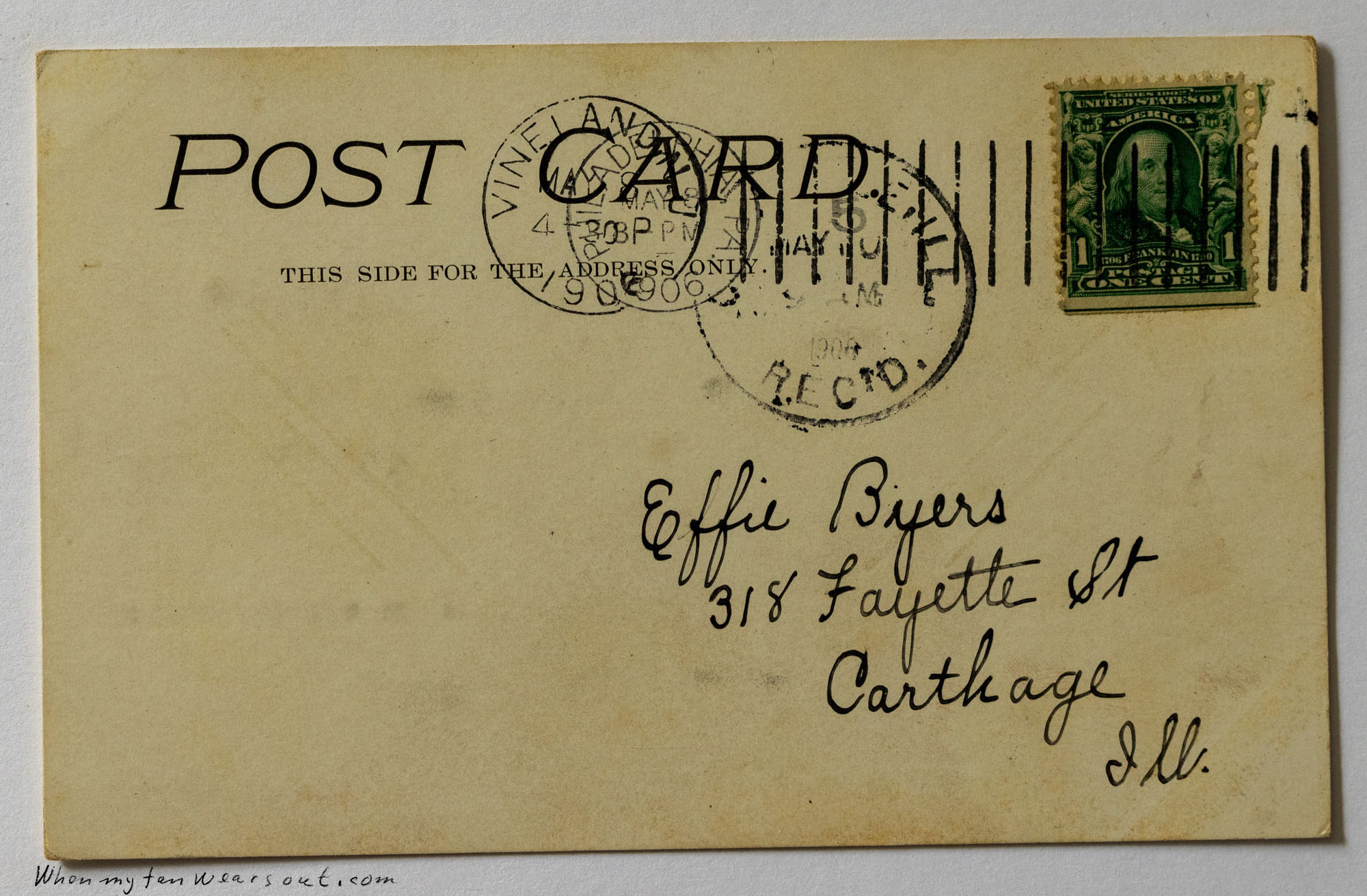
A brick high school building with a prominent central tower is surrounded by large, leafy trees in Vineland, New Jersey.
Postcard Metadata
Postmarked: Vineland, New Jersey — March 23, 1908
Sent From: Vineland, New Jersey
Sent To: Effie P. Byers 318 Lafayette St Carthage Ill.
Distance Traveled: Approximately 940 miles
Postage: One-cent green Franklin stamp
Card Details: Divided Back era (1907-1915)
Back — Correspondence from Effie Blinn to Effie P. Byers
Transcription
Thanks for card. Mar 23 – 08 Effie Blinn 433 Almond St
Historical & Family Notes
This postcard, sent from Vineland, New Jersey, captures a polite thank you note from Effie Blinn to Effie P. Byers, likely Pearl Byers’ mother or another close relative residing at the family home in Carthage, Illinois. The consistent address of 318 Lafayette Street in Carthage underscores the enduring family connection to this location, a central hub for the Byers family.
The communication, though brief, highlights the era’s common practice of using postcards for everyday greetings and short messages, predating more immediate forms of communication. The swift delivery, reaching Carthage the very next day, also showcases the efficiency of the early 20th-century postal service for cross-state mail.
While not directly featuring Pearl or Harvey, this card provides a glimpse into the broader family network surrounding Pearl Byers before her eventual marriage to Harvey Sights. It helps establish the social context and communication patterns within which their own courtship would unfold.
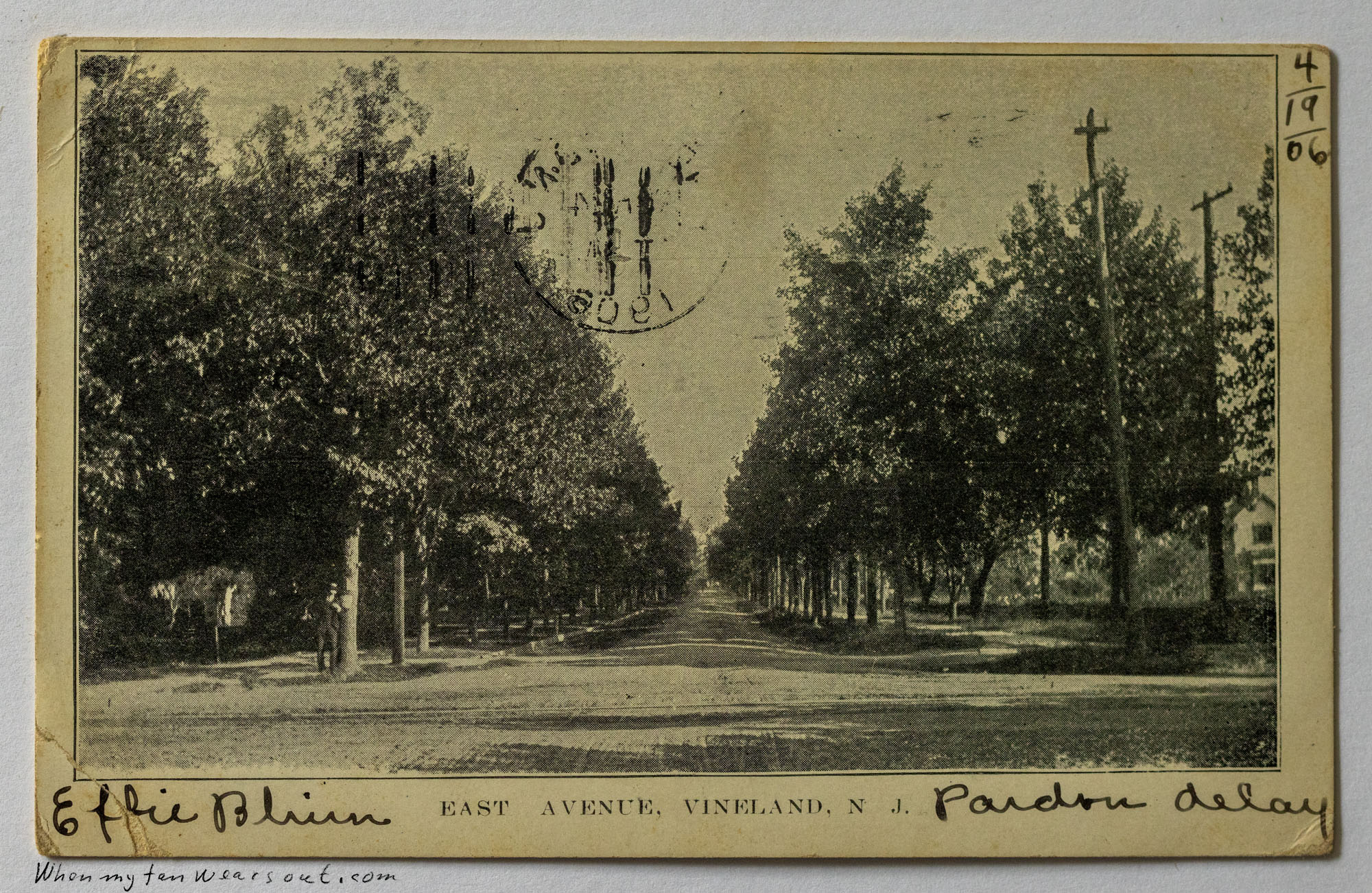
Front — A tree-lined East Avenue in Vineland, New Jersey, featuring a path flanked by utility poles.
Postcard Metadata
Postmarked: Vineland, New Jersey — April 24, 1906
Sent From: Vineland, New Jersey
Sent To: Effie Byers, 318 Fayette st, Carthage, Ill.
Distance Traveled: Approximately 830 miles
Postage: One cent US Postage stamp, George Washington
Card Details: An early example of a Divided Back card, predating the official March 1, 1907, postal regulation.
Back — Correspondence from Effie Blinn to Effie Byers
Transcription
Effie Blinn Pardon delay
Historical & Family Notes
This early 20th-century postcard captures a serene tree-lined street in Vineland, New Jersey, a common subject for postcards of the era. The brief message “Pardon delay” suggests a simple, informal exchange, perhaps between friends or family. The card is addressed to Effie Byers in Carthage, Illinois, indicating a connection to the Byers family collection, although it’s not directly addressed to Pearl Byers, the primary recipient of this archive. It’s plausible Effie Byers was a relative, such as a sister or mother, in Carthage, broadening the familial scope of the collection.
The sender, Effie Blinn, likely a friend or acquaintance, took 17 days for this postcard to travel from Vineland, New Jersey to Carthage, Illinois, arriving on May 11, 1906. This travel time was typical for mail delivery across states in the early 1900s. The card itself is noteworthy as an early example of a “divided back” postcard, a design that allowed both the address and a written message on the back, even though the official postal regulation permitting this for domestic mail began nearly a year later in March 1907.
While this specific card doesn’t directly feature Pearl Byers or Harvey Sights, its presence in the collection offers a glimpse into the broader network of friends and family connected to the Byers household in Carthage, Illinois. These small, everyday communications paint a picture of daily life and relationships that would eventually intertwine with Pearl and Harvey’s own story.
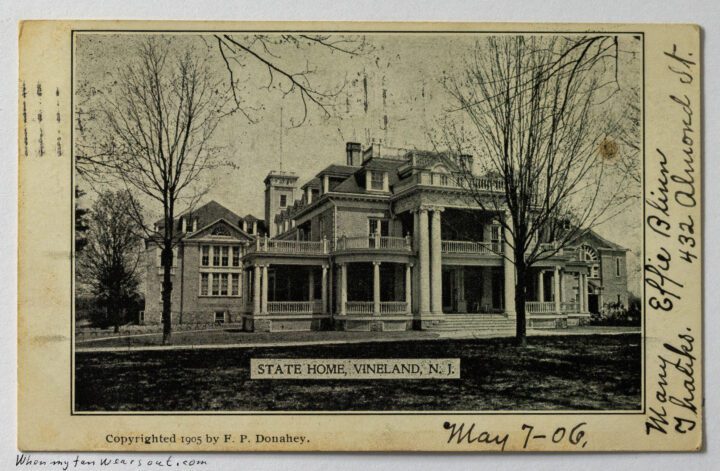
Front — A grand, multi-story brick building, labeled “STATE HOME, VINELAND, N. J.” with trees in the foreground.
Postcard Metadata
Postmarked: Vineland, New Jersey — May 7, 1906, 4:30 PM
Sent From: Vineland, New Jersey
Sent To: Effie Byers, 318 Fayette St, Carthage, Ills.
Distance Traveled: ~870 miles
Postage: US One Cent Benjamin Franklin stamp
Card Details: Undivided Back postcard, “Copyrighted 1905 by F. P. Donahey.”
Back — Correspondence from Effie Bhien to Effie Byers
Transcription
Many thanks. May 7-06. Effie Bhien 432 Almond St.
Historical & Family Notes
This early postcard, dated May 1906, offers a glimpse into the Byers family’s extended network before Pearl’s extensive correspondence with Harvey Sights. Addressed to Effie Byers at 318 Fayette Street in Carthage, Illinois—the very home Pearl would share with her family—it establishes a foundational timeline for the Byers household. While not sent directly to Pearl, the card reinforces the consistent location of her family home, a place that would later feature prominently in her personal story and eventual courtship.
The image on the front depicts the “State Home, Vineland, N. J.,” historically known as the New Jersey Training School for Feeble-Minded Girls and Boys. This institution was a significant, albeit complex, part of early 20th-century social history, pioneering research in intellectual disabilities while also becoming entangled in the eugenics movement. The postcard’s image provides a window into the types of public institutions and social structures that existed during Pearl’s formative years.
The brief message, “Many thanks,” penned by “Effie Bhien” from nearby 432 Almond Street, suggests a simple, everyday acknowledgment. Such concise notes were common on undivided back postcards, where space for correspondence was limited. This card, a tangible artifact from 1906, predates the more romantic and detailed letters Pearl would later exchange with Harvey, yet it subtly grounds their story within the broader social and familial context of the early 20th century.
Front — A grand, Art Deco-style building entrance labeled “Entrance to Victory Field, Indianapolis, Indiana.”
Postcard Metadata
Postmarked: Indianapolis, Ind. — Apr 21, 1947
Sent From: Indianapolis, Indiana
Sent To: Mr. E.T. Mathias, RCA Rep. c/o Santay Corp. 351 N. Crawford Ave. Chicago 24 Illinois
Distance Traveled: Approximately 185 miles
Postage: United States Postage, Washington, 1 Cent, green stamp
Card Details: Divided Back era (post-1907)
Back — Correspondence from Frank to Mr. E.T. Mathias
Transcription
Dear Gene, Be patient please. The shocking truth will soon be revealed. Frank
Historical & Family Notes
This postcard, sent from Indianapolis in 1947, diverts from the primary Pearl and Harvey narrative, offering a fascinating glimpse into other connections within the family’s broader historical circle. Addressed to Mr. E.T. Mathias, an RCA Representative in Chicago, the cryptic message from “Frank” promising that “The shocking truth will soon be revealed” suggests a personal or professional intrigue unfolding in the post-war landscape.
The front of the card features the impressive Art Deco entrance to Victory Field, a prominent landmark in Indianapolis. While the postcard doesn’t directly involve Pearl and Harvey Sights, its inclusion in the collection enriches the historical context, illustrating the diverse lives and correspondences that co-existed alongside their romance. It hints at the complex web of relationships and the historical backdrop of mid-20th century America.
The mention of RCA and Santay Corp. places this card within the booming electronics and manufacturing industries of the time. This piece reminds us that multi-generational family archives encompass not just core family members but also the broader professional and personal acquaintances who shaped their world, each with their own stories waiting to be unraveled.
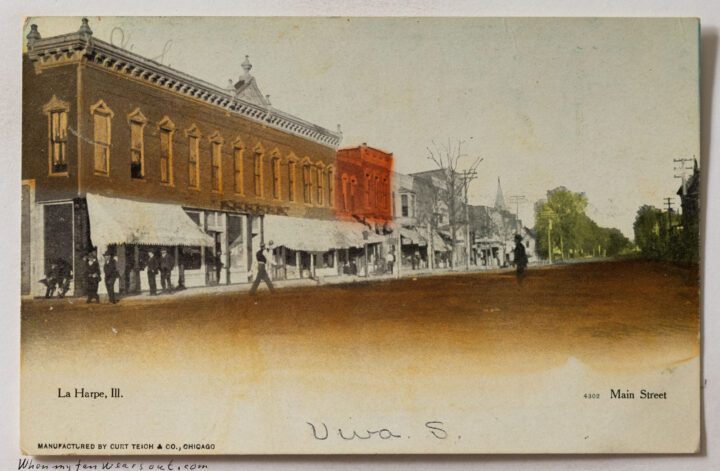
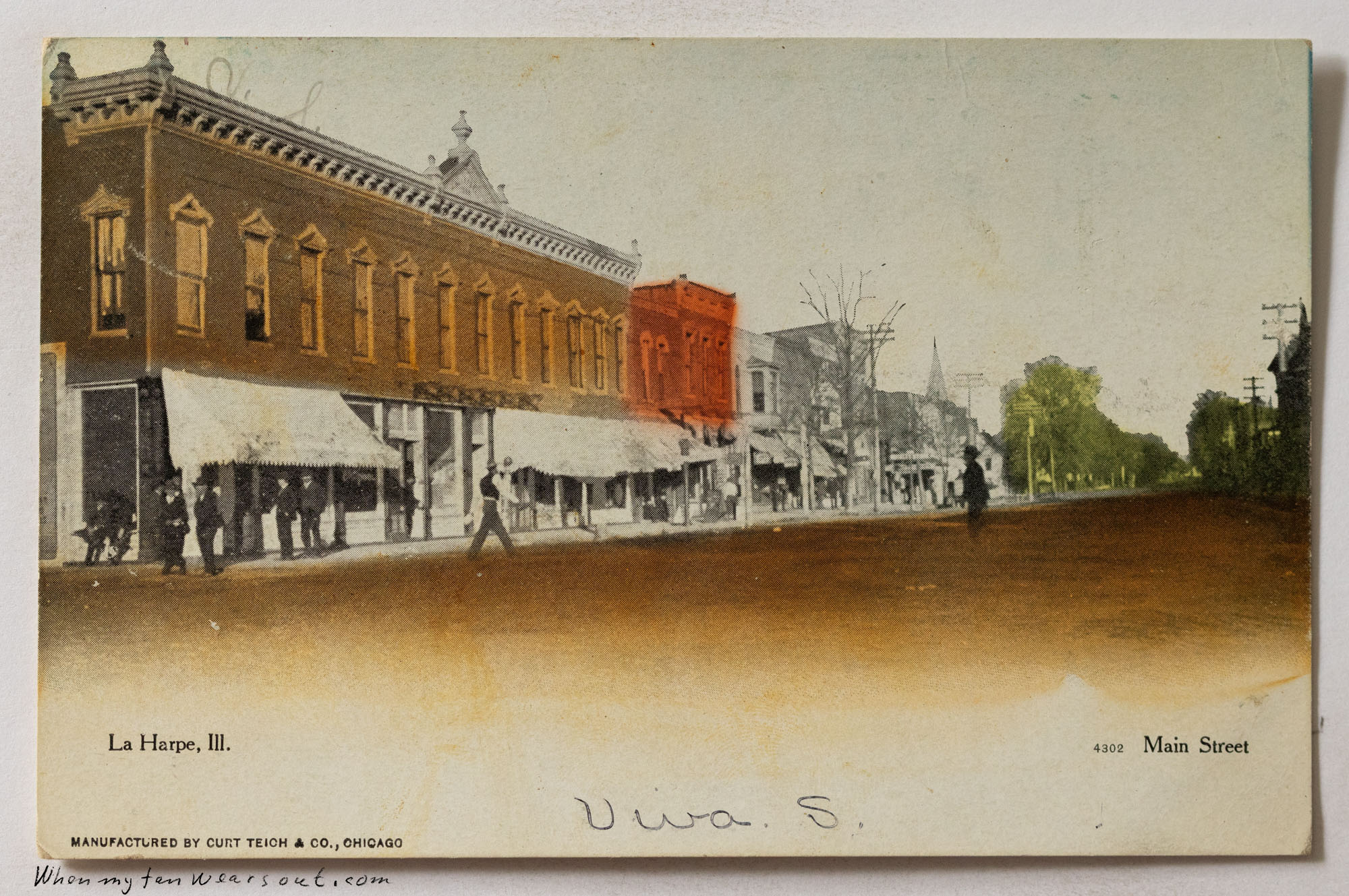
Front — A bustling view of Main Street in La Harpe, Illinois, featuring storefronts with awnings and a partially colorized brick building.
Postcard Metadata
Postmarked: Burnside, IL — June 20, 1907
Sent From: Burnside, Illinois
Sent To: Miss Pearle Byers, Carthage, Ill.
Distance Traveled: Approximately 11 miles
Postage: U.S. One Cent (Franklin)
Card Details: Undivided Back era (1901-1907), manufactured by Curt Teich & Co., Chicago
Back — Correspondence from Viwa S. to Miss Pearle Byers
Transcription
Viwa. S.
Historical & Family Notes
This early postcard, sent to the young Miss Pearle Byers, offers a quick glimpse into her social world during her formative years. The card features a common street scene of the era from nearby La Harpe, Illinois, a familiar type of imagery used for brief communications. The message, simply “Viwa. S.” on the front of the card, is characteristic of the concise messages exchanged on undivided back postcards where space for writing was limited.
Originating from Burnside, a mere 11 miles from Carthage, this card likely came from a local acquaintance or friend, Viwa S., whose brief greeting is preserved in this collection. These everyday interactions paint a picture of Pearl’s life before her marriage to Harvey Sights, highlighting the connections she maintained within her immediate community.
The postcard itself is an excellent example of the transitional period in postcard history. Though postmarked in June 1907, after divided backs were permitted, its layout with “NOTHING BUT THE ADDRESS ON THIS SIDE” firmly places it stylistically within the Undivided Back era, suggesting an older card still in circulation.
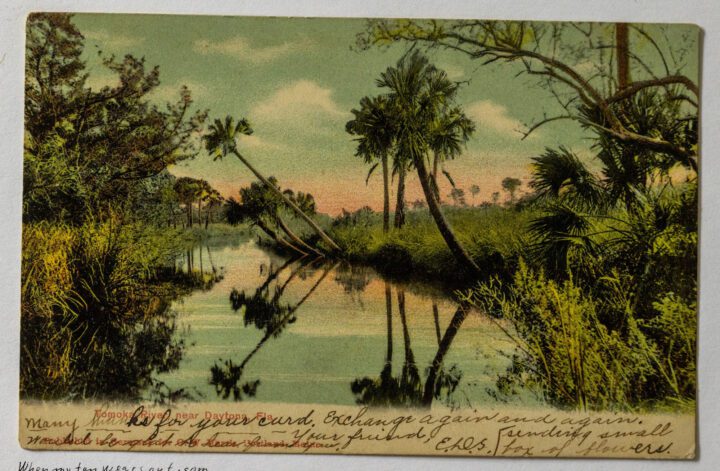
Front — A scenic view of palm trees and other tropical foliage reflected in a tranquil body of water under a colorful sky, labeled “Ormond Key near Daytona.”
Postcard Metadata
Postmarked: Lady Lake, Florida — March 10, 1906
Sent From: Lady Lake, Florida
Sent To: Miss Pearle Byers, Carthage, Ill.
Distance Traveled: Approximately 970 miles (1560 km)
Postage: One cent United States stamp featuring Benjamin Franklin, green.
Card Details: Undivided back, typical for postcards sent before March 1, 1907.
Back — Correspondence from C.H.S. to Miss Pearle Byers
Transcription
Ormond Key near Daytona. Many thanks for your card, exchange again and again. Your friend C.H.S. Send me a small novel not complicated with love something of your own. Box of flowers.
Historical & Family Notes
This early postcard, dating from 1906, shows the sender, C.H.S., corresponding with Pearl Byers from sunny Florida. The reference to “Ormond Key near Daytona” places the sender on what was then a popular winter resort destination, indicating some travel or leisure activities. The message, though brief, hints at a warm and continuous exchange, stating “exchange again and again.”
The most intriguing part of the message is the playful postscript: “Send me a small novel not complicated with love something of your own. Box of flowers.” While signed simply “Your friend C.H.S.,” the initials “H.S.” align with Harvey Sights, Pearl’s future husband. The request for a novel “not complicated with love” could be a teasing remark between two individuals who are perhaps just beginning to navigate the complexities of their own budding affections, subtly hinting at an interest beyond mere friendship. The mention of “Box of flowers” further adds to this gentle flirtation.
This card provides a charming glimpse into the early stages of communication between Pearl and her circle, potentially even with Harvey Sights himself, before their relationship fully blossomed. The request for a personalized “novel” suggests an intimate understanding and shared sense of humor between the correspondent and Pearl, laying groundwork for a deeper connection in the years to come.
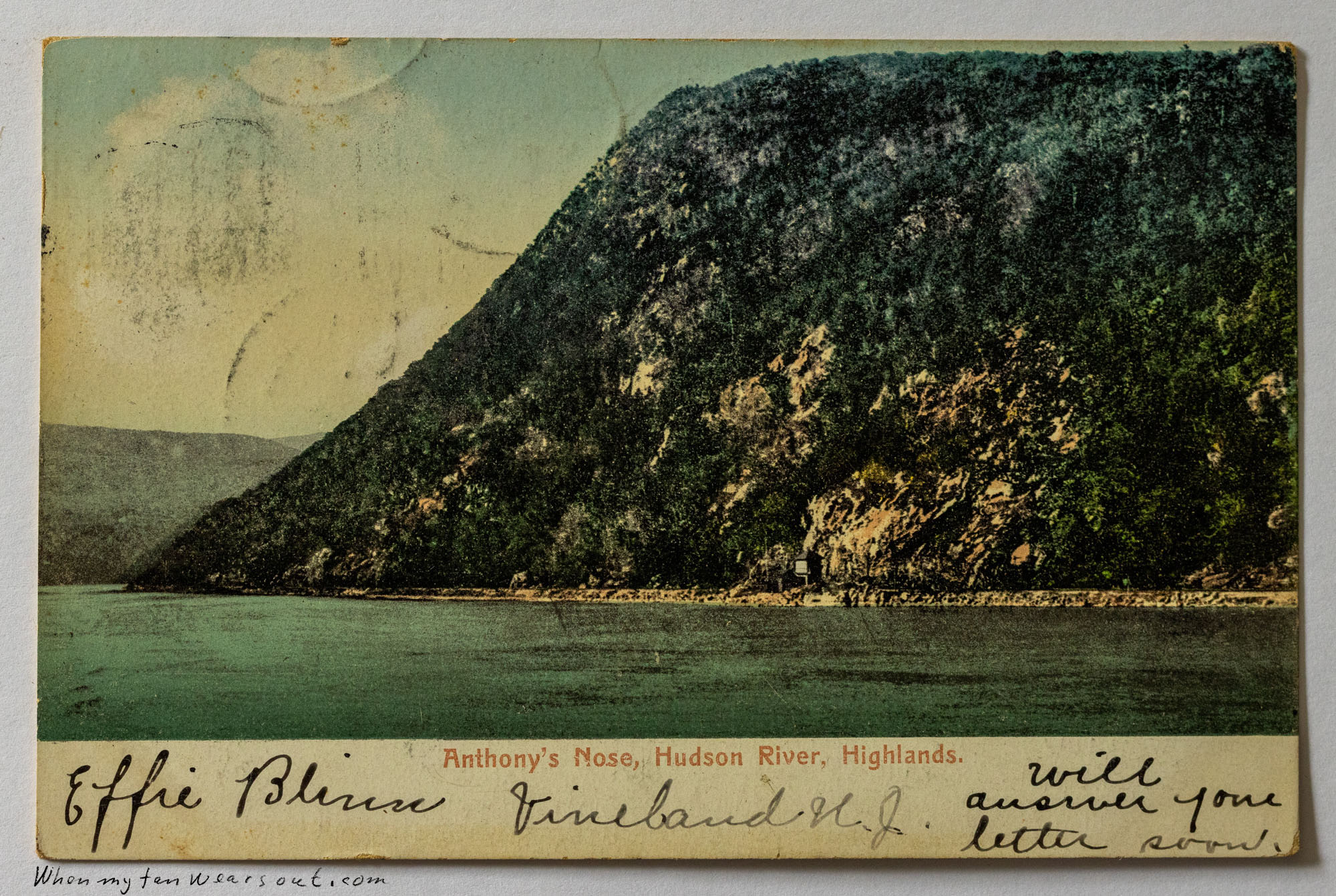
Front — A view of Anthony’s Nose, a forested mountain along the Hudson River in the New York Highlands.
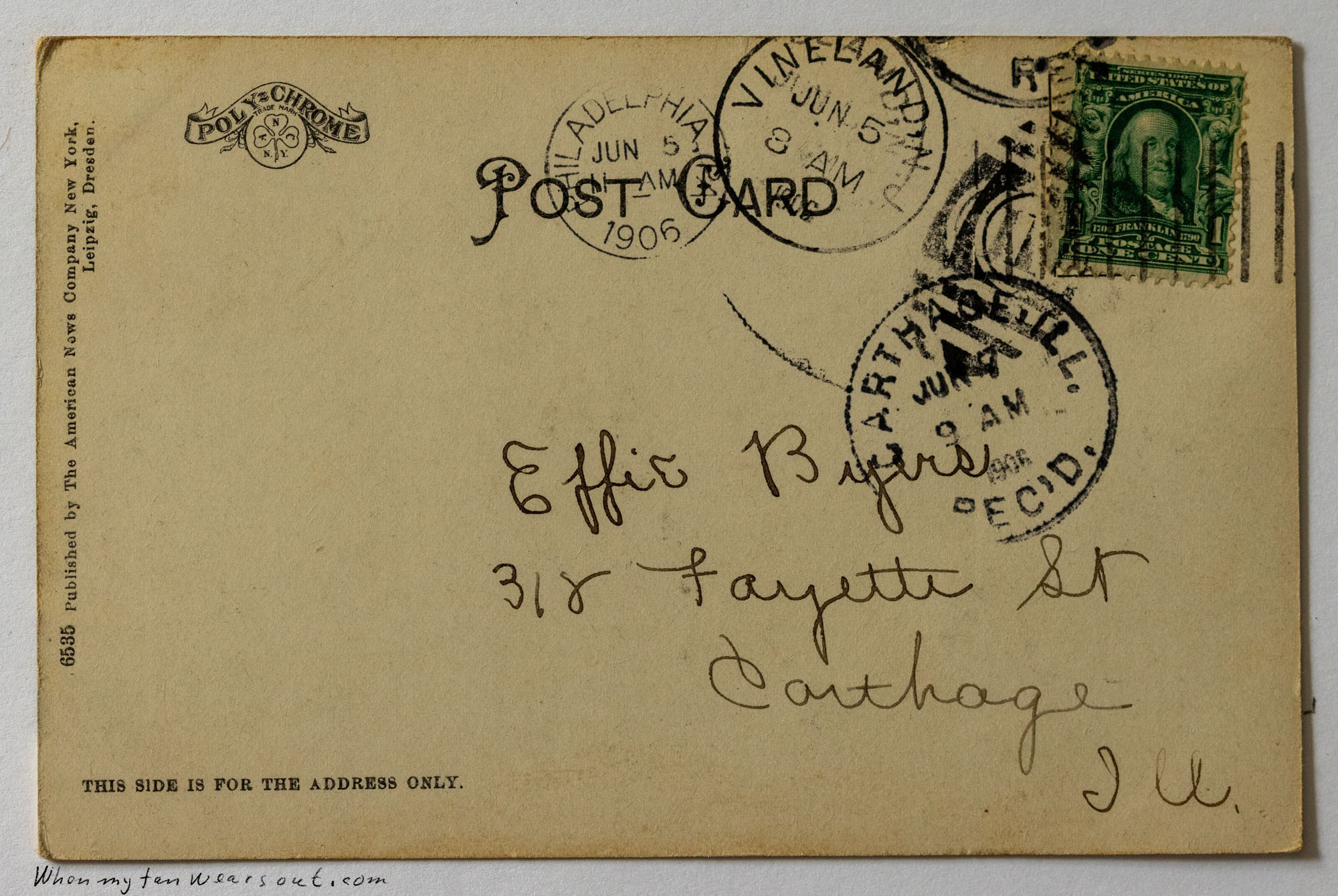
Postcard Metadata
Postmarked: Vineland, NJ — June 5, 1906
Sent From: Vineland, New Jersey
Sent To: Effie Byers, 318 Fayette St, Carthage, Ill.
Distance Traveled: Approximately 900 miles
Postage: 1-cent Benjamin Franklin stamp
Card Details: Undivided Back postcard, published by The American News Company, Leipzig, Dresden.
Back — Correspondence from Effie Blinn to Effie Byers
Transcription
Effie Blinn will answer your letter soon!
Historical & Family Notes
This early 20th-century postcard captures the majestic scenery of Anthony’s Nose overlooking the Hudson River in the New York Highlands. Sent by Effie Blinn from Vineland, New Jersey, it assures the recipient, Effie Byers of Carthage, Illinois, that a letter is forthcoming. The simple message, “will answer your letter soon!”, suggests an ongoing correspondence between the two.
Given that this postcard is addressed to Effie Byers at the same Carthage address as Pearl Byers, it’s highly probable that Effie Byers is a close family member, perhaps Pearl’s mother or sister. This card offers a glimpse into the broader network of family and friends surrounding the main characters of the collection, documenting their connections and the common practice of sharing travel experiences through postcards.
The card’s “Undivided Back” design, typical for postcards predating 1907, means the entire back was reserved for the address, pushing the message to the front alongside the image. The 1-cent postage for domestic delivery was standard at the time, allowing for wide circulation of these early photographic travel mementos.
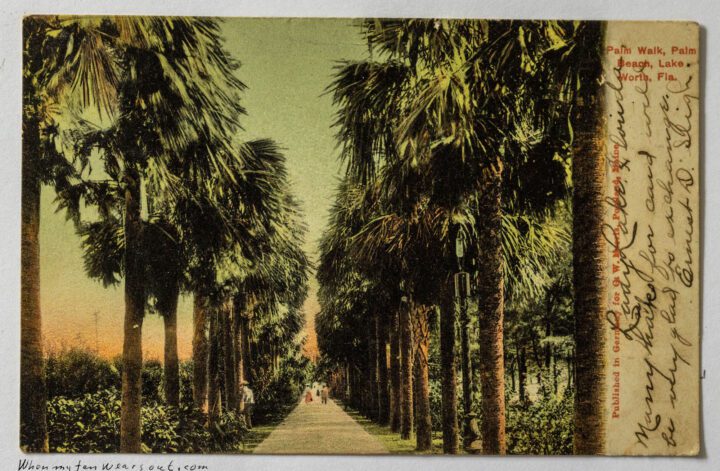
Front — A serene, sun-drenched palm-lined avenue with pedestrians strolling, labeled “Palm Walk, Palm Beach, Lake Worth, Fla.”
Postcard Metadata
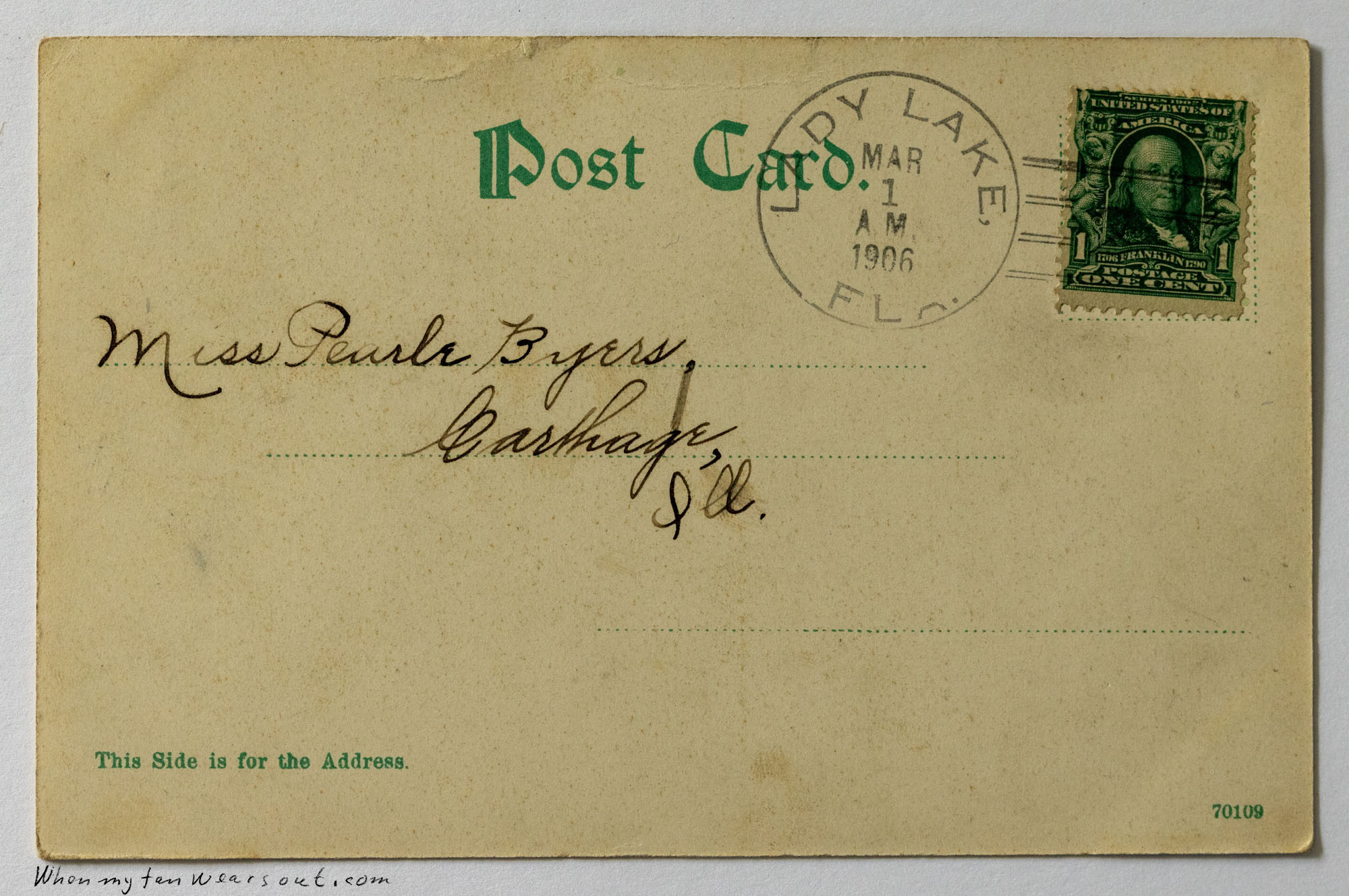
Postmarked: Lady Lake, Florida — March 1, 1906
Sent From: Lady Lake, Florida
Sent To: Miss Pearle Byers, Carthage, Ill.
Distance Traveled: Approximately 955 miles
Postage: One-cent Benjamin Franklin stamp (green)
Card Details: Early Divided Back (postmarked 1906, before official US domestic authorization in 1907; sender utilized both address and message sections for correspondence)
Back — Correspondence from Ernest D. Sh. to Miss Pearle Byers
Transcription
Published in Ger. for Geo. R. Lawrence. Palm Walk, Palm Beach, Lake Worth, Fla. Merry Xmas for exchanging cards with Mr. Sights. Ernest D. Sh.
Historical & Family Notes
This postcard, sent from sunny Florida in 1906, provides an intriguing glimpse into Pearl Byers’ social sphere before her marriage to Harvey Sights. The message from Ernest D. Sh. explicitly mentions “exchanging cards with Mr. Sights,” suggesting that Harvey was already a known figure within Pearl’s wider network of acquaintances and that social correspondence was a common practice. This early mention, even if indirect, foreshadows the deeper connection that would eventually develop between Pearl and Harvey.
The card itself, an early example of a divided back design postmarked a year before its official authorization for U.S. domestic mail, reflects the evolving nature of postcard communication. The sender’s decision to write the message across both the designated message and address portions of the card highlights a charming disregard for strict postal conventions, prioritizing the full message over proper formatting.
Such exchanges served as vital threads connecting individuals across distances in the early 20th century, fostering relationships and maintaining social ties. For Pearl and Harvey, this postcard from a faraway destination underscores the broad geographical and social contexts that shaped their lives before they became central to each other’s.
Front — A colorful illustration of a mountain railway track curving through a forest with distant peaks under a vibrant sky.
Postcard Metadata
Postmarked: Los Angeles, California — May 3, 1909
Sent From: Redondo, California
Sent To: Mr Harvey Sights La Harpe, Illinois.
Distance Traveled: Approximately 1,900 miles
Postage: United States of America, One Cent, Franklin 1706-1790 stamp
Card Details: Divided Back era postcard (circa 1907-1915), Published by Krebs., Los Angeles, Cal., No. 4605, Printed in Germany.
Back — Correspondence from E. Allan Banks to Mr Harvey Sights
Transcription
Redondo, Cal April 30/08. How do you like This for a scene? E. Allan Banks.
Historical & Family Notes
This postcard offers an intriguing glimpse into Harvey Sights’ life before his courtship with Pearl Byers. Sent by a friend, E. Allan Banks, from Redondo, California, it features a scenic view from the famous Mt. Lowe Railway. The message, “How do you like This for a scene?”, suggests a shared appreciation for natural beauty or travel between Harvey and his friend. While the message is dated April 30, 1908, the postmark clearly shows May 3, 1909, indicating a likely clerical error in the year written by the sender.
The Mt. Lowe Railway, located in the San Gabriel Mountains near Los Angeles, was a popular tourist attraction known for its breathtaking views and engineering marvels. This card hints at Harvey’s social circle and interests, receiving correspondence from friends who traveled or lived in distant, picturesque locations. It’s an interesting piece showing the world Harvey inhabited before Pearl became the central figure in his correspondence.
While this card isn’t from Pearl, it contributes to the broader narrative by painting a picture of Harvey’s life and connections prior to his significant relationship. It’s a reminder that even future spouses had their own lives, friends, and experiences before their paths intertwined, adding depth to their eventual shared history captured in this collection.
A scenic view of two people in a rowboat on the Ocklawaha River, Florida, surrounded by cypress trees draped with Spanish moss.
Postcard Metadata
Postmarked: Lady Lake, Florida — May 11, 1906
Sent From: Lady Lake, Florida
Sent To: Miss Pearle Byers. Carthage, Ill.
Distance Traveled: Approximately 988 miles
Postage: One Cent, U.S. Postage, Benjamin Franklin stamp
Card Details: Undivided Back era (pre-1907), Address only on right side. Publisher: No. 1219. Frank Huld, Publisher, New York.
Back — Correspondence from Ernest Bligh to Miss Pearle Byers
Transcription
Off for the picnic How would you like this trip— Ernest Bligh.
Historical & Family Notes
This postcard, sent to Pearl Byers in May 1906, offers a glimpse into her social life before her marriage to Harvey Sights. The sender, Ernest Bligh, describes a picnic on the scenic Ocklawaha River in Florida, asking Pearl if she would enjoy such a trip. This suggests a friendly relationship, perhaps a travel companion or an admirer, highlighting Pearl’s wider connections before settling down.
The Ocklawaha River, famous for its lush landscapes and cypress swamps draped in Spanish moss, was a popular tourist destination in the early 20th century. This postcard captures the allure of such natural beauty and the burgeoning trend of travel and leisure, with postcards serving as a common way to share experiences from afar.
While this card is not from Harvey, it enriches Pearl’s personal narrative, painting a picture of a young woman receiving mail from various acquaintances and experiencing life’s adventures, even if vicariously through postcards. The Carthage postmark indicates receipt on the same day as dispatch from Florida, a common yet intriguing postal anomaly for the era, suggesting a rapid journey or perhaps a timestamp discrepancy.