Postcard #0818

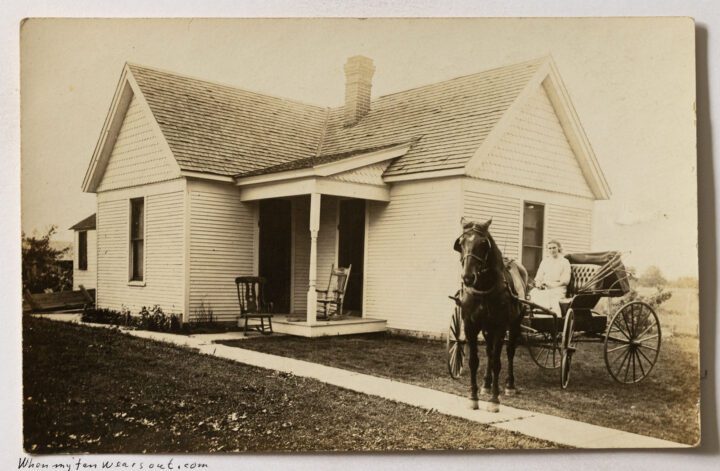
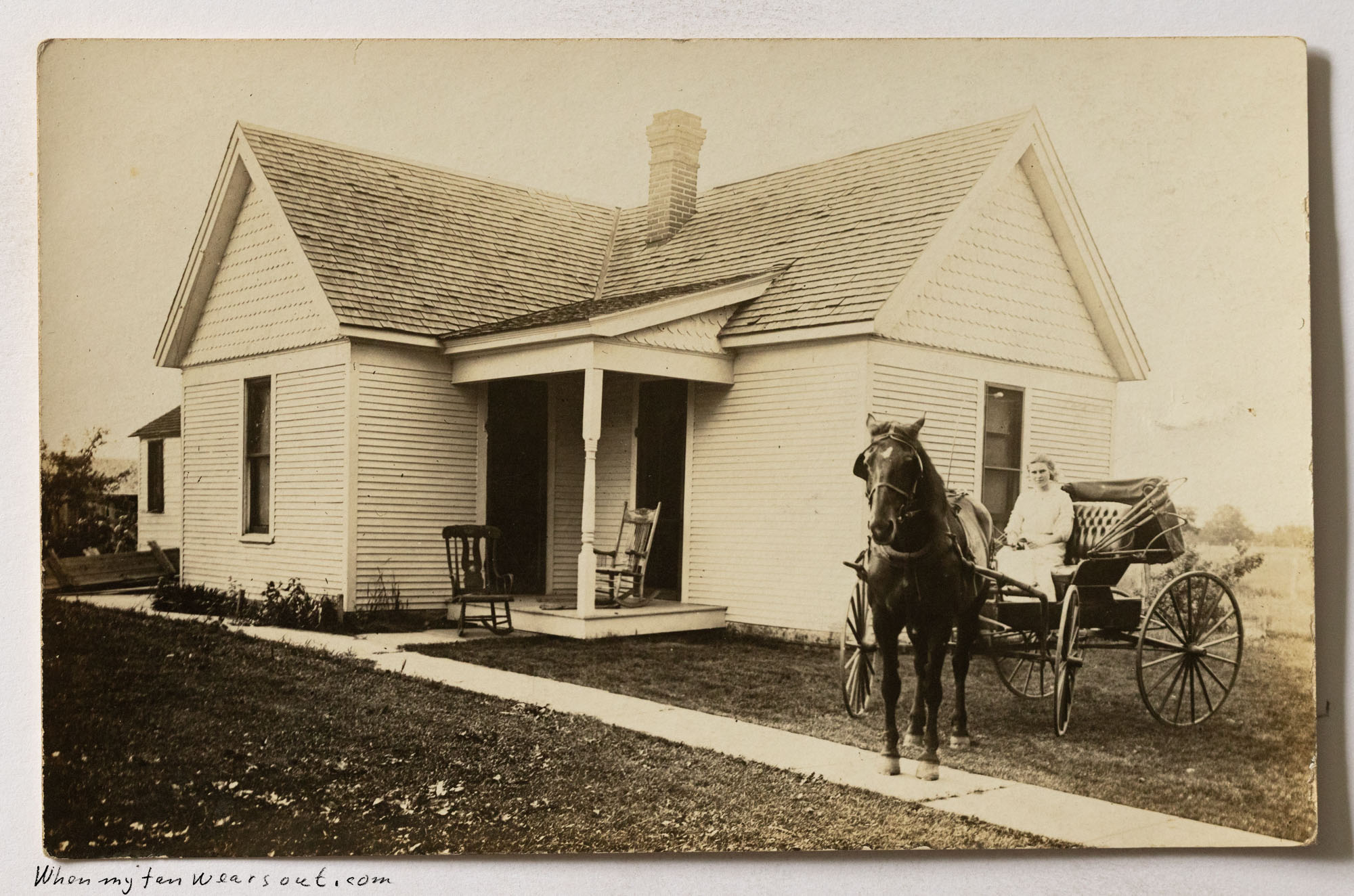
Front of postcard #0818: A sepia-toned real photo of a small white one-story house with lap siding and fish-scale shingles in the gables. A woman
Back of postcard #0818

Postcard Information

  • Postmark: ILLEGIBLE
  • Sent To: Unknown
  • Era: Golden Age (1907–1915)
  • Stamp: NOT VISIBLE
  • Distance Traveled: Undetermined
  • Notes: Blank card. Real photo postcard.

About This Card

A woman in a light-colored dress sits in a horse-drawn buggy parked on the grass in front of a tidy white frame house with fish-scale shingles in the gables and a rocking chair on the porch. The divided back and the informal, personal quality of the photograph suggest this is a family or community card from the 1907–1915 period. This is exactly the kind of image Pearl and Harvey’s circle produced and exchanged — a domestic moment, a woman at ease, a well-kept house. Whether this is someone Pearl knew or a card that came with others in a lot is unknown, but it reads as a portrait of comfortable, modest American life at the edge of the automobile age, when a horse and buggy in front of the house was still entirely ordinary.
Continue Reading

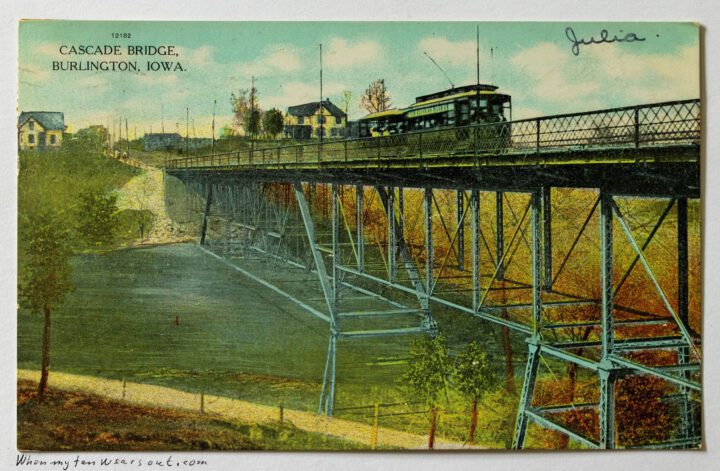
Postcard #0162: Cascade Bridge, Burlington, IA — Julia to Pearl, December 1908

Front of postcard #0162: Color illustration of the Cascade Bridge in Burlington, Iowa. A green streetcar is shown crossing the metal trestle brid

Transcription

Front — ] Julia.

Back — ] Dear friend I though I would write you a few lines to let you know that we are well and I hope these few lines will reach you the same. I wish you a happy New year when are you coming over this way again.

Back of postcard #0162

Postcard Information

  • Postmark: BURLINGTON, IA, DEC 29 1908
  • Sent To: Carthage IL
  • Era: Golden Age (1907–1915)
  • Publisher: S. H. KNOX & CO.
  • Print Origin: Printed in America
  • Stamp: 1¢
  • Distance Traveled: ~30 miles
  • Notes: Sender’s name written on front of card
Continue Reading

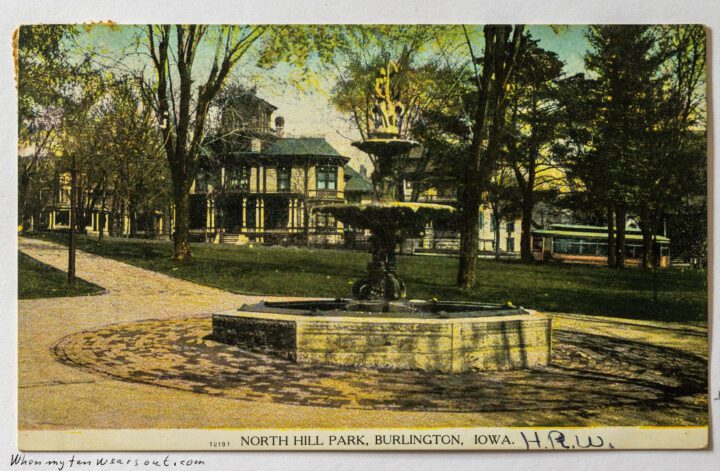
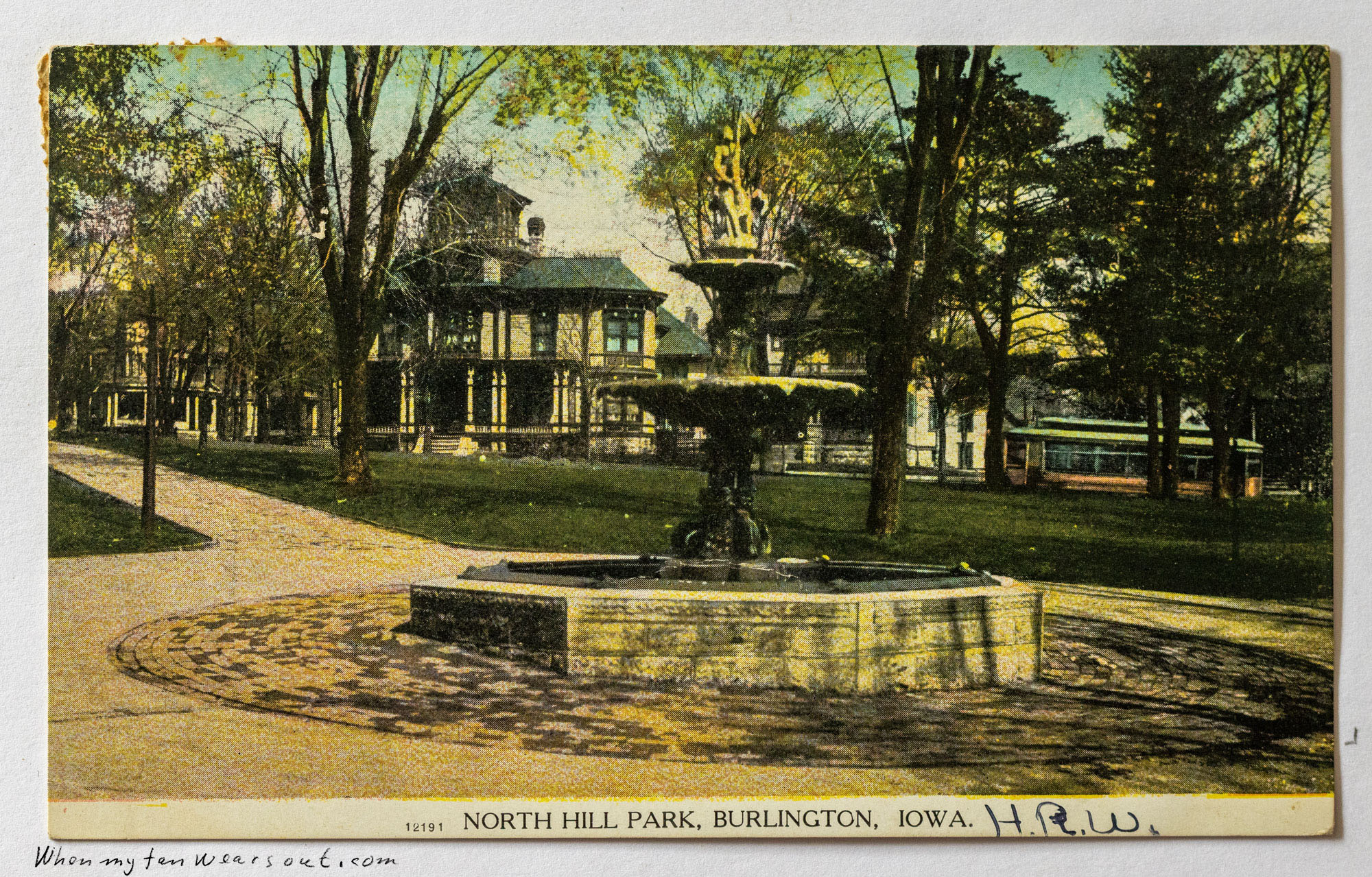
Postcard #0161: North Hill Park, Burlington, IA — Ray to Pearl, December 1926

Front of postcard #0161: Color illustration of North Hill Park in Burlington, Iowa, featuring a prominent multi-tiered stone fountain in the fore

Transcription

Back — Received card all o.k. I thought that you had forgotten little me by this time. When are you coming over in this part of the country to make every body a visit. You want to come while there is some good ice and moonlight nights. ans soon. as ever Ray ] H.R.W.

Back of postcard #0161

Postcard Information

  • Postmark: Burlington, Iowa, DEC 26 [illegible]
  • Sent To: Carthage IL
  • Era: White Border (1915–1930)
  • Publisher: S. H. Knox & Co.
  • Print Origin: Printed in America
  • Stamp: 1¢
  • Distance Traveled: ~25 miles
Continue Reading

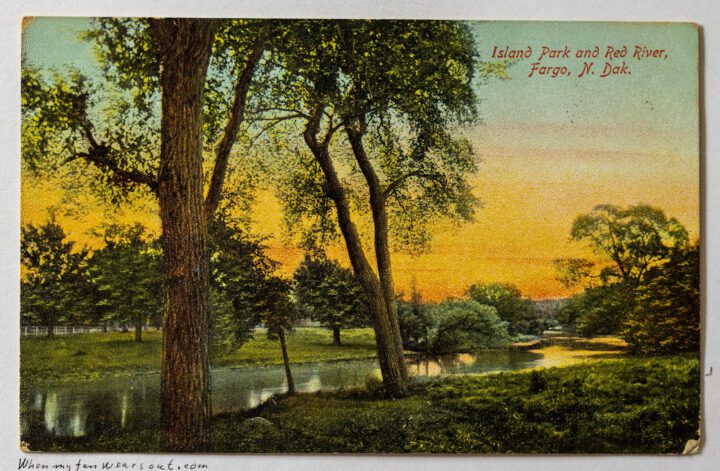
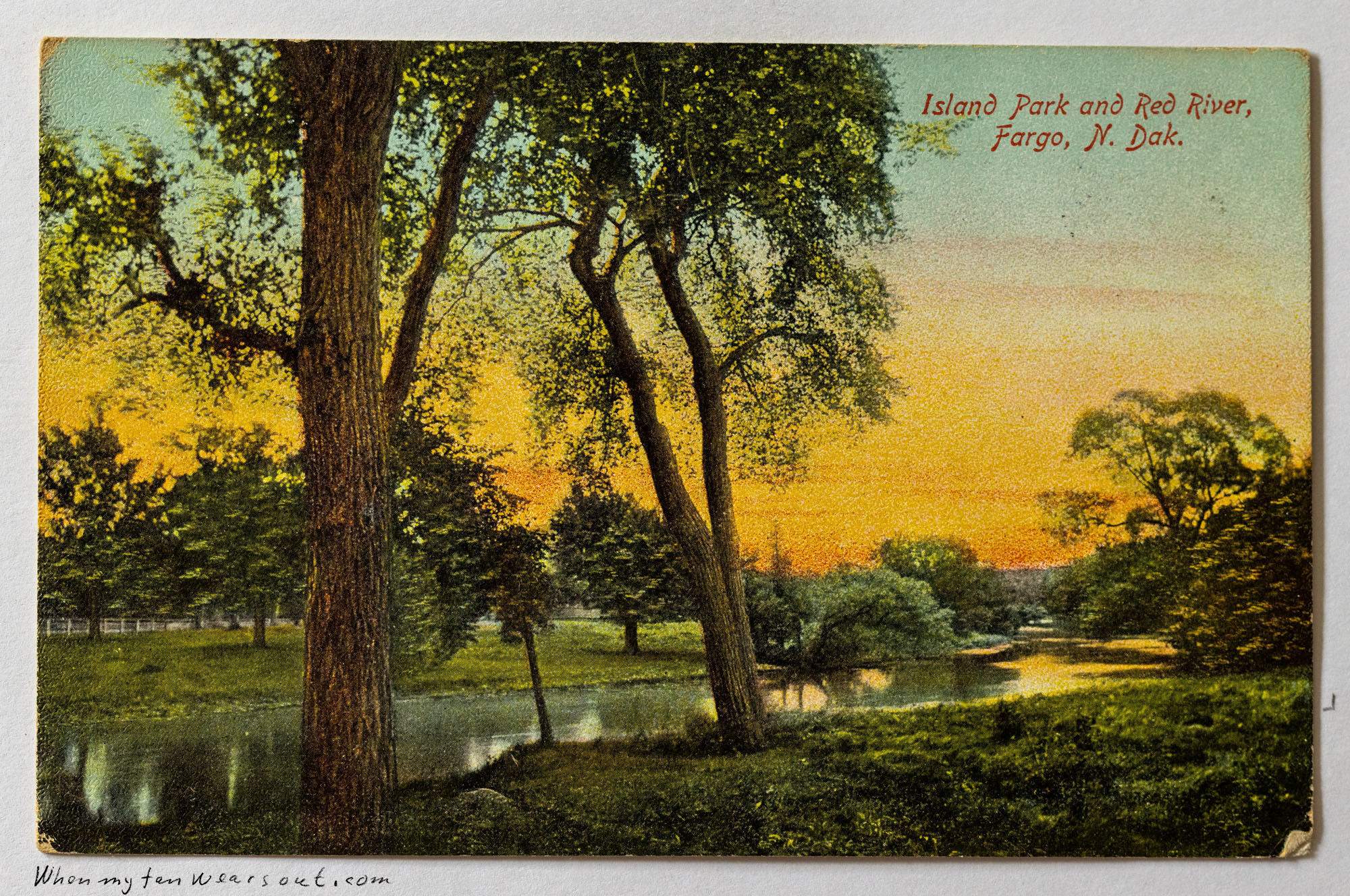
Postcard #0157: Island Park, Moorhead, MN — Otha to Pearl, June 1909

Front of postcard #0157: Colored illustration of Island Park and the Red River in Fargo, North Dakota, showing a vivid orange and yellow sunset r

Transcription

Back — June 9 09. Am all O.K. Otha

Back of postcard #0157

Postcard Information

  • Postmark: Moorhead, Minnesota, JUN 9 1909
  • Sent To: Carthage IL
  • Era: Golden Age (1907–1915)
  • Publisher: American Import Co., Minneapolis, Minnesota
  • Print Origin: Printed in Germany
  • Stamp: 1¢
  • Distance Traveled: ~470 miles

About This Card

Island Park in Fargo, North Dakota sits on an island in the Red River of the North, which forms the North Dakota-Minnesota border and flows north into Canada. The Red River valley is among the flattest terrain in North America — the bed of ancient glacial Lake Agassiz — and Fargo had grown quickly once the Northern Pacific Railroad reached it in 1872. Otha, writing from Moorhead, Minnesota (directly across the river from Fargo), was making one of several trips through this region that appear in the collection. These are some of the earliest cards Pearl received.

Continue Reading

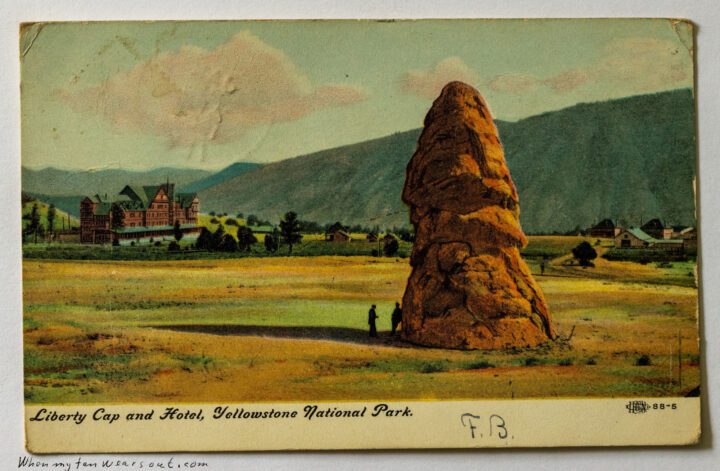
Postcard #0136: Liberty Cap,, Hamilton, IL — Frank to Pearl, January 1909

Front of postcard #0136: Color-tinted postcard showing "Liberty Cap," a large conical rock formation, with two small figures standing at its base

Transcription

Back — Hamilton Jan. 24, 08. Hello Effie here is where I send you a postal just for luck and cool weather, how are you these days, fat and sassy or quiet, pleasant or a little of both. Say, it is’nt any of my business but I just thought I would inquire as in regards to your health just for fun. Dont you know? Call me up sometime will you. “Ta Ta” Frank ] F.B.

Back of postcard #0136

Postcard Information

  • Postmark: HAMILTON, IL, JAN 25 1909
  • Sent To: Carthage IL
  • Era: Golden Age (1907–1915)
  • Stamp: NOT VISIBLE — Stamp is missing; the paper is torn where the stamp was originally affixed.
  • Distance Traveled: ~15 miles
  • Notes: Senders date in message is written as 1908 ("08"), but the postmark is dated 1909.

About This Card

Liberty Cap in Yellowstone’s Mammoth Hot Springs area is a dormant hot spring cone about 37 feet tall — the largest of its kind in the park. It stopped flowing roughly 2,500 years ago and has been cooling and mineralizing ever since. The Mammoth Hot Springs Hotel, visible in the background across the terrace fields, had been in operation since the 1880s and was the main gateway accommodation for visitors arriving from the north. Frank, writing from Hamilton on January 24, made an error in the date — he wrote “08” but the postmark reads 1909. The discrepancy was flagged in the archive. He didn’t mention Yellowstone.

Continue Reading

Postcard #1099: Dallas City, IL — H. S. S to Pearl, July 1909

Front of postcard #1099: A sepia-toned real photo postcard showing an elevated bird's eye view of Dallas City, Illinois. The scene includes house

Transcription

Back — Rec’d your card was glad to hear from you again – you stayed up longer than you intended to did you not was you mad at me for doing the way I did, but really I could not help it. H. S. S.

Back of postcard #1099

Postcard Information

  • Postmark: DALLAS CITY, ILL., JUL 13 1909
  • Sent To: Carthage IL
  • Era: Golden Age (1907–1915)
  • Publisher: C. U. WILLIAMS, BLOOMINGTON, ILL.
  • Stamp: 1¢
  • Distance Traveled: ~15 miles

About This Card

This bird’s-eye view of Dallas City, Illinois was sent by H.S.S. — initials that match Harvey Sarchet Sights. If this is Harvey, he was standing on a high point above the river town, looking down at its orderly grid of streets and the Mississippi beyond, and sending a card home. Dallas City is in Hancock County, the same county as Carthage and La Harpe; Harvey would have known the town well. The combination of H.S.S. initials and Hancock County geography makes a strong circumstantial case for Harvey as sender.

Continue Reading

Postcard #0108: La Harpe, IL — Elva to Pearl, October 1909

Front of postcard #0108: Oval illustration of a scenic river view featuring a small yellow cottage with a chimney, tall cypress trees, and a smal

Transcription

Back — 10/19/09 Came home with the intention of writing you a long letter but found out that writing material was scarce so could not write a long one as intended. Dont forget to do what I said about this card. Sigh and pray for me not to act foolish so guess will have to content myself by going to a timber land. Always, Elva.

Back of postcard #0108

Postcard Information

  • Postmark: LA HARPE, ILL., OCT 19 1909
  • Sent To: Carthage IL
  • Era: Golden Age (1907–1915)
  • Stamp: 1¢
  • Distance Traveled: ~15 miles
Continue Reading

Postcard #1093: black and white photograph of North Side Square in Carthage, Carthage, IL — Berk to Pearl, August 1912

Front of postcard #1093: A black and white photograph of North Side Square in Carthage, Illinois. The scene shows a wide dirt street with several

Transcription

Back — Lyd & I will be down to-night. You need not meet us as we will come on our wagon. Will bring fruit. Has Marg [?] got her paper. Berk.

Back of postcard #1093

Postcard Information

  • Postmark: CARTHAGE, ILL., AUG 17 1912
  • Sent To: Carthage IL
  • Era: Golden Age (1907–1915)
  • Stamp: 1¢
  • Distance Traveled: ~15 miles

About This Card

North Side Square in Carthage, Illinois shows the commercial district that surrounded the Hancock County Courthouse — the shops, banks, and professional offices that a county seat of Carthage’s size supported in the early twentieth century. Berk sent this real photo postcard from Carthage, the image capturing a specific moment in the square’s life: specific storefronts, specific automobiles at the curb, a specific Saturday afternoon. Carthage was Pearl’s town; she knew every business on this square.
Continue Reading

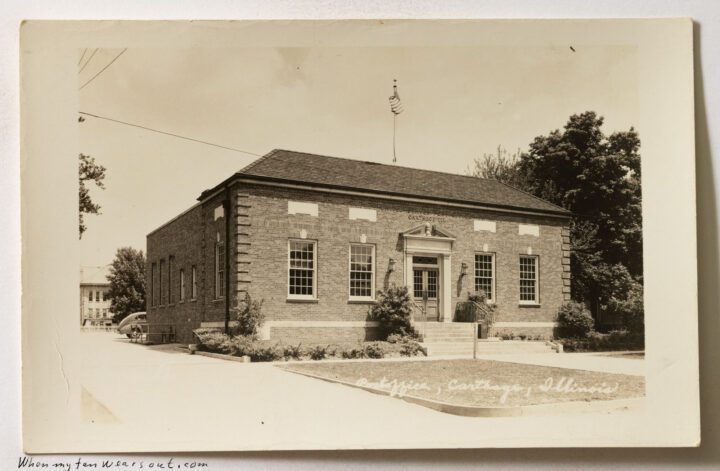
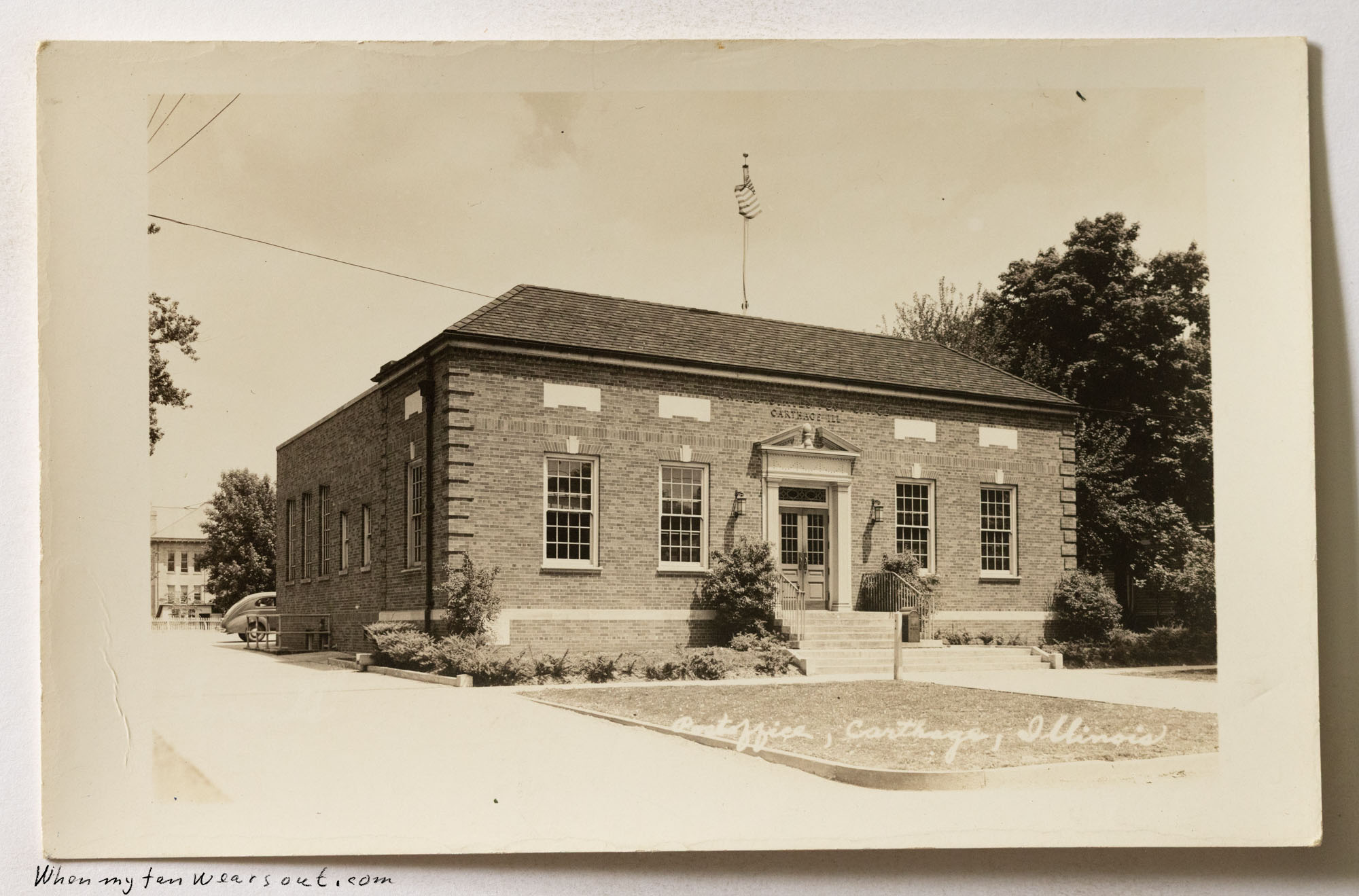
Postcard #1089: UNITED STATES POST OFFICE CARTHAGE ILL.

Front of postcard #1089: A real photo postcard showing the brick building of the Carthage, Illinois Post Office. The building has a flag flying f
Back of postcard #1089

Postcard Information

  • Postmark: ILLEGIBLE
  • Sent To: Unknown
  • Era: Golden Age (1907–1915)
  • Stamp: NOT VISIBLE — Stamp missing but printed box with EKC logo visible.
  • Distance Traveled: Undetermined
  • Notes: Blank card. Real Photo Postcard (RPPC). The car and architecture suggest a date in the late 1930s or 1940s, despite the Divided Back layout.

About This Card

The Carthage, Illinois Post Office occupied a brick building that served the city’s federal postal needs in the early twentieth century. As the county seat of Hancock County, Carthage received its federal buildings — courthouse, post office — through the same process of federal investment that gave small county seats their civic permanence. Pearl’s correspondence arrived and departed through this building for most of her life at 318 N. Fayette Street.
Continue Reading

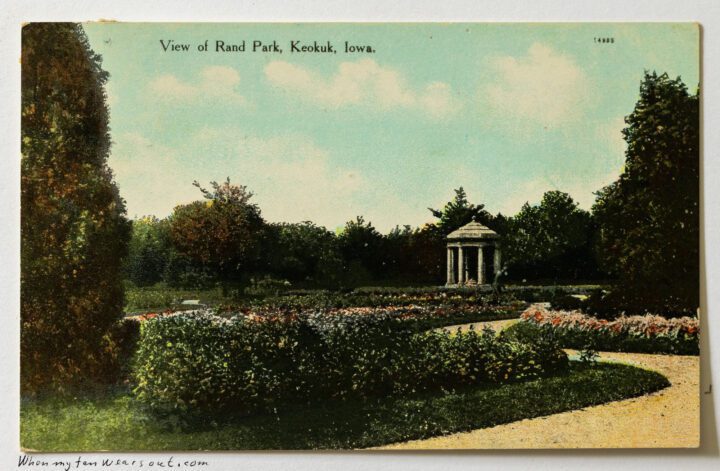
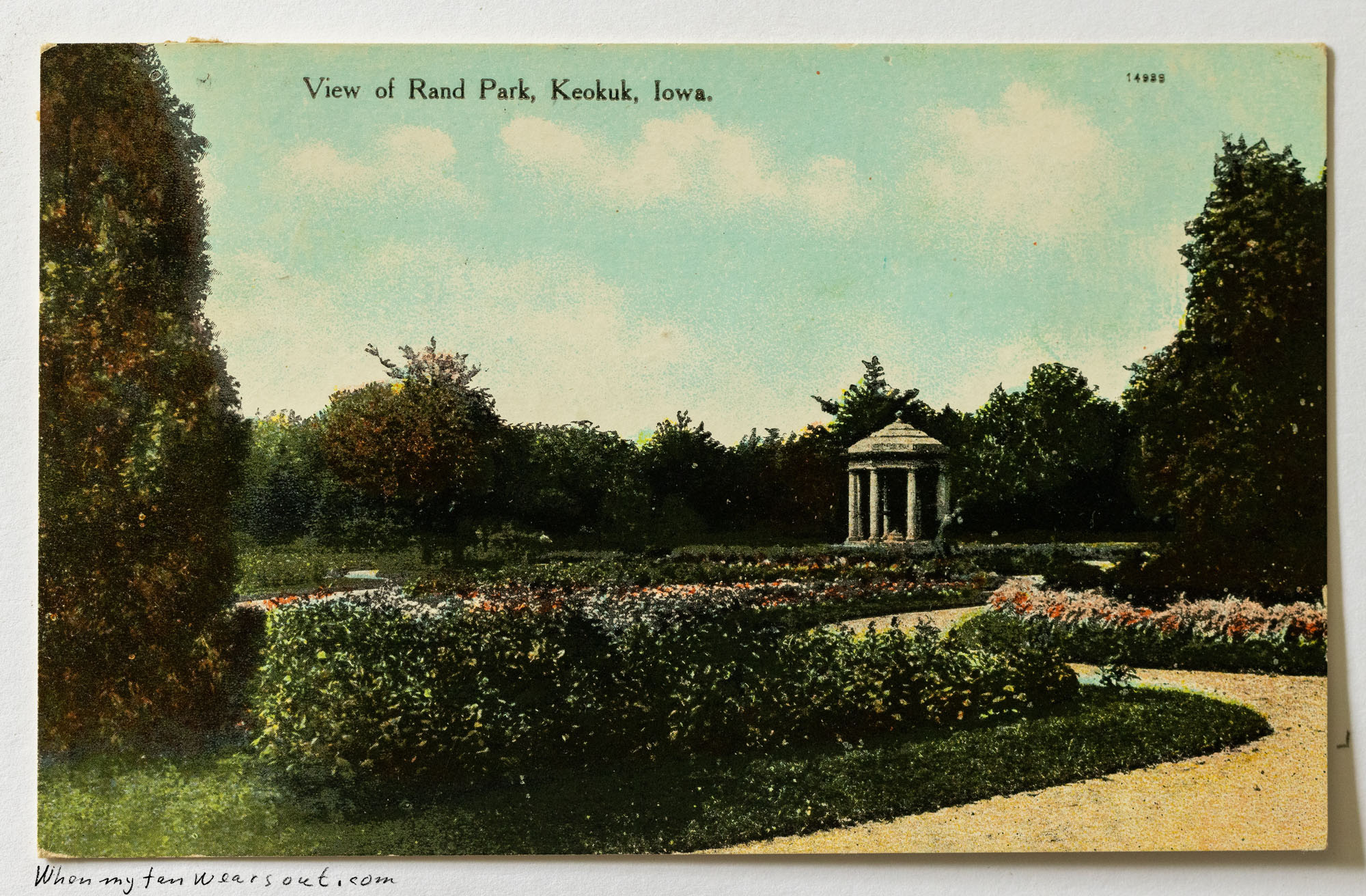
Postcard #0088: Rand Park — Jean to Pearl, 1909

Front of postcard #0088: Color illustration of Rand Park in Keokuk, Iowa, featuring a classical stone monopteros (circular pavilion) surrounded b

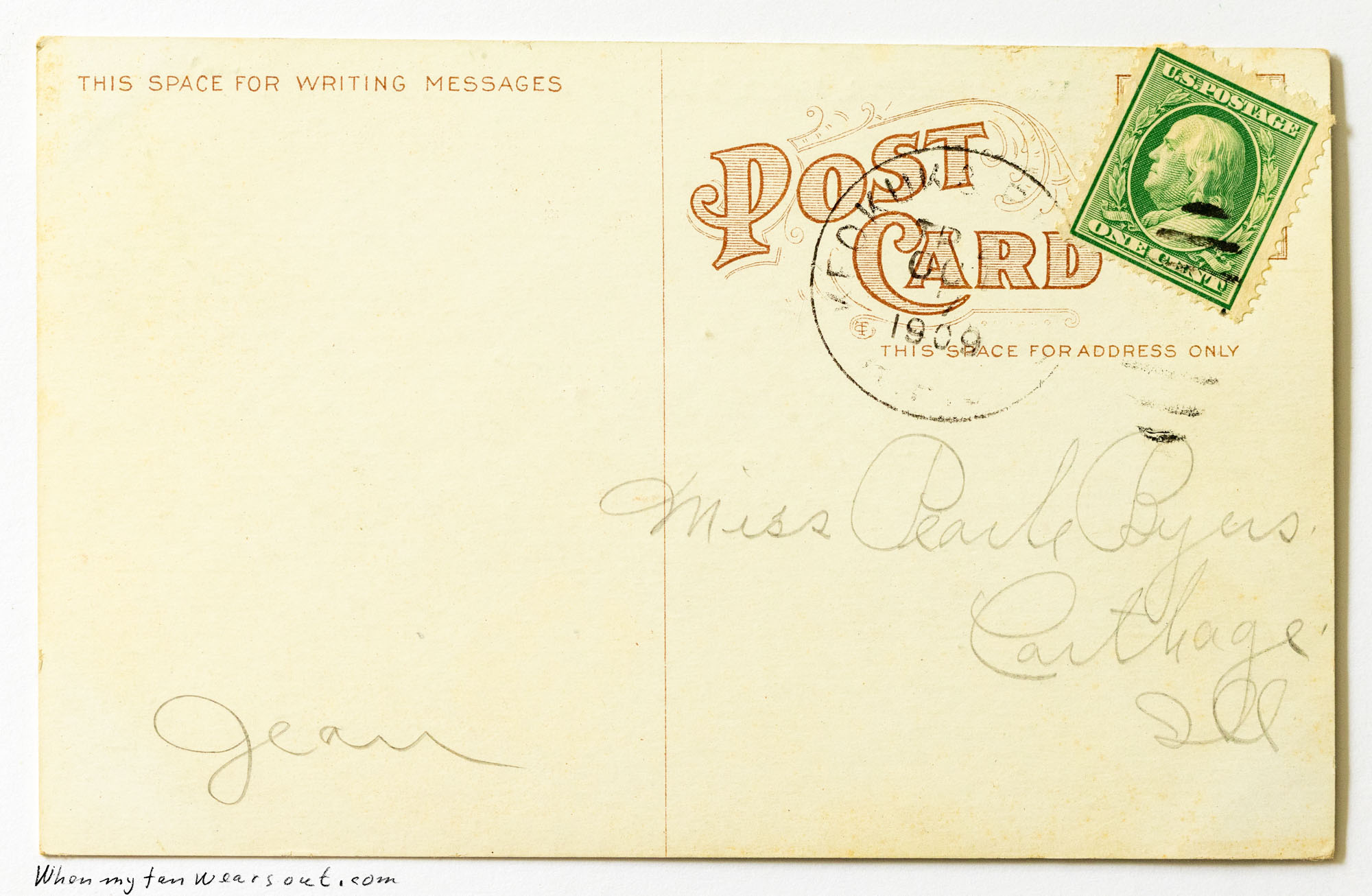
Transcription

Back — Jean

Back of postcard #0088

Postcard Information

  • Postmark: 1909 [month and day illegible]
  • Sent To: Carthage IL
  • Era: Golden Age (1907–1915)
  • Stamp: 1¢ — Features portrait of Benjamin Franklin.
  • Distance Traveled: Undetermined

About This Card

The stone circular colonnade — a monopteros — at Rand Park in Keokuk is visible from some distance on the bluffs above the Mississippi. Rand Park was named for a Keokuk family whose philanthropic gifts developed the grounds in the late 19th century. The park’s elevated position made it a natural viewpoint: on a clear day, the river curves toward the Illinois shore and the distant bluffs of Missouri are visible to the southwest. Jean, writing in 1909, sent this card signed just with her name.

Continue Reading

Postcard #0087: Rand Park, Keokuk, IA — Leota to Pearl, October 1909

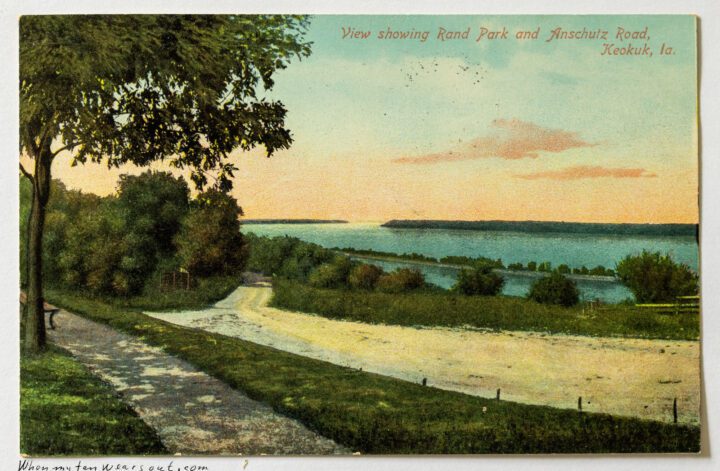
Front of postcard #0087: Colored landscape illustration showing Rand Park and Anschutz Road in Keokuk, Iowa, overlooking the Mississippi River. A

Transcription

Back — Leota

Back of postcard #0087

Postcard Information

  • Postmark: KEOKUK, IOWA, OCT 8 1909
  • Sent To: Carthage IL
  • Era: Golden Age (1907–1915)
  • Print Origin: Printed in Germany
  • Stamp: 1¢
  • Distance Traveled: ~15 miles

About This Card

Rand Park in Keokuk, Iowa sits on the bluffs above the Mississippi River, looking out over the foot of the Des Moines Rapids — the stretch of river that made Keokuk strategically important for generations. The city was once among the most powerful on the upper Mississippi; Samuel Clemens piloted steamboats past these bluffs in the 1850s, and Keokuk was briefly considered as a possible capital of Iowa. By 1909, when Leota sent this card, Keokuk was still a substantial city, though the completion of the Keokuk Dam in 1913 would transform both the river’s character and the town’s identity.

Continue Reading

Postcard #0086: Chief Keokuk’s Monument, Keokuk, IA — Stuart Hoover to Pearl, January 1908

Front of postcard #0086: Sepia-toned photograph showing Chief Keokuk's Monument, a large stone structure situated in a park with lawns, pathways,

Transcription

Back — Hello Kid Say but this is a fancy postal Put this up in garrett so no one can see it Your Friend Stuart Hoover 719 Exc St [?] Keokuk Iowa

Back of postcard #0086

Postcard Information

  • Postmark: Keokuk, Iowa, JAN 28 1908
  • Sent To: Carthage IL
  • Era: Golden Age (1907–1915)
  • Publisher: PEARSON-ULLBERG CO., MINNEAPOLIS
  • Stamp: 1¢
  • Distance Traveled: ~15 miles
Continue Reading

Postcard #0085: Burlington, IA — Julia / Mrs. Chesnut to Pearl, September 1908

Front of postcard #0085: Color illustration of the Corse Statue (an equestrian monument on a tall stone pedestal) located in Crapo Park, Burlingt

Transcription

Front — Julia.

Back — Mrs. Chesnut.

Back of postcard #0085

Postcard Information

  • Postmark: Burlington, IA, SEP 14 1908
  • Sent To: Carthage IL
  • Era: Undivided Back (Pre-1907)
  • Publisher: S. H. KNOX & CO.
  • Stamp: 1¢
  • Distance Traveled: ~30 miles

About This Card

The Corse Statue in Burlington, Iowa commemorates Brigadier General John Murray Corse, a Burlington native who commanded troops at the Battle of Allatoona in 1864 and received the famous signal “Hold the Fort” from Sherman. He held it. The equestrian monument stands near the northern entrance to Crapo Park. Julia sent this card in September 1908 and signed only her first name on the front — “Julia.” — with a separate signature on the back identifying herself as Mrs. Chesnut.

Continue Reading

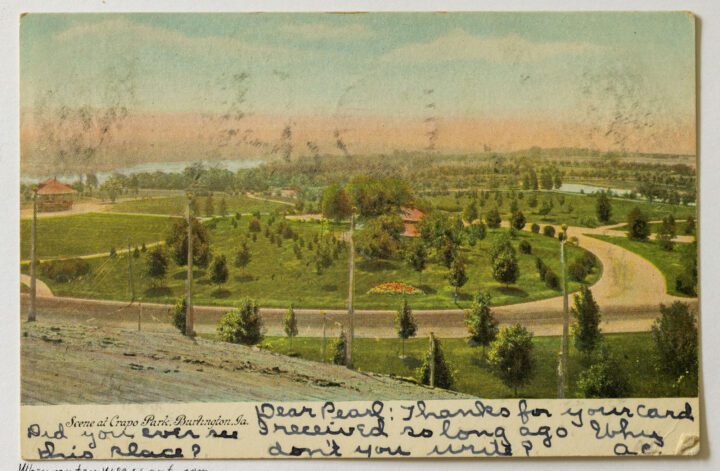
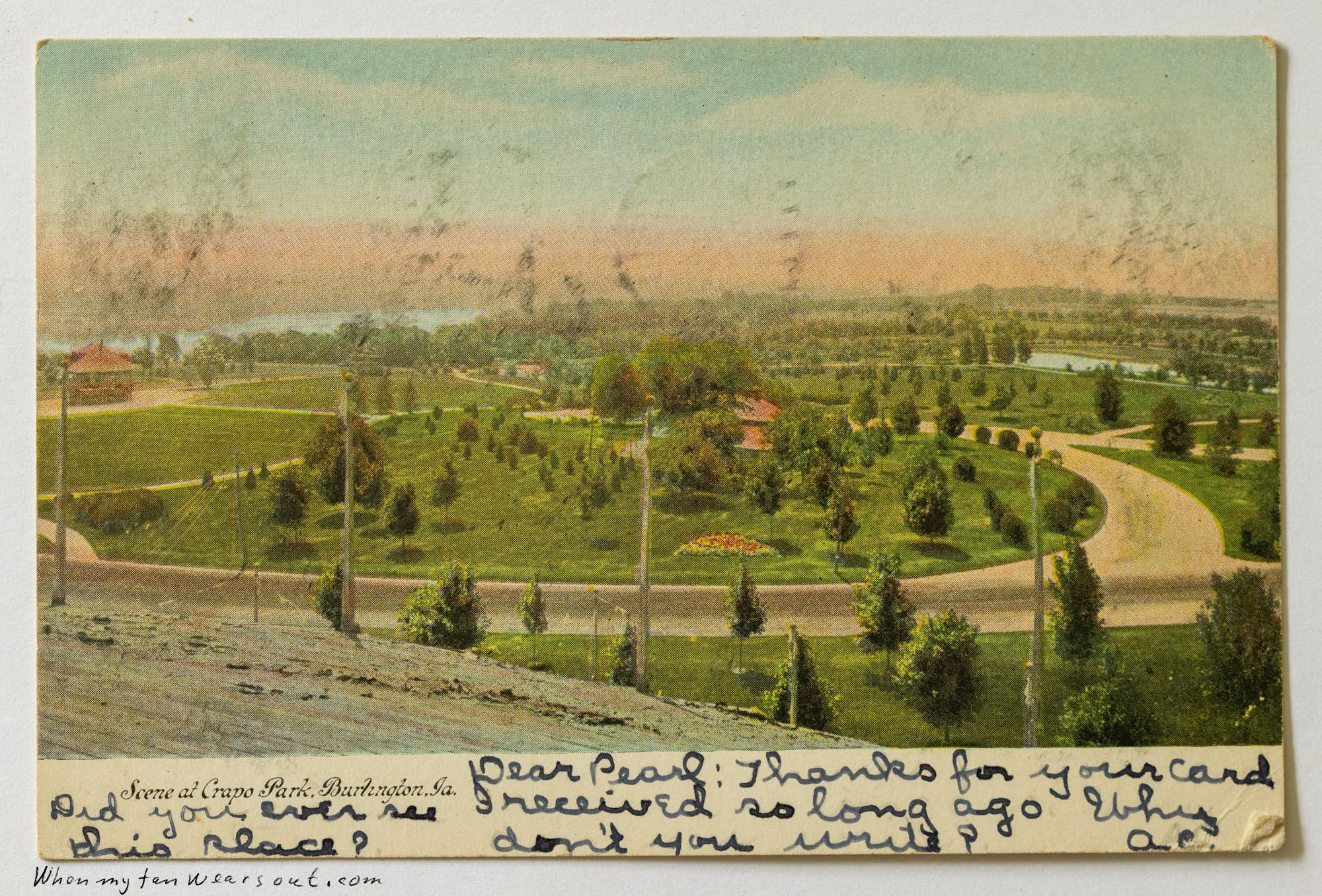
Postcard #0084: Crapo Park, Burlington, IA — A C to Pearl, July 1907

Front of postcard #0084: Illustrated postcard showing an elevated, wide scenic view of Crapo Park in Burlington, Iowa. Features lush green lawns,

Transcription

Front — Did you ever see this place? Dear Pearl: Thanks for your card received so long ago Why don’t you write? A C.

Back of postcard #0084

Postcard Information

  • Postmark: Burlington, IA., JUL 27 1907
  • Sent To: Carthage IL
  • Era: Undivided Back (Pre-1907)
  • Publisher: S. H. KNOX & CO.
  • Stamp: 1¢
  • Distance Traveled: ~30 miles
  • Notes: message written on front instead of back

About This Card

Crapo Park in Burlington, Iowa was donated to the city by the family of Michigan Governor Henry Howland Crapo in the 1890s, developed from land along the bluffs above the Mississippi. By the time A.C. sent this card in July 1907, Crapo Park was already considered one of the finest municipal parks on the upper Mississippi — a winding drive through mature trees above the river, with pavilions, a small zoo, and Black Hawk Spring, a natural spring with a storied Sauk history. Burlington had been a prosperous railroad and manufacturing city since the Civil War, and the park was an expression of that prosperity.

Continue Reading