Postcard #0819: man in a hat

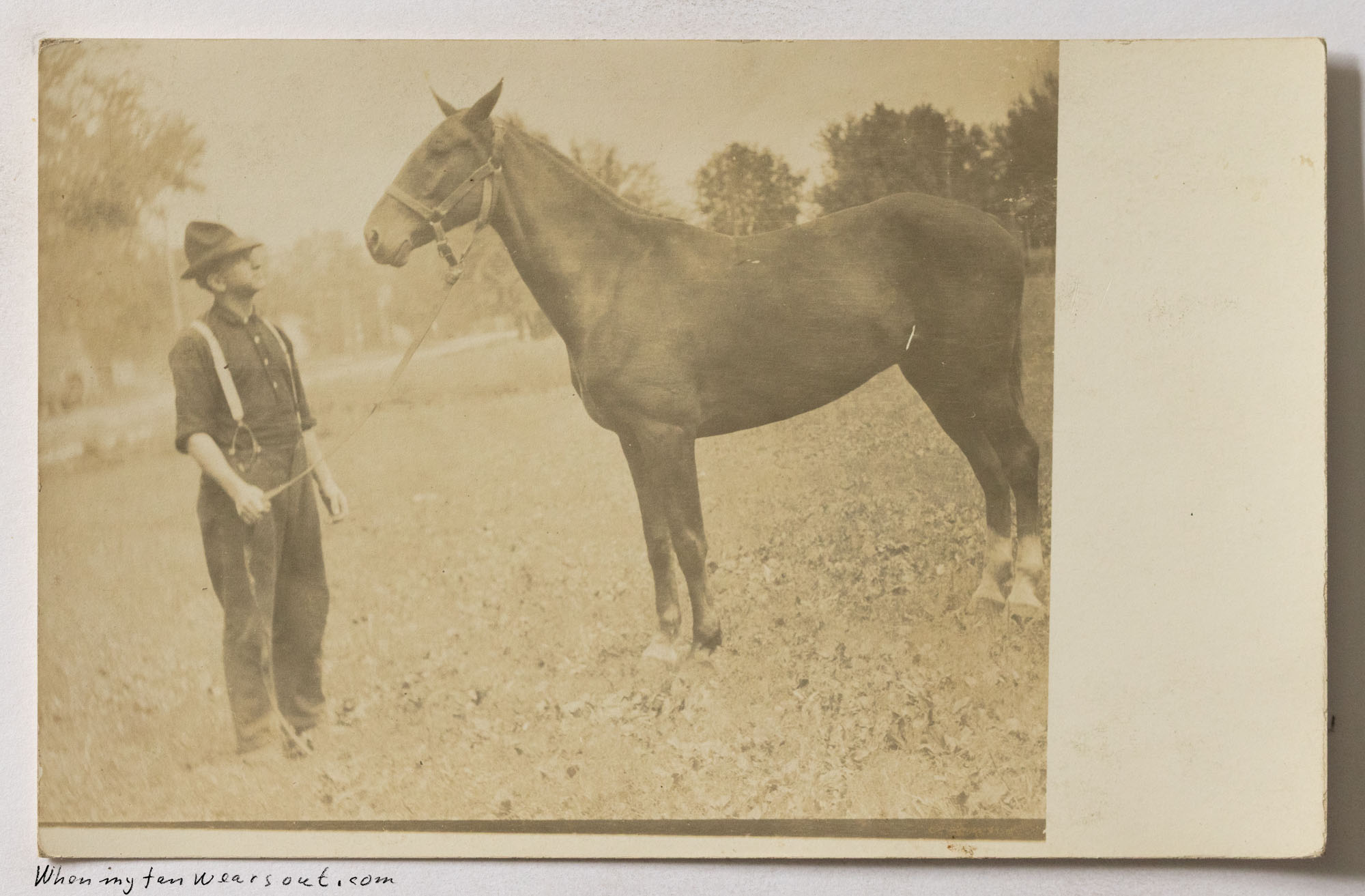
Front of postcard #0819: Real photo postcard showing a man in a hat, dark shirt, and suspenders holding a lead rope attached to a large horse. Th
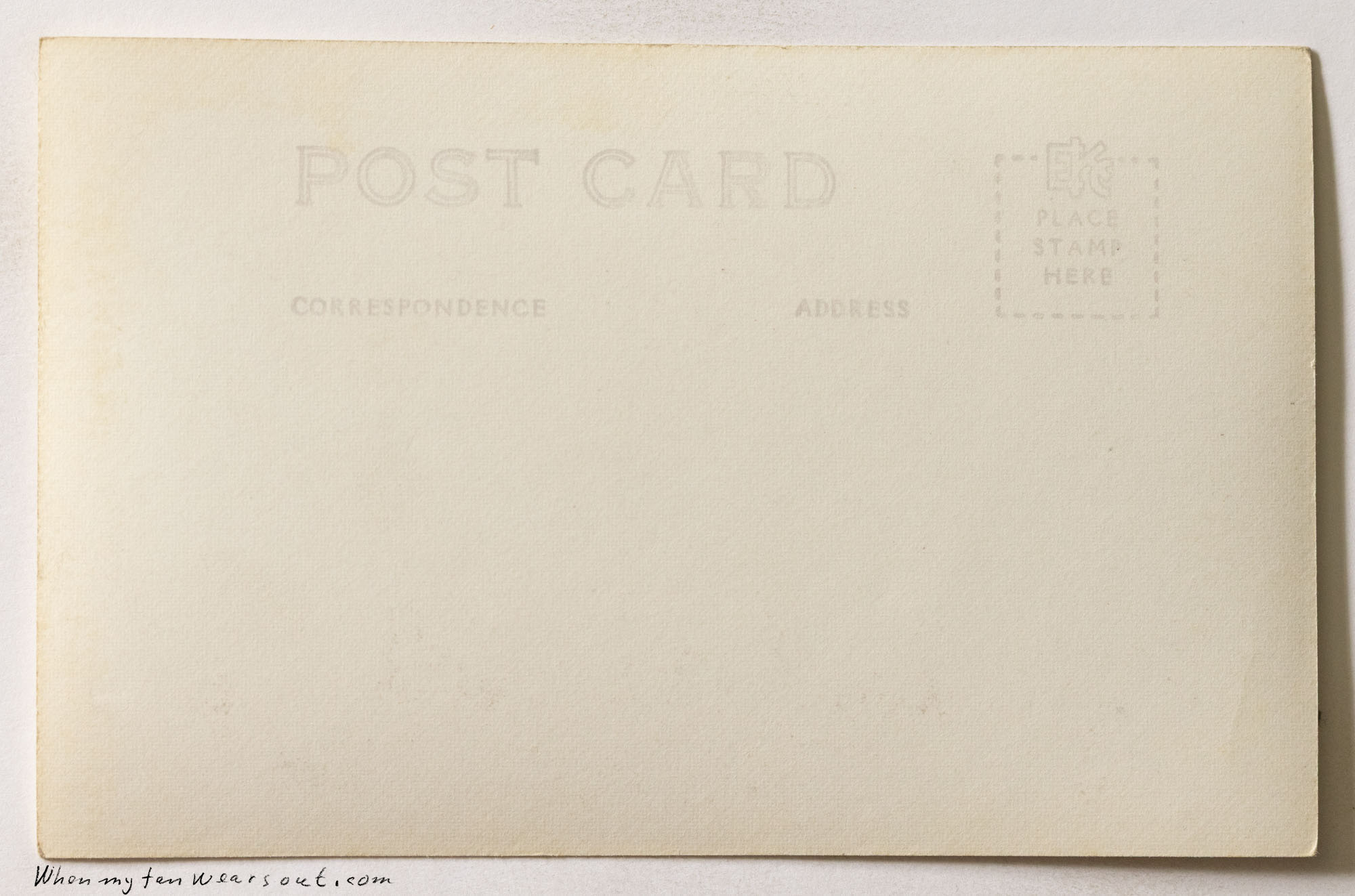
Back of postcard #0819

Postcard Information

  • Postmark: ILLEGIBLE
  • Sent To: Unknown
  • Era: Golden Age (1907–1915)
  • Stamp: NOT VISIBLE — Stamp missing but printed box visible.
  • Distance Traveled: Undetermined
  • Notes: Real photo postcard. Blank card.

About This Card

A man in a hat, dark shirt, and suspenders holds the lead rope of a large horse in an open field. The AZO stamp box dates the photographic paper to 1904–1918. Horses were still central to rural and small-town Midwestern life in this period — farm work, transportation, and commerce all depended on them. Harvey Sights grew up in that world, and many men Pearl and Harvey knew would have posed for exactly this kind of card: a man and his horse, evidence of work and self-sufficiency. The wide unprinted border on the right side of the card suggests the photographer may have had the image printed with a standard margin for writing space, a common choice.
Continue Reading

Postcard #0818

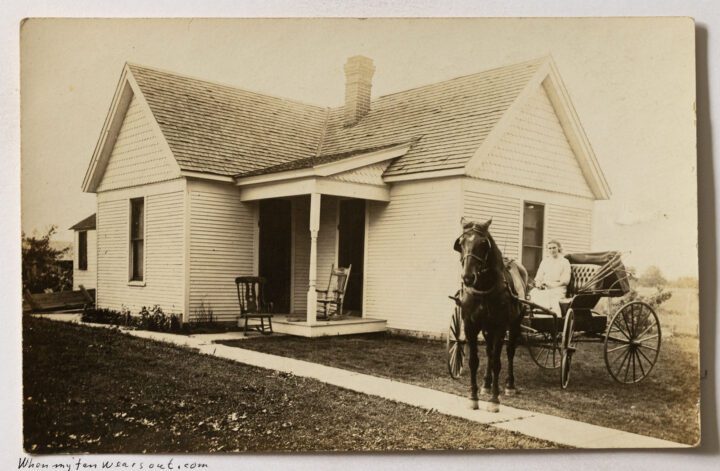
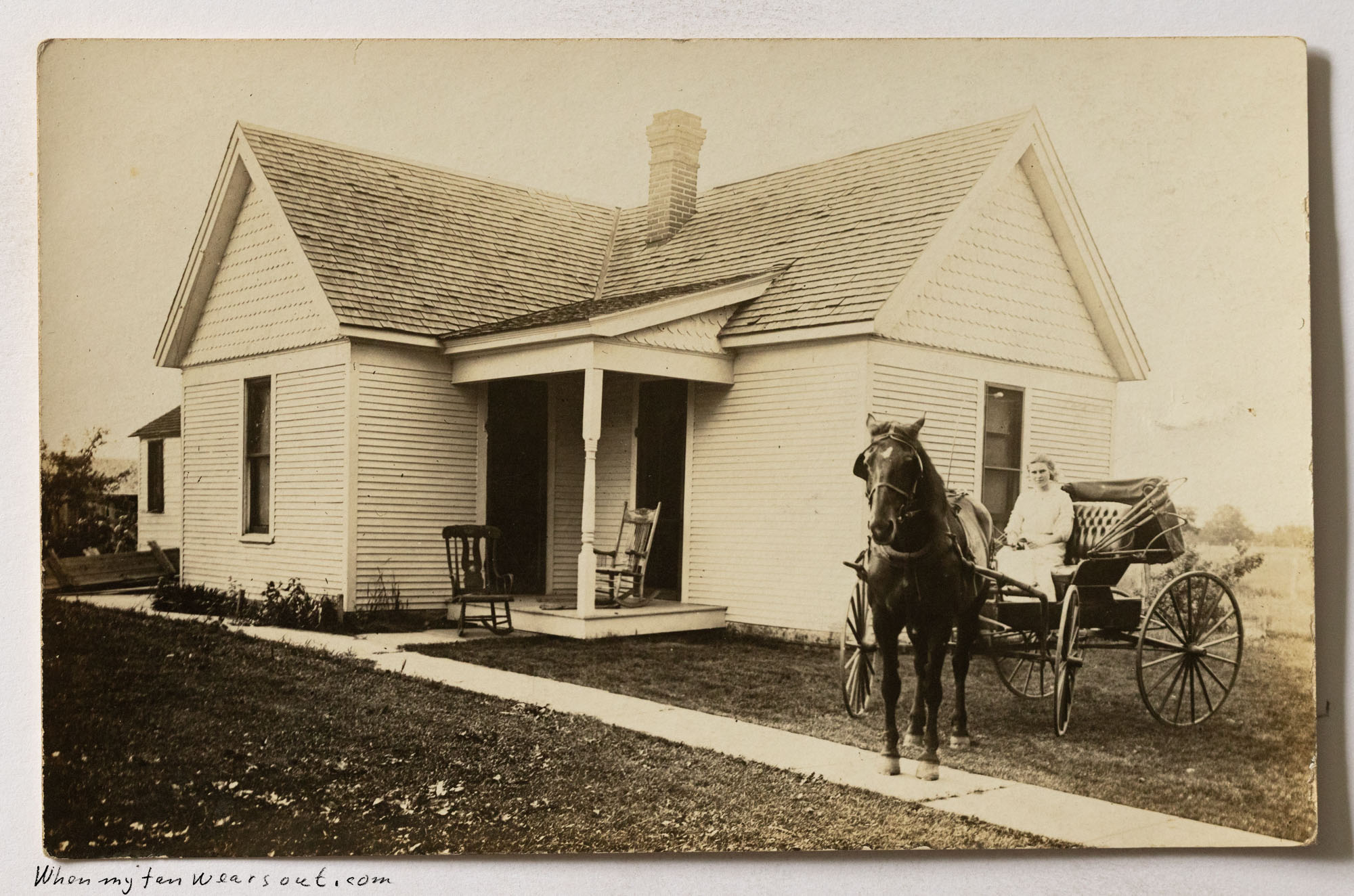
Front of postcard #0818: A sepia-toned real photo of a small white one-story house with lap siding and fish-scale shingles in the gables. A woman
Back of postcard #0818

Postcard Information

  • Postmark: ILLEGIBLE
  • Sent To: Unknown
  • Era: Golden Age (1907–1915)
  • Stamp: NOT VISIBLE
  • Distance Traveled: Undetermined
  • Notes: Blank card. Real photo postcard.

About This Card

A woman in a light-colored dress sits in a horse-drawn buggy parked on the grass in front of a tidy white frame house with fish-scale shingles in the gables and a rocking chair on the porch. The divided back and the informal, personal quality of the photograph suggest this is a family or community card from the 1907–1915 period. This is exactly the kind of image Pearl and Harvey’s circle produced and exchanged — a domestic moment, a woman at ease, a well-kept house. Whether this is someone Pearl knew or a card that came with others in a lot is unknown, but it reads as a portrait of comfortable, modest American life at the edge of the automobile age, when a horse and buggy in front of the house was still entirely ordinary.

Continue Reading

Postcard #0817: begging

Front of postcard #0817: A real photo postcard featuring four separate photographic exposures arranged in a grid. Each image captures dogs in the
Back of postcard #0817

Postcard Information

  • Postmark: ILLEGIBLE
  • Sent To: Unknown
  • Era: Golden Age (1907–1915)
  • Stamp: NOT VISIBLE
  • Distance Traveled: Undetermined
  • Notes: Blank card. Front features a composite of four distinct photographic exposures.

About This Card

Four exposures on a single real photo postcard, all of the same dog — jumping, sitting with a companion, begging on its hind legs. The AZO stamp box dates the paper to 1904–1918. Composite photography like this required either multiple exposures on the same plate or careful darkroom assembly; by the postcard era, Kodak and others made it straightforward enough that amateur photographers did it regularly. Dogs as postcard subjects were enormously popular in the Golden Age — they appeared in greeting cards, souvenir sets, and custom portraits. Someone in this household was proud of their dog and had the means and interest to document it carefully.

Continue Reading

Postcard #0815: (RPPC) showing a small wooden house or cabin with a chimney

Front of postcard #0815: A real photo postcard (RPPC) showing a small wooden house or cabin with a chimney. The building is surrounded by extreme
Back of postcard #0815

Postcard Information

  • Postmark: ILLEGIBLE
  • Sent To: Unknown
  • Era: Golden Age (1907–1915)
  • Stamp: NOT VISIBLE — Stamp box is empty but contains "AZO" with four upward-pointing triangles in the corners.
  • Distance Traveled: Undetermined
  • Notes: Blank card. This is a Real Photo Postcard (RPPC).

About This Card

A small wooden house nearly swallowed by tall grass, with a boardwalk leading to the door — the AZO stamp box with four upward-pointing triangles dates this real photo postcard to between 1904 and 1918. Someone made this image deliberately: the composition is centered, the light is good. Whether it records a homestead, a claim shack on the prairie, or a seasonal cabin is impossible to say without more information. The overgrowth suggests abandonment or at minimum long neglect — or perhaps just a summer between tenants. It’s the kind of photograph that raises more questions than it answers, which may be exactly why it ended up in a collection.

Continue Reading

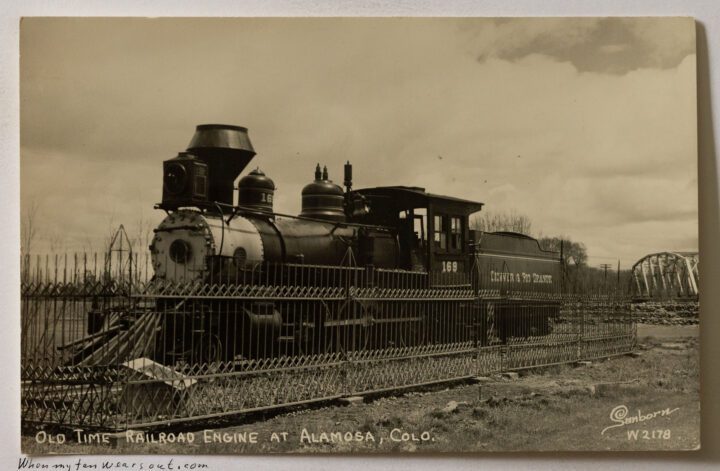
Postcard #0814: old Denver & Rio Grande steam locomotive

Front of postcard #0814: Real photo postcard of an old Denver & Rio Grande steam locomotive, engine number 169, stationed behind a decorative met
Back of postcard #0814

Postcard Information

  • Postmark: ILLEGIBLE
  • Sent To: Unknown
  • Era: Chrome (1945–present)
  • Publisher: Sanborn
  • Stamp: NOT VISIBLE
  • Distance Traveled: Undetermined
  • Notes: Blank card.

About This Card

Denver and Rio Grande Western locomotive No. 169 was built by Baldwin Locomotive Works in 1883 — the same year Pearl Byers’s parents were young adults in Illinois. A narrow-gauge ten-wheeler, it was one of the fastest and most powerful engines on the D&RGW system, assigned at various points to the famous “Chili Line” between Alamosa and Santa Fe. Retired from service in 1938, it was pulled back out of storage the following year to represent the railroad at the 1939–40 New York World’s Fair, where it was refurbished and shipped east as a showpiece. In 1941 the railroad donated it to the City of Alamosa. It still stands today in Cole Park on the Alamosa riverfront — listed on the National Register of Historic Places since 2001 — making it one of the oldest surviving D&RG locomotives in existence. Harvey Sights spent his career on the railroads; a card like this, showing an old engine posed behind a decorative fence as a kind of monument, would have fit naturally in his world.

Continue Reading

Postcard #1091: Denhart Hall

Front of postcard #1091: Hand-colored white border postcard of Denhart Hall, a three-story brick building with multiple dormer windows. The build
Back of postcard #1091

Postcard Information

  • Postmark: ILLEGIBLE
  • Sent To: Unknown
  • Era: White Border (1915–1930)
  • Publisher: NICHOLS’ BOOK STORE, CARTHAGE, ILL.
  • Stamp: NOT VISIBLE — Stamp missing but printed box visible.
  • Distance Traveled: Undetermined
  • Notes: Blank card.

About This Card

Denhart Hall — the building shown in this hand-colored white border postcard — appears to be an academic or institutional building of the type common to small Midwest college towns in the early twentieth century. The three-story brick construction with multiple windows suggests a dormitory or classroom building. Carthage College, founded in 1870 and located in Carthage, Illinois until it moved to Kenosha, Wisconsin in 1962, maintained several buildings in this style on its campus. The college’s presence made Carthage more than just a county seat.

Continue Reading

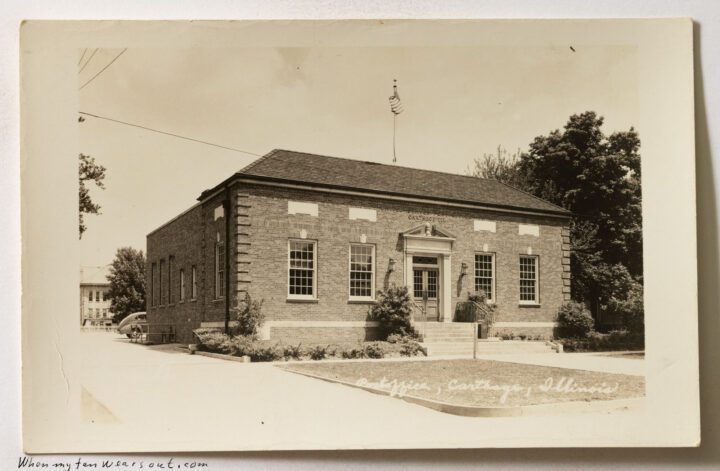
Postcard #1090: brick U

Front of postcard #1090: Real photo postcard of the brick U.S. Post Office in Carthage, Illinois. The building is a single-story structure with a
Back of postcard #1090

Postcard Information

  • Postmark: ILLEGIBLE
  • Sent To: Unknown
  • Era: Chrome (1945–present)
  • Stamp: NOT VISIBLE
  • Distance Traveled: Undetermined
  • Notes: Blank card. The Carthage Post Office building shown was completed in 1933.

About This Card

This second real photo postcard of the Carthage Post Office shows the building from a slightly different angle than card 1089, suggesting both cards were made at around the same time by someone systematically documenting the city’s public buildings. The Carthage post office was the hub of Pearl’s correspondence — every card in this collection passed through it at some point, either arriving or departing. It processed Harvey’s railroad postcards from Fort Madison, Elva’s cards from Hawaii, Marnelle’s cards from Chicago, and Frank McMinimy’s cards from France.

Continue Reading

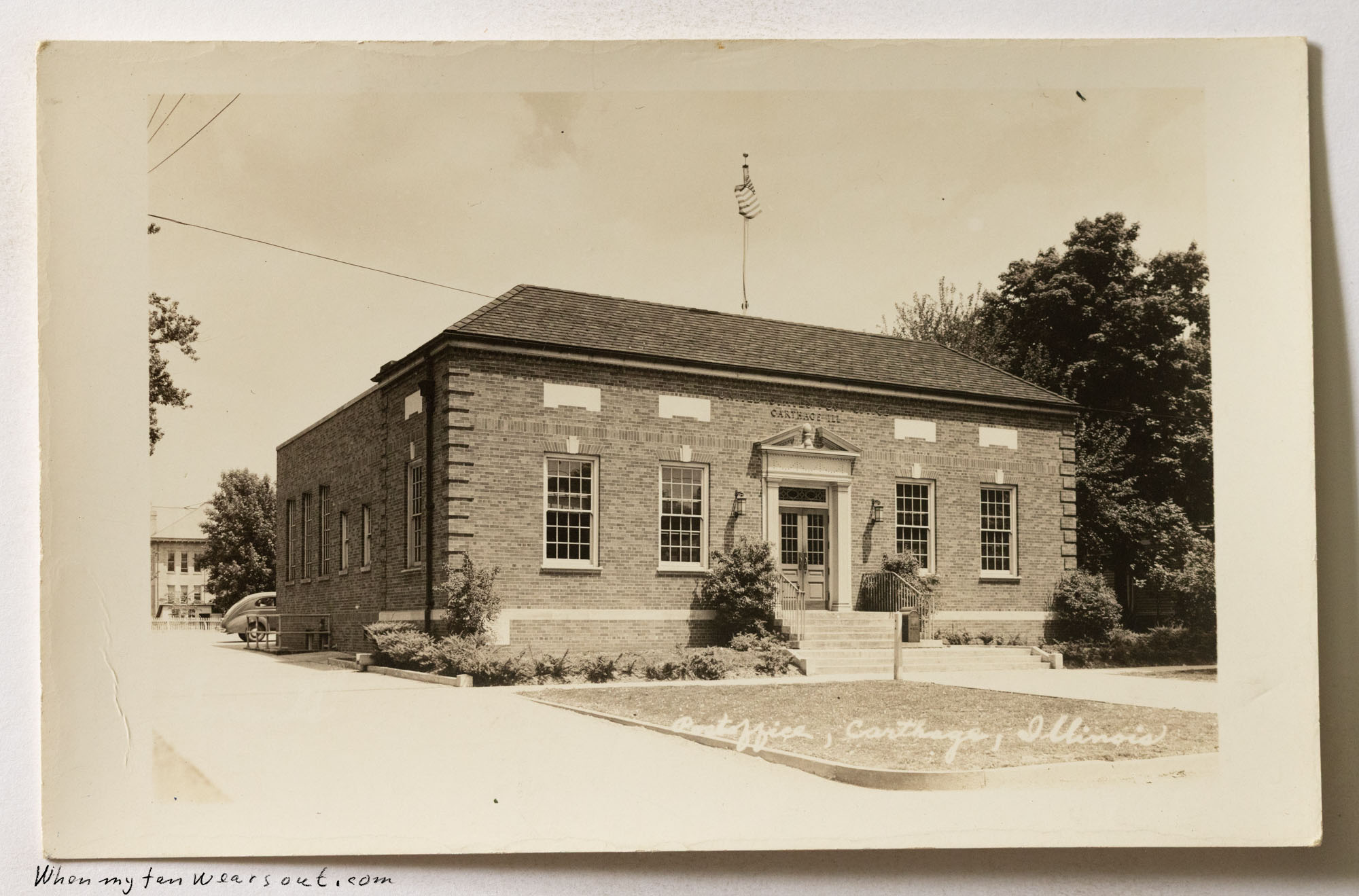
Postcard #1089: UNITED STATES POST OFFICE CARTHAGE ILL.

Front of postcard #1089: A real photo postcard showing the brick building of the Carthage, Illinois Post Office. The building has a flag flying f
Back of postcard #1089

Postcard Information

  • Postmark: ILLEGIBLE
  • Sent To: Unknown
  • Era: Golden Age (1907–1915)
  • Stamp: NOT VISIBLE — Stamp missing but printed box with EKC logo visible.
  • Distance Traveled: Undetermined
  • Notes: Blank card. Real Photo Postcard (RPPC). The car and architecture suggest a date in the late 1930s or 1940s, despite the Divided Back layout.

About This Card

The Carthage, Illinois Post Office occupied a brick building that served the city’s federal postal needs in the early twentieth century. As the county seat of Hancock County, Carthage received its federal buildings — courthouse, post office — through the same process of federal investment that gave small county seats their civic permanence. Pearl’s correspondence arrived and departed through this building for most of her life at 318 N. Fayette Street.

Continue Reading

Postcard #1078 — Clyde [illegible] to Pearl

Front of postcard #1078: Hand-colored landscape illustration of a river or stream with exposed sandbars in the foreground. A grassy green hill wi

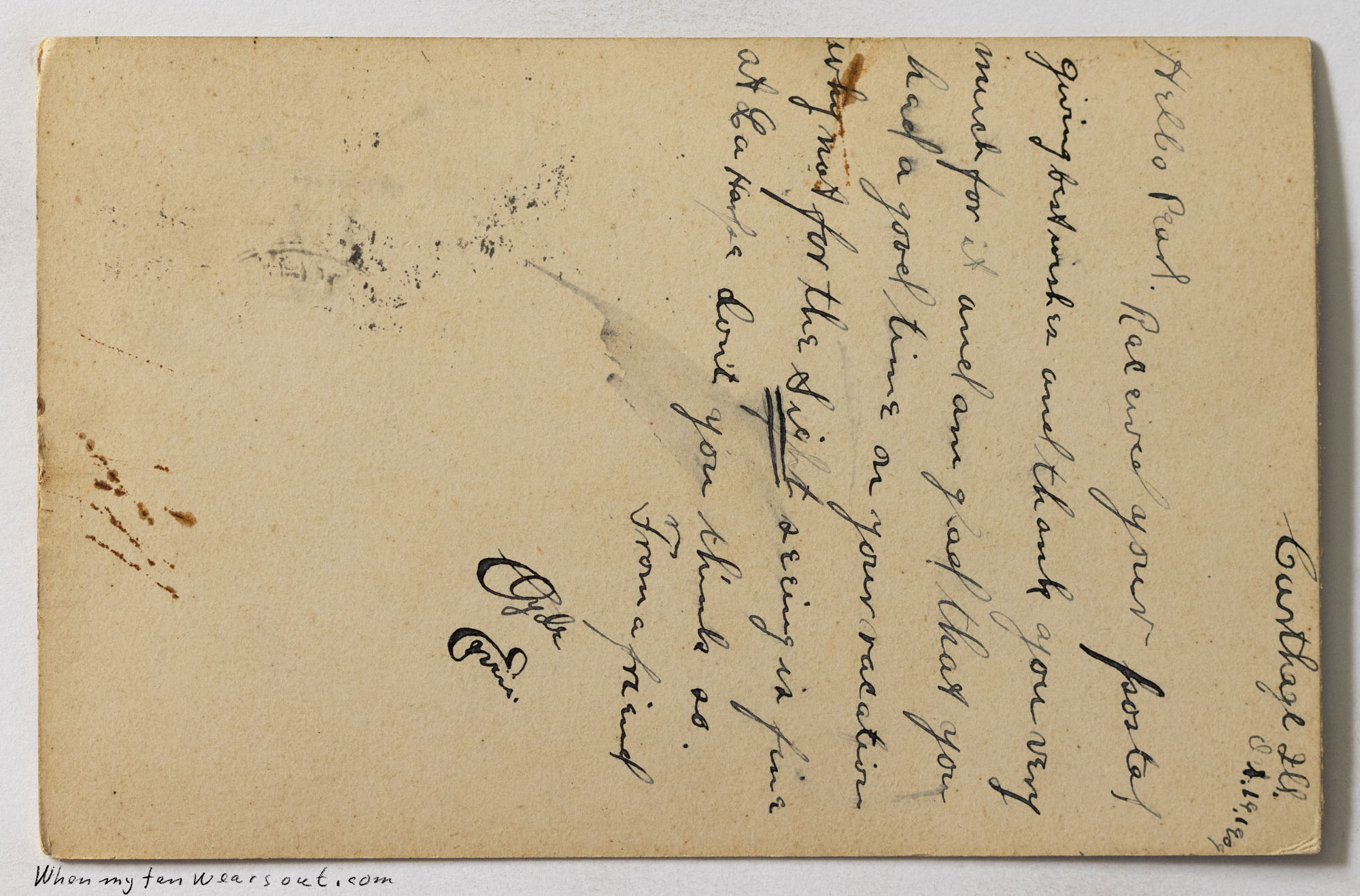
Transcription

Back — Carthage Ill. Oct. 19. 1909 Hello Pearl. Received your postal giving best wishes and thank you very much for it and am glad that you had a good time on your vacation why not for the sight seeing is fine at La Harpe don’t you think so. From a friend Clyde [illegible]

Back of postcard #1078

Postcard Information

  • Postmark: ILLEGIBLE
  • Sent To: Unknown
  • Era: Undivided Back (Pre-1907)
  • Stamp: NOT VISIBLE
  • Distance Traveled: Undetermined
  • Notes: Reference to La Harpe.
Continue Reading