Back — Received card all o.k. I thought that you had forgotten little me by this time. When are you coming over in this part of the country to make every body a visit. You want to come while there is some good ice and moonlight nights. ans soon. as ever Ray ] H.R.W.
Back — Wed a. m. Ready to go to fair and a hard day of cleaning. Letter & money came yesterday Will write a letter if I can find time later Wont see Herb [?] unless accidentally. Wish I could send this thing [?] by him. Dont know when I’ll come home now. Cant figure out the phone call Ma.
Postcard Information
Postmark: BEARDSTOWN, ILL., SEP 6 1939
Sent To: Chicago IL
Era: White Border (1915–1930)
Publisher: PUBLISHED BY NICHOLS’ BOOK STORE, CARTHAGE, ILL.
Stamp: 1¢
Distance Traveled: ~220 miles
About This Card
The Hancock County Courthouse in Carthage was completed in 1907, replacing an earlier structure. Its classical revival architecture — the columns, the prominent dome — expressed the aspirations of a county seat that had been founded in 1833 and incorporated the memory of Joseph Smith’s murder at the nearby jail in 1844 into its civic identity. “Ma.” sent this hand-colored photograph from Beardstown, Illinois — she was traveling and sent a card of Pearl’s own county courthouse, the building that defined Carthage’s civic center.
Stamp: NOT VISIBLE — Stamp missing but printed box visible.
Distance Traveled: Undetermined
Notes: Blank card.
About This Card
Denhart Hall — the building shown in this hand-colored white border postcard — appears to be an academic or institutional building of the type common to small Midwest college towns in the early twentieth century. The three-story brick construction with multiple windows suggests a dormitory or classroom building. Carthage College, founded in 1870 and located in Carthage, Illinois until it moved to Kenosha, Wisconsin in 1962, maintained several buildings in this style on its campus. The college’s presence made Carthage more than just a county seat.
Back — Seeing lots of old friends at Homecoming going to Picnic to morrow then back to Chicago. Had a big storm here last night. love from Grandma
Postcard Information
Postmark: CARTHAGE, ILL., AUG 8 1938
Sent To: Chicago IL
Era: White Border (1915–1930)
Publisher: NICHOLS’ BOOK STORE / C. T. AMERICAN ART BLUE-SKY (TEICH CO.), Carthage, Illinois / Chicago, Illinois
Stamp: 1¢
Distance Traveled: ~240 miles
About This Card
The Carthage Jail was built in 1839 and became, on June 27, 1844, the site of the murder of Joseph Smith, founder of the Church of Jesus Christ of Latter-day Saints, and his brother Hyrum. A mob stormed the jail, where Smith was being held on charges of treason, and shot both men. The LDS Church acquired the building in 1903 and has operated it as a historic site ever since. Grandma sent this hand-colored postcard during Homecoming in August 1938, saw lots of old friends, and mentioned a big storm the night before. The jail she photographed or purchased a card of had been standing for nearly a century and had housed the most consequential prisoner in American religious history.
Back — Just about time to hit the trail Have seen Docs. Harris & Ed Cutlers W. Nichols. Ran or Marnel & Neal just left Ray & E. Ethel got run over by a car and was in to see Dr. but he was not in they are coming back to morrow to pick up Mr. B. Horace is taking me to Guys to morrow Eve all are comfortable here well [?] but Lizzie is not any to good just now. tell you more when I get home. Love Harve
Postcard Information
Postmark: CARTHAGE, ILL., MAY 3 1944
Sent To: Carthage IL
Era: White Border (1915–1930)
Stamp: 1¢
Distance Traveled: ~15 miles
Notes: Real Photo Postcard (RPPC). Postmark date (1944) is much later than the typical Divided Back era. Message mentions daughter Marnelle ("Marnel") and mentions an acquaintance, Ethel, being run over by a car.
About This Card
The Stone Inn in Carthage, Illinois was a two-story stone building on or near the town square — one of the older commercial structures in the city, built from the local limestone that defined early Carthage construction before brick became the dominant material. Harvey sent this real photo postcard, signing it “Love Harve.” Harvey had grown up in La Harpe and moved to Carthage when he and Pearl married in October 1910; the Stone Inn was part of the commercial geography of the town he adopted. The building’s stone construction set it apart from the later brick commercial blocks that surrounded it.
Back — Received your letter last night had made all purchases Thursday. Do not get to work at all Saturday So nothing happened will be there either in a.m. or be on [illegible] about noon for [illegible] was well. He [?] is late and am tired so will go mail this and retire Ray
Postcard Information
Postmark: QUINCY, ILL., DEC 20 [illegible]
Sent To: Carthage IL
Era: White Border (1915–1930)
Stamp: 1¢ (two stamps) — Two 1-cent stamps applied side-by-side.
Distance Traveled: ~40 miles
About This Card
This real photo postcard of a grocery store window display in Quincy, Illinois is a small window into the retail world of early-twentieth-century commerce. The window is filled with sacks and containers — flour, possibly grain, canned goods — arranged for display in a manner that valued quantity and variety over design. Ray sent this card from Quincy with a brief note. Quincy grocery stores in this period served a large regional market, and the window display reflects the practical character of commerce in a river city that still had deep agricultural connections to its hinterland.
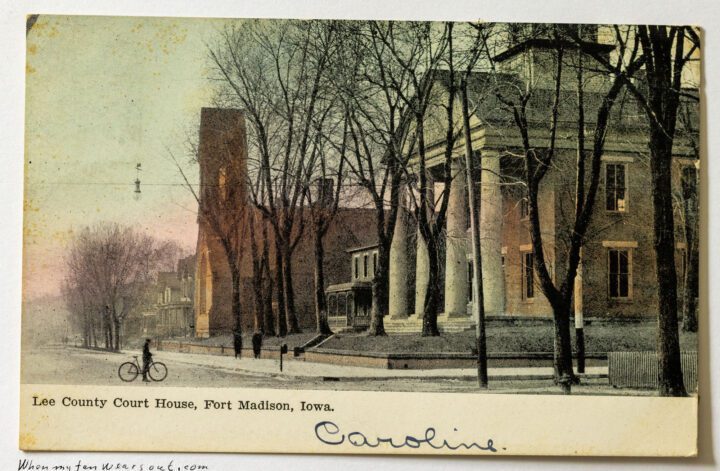
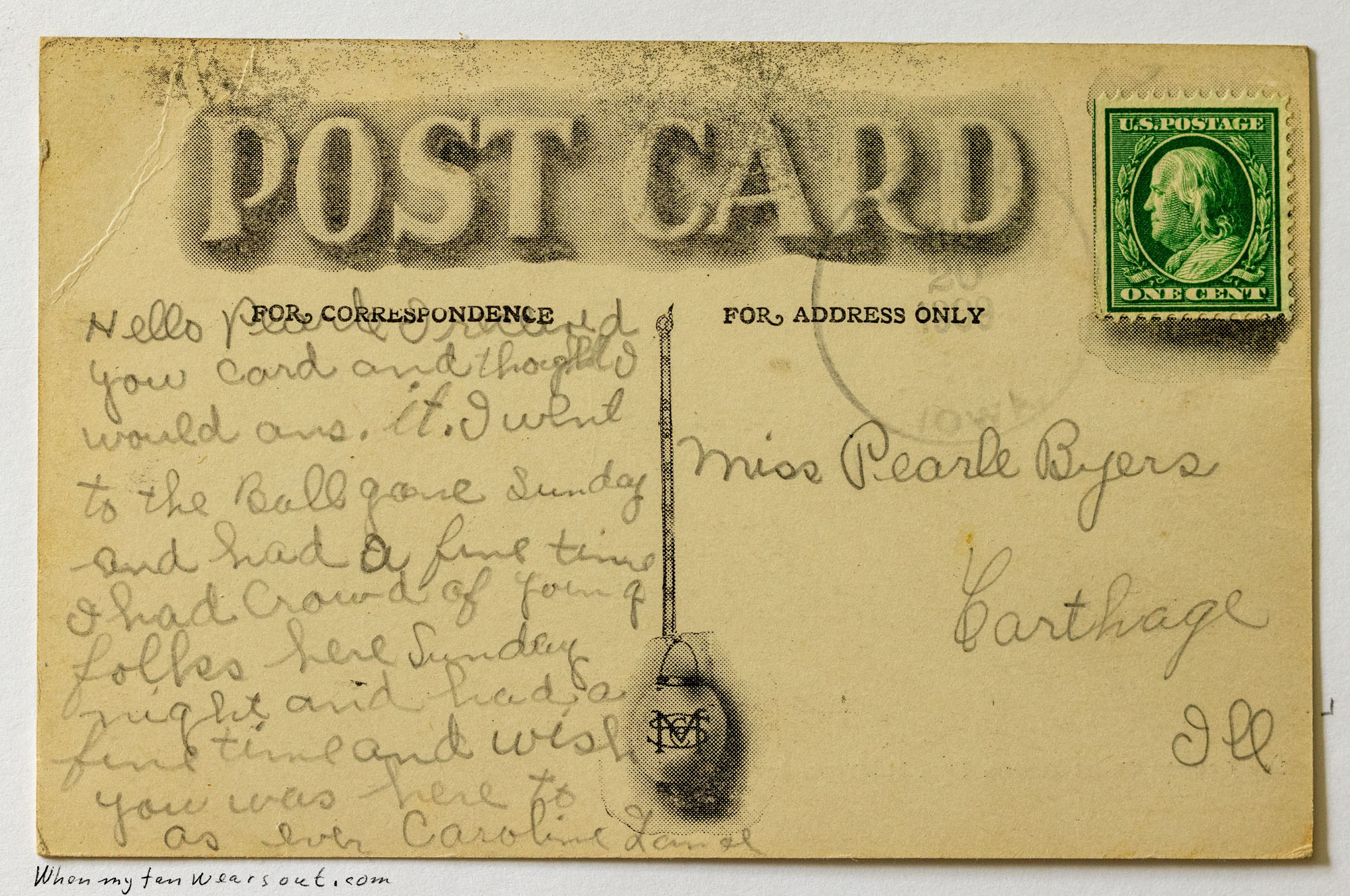
Back — Hello Pearl Received you card and thought I would ans. it. I went to the Ball game Sunday and had a fine time I had crowd of four of folkes here Sunday night and had a fine time and wish you was here to [?] as ever Caroline [illegible] ] Caroline.
Postcard Information
Postmark: Fort Madison, Iowa, OCT 20 [illegible]
Sent To: Carthage IL
Era: White Border (1915–1930)
Stamp: 1¢
Distance Traveled: ~25 miles
About This Card
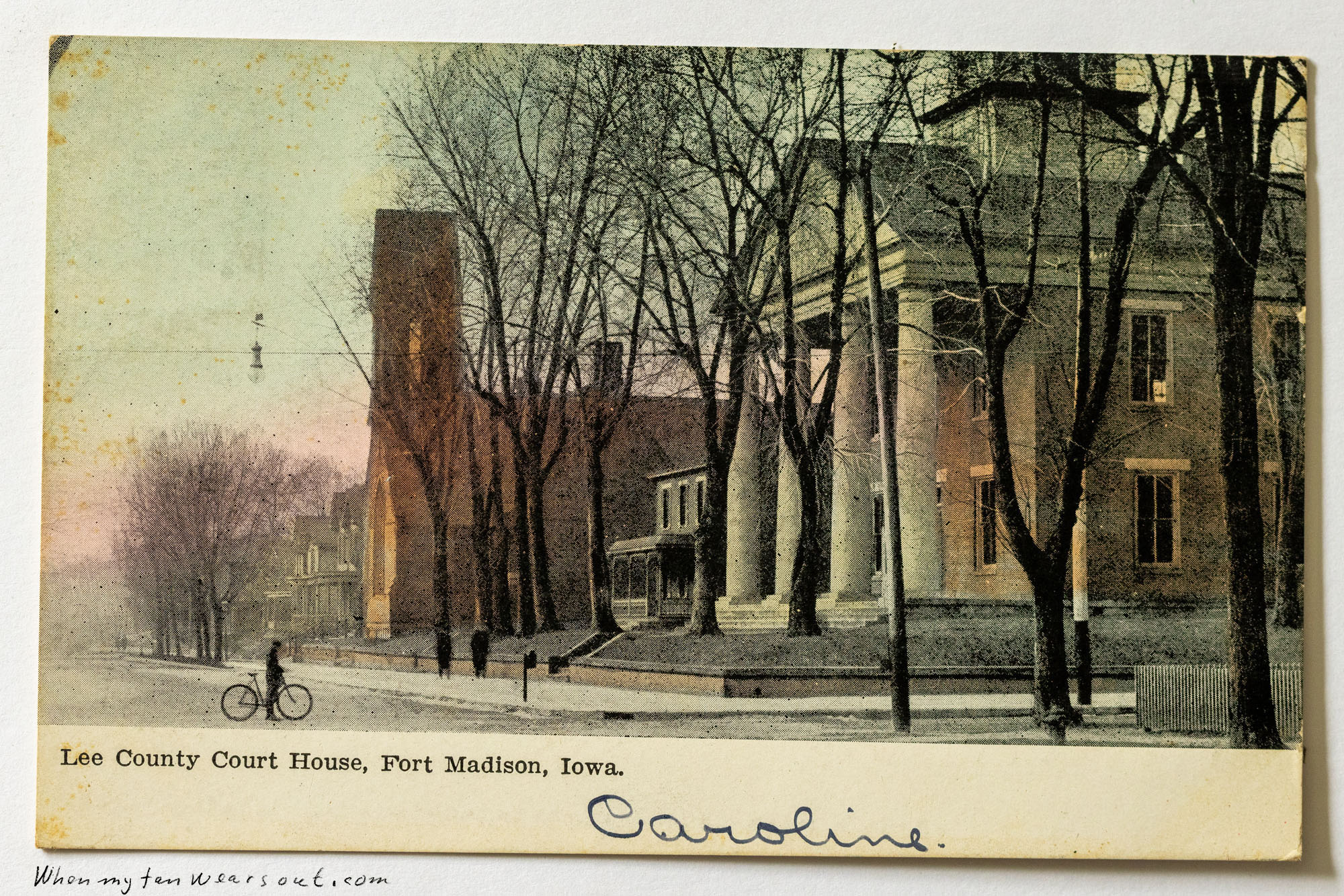
The Lee County Courthouse in Fort Madison stands on a prominent corner downtown, its white columns visible for some distance along the approaches from the river. Fort Madison sits on a sharp bend of the Mississippi, and the view from the courthouse steps takes in a wide sweep of water. Caroline, writing from Fort Madison in autumn, doesn’t mention the courthouse — she’s writing about a ball game and promising to answer Pearl’s card. The building is background, not subject.