Stamp: NOT VISIBLE — Stamp missing but printed box with EKC logo visible.
Distance Traveled: Undetermined
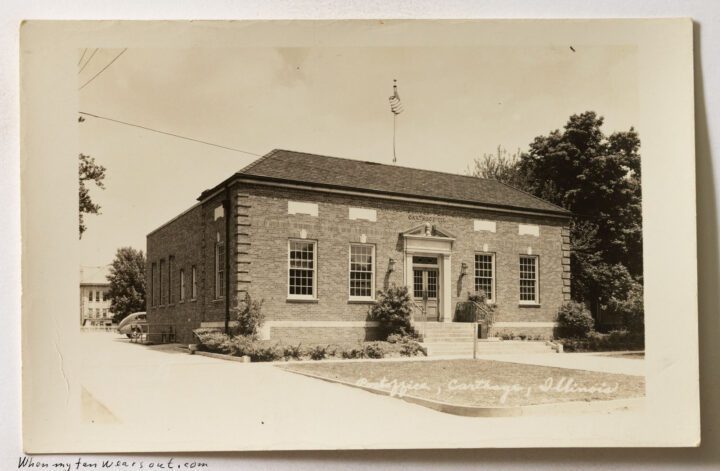
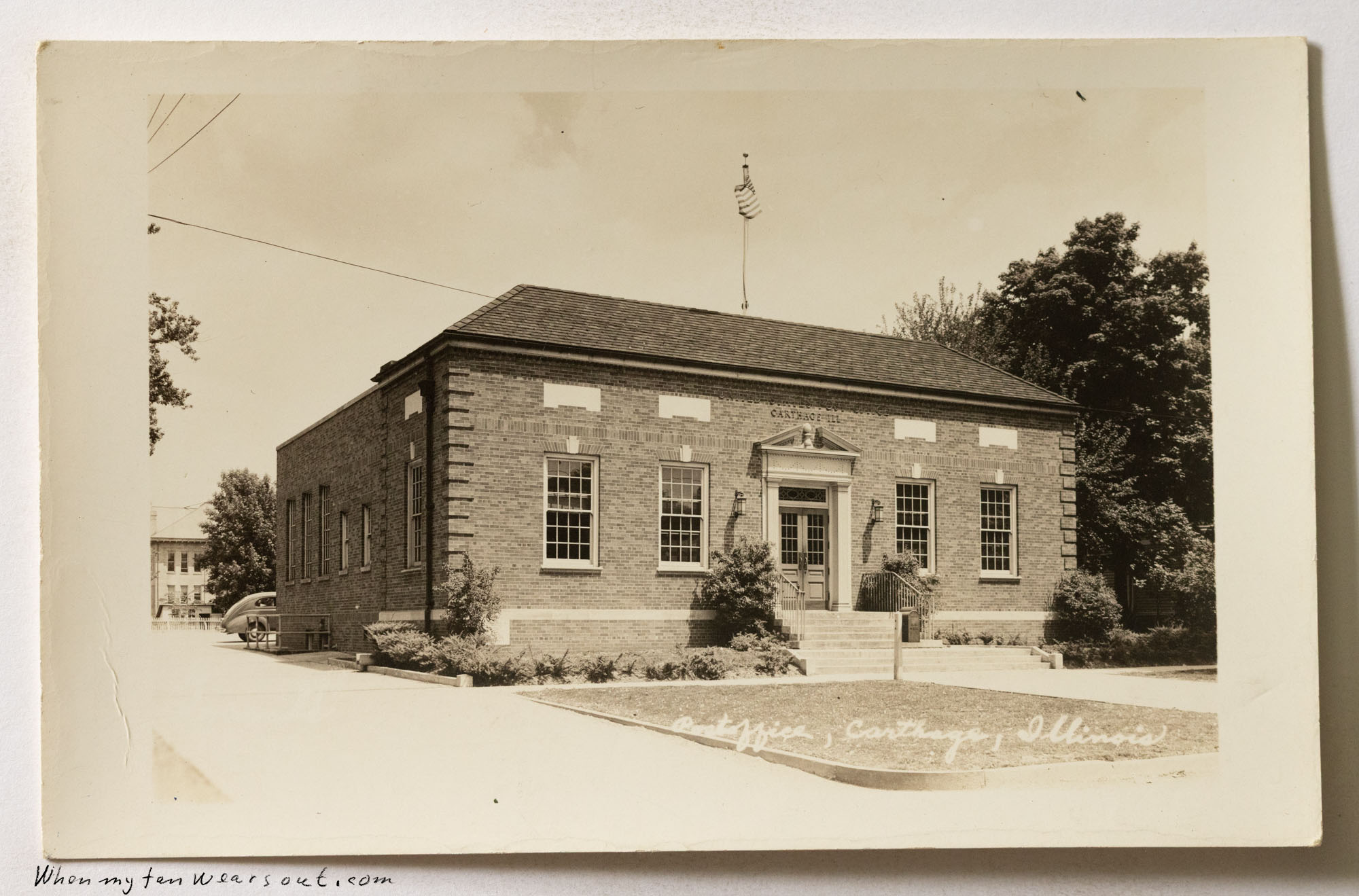
Notes: Blank card. Real Photo Postcard (RPPC). The car and architecture suggest a date in the late 1930s or 1940s, despite the Divided Back layout.
About This Card
The Carthage, Illinois Post Office occupied a brick building that served the city’s federal postal needs in the early twentieth century. As the county seat of Hancock County, Carthage received its federal buildings — courthouse, post office — through the same process of federal investment that gave small county seats their civic permanence. Pearl’s correspondence arrived and departed through this building for most of her life at 318 N. Fayette Street.
Back — ] hello Pearle, how are you dear?. was in Ft. Madison today, wish you could have been there too. Saw the -and- -irons that belonged to Jo. Smith the morman who [continued on left edge and top:] was killed in Carthage jail, -also saw the chest in which he kept his Bible, they are owned by Mrs. Campbell.
Postcard Information
Postmark: WEST [illegible], IOWA, JUN [illegible] 19[illegible]
Notes: Sender signed her name on the front of the card. The message references the death of Joseph Smith ("Jo. Smith"), founder of the Latter Day Saint movement, who was killed at the jail in Carthage, Illinois.
About This Card
The Iowa State Penitentiary in Fort Madison, Iowa was commissioned in 1839 — seven years before Iowa achieved statehood — making it the oldest continuously operating prison west of the Mississippi River. The stone walls and cell houses visible in this photograph defined the city’s eastern skyline for more than a century. Fort Madison would eventually take on a second identity connected to pens of a different kind: in 1913, a Fort Madison jeweler named Walter A. Sheaffer would patent a lever-fill mechanism for fountain pens and found the Sheaffer Pen Company a few blocks away, giving the city its durable nickname, Pen City.
Back — ] Junior Robbins Harris Seward Harold Salisbury Stuart [illegible] Leon [illegible] Karl [illegible] Laurence [illegible] Rich Owings Harvey Sights Earl [illegible] Frank Johnson Clarence Talbot. Chester Clarke. Paul Whitehouse Carthage High School Football 1908 Team ] Carthage Football 1908
Postcard Information
Postmark: ILLEGIBLE
Sent To: Carthage IL
Era: Golden Age (1907–1915)
Publisher: AZO
Stamp: NOT VISIBLE — Stamp missing but printed box visible.
Distance Traveled: Undetermined
Notes: The handwritten list on the back includes Harvey Sights. The card was never mailed and serves as a photo identification. Message is written vertically across both sections of the back. Large ink flourishes/scribbles over the center of the back. Handwriting on front identifies the team and year.
Front — A group of store employees or proprietors pose with a display case of umbrellas.
Postcard Metadata
Postmarked: Not Visible
Sent From: None
Sent To: None
Distance Traveled: None
Postage: Not visible (no stamp)
Card Details: Divided Back, Real Photo Postcard (RPPC) with “A Z O” stamp box (circa 1907-1920s).
Back — A list of names
Transcription
Fred Peasley Waldo Mason Miss Erbroidt Miss Osborn Tom Roberts Carrie Campbell Maude Biggs Mabel Roberto
Mason Dry Goods Store, La Harpe
Historical & Family Notes
This charming real photo postcard, likely dating to the early 20th century, captures a slice of small-town commerce, possibly the very store where Harvey Sights worked or visited. The image presents a bustling scene with employees, a counter, and umbrellas for sale, suggesting a dry goods or department store.
Front — An embossed illustration of a holly sprig with red berries above a winter landscape scene and “A MERRY CHRISTMAS” message.
Postcard Metadata
Postmarked: Perris, California — December 22 (Year unreadable, likely early 1910s based on stamp and card type)
Sent From: Perris, California
Sent To: Miss Pearl Byers Carthage Ill.
Distance Traveled: Approximately 1,900 miles
Postage: U.S. Postage, One Cent, green Benjamin Franklin stamp
Card Details: Divided Back Era (post-1907)
Back — Correspondence from Harvey Sights to Miss Pearl Byers
Transcription
H.S.
Historical & Family Notes
This Christmas postcard, adorned with festive holly and a serene winter scene, carries a simple but significant message from Harvey Sights to Pearl Byers. The solitary “H.S.” initial, penned vertically on the correspondence side, speaks volumes about the growing connection between them, despite the vast geographical distance separating Perris, California, from Carthage, Illinois. The journey of nearly 1,900 miles underscores Harvey’s effort to reach Pearl during the holiday season, a time traditionally associated with warmth and connection.
The absence of a longer message might suggest a burgeoning relationship where a simple acknowledgment was enough, or perhaps a more private communication was shared via other means. This card serves as a tangible link in the evolving story of Pearl and Harvey, capturing a moment when their paths, though physically distant, were drawing closer. It’s a testament to the enduring tradition of holiday greetings and the personal touch postcards offered in an era before instant communication.
As an archival piece, this postcard not only documents a festive exchange but also subtly hints at the dedication involved in maintaining a long-distance connection during the early 20th century. For Pearl, receiving this Christmas wish from Harvey, even if brief, would have been a cherished reminder of his thoughts for her, further cementing their bond that would eventually lead to marriage and their daughter, Marnelle.
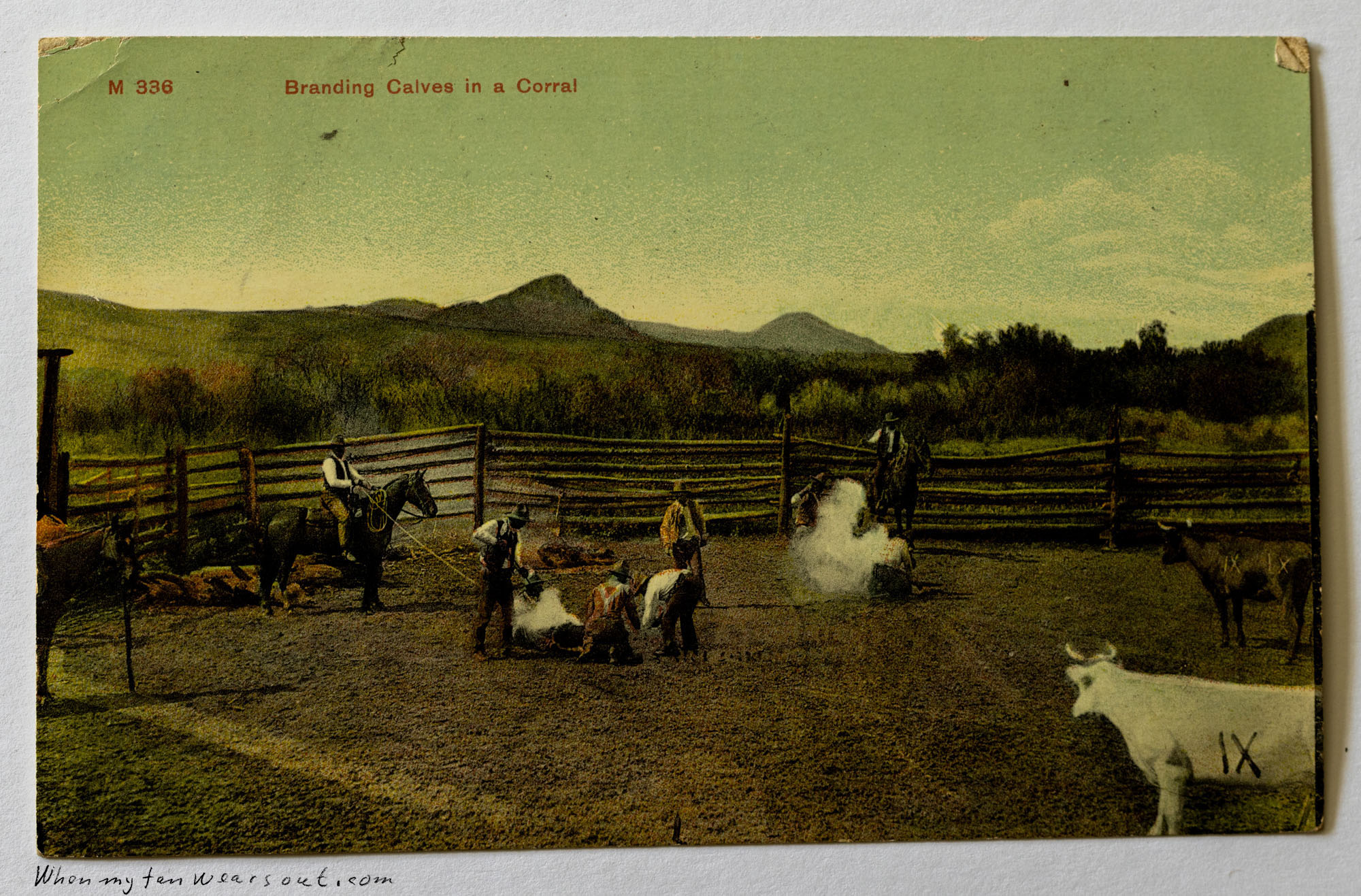
Front — A vintage hand-tinted postcard showing cowboys branding calves in a rustic corral with mountains in the background.
Postcard Metadata
Postmarked: Chinook, Montana — August 26, 1910
Sent From: Chinook, Montana
Sent To: Miss Pearle Byers, Carthage, Hancock Co., Ill.
Distance Traveled: Approximately 1,350 miles
Postage: One Cent U.S. Postage, Benjamin Franklin stamp (green)
Card Details: Divided Back, Printed in Germany. Photo Copyright by Chas. E. Morris.
Back — Correspondence from Martha to Miss Pearle Byers
Transcription
Dear Kid. well I like that you tell me to write when I’ve written you long ago. Just get busy now and drop me a line. Am very busy just now as I have the debumaker here. Weather just like summer here. I got your card some time ago. How are the boys? So your going to get married? Well I hope to get an invitation. will do likewise well I hadnt be good to your self. If I don’t hear from you soon will write. Loving by Martha.
Historical & Family Notes
This postcard offers a glimpse into Pearle Byers’ life before her marriage to Harvey Sights, hinting at the social expectations and personal developments of the era. Martha’s lighthearted yet direct inquiry about Pearle “getting married” suggests that Pearle was of marrying age and that such news might have been anticipated or rumored within their social circle, setting a significant context for her eventual union.
The message from Chinook, Montana, contrasts sharply with the rustic ranching scene on the card’s front, demonstrating the widespread use of postcards for maintaining distant friendships across vast American landscapes. While the card doesn’t mention Harvey directly, it frames Pearle’s life at a pivotal time when discussions of marriage would have been common, providing a subtle precursor to her future with Harvey.
The sender, Martha, playfully chides Pearle for not writing back sooner, indicating a close, informal relationship. Her closing remarks, “well I hadnt be good to your self. If I don’t hear from you soon will write,” reinforce the bond and the casual but consistent nature of their correspondence, a testament to the role postcards played in connecting people across vast distances in the early 20th century.
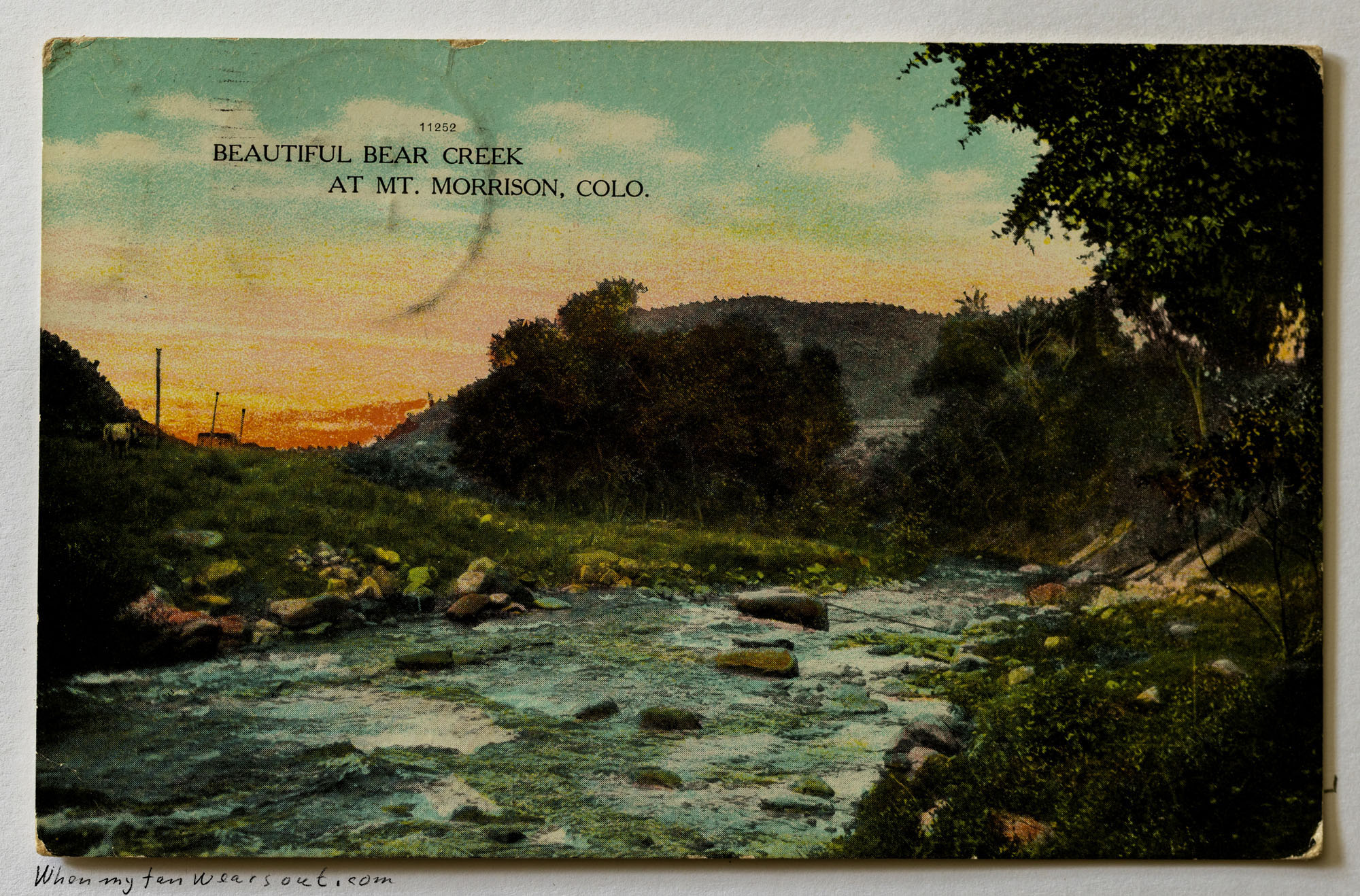
Front — A hand-colored scenic view of Bear Creek flowing through a mountainous landscape at sunset in Mt. Morrison, Colorado.
Postcard Metadata
Postmarked: Denver, Colo. — August 1, 1919
Sent From: Denver, Colorado
Sent To: Miss Pearl Byers Carthage Ill.
Distance Traveled: ~880 miles
Postage: One Cent George Washington U.S. Postage stamp
Card Details: Divided Back Era (1907-present), Published by Great Western Post Card and Novelty Co., Denver, Colo.
Back — Correspondence from Harvey Sights to Miss Pearl Byers
Transcription
Remember the 1st time I said these words to Pearl? Here goes. Cola interested? Well, I guess so! – $ 7/27/19 H.S.S.
Historical & Family Notes
This postcard captures an early moment of playful flirtation between Harvey Sights and Pearl Byers. Harvey is likely in Colorado, sending this scenic view of Bear Creek, Mt. Morrison. His message, “Cola interested? Well, I guess so!”, cleverly abbreviates “Colorado” and implies an ongoing inside joke or conversation they’ve had about the state, or perhaps about him visiting. The phrase “Remember the 1st time I said these words to Pearl?” further solidifies the intimacy of their burgeoning relationship, hinting at a shared memory or a significant romantic declaration.
Sent just before their eventual marriage, this postcard serves as a sweet testament to the lighthearted yet meaningful communication that characterized their courtship. Harvey’s hopeful response to his own question, “Well, I guess so!”, suggests his deep desire for Pearl to share in his interests or to join him on his adventures. This early exchange paints a vivid picture of the personal bond that would soon lead to their lifelong partnership and the foundation of their family.
The date “$ 7/27/19” written above his initials “H.S.S.” indicates he wrote the card a few days before it was postmarked, a common practice when traveling, giving us a precise timeline of his thoughts leading up to its dispatch.
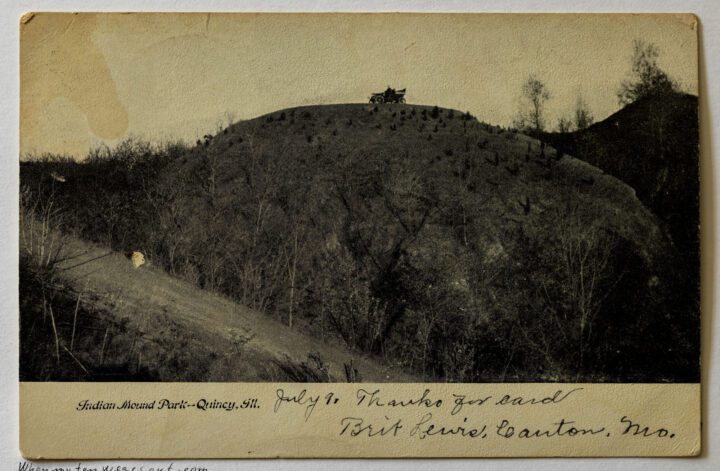
Front — A sepia-toned image shows a dirt road winding up a large, tree-covered Indian Mound with an early automobile parked on top.
Postcard Metadata
Postmarked: Carthage, Illinois — July 19, 1916
Sent From: Canton, Missouri
Sent To: Miss Pearl Byers, Carthage, Ill.
Distance Traveled: Approximately 32 miles
Postage: US 1-cent green Benjamin Franklin stamp (Scott #405)
Card Details: Divided Back era (post-1907)
Back — Correspondence from Brit Lewis to Miss Pearl Byers
Transcription
Indian Mound Park – Quincy, Ill. July 19. Thanks for card. Brit Lewis, Canton, Mo.
Historical & Family Notes
This early postcard sent to Pearl Byers by Brit Lewis captures a glimpse into her life before she met Harvey Sights. While the sender is not Harvey, the card establishes Pearl’s residence in Carthage, Illinois, a setting that would be central to her early adult life. The image of Indian Mound Park in Quincy, a nearby city, illustrates a regional landmark and popular destination, hinting at the shared experiences and local scenery common to young people in the Midwest at the time.
The casual nature of the message, “Thanks for card,” suggests an ongoing correspondence, painting a picture of Pearl’s social circle and the common practice of exchanging postcards to stay in touch. This card, dated July 19, 1916, precedes Pearl’s eventual marriage to Harvey Sights, offering a historical marker of her life during a period of significant social and technological change, reflected in the early automobile atop the mound.
Although a simple note, the postcard adds to the fabric of Pearl’s story, documenting her connections and the daily exchanges that shaped her world before the central chapter of her life with Harvey began. It grounds her in her community and time, showcasing the widespread use of postcards as a primary mode of communication for personal greetings and sharing visual experiences.