
Postcard #0058: Casual Greetings from Indian Mound Park, Quincy


A vintage, hand-tinted postcard showing a verdant landscape of Indian Mound Park in Quincy, Illinois, with rolling grassy hills, a prominent mound with steps, and scattered trees under a light sky, overlooking the distant Mississippi River.
Front — A hand-tinted postcard featuring a scenic view of Indian Mound Park in Quincy, Illinois, overlooking the Mississippi River.

Postcard Metadata


The back of a 1908 divided-back postcard with a green one-cent U.S. Franklin stamp, featuring a handwritten message in dark blue ink from
Back — Correspondence from Elva to Miss Pearl Byers

Transcription

Hello kids! Got here p.m. sound. Have a dandy room. Will have to write before long. Elva 438 N. 8th st.

Historical & Family Notes

This postcard offers a glimpse into Pearl Byers’ social circle before her eventual marriage to Harvey Sights. The sender, Elva, is likely a friend or relative, providing a quick update from Quincy, Illinois. The casual tone and simple message, “Hello kids! Got here p.m. sound. Have a dandy room,” reflect the common use of postcards for brief, informal communication in the early 20th century, a time when such exchanges were cherished links between distant friends and family.

The card’s front depicts Indian Mound Park in Quincy, a notable local landmark with its historic earthworks and scenic views of the Mississippi River. Such picturesque views were popular subjects for postcards, allowing senders to share a bit of their travels or local attractions with recipients back home. Even a relatively short trip to a nearby town like Quincy would have been an occasion worth noting and sharing with friends like Pearl in Carthage.

While Harvey Sights isn’t directly mentioned in this particular correspondence, this postcard beautifully illustrates the rich tapestry of relationships Pearl maintained. These frequent, small exchanges kept her connected to a broad community of friends and family, forming the supportive network that would surround her as she eventually married Harvey and started her own family, enriching the Sights’ family legacy.
Continue Reading

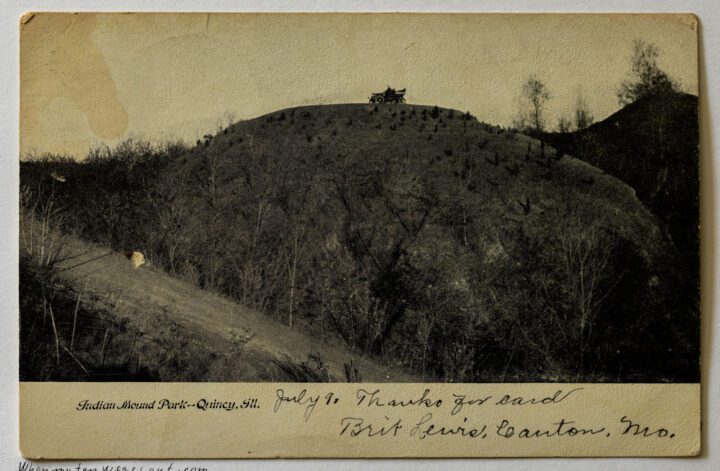
Postcard #001: Thanks from Indian Mound Park, Quincy


Sepia-toned postcard depicting Indian Mound Park in Quincy, Illinois, with an early 20th-century automobile parked on the summit of a tree-covered mound, overlooking a forested landscape.
Front — A sepia-toned image shows a dirt road winding up a large, tree-covered Indian Mound with an early automobile parked on top.

Postcard Metadata


Handwritten postcard back with a personal message dated July 19 from Brit Lewis in Canton, Missouri, to Miss Pearl Byers in Carthage, Illinois, postmarked Carthage, IL, July 19, 1916, with a one-cent Benjamin Franklin stamp.
Back — Correspondence from Brit Lewis to Miss Pearl Byers

Transcription

Indian Mound Park – Quincy, Ill. July 19. Thanks for card. Brit Lewis, Canton, Mo.

Historical & Family Notes

This early postcard sent to Pearl Byers by Brit Lewis captures a glimpse into her life before she met Harvey Sights. While the sender is not Harvey, the card establishes Pearl’s residence in Carthage, Illinois, a setting that would be central to her early adult life. The image of Indian Mound Park in Quincy, a nearby city, illustrates a regional landmark and popular destination, hinting at the shared experiences and local scenery common to young people in the Midwest at the time.

The casual nature of the message, “Thanks for card,” suggests an ongoing correspondence, painting a picture of Pearl’s social circle and the common practice of exchanging postcards to stay in touch. This card, dated July 19, 1916, precedes Pearl’s eventual marriage to Harvey Sights, offering a historical marker of her life during a period of significant social and technological change, reflected in the early automobile atop the mound.

Although a simple note, the postcard adds to the fabric of Pearl’s story, documenting her connections and the daily exchanges that shaped her world before the central chapter of her life with Harvey began. It grounds her in her community and time, showcasing the widespread use of postcards as a primary mode of communication for personal greetings and sharing visual experiences.

Continue Reading