Front — A group of store employees or proprietors pose with a display case of umbrellas.
Postcard Metadata
Postmarked: Not Visible
Sent From: None
Sent To: None
Distance Traveled: None
Postage: Not visible (no stamp)
Card Details: Divided Back, Real Photo Postcard (RPPC) with “A Z O” stamp box (circa 1907-1920s).
Back — A list of names
Transcription
Fred Peasley Waldo Mason Miss Erbroidt Miss Osborn Tom Roberts Carrie Campbell Maude Biggs Mabel Roberto
Mason Dry Goods Store, La Harpe
Historical & Family Notes
This charming real photo postcard, likely dating to the early 20th century, captures a slice of small-town commerce, possibly the very store where Harvey Sights worked or visited. The image presents a bustling scene with employees, a counter, and umbrellas for sale, suggesting a dry goods or department store.
Front — A view of the Chanute Public Library in Chanute, Kansas, with a handwritten note “Miss Pearl 3.5.08” at the top.
Postcard Metadata
Postmarked: Chanute, Kansas — November 23, 1907
Sent From: Chanute, Kansas
Sent To: Miss Pearl Byers Carthage Ill.
Distance Traveled: Approximately 410 miles
Postage: One Cent U.S. Franklin stamp, green
Card Details: Divided Back Era (1907-1915)
Back — Correspondence from Harvey Sights to Miss Pearl Byers
Transcription
Dear Pearl, Was glad to hear from you. We are having nice weather here this week. Had a good rain yesterday. I wish I was there to spend my birthday with you. Your Harvey
Historical & Family Notes
In this heartfelt message, Harvey Sights sends an early birthday wish to Pearl Byers, lamenting his absence for her December 4th celebration. The postcard, postmarked November 23, 1907, captures the anticipation of Pearl’s special day from afar, as Harvey expresses his desire to be with her. The front of the card depicts the Chanute Public Library in Kansas, where Harvey was at the time, offering a glimpse into the locale from which he sent his affections.
This card perfectly illustrates the challenges of courtship across distances in the early 20th century, relying on the postal service to bridge the miles between Chanute, Kansas, and Carthage, Illinois. The sentiment “I wish I was there to spend my birthday with you” speaks volumes about the growing bond between Harvey and Pearl, hinting at the romantic connection that would eventually lead to their marriage.
The small, handwritten note “Miss Pearl 3.5.08” on the front of the postcard appears to be a later annotation, possibly by Pearl herself or a collector, indicating a date that doesn’t align with the 1907 postmark but might mark a significant memory associated with the card. It further solidifies the postcard’s personal significance within Pearl’s collection.
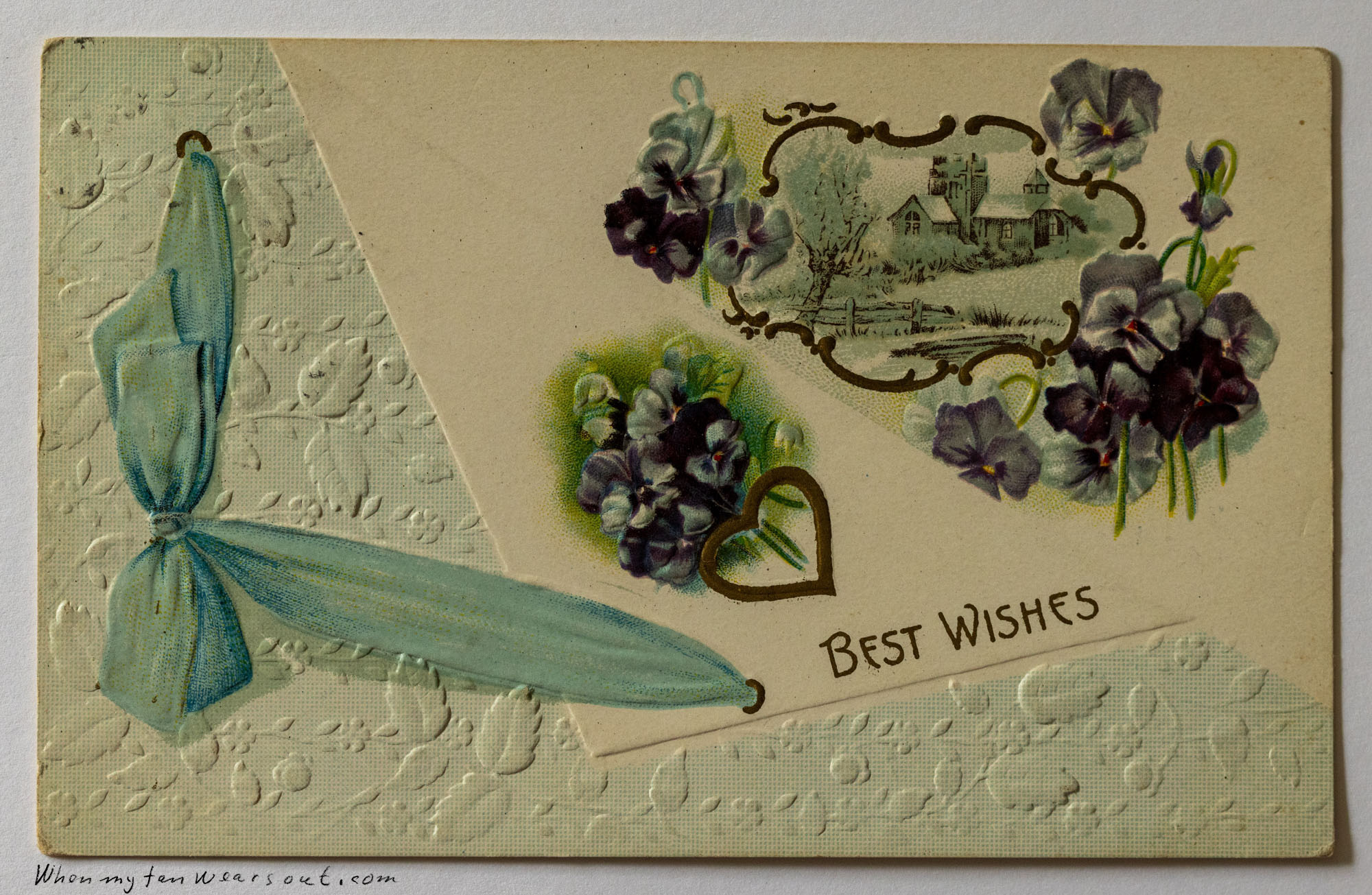
Front — A “Best Wishes” postcard featuring purple pansies, an embossed blue ribbon, and a framed rural farm scene.
Postcard Metadata
Postmarked: Carthage, Illinois — September 7, 1909
Sent From: Carthage, Illinois
Sent To: Mr. Harvey Sights, La Harpe Ill
Distance Traveled: Approximately 16 miles
Postage: U.S. Postage, One Cent (George Washington portrait)
Card Details: Divided Back postcard, popular from 1907 onwards, featuring embossed details.
Back — Correspondence from E.P.B. (Pearl Byers) to Harvey Sights
Transcription
Carthage Ill. Sept. 7-09. Rec’d card this morning as I came to work. Thanks “awfully.” It is dandy. E.P.B. Mr. Harvey Sights La Harpe Ill
Historical & Family Notes
This postcard offers a charming glimpse into the early courtship between Pearl Byers and Harvey Sights. Pearl, writing from Carthage, Illinois, expresses her thanks to Harvey for a card she received earlier that morning, playfully stating it was “dandy.” This exchange highlights their regular correspondence despite living a mere sixteen miles apart, indicating a blossoming romance through the daily ritual of postcard mail.
The sender’s initials “E.P.B.” are almost certainly Pearl Byers, aligning with the family’s identity rules and the ongoing narrative of their relationship. The card was sent on September 7, 1909, a significant period in their courtship before their eventual marriage and the birth of their daughter, Marnelle.
The message’s casual and affectionate tone—”Thanks ‘awfully'”—suggests a comfort and familiarity between Pearl and Harvey, showcasing a delightful snapshot of their everyday interactions and the simple pleasures of receiving mail from a loved one in the early 20th century.
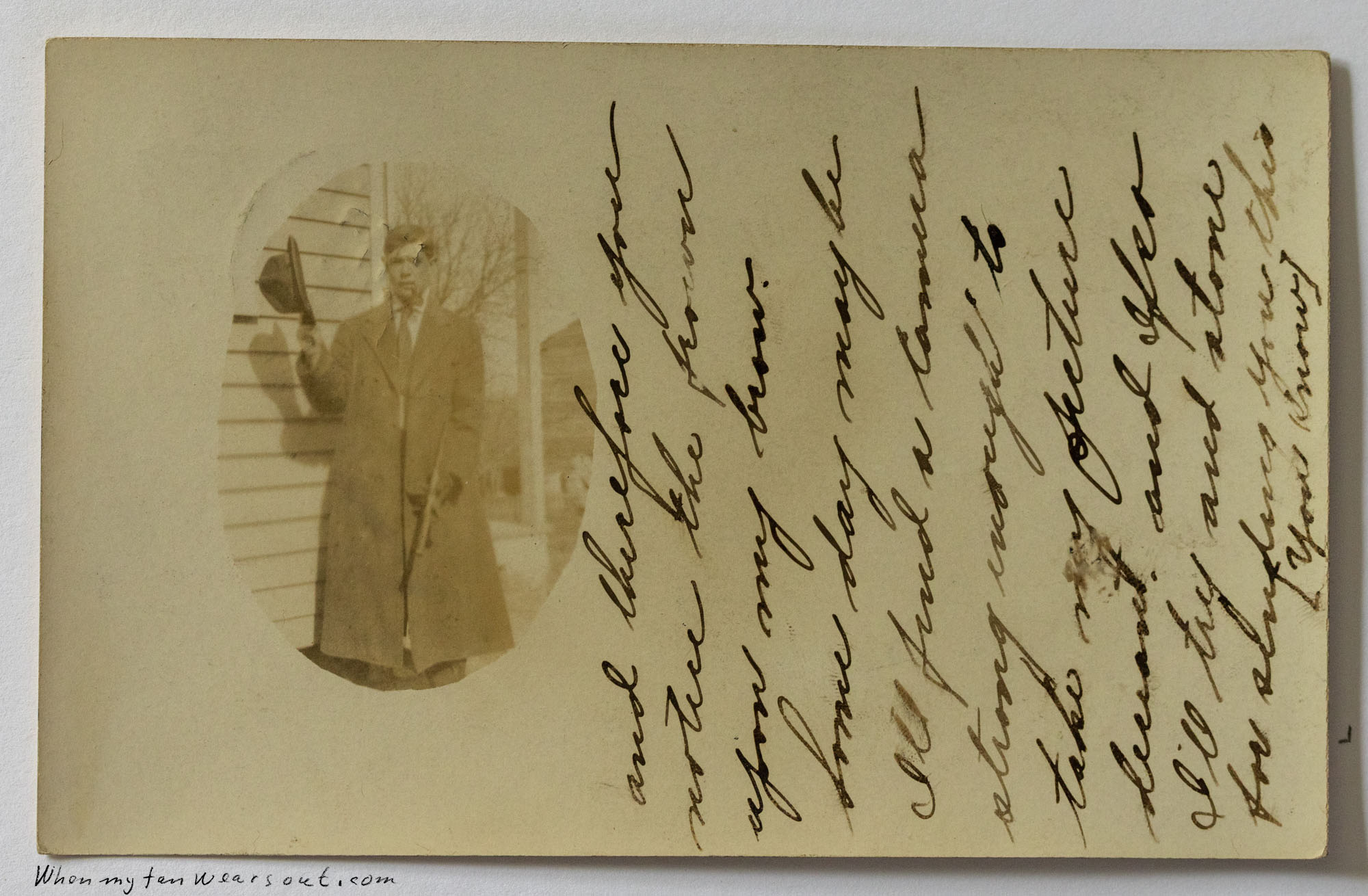
Front — Oval photographic insert featuring a young man in a long coat and hat standing on a porch, with bare trees in the background, next to a handwritten message.
Postcard Metadata
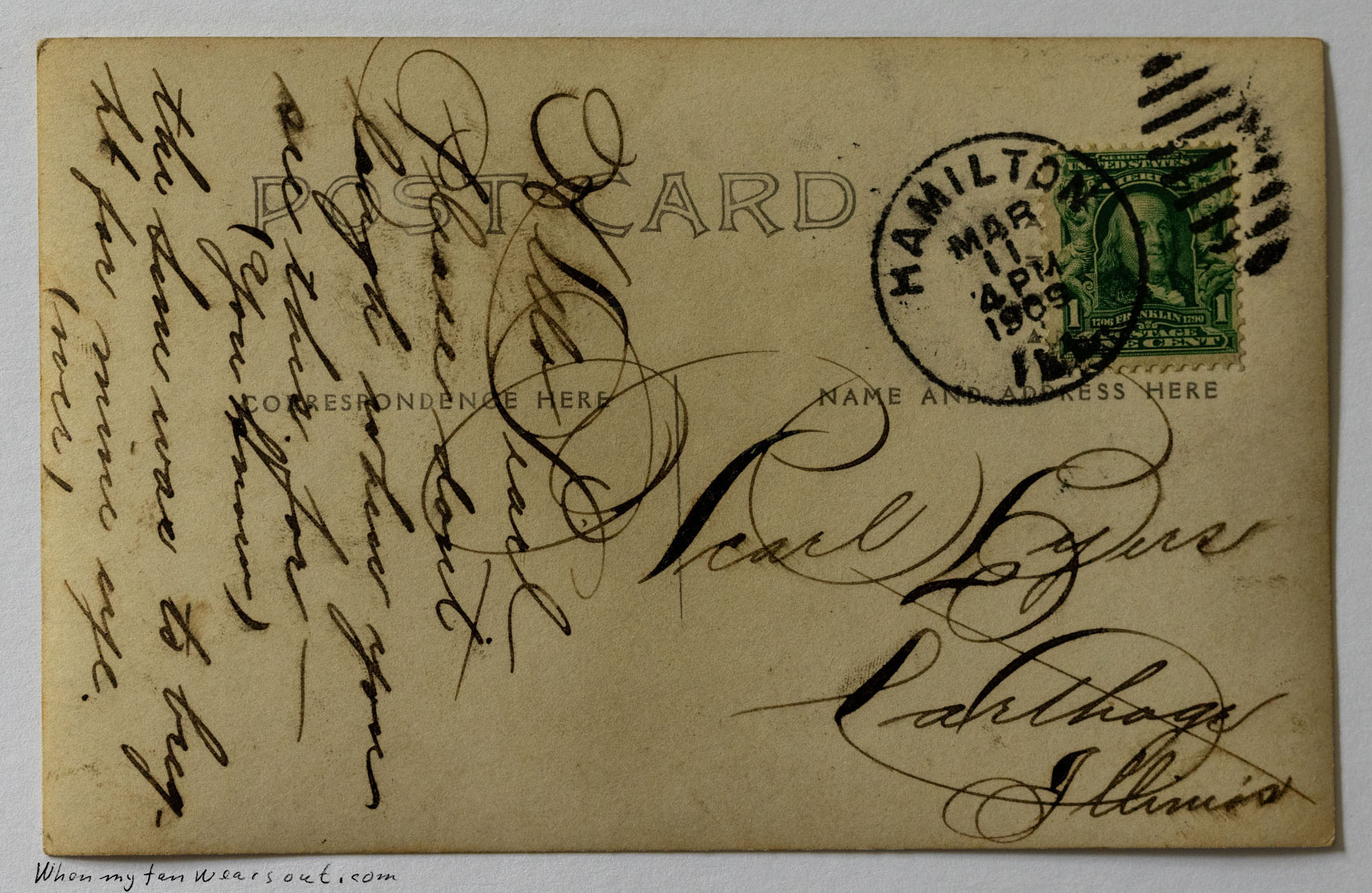
Postmarked: Hamilton, Illinois — March 11, 1909
Sent From: Hamilton, Illinois
Sent To: Miss Pearl Byers, Carthage, Illinois
Distance Traveled: Approximately 18 miles
Postage: One Cent U.S. Postage, Franklin profile (green stamp)
Card Details: Divided Back era (1907-1915)
Back — Correspondence from Harvey Sights to Pearl Byers
Transcription
and that is free and the broom since my May be I will find a camera along with me to take my picture I will try and after this for bring you to the dear your Bery Dear Pearl This leaves me very lonesome this after[text obscured by POST CARD graphic] Harvey
Historical & Family Notes
This postcard, sent by a young Harvey Sights to Pearl Byers, serves as a poignant artifact of their early courtship. Harvey sends a photographic image of himself, possibly his current appearance, and expresses a wish to either take another picture or visit Pearl, stating “I will try and after this for bring you to the dear.” This indicates his desire to see her and deepen their connection, which was common practice during this era of long-distance romance.
The message on the back, though partially obscured, reveals Harvey’s loneliness, starting with “Dear Pearl This leaves me very lonesome this after[…].” This personal touch underscores the emotional intensity of their correspondence. The relatively short distance between Hamilton and Carthage, Illinois, would have made visits plausible, adding anticipation to Harvey’s promise.
This card is a tender snapshot of their relationship before marriage, showing the efforts Harvey made to stay connected and express his feelings, using the popular medium of postcards to bridge the physical distance between them. The slight ambiguity in the sender’s signature on the front (“Bery”) further highlights the informal and intimate nature of their exchanges.
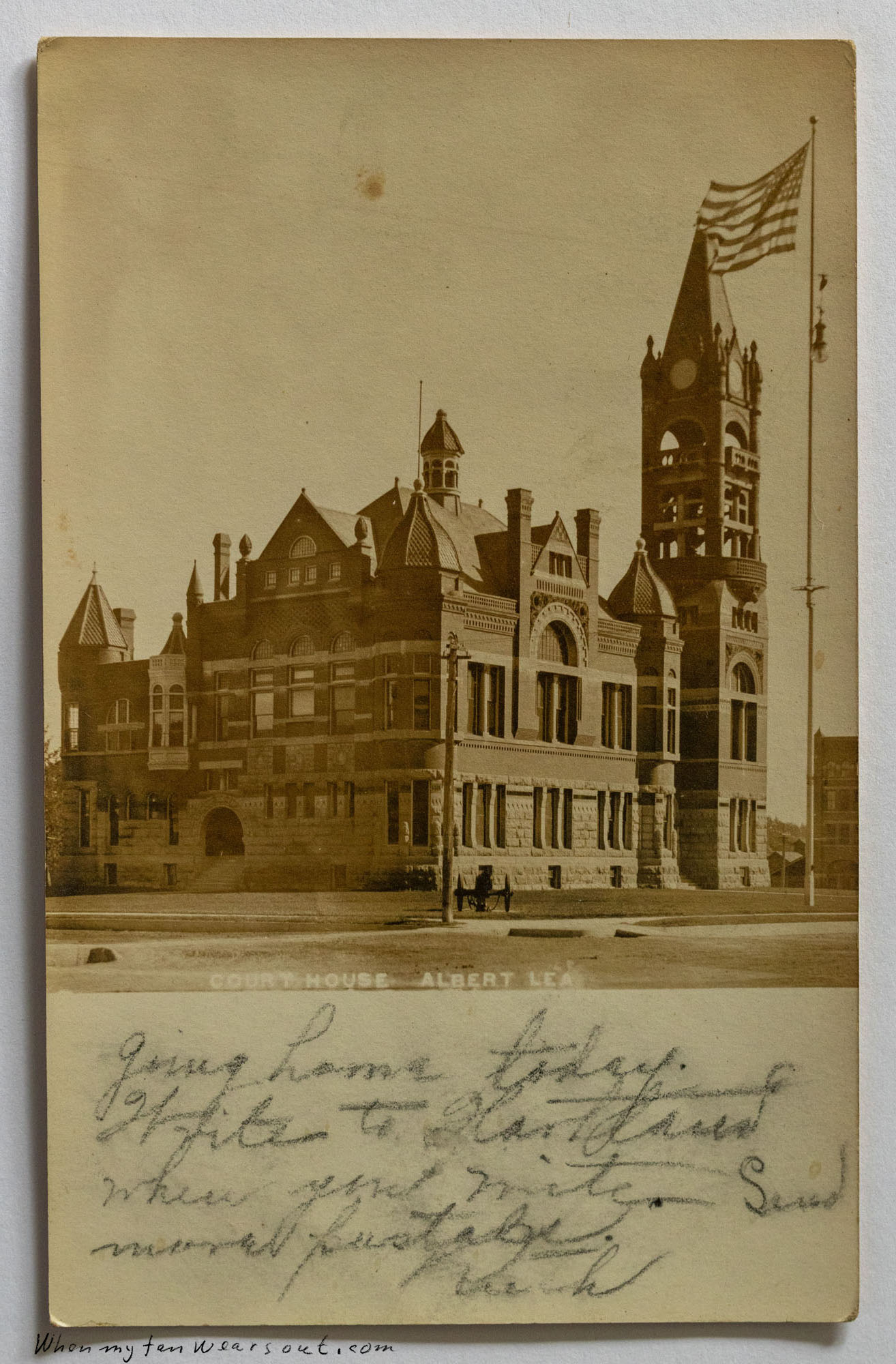
Front — View of the Albert Lea Court House with a prominent clock tower and American flag.
Postcard Metadata
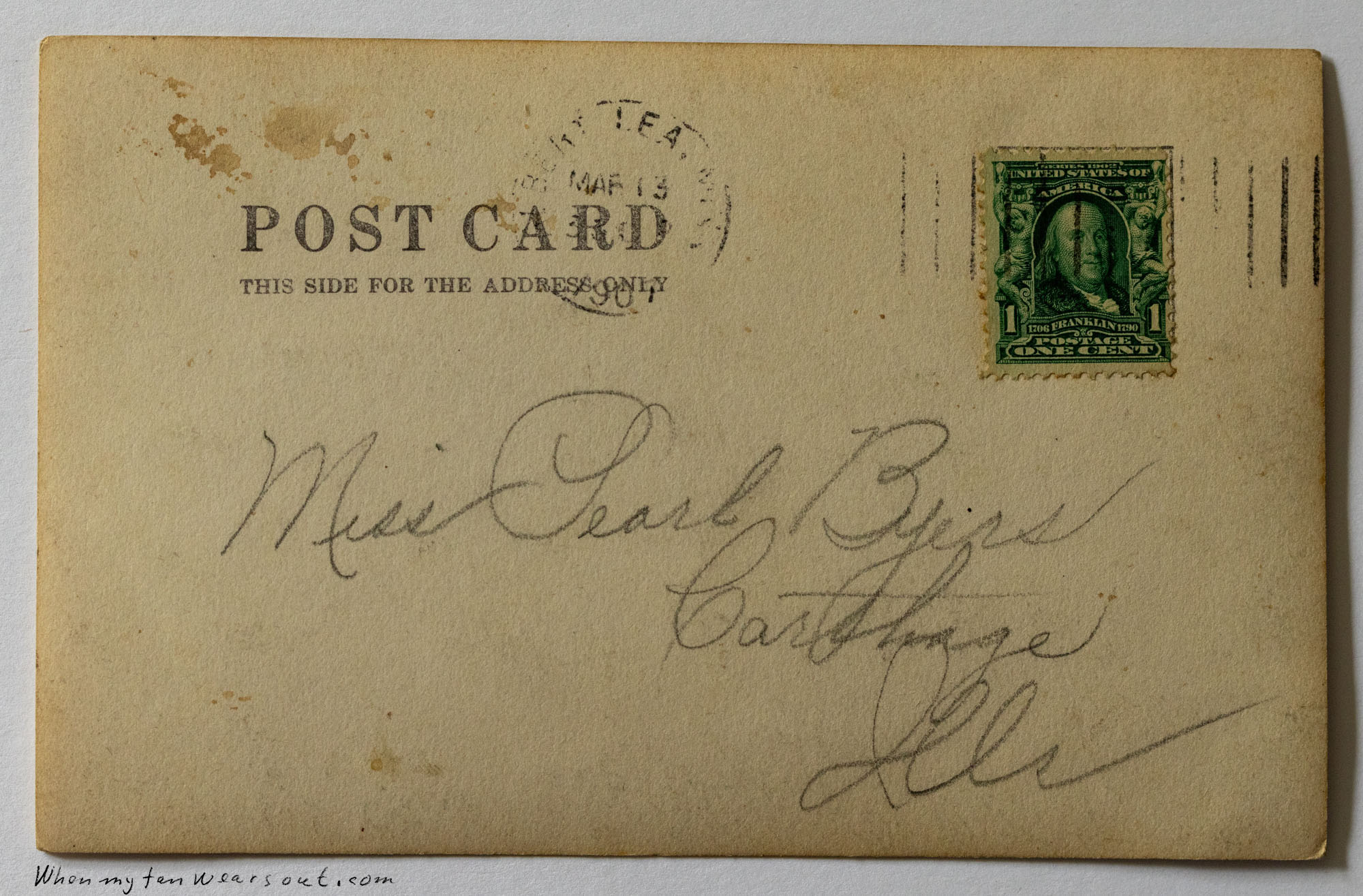
Postmarked: Albert Lea, Minnesota — March 13 (Year not visible, likely post-1907)
Sent From: Albert Lea, Minnesota
Sent To: Miss Pearl Byers, 318 N. Fayette Street, Carthage, Illinois
Distance Traveled: Approximately 390 miles
Postage: 1 Cent U.S. Postage (Benjamin Franklin, green stamp)
Card Details: Divided Back Era (Introduced March 1, 1907)
Back — Correspondence from Harvey Sights to Miss Pearl Byers
Transcription
Going home today. Expect to start from when you get my other postcard. Send me all puss.
Historical & Family Notes
This postcard captures a moment of anticipation as Harvey Sights prepares to return home, presumably to Pearl Byers. Sent from Albert Lea, Minnesota, the message “Going home today” signifies the conclusion of his travels or a temporary stay, and the impending reunion with Pearl. The reference to “my other postcard” suggests an ongoing correspondence, a common method of nurturing their relationship across the miles.
The affectionate closing, “Send me all puss,” underscores the tender and playful nature of their courtship. Such personal and informal expressions reveal a deeper intimacy than standard greetings, hinting at the bond that would eventually lead to their marriage and the start of their family. This card is a tangible piece of their unfolding love story, chronicling the small, daily communications that built their connection.
As a historical artifact, the postcard offers a glimpse into early 20th-century communication and travel. The image of the Albert Lea Court House serves as a backdrop to Harvey’s journey, while the simple yet heartfelt message conveys the human experience of longing and return. It’s a testament to the enduring power of written words to bridge distance and maintain personal connections in a time before instant digital communication.
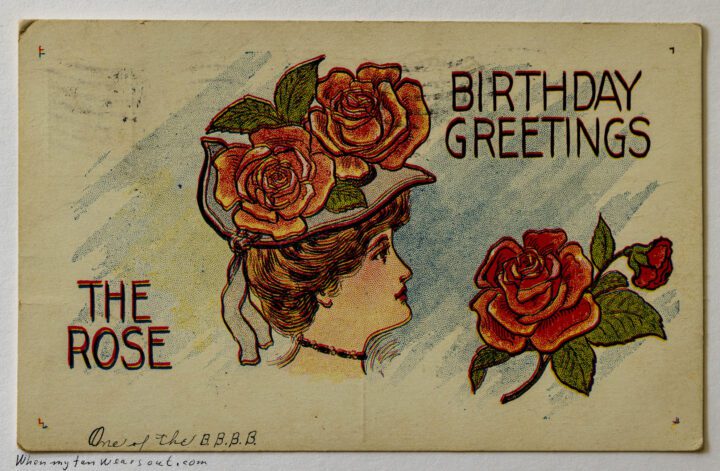
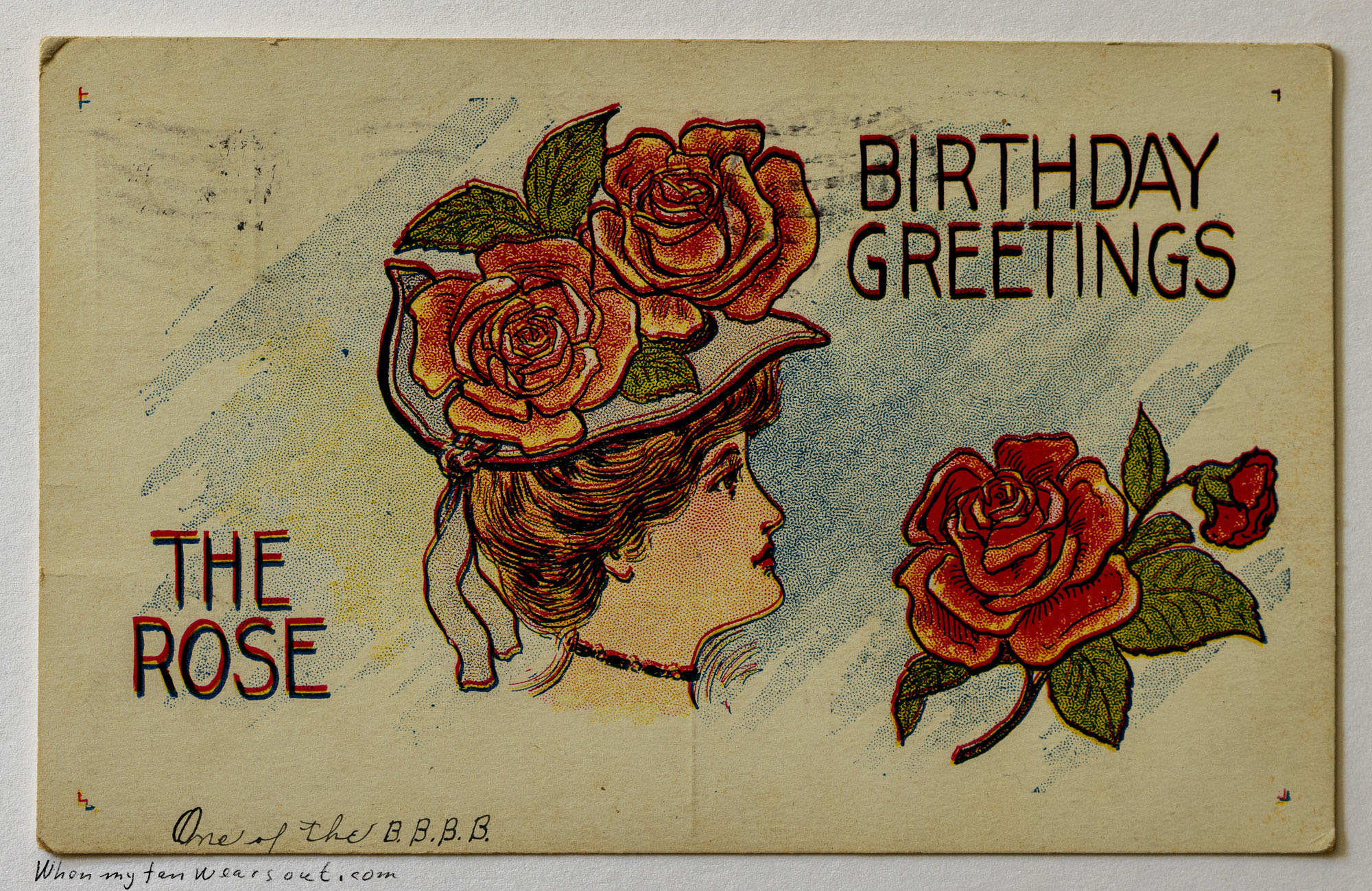
Front — A colorized illustration of a woman in a floral hat featuring roses, with additional roses and the text “THE ROSE” and “BIRTHDAY GREETINGS.”
Postcard Metadata
Postmarked: Quincy, Ill. — December 4, 1907
Sent From: Quincy, Illinois
Sent To: Miss Pearl Byers, Carthage, Ill.
Distance Traveled: Approximately 33 miles
Postage: U.S. Postage One Cent (Benjamin Franklin green stamp)
Card Details: Divided Back era (message on left, address on right, introduced in the U.S. in March 1907)
Back — Correspondence from Harvey Sights to Miss Pearl Byers
Transcription
Dec. 4 / 07 Dear Friend:- I suppose you know who this is from don’t you? Hope you have a happy birthday. As Ever. address H. L. Burling Gem City Business College. Quincy, Ill.
Historical & Family Notes
This charming birthday postcard marks Pearl Byers’ special day, December 4th, 1907, with a playful message from her future husband, Harvey Sights. Though he doesn’t explicitly sign his name, the teasing query, “I suppose you know who this is from don’t you?” is a clear indicator of a budding romance and familiarity. The sender provides the address for “H. L. Burling” at the Gem City Business College in Quincy, Illinois, likely where Harvey was studying or residing, using it as a return address for discretion in their early courtship.
The card itself features “The Rose,” a classic symbol of affection and beauty, perfectly chosen for a birthday greeting to a young woman. The postmark confirms it was sent from Quincy on Pearl’s actual birthday, suggesting a thoughtful and timely gesture. This card offers a sweet glimpse into the early stages of their relationship, highlighting the gentle humor and personal connection that would eventually lead to their marriage.
The reference to “H.L. Burling” at Gem City Business College offers a unique historical tidbit. Many young people, including those from rural areas, attended business colleges in larger towns like Quincy to acquire skills for office work. It’s plausible that Harvey was a student there, making this postcard a testament to both his personal affections and his efforts towards building a future.
Front — A hand-colored photo postcard depicts a couple strolling under a smiling moon with a romantic song lyric.
Postcard Metadata
Postmarked: Colmar, Illinois — March 1908
Sent From: Colmar, Illinois
Sent To: Miss Pearl B. Carthage Illinois
Distance Traveled: ~12 miles
Postage: U.S. Postage One Cent (green George Washington stamp)
Card Details: Divided Back, Photo Postcard, “Illustrated Song Serie No. 142B”, Printed in Germany, Photo only copyrighted 1907 by De Witt C. Wheeler, Lyrics by permission of The York Music Co., New York City.
Back — Correspondence from Harvey Sights to Miss Pearl B.
Transcription
Dear Pearl, How is it you never write to me any more? How are you getting along? I hope you are all well & getting along fine. We are all well. Mr. Sights is with us for a few days. He said to tell you he thinks you are pretty swell. I can tell you he is not a bad fellow in fact I think he is all right. I have just come over to see what kind of a good time you are having. I guess you are having a good time. Tell me what you are doing & how you are getting along. Tell me if you are looking for a young fellow who has a good time for you. What do you think of this, tell me how you think of this. Write to me as soon as you can. Your friend, Harvey Sights.
Historical & Family Notes
This postcard, sent in March 1908, offers a charming glimpse into the early courtship of Pearl Byers and Harvey Sights. The front features a romantic scene of a couple strolling under a smiling moon, accompanied by popular song lyrics of the era, “Everytime you go a strolling / With your lady love, / Mister moon is watching from above.” This sentimental imagery perfectly complements Harvey’s flirtatious message, highlighting the romantic ideals of the time.
Harvey’s message, though a bit playfully convoluted with the reference to “Mr. Sights is with us,” clearly conveys his personal admiration for Pearl. He pointedly asks, “Tell me if you are looking for a young fellow who has a good time for you. What do you think of this, tell me how you think of this,” indicating a direct and earnest pursuit of her affections. Such candid yet sweet overtures were a hallmark of early 20th-century communication, laying the groundwork for many lasting relationships.
This missive from Colmar to Carthage, a short distance across rural Illinois, marks a tender moment in Pearl and Harvey’s romantic journey. It underscores the importance of even small exchanges in fostering deep connections, foreshadowing their eventual marriage and the beginning of their family, including their daughter, Marnelle. The postcard serves as a beautiful testament to the blossoming love between them.
Front — An embossed golden horseshoe framing a rural landscape with forget-me-nots, a clover, and a butterfly, featuring the text “Good Luck AND BEST WISHES.”
Postcard Metadata
Postmarked: Kansas City, MO — September 22, 1903
Sent From: Kansas City, MO
Sent To: Miss Pearl Byers Carthage Ill.
Distance Traveled: Approximately 250 miles
Postage: U.S. Postage, One Cent, green George Washington stamp
Card Details: Undivided Back era (1901-1907), with design copyrighted 1903 by H.W. Connelley.
Back — Correspondence from Harvey Sights to Miss Pearl Byers
Transcription
Dear Pearl How are you? I am well. I saw George Murray and his girl last night. We went to the show, and then went to a party. They are sweethearts aren’t they. I wish you would come over some time. How are you and Chas.? I am at the chancelo and working like I was. My arm is not well. Good bye Love Harvey Sights
Historical & Family Notes
This postcard, sent from Kansas City by Harvey Sights to Pearl Byers in Carthage, Illinois, captures a fleeting moment of early courtship. The “Good Luck” sentiment on the front, while generic, gains a personal touch from Harvey’s longing message. His mention of seeing “George Murray and his girl” at a show and party, followed by the observation, “They are sweethearts aren’t they,” could subtly allude to his own hopes for a similar relationship with Pearl.
Harvey’s casual yet intimate closing, “Love Harvey Sights,” suggests an affectionate bond already forming between the two, despite the distance. His desire for Pearl to “come over some time” clearly expresses a wish for closer connection. The reference to his injured arm (“My arm is not well”) offers a glimpse into his daily life, adding a personal detail that would resonate with Pearl.
The card serves as an early document in Pearl and Harvey’s enduring love story, hinting at the affections that would eventually lead to their marriage and the birth of their daughter, Marnelle. It showcases the charming, informal communication style of the early 20th century, where simple postcards carried heartfelt messages across miles.
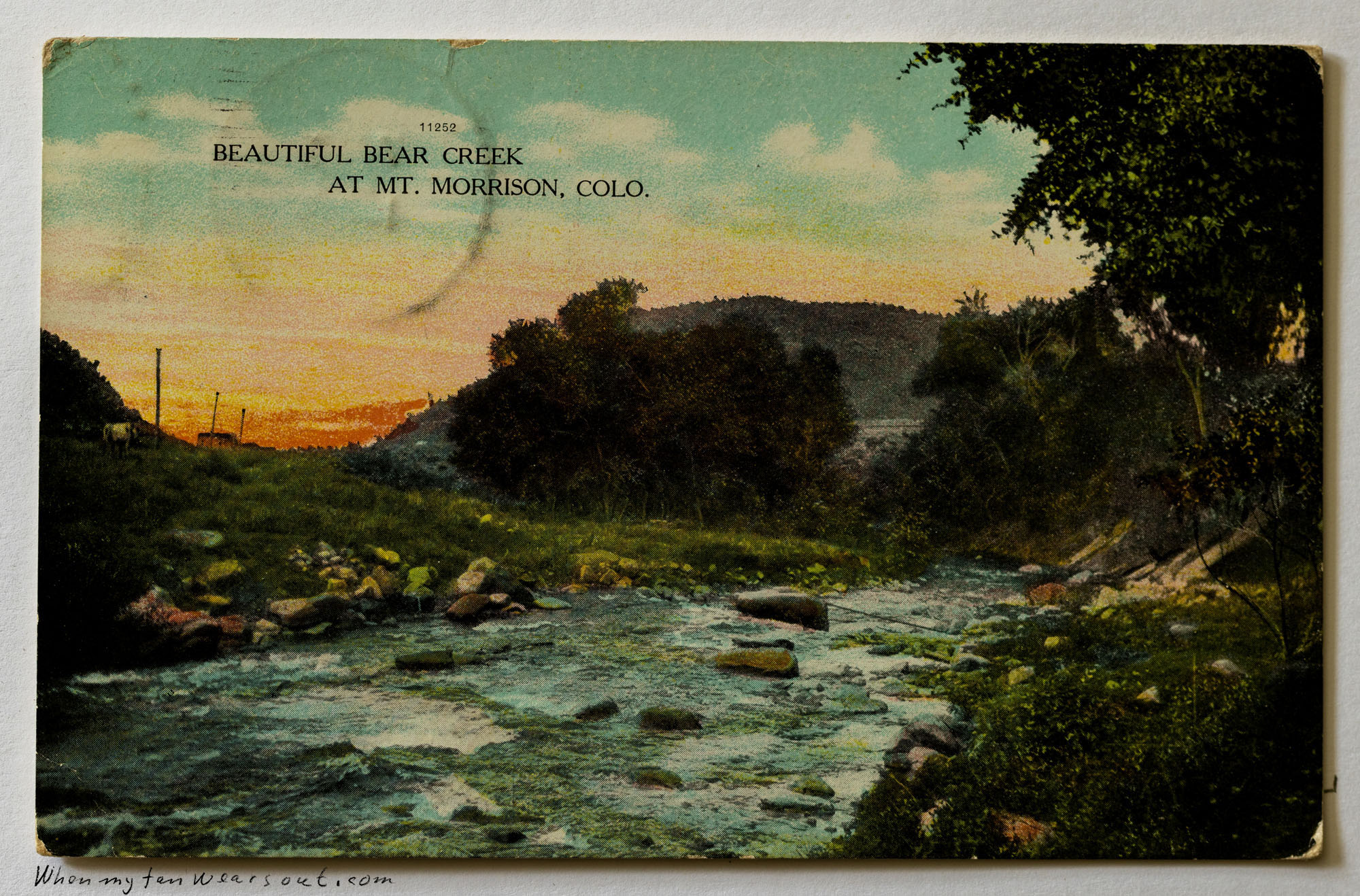
Front — A hand-colored scenic view of Bear Creek flowing through a mountainous landscape at sunset in Mt. Morrison, Colorado.
Postcard Metadata
Postmarked: Denver, Colo. — August 1, 1919
Sent From: Denver, Colorado
Sent To: Miss Pearl Byers Carthage Ill.
Distance Traveled: ~880 miles
Postage: One Cent George Washington U.S. Postage stamp
Card Details: Divided Back Era (1907-present), Published by Great Western Post Card and Novelty Co., Denver, Colo.
Back — Correspondence from Harvey Sights to Miss Pearl Byers
Transcription
Remember the 1st time I said these words to Pearl? Here goes. Cola interested? Well, I guess so! – $ 7/27/19 H.S.S.
Historical & Family Notes
This postcard captures an early moment of playful flirtation between Harvey Sights and Pearl Byers. Harvey is likely in Colorado, sending this scenic view of Bear Creek, Mt. Morrison. His message, “Cola interested? Well, I guess so!”, cleverly abbreviates “Colorado” and implies an ongoing inside joke or conversation they’ve had about the state, or perhaps about him visiting. The phrase “Remember the 1st time I said these words to Pearl?” further solidifies the intimacy of their burgeoning relationship, hinting at a shared memory or a significant romantic declaration.
Sent just before their eventual marriage, this postcard serves as a sweet testament to the lighthearted yet meaningful communication that characterized their courtship. Harvey’s hopeful response to his own question, “Well, I guess so!”, suggests his deep desire for Pearl to share in his interests or to join him on his adventures. This early exchange paints a vivid picture of the personal bond that would soon lead to their lifelong partnership and the foundation of their family.
The date “$ 7/27/19” written above his initials “H.S.S.” indicates he wrote the card a few days before it was postmarked, a common practice when traveling, giving us a precise timeline of his thoughts leading up to its dispatch.
Front — A vintage postcard image of the Galesburg Court House with a prominent clock tower, depicted upside down.
Postcard Metadata
Postmarked: Galesburg, Illinois — August 12, 1903
Sent From: Galesburg, Illinois
Sent To: Miss Pearl Byers Carthage, Ill.
Distance Traveled: Approximately 78 miles
Postage: One Cent U.S. Postage stamp (green, Washington profile)
Card Details: Undivided Back postcard, published for S. H. Knox & Co., Made in U.S.A.
Back — Correspondence from Harvey Sights to Miss Pearl Byers
Transcription
8-11-03 Hello Pear. How is my little girlie. I am having a good time at my work and will be home Sat. by by. Need.
Historical & Family Notes
This early postcard, penned by Harvey Sights to his future wife Pearl Byers, offers a charming glimpse into their courtship in 1903. Sent from Galesburg, Illinois, where Harvey was likely for work or a visit, the message conveys an eagerness to return home to Carthage, underscoring the distance that often separated young sweethearts in the early 20th century. His affectionate salutation, “Hello Pear. How is my little girlie,” clearly demonstrates the intimate and tender nature of their burgeoning relationship.
The card’s front, featuring the impressive Galesburg Court House, serves as a geographical marker for Harvey’s temporary whereabouts, connecting his personal message to a tangible place in the Midwestern landscape. The use of an undivided back postcard, popular prior to 1907, highlights the primary mode of personal correspondence during this era, where brevity and directness were key, much like a quick text message today.
Harvey’s promise to be “home Sat.” and the affectionate “by by” not only signal his imminent return but also suggest a longing for reconnection. These small, daily communications formed the fabric of their long-distance relationship, laying the foundation for their eventual marriage and shared life together. The collection of these postcards traces the romantic journey that defined Pearl and Harvey’s early years.