Postcard #0049: Picnic Trip on the Ocklawaha River, Florida


Black and white postcard image depicting two people in a small rowboat navigating a narrow section of the Ocklawaha River in Florida. The riverbanks are heavily forested with tall cypress trees draped in Spanish moss, creating a dense canopy. The water is calm, reflecting the trees and sky. The printed caption at the bottom reads
A scenic view of two people in a rowboat on the Ocklawaha River, Florida, surrounded by cypress trees draped with Spanish moss.

Postcard Metadata


The undivided back of a vintage postcard featuring a green one-cent Benjamin Franklin postage stamp in the upper right corner. The main postmark reads
Back — Correspondence from Ernest Bligh to Miss Pearle Byers

Transcription

Off for the picnic How would you like this trip— Ernest Bligh.

Historical & Family Notes

This postcard, sent to Pearl Byers in May 1906, offers a glimpse into her social life before her marriage to Harvey Sights. The sender, Ernest Bligh, describes a picnic on the scenic Ocklawaha River in Florida, asking Pearl if she would enjoy such a trip. This suggests a friendly relationship, perhaps a travel companion or an admirer, highlighting Pearl’s wider connections before settling down.

The Ocklawaha River, famous for its lush landscapes and cypress swamps draped in Spanish moss, was a popular tourist destination in the early 20th century. This postcard captures the allure of such natural beauty and the burgeoning trend of travel and leisure, with postcards serving as a common way to share experiences from afar.

While this card is not from Harvey, it enriches Pearl’s personal narrative, painting a picture of a young woman receiving mail from various acquaintances and experiencing life’s adventures, even if vicariously through postcards. The Carthage postmark indicates receipt on the same day as dispatch from Florida, a common yet intriguing postal anomaly for the era, suggesting a rapid journey or perhaps a timestamp discrepancy.

Continue Reading

Postcard #0042: Niagara Falls Greetings to “Fine Pearl”


Vintage postcard showing the American Falls at Niagara Falls, New York, with a large steel arch bridge spanning the Niagara River above the falls. Mist rises from the powerful waterfall, and a few small figures of people are visible on a pathway on Goat Island in the foreground. The image has a sepia tone, indicative of early 20th-century photography.
Front — A scenic view of the American Falls at Niagara Falls, New York, with the Upper Steel Arch Bridge and tourists on Goat Island.

Postcard Metadata


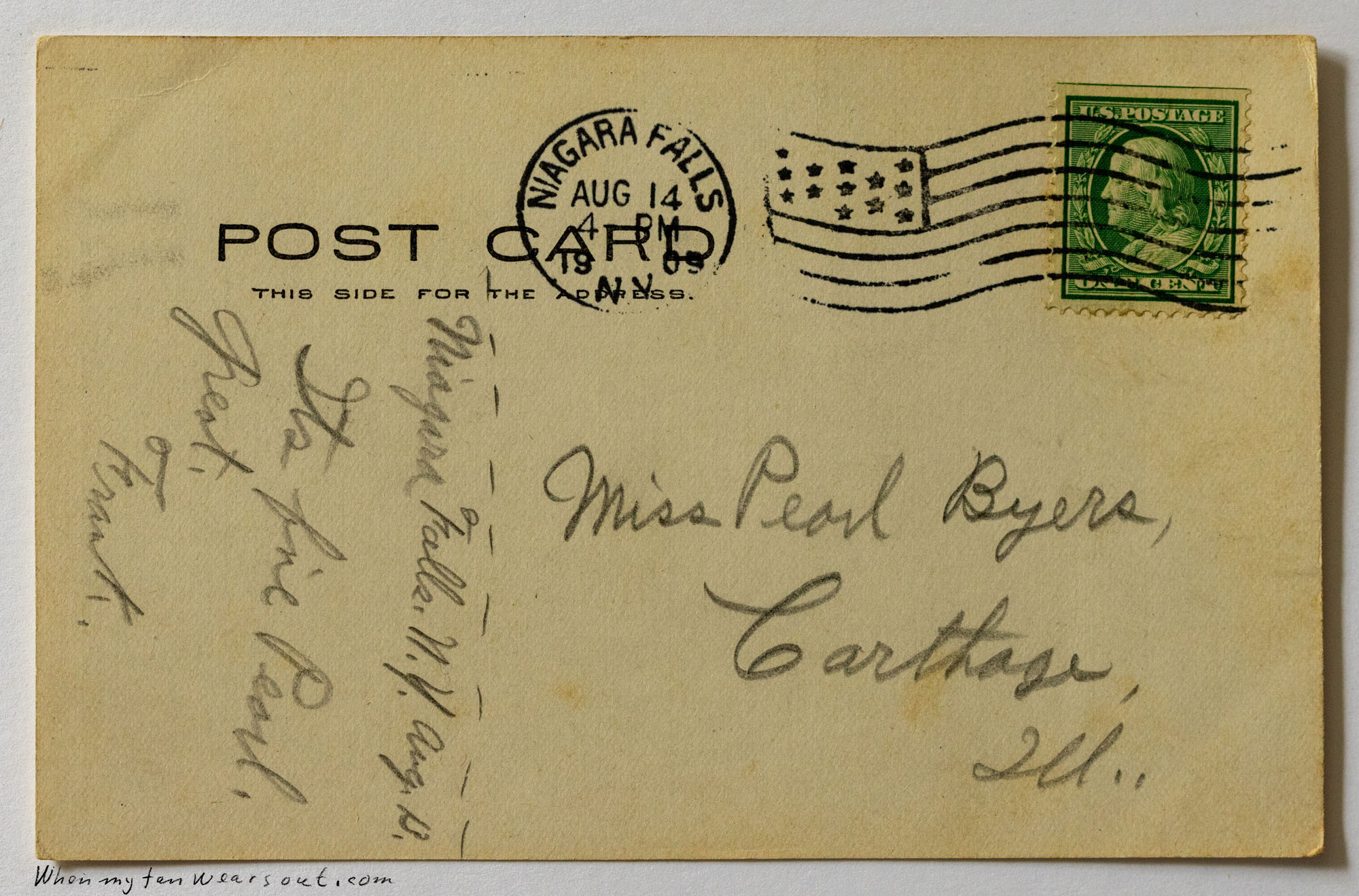
The back of a vintage postcard featuring a divided back for message and address. Handwriting in cursive reads
Back — Correspondence from Frank to Miss Pearl Byers

Transcription

Niagara Falls, N.Y. Aug. 14. To fine Pearl, Great. Frank.

Historical & Family Notes

This postcard from Niagara Falls to Miss Pearl Byers in Carthage, Illinois, provides a glimpse into Pearl’s social circle before her eventual marriage to Harvey Sights. Sent by a sender simply identified as “Frank” on August 14, 1909, the brief message, “To fine Pearl, Great,” suggests a casual yet warm acquaintance. Niagara Falls, then as now, was a quintessential destination for scenic wonder, often associated with romantic getaways and honeymoons, though Pearl was still a young, unmarried woman at the time of this correspondence.

The simplicity of the message, a common characteristic of early 20th-century postcards, doesn’t reveal the nature of Pearl’s relationship with Frank. He could be a friend, a family member, or perhaps even a suitor before Harvey Sights entered her life more prominently. Regardless, the card serves as a charming piece of ephemera, documenting a moment in time when Pearl was receiving greetings from various individuals and locations, contributing to the rich tapestry of her personal history.

Continue Reading

Postcard #0025: Greetings from Hannibal’s Grand Cruikshank Residence


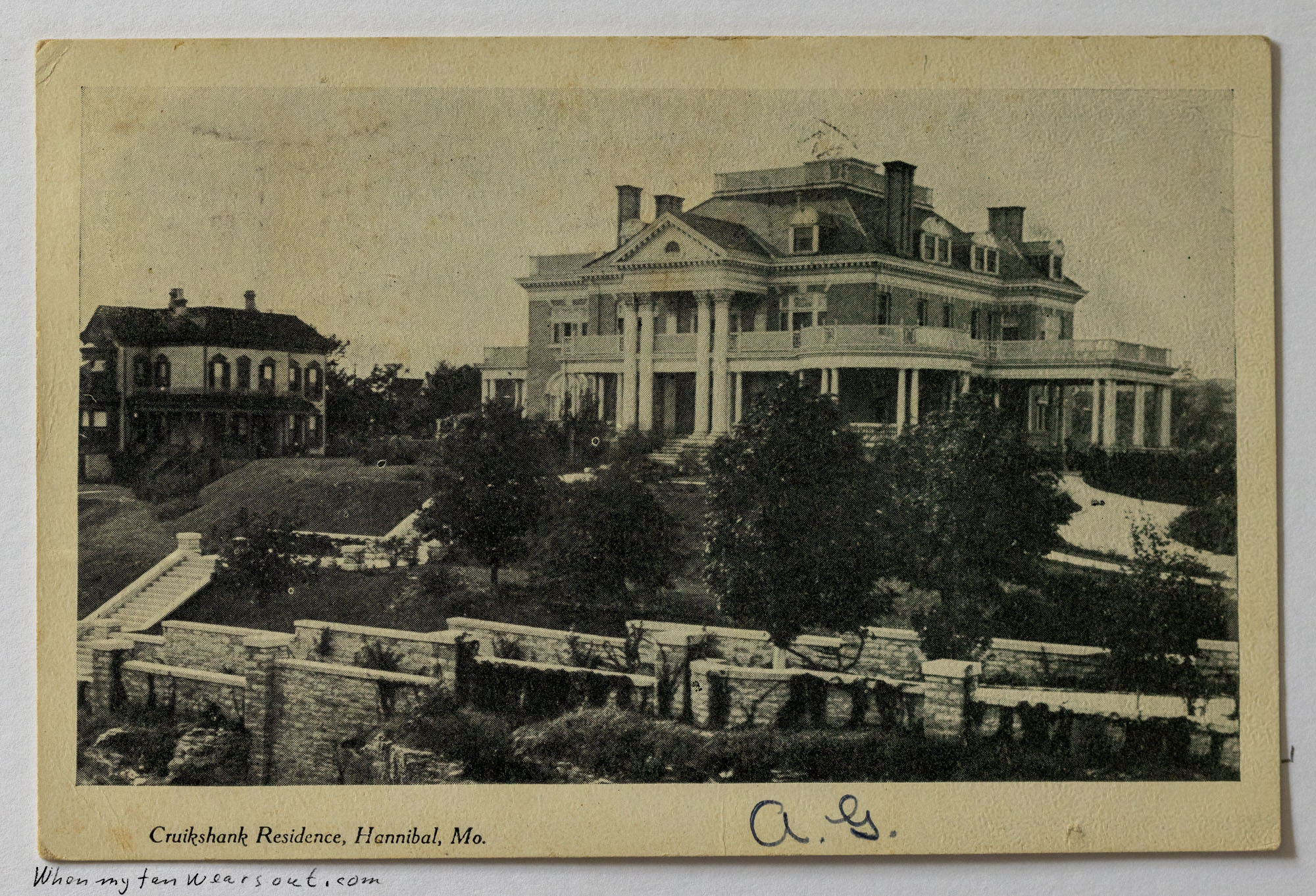
A vintage postcard depicting the large, three-story Cruikshank Residence in Hannibal, Missouri, featuring classical columns, multiple porches, and a grand entrance. A smaller, two-story house stands to the left. The foreground shows a stone wall and landscaped terracing with a set of stairs. The sky is hazy. Below the image,
Front — A large, stately Cruikshank Residence mansion with a smaller house beside it, surrounded by manicured grounds.

Postcard Metadata


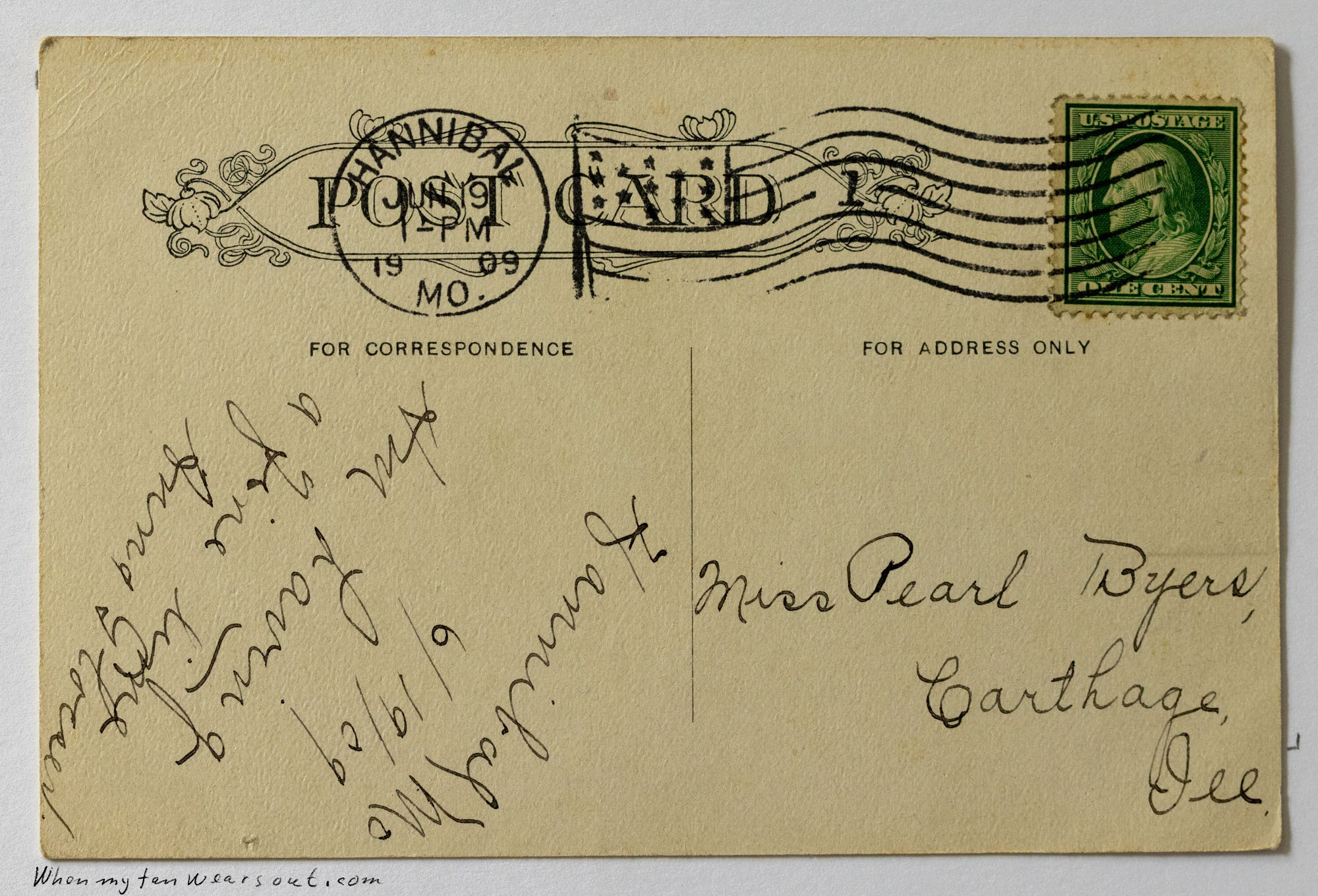
The back of a vintage postcard with a
Back — Correspondence from Lavina Byrd to Miss Pearl Byers

Transcription

Am from Hannibal, Mo. 9/10/09 a fine time. Lavina Byrd. Miss Pearl Byers, Carthage, Ill.

Historical & Family Notes

This postcard offers a charming glimpse into Pearl Byers’ social life in 1909, years before her eventual marriage to Harvey Sights. Sent by her friend Lavina Byrd from Hannibal, Missouri—a city famously associated with Mark Twain and its Mississippi River heritage—it captures a simple update of enjoying a “fine time” during a visit. The image of the grand Cruikshank Residence speaks to the architectural prosperity of the era and the types of impressive landmarks travelers would share with friends back home.

The brief message reflects the common use of postcards for quick social connections, serving as a tangible record of Pearl’s friendships and daily interactions. These snippets from her past provide valuable context for her life before and during her early courtship, illustrating the social landscape she navigated as a young woman in the early 20th century. While Harvey Sights is not mentioned, this card rounds out the picture of Pearl’s world, highlighting her network of friends and their shared experiences.

The card’s details, from the postmark date of September 9, 1909, to the one-cent postage, are authentic markers of its time. It’s a small, personal artifact that connects Pearl to a broader historical moment, showcasing how friendships were maintained through the simple act of sending a picture and a few words across the Midwestern landscape.

Continue Reading

Postcard #0021: Lebanon Kansas Main Street and a Rainy Journey Home


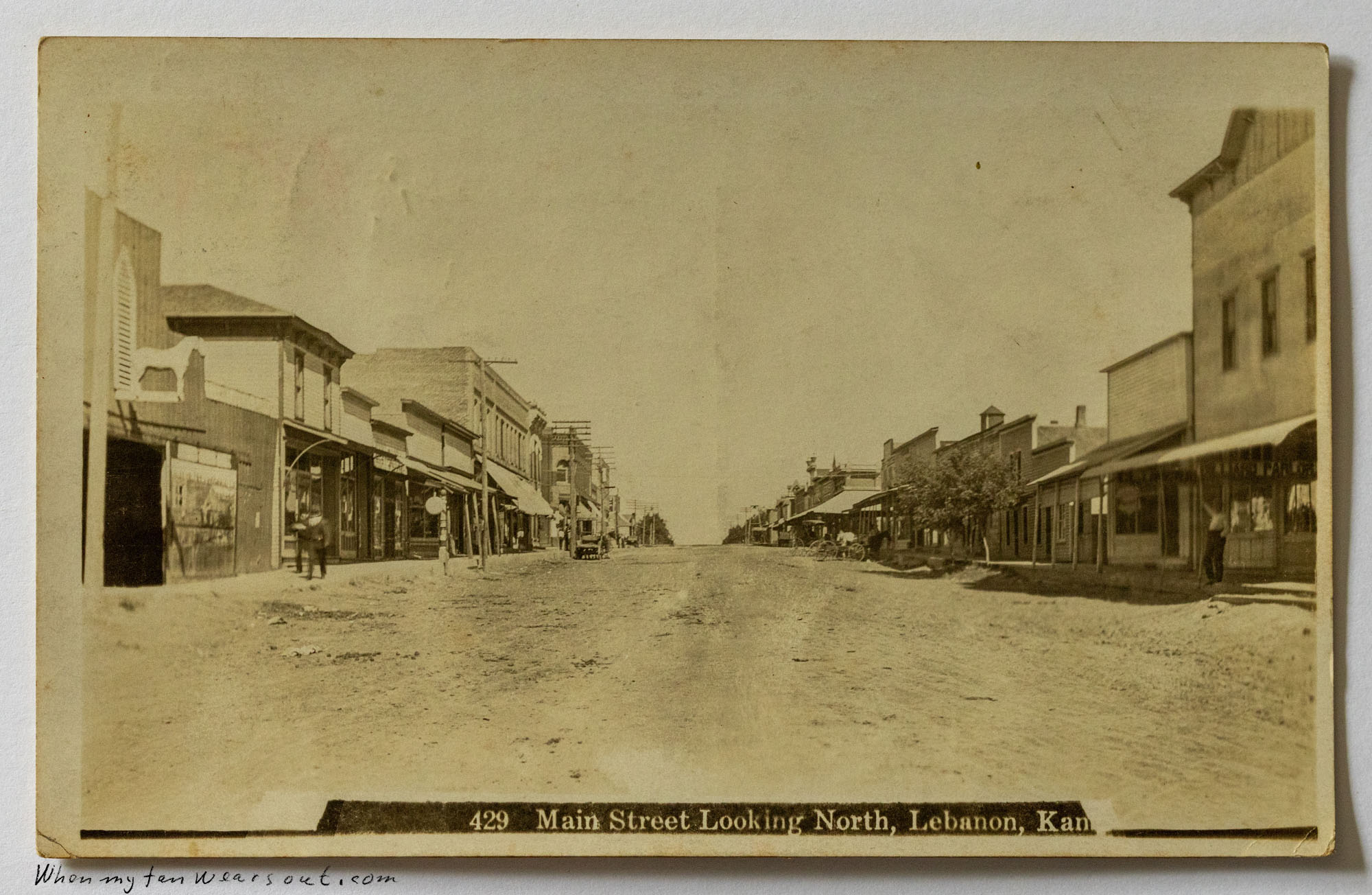
Sepia-toned historical postcard showing a wide, unpaved Main Street in Lebanon, Kansas, looking north. The street is lined with two-story commercial buildings featuring awnings, and a few indistinct figures walk along the dirt street and sidewalks under a bright sky. The caption
Front — A wide, unpaved Main Street in Lebanon, Kansas, looking north, lined with multi-story business buildings.

Postcard Metadata


Back of a sepia-toned postcard with a handwritten message in cursive from Leonard Timberlake to Miss Pearl Byers in Carthage, Illinois. The card is postmarked Topeka, Kansas, October 27, 1909, 6PM, and bears a one-cent green U.S. postage stamp featuring Benjamin Franklin. The manufacturer's details are visible on the left side.
Back — Correspondence from Leonard Timberlake to Miss Pearl Byers

Transcription

Well I guess you thought I was never going to write anything but I finally got around to it. I had swell trip home it rained severall the time after I left Quincy. Leonard Timberlake.

Historical & Family Notes

This postcard, sent to Pearl Byers from Leonard Timberlake, provides a glimpse into her social circle before her eventual marriage to Harvey Sights. The message details Leonard’s “swell trip home” despite rain after leaving Quincy, suggesting Pearl might have been visiting Quincy, Illinois, or that Leonard was visiting Pearl (or nearby) before heading back to his own home, likely in or near Topeka, Kansas, where the card was postmarked.

The existence of correspondence from other individuals like Leonard underscores that Pearl had a vibrant social life and various acquaintances, a common experience for young women of the era. These interactions form part of the broader narrative leading up to her relationship with Harvey Sights, showing the context of her world.

The card’s front, depicting Main Street in Lebanon, Kansas, is a generic scene often found on postcards of the period, chosen by the sender likely for its availability rather than any specific connection to Pearl or Leonard. It highlights the widespread use of postcards for casual correspondence and sharing snippets of daily life or travel.

Continue Reading

Postcard #0020: Albert Lea Courthouse and the Journey Home


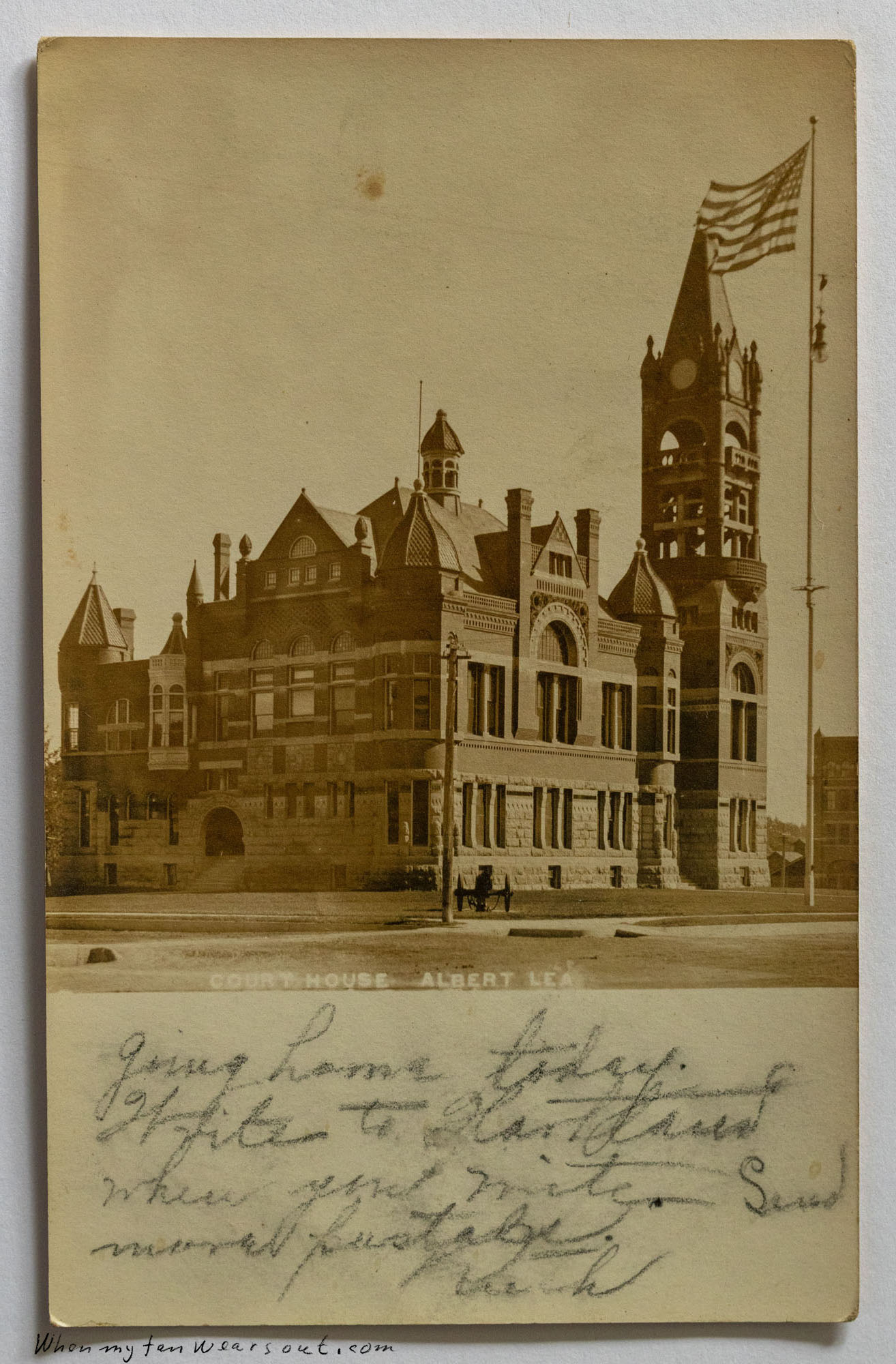
Sepia-toned postcard depicting the grand Albert Lea Court House in Minnesota, a brick and stone building with a prominent clock tower, an American flag flying, and a small horse-drawn carriage on the street in front. Handwritten message is visible below the image.
Front — View of the Albert Lea Court House with a prominent clock tower and American flag.

Postcard Metadata


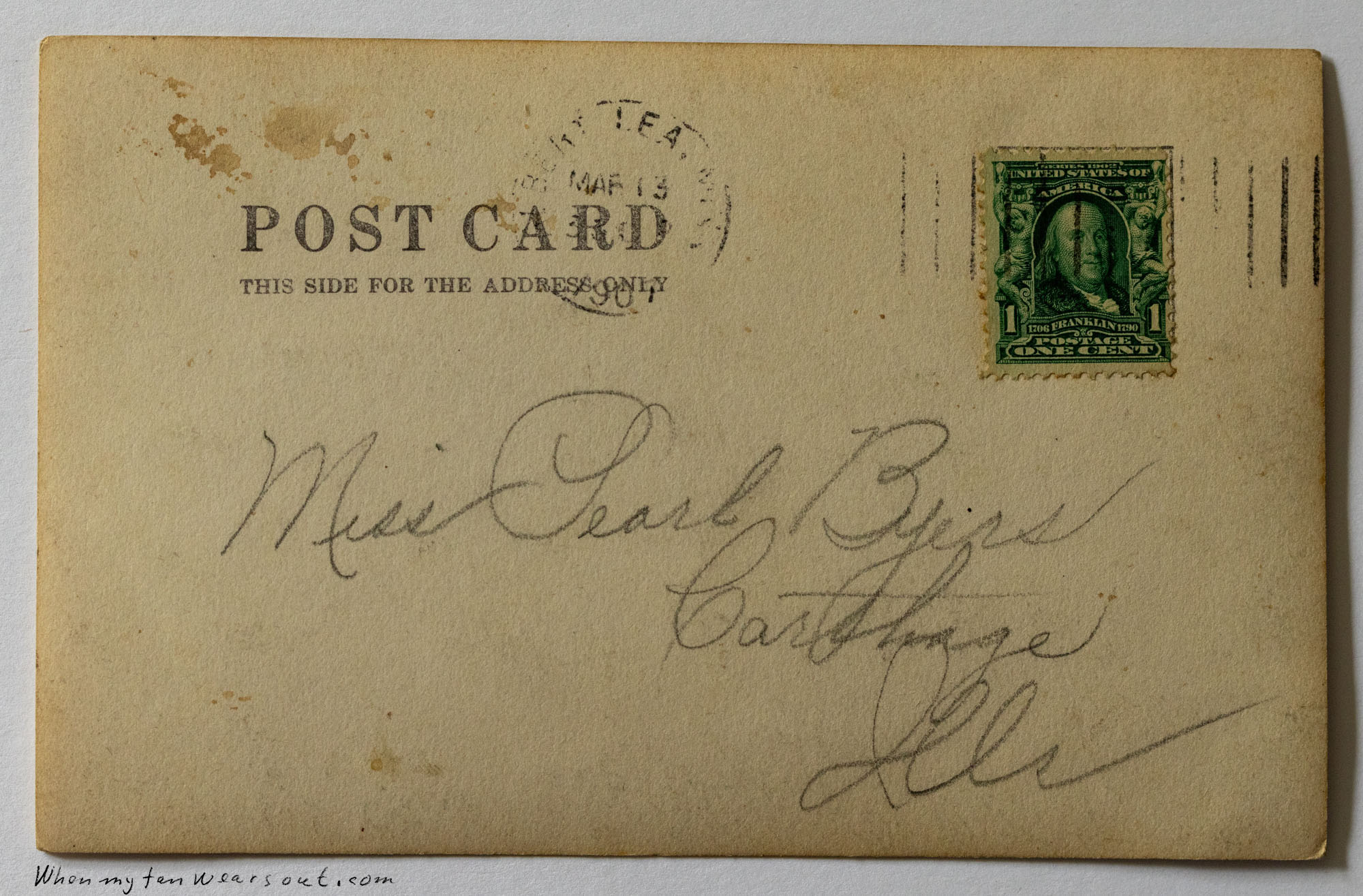
Sepia-toned back of a postcard with a 1-cent green Benjamin Franklin stamp, an
Back — Correspondence from Harvey Sights to Miss Pearl Byers

Transcription

Going home today. Expect to start from when you get my other postcard. Send me all puss.

Historical & Family Notes

This postcard captures a moment of anticipation as Harvey Sights prepares to return home, presumably to Pearl Byers. Sent from Albert Lea, Minnesota, the message “Going home today” signifies the conclusion of his travels or a temporary stay, and the impending reunion with Pearl. The reference to “my other postcard” suggests an ongoing correspondence, a common method of nurturing their relationship across the miles.

The affectionate closing, “Send me all puss,” underscores the tender and playful nature of their courtship. Such personal and informal expressions reveal a deeper intimacy than standard greetings, hinting at the bond that would eventually lead to their marriage and the start of their family. This card is a tangible piece of their unfolding love story, chronicling the small, daily communications that built their connection.

As a historical artifact, the postcard offers a glimpse into early 20th-century communication and travel. The image of the Albert Lea Court House serves as a backdrop to Harvey’s journey, while the simple yet heartfelt message conveys the human experience of longing and return. It’s a testament to the enduring power of written words to bridge distance and maintain personal connections in a time before instant digital communication.

Continue Reading