Postcard #0053: Florida Palms and a Request for a “Novel Not Complicated with Love”


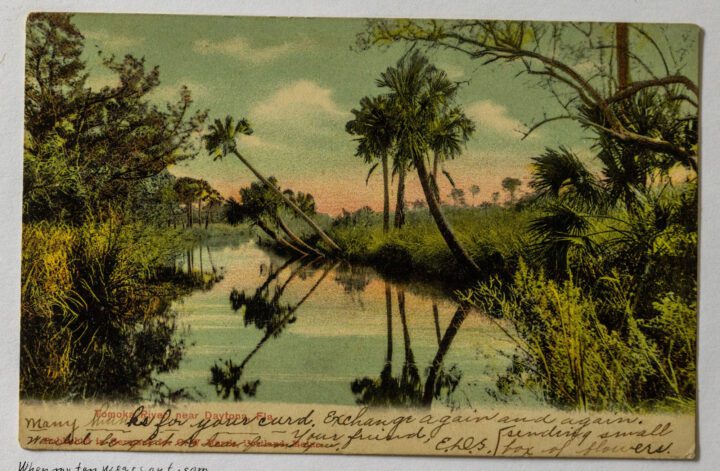
A vintage postcard depicting a lush Florida landscape with tall palm trees and dense green foliage along the banks of a reflective stream. The scene is bathed in the warm light of sunrise or sunset, with a vibrant orange and green sky. The water perfectly mirrors the trees and sky. Text on the bottom left reads
Front — A scenic view of palm trees and other tropical foliage reflected in a tranquil body of water under a colorful sky, labeled “Ormond Key near Daytona.”

Postcard Metadata


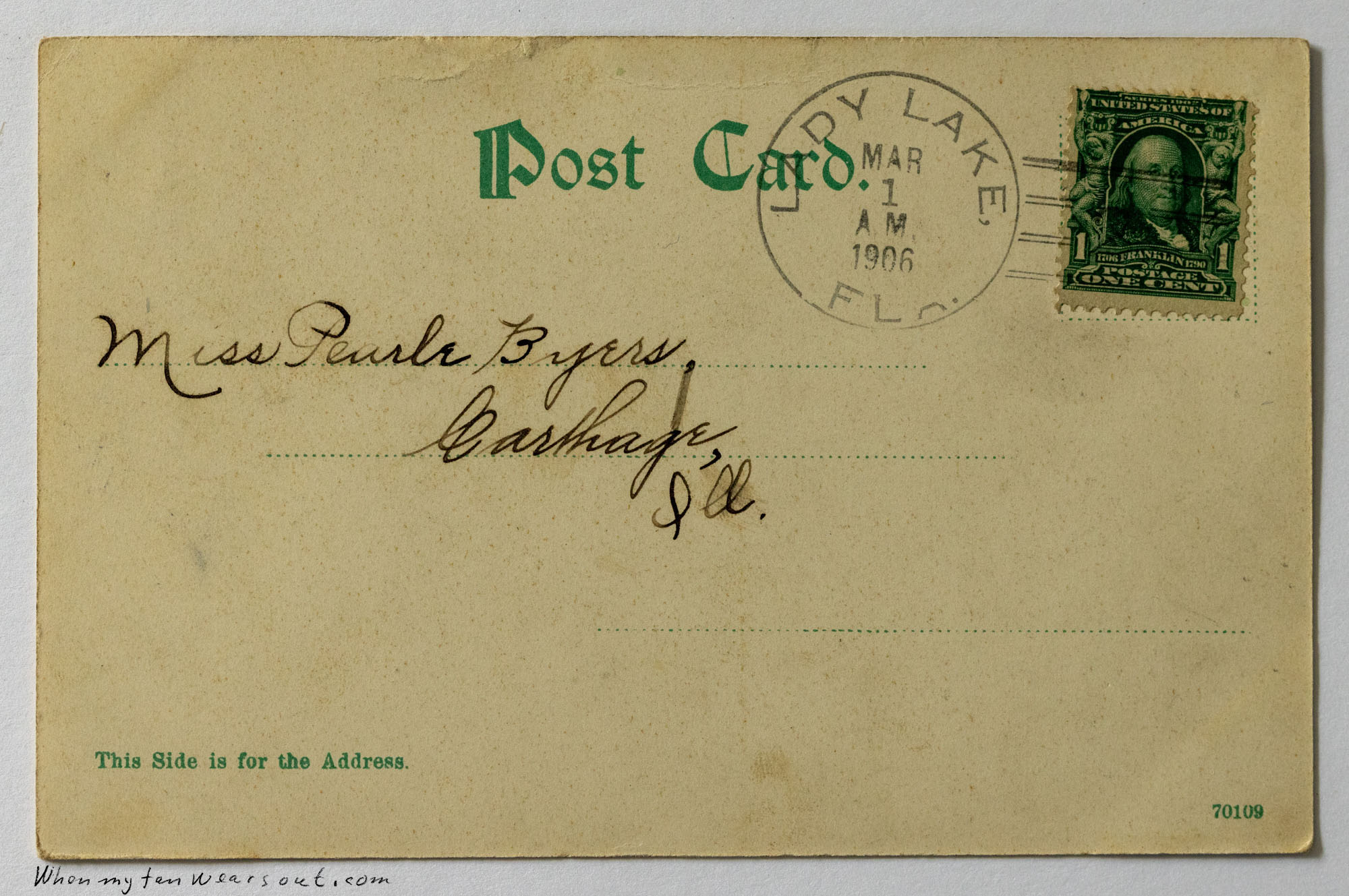
The back of a vintage undivided postcard with a green one-cent Benjamin Franklin stamp postmarked
Back — Correspondence from C.H.S. to Miss Pearle Byers

Transcription

Ormond Key near Daytona. Many thanks for your card, exchange again and again. Your friend C.H.S. Send me a small novel not complicated with love something of your own. Box of flowers.

Historical & Family Notes

This early postcard, dating from 1906, shows the sender, C.H.S., corresponding with Pearl Byers from sunny Florida. The reference to “Ormond Key near Daytona” places the sender on what was then a popular winter resort destination, indicating some travel or leisure activities. The message, though brief, hints at a warm and continuous exchange, stating “exchange again and again.”

The most intriguing part of the message is the playful postscript: “Send me a small novel not complicated with love something of your own. Box of flowers.” While signed simply “Your friend C.H.S.,” the initials “H.S.” align with Harvey Sights, Pearl’s future husband. The request for a novel “not complicated with love” could be a teasing remark between two individuals who are perhaps just beginning to navigate the complexities of their own budding affections, subtly hinting at an interest beyond mere friendship. The mention of “Box of flowers” further adds to this gentle flirtation.

This card provides a charming glimpse into the early stages of communication between Pearl and her circle, potentially even with Harvey Sights himself, before their relationship fully blossomed. The request for a personalized “novel” suggests an intimate understanding and shared sense of humor between the correspondent and Pearl, laying groundwork for a deeper connection in the years to come.
Continue Reading

Postcard #0051: Palm Walk in Florida and a Card Exchange with Mr. Sights


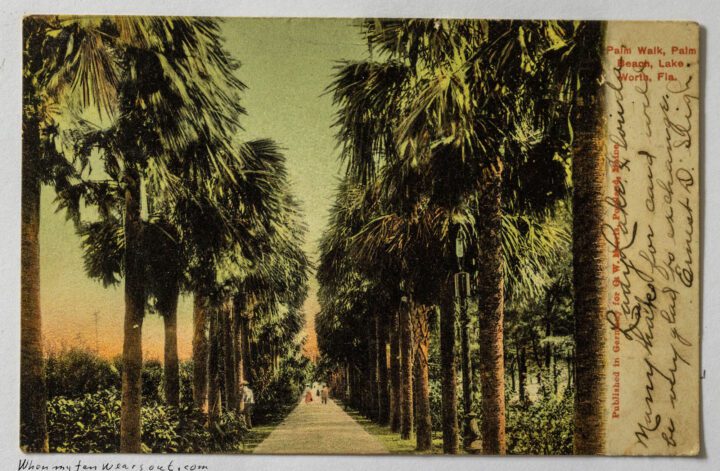
Vintage postcard illustration depicting a picturesque tree-lined avenue with numerous tall palm trees, creating a shaded pathway. The scene is bathed in a warm, golden-orange light at the horizon, transitioning to a greenish-yellow sky above. Several people are visible strolling along the path.
Front — A serene, sun-drenched palm-lined avenue with pedestrians strolling, labeled “Palm Walk, Palm Beach, Lake Worth, Fla.”

Postcard Metadata


The back of a vintage postcard features a one-cent green Benjamin Franklin stamp from the United States, cancelled with a
Back — Correspondence from Ernest D. Sh. to Miss Pearle Byers

Transcription

Published in Ger. for Geo. R. Lawrence. Palm Walk, Palm Beach, Lake Worth, Fla. Merry Xmas for exchanging cards with Mr. Sights. Ernest D. Sh.

Historical & Family Notes

This postcard, sent from sunny Florida in 1906, provides an intriguing glimpse into Pearl Byers’ social sphere before her marriage to Harvey Sights. The message from Ernest D. Sh. explicitly mentions “exchanging cards with Mr. Sights,” suggesting that Harvey was already a known figure within Pearl’s wider network of acquaintances and that social correspondence was a common practice. This early mention, even if indirect, foreshadows the deeper connection that would eventually develop between Pearl and Harvey.

The card itself, an early example of a divided back design postmarked a year before its official authorization for U.S. domestic mail, reflects the evolving nature of postcard communication. The sender’s decision to write the message across both the designated message and address portions of the card highlights a charming disregard for strict postal conventions, prioritizing the full message over proper formatting.

Such exchanges served as vital threads connecting individuals across distances in the early 20th century, fostering relationships and maintaining social ties. For Pearl and Harvey, this postcard from a faraway destination underscores the broad geographical and social contexts that shaped their lives before they became central to each other’s.

Continue Reading

Postcard #0049: Picnic Trip on the Ocklawaha River, Florida


Black and white postcard image depicting two people in a small rowboat navigating a narrow section of the Ocklawaha River in Florida. The riverbanks are heavily forested with tall cypress trees draped in Spanish moss, creating a dense canopy. The water is calm, reflecting the trees and sky. The printed caption at the bottom reads
A scenic view of two people in a rowboat on the Ocklawaha River, Florida, surrounded by cypress trees draped with Spanish moss.

Postcard Metadata


The undivided back of a vintage postcard featuring a green one-cent Benjamin Franklin postage stamp in the upper right corner. The main postmark reads
Back — Correspondence from Ernest Bligh to Miss Pearle Byers

Transcription

Off for the picnic How would you like this trip— Ernest Bligh.

Historical & Family Notes

This postcard, sent to Pearl Byers in May 1906, offers a glimpse into her social life before her marriage to Harvey Sights. The sender, Ernest Bligh, describes a picnic on the scenic Ocklawaha River in Florida, asking Pearl if she would enjoy such a trip. This suggests a friendly relationship, perhaps a travel companion or an admirer, highlighting Pearl’s wider connections before settling down.

The Ocklawaha River, famous for its lush landscapes and cypress swamps draped in Spanish moss, was a popular tourist destination in the early 20th century. This postcard captures the allure of such natural beauty and the burgeoning trend of travel and leisure, with postcards serving as a common way to share experiences from afar.

While this card is not from Harvey, it enriches Pearl’s personal narrative, painting a picture of a young woman receiving mail from various acquaintances and experiencing life’s adventures, even if vicariously through postcards. The Carthage postmark indicates receipt on the same day as dispatch from Florida, a common yet intriguing postal anomaly for the era, suggesting a rapid journey or perhaps a timestamp discrepancy.

Continue Reading

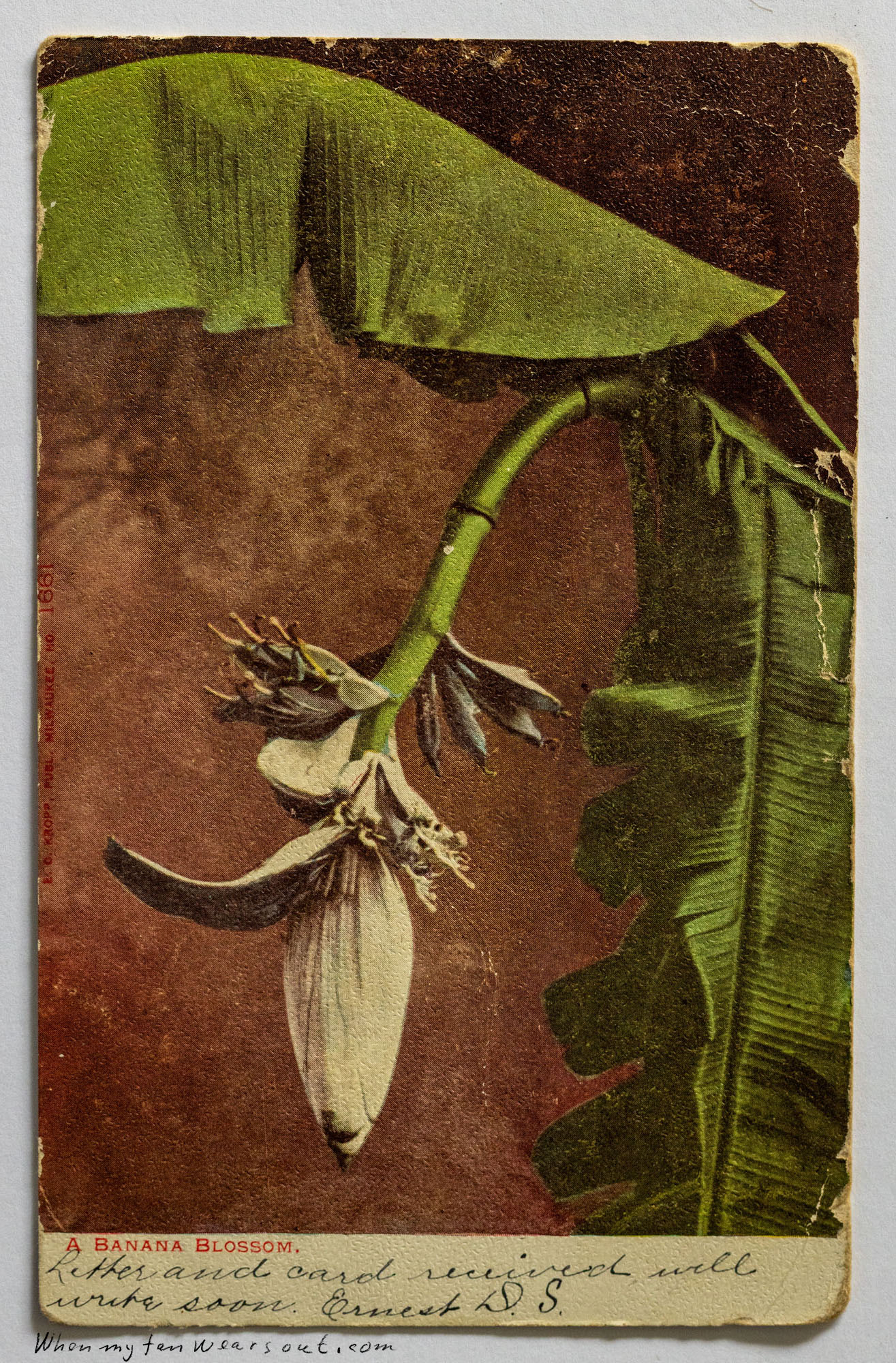
Postcard #0048: A Banana Blossom from Ernest D. S.


A colorized vintage postcard showing a large, cream-colored banana blossom hanging from a green banana tree stalk, with small green bananas starting to form at the top of the blossom. The background is a warm, mottled brown. Printed text
Front — A vibrant illustration of a banana tree’s large, pendulous blossom with emerging fruit.

Postcard Metadata


The back of a vintage postcard with a light tan surface. A green one-cent U.S. Postage stamp with Benjamin Franklin's portrait is affixed to the upper right. Two circular postmarks are present: one from
Back — Correspondence from Ernest D. S. to Miss Pearle Byers

Transcription

Letters and card received will write soon. Ernest D. S.

Historical & Family Notes

This postcard, sent from a warmer climate in Florida, offers a glimpse into the diverse correspondence Pearl Byers received. While not from her eventual husband, Harvey Sights, it confirms Pearl was an active recipient of mail, maintaining connections with various friends and family members across the country. The sender, Ernest D. S., acknowledges previous correspondence, indicating an ongoing exchange.

The postcard’s depiction of a banana blossom highlights an exotic fruit for many Midwesterners at the turn of the 20th century. Such imagery provided a window into distant lands and unfamiliar flora, a common theme for postcards intended to transport recipients beyond their immediate surroundings. This particular card showcases the aesthetic appeal of nature photography combined with the practical function of postal communication during a burgeoning era of travel and correspondence.

Continue Reading