Front — A group of store employees or proprietors pose with a display case of umbrellas.
Postcard Metadata
Postmarked: Not Visible
Sent From: None
Sent To: None
Distance Traveled: None
Postage: Not visible (no stamp)
Card Details: Divided Back, Real Photo Postcard (RPPC) with “A Z O” stamp box (circa 1907-1920s).
Back — A list of names
Transcription
Fred Peasley Waldo Mason Miss Erbroidt Miss Osborn Tom Roberts Carrie Campbell Maude Biggs Mabel Roberto
Mason Dry Goods Store, La Harpe
Historical & Family Notes
This charming real photo postcard, likely dating to the early 20th century, captures a slice of small-town commerce, possibly the very store where Harvey Sights worked or visited. The image presents a bustling scene with employees, a counter, and umbrellas for sale, suggesting a dry goods or department store.
Front — A hand-tinted postcard featuring a scenic view of Indian Mound Park in Quincy, Illinois, overlooking the Mississippi River.
Postcard Metadata
Postmarked: Quincy, Ill. — AUG 25 4 PM 1908
Sent From: Quincy, Illinois
Sent To: Miss Pearl Byers, Carthage, Ill.
Distance Traveled: Approximately 32 miles
Postage: One Cent U.S. Franklin stamp, green.
Card Details: Divided back postcard, printed by “Leipzig Berlin Dresden Litho-Chrome”, trademark indicates “Printed in Germany”.
Back — Correspondence from Elva to Miss Pearl Byers
Transcription
Hello kids! Got here p.m. sound. Have a dandy room. Will have to write before long. Elva 438 N. 8th st.
Historical & Family Notes
This postcard offers a glimpse into Pearl Byers’ social circle before her eventual marriage to Harvey Sights. The sender, Elva, is likely a friend or relative, providing a quick update from Quincy, Illinois. The casual tone and simple message, “Hello kids! Got here p.m. sound. Have a dandy room,” reflect the common use of postcards for brief, informal communication in the early 20th century, a time when such exchanges were cherished links between distant friends and family.
The card’s front depicts Indian Mound Park in Quincy, a notable local landmark with its historic earthworks and scenic views of the Mississippi River. Such picturesque views were popular subjects for postcards, allowing senders to share a bit of their travels or local attractions with recipients back home. Even a relatively short trip to a nearby town like Quincy would have been an occasion worth noting and sharing with friends like Pearl in Carthage.
While Harvey Sights isn’t directly mentioned in this particular correspondence, this postcard beautifully illustrates the rich tapestry of relationships Pearl maintained. These frequent, small exchanges kept her connected to a broad community of friends and family, forming the supportive network that would surround her as she eventually married Harvey and started her own family, enriching the Sights’ family legacy.
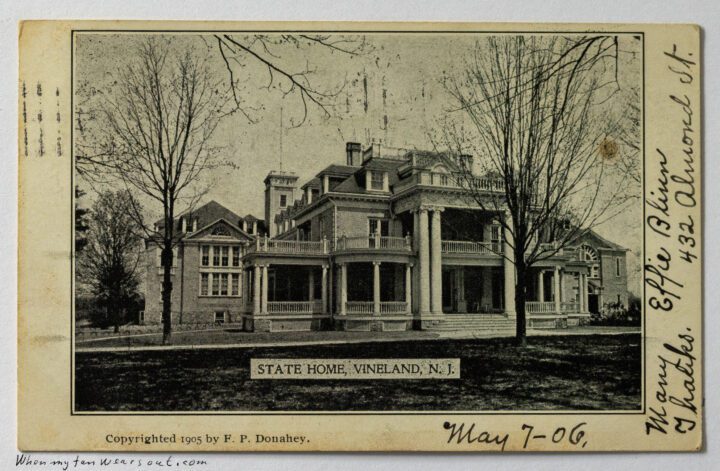
Front — A grand, multi-story brick building, labeled “STATE HOME, VINELAND, N. J.” with trees in the foreground.
Postcard Metadata
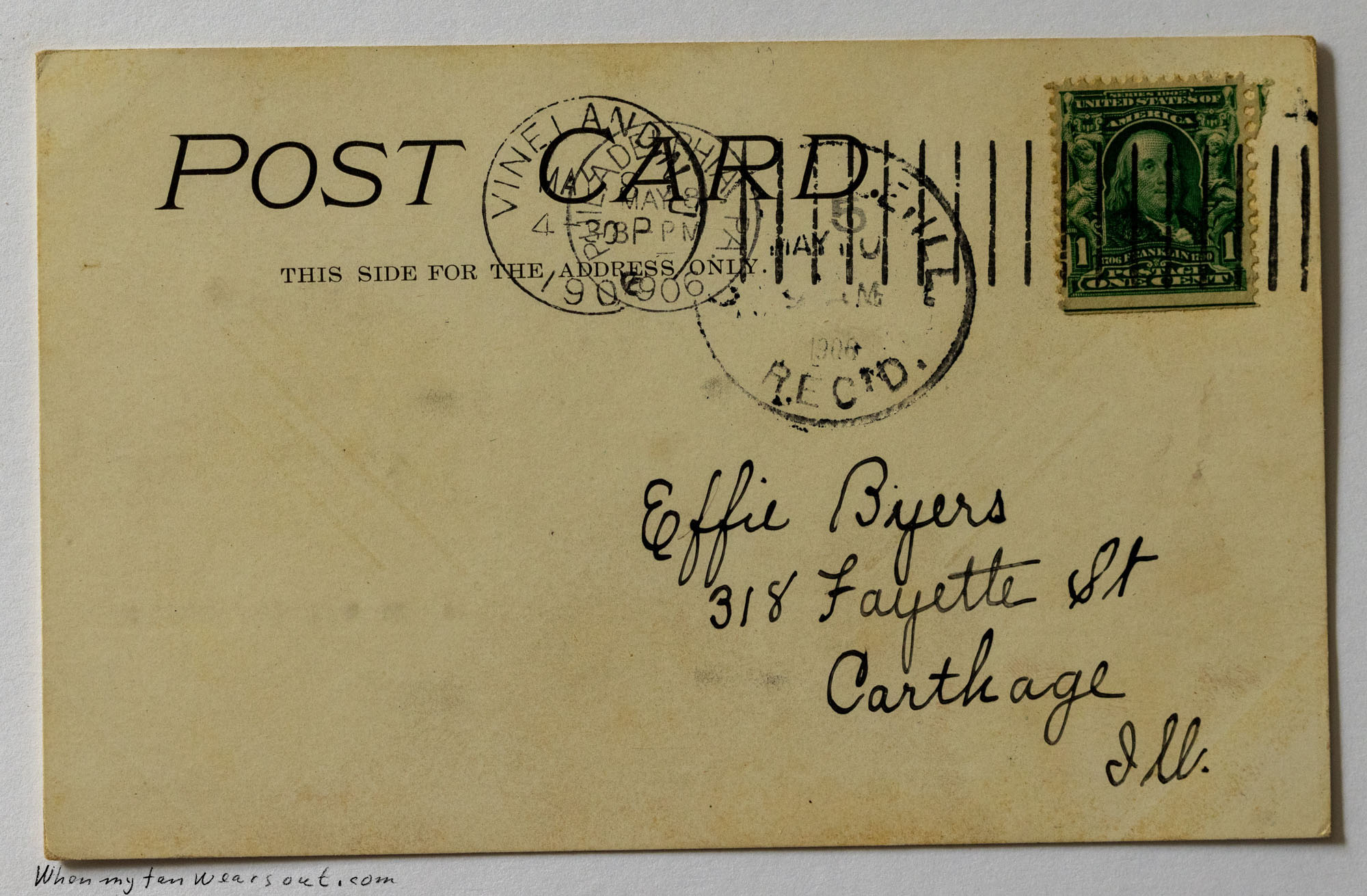
Postmarked: Vineland, New Jersey — May 7, 1906, 4:30 PM
Sent From: Vineland, New Jersey
Sent To: Effie Byers, 318 Fayette St, Carthage, Ills.
Distance Traveled: ~870 miles
Postage: US One Cent Benjamin Franklin stamp
Card Details: Undivided Back postcard, “Copyrighted 1905 by F. P. Donahey.”
Back — Correspondence from Effie Bhien to Effie Byers
Transcription
Many thanks. May 7-06. Effie Bhien 432 Almond St.
Historical & Family Notes
This early postcard, dated May 1906, offers a glimpse into the Byers family’s extended network before Pearl’s extensive correspondence with Harvey Sights. Addressed to Effie Byers at 318 Fayette Street in Carthage, Illinois—the very home Pearl would share with her family—it establishes a foundational timeline for the Byers household. While not sent directly to Pearl, the card reinforces the consistent location of her family home, a place that would later feature prominently in her personal story and eventual courtship.
The image on the front depicts the “State Home, Vineland, N. J.,” historically known as the New Jersey Training School for Feeble-Minded Girls and Boys. This institution was a significant, albeit complex, part of early 20th-century social history, pioneering research in intellectual disabilities while also becoming entangled in the eugenics movement. The postcard’s image provides a window into the types of public institutions and social structures that existed during Pearl’s formative years.
The brief message, “Many thanks,” penned by “Effie Bhien” from nearby 432 Almond Street, suggests a simple, everyday acknowledgment. Such concise notes were common on undivided back postcards, where space for correspondence was limited. This card, a tangible artifact from 1906, predates the more romantic and detailed letters Pearl would later exchange with Harvey, yet it subtly grounds their story within the broader social and familial context of the early 20th century.
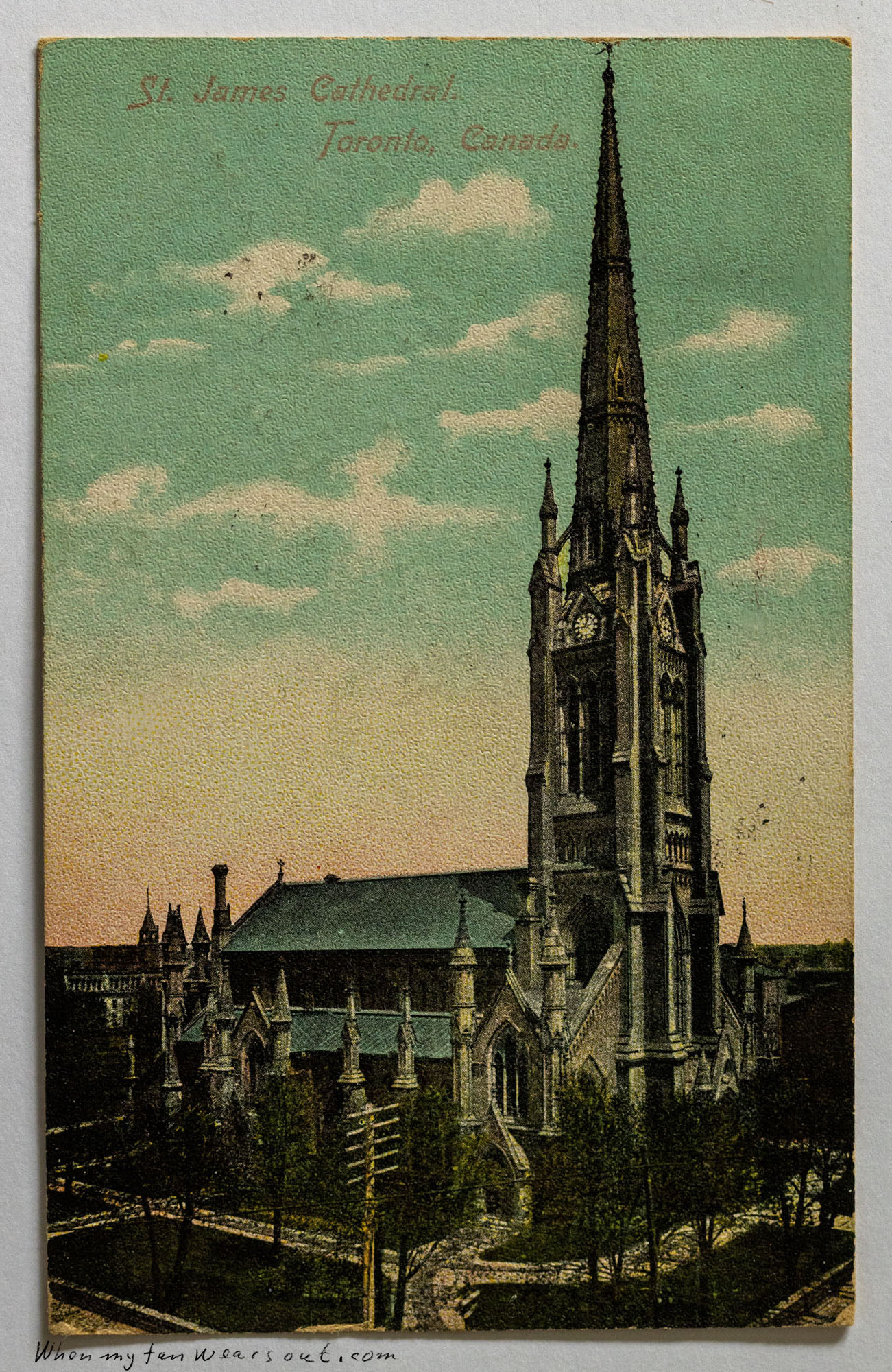
Front — A colorized vintage view of St. James Cathedral in Toronto, Canada, with a tall Gothic spire dominating the skyline.
Postcard Metadata
Postmarked: Toronto, Ontario, Canada — August 14, 1909
Sent From: Toronto, Ontario, Canada
Sent To: Miss Pearl Byers, Carthage, Ill.
Distance Traveled: Approximately 620 miles (1000 km)
Postage: Canada Post, One Cent, King Edward VII stamp
Card Details: Divided Back (post-1907)
Back — Correspondence from Unknown to Miss Pearl Byers
Transcription
Miss Pearl Byers, Carthage, Ill.
Historical & Family Notes
This postcard, postmarked from Toronto, Canada in August 1909, offers a glimpse into Pearl Byers’ social circle and the broader world she connected with, even without a personal message. The absence of a handwritten note beyond the address suggests this might have been sent as a simple greeting or a souvenir from a traveler, perhaps a friend or family member exploring outside the United States. It highlights the growing popularity of postcards for casual correspondence during the early 20th century, enabling quick and inexpensive communication across significant distances.
The card’s journey from Toronto to Carthage, Illinois, underscores the extensive postal networks of the era. While the sender remains unknown, such a card could have sparked conversations or shared memories for Pearl, connecting her small Midwestern town to a bustling Canadian metropolis. This piece, though brief in its written content, contributes to the narrative of Pearl’s life, illustrating the everyday interactions and mementos that shaped her experiences before her eventual marriage to Harvey Sights.
Front — A view of the Chanute Public Library in Chanute, Kansas, with a handwritten note “Miss Pearl 3.5.08” at the top.
Postcard Metadata
Postmarked: Chanute, Kansas — November 23, 1907
Sent From: Chanute, Kansas
Sent To: Miss Pearl Byers Carthage Ill.
Distance Traveled: Approximately 410 miles
Postage: One Cent U.S. Franklin stamp, green
Card Details: Divided Back Era (1907-1915)
Back — Correspondence from Harvey Sights to Miss Pearl Byers
Transcription
Dear Pearl, Was glad to hear from you. We are having nice weather here this week. Had a good rain yesterday. I wish I was there to spend my birthday with you. Your Harvey
Historical & Family Notes
In this heartfelt message, Harvey Sights sends an early birthday wish to Pearl Byers, lamenting his absence for her December 4th celebration. The postcard, postmarked November 23, 1907, captures the anticipation of Pearl’s special day from afar, as Harvey expresses his desire to be with her. The front of the card depicts the Chanute Public Library in Kansas, where Harvey was at the time, offering a glimpse into the locale from which he sent his affections.
This card perfectly illustrates the challenges of courtship across distances in the early 20th century, relying on the postal service to bridge the miles between Chanute, Kansas, and Carthage, Illinois. The sentiment “I wish I was there to spend my birthday with you” speaks volumes about the growing bond between Harvey and Pearl, hinting at the romantic connection that would eventually lead to their marriage.
The small, handwritten note “Miss Pearl 3.5.08” on the front of the postcard appears to be a later annotation, possibly by Pearl herself or a collector, indicating a date that doesn’t align with the 1907 postmark but might mark a significant memory associated with the card. It further solidifies the postcard’s personal significance within Pearl’s collection.
Front — A hand-colored postcard depicting the brick Town Hall of Peabody, Massachusetts, with a large tree on the left.
Postcard Metadata
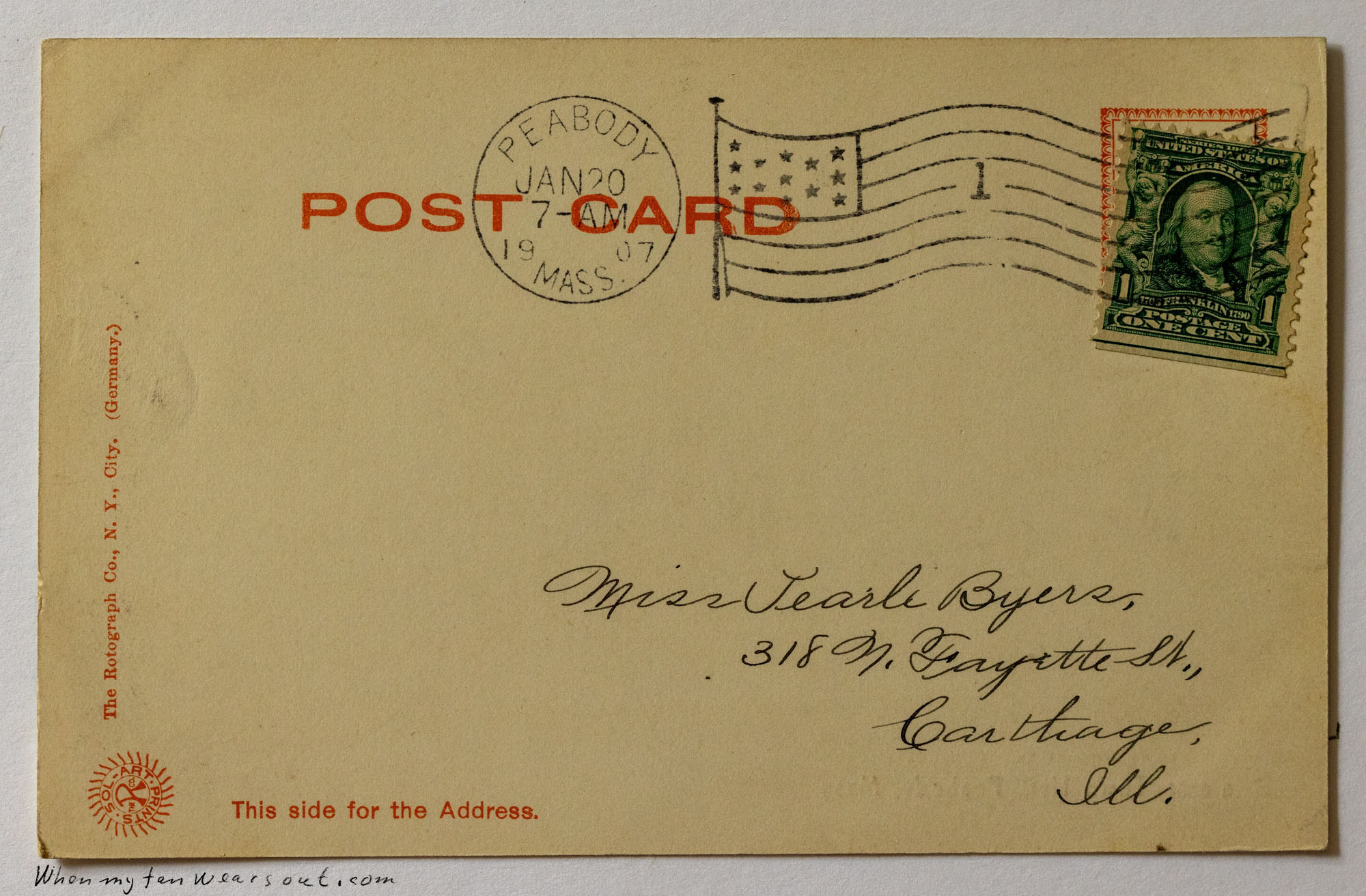
Postmarked: Peabody, Massachusetts — January 20, 1907
Sent From: Peabody, Massachusetts
Sent To: Miss Pearle Byers, 318 N. Fayette St., Carthage, Ill.
Distance Traveled: Approximately 1,050 miles
Postage: One Cent U.S. Postage, Franklin (green)
Card Details: Divided Back Era (produced by The Rotograph Co., N. Y., City, Germany; postmarked before the widespread domestic Divided Back adoption in March 1907)
Back — Correspondence from M. M. Powers to Miss Pearle Byers
Transcription
1-18-’07 M. M. Powers.
Historical & Family Notes
This early postcard, dated January 18, 1907, and postmarked January 20, 1907, presents a hand-colored image of the Town Hall in Peabody, Massachusetts. Sent by M. M. Powers to Pearle Byers in Carthage, Illinois, it is unusual in that the only handwritten message beyond the address is the sender’s signature and the date on the front of the card. This suggests a very brief, perhaps casual or purely demonstrative, exchange.
The card is a product of The Rotograph Co., based in New York City but with manufacturing noted as “Germany.” This highlights the significant role of German printers in the early postcard boom in the United States. Its “divided back” design, with a dedicated space for the message and address, was officially sanctioned in the U.S. for domestic postcards starting March 1, 1907. This card, postmarked slightly before that date, indicates it was likely an imported card using the divided back format already popular in Europe, predating the American regulation.
Although the sender isn’t Harvey Sights, this postcard adds another piece to Pearle’s growing collection of correspondence, showcasing her connections across different parts of the country. It captures a moment in her life just a few years before her eventual marriage to Harvey, documenting the diverse array of people who communicated with her during her youth in Carthage.
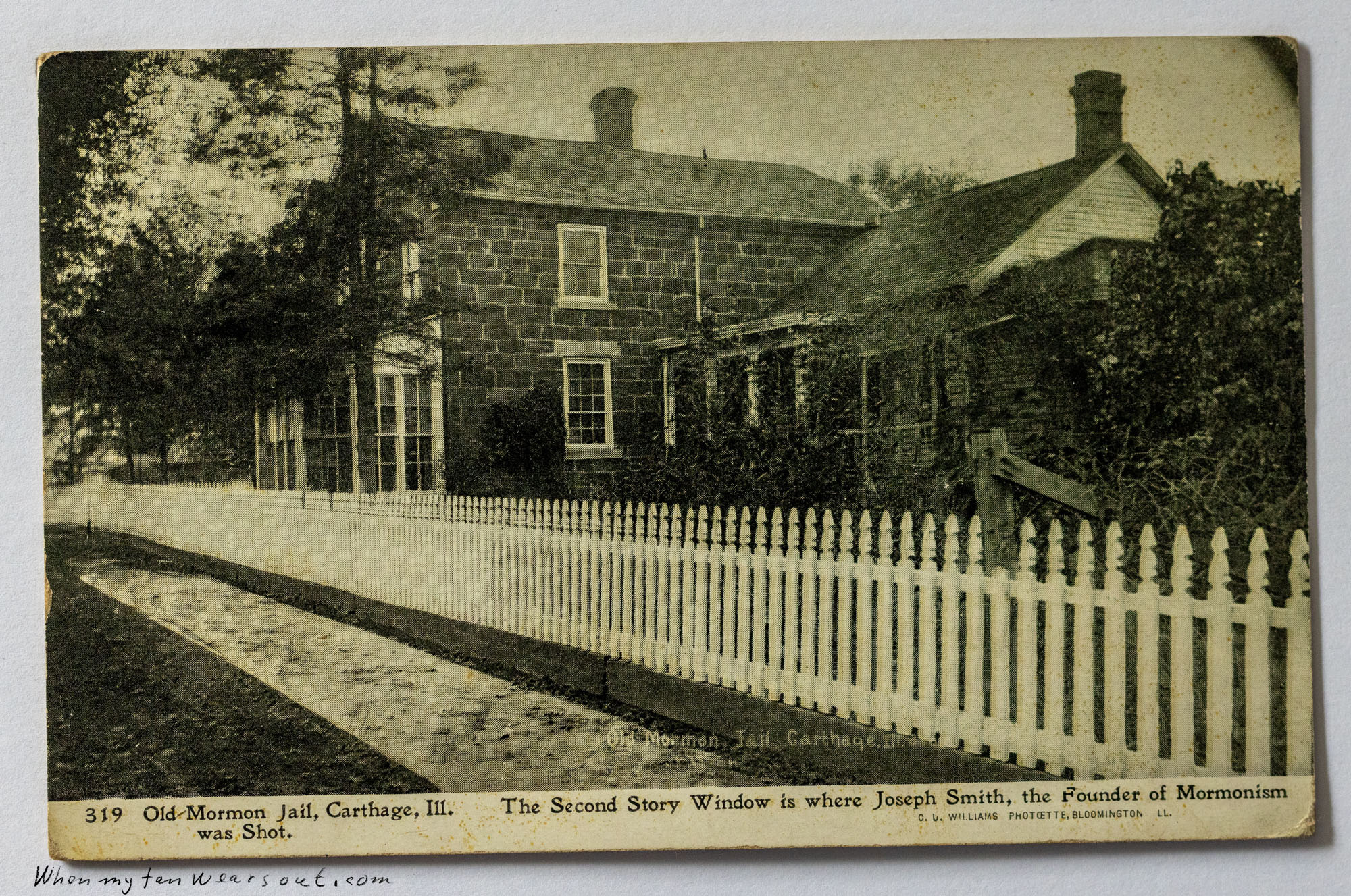
Front — A sepia-toned image of the Old Mormon Jail in Carthage, Illinois, with a white picket fence.
Postcard Metadata
Postmarked: Iowa City, Iowa — July 8, 1908, 9 PM
Sent From: Iowa City, Iowa
Sent To: Mr Harvey Sightes, La Harpe, Ill.
Distance Traveled: Approximately 95 miles
Postage: 1 Cent U.S. Postage (Benjamin Franklin)
Card Details: Divided Back era (1907-1915)
Back — Correspondence from an unknown sender to Mr Harvey Sights
Transcription
Vanmeter Hotel Be good to you. Hello dad!- (Once upon a time) How are you, I am fine, got here about 1 o’clock mon night, having fine time. You adds this some day to fun address my E. M. Collars General Delived Iowa City, Io
Historical & Family Notes
This postcard, postmarked in Iowa City in 1908, is addressed to Harvey Sights, who would later marry Pearl Byers. The message, though informal and from an unidentified sender, offers a glimpse into the casual communications of the era, reporting on travel and a “fine time” to a father figure. The sender provides a return address for “my E. M. Collars” at General Delivery in Iowa City, suggesting either a temporary stay or a traveling companion.
The front of the postcard features the historically significant Old Mormon Jail in Carthage, Illinois, where Joseph Smith, the founder of Mormonism, was killed. This landmark in Carthage holds particular relevance as it is the town where Pearl Byers resided and where she and Harvey Sights would eventually build their life together.
While not a direct communication between Pearl and Harvey, this postcard to Harvey connects to the broader geographical and historical context of their lives. It captures a moment in time when travel was an adventure, and postcards served as brief, tangible links between people across distances, even if just to share a historical site or a simple update on one’s well-being.
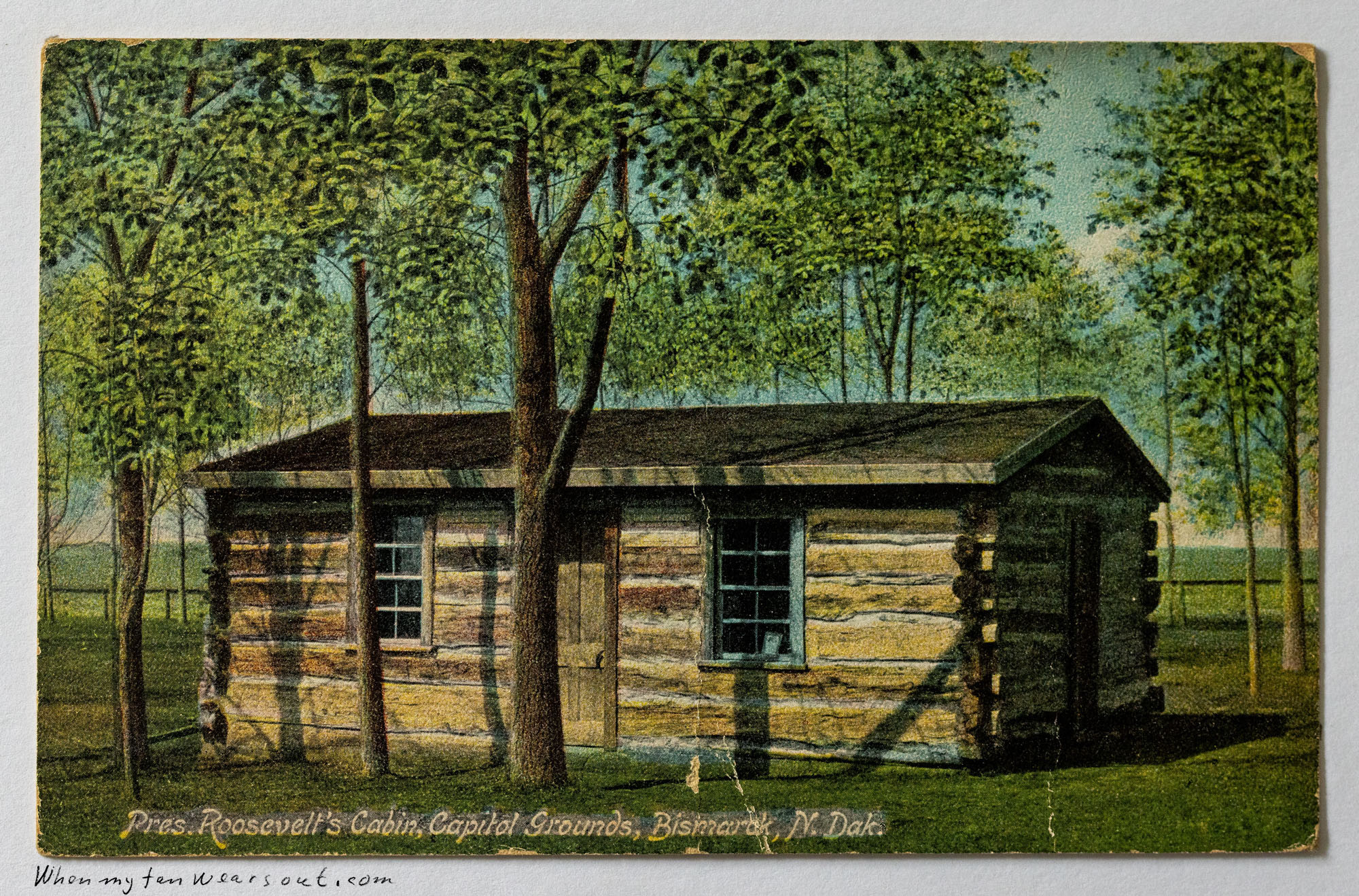
Front — A colorized postcard image of President Theodore Roosevelt’s log cabin on the Capitol Grounds in Bismarck, North Dakota, surrounded by trees.
Postcard Metadata
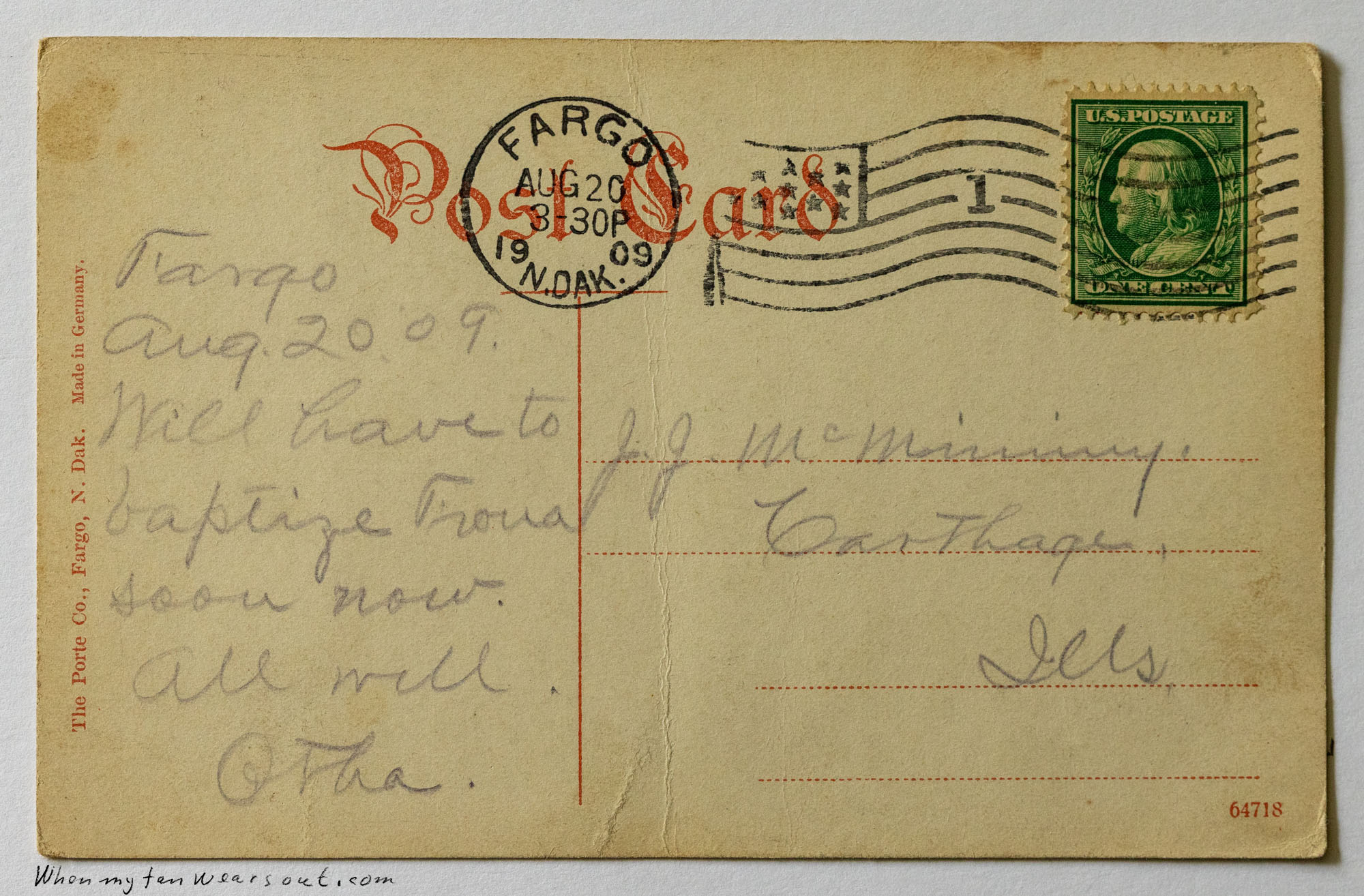
Postmarked: Fargo, N.Dak. — August 20, 1909
Sent From: Fargo, N.Dak.
Sent To: Miss J.D. McMinniny, Carthage, Ills
Distance Traveled: Approximately 820 miles
Postage: One Cent U.S. Postage stamp, green, depicting George Washington
Card Details: Divided Back era (1907-present), printed by The Porte Co., Fargo, N. Dak., Made in Germany.
Back — Correspondence from Otha to Miss J.D. McMinniny
Transcription
Fargo Aug. 20. 09. Will have to baptize Fronna soon now. All well. OTha.
Historical & Family Notes
This postcard, sent from Fargo, North Dakota, by “Otha” to Miss J.D. McMinniny in Carthage, Illinois, offers a snapshot of life in 1909. While the recipient is not Pearl Byers, the destination of Carthage, Illinois, links this card to Pearl’s hometown, suggesting a potential connection through extended family or shared acquaintances within her community. The brief message hints at an upcoming family event, stating, “Will have to baptize Fronna soon now,” indicating a significant personal or religious occasion.
The front of the postcard features a popular historical landmark, President Theodore Roosevelt’s cabin on the Capitol Grounds in Bismarck, North Dakota. Roosevelt’s deep ties to North Dakota through his ranching days made this a recognizable and popular image for early 20th-century postcards, showcasing the historical significance and natural beauty of the region.
The card’s “Made in Germany” notation underscores the global nature of postcard production at the time, with many high-quality, colorized cards being printed abroad for the American market. Such cards provided an efficient way for people to send quick updates and maintain connections across distances, as demonstrated by Otha’s concise but meaningful message.
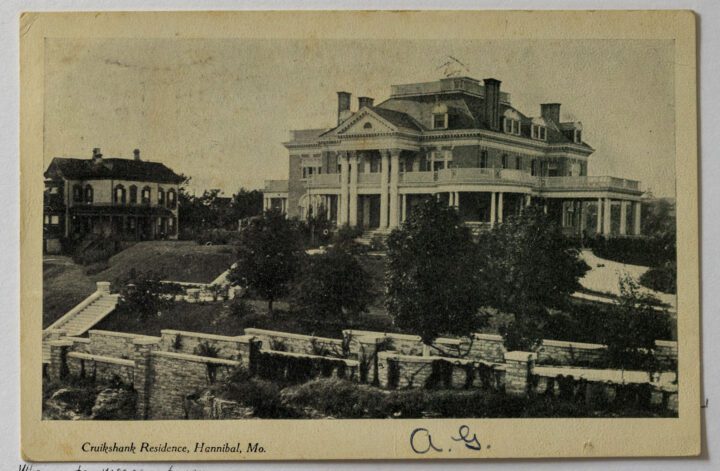
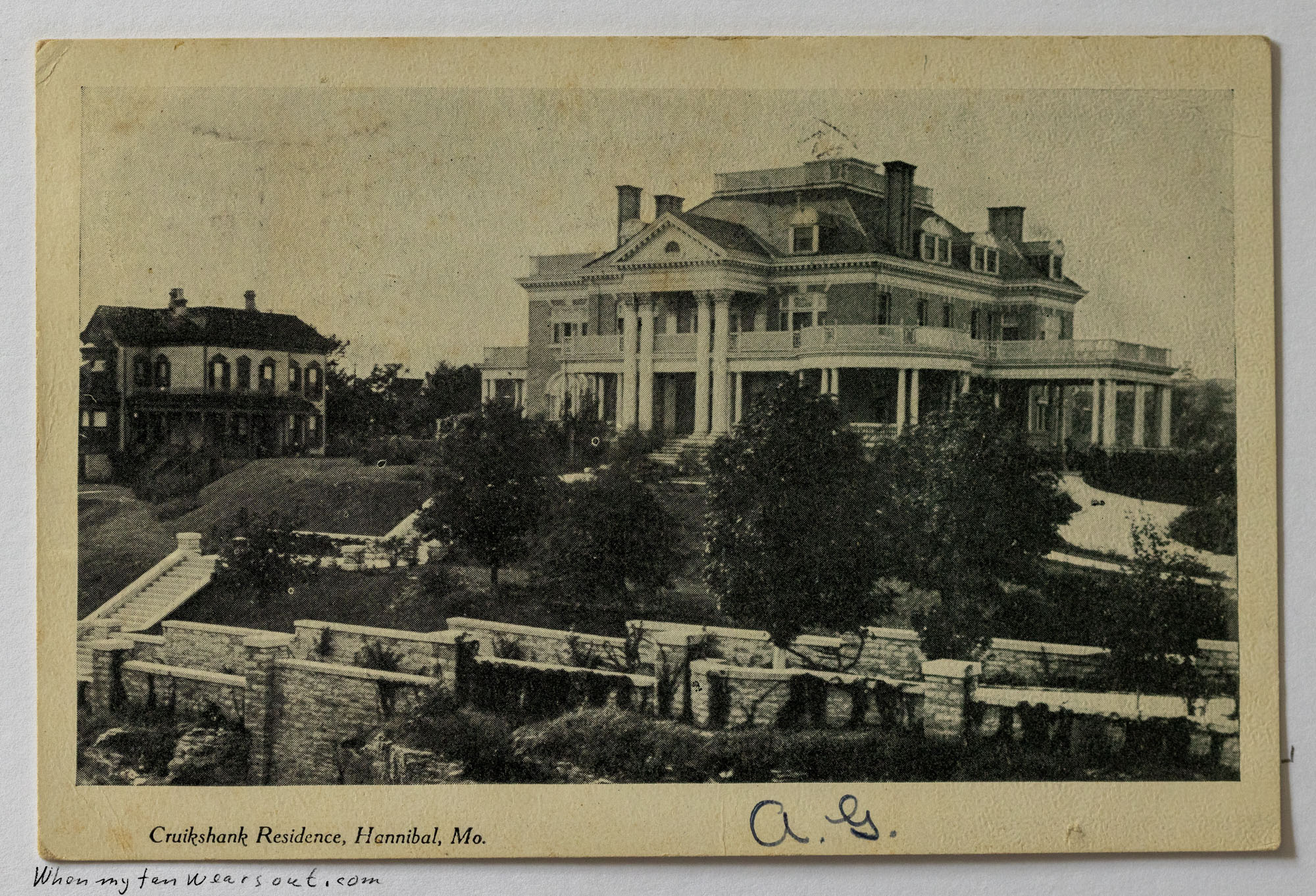
Front — A large, stately Cruikshank Residence mansion with a smaller house beside it, surrounded by manicured grounds.
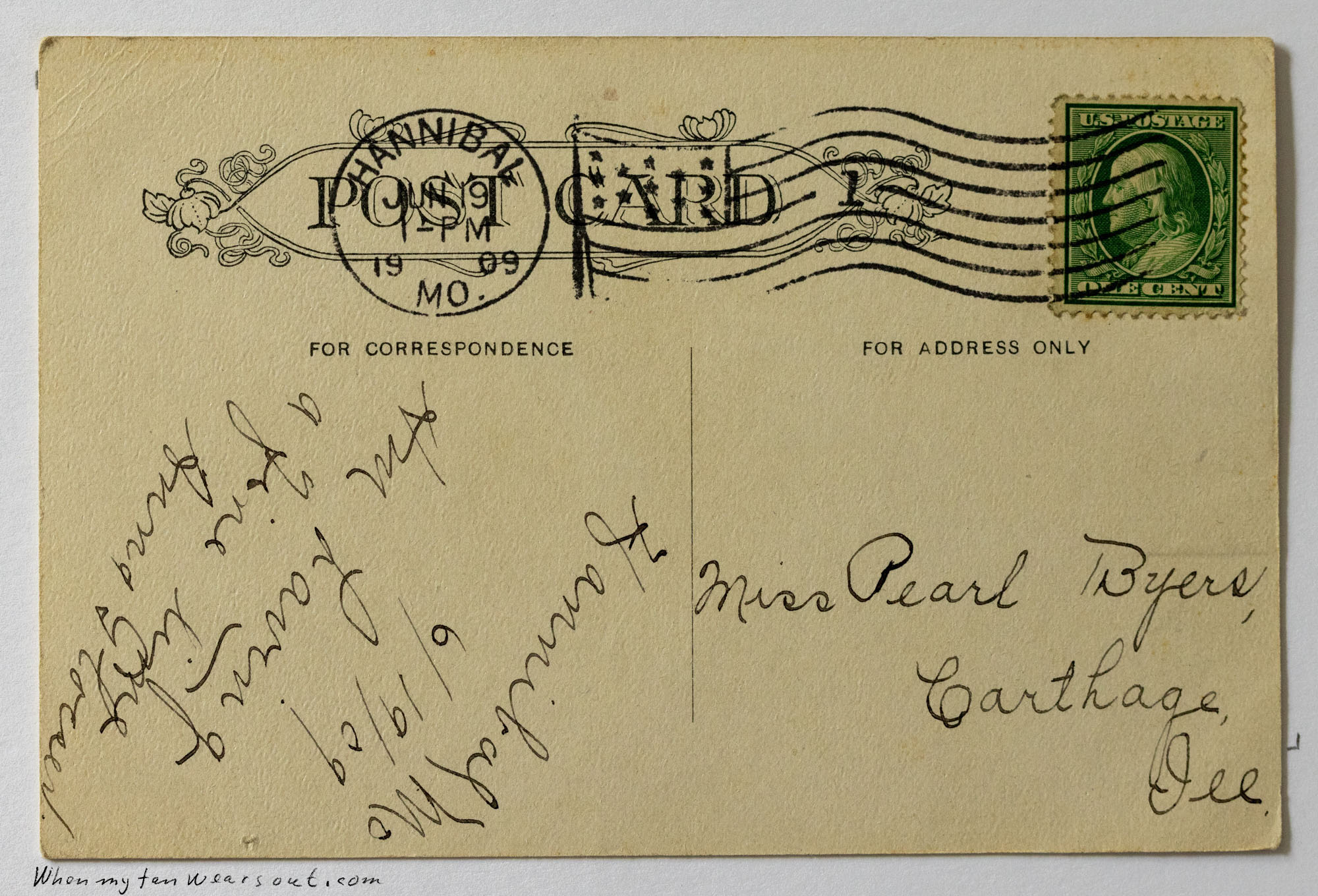
Postcard Metadata
Postmarked: Hannibal, MO — Sep 9, 1909
Sent From: Hannibal, MO
Sent To: Miss Pearl Byers, Carthage, Ill.
Distance Traveled: Approximately 40 miles
Postage: U.S. POSTAGE ONE CENT (Green Benjamin Franklin)
Card Details: Divided Back era postcard
Back — Correspondence from Lavina Byrd to Miss Pearl Byers
Transcription
Am from Hannibal, Mo. 9/10/09 a fine time. Lavina Byrd. Miss Pearl Byers, Carthage, Ill.
Historical & Family Notes
This postcard offers a charming glimpse into Pearl Byers’ social life in 1909, years before her eventual marriage to Harvey Sights. Sent by her friend Lavina Byrd from Hannibal, Missouri—a city famously associated with Mark Twain and its Mississippi River heritage—it captures a simple update of enjoying a “fine time” during a visit. The image of the grand Cruikshank Residence speaks to the architectural prosperity of the era and the types of impressive landmarks travelers would share with friends back home.
The brief message reflects the common use of postcards for quick social connections, serving as a tangible record of Pearl’s friendships and daily interactions. These snippets from her past provide valuable context for her life before and during her early courtship, illustrating the social landscape she navigated as a young woman in the early 20th century. While Harvey Sights is not mentioned, this card rounds out the picture of Pearl’s world, highlighting her network of friends and their shared experiences.
The card’s details, from the postmark date of September 9, 1909, to the one-cent postage, are authentic markers of its time. It’s a small, personal artifact that connects Pearl to a broader historical moment, showcasing how friendships were maintained through the simple act of sending a picture and a few words across the Midwestern landscape.
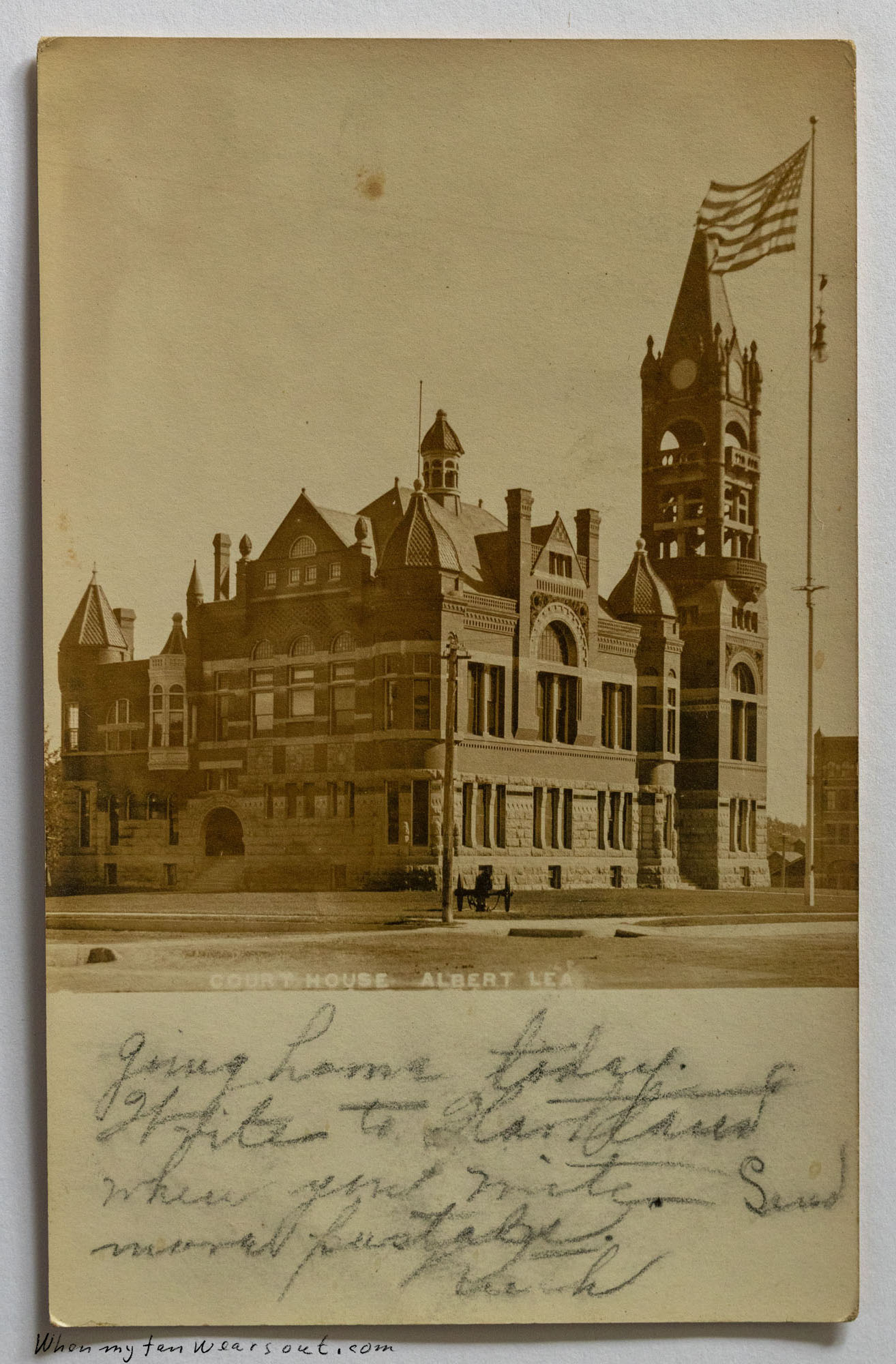
Front — View of the Albert Lea Court House with a prominent clock tower and American flag.
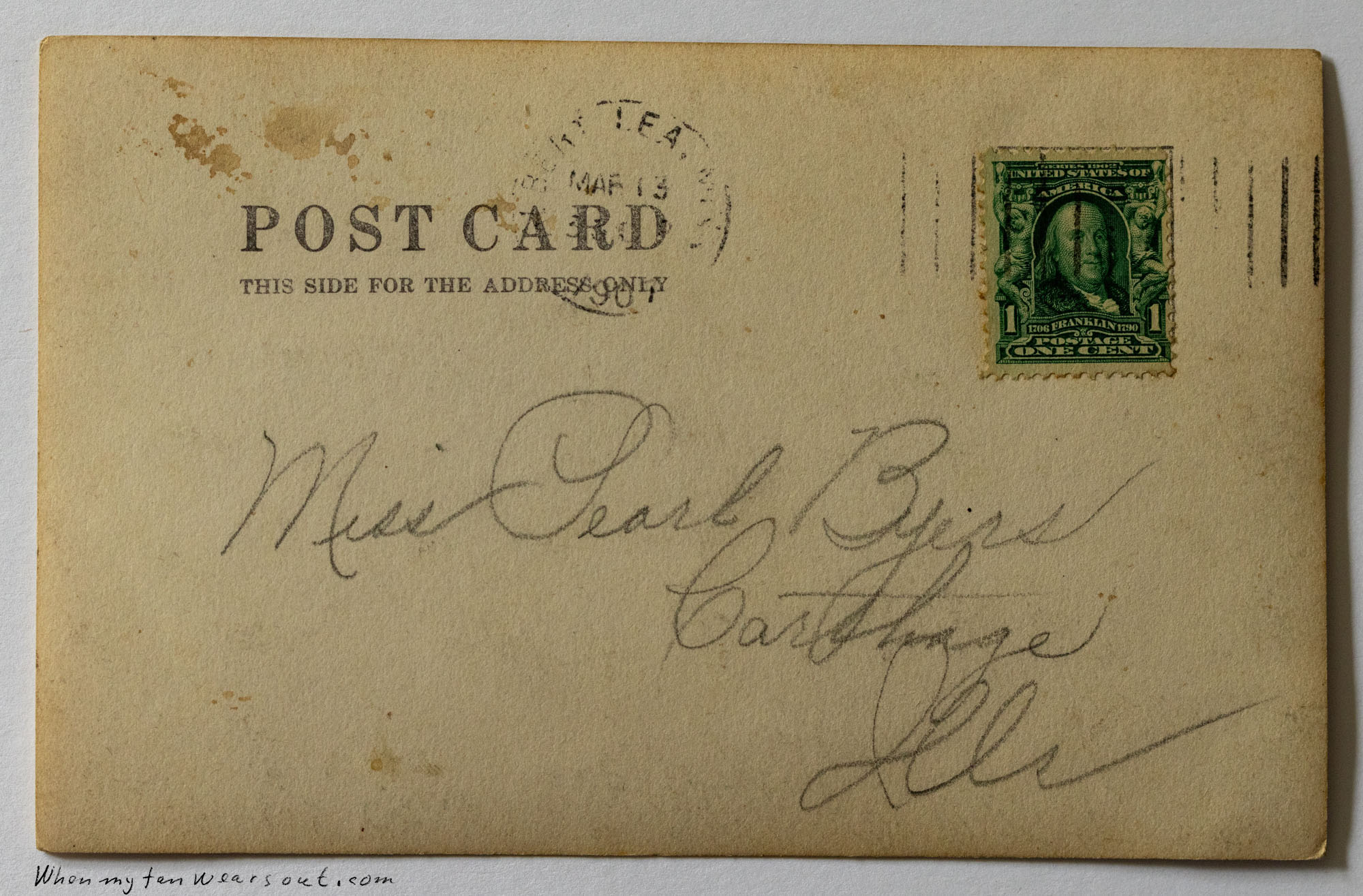
Postcard Metadata
Postmarked: Albert Lea, Minnesota — March 13 (Year not visible, likely post-1907)
Sent From: Albert Lea, Minnesota
Sent To: Miss Pearl Byers, 318 N. Fayette Street, Carthage, Illinois
Distance Traveled: Approximately 390 miles
Postage: 1 Cent U.S. Postage (Benjamin Franklin, green stamp)
Card Details: Divided Back Era (Introduced March 1, 1907)
Back — Correspondence from Harvey Sights to Miss Pearl Byers
Transcription
Going home today. Expect to start from when you get my other postcard. Send me all puss.
Historical & Family Notes
This postcard captures a moment of anticipation as Harvey Sights prepares to return home, presumably to Pearl Byers. Sent from Albert Lea, Minnesota, the message “Going home today” signifies the conclusion of his travels or a temporary stay, and the impending reunion with Pearl. The reference to “my other postcard” suggests an ongoing correspondence, a common method of nurturing their relationship across the miles.
The affectionate closing, “Send me all puss,” underscores the tender and playful nature of their courtship. Such personal and informal expressions reveal a deeper intimacy than standard greetings, hinting at the bond that would eventually lead to their marriage and the start of their family. This card is a tangible piece of their unfolding love story, chronicling the small, daily communications that built their connection.
As a historical artifact, the postcard offers a glimpse into early 20th-century communication and travel. The image of the Albert Lea Court House serves as a backdrop to Harvey’s journey, while the simple yet heartfelt message conveys the human experience of longing and return. It’s a testament to the enduring power of written words to bridge distance and maintain personal connections in a time before instant digital communication.
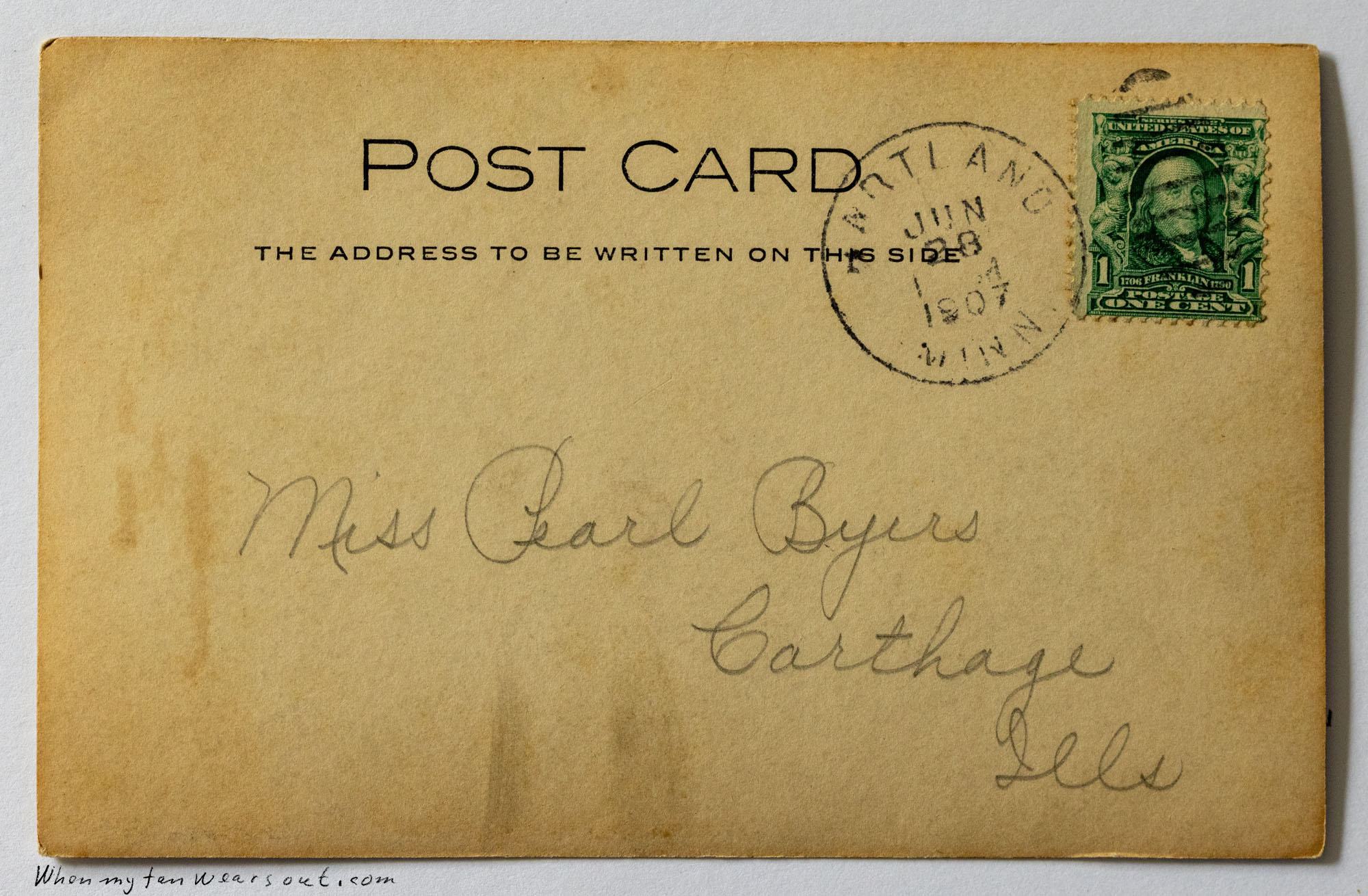
Front — A group of children and a few adults standing outside a one-room schoolhouse with a handwritten message on the left.
Postcard Metadata
Postmarked: Atlanta, Illinois — June 28, 1907
Sent From: Atlanta, Illinois
Sent To: Miss Pearl Byers, Carthage, Ills.
Distance Traveled: Approximately 100 miles (161 km)
Postage: One Cent, U.S. Franklin stamp
Card Details: Divided Back Era (Post Card Act of 1907), message written on front.
Back — Correspondence from Ruth to Miss Pearl Byers
Transcription
This is where I taught while I was a roof mite. Sorry – Ruth
Historical & Family Notes
This charming postcard, sent by “Ruth” to Pearl Byers, offers a vivid snapshot of early 20th-century rural education, depicting a classic one-room schoolhouse. Ruth’s message, “This is where I taught while I was a roof mite,” is a distinctive and intriguing phrase, likely a self-deprecating or affectionate reference to her youth or small stature during her time as a teacher. The photograph captures a group of children and adults, perhaps the students and their families, gathered outside the humble wooden structure.
Postmarked June 28, 1907, the card is an early example from the Divided Back era, which began just months prior with the Post Card Act of 1907 allowing messages on the address side. Despite the new format, Ruth chose to write her message on the front, a common practice during this transitional period as people adapted to the change. The stamp, featuring Benjamin Franklin, further roots the card in its historical context.
While this card does not directly mention Harvey Sights, it provides valuable insight into Pearl Byers’ social circle and the broader world she inhabited before her eventual marriage to Harvey. Correspondence like this from friends and family helps to paint a fuller picture of Pearl’s life experiences and connections during her youth in Carthage, Illinois.
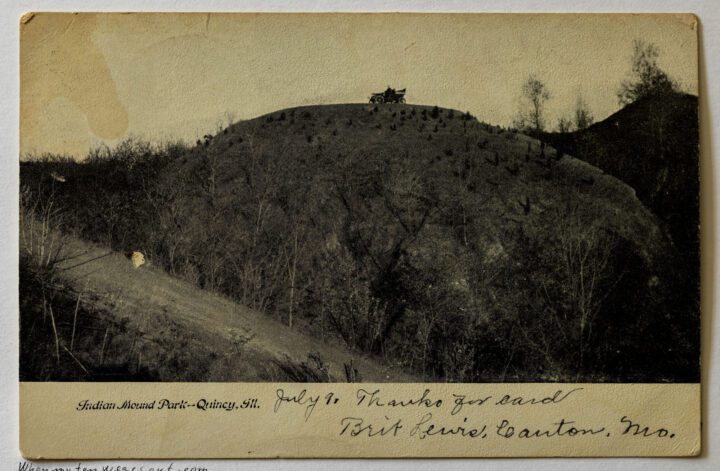
Front — A sepia-toned image shows a dirt road winding up a large, tree-covered Indian Mound with an early automobile parked on top.
Postcard Metadata
Postmarked: Carthage, Illinois — July 19, 1916
Sent From: Canton, Missouri
Sent To: Miss Pearl Byers, Carthage, Ill.
Distance Traveled: Approximately 32 miles
Postage: US 1-cent green Benjamin Franklin stamp (Scott #405)
Card Details: Divided Back era (post-1907)
Back — Correspondence from Brit Lewis to Miss Pearl Byers
Transcription
Indian Mound Park – Quincy, Ill. July 19. Thanks for card. Brit Lewis, Canton, Mo.
Historical & Family Notes
This early postcard sent to Pearl Byers by Brit Lewis captures a glimpse into her life before she met Harvey Sights. While the sender is not Harvey, the card establishes Pearl’s residence in Carthage, Illinois, a setting that would be central to her early adult life. The image of Indian Mound Park in Quincy, a nearby city, illustrates a regional landmark and popular destination, hinting at the shared experiences and local scenery common to young people in the Midwest at the time.
The casual nature of the message, “Thanks for card,” suggests an ongoing correspondence, painting a picture of Pearl’s social circle and the common practice of exchanging postcards to stay in touch. This card, dated July 19, 1916, precedes Pearl’s eventual marriage to Harvey Sights, offering a historical marker of her life during a period of significant social and technological change, reflected in the early automobile atop the mound.
Although a simple note, the postcard adds to the fabric of Pearl’s story, documenting her connections and the daily exchanges that shaped her world before the central chapter of her life with Harvey began. It grounds her in her community and time, showcasing the widespread use of postcards as a primary mode of communication for personal greetings and sharing visual experiences.