Postcard #0047: Chehalis Churches and a Pen Pal’s Bank Job Update


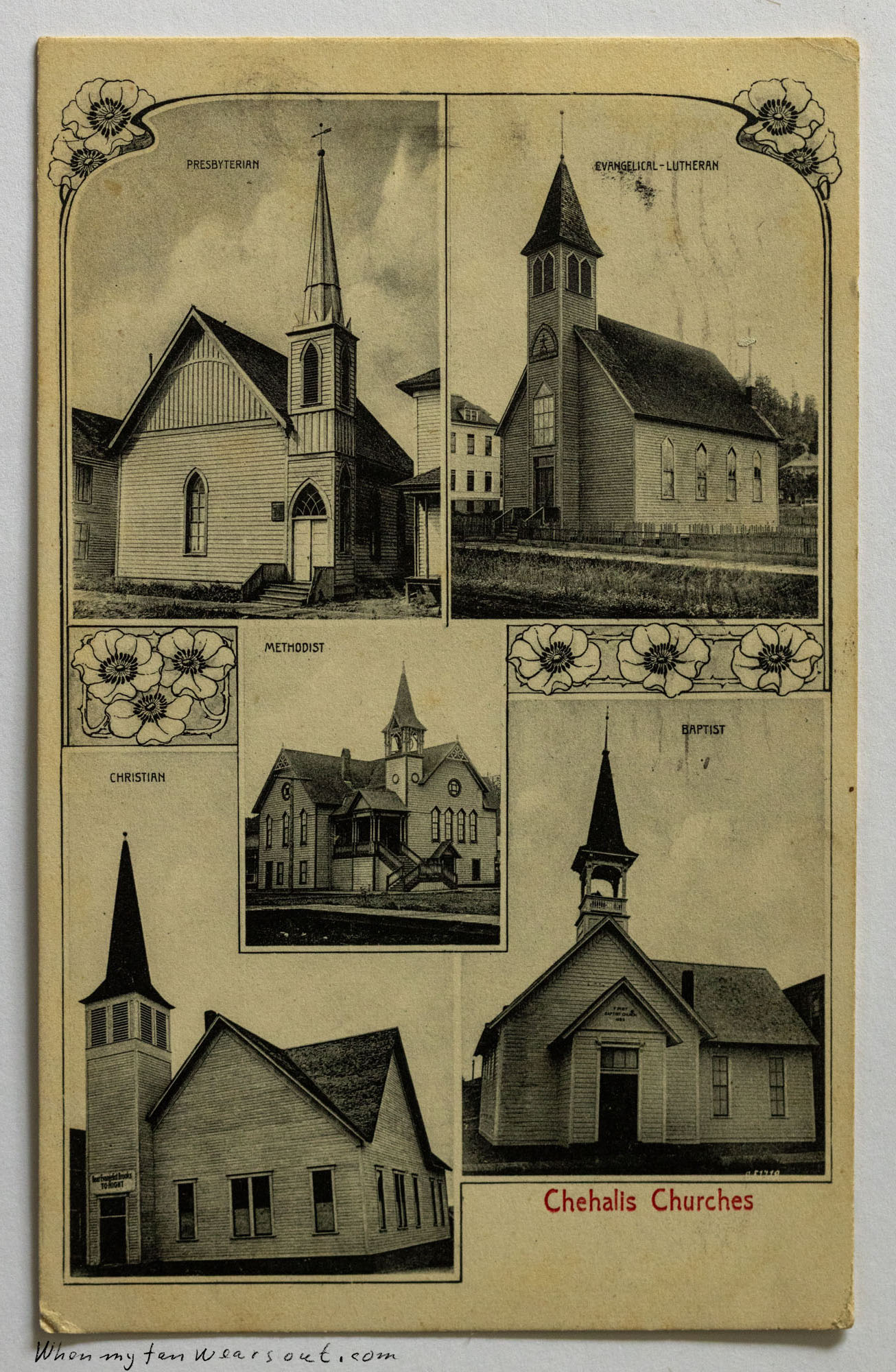
Vintage multi-panel postcard depicting five different church buildings in Chehalis, Washington, with decorative floral borders. The churches include Presbyterian, Evangelical-Lutheran, Methodist, Christian, and Baptist, each shown with their distinct architectural styles.
Front — A multi-panel collage showcasing five different church buildings in Chehalis, Washington, including Presbyterian, Evangelical-Lutheran, Methodist, Christian, and Baptist.

Postcard Metadata


Handwritten message on the back of a vintage postcard, addressed to Miss Pearl Rogers in Carthage, Illinois. The card bears a Chehalis, Washington postmark dated May 2, 1908, and features a one-cent Benjamin Franklin postage stamp, with additional sender information at the top left.
Back — Correspondence from Marguerite G. Lattler (likely) to Miss Pearl Rogers

Transcription

A friend Pearl, I believe one you an answer excuse me for the delay but I thought I had answered. How are you I wish I knew you personally. I have finished school and am working in the Bank in Chehalis. I like it fine.

Historical & Family Notes

This postcard, while part of the Pearl Byers collection, is explicitly addressed to “Miss Pearl Rogers.” Given the project’s primary focus on Pearl Byers of Carthage, Illinois, this discrepancy in the recipient’s surname presents an intriguing genealogical question. It may suggest a previous family name, a different recipient, or a common addressing variation of the era, inviting further research into its precise connection to Pearl Byers’ personal archives.

The sender, likely Marguerite G. Lattler from Chehalis, Washington, apologizes for a delayed reply, indicating a pre-existing correspondence between the two. Her message provides a snapshot of life in the early 20th century, sharing personal news of finishing school and beginning a new job at a local bank in Chehalis. The expression “I wish I knew you personally” suggests their relationship might have been primarily through letters or distant acquaintance, rather than close physical proximity.

The significant distance between Chehalis, Washington, and Carthage, Illinois, highlights the importance of postcards as a primary means of long-distance communication and maintaining social connections during this period. The card offers a glimpse into the sender’s new career path and general well-being, sharing a common theme of personal updates exchanged across vast geographical divides.

Continue Reading

Postcard #0026: Roosevelt’s Cabin and a Baptism Reminder from Fargo


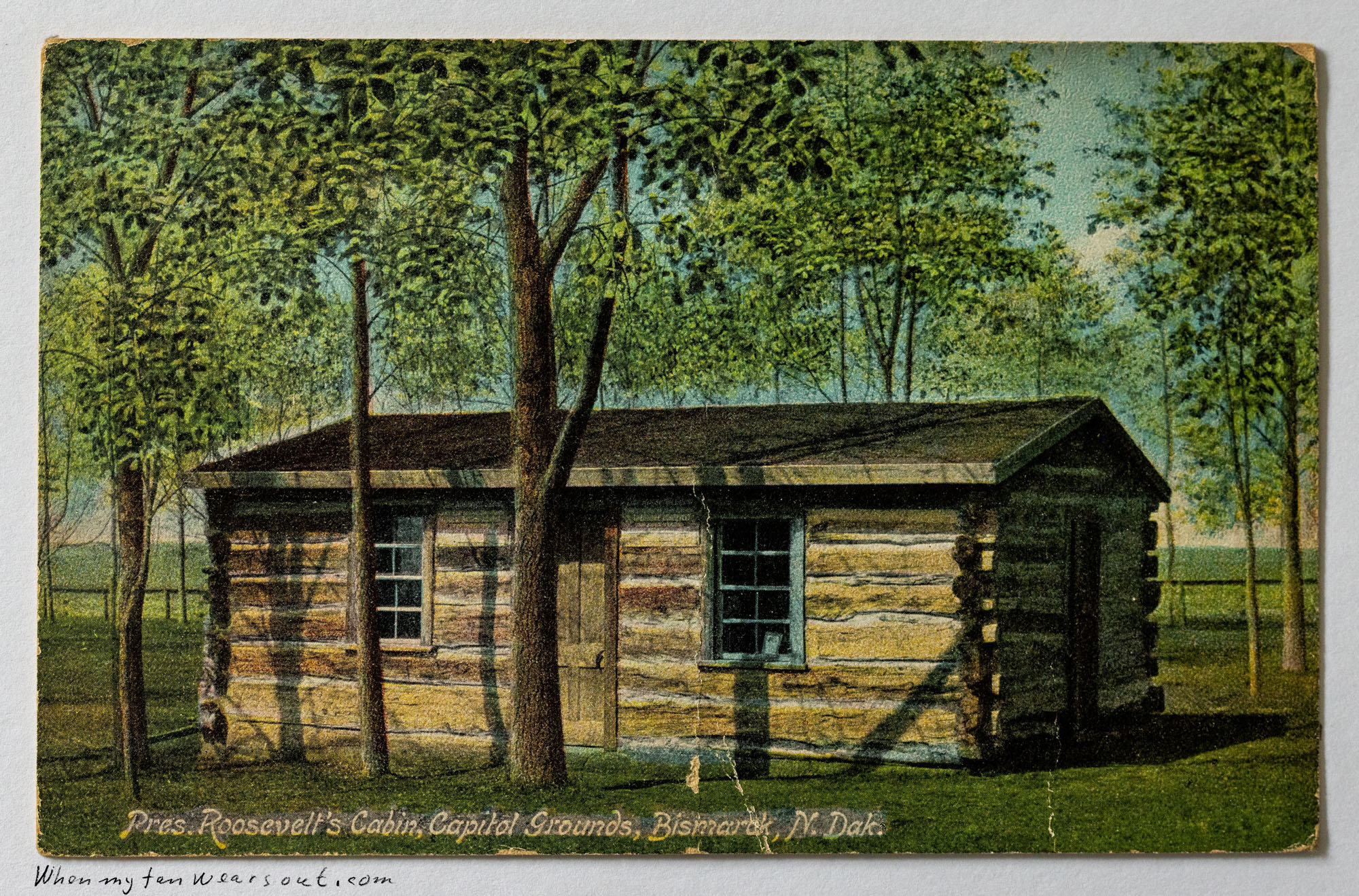
A vintage colorized postcard showing President Theodore Roosevelt's log cabin on the Capitol Grounds in Bismarck, North Dakota. The rustic cabin is made of horizontal logs with two windows and a door, nestled among numerous green trees under a bright blue sky.
Front — A colorized postcard image of President Theodore Roosevelt’s log cabin on the Capitol Grounds in Bismarck, North Dakota, surrounded by trees.

Postcard Metadata


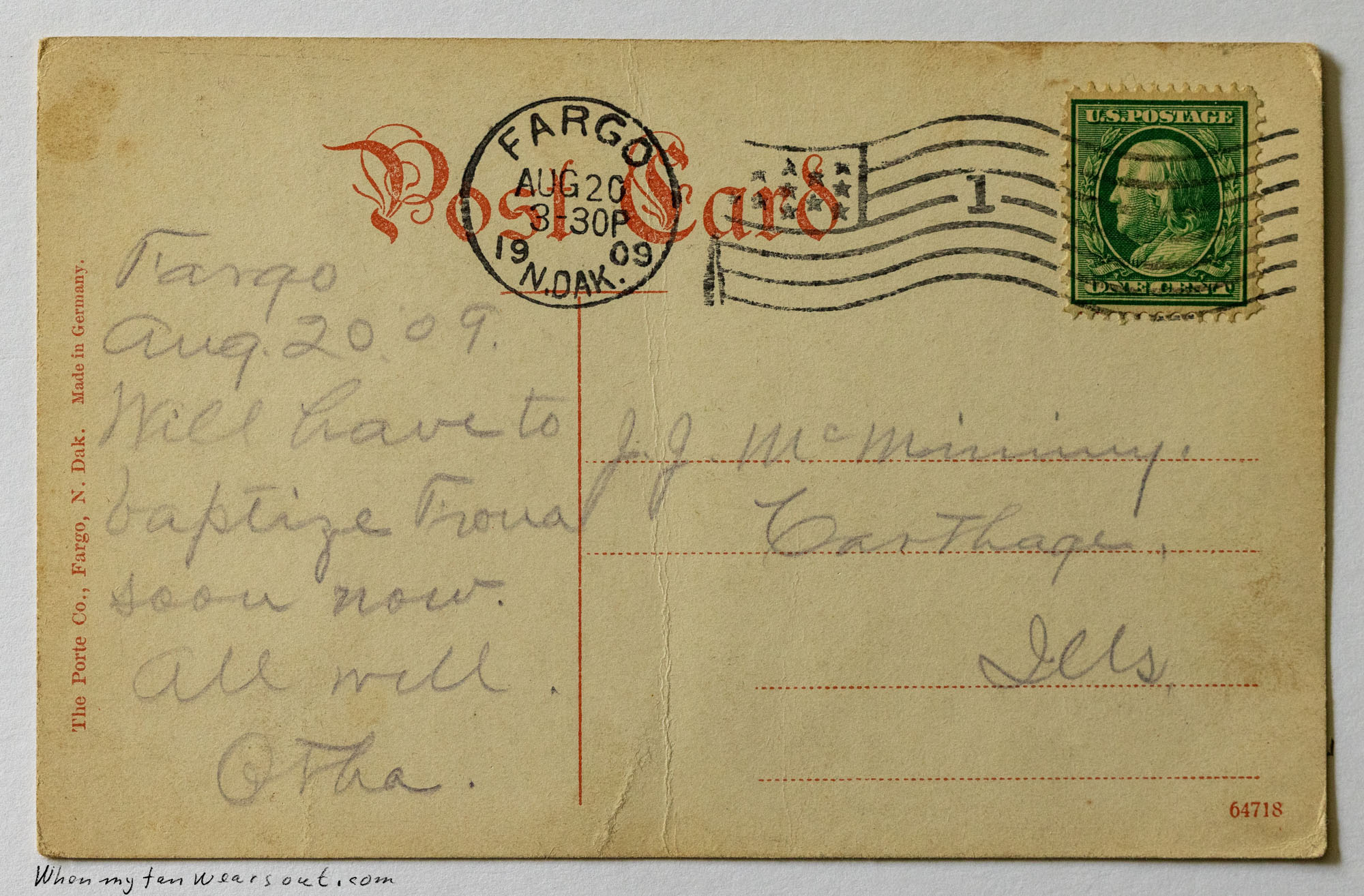
The back of a 1909 divided-back postcard with a green one-cent George Washington stamp postmarked Fargo, North Dakota, August 20, 1909. Handwritten in cursive is a message from 'Otha' to 'Miss J.D. McMinniny' in Carthage, Illinois, discussing a baptism.
Back — Correspondence from Otha to Miss J.D. McMinniny

Transcription

Fargo Aug. 20. 09. Will have to baptize Fronna soon now. All well. OTha.

Historical & Family Notes

This postcard, sent from Fargo, North Dakota, by “Otha” to Miss J.D. McMinniny in Carthage, Illinois, offers a snapshot of life in 1909. While the recipient is not Pearl Byers, the destination of Carthage, Illinois, links this card to Pearl’s hometown, suggesting a potential connection through extended family or shared acquaintances within her community. The brief message hints at an upcoming family event, stating, “Will have to baptize Fronna soon now,” indicating a significant personal or religious occasion.

The front of the postcard features a popular historical landmark, President Theodore Roosevelt’s cabin on the Capitol Grounds in Bismarck, North Dakota. Roosevelt’s deep ties to North Dakota through his ranching days made this a recognizable and popular image for early 20th-century postcards, showcasing the historical significance and natural beauty of the region.

The card’s “Made in Germany” notation underscores the global nature of postcard production at the time, with many high-quality, colorized cards being printed abroad for the American market. Such cards provided an efficient way for people to send quick updates and maintain connections across distances, as demonstrated by Otha’s concise but meaningful message.

Continue Reading