
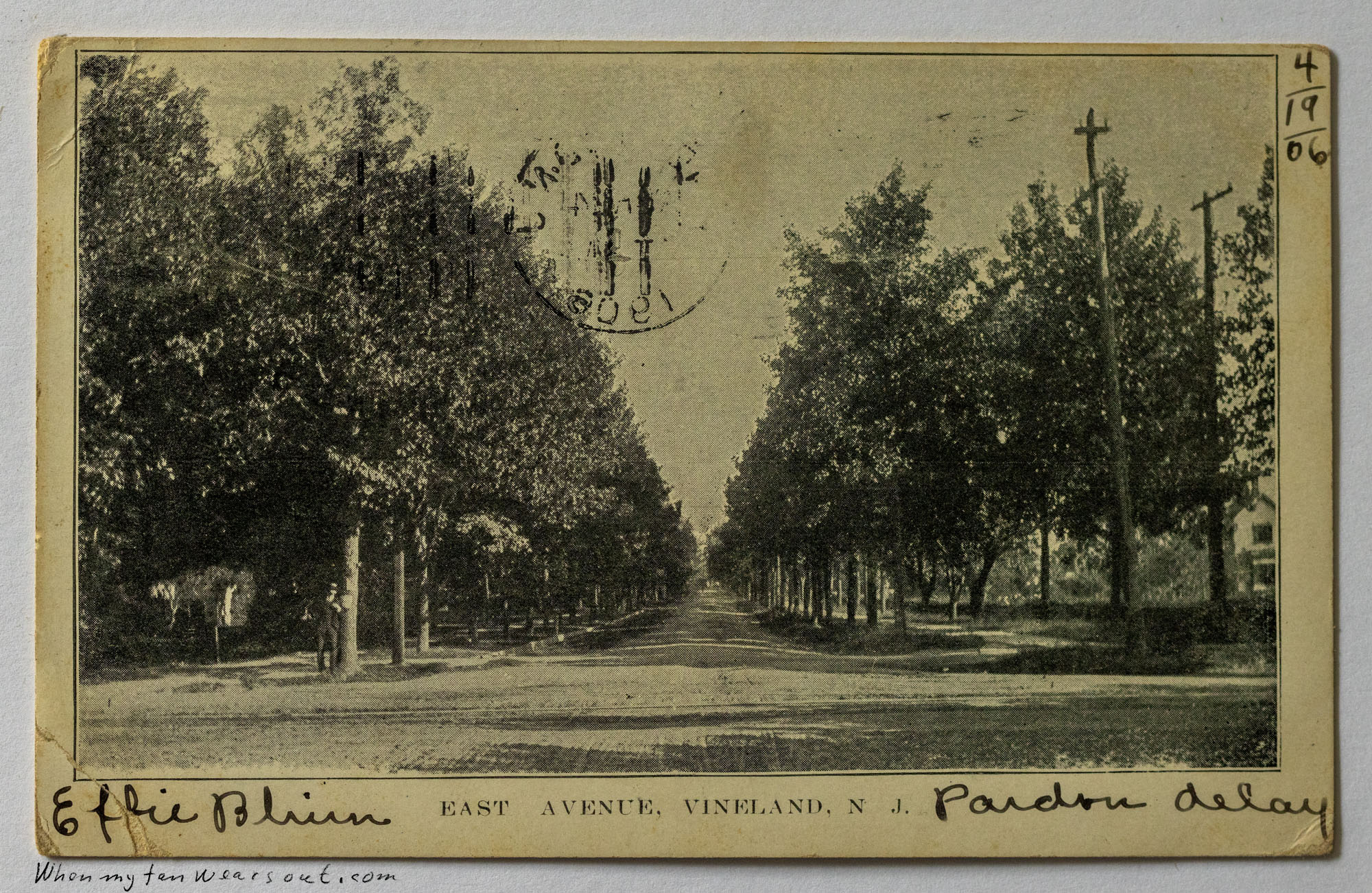
Postcard #0055: East Avenue Vineland, with an Apology for Delay


A vintage black and white postcard image showing a wide, unpaved road, East Avenue, in Vineland, New Jersey, flanked on both sides by a dense row of tall, mature deciduous trees creating a canopy overhead. The road recedes into the distance, almost disappearing at the horizon. On the left side of the road, a lone figure in dark clothing stands near a tree trunk. On the right, several utility poles with visible lines run parallel to the road. The bottom border of the card has handwritten text
Front — A tree-lined East Avenue in Vineland, New Jersey, featuring a path flanked by utility poles.

Postcard Metadata


The back of a vintage postcard with a beige background. The words
Back — Correspondence from Effie Blinn to Effie Byers

Transcription

Effie Blinn Pardon delay

Historical & Family Notes

This early 20th-century postcard captures a serene tree-lined street in Vineland, New Jersey, a common subject for postcards of the era. The brief message “Pardon delay” suggests a simple, informal exchange, perhaps between friends or family. The card is addressed to Effie Byers in Carthage, Illinois, indicating a connection to the Byers family collection, although it’s not directly addressed to Pearl Byers, the primary recipient of this archive. It’s plausible Effie Byers was a relative, such as a sister or mother, in Carthage, broadening the familial scope of the collection.

The sender, Effie Blinn, likely a friend or acquaintance, took 17 days for this postcard to travel from Vineland, New Jersey to Carthage, Illinois, arriving on May 11, 1906. This travel time was typical for mail delivery across states in the early 1900s. The card itself is noteworthy as an early example of a “divided back” postcard, a design that allowed both the address and a written message on the back, even though the official postal regulation permitting this for domestic mail began nearly a year later in March 1907.

While this specific card doesn’t directly feature Pearl Byers or Harvey Sights, its presence in the collection offers a glimpse into the broader network of friends and family connected to the Byers household in Carthage, Illinois. These small, everyday communications paint a picture of daily life and relationships that would eventually intertwine with Pearl and Harvey’s own story.
Continue Reading

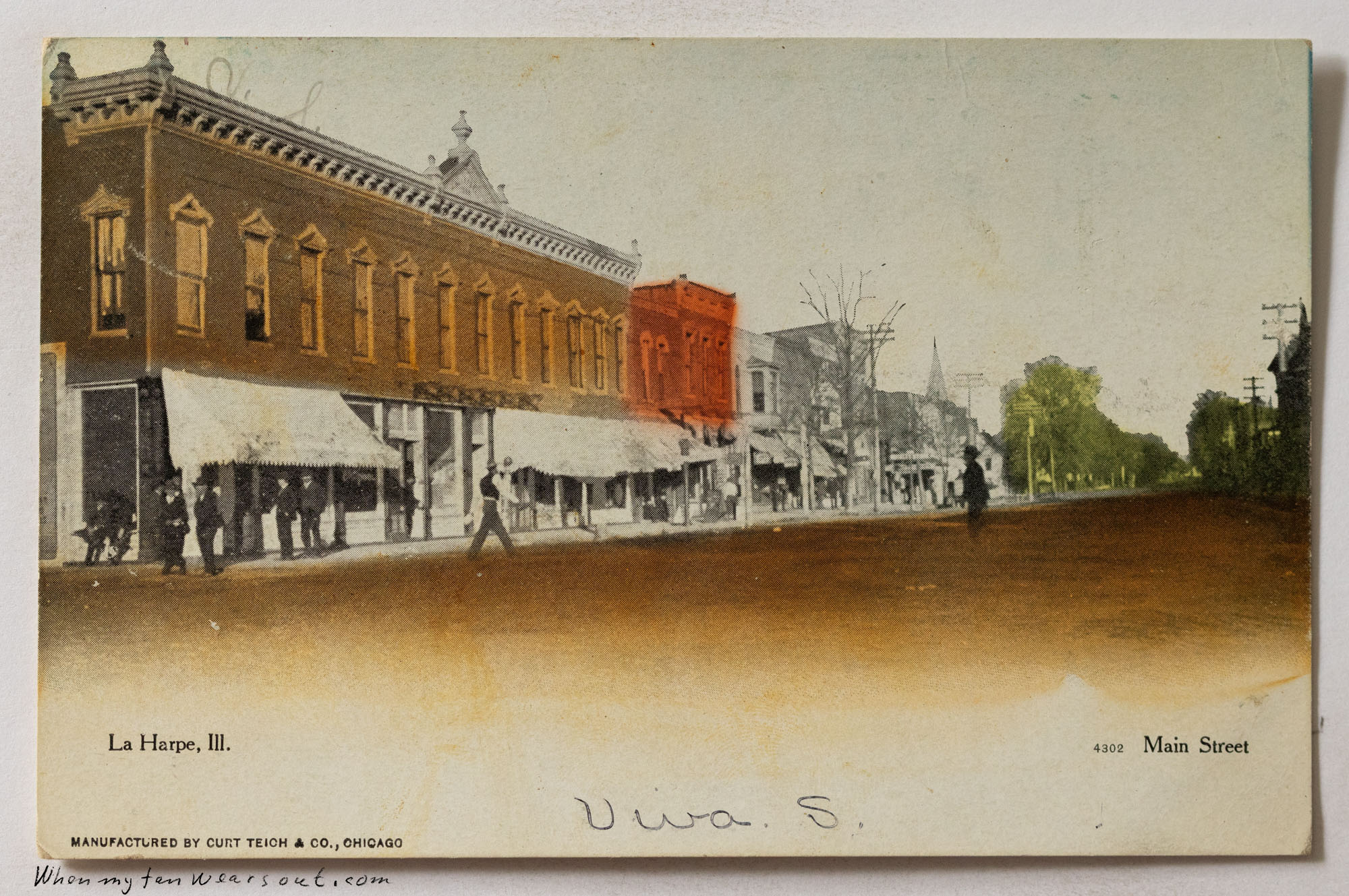
Postcard #1073: A Brief ‘Viwa. S.’ from La Harpe’s Main Street


A vintage postcard depicting a lively Main Street in La Harpe, Illinois, circa early 1900s. The street is lined with multi-story brick buildings, some featuring striped awnings over ground-level shops. People are visible walking on the sidewalks and in the street. A prominent three-story brick building, partially hand-colored in red, stands further down the street. The sky is light, and trees are visible in the distance. The bottom left corner reads
Front — A bustling view of Main Street in La Harpe, Illinois, featuring storefronts with awnings and a partially colorized brick building.

Postcard Metadata


The reverse side of the postcard features the standard
Back — Correspondence from Viwa S. to Miss Pearle Byers

Transcription

Viwa. S.

Historical & Family Notes

This early postcard, sent to the young Miss Pearle Byers, offers a quick glimpse into her social world during her formative years. The card features a common street scene of the era from nearby La Harpe, Illinois, a familiar type of imagery used for brief communications. The message, simply “Viwa. S.” on the front of the card, is characteristic of the concise messages exchanged on undivided back postcards where space for writing was limited.

Originating from Burnside, a mere 11 miles from Carthage, this card likely came from a local acquaintance or friend, Viwa S., whose brief greeting is preserved in this collection. These everyday interactions paint a picture of Pearl’s life before her marriage to Harvey Sights, highlighting the connections she maintained within her immediate community.

The postcard itself is an excellent example of the transitional period in postcard history. Though postmarked in June 1907, after divided backs were permitted, its layout with “NOTHING BUT THE ADDRESS ON THIS SIDE” firmly places it stylistically within the Undivided Back era, suggesting an older card still in circulation.

Continue Reading