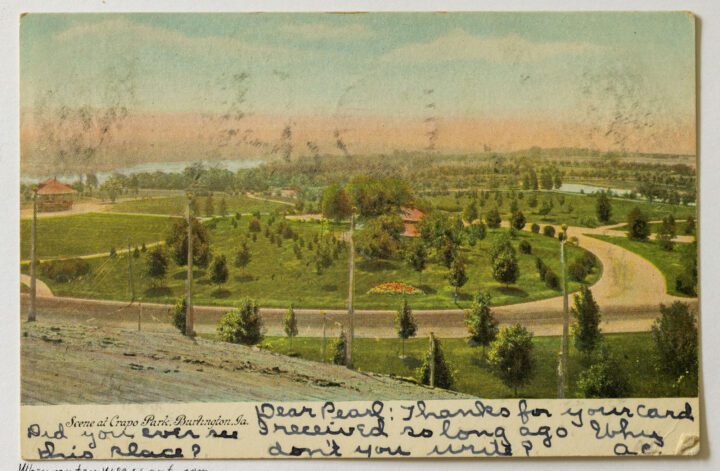
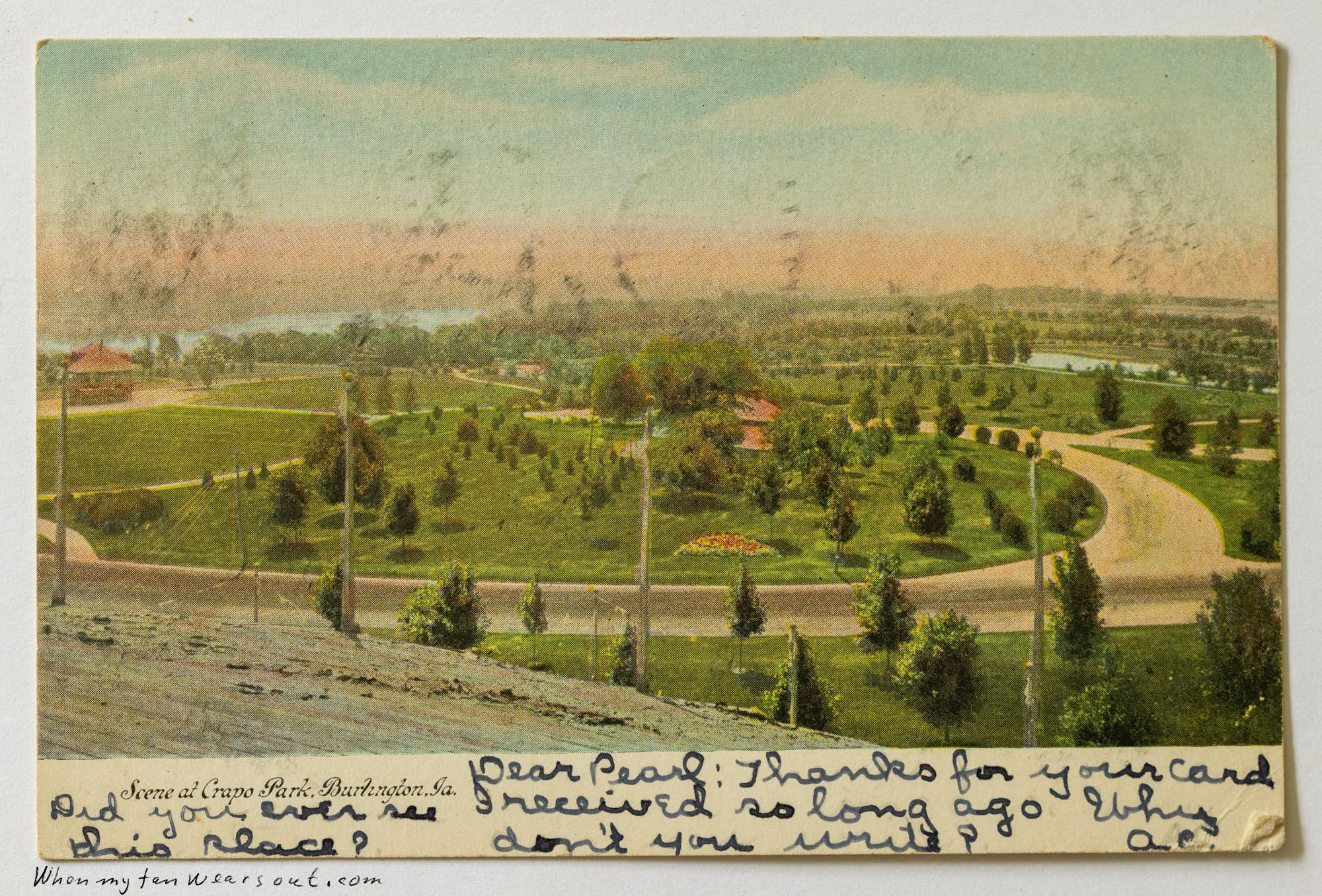
Postcard #0084: Crapo Park, Burlington, IA — A C to Pearl, July 1907

Front of postcard #0084: Illustrated postcard showing an elevated, wide scenic view of Crapo Park in Burlington, Iowa. Features lush green lawns,

Transcription

Front — Did you ever see this place? Dear Pearl: Thanks for your card received so long ago Why don’t you write? A C.

Back of postcard #0084

Postcard Information

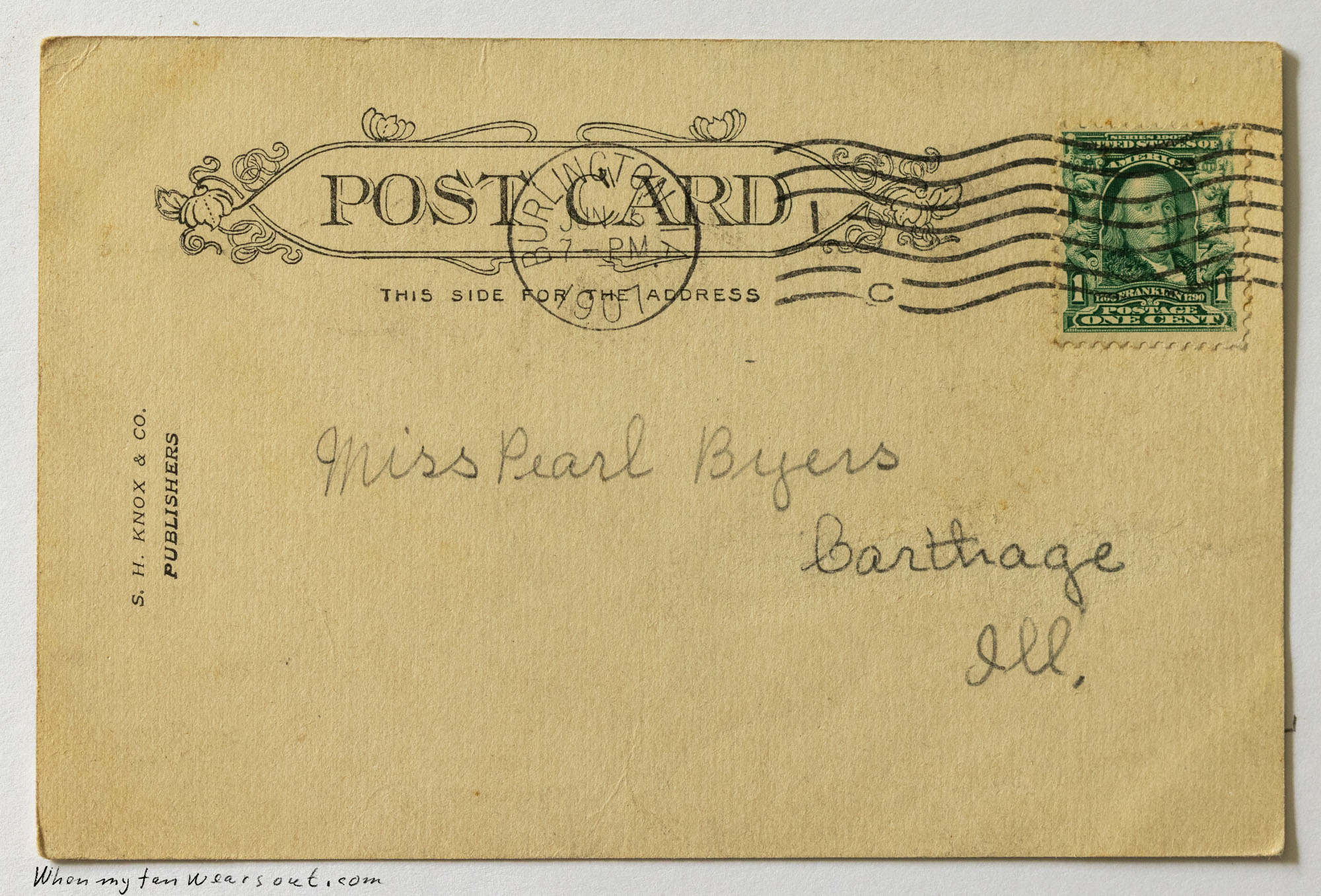
  • Postmark: Burlington, IA., JUL 27 1907
  • Sent To: Carthage IL
  • Era: Undivided Back (Pre-1907)
  • Publisher: S. H. KNOX & CO.
  • Stamp: 1¢
  • Distance Traveled: ~30 miles
  • Notes: message written on front instead of back

About This Card

Crapo Park in Burlington, Iowa was donated to the city by the family of Michigan Governor Henry Howland Crapo in the 1890s, developed from land along the bluffs above the Mississippi. By the time A.C. sent this card in July 1907, Crapo Park was already considered one of the finest municipal parks on the upper Mississippi — a winding drive through mature trees above the river, with pavilions, a small zoo, and Black Hawk Spring, a natural spring with a storied Sauk history. Burlington had been a prosperous railroad and manufacturing city since the Civil War, and the park was an expression of that prosperity.
Continue Reading

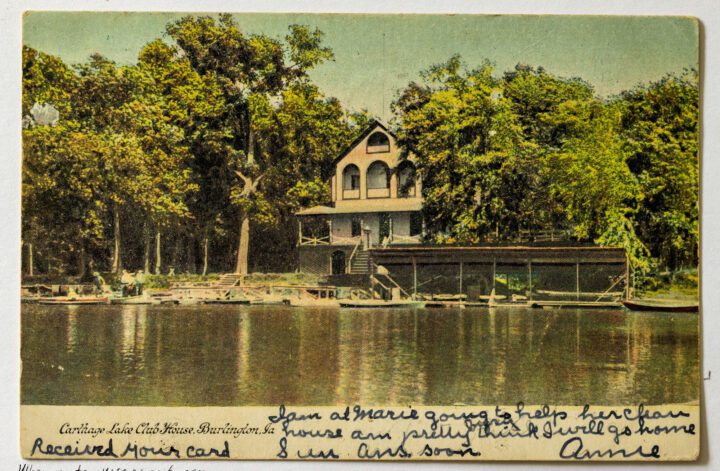
Postcard #0083: Carthage Lake Club House in Burlington, Burlington, IA — Annie to Pearl, June 1907

Front of postcard #0083: Color illustration depicting the Carthage Lake Club House in Burlington, Iowa, a multi-story building with arched upper

Transcription

Front — Received your card I am at Marie going to help her clean house am pretty tired think I will go home Sun Ans. soon. Annie

Back of postcard #0083

Postcard Information

  • Postmark: Burlington, IA., JUN 14 1907
  • Sent To: Carthage IL
  • Era: Undivided Back (Pre-1907)
  • Publisher: S. H. KNOX & CO.
  • Stamp: 1¢
  • Distance Traveled: ~30 miles
  • Notes: Message written on front instead of back due to undivided back format.
Continue Reading

Postcard #0080: landscape illustration depicting a stream flowing between tr, Lebanon, KS — aunt Susie to Pearl, September 1906

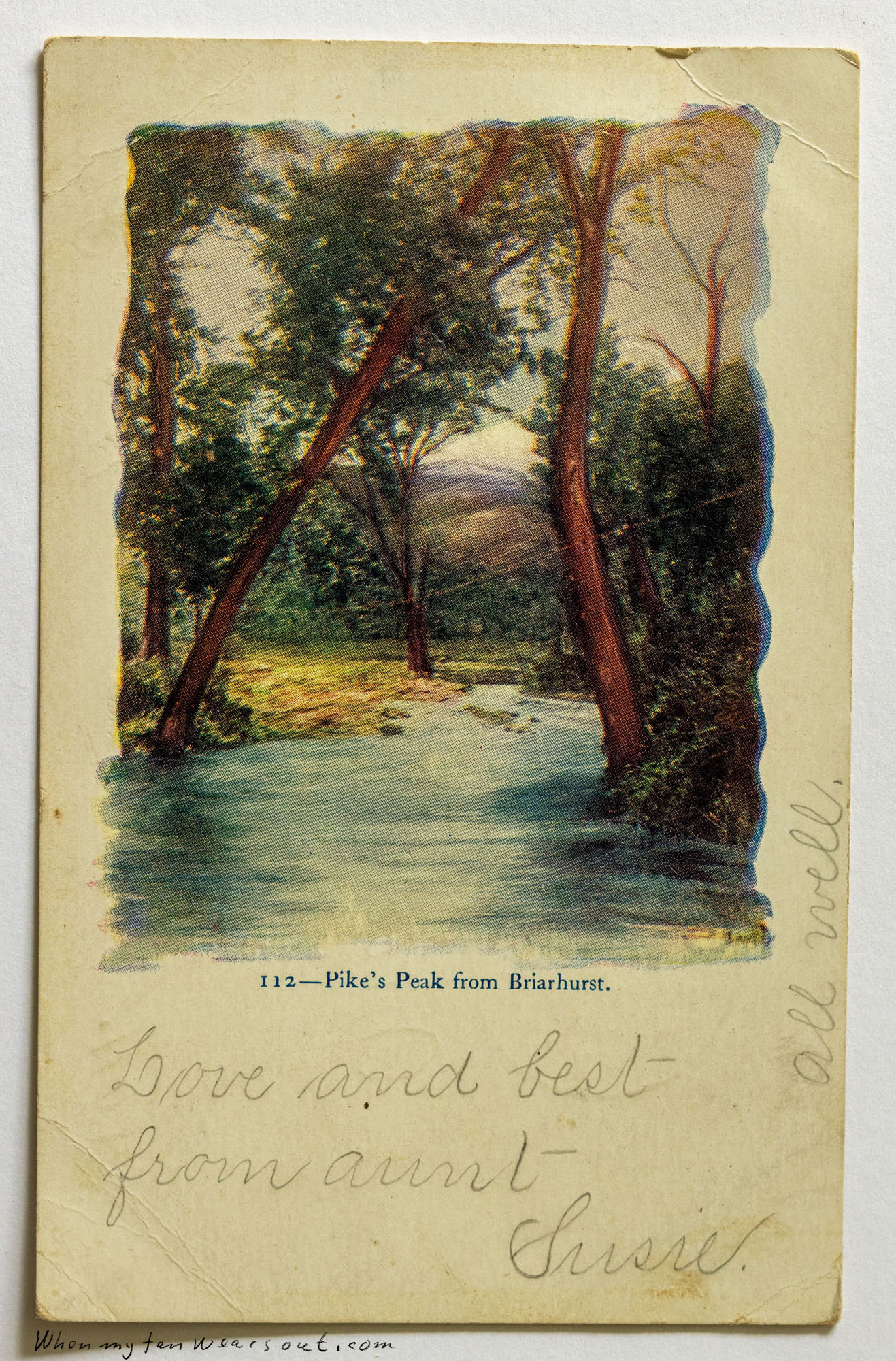
Front of postcard #0080: Colored landscape illustration depicting a stream flowing between trees, with a mountain peak (Pike's Peak) visible in t

Transcription

Front — Love and best from aunt Susie. all well.

Back of postcard #0080

Postcard Information

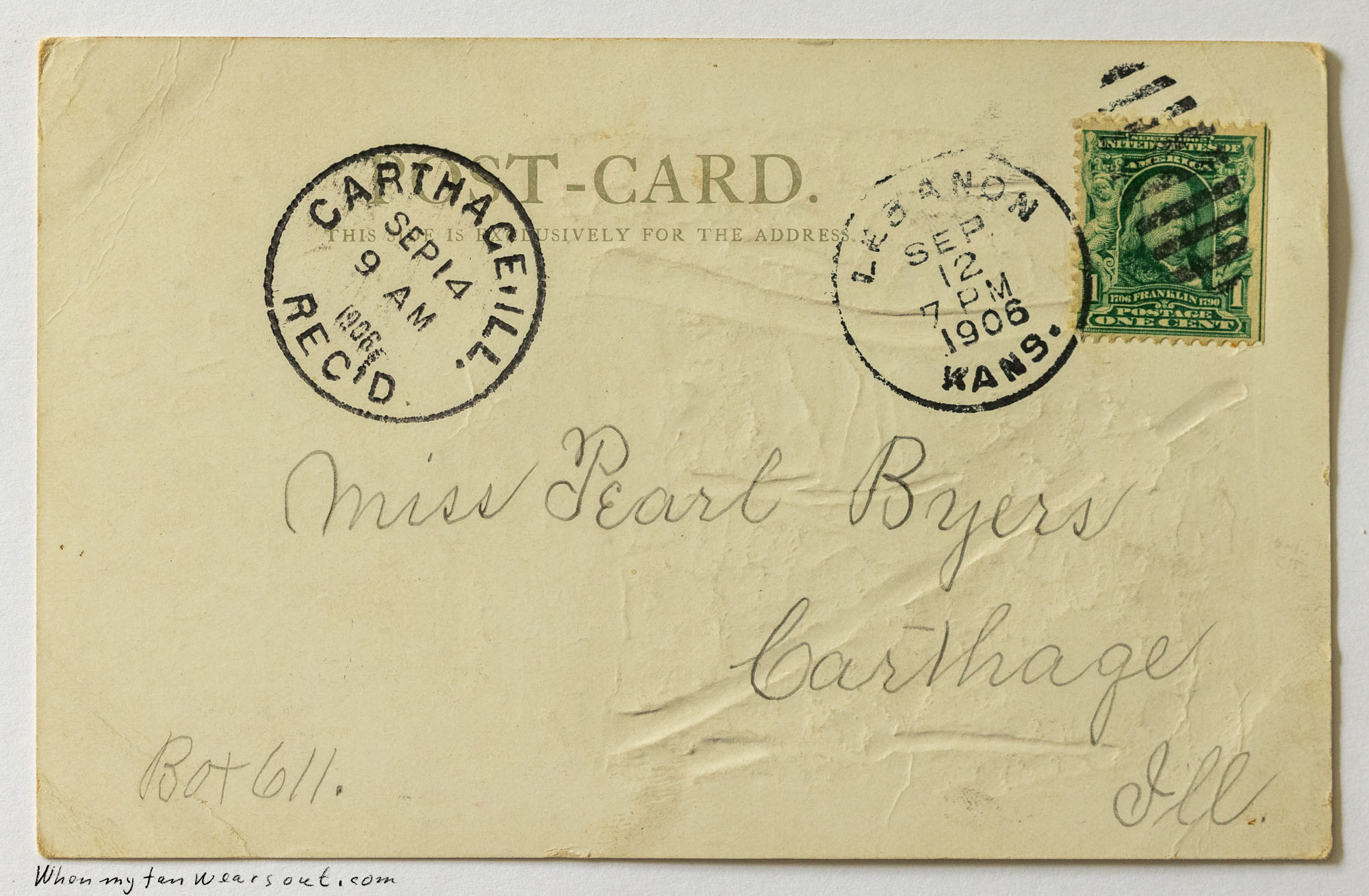
  • Postmark: Lebanon, KANS., SEP 12 1906
  • Sent To: Carthage IL
  • Era: Undivided Back (Pre-1907)
  • Stamp: 1¢
  • Distance Traveled: ~380 miles
  • Notes: message written on front instead of back, receiving postmark present from Carthage IL (SEP 14 1906)
Continue Reading

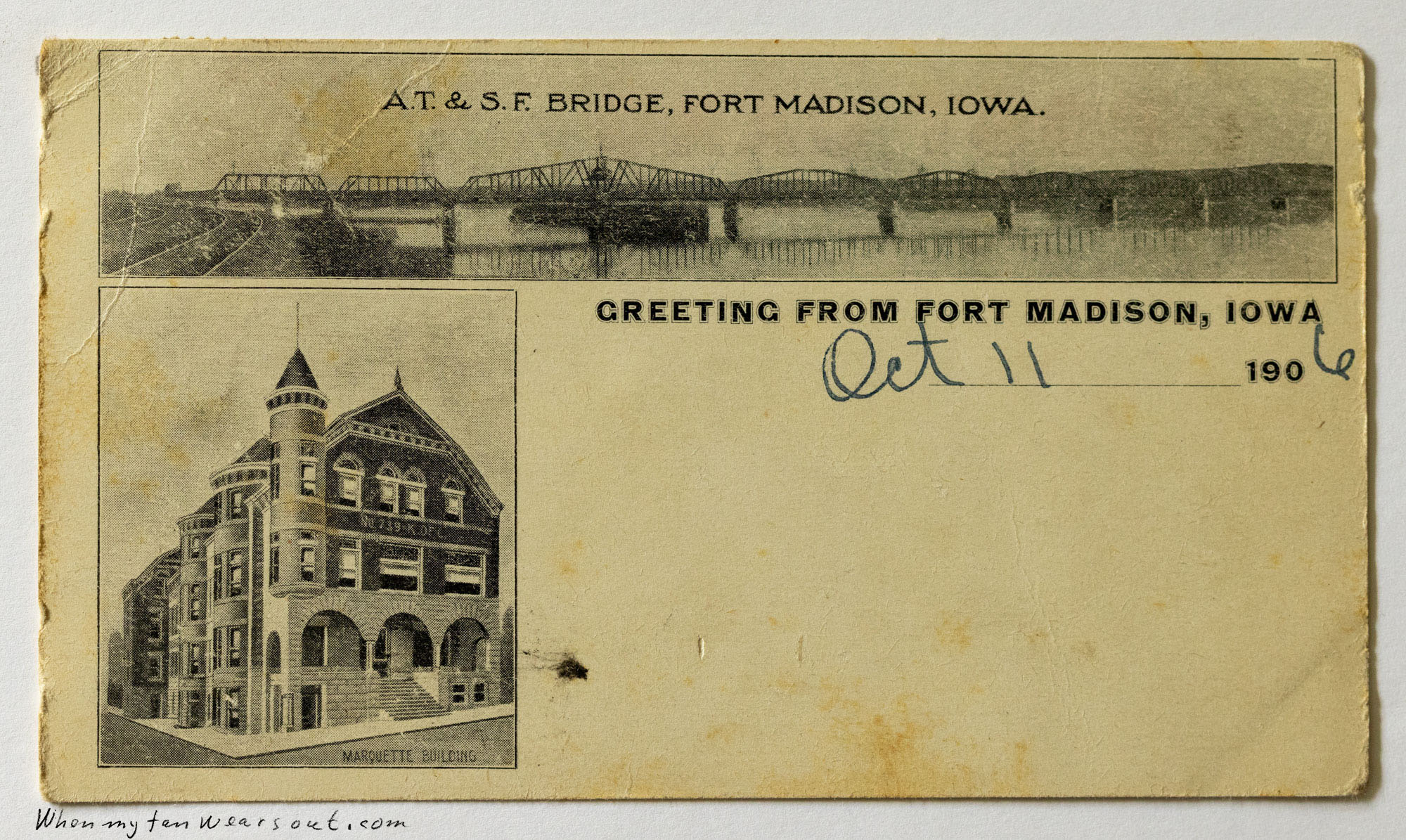
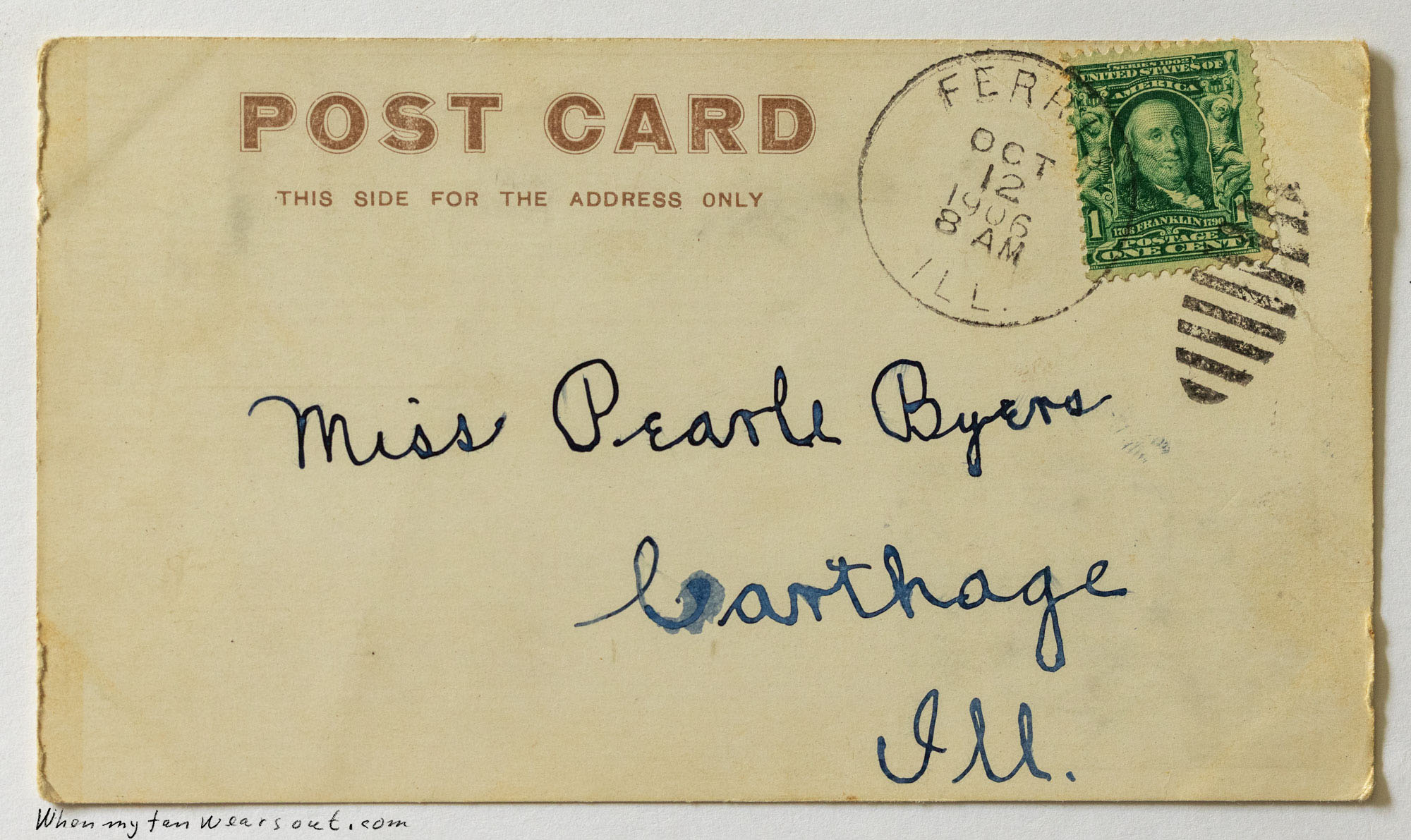
Postcard #0078: Pine Street looking south in Fort Madison, Wever, IA — Violet to Pearl, June 1908

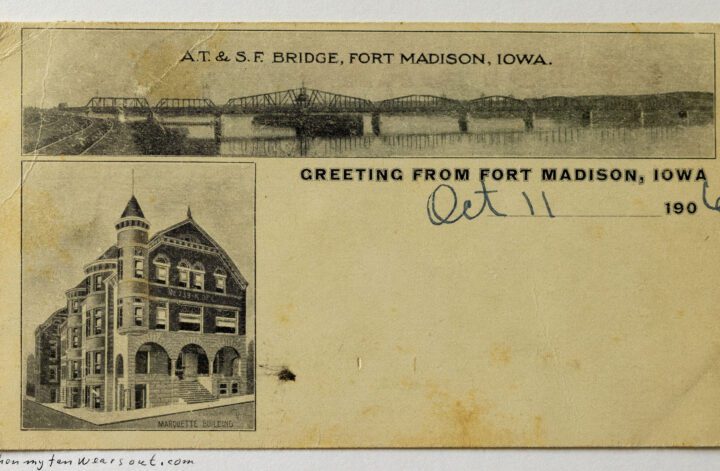
Front of postcard #0078: Color illustration of Pine Street looking south in Fort Madison, Iowa, featuring a prominent brick building with a conic

Transcription

Front — ] mayme.

Back — ] "Better late than never" but I would have answered sooner if I’d had any cards. I haven’t as pretty a card to send as the one I rec’d from you, for that violet postal was certainly pretty. I liked it fine. Don’t you think all had a fairly good time yesterday afternoon, at least what we done kept us pretty busy. How is the Children’s Day exercises. I’ve got a job today I don’t like very well – helping Mamma pick up cherries. Ans. soon as ever. – Violet.

Back of postcard #0078

Postcard Information

  • Postmark: Wever, Iowa, JUN 8 1908
  • Sent To: Carthage IL
  • Era: Undivided Back (Pre-1907)
  • Publisher: Axt Drug Co., Fort Madison, Iowa
  • Stamp: 1¢
  • Distance Traveled: ~25 miles
  • Notes: Hand-drawn dividing line on back, message written on front margin

About This Card

Pine Street in Fort Madison, looking south from this vantage, shows the kind of small-city commercial vitality that characterized river towns along the upper Mississippi in the early twentieth century. Fort Madison had grown up around an early American fort — the original Fort Madison, the first U.S. military post in what would become Iowa, was destroyed and abandoned in 1813 after repeated Sauk attacks during the War of 1812. The town that took its name later that century had no direct connection to the military installation; it simply kept the name. Five years after Violet sent this card, Walter Sheaffer would open his pen factory nearby, and Pine Street’s commercial character would begin to shift.

Continue Reading

Postcard #0073: Keokuk and Hamilton Bridge, Not Visible — Jean to Pearl

Front of postcard #0073: Black and white photograph of the Keokuk and Hamilton Bridge spanning a wide river, with wooded hills in the background.

Transcription

Front — July 8, 1907. Love no boys, except your brother If girls must love, love one another Jean. Hry[?]

Back of postcard #0073

Postcard Information

  • Postmark: NOT VISIBLE, NOT VISIBLE, NOT VISIBLE
  • Sent To: Carthage IL
  • Era: Undivided Back (Pre-1907)
  • Publisher: THE ALBERTYPE CO., Brooklyn, N.Y.
  • Stamp: NOT VISIBLE — Stamp is missing but printed box is visible.
  • Distance Traveled: Undetermined
  • Notes: Message written on front instead of back, Undivided back card, No postmark or stamp.
Continue Reading

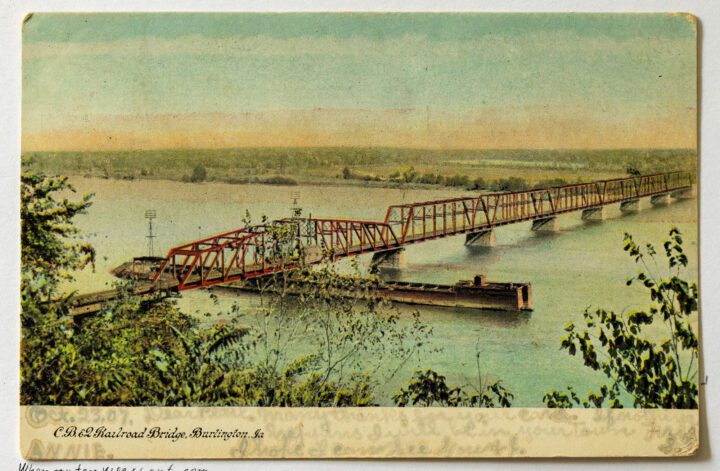
Postcard #0072: Railroad Bridge — Annie to Pearl, October 1907

Front of postcard #0072: Hand-colored postcard showing the C. B. & Q. Railroad Bridge, a long red metal truss bridge spanning a wide river at Bur

Transcription

Front — Oct.23.07. Dear Pearl. many thanks for your card. If nothing prevents I will be in your town Friday I hope I can see you. ANNIE

Back of postcard #0072

Postcard Information

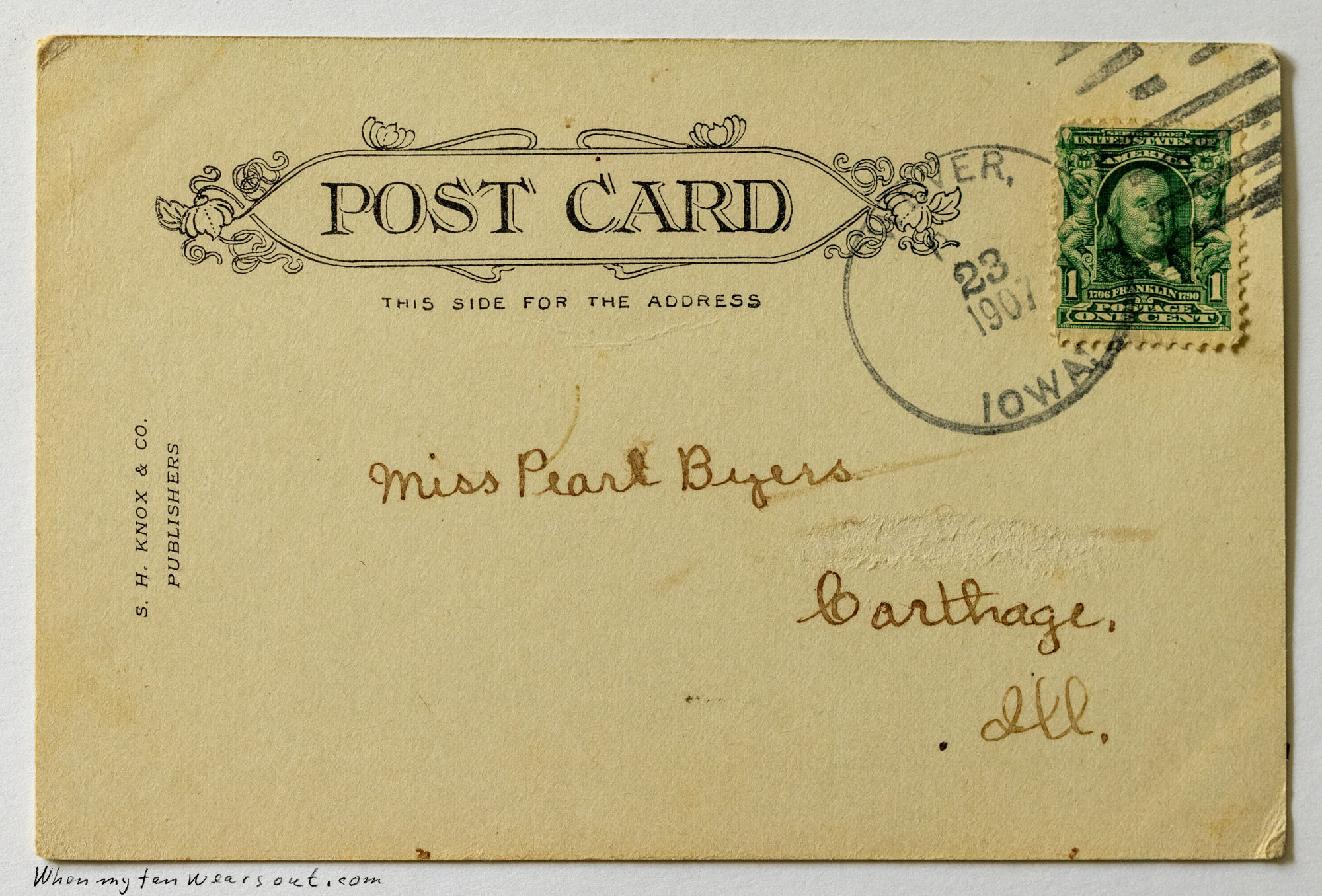
  • Postmark: IOWA, OCT 23 1907
  • Sent To: Carthage IL
  • Era: Undivided Back (Pre-1907)
  • Publisher: S. H. KNOX & CO. PUBLISHERS
  • Stamp: 1¢
  • Distance Traveled: Undetermined
  • Notes: message written on front instead of back
Continue Reading

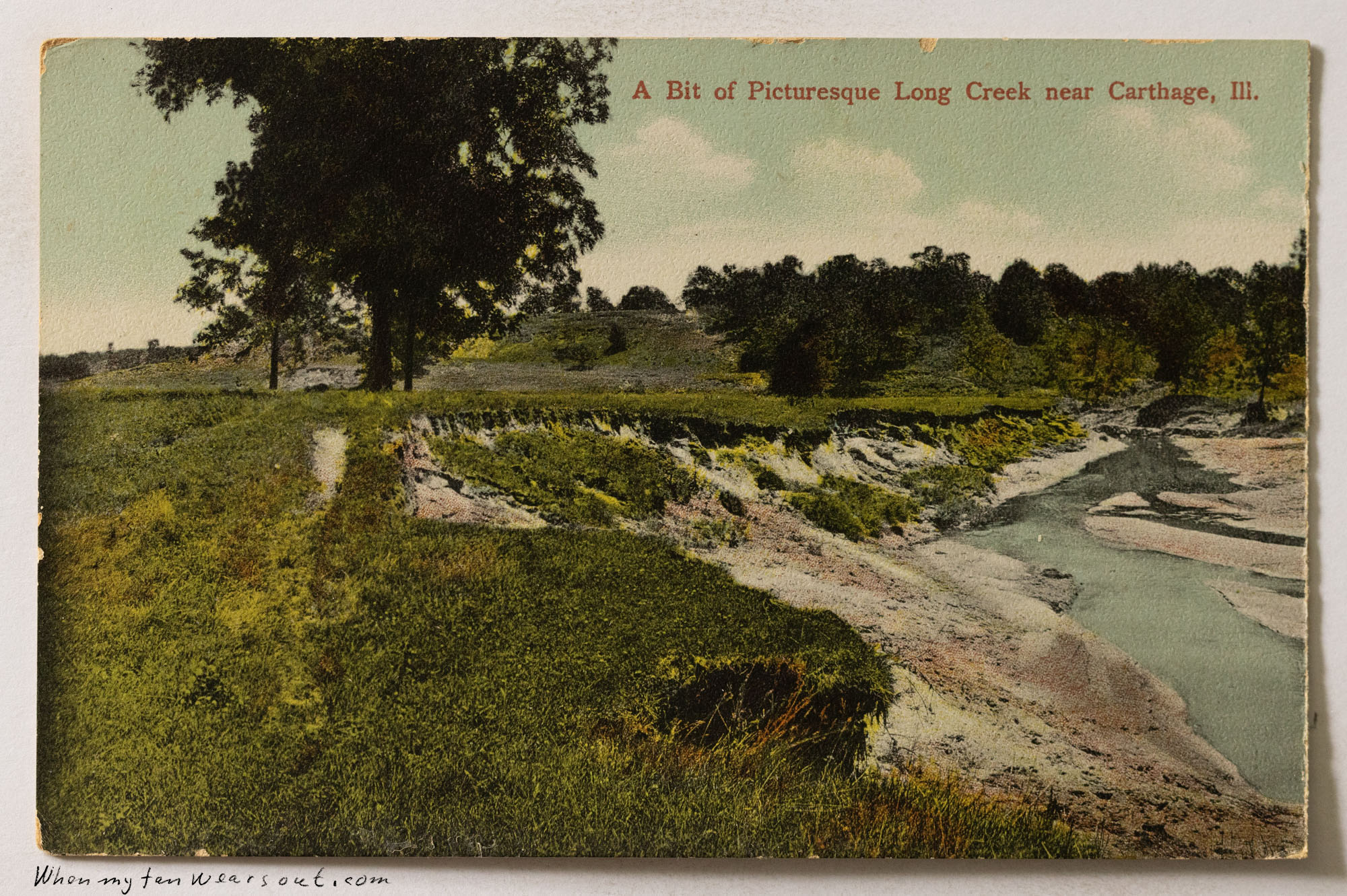
Postcard #1079: landscape view of Long Creek near Carthage, Carthage, IL — October 1909

Front of postcard #1079: Hand-colored landscape view of Long Creek near Carthage, Illinois. The image shows a wide, shallow creek bed with muddy

Transcription

Back — Before 1910

Back of postcard #1079

Postcard Information

  • Postmark: Carthage, ILL., OCT 20 1909
  • Sent To: Carthage IL
  • Era: Undivided Back (Pre-1907)
  • Publisher: Ed. Hoch, Importer and Publisher, Carthage, Ill.
  • Print Origin: Printed in Germany
  • Stamp: 1¢ — Two identical 1¢ stamps.
  • Distance Traveled: Local mail
  • Notes: Two 1¢ stamps used on a single card; card is an undivided back style design despite being mailed in 1909; contains a handwritten pencil note "Before 1910" at the top of the back which appears to be a later addition.

About This Card

Long Creek near Carthage appears in the collection multiple times across different decades — Harvey sending a card of it from La Harpe before their wedding, Pearl’s mother sending a view later, and now this hand-colored landscape postmarked from Carthage in the linen era. Long Creek was the natural feature closest to both of their hometowns: it ran through the farm country between Carthage and La Harpe, and it was the kind of creek people knew by name because they crossed it regularly. This unsigned card was sent by an unsigned sender — the creek speaks for itself.

Continue Reading

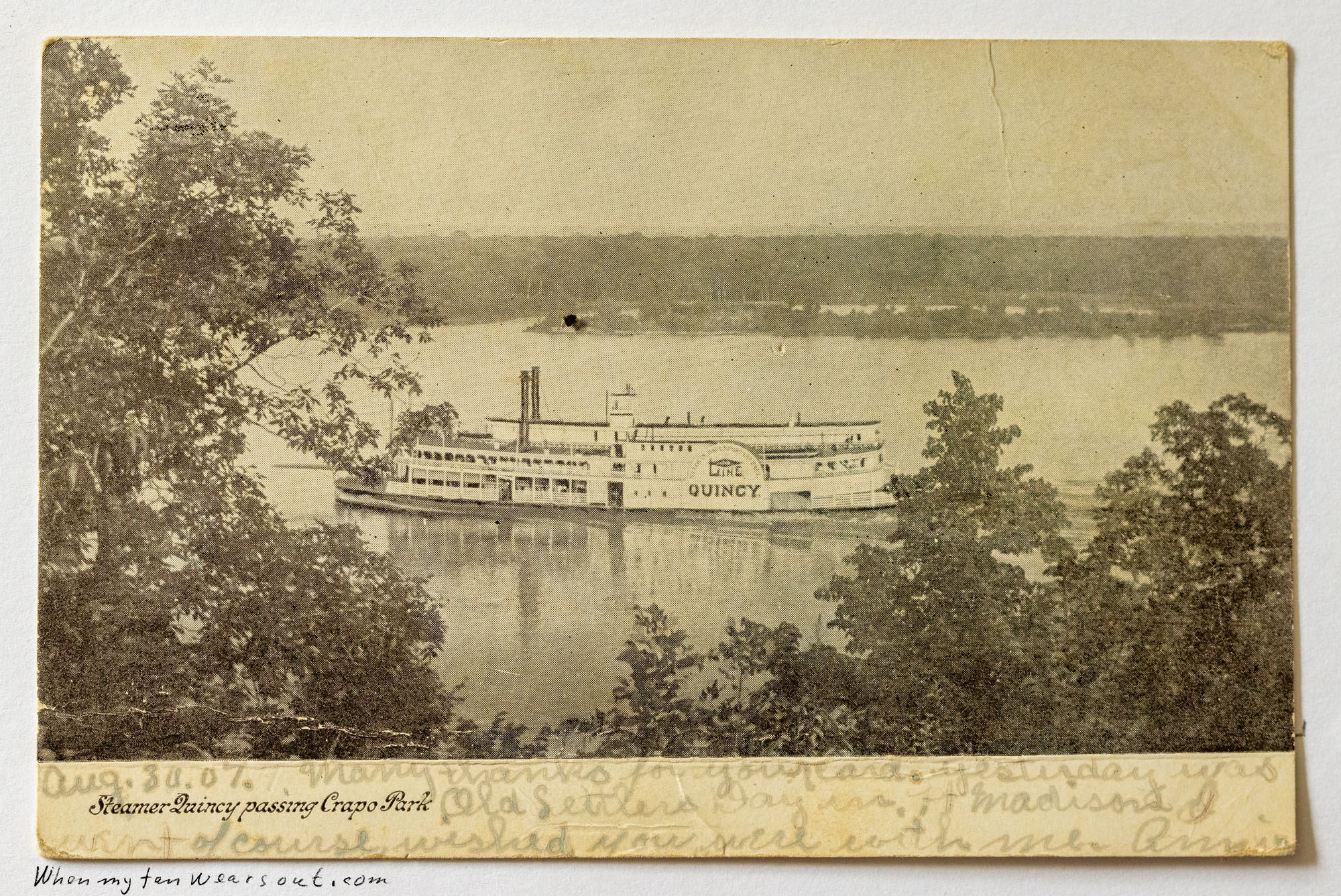
Postcard #0066: Quincy, Wever, IA — Annie to Pearl, August 1907

Front of postcard #0066: Sepia-toned photograph of the paddle-wheel steamboat "Quincy" on a river, viewed from an elevated bank through framing t

Transcription

Front — Aug. 30. 07. Many thanks for your card. Yesterday was Old Settlers Day in Ft Madison. I went of course, wished you were with me. Annie

Back of postcard #0066

Postcard Information

  • Postmark: Wever, Iowa, AUG 30 1907
  • Sent To: Carthage IL
  • Era: Undivided Back (Pre-1907)
  • Publisher: S. H. KNOX & CO. PUBLISHERS
  • Stamp: 1¢
  • Distance Traveled: ~30 miles
  • Notes: Message written on front instead of back
Continue Reading

Postcard #1078 — Clyde [illegible] to Pearl

Front of postcard #1078: Hand-colored landscape illustration of a river or stream with exposed sandbars in the foreground. A grassy green hill wi

Transcription

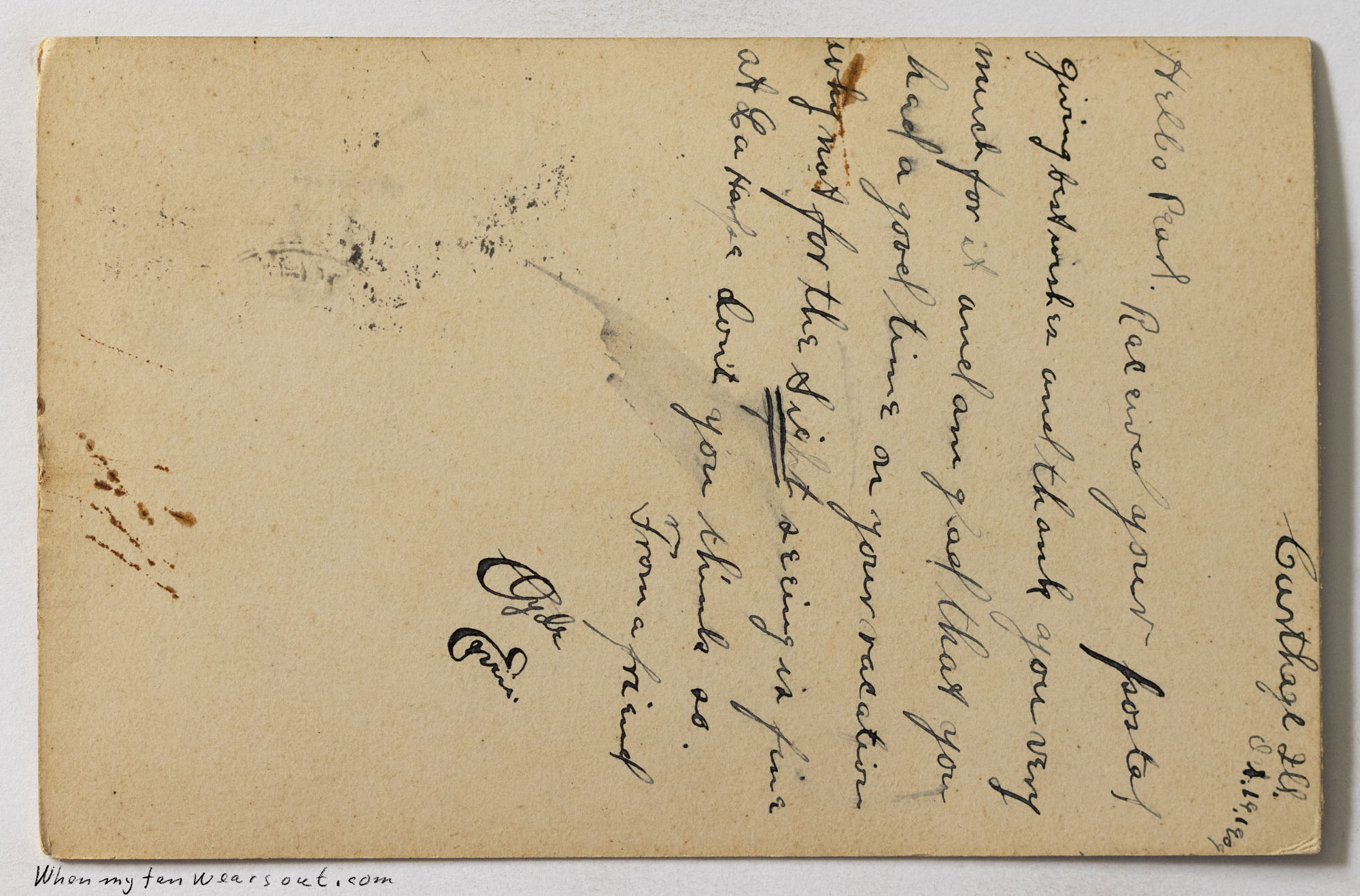
Back — Carthage Ill. Oct. 19. 1909 Hello Pearl. Received your postal giving best wishes and thank you very much for it and am glad that you had a good time on your vacation why not for the sight seeing is fine at La Harpe don’t you think so. From a friend Clyde [illegible]

Back of postcard #1078

Postcard Information

  • Postmark: ILLEGIBLE
  • Sent To: Unknown
  • Era: Undivided Back (Pre-1907)
  • Stamp: NOT VISIBLE
  • Distance Traveled: Undetermined
  • Notes: Reference to La Harpe.
Continue Reading

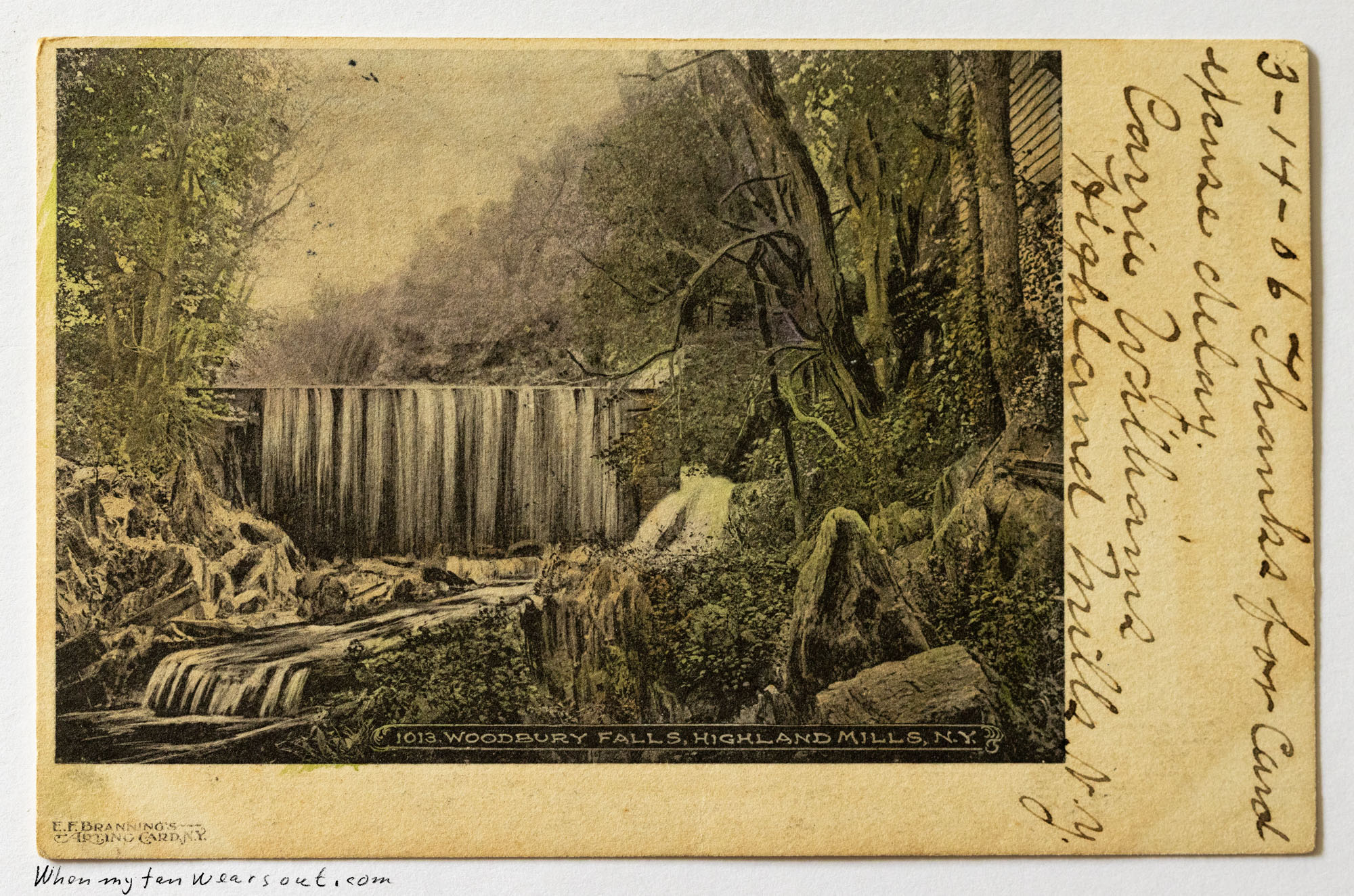
Postcard #0057: Woodbury Falls Thanks and Greetings


A hand-tinted postcard image of Woodbury Falls, Highland Mills, New York, showing a wide waterfall cascading over rocks into a stream below, surrounded by lush green trees and foliage. A handwritten message is visible on the right border with the date 3-14-06 and signed by Carrie.
Front — A serene depiction of Woodbury Falls in Highland Mills, New York, with a short message on the right.

Postcard Metadata


The back of an undivided postcard with a 1-cent Benjamin Franklin stamp postmarked Newburgh, NY, March 14, 1906, at 6:45 PM. It is addressed in cursive to
Back — Correspondence from Carrie to Pearle Byers

Transcription

3 – 14 – 06 Thanks for card Was glad to hear from you Carrie Write soon P.S. Highland Mills N.Y.

Historical & Family Notes

This postcard, sent to Pearle Byers in March 1906, offers a charming glimpse into her early social life, long before her eventual marriage to Harvey Sights. The sender, Carrie, clearly a friend, expresses gratitude for a previous card and encourages further correspondence, highlighting the personal nature of such exchanges. The simple, heartfelt message, “Was glad to hear from you,” underscores the role of postcards in maintaining friendships and connections across distances in the early 20th century.

The card itself features a picturesque view of Woodbury Falls in Highland Mills, New York, a location mentioned by Carrie in her postscript, suggesting a personal connection to the scene. While not directly related to Pearl and Harvey’s courtship, such cards reveal the typical ways young women like Pearl engaged with their friends and world, building a network of social ties that would have been an integral part of her life.

The swift two-day delivery from Newburgh, New York, to Carthage, Illinois, demonstrates the remarkable efficiency of the U.S. postal service at the time. This allowed friends such as Carrie and Pearle to share news and greetings across vast geographical spans with relative ease, contributing to the rich tapestry of Pearl’s life story before she became Mrs. Sights.

Continue Reading

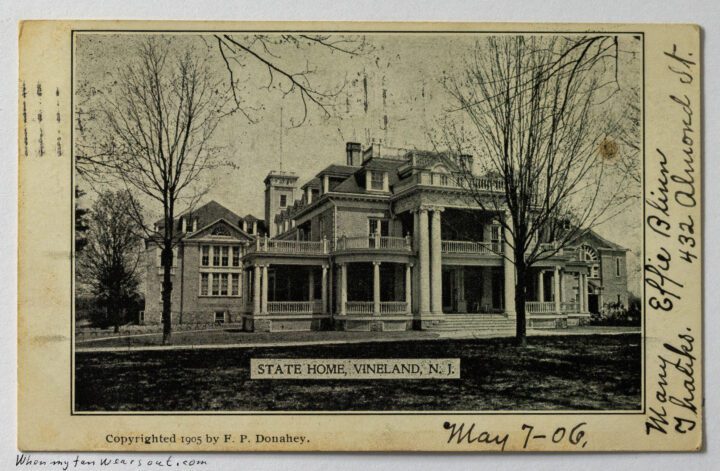
Postcard #0054: State Home in Vineland, New Jersey


Black and white postcard showing the
Front — A grand, multi-story brick building, labeled “STATE HOME, VINELAND, N. J.” with trees in the foreground.

Postcard Metadata


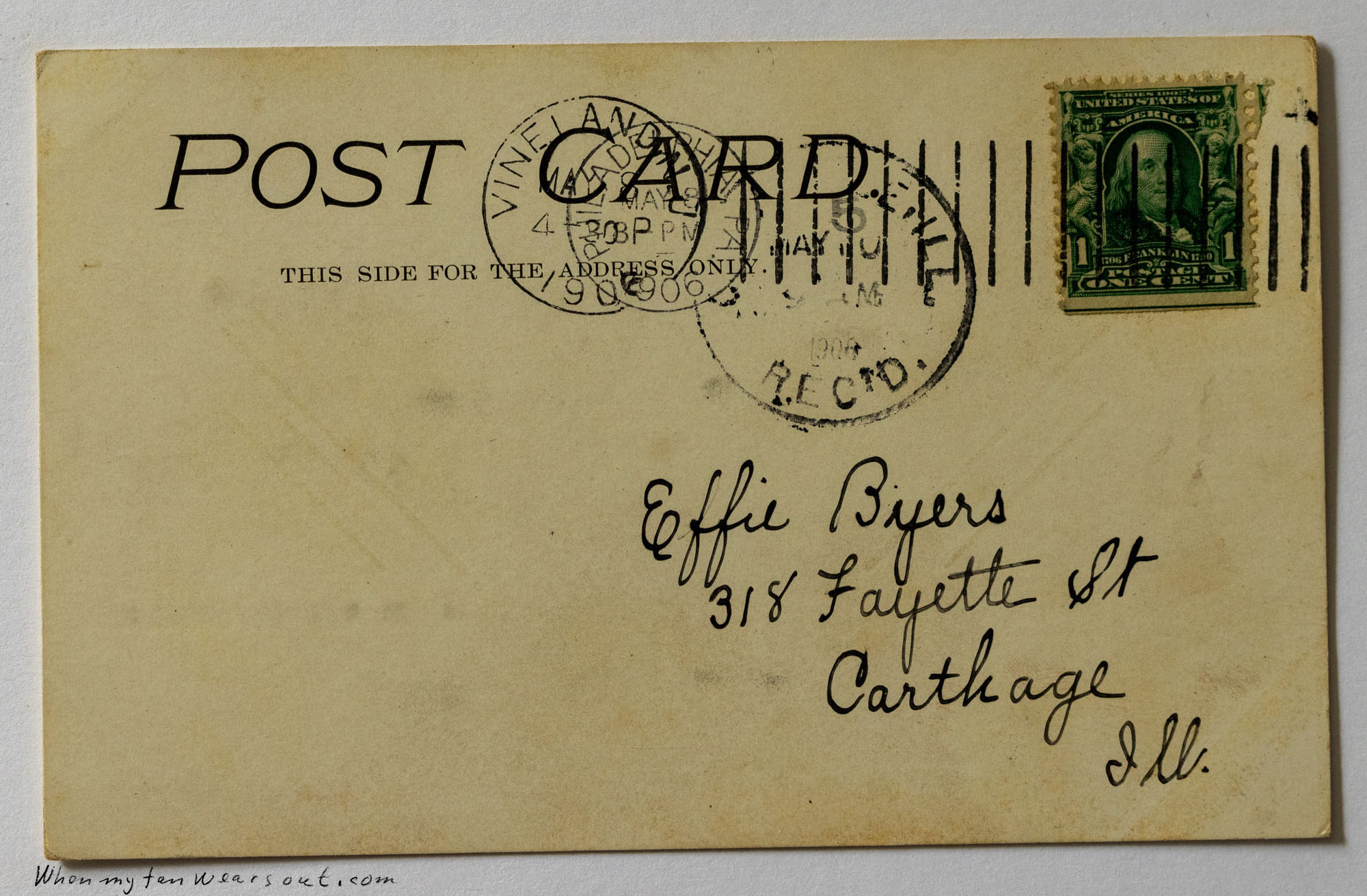
Undivided back postcard with a 1-cent Benjamin Franklin stamp, postmarked Vineland, NJ, May 7, 1906. Handwritten message
Back — Correspondence from Effie Bhien to Effie Byers

Transcription

Many thanks. May 7-06. Effie Bhien 432 Almond St.

Historical & Family Notes

This early postcard, dated May 1906, offers a glimpse into the Byers family’s extended network before Pearl’s extensive correspondence with Harvey Sights. Addressed to Effie Byers at 318 Fayette Street in Carthage, Illinois—the very home Pearl would share with her family—it establishes a foundational timeline for the Byers household. While not sent directly to Pearl, the card reinforces the consistent location of her family home, a place that would later feature prominently in her personal story and eventual courtship.

The image on the front depicts the “State Home, Vineland, N. J.,” historically known as the New Jersey Training School for Feeble-Minded Girls and Boys. This institution was a significant, albeit complex, part of early 20th-century social history, pioneering research in intellectual disabilities while also becoming entangled in the eugenics movement. The postcard’s image provides a window into the types of public institutions and social structures that existed during Pearl’s formative years.

The brief message, “Many thanks,” penned by “Effie Bhien” from nearby 432 Almond Street, suggests a simple, everyday acknowledgment. Such concise notes were common on undivided back postcards, where space for correspondence was limited. This card, a tangible artifact from 1906, predates the more romantic and detailed letters Pearl would later exchange with Harvey, yet it subtly grounds their story within the broader social and familial context of the early 20th century.

Continue Reading

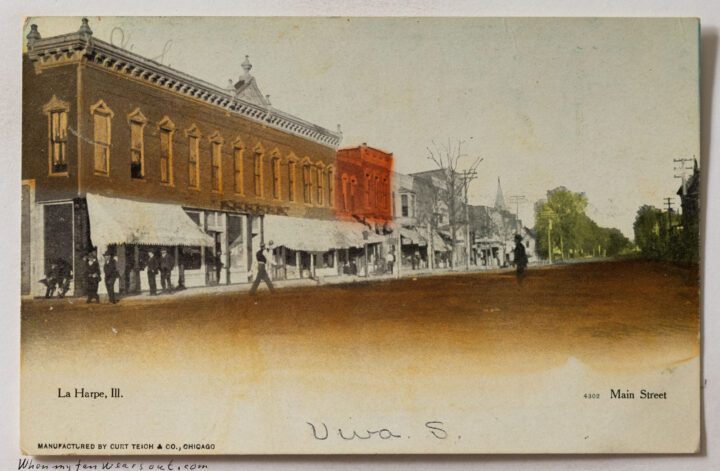
Postcard #1073: A Brief ‘Viwa. S.’ from La Harpe’s Main Street


A vintage postcard depicting a lively Main Street in La Harpe, Illinois, circa early 1900s. The street is lined with multi-story brick buildings, some featuring striped awnings over ground-level shops. People are visible walking on the sidewalks and in the street. A prominent three-story brick building, partially hand-colored in red, stands further down the street. The sky is light, and trees are visible in the distance. The bottom left corner reads
Front — A bustling view of Main Street in La Harpe, Illinois, featuring storefronts with awnings and a partially colorized brick building.

Postcard Metadata


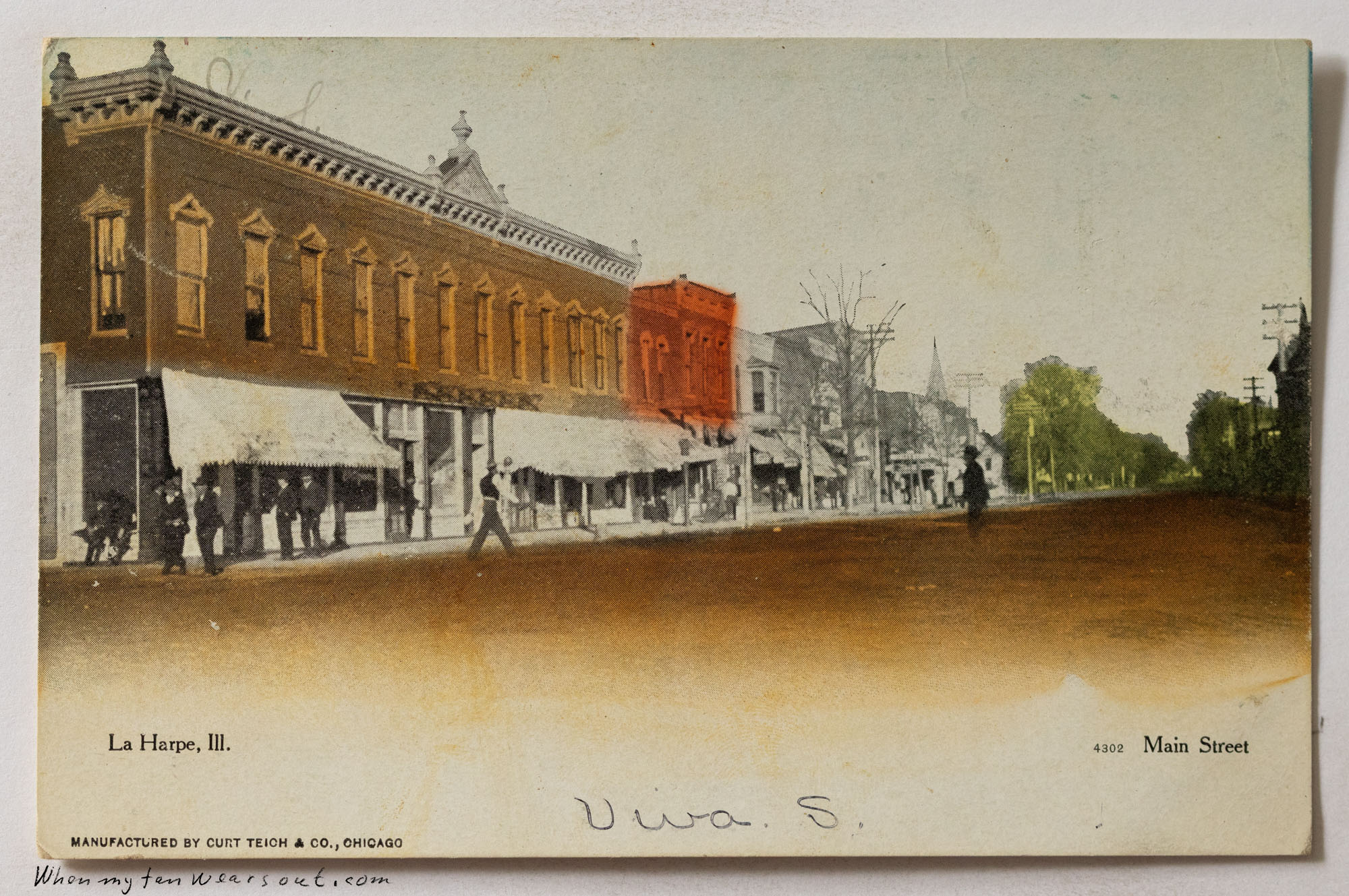
The reverse side of the postcard features the standard
Back — Correspondence from Viwa S. to Miss Pearle Byers

Transcription

Viwa. S.

Historical & Family Notes

This early postcard, sent to the young Miss Pearle Byers, offers a quick glimpse into her social world during her formative years. The card features a common street scene of the era from nearby La Harpe, Illinois, a familiar type of imagery used for brief communications. The message, simply “Viwa. S.” on the front of the card, is characteristic of the concise messages exchanged on undivided back postcards where space for writing was limited.

Originating from Burnside, a mere 11 miles from Carthage, this card likely came from a local acquaintance or friend, Viwa S., whose brief greeting is preserved in this collection. These everyday interactions paint a picture of Pearl’s life before her marriage to Harvey Sights, highlighting the connections she maintained within her immediate community.

The postcard itself is an excellent example of the transitional period in postcard history. Though postmarked in June 1907, after divided backs were permitted, its layout with “NOTHING BUT THE ADDRESS ON THIS SIDE” firmly places it stylistically within the Undivided Back era, suggesting an older card still in circulation.
Continue Reading

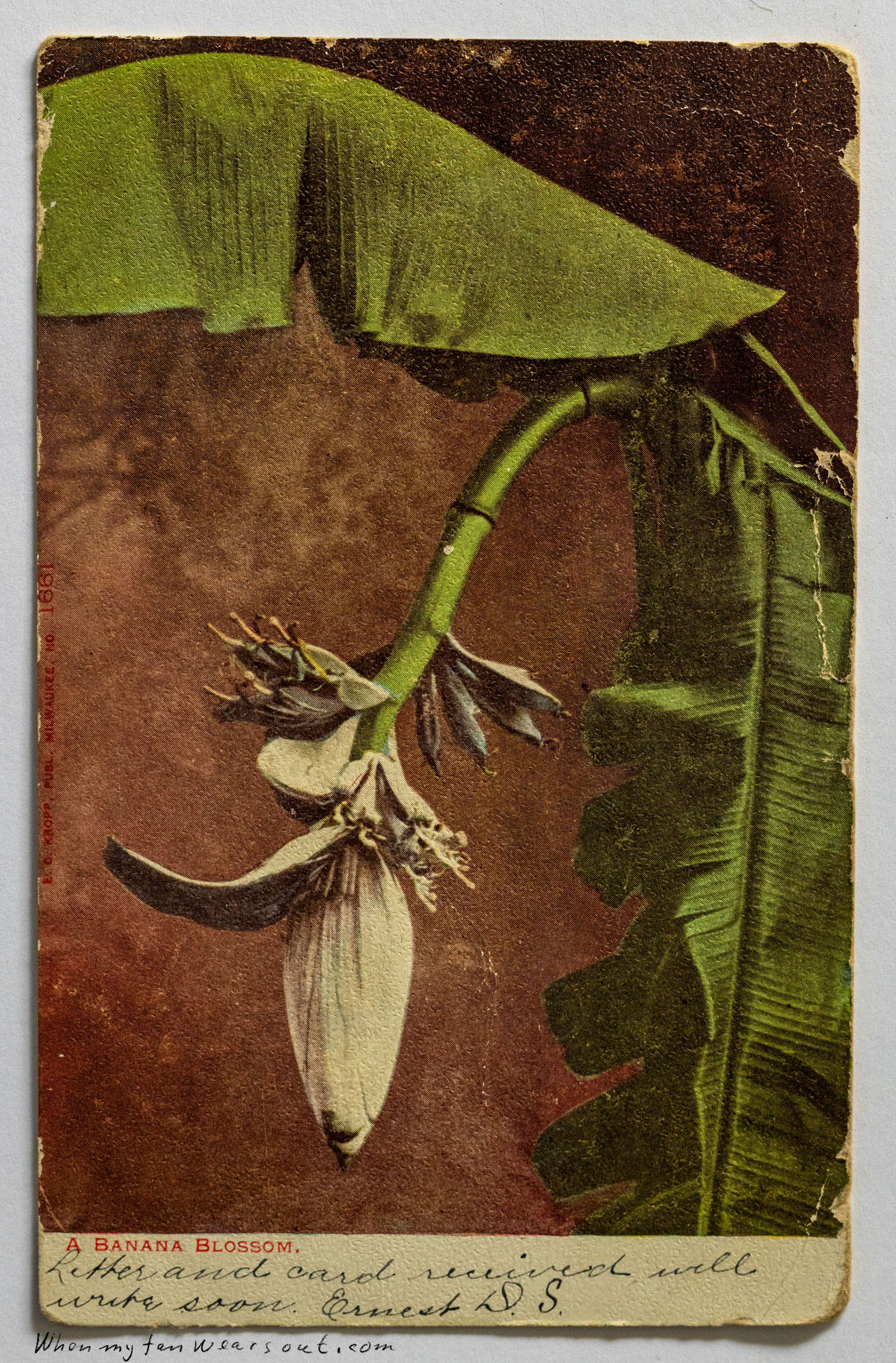
Postcard #0048: A Banana Blossom from Ernest D. S.


A colorized vintage postcard showing a large, cream-colored banana blossom hanging from a green banana tree stalk, with small green bananas starting to form at the top of the blossom. The background is a warm, mottled brown. Printed text
Front — A vibrant illustration of a banana tree’s large, pendulous blossom with emerging fruit.

Postcard Metadata


The back of a vintage postcard with a light tan surface. A green one-cent U.S. Postage stamp with Benjamin Franklin's portrait is affixed to the upper right. Two circular postmarks are present: one from
Back — Correspondence from Ernest D. S. to Miss Pearle Byers

Transcription

Letters and card received will write soon. Ernest D. S.

Historical & Family Notes

This postcard, sent from a warmer climate in Florida, offers a glimpse into the diverse correspondence Pearl Byers received. While not from her eventual husband, Harvey Sights, it confirms Pearl was an active recipient of mail, maintaining connections with various friends and family members across the country. The sender, Ernest D. S., acknowledges previous correspondence, indicating an ongoing exchange.

The postcard’s depiction of a banana blossom highlights an exotic fruit for many Midwesterners at the turn of the 20th century. Such imagery provided a window into distant lands and unfamiliar flora, a common theme for postcards intended to transport recipients beyond their immediate surroundings. This particular card showcases the aesthetic appeal of nature photography combined with the practical function of postal communication during a burgeoning era of travel and correspondence.

Continue Reading