Postcard #0038: A Quick Note from Lebanon, Kansas, with a View of Dresden’s Zwingerhof


Hand-colored vintage postcard of the Zwingerhof, a grand Baroque palace courtyard in Dresden, Germany, featuring ornate buildings, manicured gardens, a central fountain, and a figure in historical attire on a path. The sky is light blue with soft clouds, and the palace architecture is detailed with classical elements.
Front — A hand-colored image depicting the elegant Zwingerhof palace and gardens in Dresden, Germany.

Postcard Metadata


Vintage postcard back with a handwritten message in cursive on the left side, reading
Back — Correspondence from Frankie to Pearle Bryers

Transcription

Postkarte. Card and letter recd. will write soon Frankie

Historical & Family Notes

This postcard offers a glimpse into Pearl Byers’s broader social network prior to her marriage to Harvey Sights, as she receives a brief acknowledgment from a sender named Frankie. The early 20th century saw a boom in postcard popularity, with people often sending quick notes like this one rather than full letters. This card, postmarked just over a month before the official start of the Divided Back era in the U.S., showcases an early adoption of the format, allowing for both address and message on the back.

The exotic image of the Zwingerhof in Dresden, Germany, provides a stark contrast to the everyday, concise message from Kansas. It reflects a common practice of the time: using scenic or international cards for purely domestic, informal communication, bridging vast geographical and cultural distances through a simple piece of mail.

While this card doesn’t directly mention Harvey Sights, it helps to paint a more complete picture of Pearl’s life and her connections before her romance with Harvey blossomed. It shows her as a recipient of regular correspondence, illustrating the everyday communication practices of young women in rural America at the turn of the century.
Continue Reading

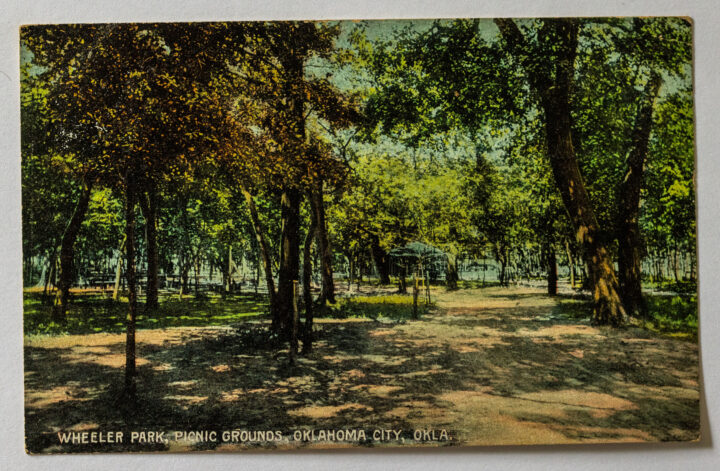
Postcard #0037: Wheeler Park Picnic Grounds, Oklahoma City


A vintage, hand-colored postcard image depicting the Wheeler Park Picnic Grounds in Oklahoma City, Oklahoma. The scene shows a wide, sun-dappled dirt path winding through a dense grove of mature trees with lush green foliage, suggesting a peaceful, park-like setting. The sky is a light blue, and sunlight filters through the tree canopy, creating patterns of light and shadow on the ground.
Front — A hand-colored image of the Wheeler Park Picnic Grounds in Oklahoma City, Oklahoma, showing a tree-lined path.

Postcard Metadata


The back of a 1909 postcard featuring handwritten cursive correspondence from Harvey Sights to Miss Pearl Byers. A circular Oklahoma City postmark dated August 11, 1909, overlaps the message. A one-cent green U.S. Postage stamp with George Washington's portrait is affixed to the upper right corner. The publisher details
Back — Correspondence from Harvey Sights to Miss Pearl Byers

Transcription

I guess you hardly expect to hear from me again but I waited until I got home to write. I would love to hear from you. My address is 218 East 10 St. Okla.

Historical & Family Notes

This postcard, sent from Harvey Sights in Oklahoma City to Pearl Byers in Carthage, Illinois, offers a glimpse into their early correspondence, hinting at a dynamic courtship. Harvey’s opening line, “I guess you hardly expect to hear from me again,” suggests a pause in their communication or perhaps a period of uncertainty, which he quickly aims to remedy by sending this note from his home address. The sentiment “I would love to hear from you” clearly indicates his desire to continue their connection despite any prior gaps.

The fact that Harvey waited until he was home to write suggests a personal touch to his message, reinforcing the emerging bond between them. As Pearl and Harvey’s story unfolds towards marriage, these early postcards become precious artifacts, chronicling the subtle emotional currents that shaped their relationship. His providing a specific address, “218 East 10 St. Okla.”, underscores his eagerness for a response and to cement their line of communication.

The image of the picnic grounds on the front, with its inviting paths and dappled sunlight, could subtly reflect the pleasant anticipation of future shared moments, even as their correspondence traversed hundreds of miles across the Midwest. The postcard serves as a tangible reminder of the effort and intention invested in building their relationship from afar, a common scenario in an era when such written exchanges were vital for maintaining long-distance connections.

Continue Reading

Postcard #0036: A Peculiar Kiss and a Sunday Morning Homecoming


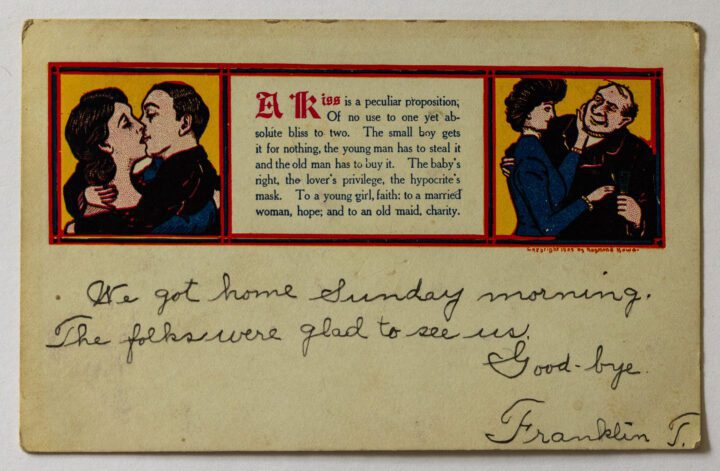
Vintage postcard illustration depicting two couples kissing, one young and one older, with a poem titled
Front — An illustration featuring two panels of couples kissing and a humorous poem about the nature of a kiss.

Postcard Metadata


The back of a vintage postcard with a handwritten message in cursive script from Franklin T. to Miss Pearl Byers. It is postmarked Carthage, Illinois, October 3, 1905, and bears a green one-cent Benjamin Franklin postage stamp in the upper right corner.
Back — Correspondence from Franklin T. to Miss Pearl Byers

Transcription

We got home Sunday morning. The folks were glad to see us. Good-bye Franklin T.

Historical & Family Notes

This postcard offers a charming glimpse into the everyday social life of Pearl Byers in the early 20th century. While not from Harvey Sights, it illustrates the common practice of sending brief updates to friends and family through the mail, even for local news like a weekend trip. The sender, Franklin T., shares a simple message confirming their safe return home and the family’s happiness at their arrival.
The front of the card, with its humorous take on “A KISS,” adds a playful, slightly risqué touch, common for postcards of the era. It presents a lighthearted reflection on romance, from young love to the enduring affection of an older couple. This choice of card suggests a friendly and perhaps jovial relationship between Pearl and Franklin T.

Given that the postcard was sent and received within Carthage, Illinois, it highlights the role of the postal service in maintaining local connections. Even for messages that could easily be conveyed in person, postcards provided a quick and convenient way to share news, keeping individuals like Pearl Byers connected to their wider community before the advent of modern communication.

Continue Reading

Postcard #0035: Lake Starker, Always Remember, Never Forget


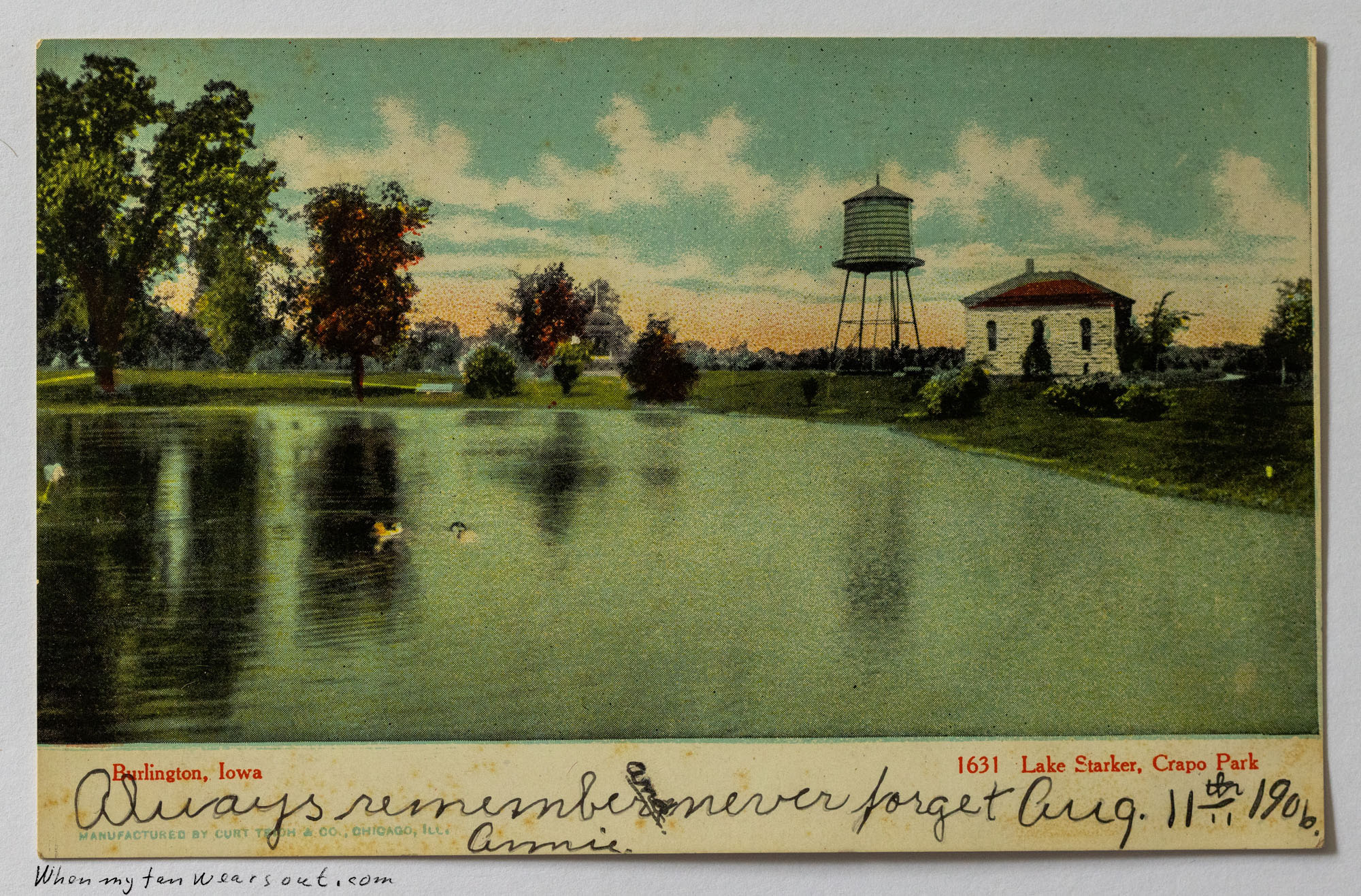
A hand-colored vintage postcard depicts a serene green lake reflecting trees on the left, with two ducks on the water. On the right bank, a tall metal water tower stands next to a white building with a red roof under a light blue sky with white clouds.
Front — A scenic, hand-colored view of Lake Starker in Crapo Park, Burlington, Iowa, with a water tower and building visible on the far bank.

Postcard Metadata


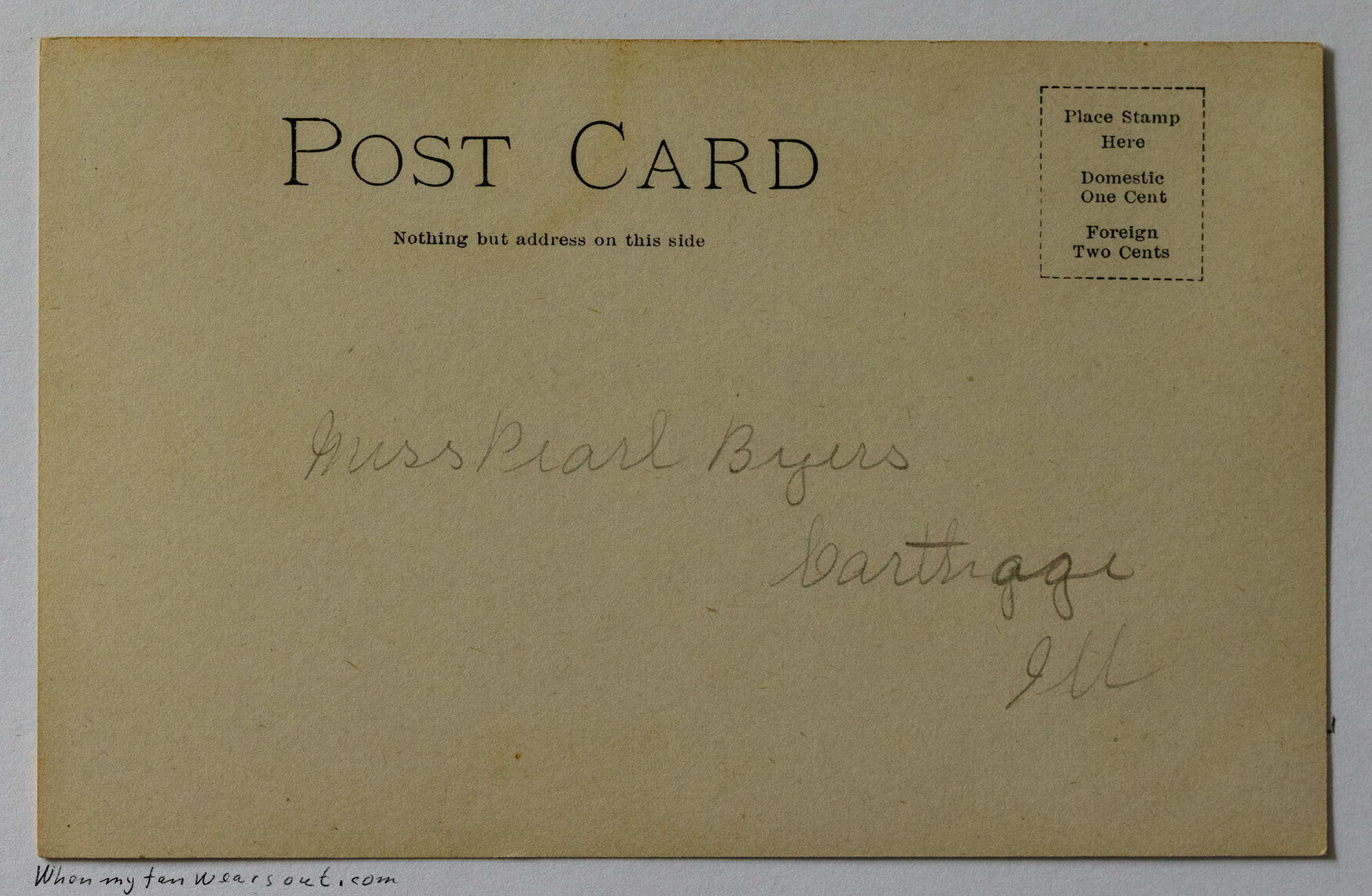
The undivided back of a vintage postcard features the printed text
Back — Correspondence from Annie to Miss Pearl Byers

Transcription

Always remember never forget Aug. 11th 1906. Annie.

Historical & Family Notes

This postcard, sent by someone named Annie to Pearl Byers in 1906, offers a glimpse into Pearl’s social life before her eventual marriage to Harvey Sights. The message, “Always remember never forget Aug. 11th 1906,” strongly suggests a significant shared memory or event that took place on that particular date between Pearl and Annie. The image itself, featuring Lake Starker in Burlington’s Crapo Park, illustrates a popular scenic and recreational spot of the era.

Crapo Park, established in 1895, was a beloved local destination, known for its picturesque landscapes and facilities, making it an ideal setting for outings and creating lasting memories. This card serves as a tangible reminder of a moment in Pearl’s youth, connecting her to friendships and experiences that shaped her life prior to her primary role as a wife and mother in the Sights family.

While the exact nature of the August 11th event remains a mystery, the sentiment of the message emphasizes its importance to both Annie and Pearl. Such postcards were vital for maintaining connections in a time before modern communication, preserving snippets of personal history and social bonds.

Continue Reading

Postcard #0034: Swiss Cottage in Crapo Park, Burlington, Iowa, with a Memory from September 5, 1906


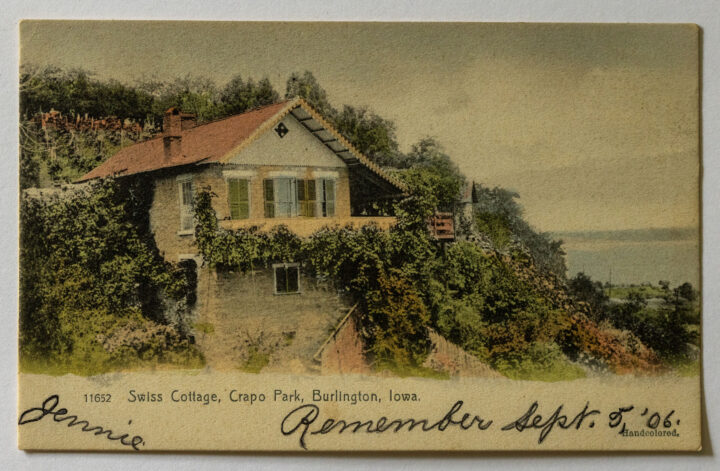
A vintage, handcolored postcard featuring a two-story Swiss-style cottage with a red roof, surrounded by lush green foliage and vines, situated on a hillside with a body of water visible in the background under a light sky. The text
Front — A handcolored image of a quaint Swiss Cottage nestled on a hill overlooking water in Crapo Park.

Postcard Metadata


The back of a vintage postcard with an undivided back, showing a large
Back — Correspondence from Jennie to Miss Pearle Byers

Transcription

Jennie Remember Sept. 5, ’06.

Historical & Family Notes

This postcard, sent to Pearle Byers, provides a glimpse into her social life before her significant connection with Harvey Sights. The sender, Jennie, uses a specific date, September 5, 1906, suggesting an event, anniversary, or shared memory that was important to both friends. It’s a sweet, personal message indicating a close bond between Pearle and Jennie, predating the main courtship narrative with Harvey.

The setting of Crapo Park in Burlington, Iowa, with its picturesque “Swiss Cottage,” reflects the popular tourist destinations and scenic spots that people enjoyed and commemorated on postcards during the early 20th century. This card helps to establish Pearle’s personal network and the popular culture of the time, showing her receiving mail from friends even before her path truly intertwined with Harvey’s.
Continue Reading

Postcard #0033: Burlington’s Potter Memorial Arch and Pearl’s December Birthday


Vintage hand-tinted postcard illustrating the grand stone Potter Memorial Arch, the entrance to Aspen Grove Cemetery in Burlington, Iowa, under a bright sky with lush green trees.
Front — A hand-tinted postcard showing the Potter Memorial Arch at Aspen Grove Cemetery in Burlington, Iowa.

Postcard Metadata


The reverse side of the postcard features a handwritten message in cursive, addressed to Miss Pearl Byers in Carthage, Illinois, with a circular postmark from Biggsville, Illinois, dated December 31, 1908, and a green one-cent Franklin stamp.
Back — Correspondence from Mayme to Miss Pearl Byers

Transcription

Hello Pearl. How are you? Dim Mr Biggs-ville at present and having a fine time. Your Dec Birthday time do you get a letter? Mayme

Historical & Family Notes

This postcard offers a charming glimpse into Pearl Byers’ life before her marriage to Harvey Sights. Sent by a friend named Mayme, the message playfully references Pearl’s “Dec Birthday time,” confirming that her special day fell in December, aligning with family records that place it on December 4th. The casual tone and inquiry “do you get a letter?” suggest an ongoing correspondence between Pearl and her social circle.

The sender, Mayme, appears to be writing from “Biggs-ville,” which is likely Biggsville, Illinois, a small town not far from Carthage. This connection between nearby towns highlights the tight-knit social fabric of rural Illinois at the turn of the century, where friends and family might live just a short distance apart. The front image of Burlington, Iowa’s Potter Memorial Arch, a common subject for early postcards, suggests Mayme might have been visiting or simply chose an interesting card for her friend.

The postcard serves as a small but significant artifact, documenting Pearl’s connections and confirming details of her early life, an important foundation for understanding her personal story before she and Harvey Sights embarked on their shared journey, eventually welcoming their daughter Marnelle.

Continue Reading

Postcard #0032: Grapes and Good Times in Nauvoo


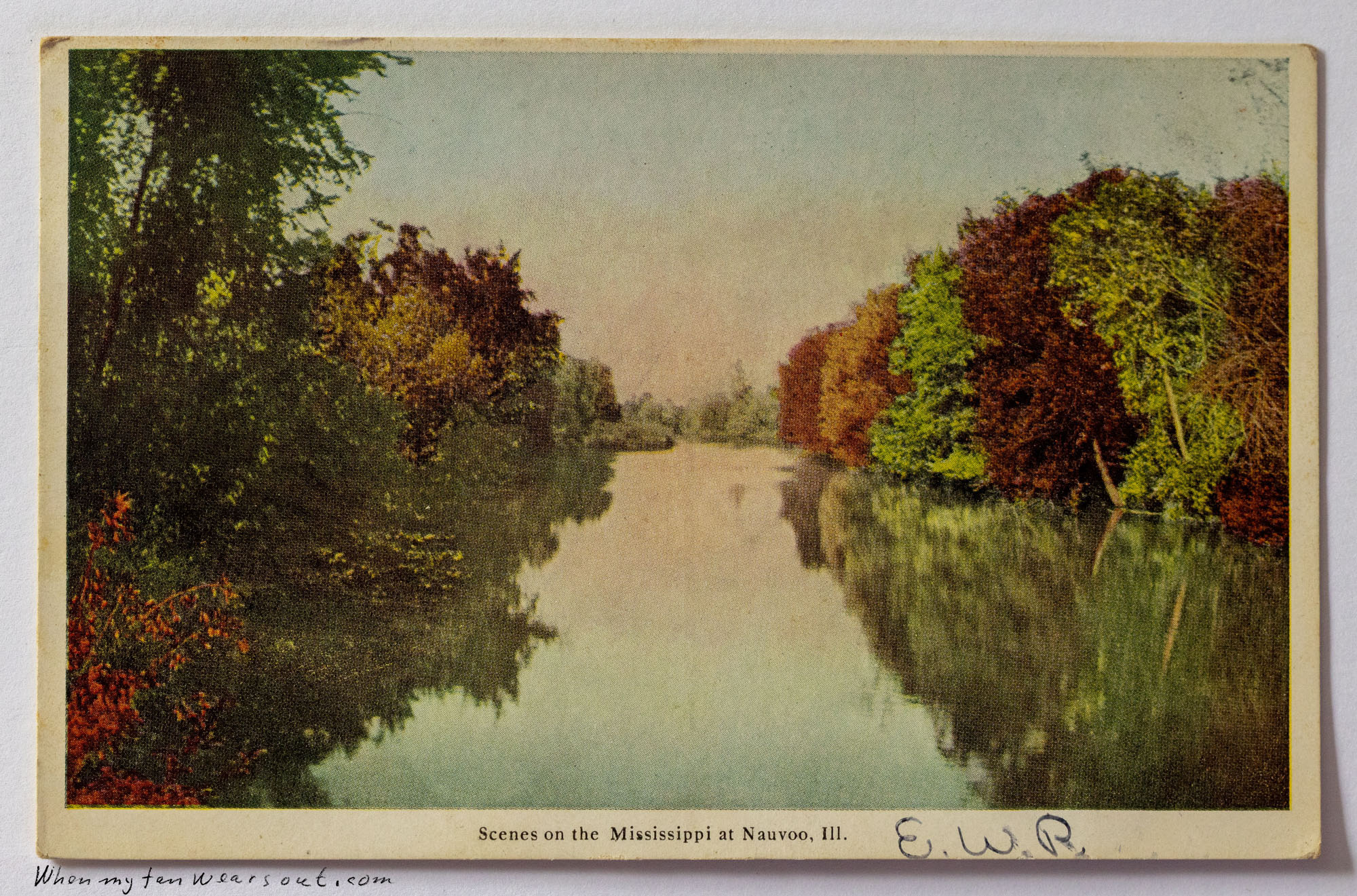
Hand-colored postcard depicting the Mississippi River at Nauvoo, Illinois, with lush green and autumnal trees lining both banks under a soft, hazy sky.
Front — Hand-colored view of the Mississippi River flowing past Nauvoo, Illinois.

Postcard Metadata


Back of a vintage postcard with a Wever, Iowa, postmark from August 20, 1908, a one-cent Benjamin Franklin stamp, and a handwritten message from E.W.B. to Miss Pearle Byers in Carthage, Illinois, discussing an excursion to Nauvoo.
Back — Correspondence from E.W.B. to Miss Pearle Byers

Transcription

Twas at Nauvoo Wednesday on an excursion. Had a good time. It is quite a nice place. It is a great place for grapes. E.W.B.

Historical & Family Notes

This postcard, sent to Pearle Byers, captures a pleasant “excursion” to Nauvoo, Illinois, a town known for its historical significance and scenic beauty along the Mississippi River. The sender, identified only by the initials E.W.B., was particularly impressed by the local produce, noting it as a “great place for grapes,” indicating a delightful day spent exploring.

While not from Harvey Sights, this card provides a glimpse into Pearle’s social life and the popular recreational activities of the era. Excursions, often involving steamboat trips or train rides to picturesque locations, were a common way for people to enjoy nature, escape daily routines, and socialize with friends and acquaintances.

This artifact contributes to the broader understanding of Pearle’s world before her marriage, showcasing the types of communications she received and the leisurely pursuits of her contemporaries. It paints a picture of a time when the simple pleasures of travel and local delights were cherished and shared through the mail.

Continue Reading

Postcard #0031: A Merry Christmas with Holly and Berries from Perris


Vintage Christmas postcard from the early 1900s featuring an embossed sprig of green holly leaves with vibrant red berries at the top. Below the holly, a watercolor illustration depicts a snow-covered winter landscape with a small house, bare trees, and a wooden fence at sunset or sunrise. The text
Front — An embossed illustration of a holly sprig with red berries above a winter landscape scene and “A MERRY CHRISTMAS” message.

Postcard Metadata


The back of a vintage postcard with a divided back design. The left side is labeled
Back — Correspondence from Harvey Sights to Miss Pearl Byers

Transcription

H.S.

Historical & Family Notes

This Christmas postcard, adorned with festive holly and a serene winter scene, carries a simple but significant message from Harvey Sights to Pearl Byers. The solitary “H.S.” initial, penned vertically on the correspondence side, speaks volumes about the growing connection between them, despite the vast geographical distance separating Perris, California, from Carthage, Illinois. The journey of nearly 1,900 miles underscores Harvey’s effort to reach Pearl during the holiday season, a time traditionally associated with warmth and connection.

The absence of a longer message might suggest a burgeoning relationship where a simple acknowledgment was enough, or perhaps a more private communication was shared via other means. This card serves as a tangible link in the evolving story of Pearl and Harvey, capturing a moment when their paths, though physically distant, were drawing closer. It’s a testament to the enduring tradition of holiday greetings and the personal touch postcards offered in an era before instant communication.

As an archival piece, this postcard not only documents a festive exchange but also subtly hints at the dedication involved in maintaining a long-distance connection during the early 20th century. For Pearl, receiving this Christmas wish from Harvey, even if brief, would have been a cherished reminder of his thoughts for her, further cementing their bond that would eventually lead to marriage and their daughter, Marnelle.
Continue Reading

Postcard #0030: Best Wishes with Pansies and a Midwest Farm Scene


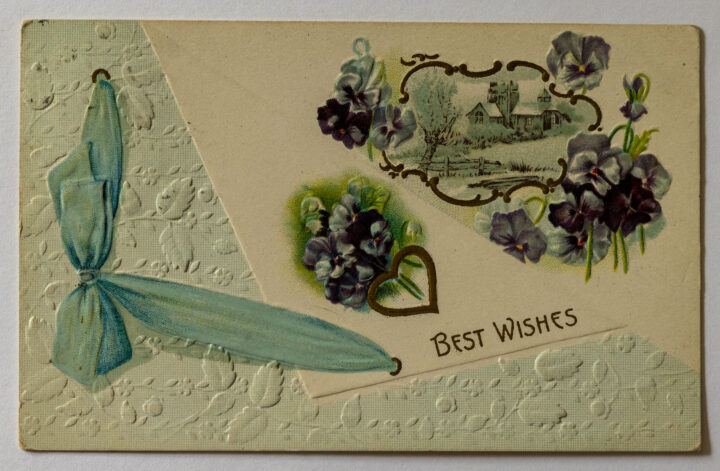
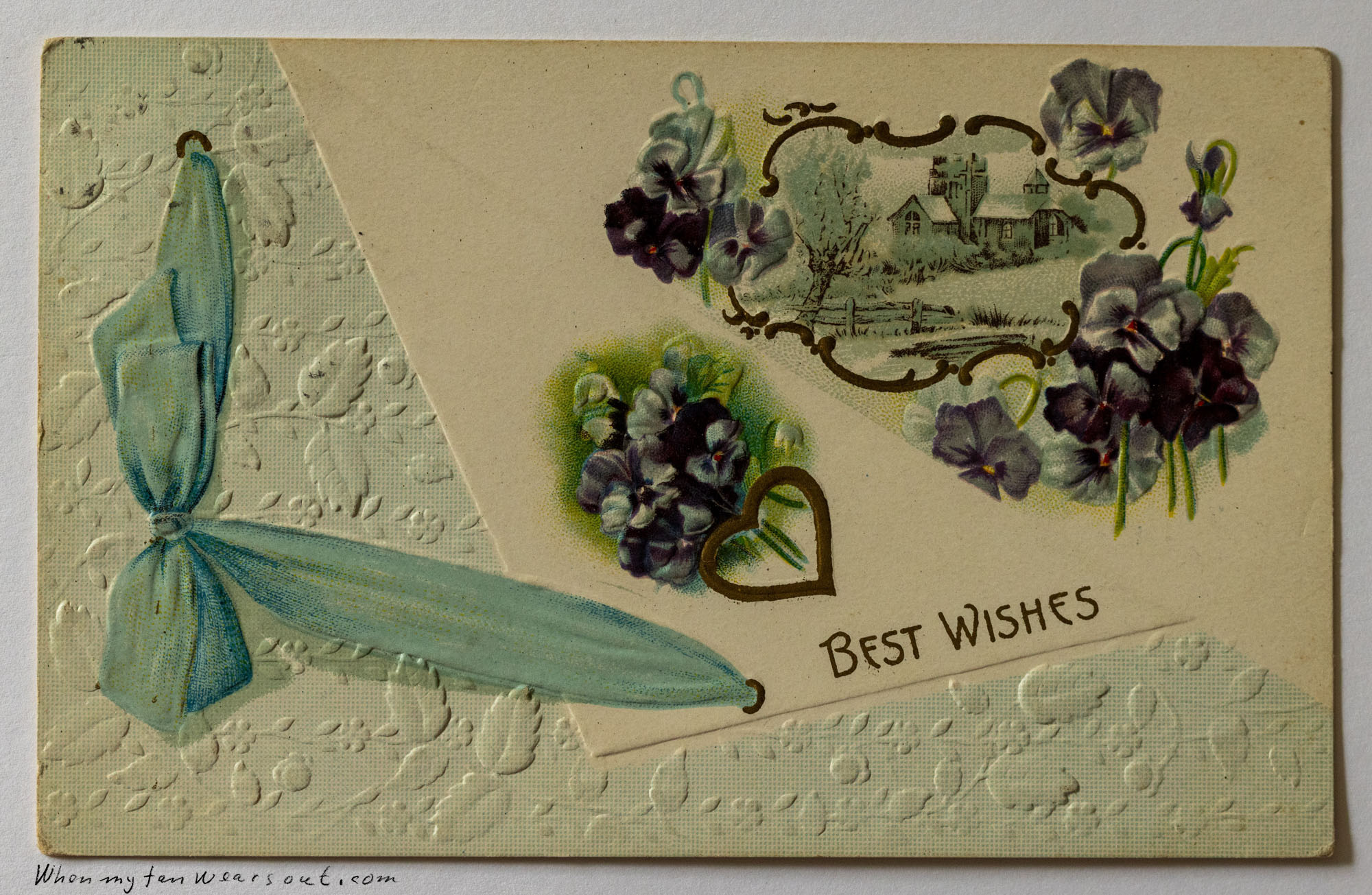
Vintage postcard with a teal blue satin ribbon bow and flowing ribbon on the left side, over an embossed background pattern. The right side features two clusters of purple and blue pansies, and a central framed vignette depicting a quaint rural farm scene with a house, trees, and fence. The text
Front — A “Best Wishes” postcard featuring purple pansies, an embossed blue ribbon, and a framed rural farm scene.

Postcard Metadata


The back of a vintage postcard featuring a handwritten message in black cursive ink. The sender is E.P.B. and the recipient is Mr. Harvey Sights, La Harpe, Illinois. A Carthage, Illinois postmark dated September 7, 1909, is visible along with a green one-cent U.S. Postage stamp with George Washington's portrait. The card has a vertical dividing line and an embossed floral pattern.
Back — Correspondence from E.P.B. (Pearl Byers) to Harvey Sights

Transcription

Carthage Ill. Sept. 7-09. Rec’d card this morning as I came to work. Thanks “awfully.” It is dandy. E.P.B. Mr. Harvey Sights La Harpe Ill

Historical & Family Notes

This postcard offers a charming glimpse into the early courtship between Pearl Byers and Harvey Sights. Pearl, writing from Carthage, Illinois, expresses her thanks to Harvey for a card she received earlier that morning, playfully stating it was “dandy.” This exchange highlights their regular correspondence despite living a mere sixteen miles apart, indicating a blossoming romance through the daily ritual of postcard mail.

The sender’s initials “E.P.B.” are almost certainly Pearl Byers, aligning with the family’s identity rules and the ongoing narrative of their relationship. The card was sent on September 7, 1909, a significant period in their courtship before their eventual marriage and the birth of their daughter, Marnelle.

The message’s casual and affectionate tone—”Thanks ‘awfully'”—suggests a comfort and familiarity between Pearl and Harvey, showcasing a delightful snapshot of their everyday interactions and the simple pleasures of receiving mail from a loved one in the early 20th century.

Continue Reading

Postcard #0029: The Old Mormon Jail in Carthage, Illinois


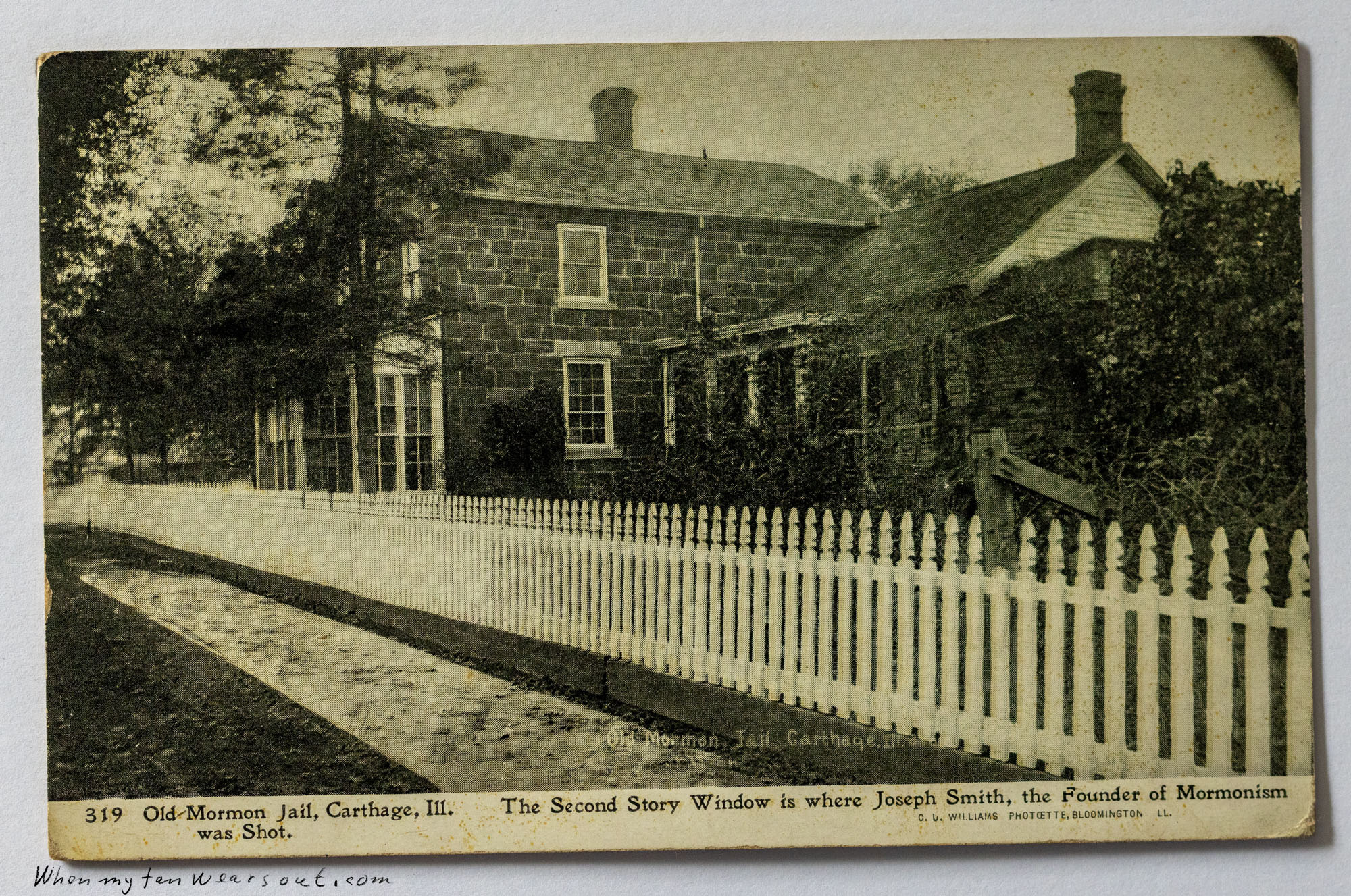
Sepia-toned postcard depicting the Old Mormon Jail in Carthage, Illinois, a two-story stone building with a white picket fence, a dirt path, and trees, with text indicating Joseph Smith was shot from the second-story window.
Front — A sepia-toned image of the Old Mormon Jail in Carthage, Illinois, with a white picket fence.

Postcard Metadata


Tan postcard back with a 1908 Iowa City postmark, a 1-cent Benjamin Franklin stamp, handwritten cursive message to Mr Harvey Sights in La Harpe, Illinois, and a return address for E. M. Collars, General Delivery, Iowa City.
Back — Correspondence from an unknown sender to Mr Harvey Sights

Transcription

Vanmeter Hotel Be good to you. Hello dad!- (Once upon a time) How are you, I am fine, got here about 1 o’clock mon night, having fine time. You adds this some day to fun address my E. M. Collars General Delived Iowa City, Io

Historical & Family Notes

This postcard, postmarked in Iowa City in 1908, is addressed to Harvey Sights, who would later marry Pearl Byers. The message, though informal and from an unidentified sender, offers a glimpse into the casual communications of the era, reporting on travel and a “fine time” to a father figure. The sender provides a return address for “my E. M. Collars” at General Delivery in Iowa City, suggesting either a temporary stay or a traveling companion.

The front of the postcard features the historically significant Old Mormon Jail in Carthage, Illinois, where Joseph Smith, the founder of Mormonism, was killed. This landmark in Carthage holds particular relevance as it is the town where Pearl Byers resided and where she and Harvey Sights would eventually build their life together.

While not a direct communication between Pearl and Harvey, this postcard to Harvey connects to the broader geographical and historical context of their lives. It captures a moment in time when travel was an adventure, and postcards served as brief, tangible links between people across distances, even if just to share a historical site or a simple update on one’s well-being.

Continue Reading

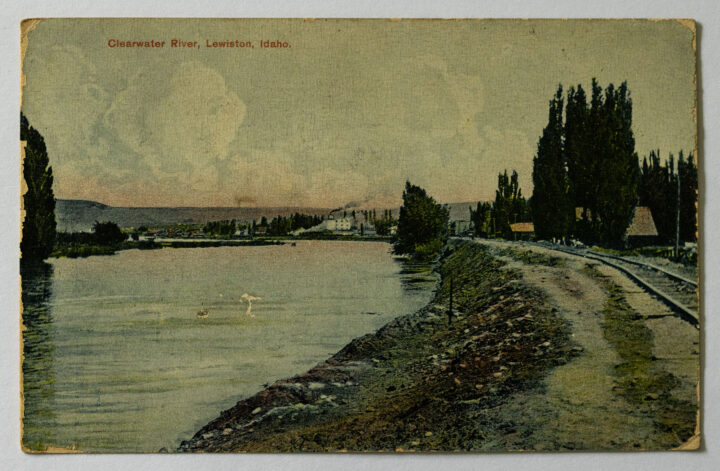
Postcard #0028: Clearwater River, Lewiston with Merry Christmas 1908 Greetings


A vintage postcard depicting the Clearwater River in Lewiston, Idaho. The river dominates the foreground with calm, reflective water. Along the right bank, a raised railroad track runs parallel to the river, with tall, slender trees lining its side. In the background, across the river, lies the town of Lewiston nestled against distant hills under a cloudy sky. The sky above is a mix of pale blues and whites, with a hint of warm colors from the postcard's printing process. The title
Front — A postcard view of the Clearwater River in Lewiston, Idaho, with a railroad track running alongside the water and a town visible in the distance.

Postcard Metadata


The divided back of a postcard, featuring handwritten cursive text on the left side and an address on the right. A green one-cent U.S. Franklin stamp is affixed in the upper right corner. A clear circular postmark indicates
Back — Correspondence from O.W. and Aunt Clara to J.J. McMenamy

Transcription

Merry Xmas and Happy 1908 From your nephew O.W. and Niece Aunt Clara

Historical & Family Notes

While this postcard features a beautiful early 20th-century landscape of the Clearwater River in Idaho, its primary interest for this collection lies in its connection to Carthage, Illinois—the hometown of Pearl Byers. Uniquely, this card is not addressed to Pearl or Harvey, but to J.J. McMenamy, a resident of Carthage. The senders, identified as “nephew O.W. and Aunt Clara,” extend simple holiday wishes for Christmas 1908.

The presence of this card in a collection primarily focused on Pearl Byers and Harvey Sights suggests a possible familial or community tie within Carthage, perhaps indicating that the McMenamy family was known to the Byers or Sights, or that the card was later acquired and added to the collection for its local historical relevance. It offers a glimpse into broader social connections within Carthage during the early 1900s, even if not directly part of Pearl and Harvey’s personal correspondence.

This holiday greeting provides a brief snapshot of seasonal communication at the turn of the century, sent across a vast distance from Idaho to Illinois. It captures the simple charm of period postcards, serving as a reminder of distant relations and the enduring tradition of sharing good wishes during the festive season.

Continue Reading

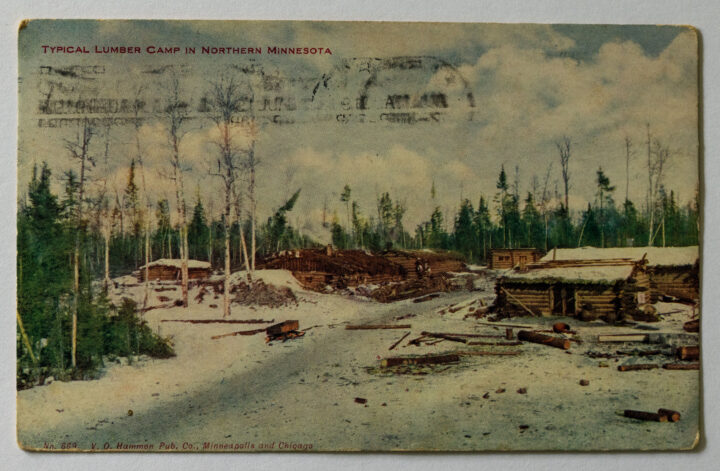
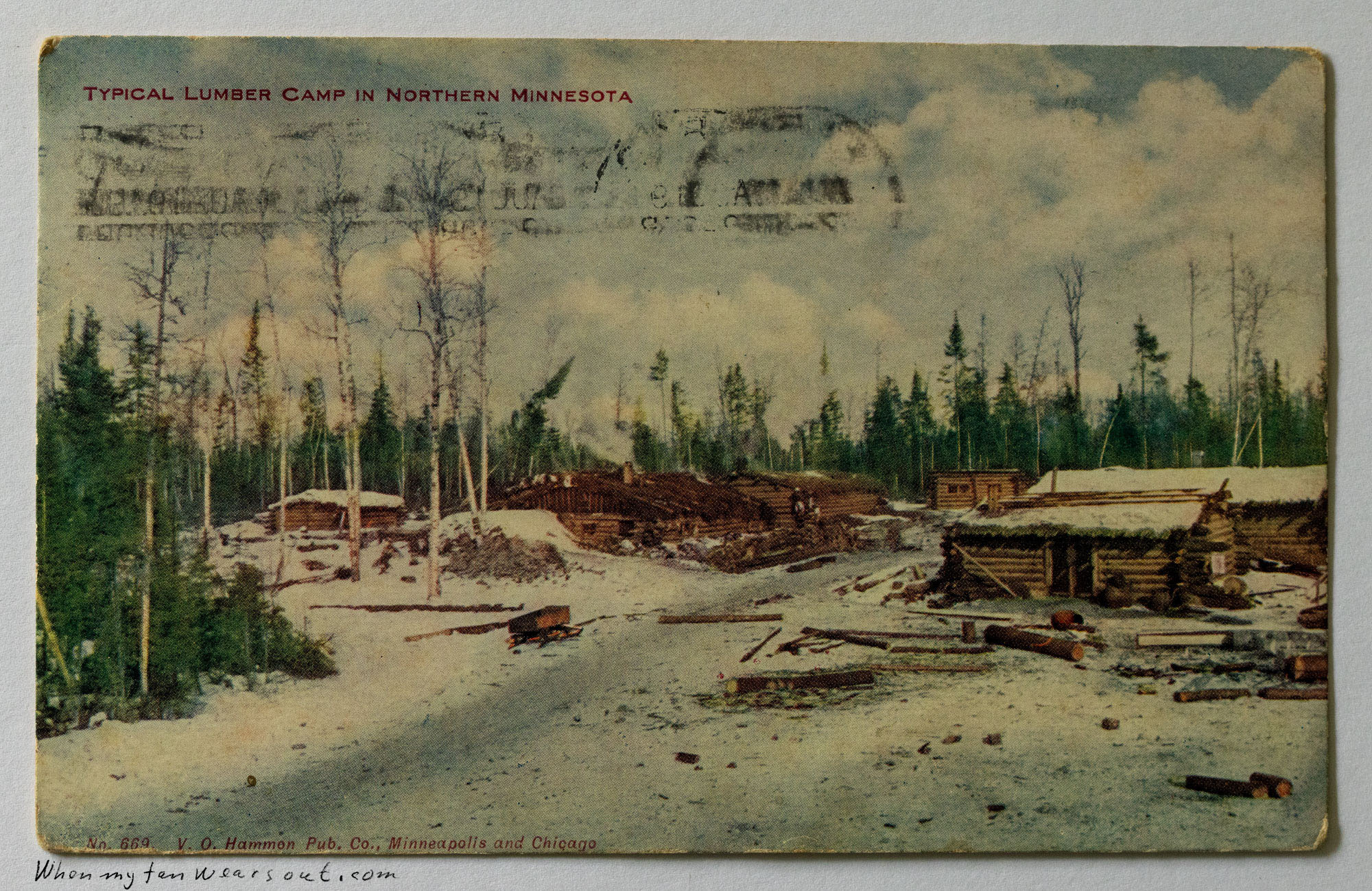
Postcard #0027: Snowy Northern Minnesota Lumber Camp


Hand-colored postcard depicting a snowy lumber camp in Northern Minnesota with log cabins, stacked timber, and bare trees under a cloudy sky, titled
Front — A snowy scene of a typical lumber camp in Northern Minnesota with log cabins and felled trees.

Postcard Metadata


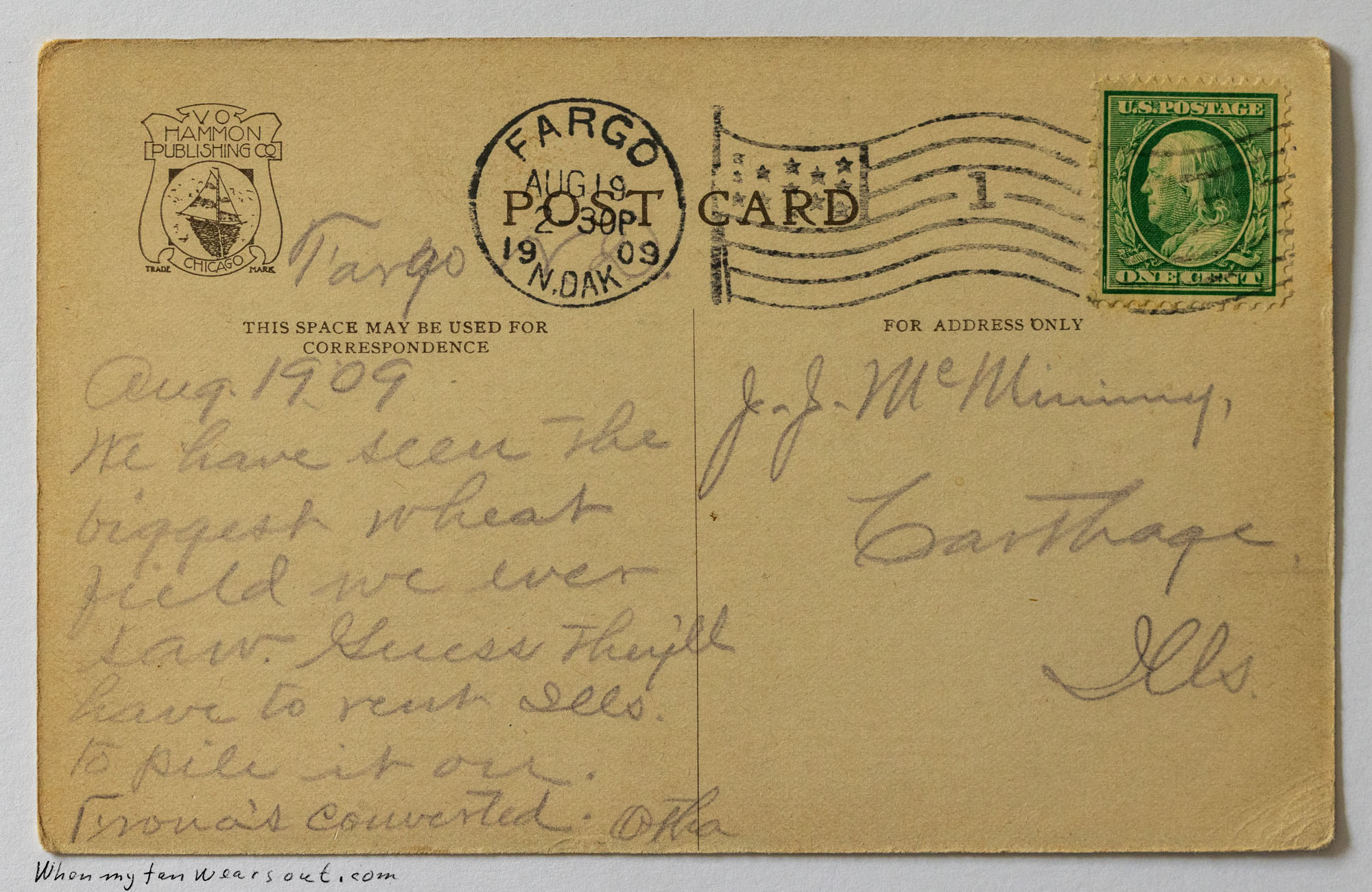
The back of the postcard features a Fargo, North Dakota postmark from August 19, 1909, a green one-cent Benjamin Franklin stamp, and a handwritten message about seeing a large wheat field and
Back — Correspondence from (unknown sender) to J. F. McMinnimy

Transcription

Aug. 19. 09. We have seen the biggest wheat field we ever saw. Guess they’ll have to rent silos to pile it on. Trona’s converted. O.K.

Historical & Family Notes

This postcard offers a glimpse into early 20th-century travel and industry, depicting a harsh winter scene from a Northern Minnesota lumber camp. While the postcard itself showcases an industrial snapshot, the message on the reverse speaks of agricultural abundance in North Dakota, noting an impressively large wheat field and the sender’s amusement at its size.

Notably, this particular postcard is not addressed to Pearl Byers or Harvey Sights, unlike many others in the collection. Instead, it is sent to J. F. McMinnimy in Carthage, Illinois, suggesting it was acquired into the family collection through means other than direct correspondence between Pearl and Harvey. This card likely entered the collection as an artifact of broader family connections or local historical interest.

The message’s casual tone, “Trona’s converted. O.K.”, hints at an ongoing personal narrative or shared understanding between the sender and recipient, a common feature of informal postcard exchanges of the era, conveying news that would have been significant to the immediate circle.

Continue Reading

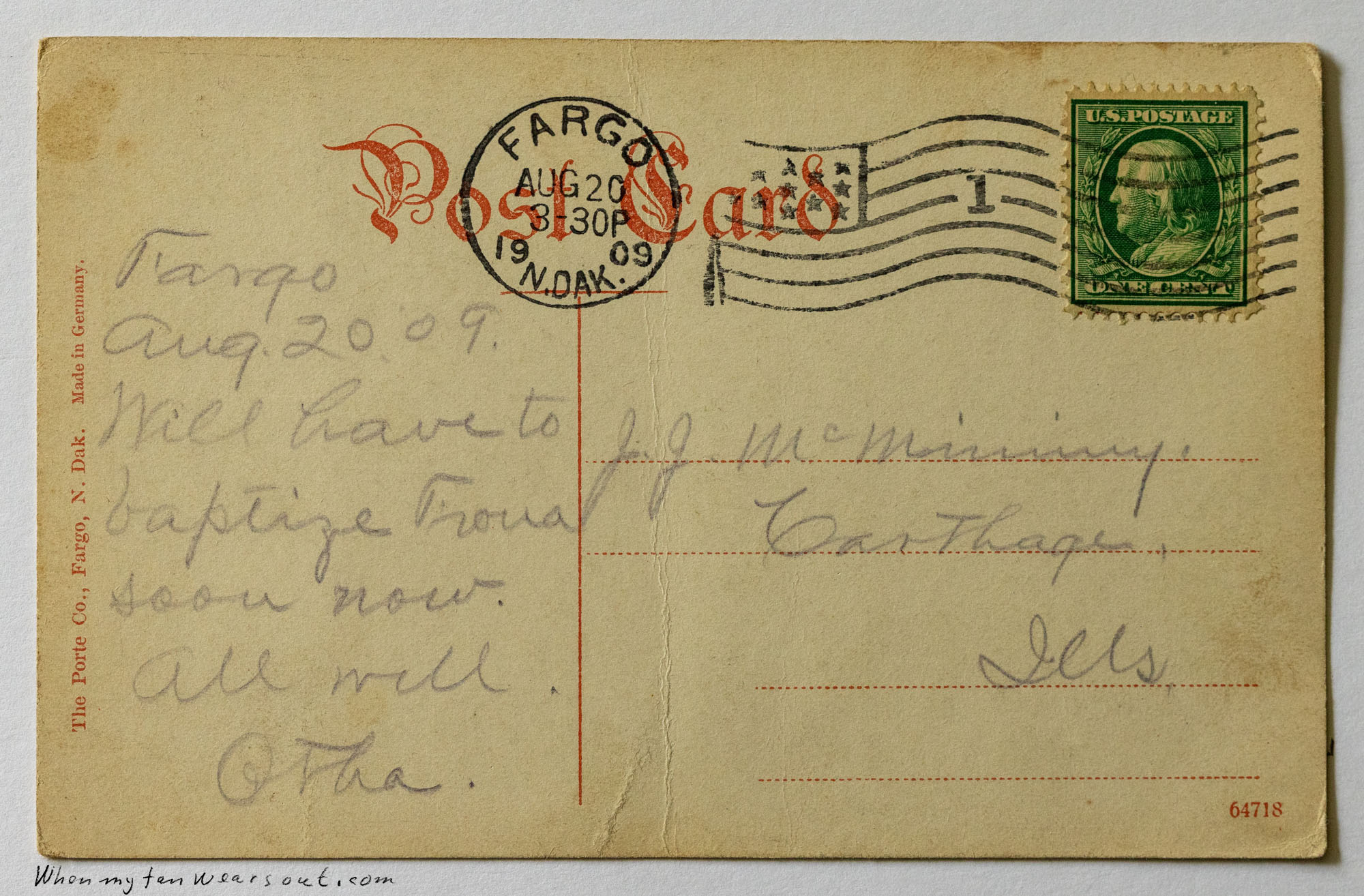
Postcard #0026: Roosevelt’s Cabin and a Baptism Reminder from Fargo


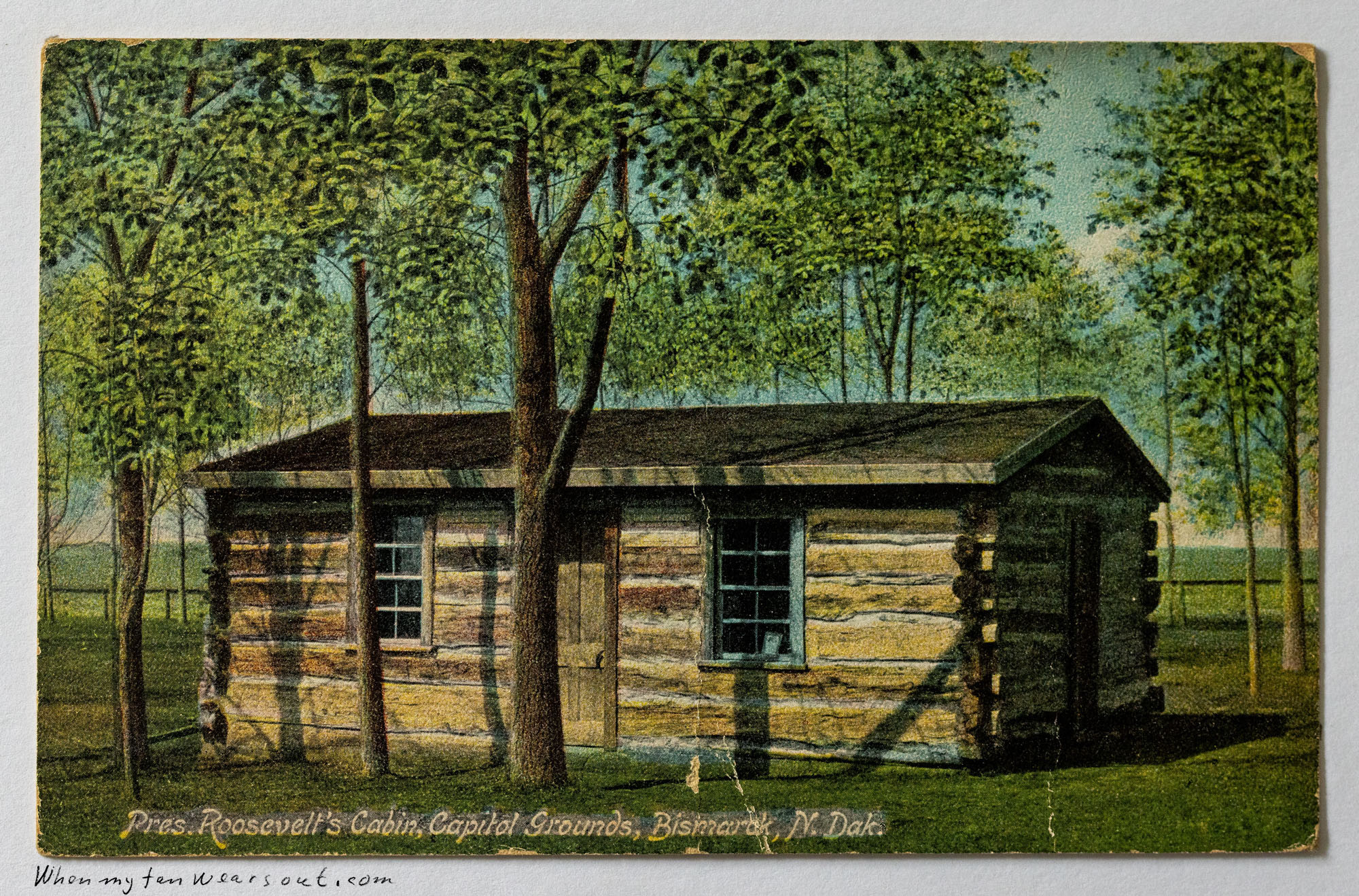
A vintage colorized postcard showing President Theodore Roosevelt's log cabin on the Capitol Grounds in Bismarck, North Dakota. The rustic cabin is made of horizontal logs with two windows and a door, nestled among numerous green trees under a bright blue sky.
Front — A colorized postcard image of President Theodore Roosevelt’s log cabin on the Capitol Grounds in Bismarck, North Dakota, surrounded by trees.

Postcard Metadata


The back of a 1909 divided-back postcard with a green one-cent George Washington stamp postmarked Fargo, North Dakota, August 20, 1909. Handwritten in cursive is a message from 'Otha' to 'Miss J.D. McMinniny' in Carthage, Illinois, discussing a baptism.
Back — Correspondence from Otha to Miss J.D. McMinniny

Transcription

Fargo Aug. 20. 09. Will have to baptize Fronna soon now. All well. OTha.

Historical & Family Notes

This postcard, sent from Fargo, North Dakota, by “Otha” to Miss J.D. McMinniny in Carthage, Illinois, offers a snapshot of life in 1909. While the recipient is not Pearl Byers, the destination of Carthage, Illinois, links this card to Pearl’s hometown, suggesting a potential connection through extended family or shared acquaintances within her community. The brief message hints at an upcoming family event, stating, “Will have to baptize Fronna soon now,” indicating a significant personal or religious occasion.

The front of the postcard features a popular historical landmark, President Theodore Roosevelt’s cabin on the Capitol Grounds in Bismarck, North Dakota. Roosevelt’s deep ties to North Dakota through his ranching days made this a recognizable and popular image for early 20th-century postcards, showcasing the historical significance and natural beauty of the region.

The card’s “Made in Germany” notation underscores the global nature of postcard production at the time, with many high-quality, colorized cards being printed abroad for the American market. Such cards provided an efficient way for people to send quick updates and maintain connections across distances, as demonstrated by Otha’s concise but meaningful message.

Continue Reading

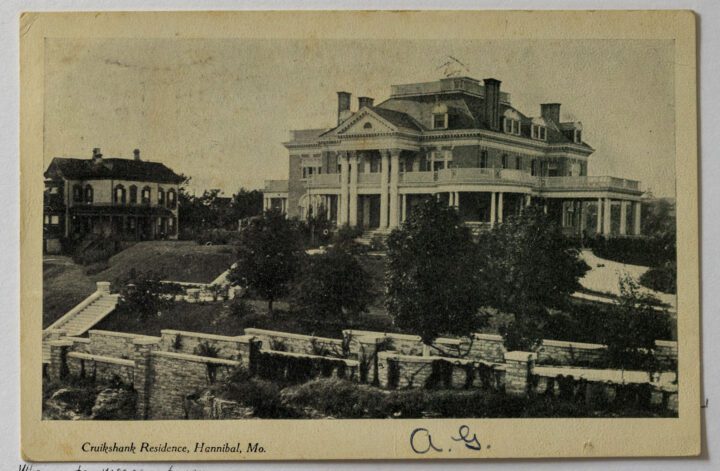
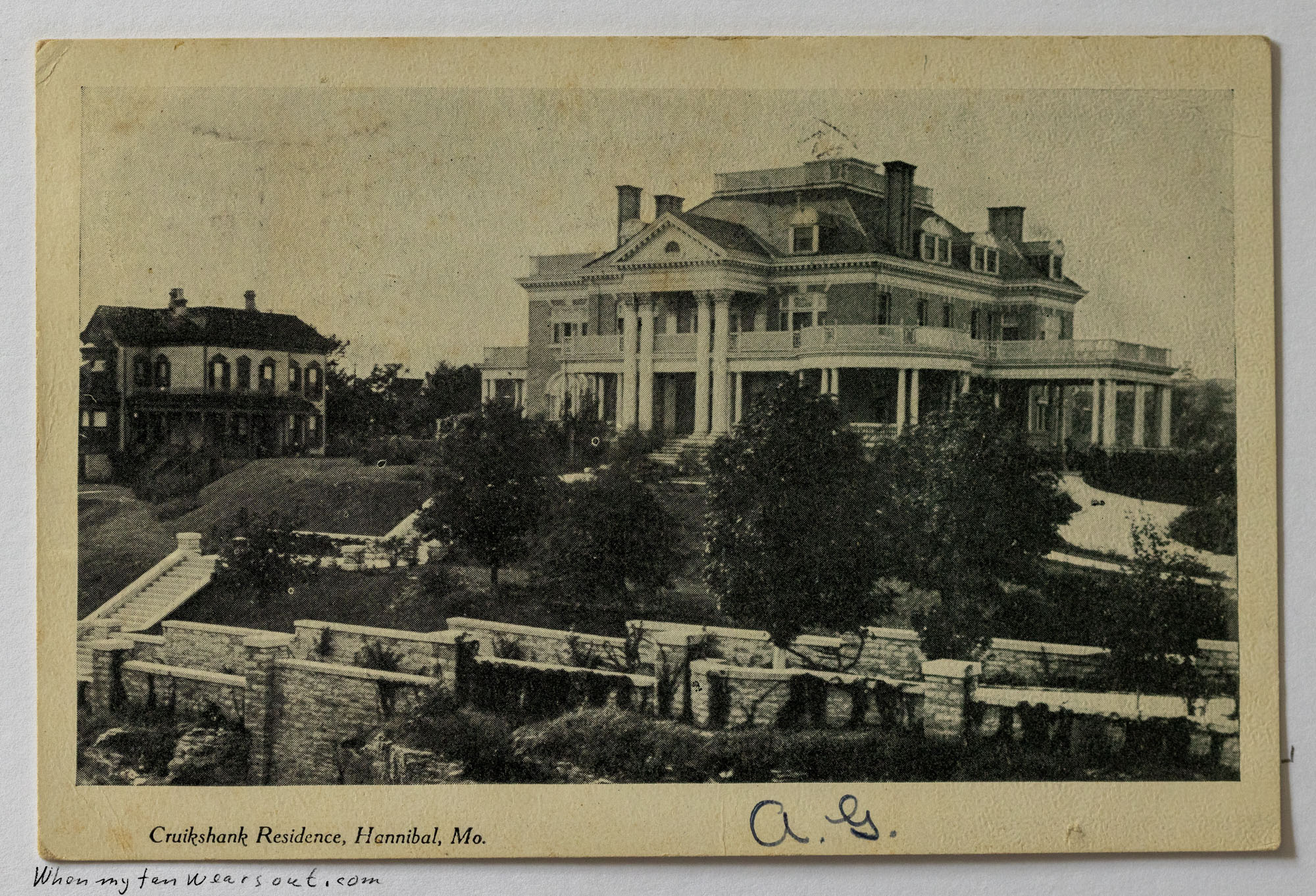
Postcard #0025: Greetings from Hannibal’s Grand Cruikshank Residence


A vintage postcard depicting the large, three-story Cruikshank Residence in Hannibal, Missouri, featuring classical columns, multiple porches, and a grand entrance. A smaller, two-story house stands to the left. The foreground shows a stone wall and landscaped terracing with a set of stairs. The sky is hazy. Below the image,
Front — A large, stately Cruikshank Residence mansion with a smaller house beside it, surrounded by manicured grounds.

Postcard Metadata


The back of a vintage postcard with a
Back — Correspondence from Lavina Byrd to Miss Pearl Byers

Transcription

Am from Hannibal, Mo. 9/10/09 a fine time. Lavina Byrd. Miss Pearl Byers, Carthage, Ill.

Historical & Family Notes

This postcard offers a charming glimpse into Pearl Byers’ social life in 1909, years before her eventual marriage to Harvey Sights. Sent by her friend Lavina Byrd from Hannibal, Missouri—a city famously associated with Mark Twain and its Mississippi River heritage—it captures a simple update of enjoying a “fine time” during a visit. The image of the grand Cruikshank Residence speaks to the architectural prosperity of the era and the types of impressive landmarks travelers would share with friends back home.

The brief message reflects the common use of postcards for quick social connections, serving as a tangible record of Pearl’s friendships and daily interactions. These snippets from her past provide valuable context for her life before and during her early courtship, illustrating the social landscape she navigated as a young woman in the early 20th century. While Harvey Sights is not mentioned, this card rounds out the picture of Pearl’s world, highlighting her network of friends and their shared experiences.
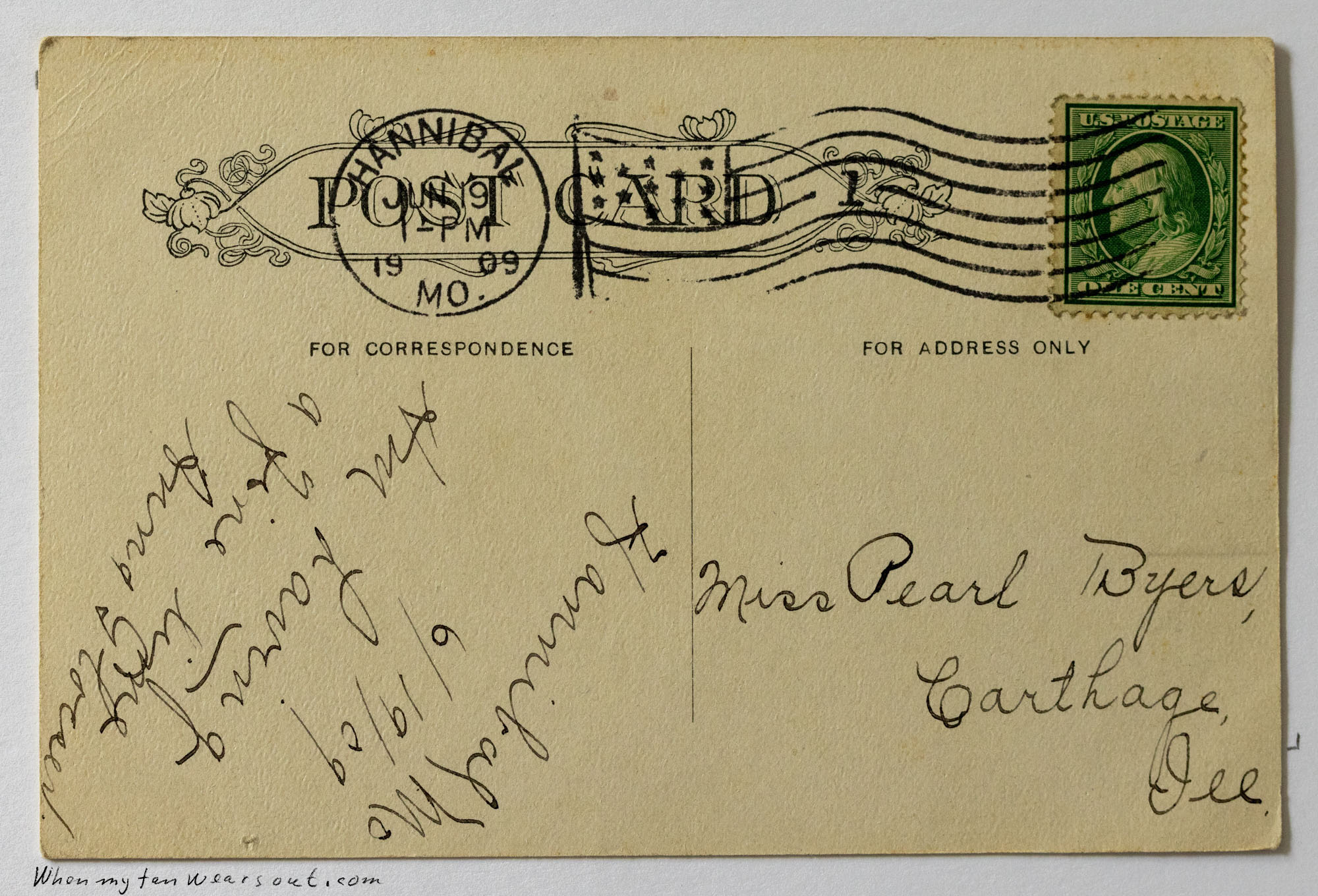
The card’s details, from the postmark date of September 9, 1909, to the one-cent postage, are authentic markers of its time. It’s a small, personal artifact that connects Pearl to a broader historical moment, showcasing how friendships were maintained through the simple act of sending a picture and a few words across the Midwestern landscape.

Continue Reading