Postcard #010: Bear Creek and a Playful Colorado Inquiry


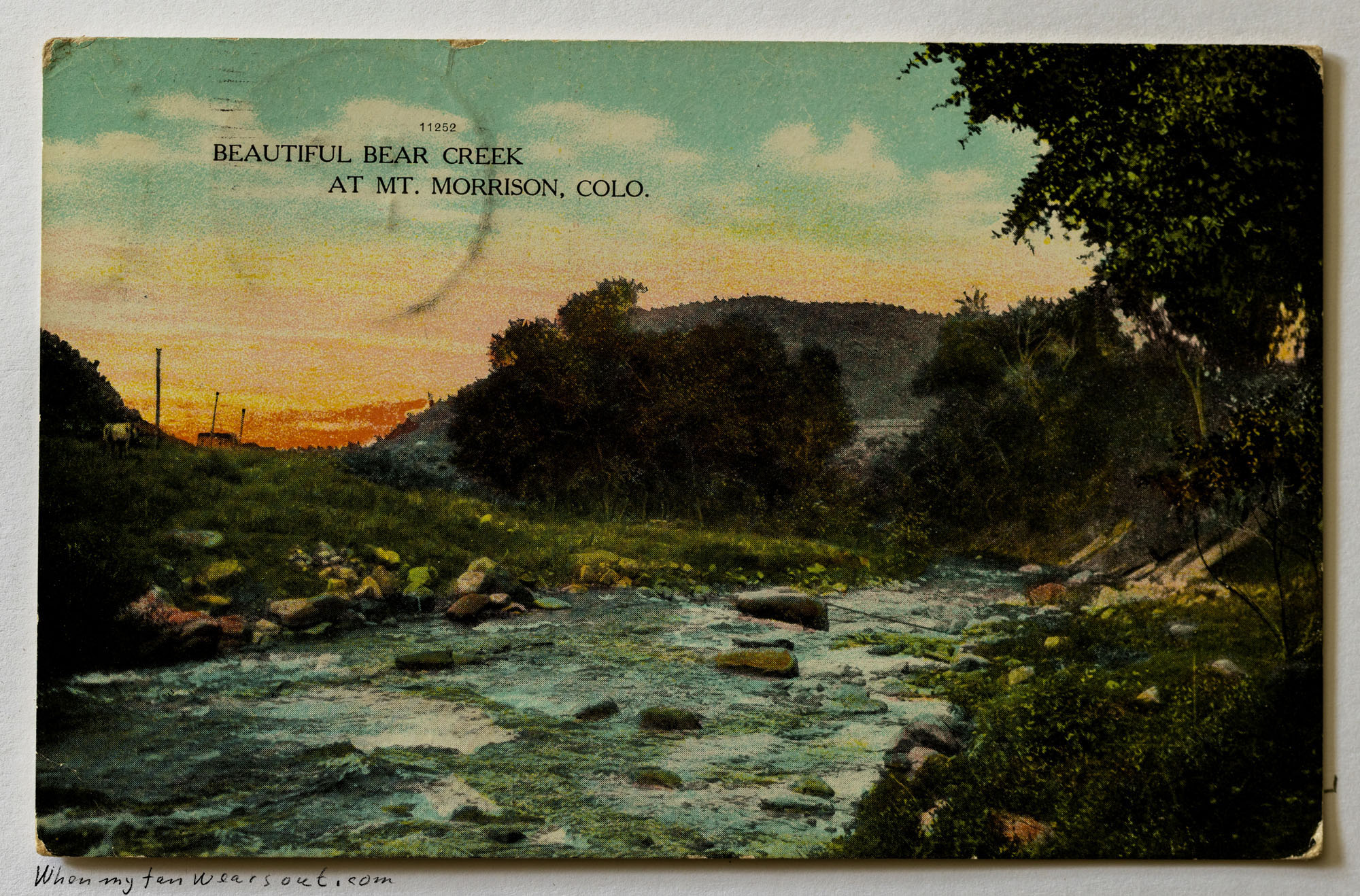
A vintage, hand-colored postcard depicting a serene sunset over Bear Creek at Mount Morrison, Colorado, with water flowing over rocks surrounded by dense green trees and distant hills under a vibrant orange and green sky.
Front — A hand-colored scenic view of Bear Creek flowing through a mountainous landscape at sunset in Mt. Morrison, Colorado.

Postcard Metadata


The reverse side of a postcard with a handwritten message in black ink from Harvey Sights to Miss Pearl Byers, featuring a one-cent George Washington stamp, a Denver, Colorado postmark dated August 1, 1919, and the card publisher's details.
Back — Correspondence from Harvey Sights to Miss Pearl Byers

Transcription

Remember the 1st time I said these words to Pearl? Here goes. Cola interested? Well, I guess so! – $ 7/27/19 H.S.S.

Historical & Family Notes

This postcard captures an early moment of playful flirtation between Harvey Sights and Pearl Byers. Harvey is likely in Colorado, sending this scenic view of Bear Creek, Mt. Morrison. His message, “Cola interested? Well, I guess so!”, cleverly abbreviates “Colorado” and implies an ongoing inside joke or conversation they’ve had about the state, or perhaps about him visiting. The phrase “Remember the 1st time I said these words to Pearl?” further solidifies the intimacy of their burgeoning relationship, hinting at a shared memory or a significant romantic declaration.

Sent just before their eventual marriage, this postcard serves as a sweet testament to the lighthearted yet meaningful communication that characterized their courtship. Harvey’s hopeful response to his own question, “Well, I guess so!”, suggests his deep desire for Pearl to share in his interests or to join him on his adventures. This early exchange paints a vivid picture of the personal bond that would soon lead to their lifelong partnership and the foundation of their family.

The date “$ 7/27/19” written above his initials “H.S.S.” indicates he wrote the card a few days before it was postmarked, a common practice when traveling, giving us a precise timeline of his thoughts leading up to its dispatch.

Continue Reading

Postcard #009: Merry Christmas Lilies and a Skating P.M.


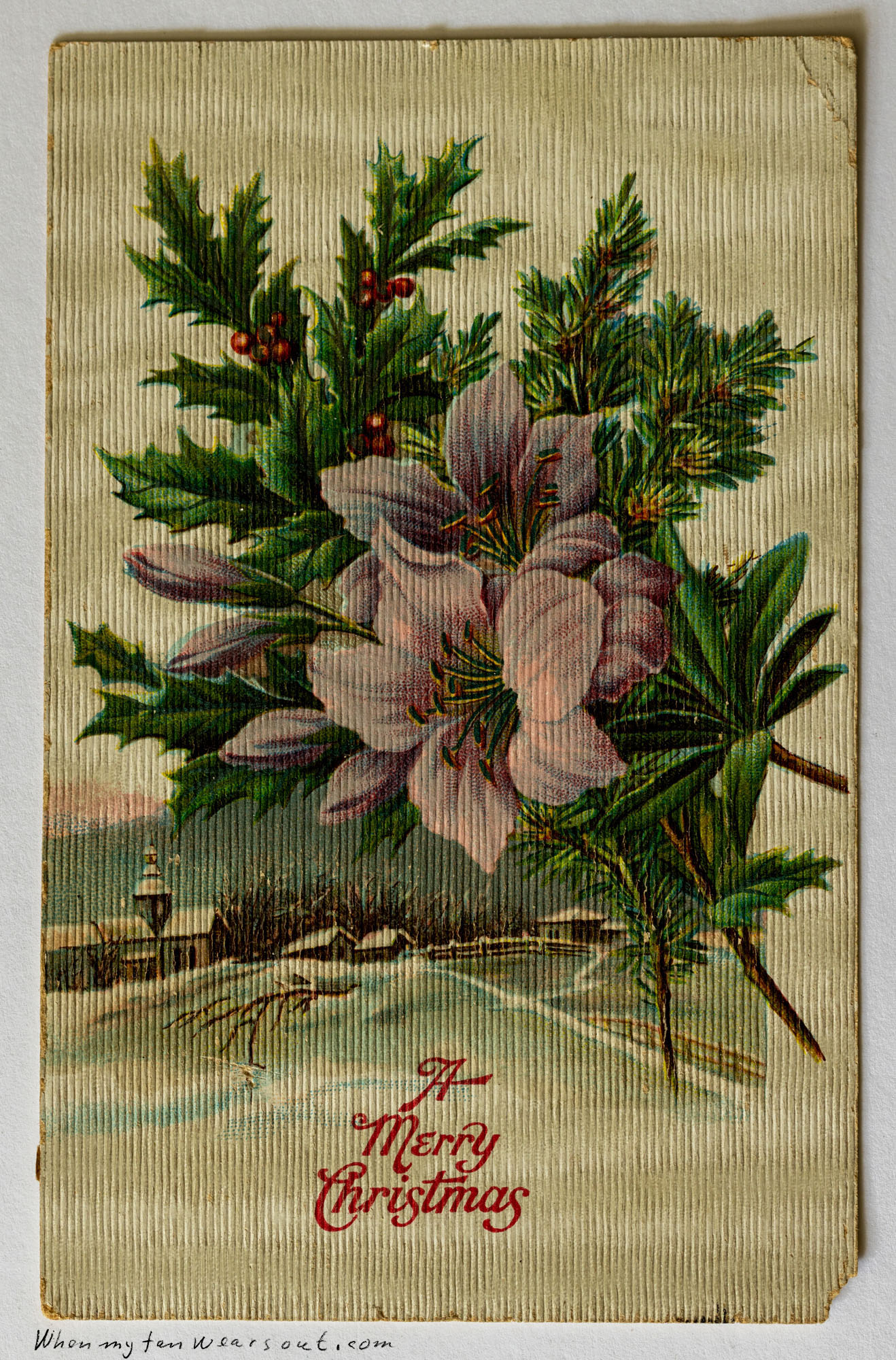
A vintage Merry Christmas postcard featuring a vibrant central arrangement of pink lilies with prominent green stamens, surrounded by dark green holly leaves with red berries, and deep green pine needles. In the soft, blurred background, a winter landscape with a bare tree and distant snow-covered buildings is visible. The words
Front — An illustration of pink lilies, holly, and pine branches, with “Merry Christmas” script, superimposed on a faint winter landscape.

Postcard Metadata


The back of a vintage postcard with a postmark from Quincy, Illinois, dated December 20, 1908. A green one-cent Benjamin Franklin U.S. postage stamp is affixed in the upper right corner. The left half contains a handwritten cursive message in purple ink from
Back — Correspondence from Harvey Sights to Pearle Byers

Transcription

Dec. 20. 08 We were all down to illard Fri. night We were about 30 there. Hello Sis. Wish I had a fine time. Merry Christmas and Happy New Year! How are you? Why in the world dont you write. This was received today. I was skating this P.M. Verna said you never answered her card and so did Bertha. No news around here. There is a Xmas tree in room. How come. And soon. Your true friend Harvey

Historical & Family Notes

This festive Christmas postcard from December 1908 catches Harvey Sights playfully chiding Pearl Byers for her lack of correspondence. His query, “Why in the world don’t you write,” hints at a burgeoning flirtation and the desire for more frequent communication during their early courtship phase. He shares snippets of his life, mentioning a social gathering and an afternoon of skating, painting a picture of typical Midwestern winter activities.

The reference to Verna and Bertha, likely mutual friends or relatives, suggests a shared social circle and adds a layer of community to their interactions, further binding Pearl and Harvey together within their small-town world. The mention of a “Xmas tree in room” and “How come. And soon.” leaves a hint of anticipation, perhaps for a future meeting or further holiday tidings.

This card captures a tender moment in their relationship, framed by the holiday season and the charming impatience of a suitor eager for a response. It’s a sweet, authentic glimpse into the early stages of the connection that would eventually lead to their marriage and the birth of their daughter, Marnelle.

Continue Reading

Postcard #008: Bird Family Birthday Greetings to Pearl


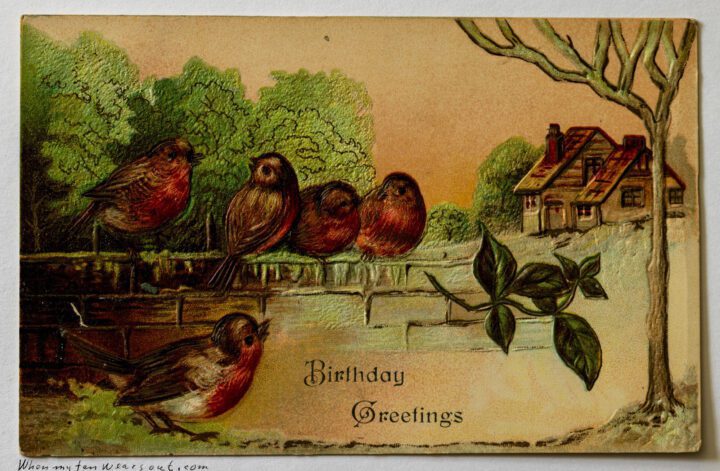
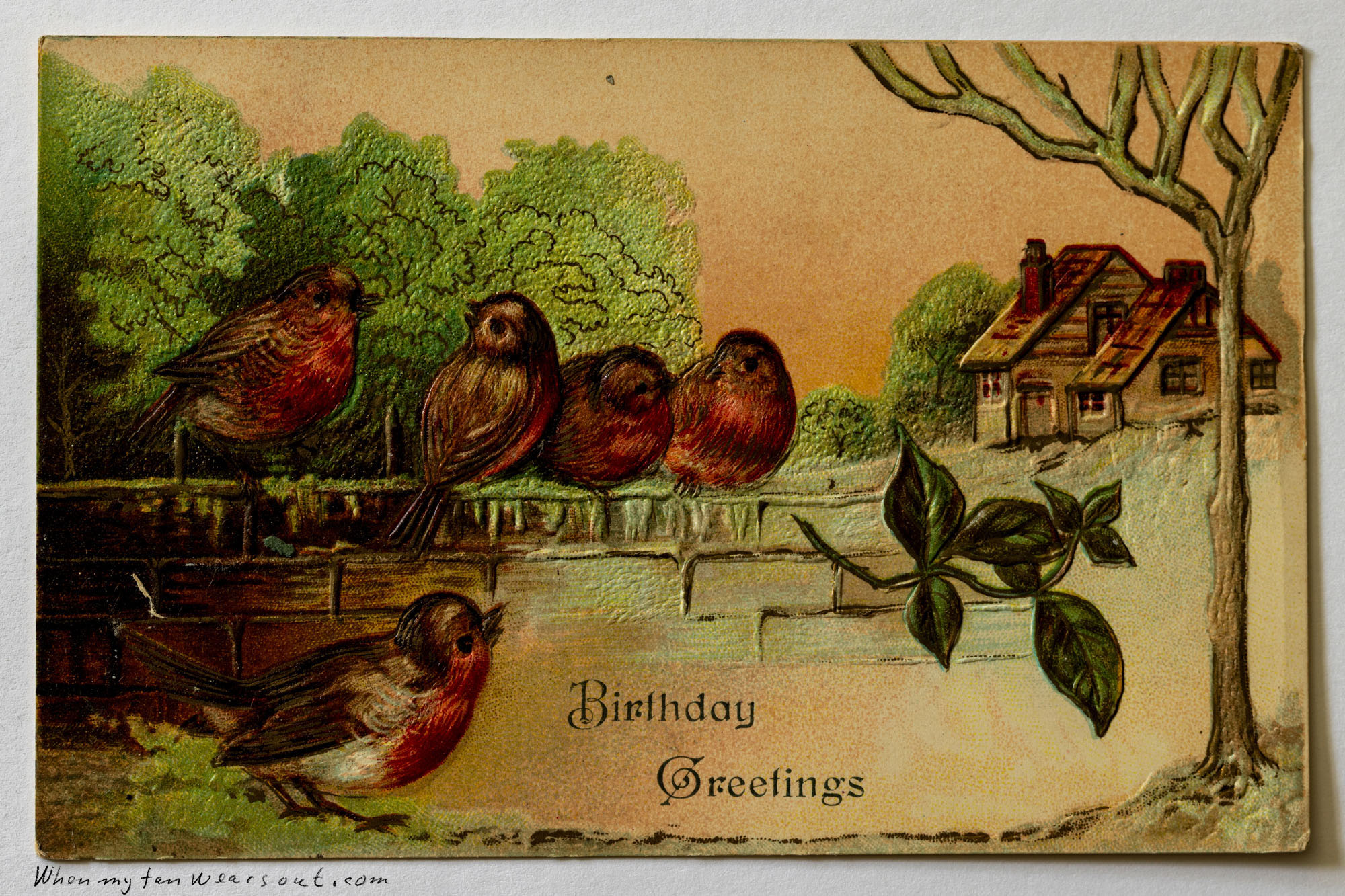
Vintage postcard illustration of a rustic nature scene featuring five red-breasted robins perched on a weathered stone wall, with a quaint cottage and lush green trees in the background under a warm, gradient sky. The phrase
Front — An illustration of a bird family gathered on a stone wall in a country setting with a house and trees, wishing “Birthday Greetings”.

Postcard Metadata


The back of a vintage postcard with a green 1-cent Benjamin Franklin postage stamp postmarked
Back — Correspondence from Dora C. to Miss Pearl Byers

Transcription

Dear Pearl. I wish you many, many happy Birthdays Dora C. Miss Pearl Byers Carthage Ill. Dec. 4. 1908.

Historical & Family Notes

This charming postcard marks a special day, as it was sent to Pearl Byers on her exact birthday, December 4, 1908. The sender, identified as Dora C., extended warm wishes for “many, many happy Birthdays,” a sentiment that was delivered locally within Carthage, Illinois.

The card serves as a delightful record of Pearl’s social connections and the customary practice of sending celebratory postcards, even for local greetings. It highlights the importance of marking personal milestones through tangible correspondence, a cherished tradition in the early 20th century.

Establishing Pearl’s precise birthday through this card provides valuable archival data, anchoring future biographical details within the collection. It allows us to connect the dots in her timeline and understand the personal touches that adorned her life before her marriage to Harvey Sights.

Continue Reading

Postcard #007: Birthday Greetings to Pearle Byer from Elva J. Sights


Vintage postcard illustration featuring five small brown birds perched on white branches against a bright yellow and green forest background, surrounded by a decorative white and yellow border, with 'Birthday Greetings' text on a solid green background bordered by purple flowers.
Front — A serene green-bordered scene featuring five birds on tree branches against a bright yellow and green forest background with ‘Birthday Greetings’ text.

Postcard Metadata


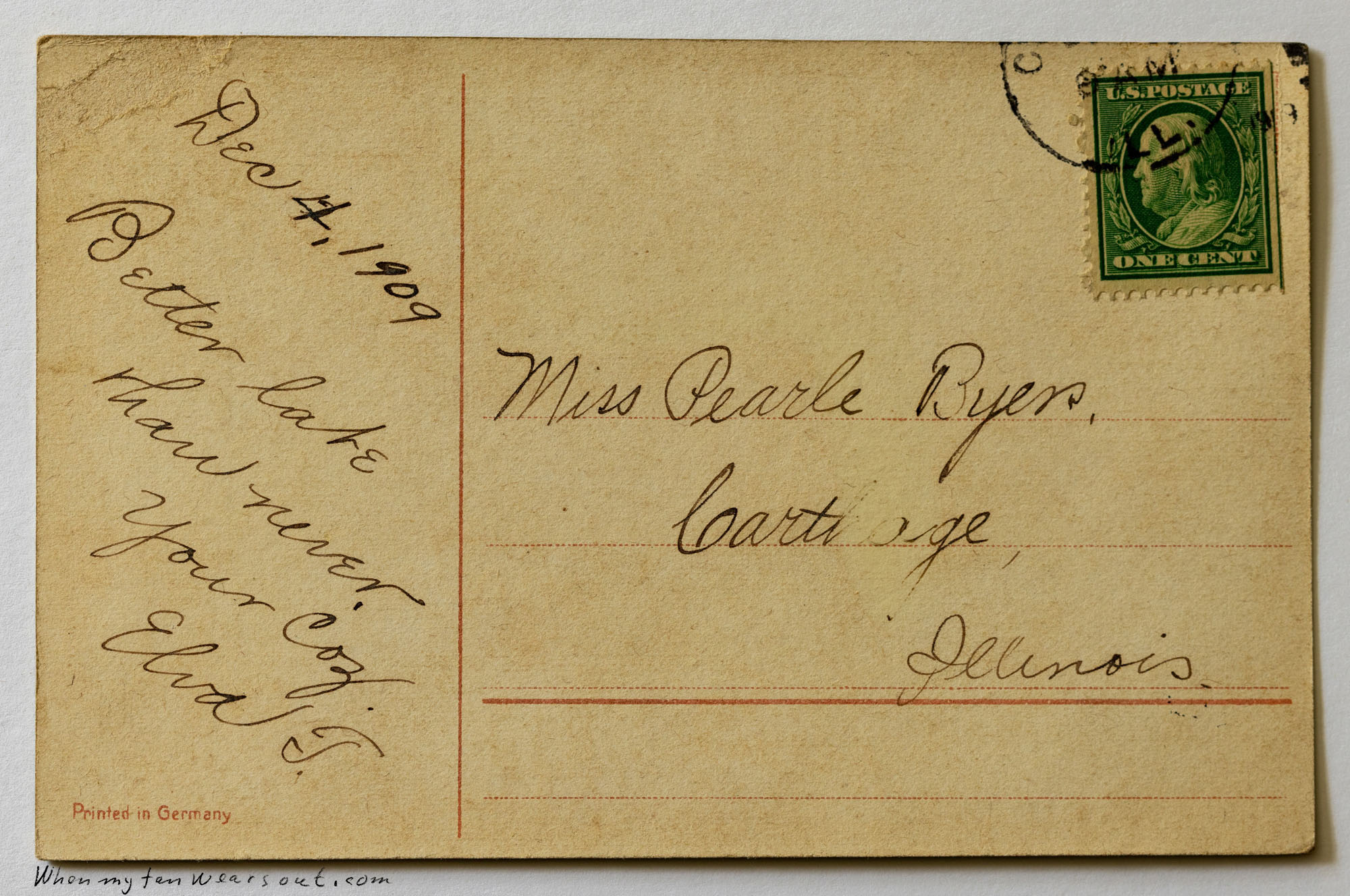
Back of a vintage postcard with a green one-cent George Washington stamp and a round postmark, handwritten cursive address to Miss Pearle Byer in Carthage, Illinois, and a handwritten message dated Dec 4, 1909, from Elva J. S. on a light brown divided back.
Back — Correspondence from Elva J. Sights to Pearle Byer

Transcription

Dec 4, 1909 Better late than never. Your Cog. J. Elva J. S.

Historical & Family Notes

This charming postcard, dated and postmarked on December 4, 1909, delivers a direct birthday greeting to Pearle Byer, the future wife of Harvey Sights. The sender, “Elva J. S.”, can be identified as Elva J. Sights, given the distinctive cursive capital ‘S’ that mimics an ‘L’, consistent with the Sights family record’s unique handwriting characteristics. The card likely signifies a close familial or social bond already present between Pearle and the Sights family network even before her marriage to Harvey.

The message, “Better late than never,” playfully implies a slight delay in sending the birthday wishes, yet the postcard was postmarked on Pearle’s actual birthday, December 4th. This suggests Elva may have intended for it to arrive earlier, but ensured it was mailed on the day itself, perhaps for a local delivery in Carthage, Illinois. The card, with its cheerful birds amidst a vibrant natural scene, reflects a popular aesthetic for sentimental greetings of the era.

Printed in Germany, this postcard illustrates the global reach of printed goods at the turn of the 20th century, bringing a touch of international craft to the heartland of Illinois. As an early artifact in the WhenMyTanWearsOut.com collection, it offers a sweet glimpse into Pearle’s social connections and her developing role within the Sights family’s circle, long before her eventual marriage to Harvey Sights.

Continue Reading

Postcard #006: Galesburg Court House and Plans to Return Home


A vintage colorized postcard showing the Galesburg Court House in Illinois, featuring a prominent clock tower and stone architecture against a blue and green sky, with the image printed upside down.
Front — A vintage postcard image of the Galesburg Court House with a prominent clock tower, depicted upside down.

Postcard Metadata


The back of a 1903 undivided back postcard with handwritten message in faded ink from Harvey Sights to Miss Pearl Byers, postmarked Galesburg, Illinois, with a green One Cent U.S. Postage stamp.
Back — Correspondence from Harvey Sights to Miss Pearl Byers

Transcription

8-11-03 Hello Pear. How is my little girlie. I am having a good time at my work and will be home Sat. by by. Need.

Historical & Family Notes

This early postcard, penned by Harvey Sights to his future wife Pearl Byers, offers a charming glimpse into their courtship in 1903. Sent from Galesburg, Illinois, where Harvey was likely for work or a visit, the message conveys an eagerness to return home to Carthage, underscoring the distance that often separated young sweethearts in the early 20th century. His affectionate salutation, “Hello Pear. How is my little girlie,” clearly demonstrates the intimate and tender nature of their burgeoning relationship.

The card’s front, featuring the impressive Galesburg Court House, serves as a geographical marker for Harvey’s temporary whereabouts, connecting his personal message to a tangible place in the Midwestern landscape. The use of an undivided back postcard, popular prior to 1907, highlights the primary mode of personal correspondence during this era, where brevity and directness were key, much like a quick text message today.

Harvey’s promise to be “home Sat.” and the affectionate “by by” not only signal his imminent return but also suggest a longing for reconnection. These small, daily communications formed the fabric of their long-distance relationship, laying the foundation for their eventual marriage and shared life together. The collection of these postcards traces the romantic journey that defined Pearl and Harvey’s early years.

Continue Reading

Postcard #005: Mother’s Hot Summer Greetings to Harvey from Guide Rock


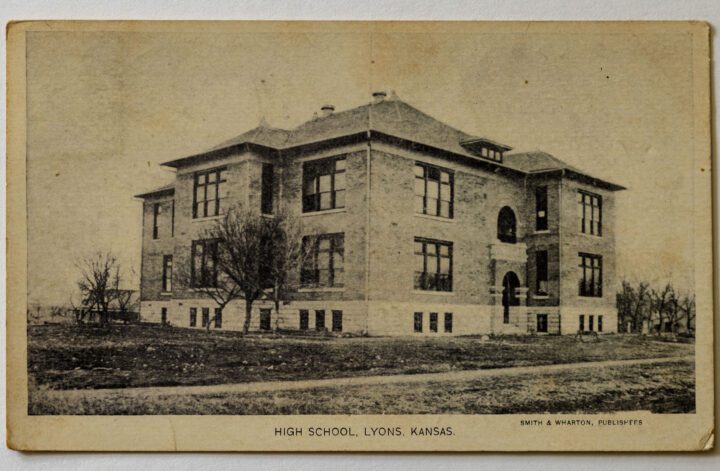
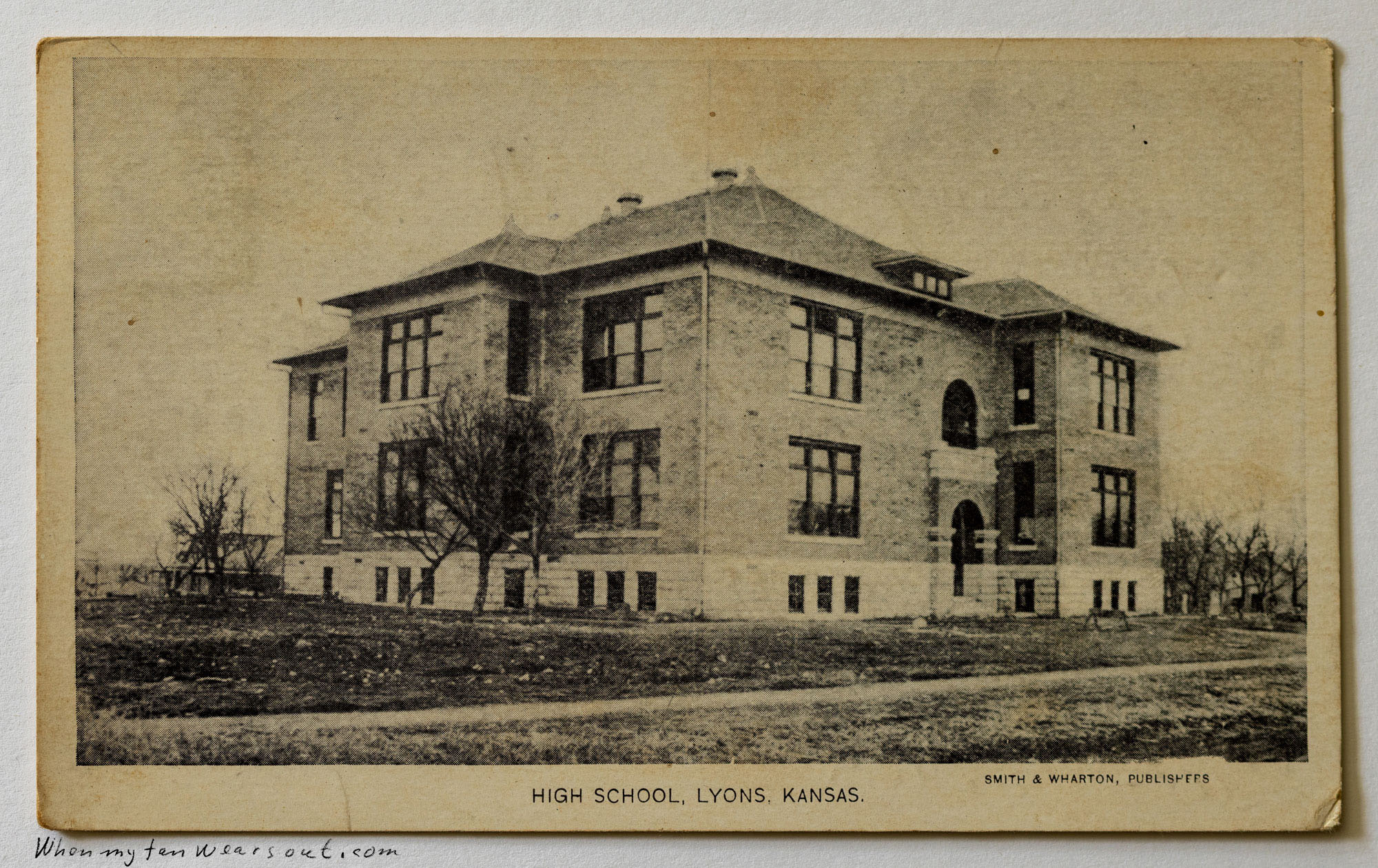
A sepia-toned photograph of a three-story brick high school building with a hipped roof and multiple large windows, situated on a grassy hill. The text
Front — A large brick high school building in Lyons, Kansas, with “SMITH & WHARTON, PUBLISHERS” noted.

Postcard Metadata


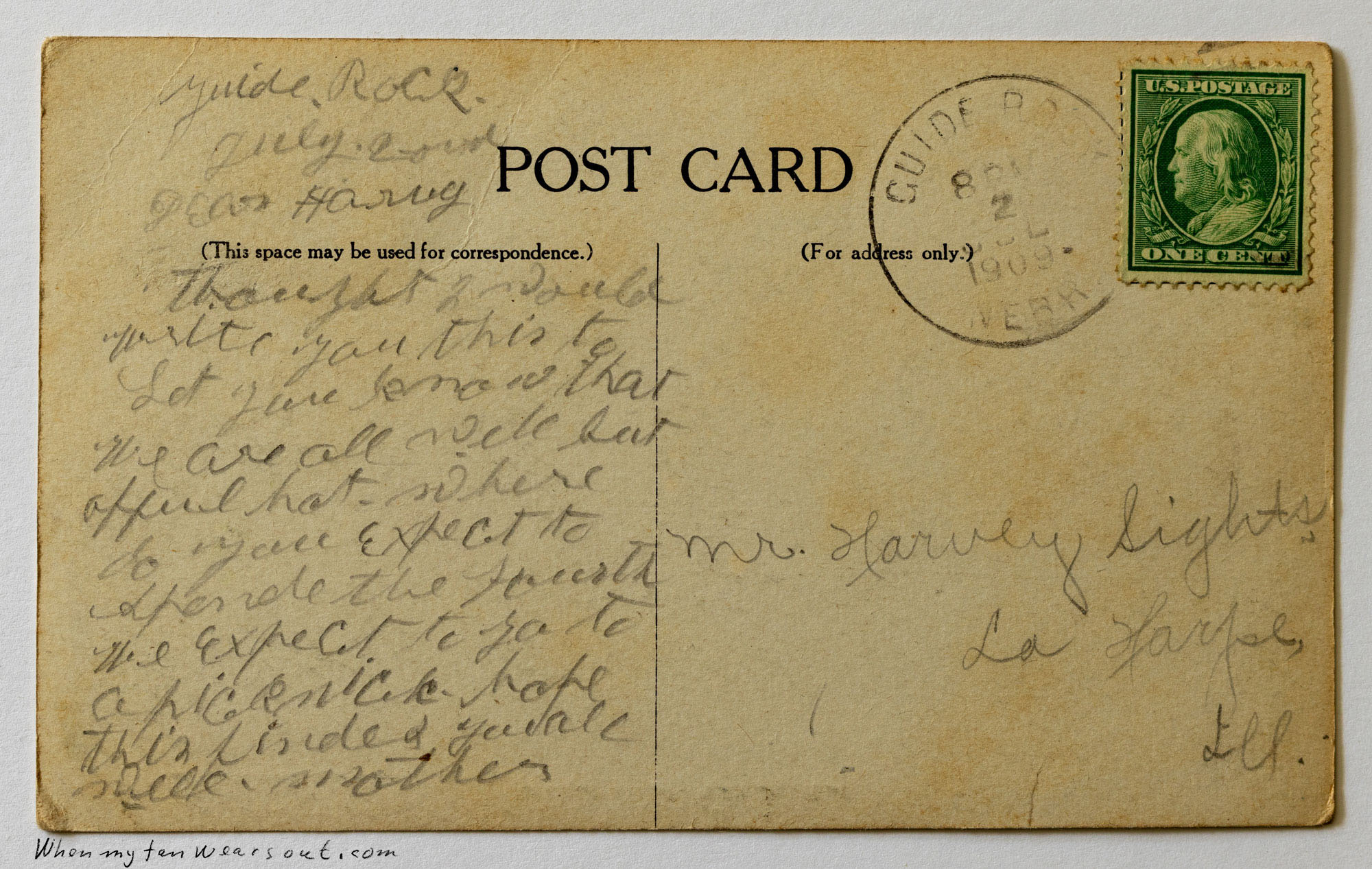
The back of a faded postcard featuring handwritten cursive in faded ink on the left side, starting with
Back — Correspondence from Mother (Harvey Sights’ Mother) to Harvey Sights

Transcription

Guide Rock. July 2nd 1909 Dear Harvey Thought I would write you this to let you know that We are all well but awful hot where do you expect to spend the fourth We expect to go to a picnic hope this finds you all well. Mother

Historical & Family Notes

This postcard offers a personal glimpse into Harvey Sights’ life just a few years before he would meet and marry Pearl Byers. Sent by his mother from Guide Rock, Nebraska, to Harvey in La Harpe, Illinois, it paints a picture of everyday family correspondence, discussing the weather (“awful hot”) and Fourth of July plans. This card is significant as it establishes Harvey’s family background and geographical context, showing him as a young man still connected to his roots.

The message, brief and warm, highlights the simple pleasures and concerns of the time, such as summer heat and holiday picnics. While Pearl is not mentioned, understanding Harvey’s familial ties and his life prior to their relationship enriches the overall narrative of their eventual romance and the family they would build together. It’s a fragment of his world, hinting at the life experiences he brought into his future with Pearl.

The generic image of a high school in Lyons, Kansas, suggests this was a common type of postcard available across regions, used for personal messages regardless of the scene’s direct relevance to the sender or recipient’s location. This underscores the widespread use of postcards as a primary form of communication in the early 20th century, connecting families across growing distances.

Continue Reading

Postcard #004: Cowgirl Picture Sent to Pearl Byers by Theo Wind


Vintage postcard illustration showing a dynamic cowgirl on a dark horse, wearing a white sweater and polka-dotted bandana, expertly lassoing a steer in a dusty western scene with other riders and cattle in the background. The text
Front — A vibrant illustration of a woman on a dark horse, lassoing, with ‘782. Cow Puncher Girl’ printed below.

Postcard Metadata


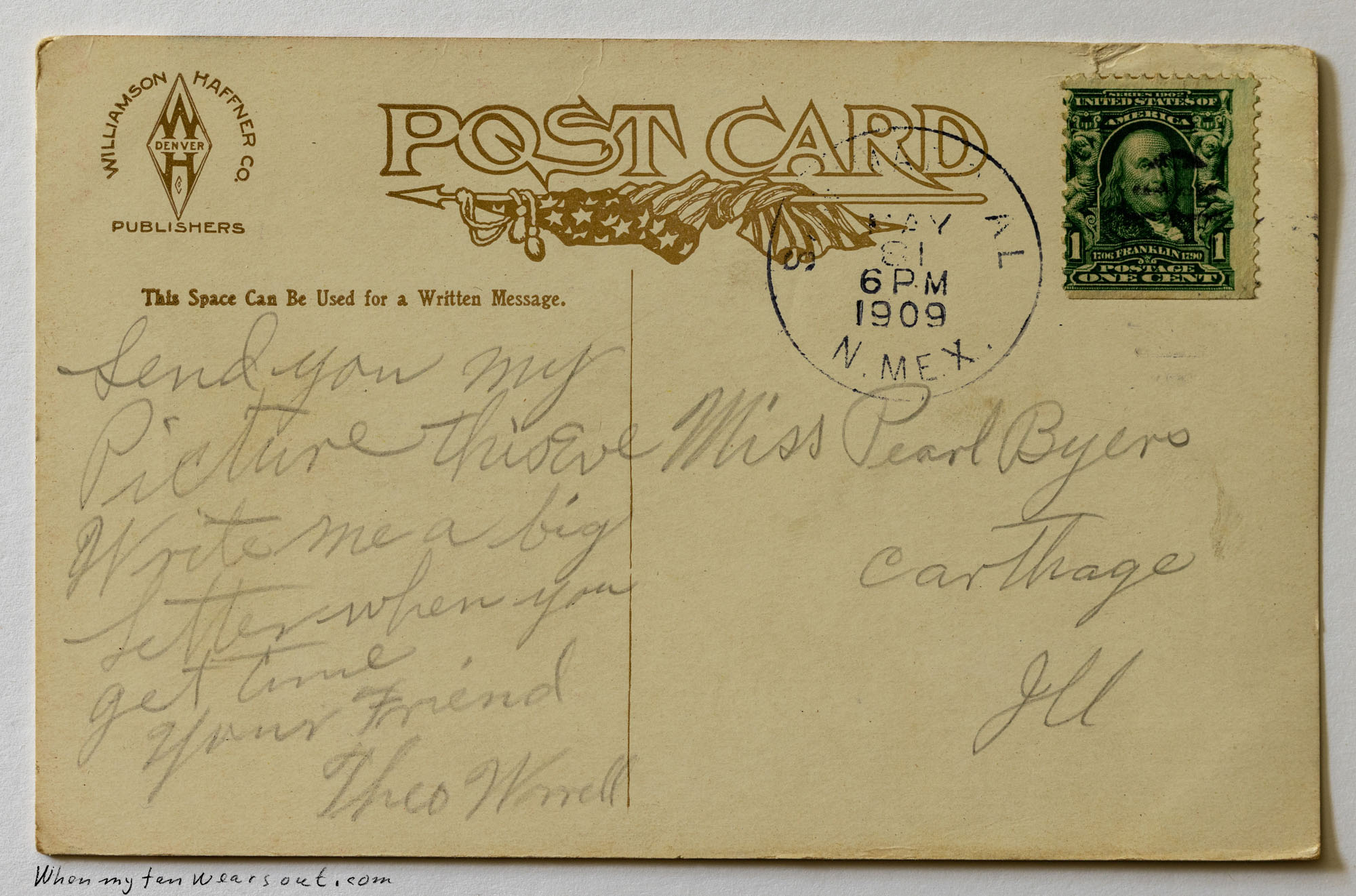
The back of a 1909 Williamson-Haffner Co. postcard with a one-cent Benjamin Franklin stamp postmarked Carthage, New Mexico, May 21, 1909. A handwritten message from 'Theo Wind' to 'Miss Pearl Byers' in Carthage, Illinois, is visible on the left, with the address 'Carthage Ill' on the right.
Back — Correspondence from Theo Wind to Pearl Byers

Transcription

Send you my Picture that I’ve Miss Pearl Byers Write me a big letter when you get time Your friend Theo Wind Carthage Ill

Historical & Family Notes

This postcard, featuring a spirited “Cow Puncher Girl” in a dynamic lassoing pose, was sent to Pearl Byers by her friend Theo Wind from Carthage, New Mexico. The vivid illustration likely offered a stark contrast to the more settled life in rural Illinois, perhaps appealing to Pearl’s own sense of adventure or simply reflecting the popular imagery of the American West at the time. The sender, Theo Wind, thoughtfully requests a “big letter” in return, highlighting the personal touch and effort involved in maintaining long-distance friendships through correspondence in the early 20th century.

The message, “Send you my Picture that I’ve Miss Pearl Byers,” suggests Theo is dedicating this particular postcard to Pearl. It’s a charming glimpse into Pearl’s social circle and the connections she maintained across vast distances. While Harvey Sights is not mentioned on this particular card, it’s a testament to Pearl’s active life and relationships preceding or during her courtship with Harvey, painting a richer picture of her world.

The card’s journey from the rugged landscapes of New Mexico to the farmlands of Illinois underscores the power of postcards in bridging geographical divides, allowing friends like Theo and Pearl to share moments and maintain their bond. This seemingly simple message embodies the era’s communication methods and the importance of personal connections.

Continue Reading

Postcard #003: A Birthday Greeting from Hallie, Featuring a Dutch Windmill Scene


Vintage sepia-toned postcard from 1909 depicting a woman with long, flowing hair looking down at a cluster of flowers, with a small Dutch windmill nestled among them, all within a circular frame. The circular image is flanked by two rectangular, abstract, darker panels. Above the central image, oriented vertically, is decorative script text that reads
Front — A sepia-toned postcard featuring a central circular vignette of a woman with flowing hair among flowers and a windmill, flanked by abstract rectangular designs, with Dutch text “A Hartelijk Welkom.”

Postcard Metadata


The back of a 1909 postcard featuring a split back for correspondence and address. The left side contains a handwritten birthday message in cursive ink:
Back — Correspondence from Hallie to Miss Pearle Byers

Transcription

Wishing you Many Happy Returns of the day. Hallie 12-4-09. Miss Pearle Byers City

Historical & Family Notes

This postcard offers a charming glimpse into Pearle Byers’ early life, marking her birthday on December 4th, 1909. The sender, Hallie, likely a close friend or family member also residing in Carthage, sent this brief but warm greeting locally, as indicated by the “City” address. Such local correspondence was common, strengthening community ties within small Midwestern towns like Carthage.

The front of the card, with its distinctly European theme featuring a windmill and the Dutch phrase “A Hartelijk Welkom” (A Hearty Welcome), reflects the era’s fascination with international imagery and diverse artistic styles. While the message is simple, the act of sending a birthday card was a meaningful gesture, especially for a young woman like Pearle.

This card, sent before her eventual marriage to Harvey Sights, captures a moment of personal celebration in Pearle’s life. It serves as a gentle reminder of the network of friends and well-wishers who acknowledged her special day, contributing to the rich tapestry of her personal history.

Continue Reading

Postcard #002: Lonesome Greetings from Burlington, Iowa


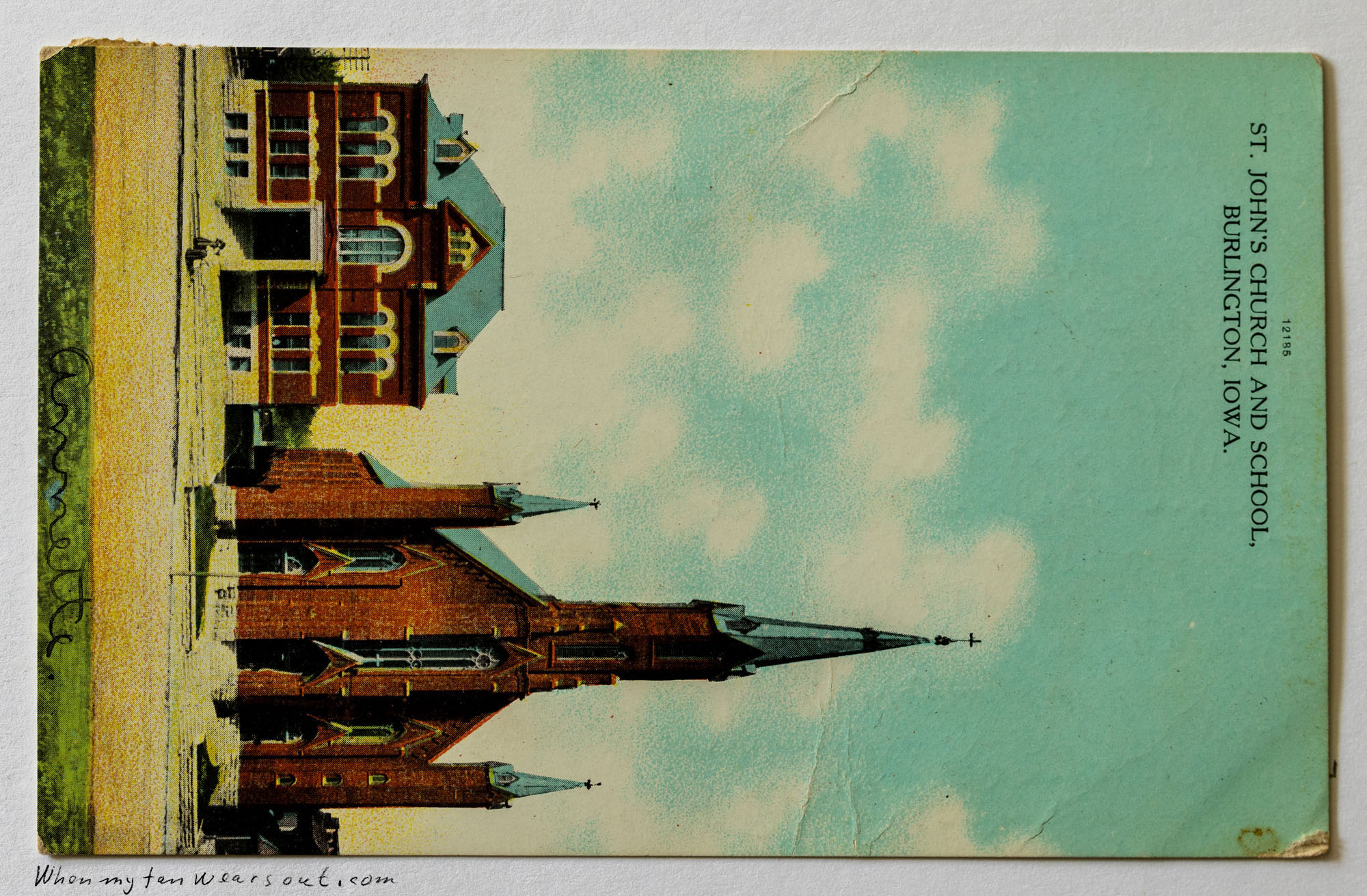
Vintage postcard featuring an upside-down view of St. John's Church, a tall brick building with spires, next to a matching brick school building under a light blue sky with white clouds. Text at the bottom reads
Front — An upside-down view of St. John’s Church and School in Burlington, Iowa, under a cloudy sky.

Postcard Metadata


Handwritten postcard message from
Back — Correspondence from Emma to Miss Pearle Byers

Transcription

Hello Sis: How are you? I am fine and dandy. Vergie, Albert, Mayme, Jim, Ray and I were down to Porters last night had a fine time. Everyone is well and happy but me. ha, ha. I am lonesome. I want to send Hiram a card to day. I suppose you know he and John are in Monmouth. Why don’t you write I haven’t heard from you for ages. Write me soon, your Sis Emma.

Historical & Family Notes

This postcard, sent by Pearl’s sister Emma, provides a charming glimpse into the everyday life and familial connections within the Byers family. Emma, writing from what is inferred to be Burlington, Iowa (based on the front image and “IOWA” postmark), expresses a common sentiment of the era: loneliness and the desire for more frequent communication. Her message highlights the vital role postcards played in maintaining relationships across distances, especially when visits were less frequent.

Emma shares news of a “fine time” at “Porters” with a group of friends or family, listing names like Vergie, Albert, Mayme, Jim, and Ray, illustrating Pearl’s broader social network. The mention of Hiram and John in Monmouth further expands the geographic and relational web, demonstrating how these small missives served as updates on various acquaintances and family members. This card underscores the casual, yet deeply personal, nature of postcard correspondence as sisters shared their daily happenings and emotional states.

The heartfelt plea, “Why don’t you write I haven’t heard from you for ages. Write me soon,” beautifully encapsulates the longing for connection. This exchange between sisters is a testament to the enduring bond between Pearl and her family, setting a personal context for her future relationship with Harvey Sights, who would also become a prolific postcard writer to her.

Continue Reading

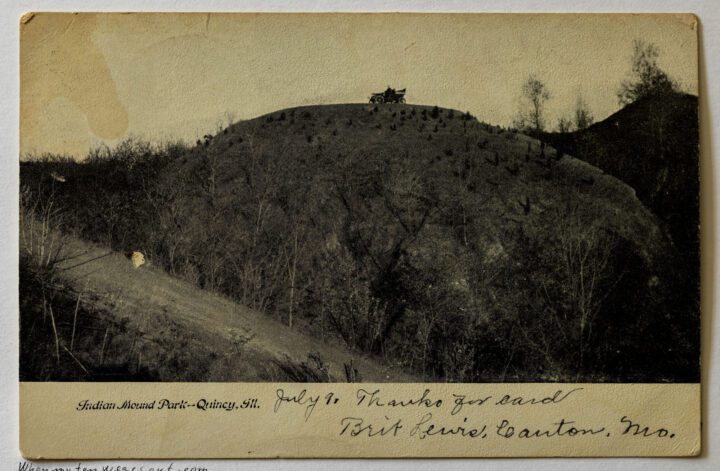
Postcard #001: Thanks from Indian Mound Park, Quincy


Sepia-toned postcard depicting Indian Mound Park in Quincy, Illinois, with an early 20th-century automobile parked on the summit of a tree-covered mound, overlooking a forested landscape.
Front — A sepia-toned image shows a dirt road winding up a large, tree-covered Indian Mound with an early automobile parked on top.

Postcard Metadata


Handwritten postcard back with a personal message dated July 19 from Brit Lewis in Canton, Missouri, to Miss Pearl Byers in Carthage, Illinois, postmarked Carthage, IL, July 19, 1916, with a one-cent Benjamin Franklin stamp.
Back — Correspondence from Brit Lewis to Miss Pearl Byers

Transcription

Indian Mound Park – Quincy, Ill. July 19. Thanks for card. Brit Lewis, Canton, Mo.

Historical & Family Notes

This early postcard sent to Pearl Byers by Brit Lewis captures a glimpse into her life before she met Harvey Sights. While the sender is not Harvey, the card establishes Pearl’s residence in Carthage, Illinois, a setting that would be central to her early adult life. The image of Indian Mound Park in Quincy, a nearby city, illustrates a regional landmark and popular destination, hinting at the shared experiences and local scenery common to young people in the Midwest at the time.

The casual nature of the message, “Thanks for card,” suggests an ongoing correspondence, painting a picture of Pearl’s social circle and the common practice of exchanging postcards to stay in touch. This card, dated July 19, 1916, precedes Pearl’s eventual marriage to Harvey Sights, offering a historical marker of her life during a period of significant social and technological change, reflected in the early automobile atop the mound.

Although a simple note, the postcard adds to the fabric of Pearl’s story, documenting her connections and the daily exchanges that shaped her world before the central chapter of her life with Harvey began. It grounds her in her community and time, showcasing the widespread use of postcards as a primary mode of communication for personal greetings and sharing visual experiences.

Continue Reading