Postcard #0030: Best Wishes with Pansies and a Midwest Farm Scene


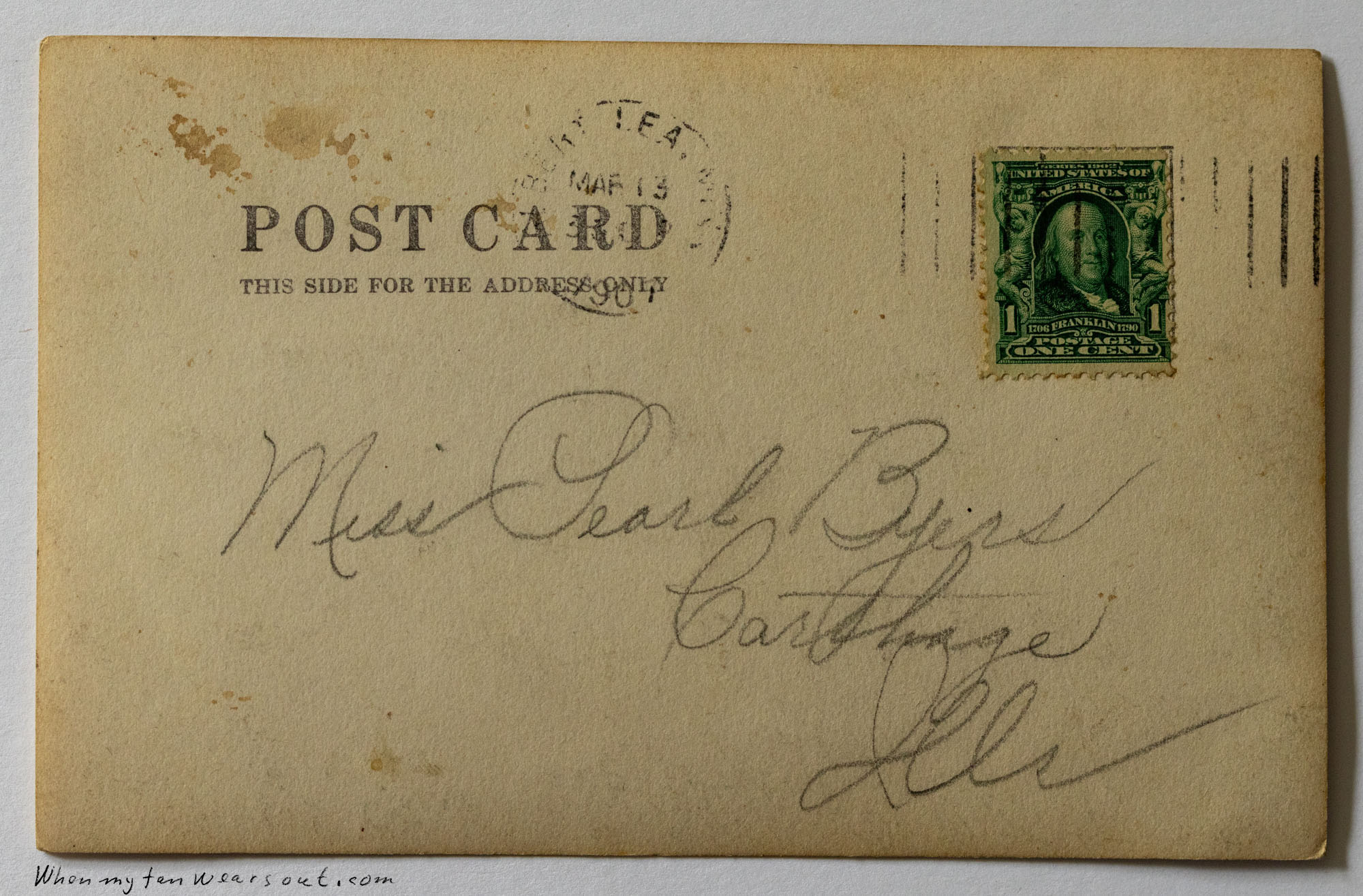
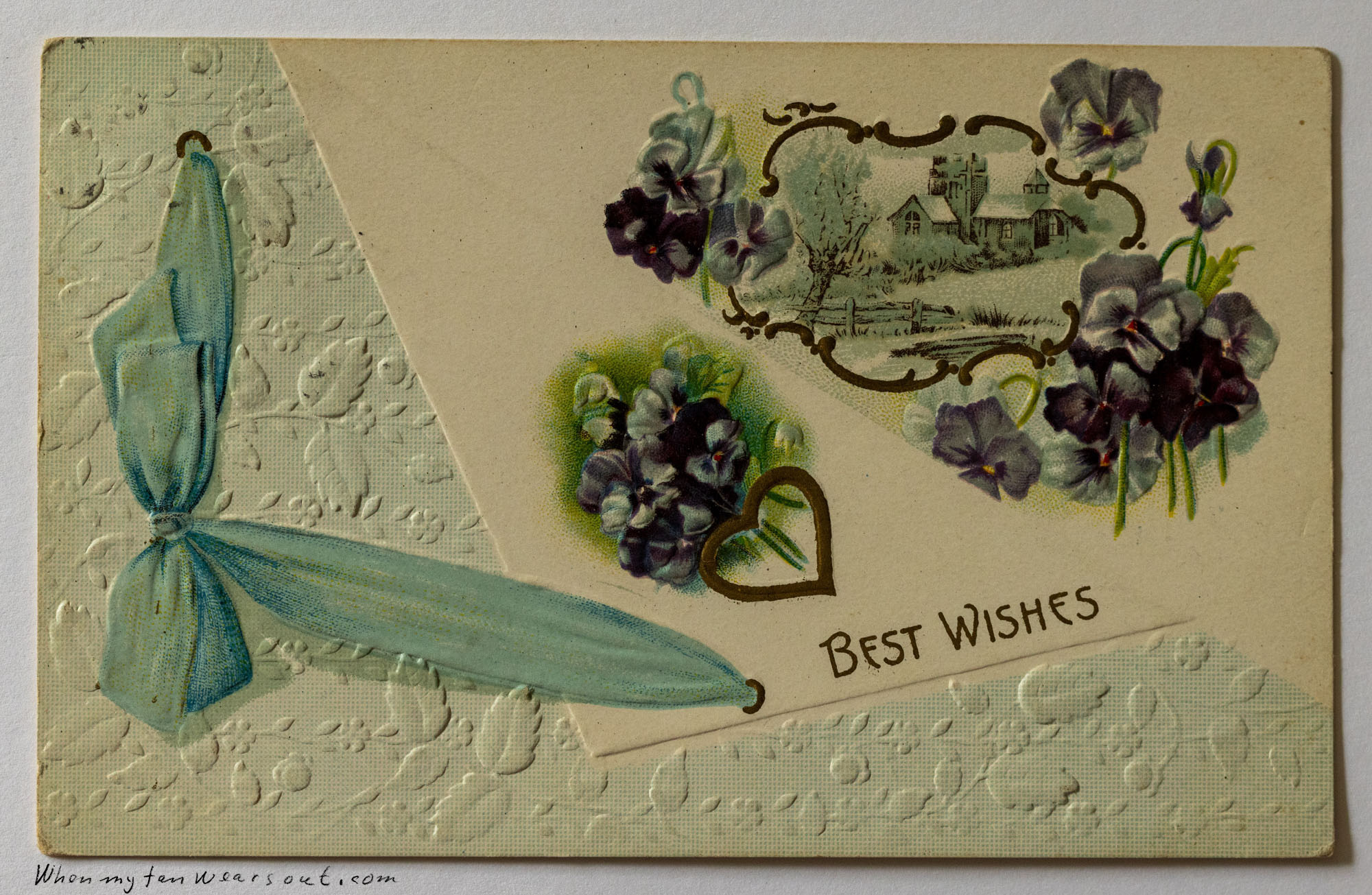
Vintage postcard with a teal blue satin ribbon bow and flowing ribbon on the left side, over an embossed background pattern. The right side features two clusters of purple and blue pansies, and a central framed vignette depicting a quaint rural farm scene with a house, trees, and fence. The text
Front — A “Best Wishes” postcard featuring purple pansies, an embossed blue ribbon, and a framed rural farm scene.

Postcard Metadata


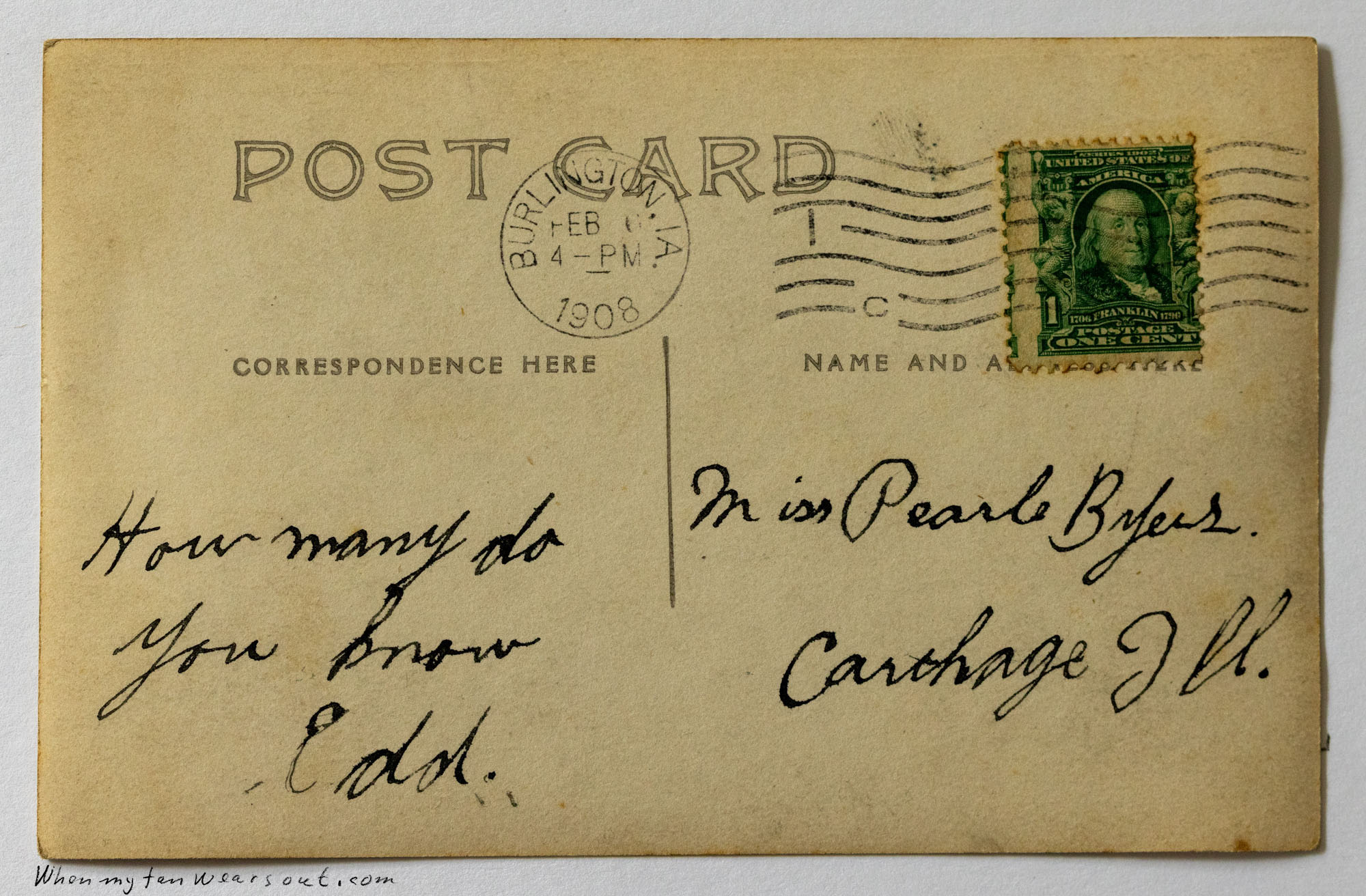
The back of a vintage postcard featuring a handwritten message in black cursive ink. The sender is E.P.B. and the recipient is Mr. Harvey Sights, La Harpe, Illinois. A Carthage, Illinois postmark dated September 7, 1909, is visible along with a green one-cent U.S. Postage stamp with George Washington's portrait. The card has a vertical dividing line and an embossed floral pattern.
Back — Correspondence from E.P.B. (Pearl Byers) to Harvey Sights

Transcription

Carthage Ill. Sept. 7-09. Rec’d card this morning as I came to work. Thanks “awfully.” It is dandy. E.P.B. Mr. Harvey Sights La Harpe Ill

Historical & Family Notes

This postcard offers a charming glimpse into the early courtship between Pearl Byers and Harvey Sights. Pearl, writing from Carthage, Illinois, expresses her thanks to Harvey for a card she received earlier that morning, playfully stating it was “dandy.” This exchange highlights their regular correspondence despite living a mere sixteen miles apart, indicating a blossoming romance through the daily ritual of postcard mail.

The sender’s initials “E.P.B.” are almost certainly Pearl Byers, aligning with the family’s identity rules and the ongoing narrative of their relationship. The card was sent on September 7, 1909, a significant period in their courtship before their eventual marriage and the birth of their daughter, Marnelle.

The message’s casual and affectionate tone—”Thanks ‘awfully'”—suggests a comfort and familiarity between Pearl and Harvey, showcasing a delightful snapshot of their everyday interactions and the simple pleasures of receiving mail from a loved one in the early 20th century.

Continue Reading

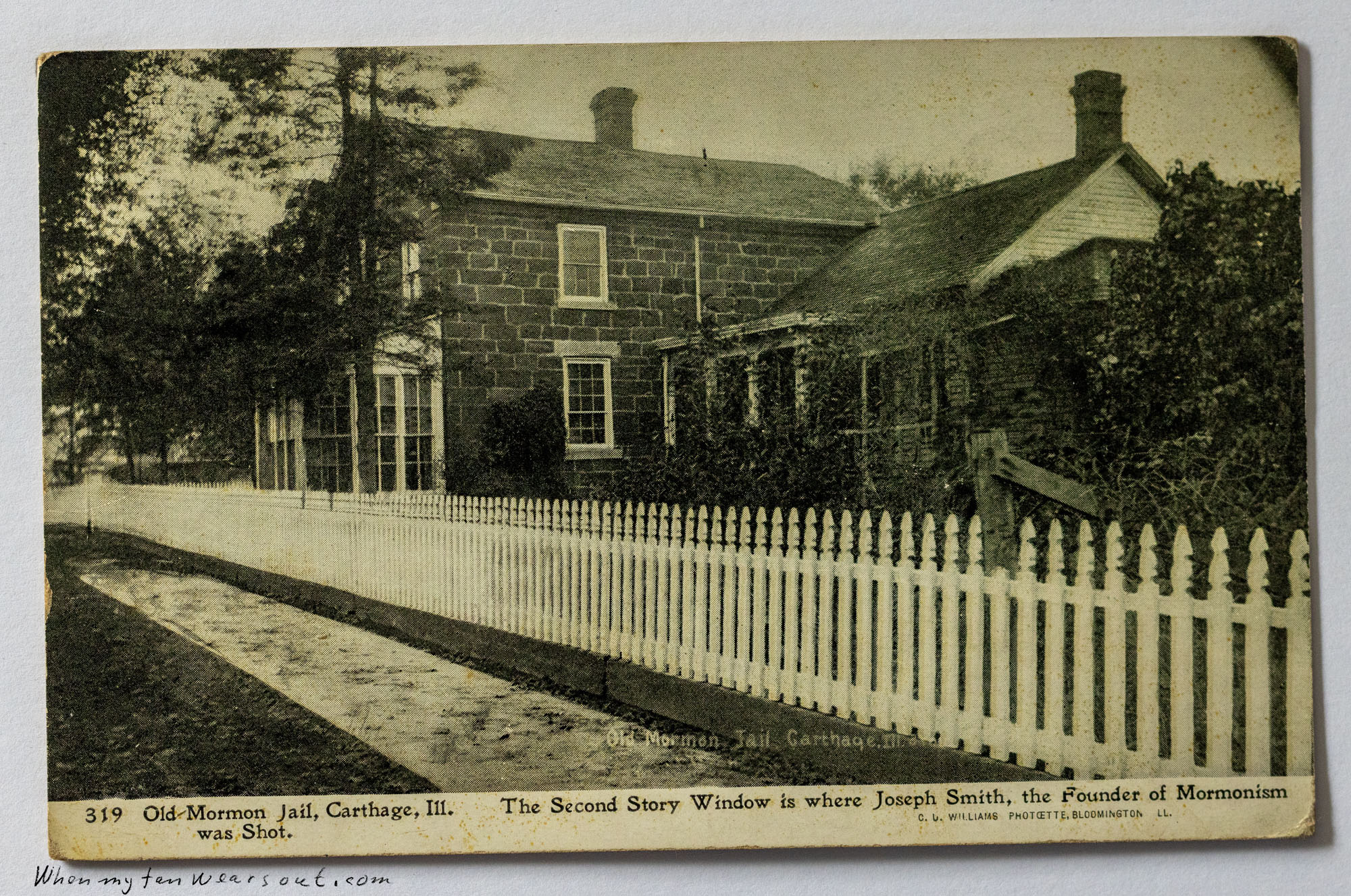
Postcard #0029: The Old Mormon Jail in Carthage, Illinois


Sepia-toned postcard depicting the Old Mormon Jail in Carthage, Illinois, a two-story stone building with a white picket fence, a dirt path, and trees, with text indicating Joseph Smith was shot from the second-story window.
Front — A sepia-toned image of the Old Mormon Jail in Carthage, Illinois, with a white picket fence.

Postcard Metadata


Tan postcard back with a 1908 Iowa City postmark, a 1-cent Benjamin Franklin stamp, handwritten cursive message to Mr Harvey Sights in La Harpe, Illinois, and a return address for E. M. Collars, General Delivery, Iowa City.
Back — Correspondence from an unknown sender to Mr Harvey Sights

Transcription

Vanmeter Hotel Be good to you. Hello dad!- (Once upon a time) How are you, I am fine, got here about 1 o’clock mon night, having fine time. You adds this some day to fun address my E. M. Collars General Delived Iowa City, Io

Historical & Family Notes

This postcard, postmarked in Iowa City in 1908, is addressed to Harvey Sights, who would later marry Pearl Byers. The message, though informal and from an unidentified sender, offers a glimpse into the casual communications of the era, reporting on travel and a “fine time” to a father figure. The sender provides a return address for “my E. M. Collars” at General Delivery in Iowa City, suggesting either a temporary stay or a traveling companion.

The front of the postcard features the historically significant Old Mormon Jail in Carthage, Illinois, where Joseph Smith, the founder of Mormonism, was killed. This landmark in Carthage holds particular relevance as it is the town where Pearl Byers resided and where she and Harvey Sights would eventually build their life together.

While not a direct communication between Pearl and Harvey, this postcard to Harvey connects to the broader geographical and historical context of their lives. It captures a moment in time when travel was an adventure, and postcards served as brief, tangible links between people across distances, even if just to share a historical site or a simple update on one’s well-being.

Continue Reading

Postcard #0028: Clearwater River, Lewiston with Merry Christmas 1908 Greetings


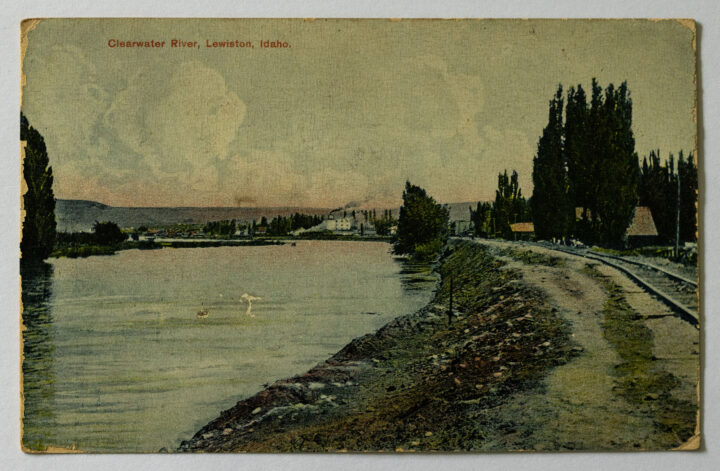
A vintage postcard depicting the Clearwater River in Lewiston, Idaho. The river dominates the foreground with calm, reflective water. Along the right bank, a raised railroad track runs parallel to the river, with tall, slender trees lining its side. In the background, across the river, lies the town of Lewiston nestled against distant hills under a cloudy sky. The sky above is a mix of pale blues and whites, with a hint of warm colors from the postcard's printing process. The title
Front — A postcard view of the Clearwater River in Lewiston, Idaho, with a railroad track running alongside the water and a town visible in the distance.

Postcard Metadata


The divided back of a postcard, featuring handwritten cursive text on the left side and an address on the right. A green one-cent U.S. Franklin stamp is affixed in the upper right corner. A clear circular postmark indicates
Back — Correspondence from O.W. and Aunt Clara to J.J. McMenamy

Transcription

Merry Xmas and Happy 1908 From your nephew O.W. and Niece Aunt Clara

Historical & Family Notes

While this postcard features a beautiful early 20th-century landscape of the Clearwater River in Idaho, its primary interest for this collection lies in its connection to Carthage, Illinois—the hometown of Pearl Byers. Uniquely, this card is not addressed to Pearl or Harvey, but to J.J. McMenamy, a resident of Carthage. The senders, identified as “nephew O.W. and Aunt Clara,” extend simple holiday wishes for Christmas 1908.

The presence of this card in a collection primarily focused on Pearl Byers and Harvey Sights suggests a possible familial or community tie within Carthage, perhaps indicating that the McMenamy family was known to the Byers or Sights, or that the card was later acquired and added to the collection for its local historical relevance. It offers a glimpse into broader social connections within Carthage during the early 1900s, even if not directly part of Pearl and Harvey’s personal correspondence.

This holiday greeting provides a brief snapshot of seasonal communication at the turn of the century, sent across a vast distance from Idaho to Illinois. It captures the simple charm of period postcards, serving as a reminder of distant relations and the enduring tradition of sharing good wishes during the festive season.

Continue Reading

Postcard #0027: Snowy Northern Minnesota Lumber Camp


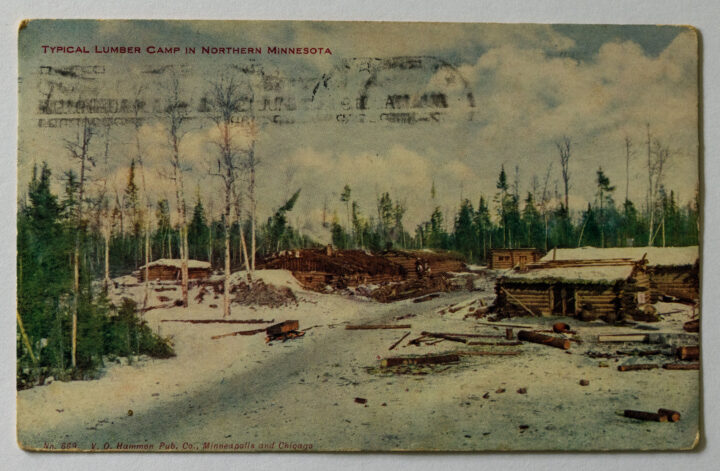
Hand-colored postcard depicting a snowy lumber camp in Northern Minnesota with log cabins, stacked timber, and bare trees under a cloudy sky, titled
Front — A snowy scene of a typical lumber camp in Northern Minnesota with log cabins and felled trees.

Postcard Metadata


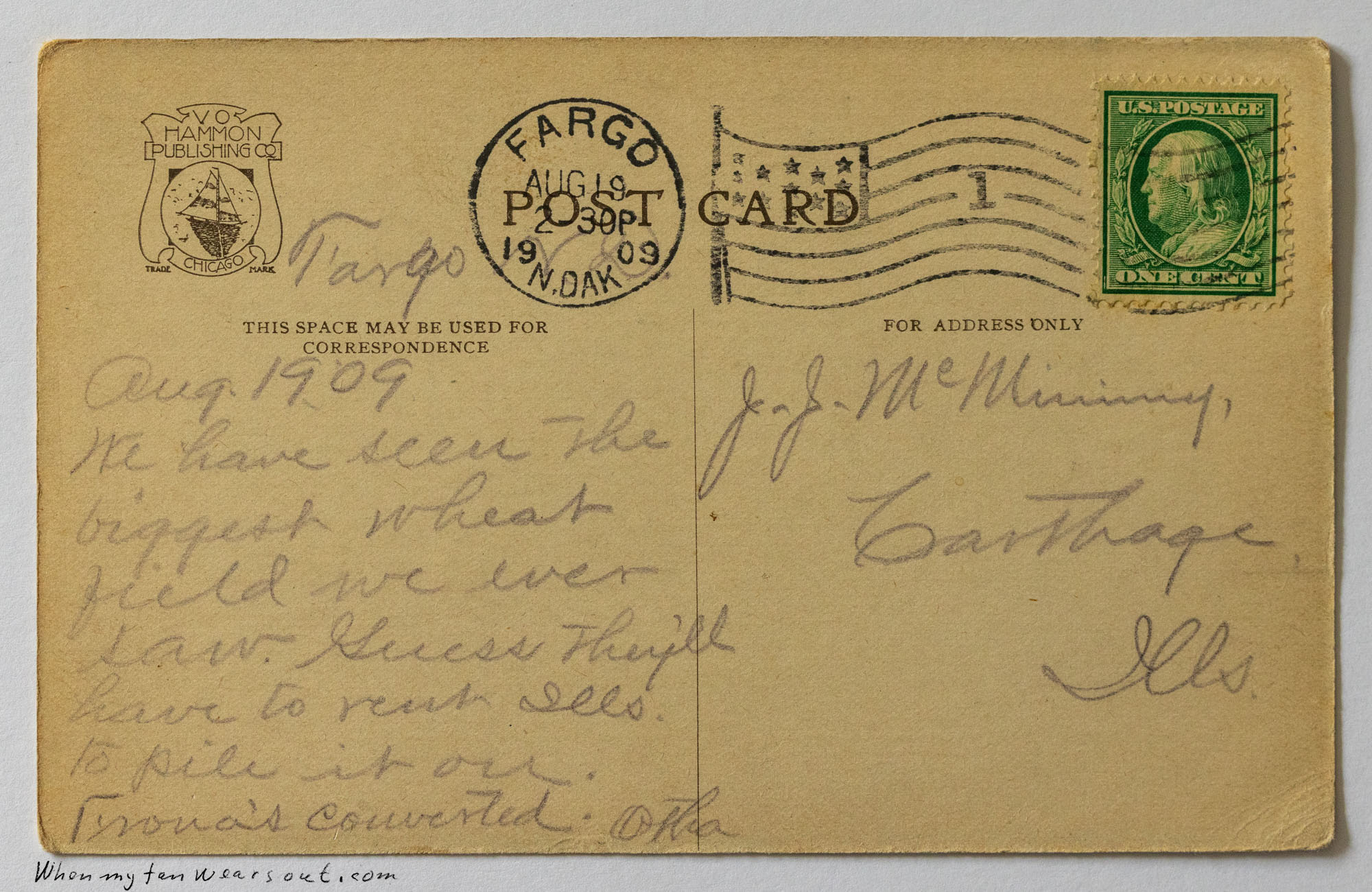
The back of the postcard features a Fargo, North Dakota postmark from August 19, 1909, a green one-cent Benjamin Franklin stamp, and a handwritten message about seeing a large wheat field and
Back — Correspondence from (unknown sender) to J. F. McMinnimy

Transcription

Aug. 19. 09. We have seen the biggest wheat field we ever saw. Guess they’ll have to rent silos to pile it on. Trona’s converted. O.K.

Historical & Family Notes

This postcard offers a glimpse into early 20th-century travel and industry, depicting a harsh winter scene from a Northern Minnesota lumber camp. While the postcard itself showcases an industrial snapshot, the message on the reverse speaks of agricultural abundance in North Dakota, noting an impressively large wheat field and the sender’s amusement at its size.

Notably, this particular postcard is not addressed to Pearl Byers or Harvey Sights, unlike many others in the collection. Instead, it is sent to J. F. McMinnimy in Carthage, Illinois, suggesting it was acquired into the family collection through means other than direct correspondence between Pearl and Harvey. This card likely entered the collection as an artifact of broader family connections or local historical interest.

The message’s casual tone, “Trona’s converted. O.K.”, hints at an ongoing personal narrative or shared understanding between the sender and recipient, a common feature of informal postcard exchanges of the era, conveying news that would have been significant to the immediate circle.

Continue Reading

Postcard #0026: Roosevelt’s Cabin and a Baptism Reminder from Fargo


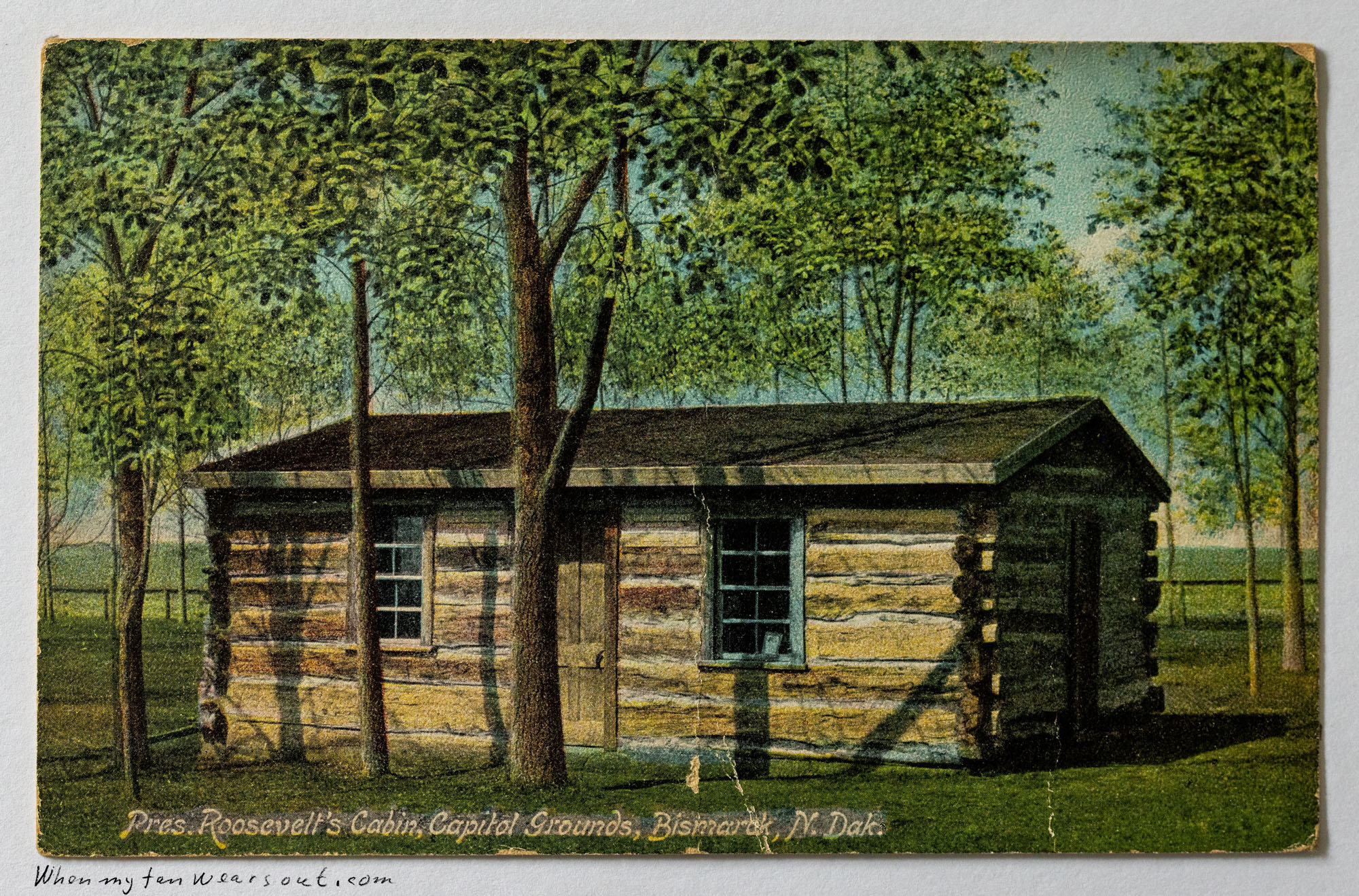
A vintage colorized postcard showing President Theodore Roosevelt's log cabin on the Capitol Grounds in Bismarck, North Dakota. The rustic cabin is made of horizontal logs with two windows and a door, nestled among numerous green trees under a bright blue sky.
Front — A colorized postcard image of President Theodore Roosevelt’s log cabin on the Capitol Grounds in Bismarck, North Dakota, surrounded by trees.

Postcard Metadata


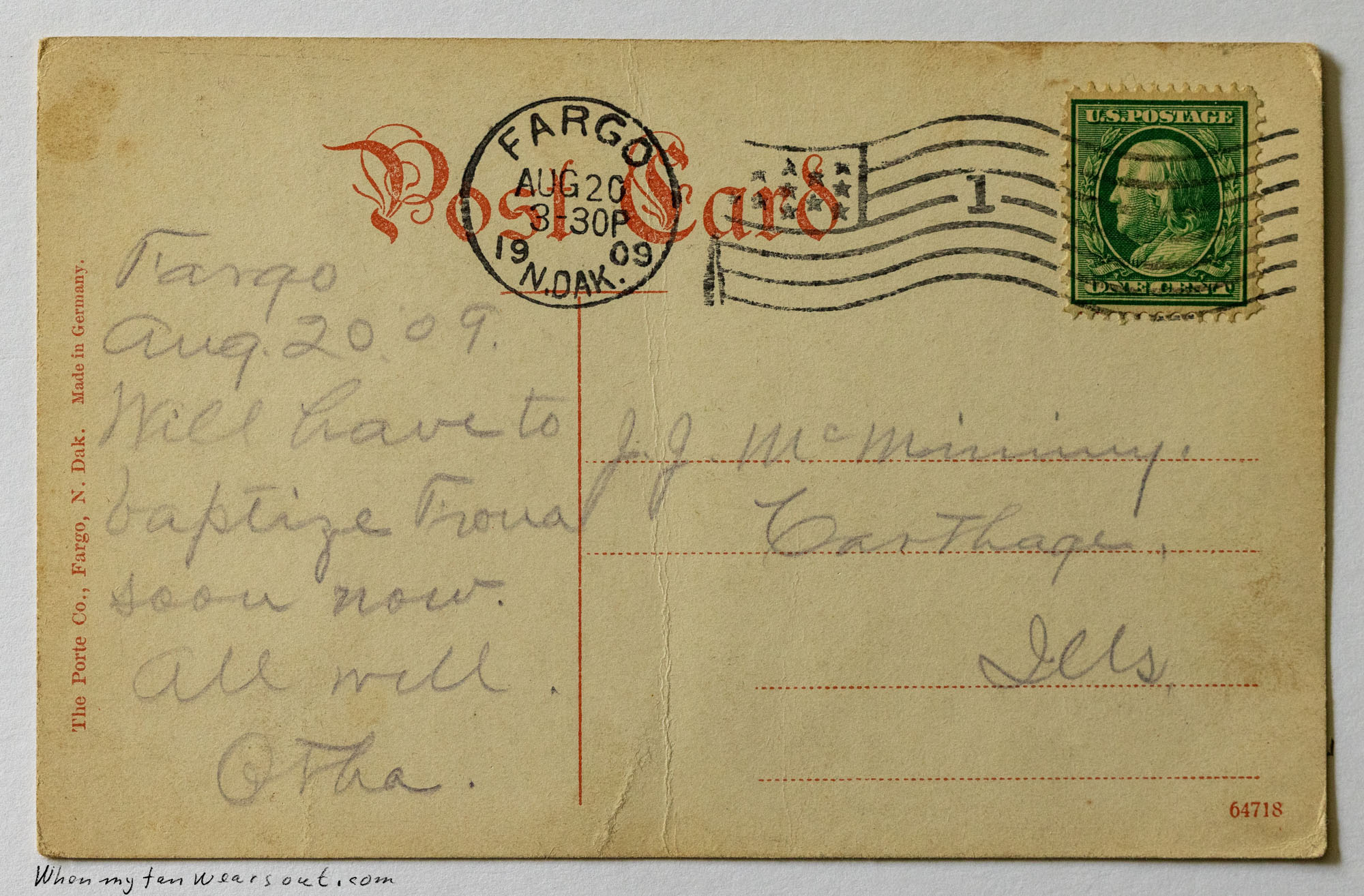
The back of a 1909 divided-back postcard with a green one-cent George Washington stamp postmarked Fargo, North Dakota, August 20, 1909. Handwritten in cursive is a message from 'Otha' to 'Miss J.D. McMinniny' in Carthage, Illinois, discussing a baptism.
Back — Correspondence from Otha to Miss J.D. McMinniny

Transcription

Fargo Aug. 20. 09. Will have to baptize Fronna soon now. All well. OTha.

Historical & Family Notes

This postcard, sent from Fargo, North Dakota, by “Otha” to Miss J.D. McMinniny in Carthage, Illinois, offers a snapshot of life in 1909. While the recipient is not Pearl Byers, the destination of Carthage, Illinois, links this card to Pearl’s hometown, suggesting a potential connection through extended family or shared acquaintances within her community. The brief message hints at an upcoming family event, stating, “Will have to baptize Fronna soon now,” indicating a significant personal or religious occasion.

The front of the postcard features a popular historical landmark, President Theodore Roosevelt’s cabin on the Capitol Grounds in Bismarck, North Dakota. Roosevelt’s deep ties to North Dakota through his ranching days made this a recognizable and popular image for early 20th-century postcards, showcasing the historical significance and natural beauty of the region.

The card’s “Made in Germany” notation underscores the global nature of postcard production at the time, with many high-quality, colorized cards being printed abroad for the American market. Such cards provided an efficient way for people to send quick updates and maintain connections across distances, as demonstrated by Otha’s concise but meaningful message.

Continue Reading

Postcard #0025: Greetings from Hannibal’s Grand Cruikshank Residence


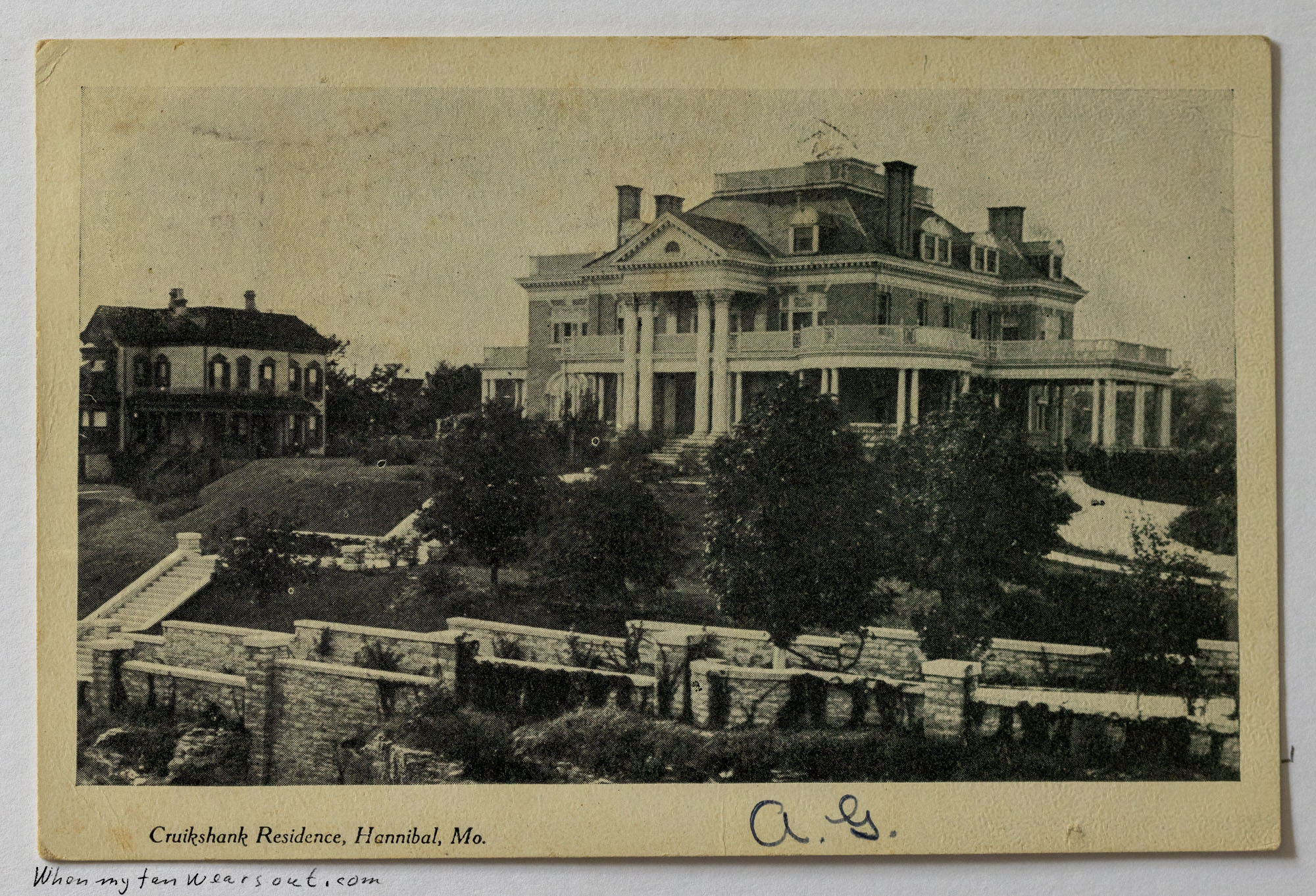
A vintage postcard depicting the large, three-story Cruikshank Residence in Hannibal, Missouri, featuring classical columns, multiple porches, and a grand entrance. A smaller, two-story house stands to the left. The foreground shows a stone wall and landscaped terracing with a set of stairs. The sky is hazy. Below the image,
Front — A large, stately Cruikshank Residence mansion with a smaller house beside it, surrounded by manicured grounds.

Postcard Metadata


The back of a vintage postcard with a
Back — Correspondence from Lavina Byrd to Miss Pearl Byers

Transcription

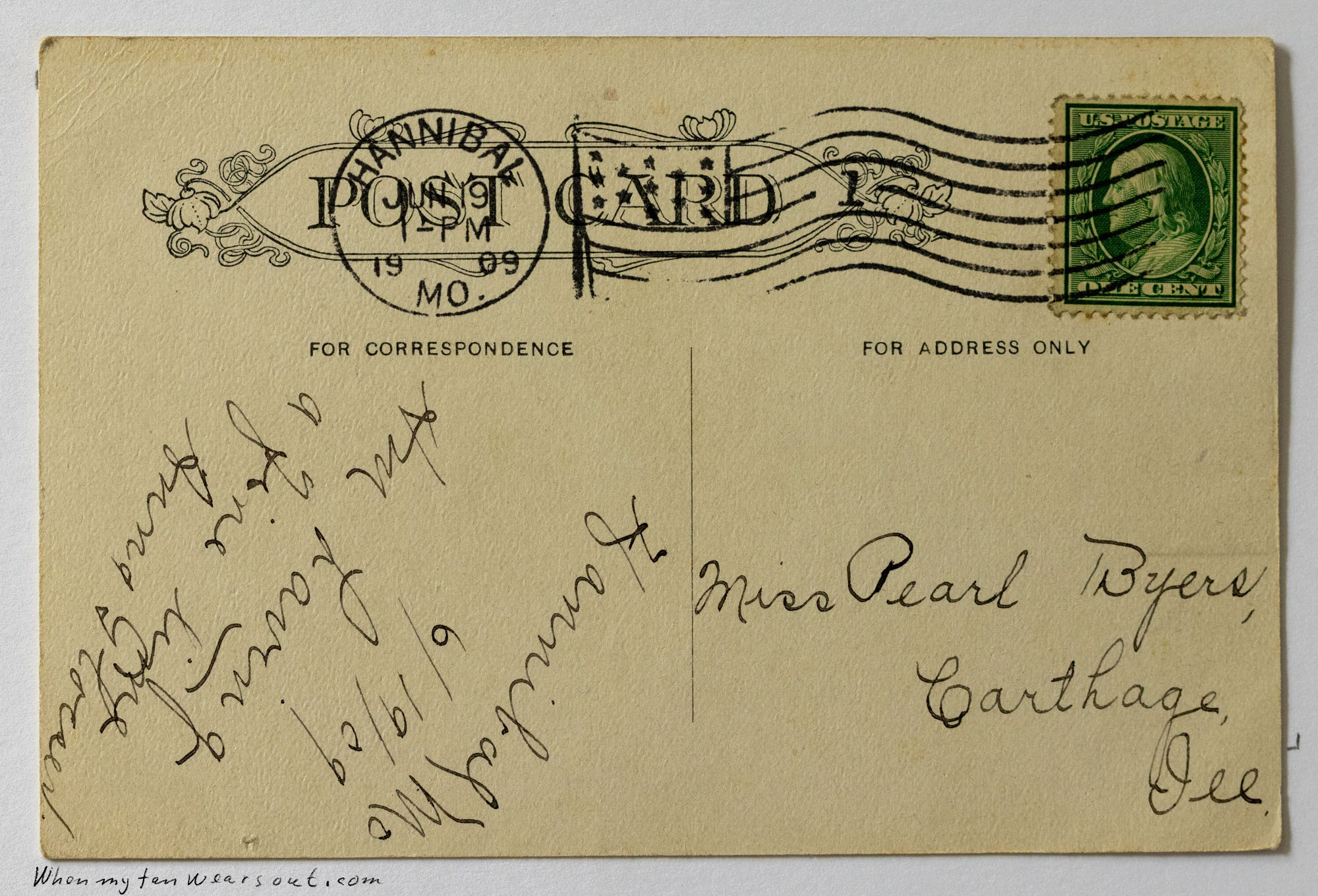
Am from Hannibal, Mo. 9/10/09 a fine time. Lavina Byrd. Miss Pearl Byers, Carthage, Ill.

Historical & Family Notes

This postcard offers a charming glimpse into Pearl Byers’ social life in 1909, years before her eventual marriage to Harvey Sights. Sent by her friend Lavina Byrd from Hannibal, Missouri—a city famously associated with Mark Twain and its Mississippi River heritage—it captures a simple update of enjoying a “fine time” during a visit. The image of the grand Cruikshank Residence speaks to the architectural prosperity of the era and the types of impressive landmarks travelers would share with friends back home.

The brief message reflects the common use of postcards for quick social connections, serving as a tangible record of Pearl’s friendships and daily interactions. These snippets from her past provide valuable context for her life before and during her early courtship, illustrating the social landscape she navigated as a young woman in the early 20th century. While Harvey Sights is not mentioned, this card rounds out the picture of Pearl’s world, highlighting her network of friends and their shared experiences.

The card’s details, from the postmark date of September 9, 1909, to the one-cent postage, are authentic markers of its time. It’s a small, personal artifact that connects Pearl to a broader historical moment, showcasing how friendships were maintained through the simple act of sending a picture and a few words across the Midwestern landscape.

Continue Reading

Postcard #0024: Harvey’s Photo and a Promise to Visit


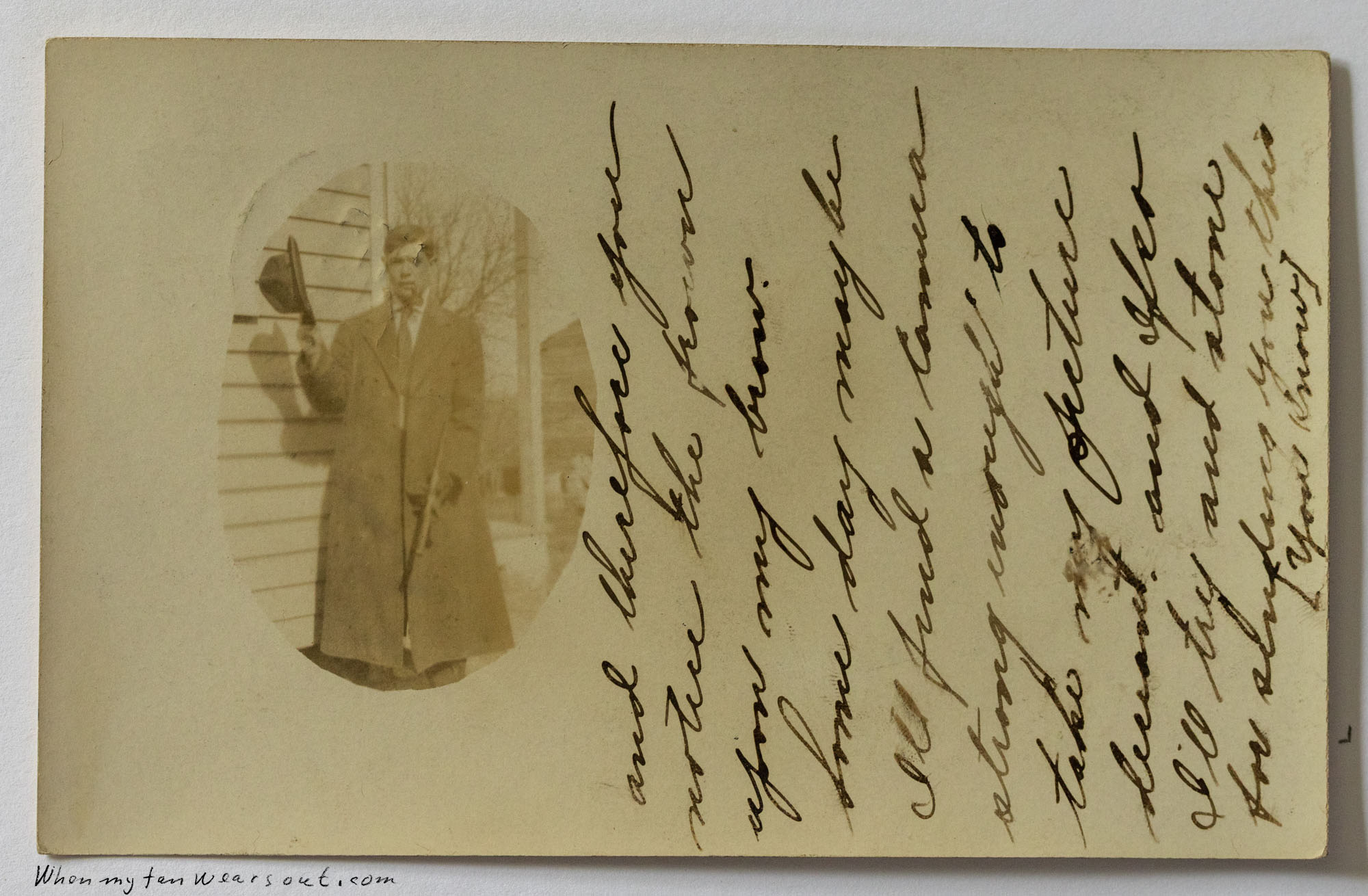
Oval photographic insert featuring a young man in a long coat and hat standing on a porch, with bare trees in the snowy background. Handwritten message on the postcard reads:
Front — Oval photographic insert featuring a young man in a long coat and hat standing on a porch, with bare trees in the background, next to a handwritten message.

Postcard Metadata


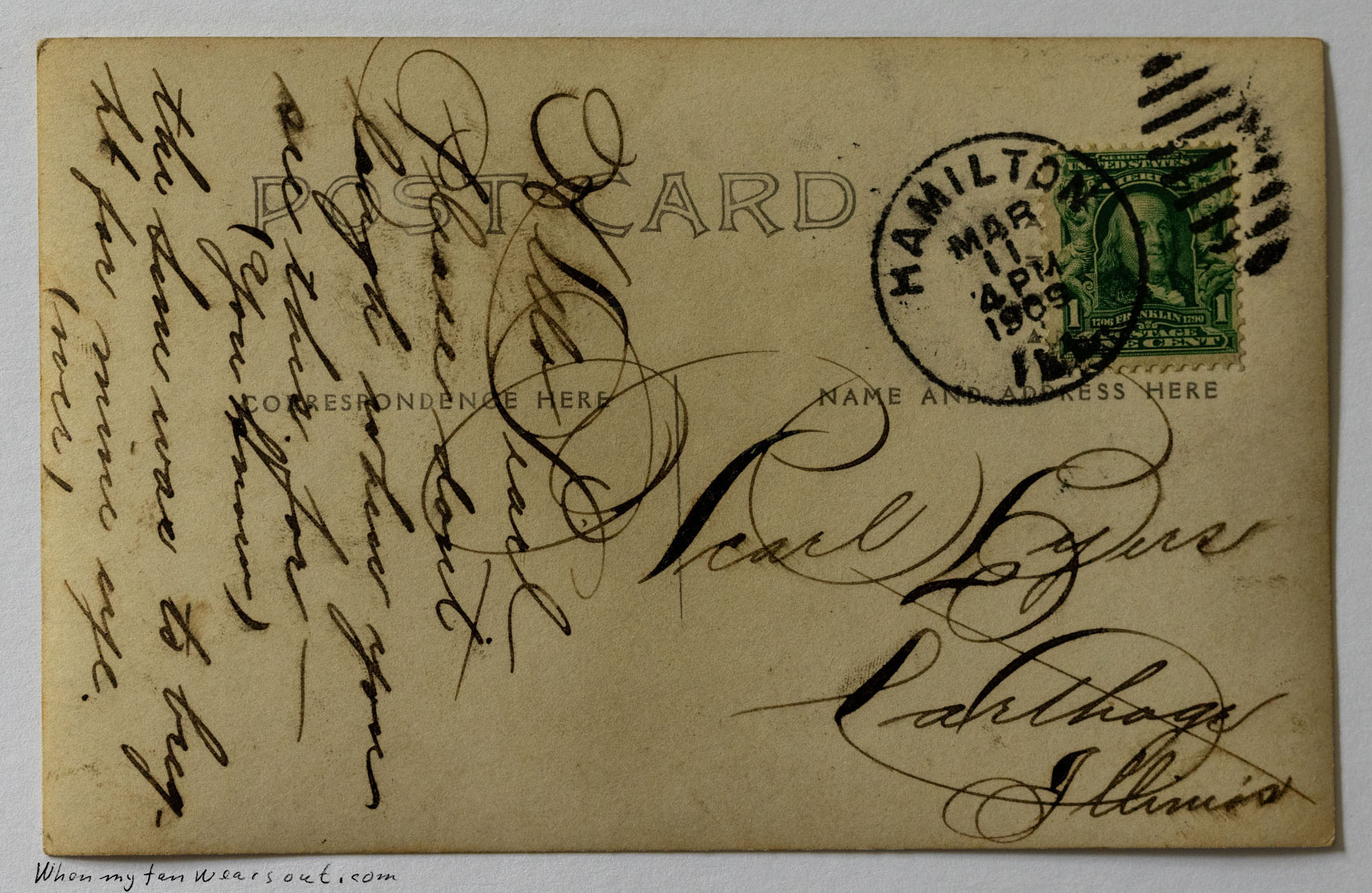
Back of a vintage postcard with a Hamilton, Illinois postmark dated March 11, 1909, a one-cent Franklin stamp, and a handwritten message from Harvey to Miss Pearl Byers in Carthage, Illinois. The message reads:
Back — Correspondence from Harvey Sights to Pearl Byers

Transcription

and that is free and the broom since my May be I will find a camera along with me to take my picture I will try and after this for bring you to the dear your Bery Dear Pearl This leaves me very lonesome this after[text obscured by POST CARD graphic] Harvey

Historical & Family Notes

This postcard, sent by a young Harvey Sights to Pearl Byers, serves as a poignant artifact of their early courtship. Harvey sends a photographic image of himself, possibly his current appearance, and expresses a wish to either take another picture or visit Pearl, stating “I will try and after this for bring you to the dear.” This indicates his desire to see her and deepen their connection, which was common practice during this era of long-distance romance.

The message on the back, though partially obscured, reveals Harvey’s loneliness, starting with “Dear Pearl This leaves me very lonesome this after[…].” This personal touch underscores the emotional intensity of their correspondence. The relatively short distance between Hamilton and Carthage, Illinois, would have made visits plausible, adding anticipation to Harvey’s promise.

This card is a tender snapshot of their relationship before marriage, showing the efforts Harvey made to stay connected and express his feelings, using the popular medium of postcards to bridge the physical distance between them. The slight ambiguity in the sender’s signature on the front (“Bery”) further highlights the informal and intimate nature of their exchanges.

Continue Reading

Postcard #0023: The Home of Mahala in Rural Kansas


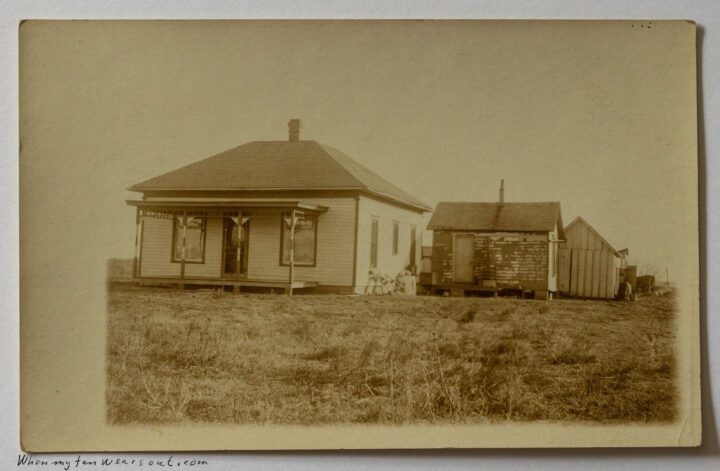
A sepia-toned vintage photograph depicting a modest, single-story wooden house with a front porch and two smaller wooden outbuildings to its right, set in a sparse grassy field under a pale sky.
Front — A sepia-toned photograph of a rural home with a porch and two smaller outbuildings under a clear sky.

Postcard Metadata


The divided back of an old postcard with a handwritten message in cursive, addressed to
Back — Correspondence from Mahala to Miss Pearl Byers

Transcription

Dear Pearl I will send you the picture of the place where we live and thank you for the pretty post cards you sent me. Goodby Mahala.

Historical & Family Notes

This postcard offers a glimpse into Pearl Byers’ wider network of friends and family beyond Harvey Sights, showing her engaging in the common practice of postcard exchange. The sender, Mahala, shares an image of “the place where we live,” indicating a personal connection and a desire to share her current surroundings with Pearl. The picture likely depicts Mahala’s home in Lebanon, Kansas, a simple but sturdy dwelling typical of rural Midwestern life in the early 20th century.
The message reveals Pearl herself was an active sender of postcards, with Mahala thanking her for the “pretty post cards.” This reciprocal exchange highlights the social role of postcards as a primary means of staying connected and sharing snippets of life across distances before the advent of more modern communication technologies. While this specific card is not from Harvey Sights, it nonetheless enriches the narrative of Pearl’s life by illustrating her connections with others during the period when her relationship with Harvey was developing.

Continue Reading

Postcard #0022: Train Wreck in the North End of the Yard


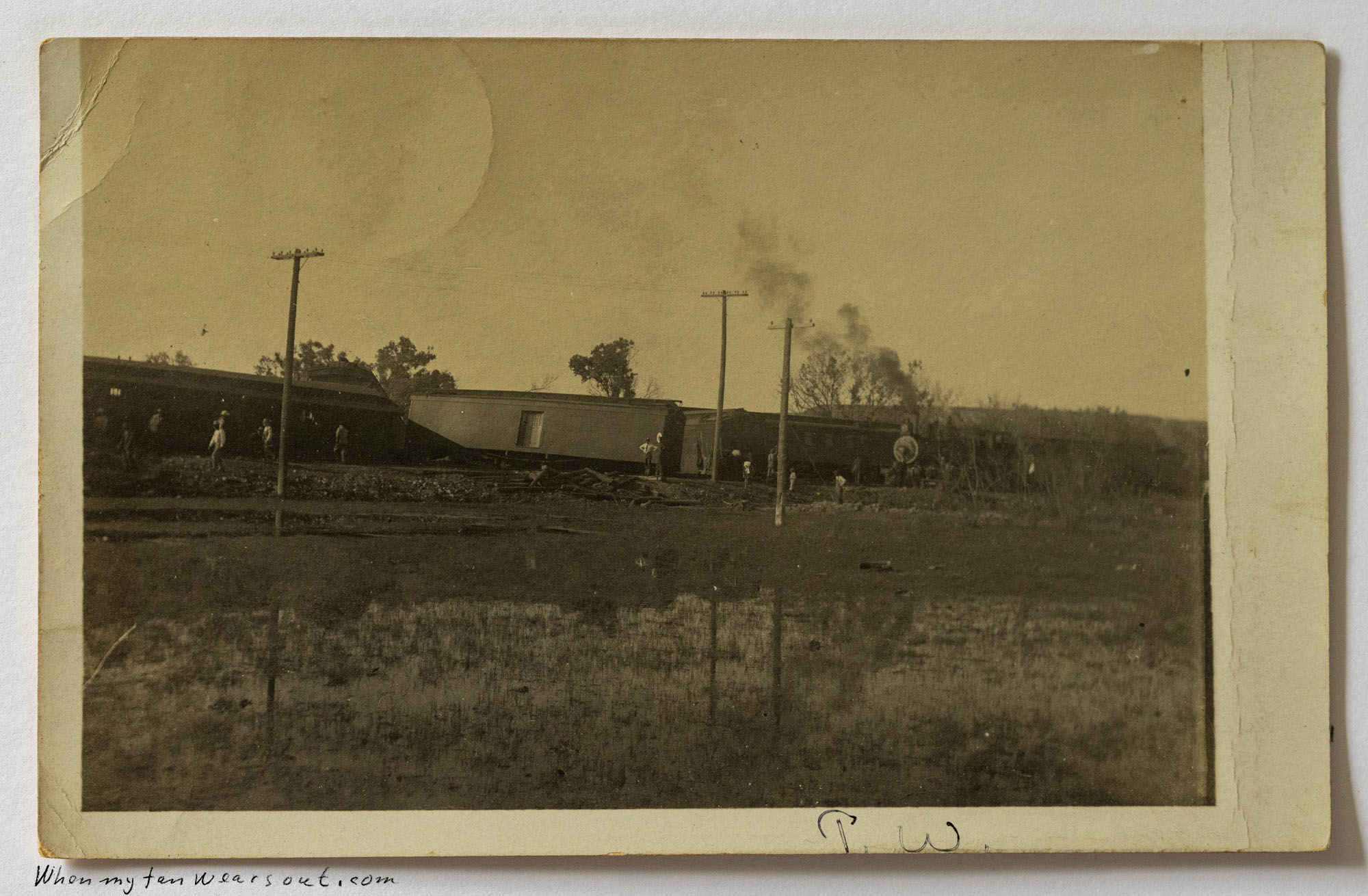
Sepia-toned photograph of a train derailment showing several passenger cars or freight cars overturned or off the tracks, with utility poles stretching across the horizon, a few people inspecting the damage, and a flooded or muddy field in the foreground, with the faint initials
Front — A sepia-toned photograph depicts a train derailment with multiple cars off the tracks and leaning, surrounded by people, utility poles, and muddy ground.

Postcard Metadata


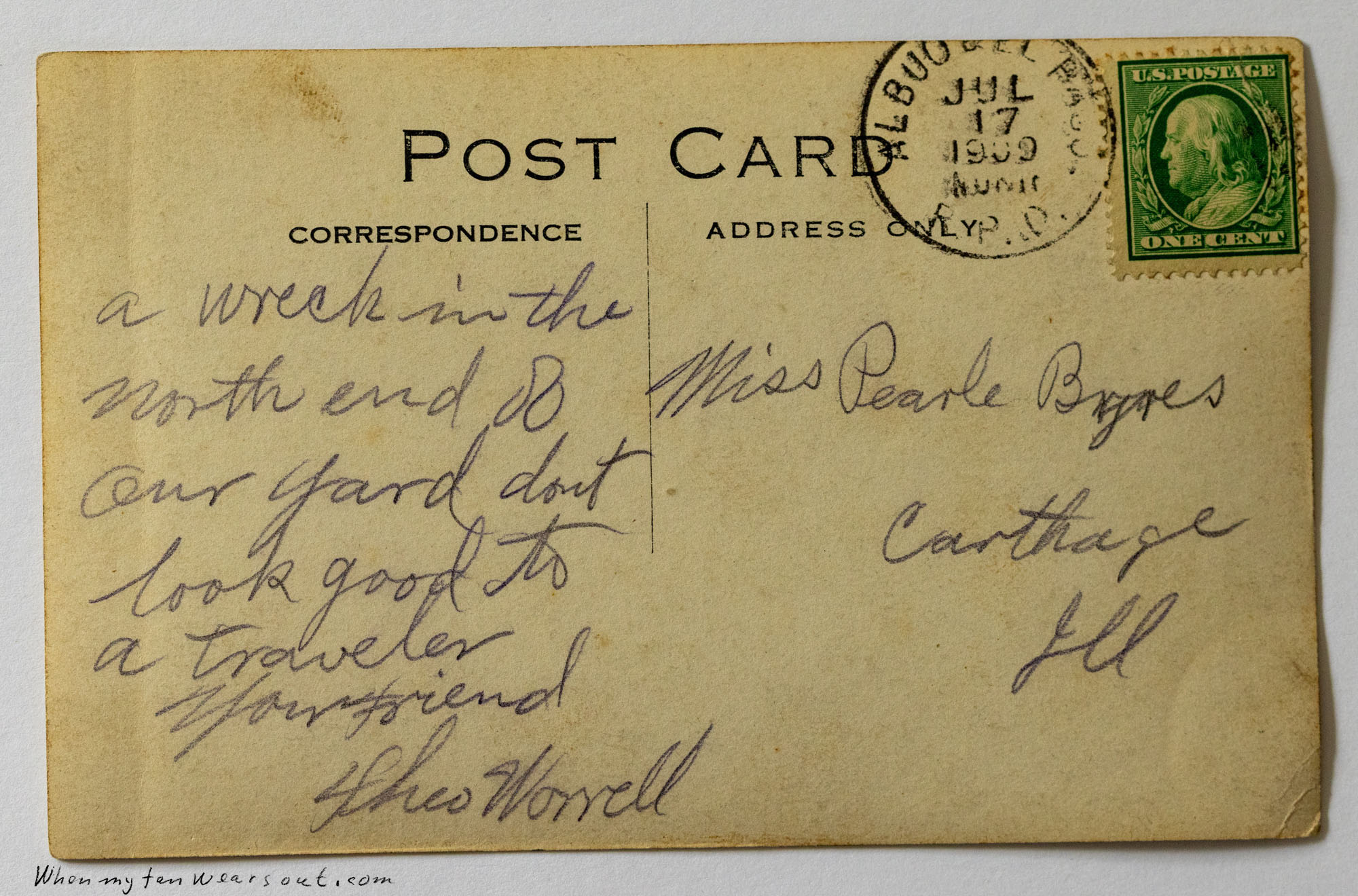
The back of a vintage postcard with a one-cent George Washington U.S. postage stamp postmarked
Back — Correspondence from Theo Worrell to Miss Pearle Byres

Transcription

a wreck in the north end of our yard dont look good to a traveler Your friend Theo Worrell

Historical & Family Notes

This postcard, sent from Quincy, Illinois, by “Theo Worrell” to “Miss Pearle Byres,” offers a stark glimpse into a dramatic, yet seemingly commonplace, event of the era: a train wreck. The sender’s casual observation, “a wreck in the north end of our yard dont look good to a traveler,” suggests that such incidents, while severe, were perhaps not entirely uncommon or were at least a significant local talking point in 1909.

While this specific message doesn’t directly involve Pearl’s future husband, Harvey Sights, it illustrates the network of friends and acquaintances Pearl maintained before their marriage. Postcards served as an essential medium for sharing news and observations across nearby towns, providing immediate, albeit brief, updates on daily life and local happenings.

Carthage, Illinois, where Pearl resided (at 318 N. Fayette Street), is located southeast of Quincy. This card provides a small window into the kind of everyday communication that filled the lives of young people like Pearl and her friends, connecting their worlds through brief written exchanges often accompanied by photographs of local interest.

Continue Reading

Postcard #0021: Lebanon Kansas Main Street and a Rainy Journey Home


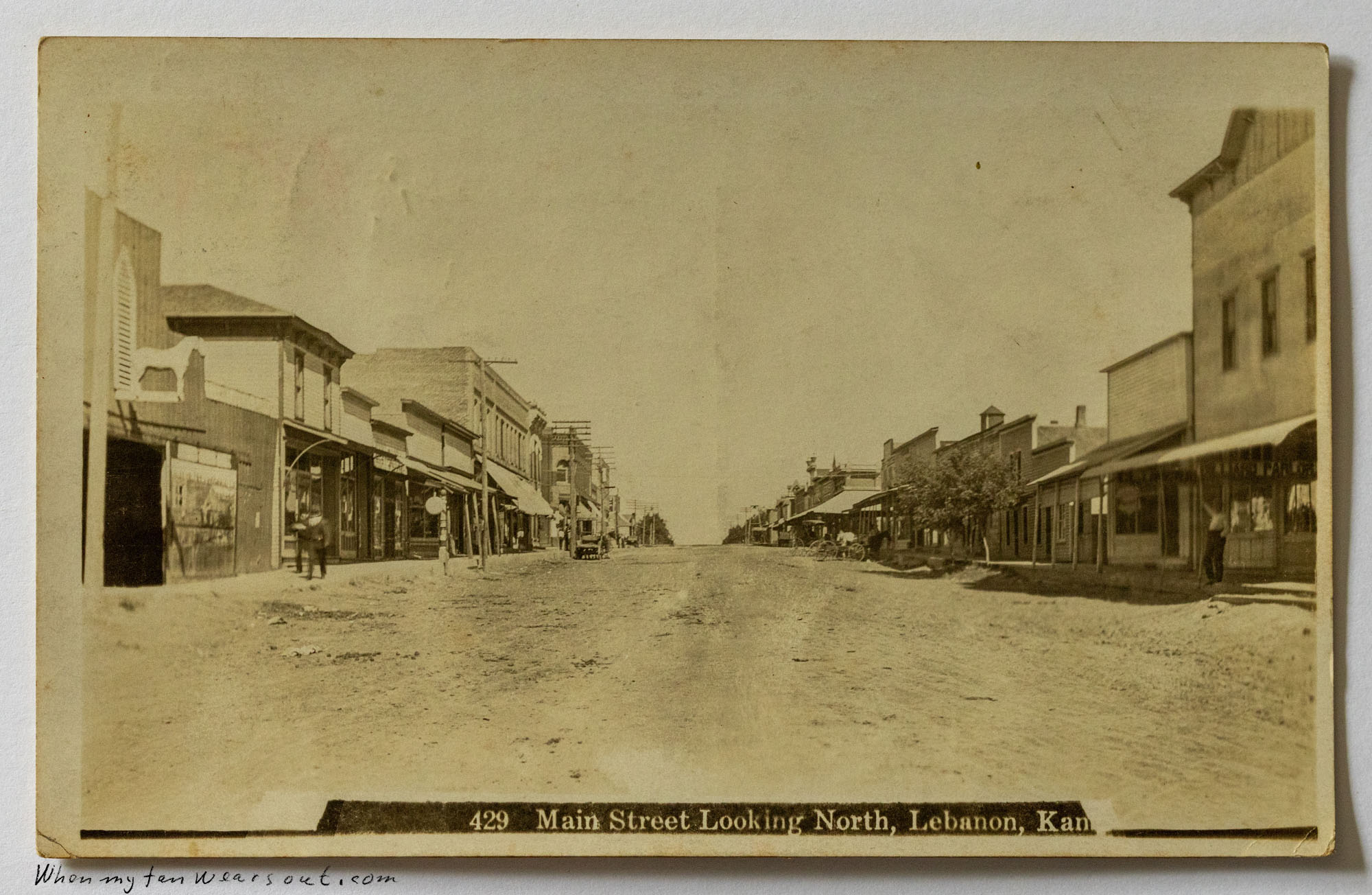
Sepia-toned historical postcard showing a wide, unpaved Main Street in Lebanon, Kansas, looking north. The street is lined with two-story commercial buildings featuring awnings, and a few indistinct figures walk along the dirt street and sidewalks under a bright sky. The caption
Front — A wide, unpaved Main Street in Lebanon, Kansas, looking north, lined with multi-story business buildings.

Postcard Metadata


Back of a sepia-toned postcard with a handwritten message in cursive from Leonard Timberlake to Miss Pearl Byers in Carthage, Illinois. The card is postmarked Topeka, Kansas, October 27, 1909, 6PM, and bears a one-cent green U.S. postage stamp featuring Benjamin Franklin. The manufacturer's details are visible on the left side.
Back — Correspondence from Leonard Timberlake to Miss Pearl Byers

Transcription

Well I guess you thought I was never going to write anything but I finally got around to it. I had swell trip home it rained severall the time after I left Quincy. Leonard Timberlake.

Historical & Family Notes

This postcard, sent to Pearl Byers from Leonard Timberlake, provides a glimpse into her social circle before her eventual marriage to Harvey Sights. The message details Leonard’s “swell trip home” despite rain after leaving Quincy, suggesting Pearl might have been visiting Quincy, Illinois, or that Leonard was visiting Pearl (or nearby) before heading back to his own home, likely in or near Topeka, Kansas, where the card was postmarked.

The existence of correspondence from other individuals like Leonard underscores that Pearl had a vibrant social life and various acquaintances, a common experience for young women of the era. These interactions form part of the broader narrative leading up to her relationship with Harvey Sights, showing the context of her world.

The card’s front, depicting Main Street in Lebanon, Kansas, is a generic scene often found on postcards of the period, chosen by the sender likely for its availability rather than any specific connection to Pearl or Leonard. It highlights the widespread use of postcards for casual correspondence and sharing snippets of daily life or travel.

Continue Reading

Postcard #0020: Albert Lea Courthouse and the Journey Home


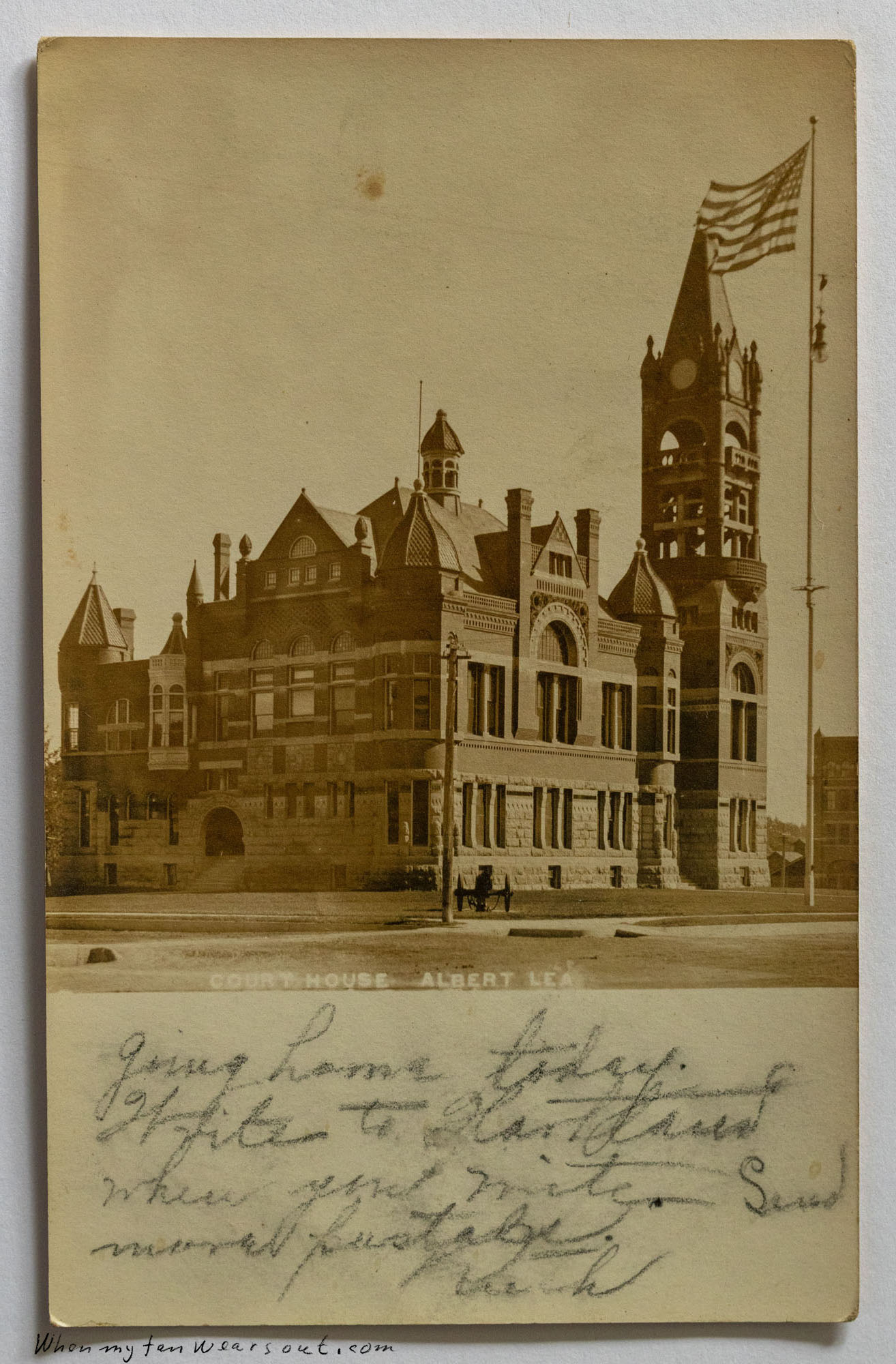
Sepia-toned postcard depicting the grand Albert Lea Court House in Minnesota, a brick and stone building with a prominent clock tower, an American flag flying, and a small horse-drawn carriage on the street in front. Handwritten message is visible below the image.
Front — View of the Albert Lea Court House with a prominent clock tower and American flag.

Postcard Metadata


Sepia-toned back of a postcard with a 1-cent green Benjamin Franklin stamp, an
Back — Correspondence from Harvey Sights to Miss Pearl Byers

Transcription

Going home today. Expect to start from when you get my other postcard. Send me all puss.

Historical & Family Notes

This postcard captures a moment of anticipation as Harvey Sights prepares to return home, presumably to Pearl Byers. Sent from Albert Lea, Minnesota, the message “Going home today” signifies the conclusion of his travels or a temporary stay, and the impending reunion with Pearl. The reference to “my other postcard” suggests an ongoing correspondence, a common method of nurturing their relationship across the miles.

The affectionate closing, “Send me all puss,” underscores the tender and playful nature of their courtship. Such personal and informal expressions reveal a deeper intimacy than standard greetings, hinting at the bond that would eventually lead to their marriage and the start of their family. This card is a tangible piece of their unfolding love story, chronicling the small, daily communications that built their connection.

As a historical artifact, the postcard offers a glimpse into early 20th-century communication and travel. The image of the Albert Lea Court House serves as a backdrop to Harvey’s journey, while the simple yet heartfelt message conveys the human experience of longing and return. It’s a testament to the enduring power of written words to bridge distance and maintain personal connections in a time before instant digital communication.

Continue Reading

Postcard #0019: A Burlington Group Portrait for Pearle


A vintage, sepia-toned photograph showing a large gathering of approximately 25-30 young adult men and women, likely a social group, arranged for a formal portrait. Some individuals are seated in the foreground, while others stand behind them, all dressed in early 20th-century attire, with an ornate patterned wallpaper visible in the background.
Front — A sepia-toned group photograph of many young men and women posed formally indoors.

Postcard Metadata


The back of a divided postcard featuring a Burlington, Iowa postmark dated February 4, 1908, a one-cent green Benjamin Franklin stamp, and a handwritten message in cursive reading
Back — Correspondence from Edd to Miss Pearle Byers

Transcription

How many do you know Edd.

Historical & Family Notes

This early postcard, addressed to Pearle Byers in Carthage, Illinois, offers a fascinating glimpse into her social life before her marriage to Harvey Sights. The sender, identified only as “Edd,” challenges Pearle to identify individuals within the large group portrait, suggesting a shared network of acquaintances or perhaps introducing her to a new circle. This informal query highlights the casual nature of correspondence between friends and potential admirers during the early 20th century.

The card’s origin in Burlington, Iowa, a relatively short distance from Carthage, suggests Pearle may have had connections or visited the area, expanding her social sphere beyond her hometown. While Edd’s relationship to Pearle remains a mystery, this card serves as a tangible record of her broader connections and interactions in the years preceding her significant life events.

As an archival piece, this postcard helps to build a more complete picture of Pearle’s youth and the social landscape she navigated. It underscores the importance of visual communication and personal connection in an era when photographs, even mass-produced ones, were cherished objects for sharing experiences and maintaining ties.

Continue Reading

Postcard #0018: G.S. Buch’s Room Corner in Lea, Minnesota


Vintage sepia-toned photograph showing a cozy room interior featuring a wicker sofa with patterned cushions, a large wooden bookshelf filled with books, and walls extensively covered with various small framed photographs and decorative papers. A small, round, white decorative element is visible in the upper left corner of the room.
Front — A vintage sepia-toned photograph of a cozy room corner with a wicker couch, a large bookshelf, and many framed pictures adorning the walls.

Postcard Metadata


The reverse side of a vintage postcard featuring a green one-cent Benjamin Franklin stamp postmarked from Lea, Minnesota on August 7, 1909. The card has a divided back with handwritten cursive text from 'G. S. Buch' to 'Miss Pearl Byers, Carthage, Ills.', where the sender asks Pearl how she likes their room and requests any future letters to be addressed to Hartland.
Back — Correspondence from G. S. Buch to Miss Pearl Byers

Transcription

this is a corner in my room here, how do you like it? write soon to your G. S. Buch. ad. letter to Hartland

Historical & Family Notes

This postcard offers a charming glimpse into a personal space from over a century ago, a common way to share life and surroundings with distant friends or family before the advent of widespread personal photography and social media. The room, with its wicker couch, overflowing bookshelf, and walls covered in an array of small pictures, suggests a comfortable, well-inhabited corner.

While the sender, G. S. Buch, is not Pearl Byers’ future husband, Harvey Sights, this card is part of Pearl’s collection, indicating her broader circle of acquaintances and friendships. The sender’s direct question, “how do you like it?”, suggests a familiar and perhaps intimate relationship, inviting Pearl’s opinion on their private environment.

The instruction “ad. letter to Hartland” (likely an abbreviation for “address letter to Hartland”) provides a more specific location for G. S. Buch at the time. Hartland, Minnesota, like Lea (the postmark location, likely near Albert Lea), is situated in Freeborn County, suggesting the sender was either staying in or had recently moved to this nearby community when sending the card to Pearl in Carthage, Illinois.

Continue Reading

Postcard #0017: Ruth’s Schoolhouse Where She Taught in Atlanta, Illinois


A sepia-toned photograph of a white wooden one-room schoolhouse with a dark roof, featuring multiple windows and a single door. A group of about a dozen children and several adults are standing on the grassy lawn in front of the building. Handwritten cursive text is on the left side of the image.
Front — A group of children and a few adults standing outside a one-room schoolhouse with a handwritten message on the left.

Postcard Metadata


The back of a vintage postcard with
Back — Correspondence from Ruth to Miss Pearl Byers

Transcription

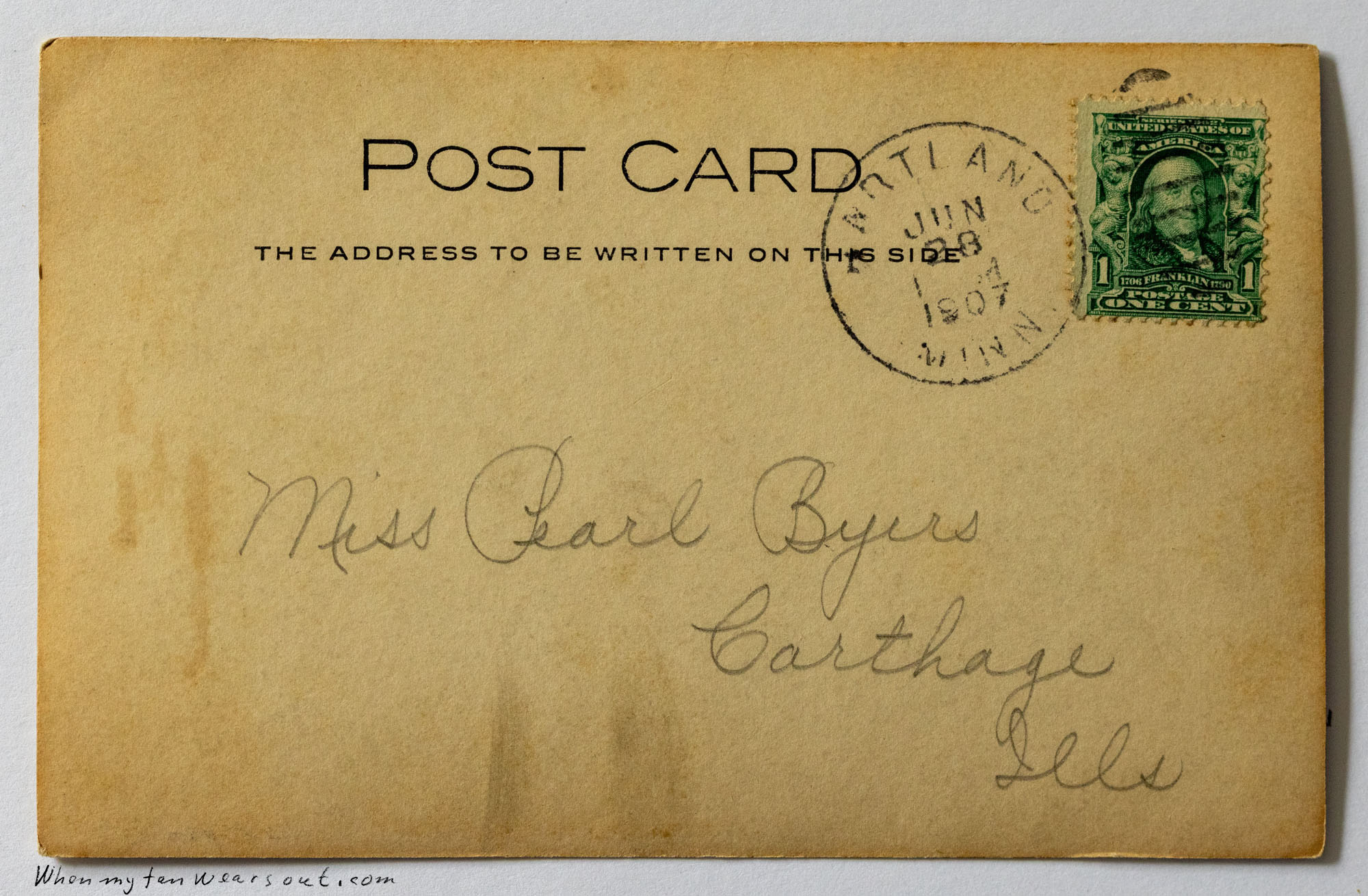
This is where I taught while I was a roof mite. Sorry – Ruth

Historical & Family Notes

This charming postcard, sent by “Ruth” to Pearl Byers, offers a vivid snapshot of early 20th-century rural education, depicting a classic one-room schoolhouse. Ruth’s message, “This is where I taught while I was a roof mite,” is a distinctive and intriguing phrase, likely a self-deprecating or affectionate reference to her youth or small stature during her time as a teacher. The photograph captures a group of children and adults, perhaps the students and their families, gathered outside the humble wooden structure.

Postmarked June 28, 1907, the card is an early example from the Divided Back era, which began just months prior with the Post Card Act of 1907 allowing messages on the address side. Despite the new format, Ruth chose to write her message on the front, a common practice during this transitional period as people adapted to the change. The stamp, featuring Benjamin Franklin, further roots the card in its historical context.

While this card does not directly mention Harvey Sights, it provides valuable insight into Pearl Byers’ social circle and the broader world she inhabited before her eventual marriage to Harvey. Correspondence like this from friends and family helps to paint a fuller picture of Pearl’s life experiences and connections during her youth in Carthage, Illinois.
Continue Reading