Front — ] Emma Carrol ] having lulu [?] time With [?] Love Emma C.
Postcard Information
Postmark: QUINCY, ILL., MAY 19 09
Sent To: Carthage IL
Era: Golden Age (1907–1915)
Publisher: C. U. Williams, Photœtte, Bloomington, Illinois
Stamp: 1¢
Distance Traveled: ~40 miles
About This Card
The Adams County Courthouse in Quincy, Illinois was completed in 1885 in a Romanesque Revival style, replacing an earlier structure. Quincy was one of the more significant cities on the upper Mississippi in the 19th century — large enough to host the sixth Lincoln-Douglas debate in October 1858, drawing an estimated crowd of twelve thousand people to Washington Park, a few blocks from the courthouse. Emma Carroll was writing from a city with a serious civic tradition, even if her note was brief.
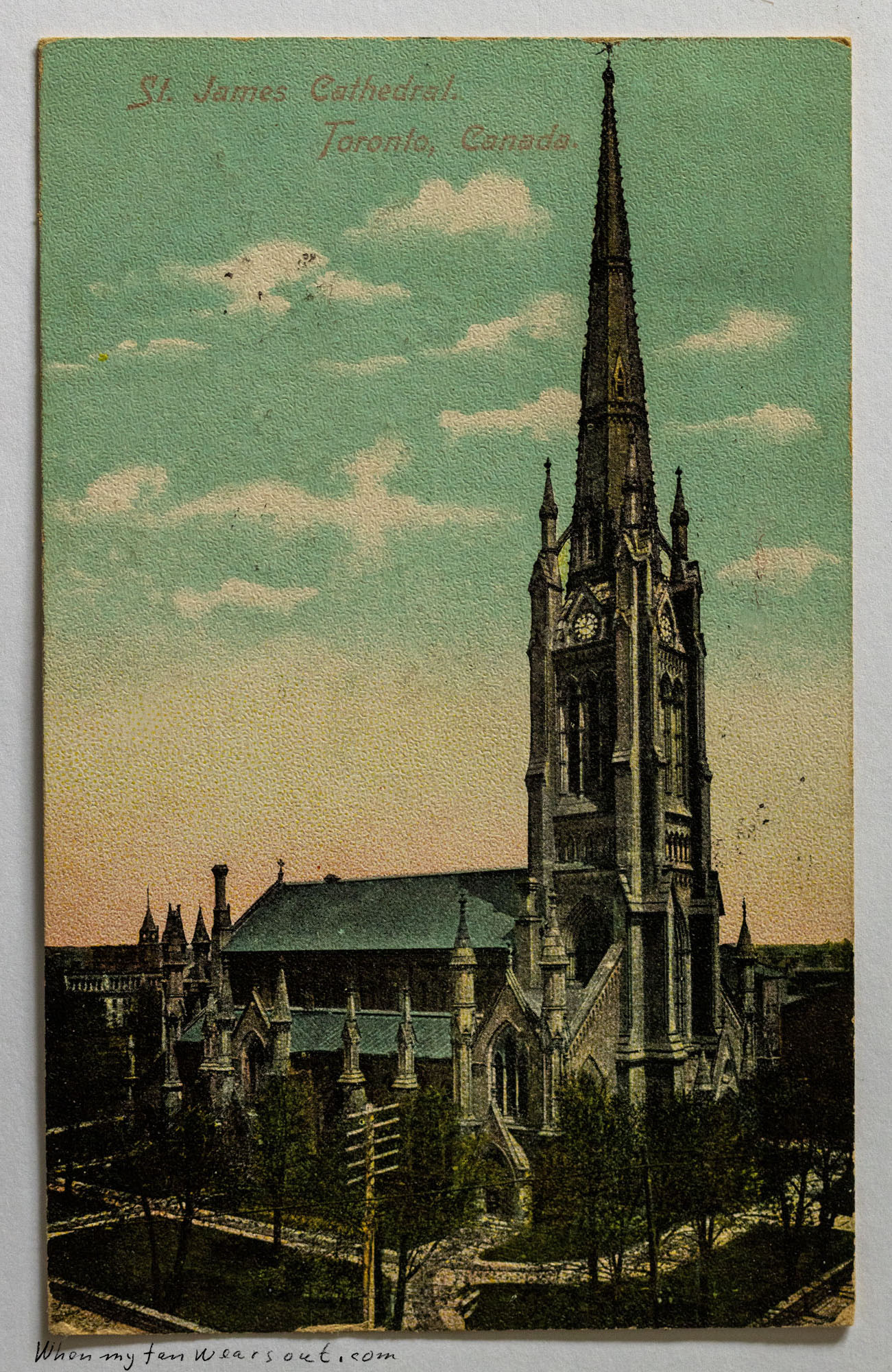
Front — A colorized vintage view of St. James Cathedral in Toronto, Canada, with a tall Gothic spire dominating the skyline.
Postcard Metadata
Postmarked: Toronto, Ontario, Canada — August 14, 1909
Sent From: Toronto, Ontario, Canada
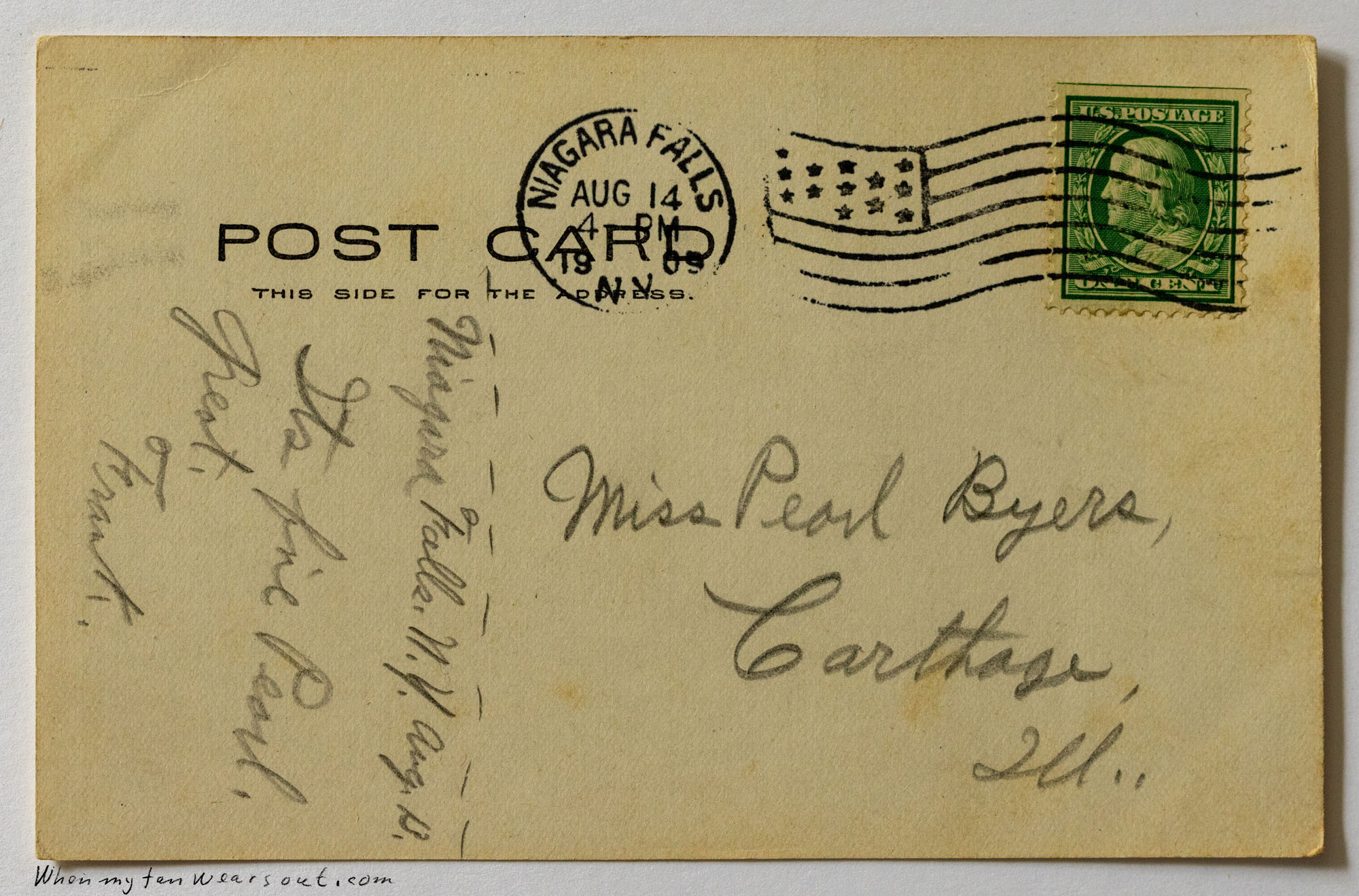
Sent To: Miss Pearl Byers, Carthage, Ill.
Distance Traveled: Approximately 620 miles (1000 km)
Postage: Canada Post, One Cent, King Edward VII stamp
Card Details: Divided Back (post-1907)
Back — Correspondence from Unknown to Miss Pearl Byers
Transcription
Miss Pearl Byers, Carthage, Ill.
Historical & Family Notes
This postcard, postmarked from Toronto, Canada in August 1909, offers a glimpse into Pearl Byers’ social circle and the broader world she connected with, even without a personal message. The absence of a handwritten note beyond the address suggests this might have been sent as a simple greeting or a souvenir from a traveler, perhaps a friend or family member exploring outside the United States. It highlights the growing popularity of postcards for casual correspondence during the early 20th century, enabling quick and inexpensive communication across significant distances.
The card’s journey from Toronto to Carthage, Illinois, underscores the extensive postal networks of the era. While the sender remains unknown, such a card could have sparked conversations or shared memories for Pearl, connecting her small Midwestern town to a bustling Canadian metropolis. This piece, though brief in its written content, contributes to the narrative of Pearl’s life, illustrating the everyday interactions and mementos that shaped her experiences before her eventual marriage to Harvey Sights.
Front — A vibrant garden path lined with white and pink marguerite hedges in Santa Monica, California.
Postcard Metadata
Postmarked: Not visible
Sent From: Not specified by sender
Sent To: Miss Pearl Byers, Carthage, Ills.
Distance Traveled: Cannot calculate, sender’s location not specified.
Postage: Missing/Not applied (Domestic: One Cent specified)
Card Details: Divided Back era (post-1907), published by Edward H. Mitchell, San Francisco / Wellington, Kansas.
Back — Correspondence from W H Nelson to Miss Pearl Byers
Transcription
Dec. 4th 1909 Best wishes and many happy birth days yet to come. W H Nelson Miss Pearl Byers Carthage Ills.
Historical & Family Notes
This festive postcard, dated December 4th, 1909, marks a special occasion for Miss Pearl Byers: her birthday. The sender, W H Nelson, extends heartfelt “best wishes and many happy birth days yet to come,” highlighting the tradition of celebrating milestones through handwritten notes. The front features the picturesque Marguerite Hedge in Santa Monica, California, an intriguing choice for a sender likely from further east given Pearl’s Illinois residence, suggesting a souvenir from travel or a purchased scenic view.
While this card doesn’t explicitly involve Harvey Sights, it captures a glimpse into Pearl’s social circle and the importance of personal connections during her formative years. These early birthday wishes underscore a period of her life before her eventual marriage, emphasizing her individuality and the network of friends and family who celebrated her. It’s a reminder of the simple yet profound ways people connected across distances in the early 20th century.
Front — A scenic view of the American Falls at Niagara Falls, New York, with the Upper Steel Arch Bridge and tourists on Goat Island.
Postcard Metadata
Postmarked: Niagara Falls, N.Y. — August 14, 1909
Sent From: Niagara Falls, N.Y.
Sent To: Miss Pearl Byers, Carthage, Ill.
Distance Traveled: Approximately 580 miles
Postage: U.S. POSTAGE ONE CENT green stamp, featuring a profile of George Washington.
Card Details: Divided Back era (1907-present), allowing separate sections for message and address.
Back — Correspondence from Frank to Miss Pearl Byers
Transcription
Niagara Falls, N.Y. Aug. 14. To fine Pearl, Great. Frank.
Historical & Family Notes
This postcard from Niagara Falls to Miss Pearl Byers in Carthage, Illinois, provides a glimpse into Pearl’s social circle before her eventual marriage to Harvey Sights. Sent by a sender simply identified as “Frank” on August 14, 1909, the brief message, “To fine Pearl, Great,” suggests a casual yet warm acquaintance. Niagara Falls, then as now, was a quintessential destination for scenic wonder, often associated with romantic getaways and honeymoons, though Pearl was still a young, unmarried woman at the time of this correspondence.
The simplicity of the message, a common characteristic of early 20th-century postcards, doesn’t reveal the nature of Pearl’s relationship with Frank. He could be a friend, a family member, or perhaps even a suitor before Harvey Sights entered her life more prominently. Regardless, the card serves as a charming piece of ephemera, documenting a moment in time when Pearl was receiving greetings from various individuals and locations, contributing to the rich tapestry of her personal history.
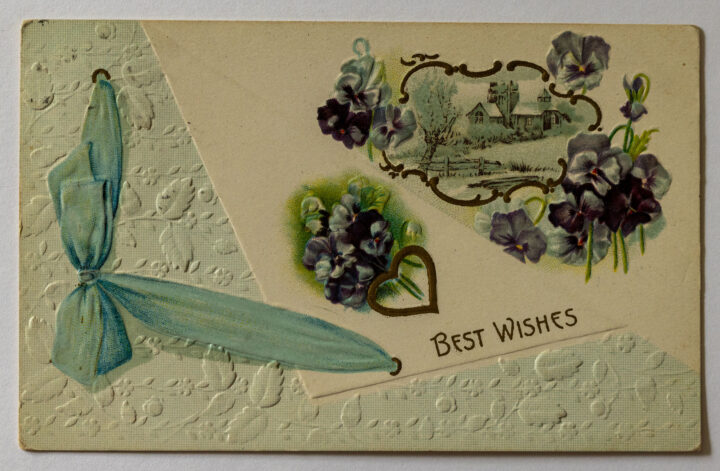
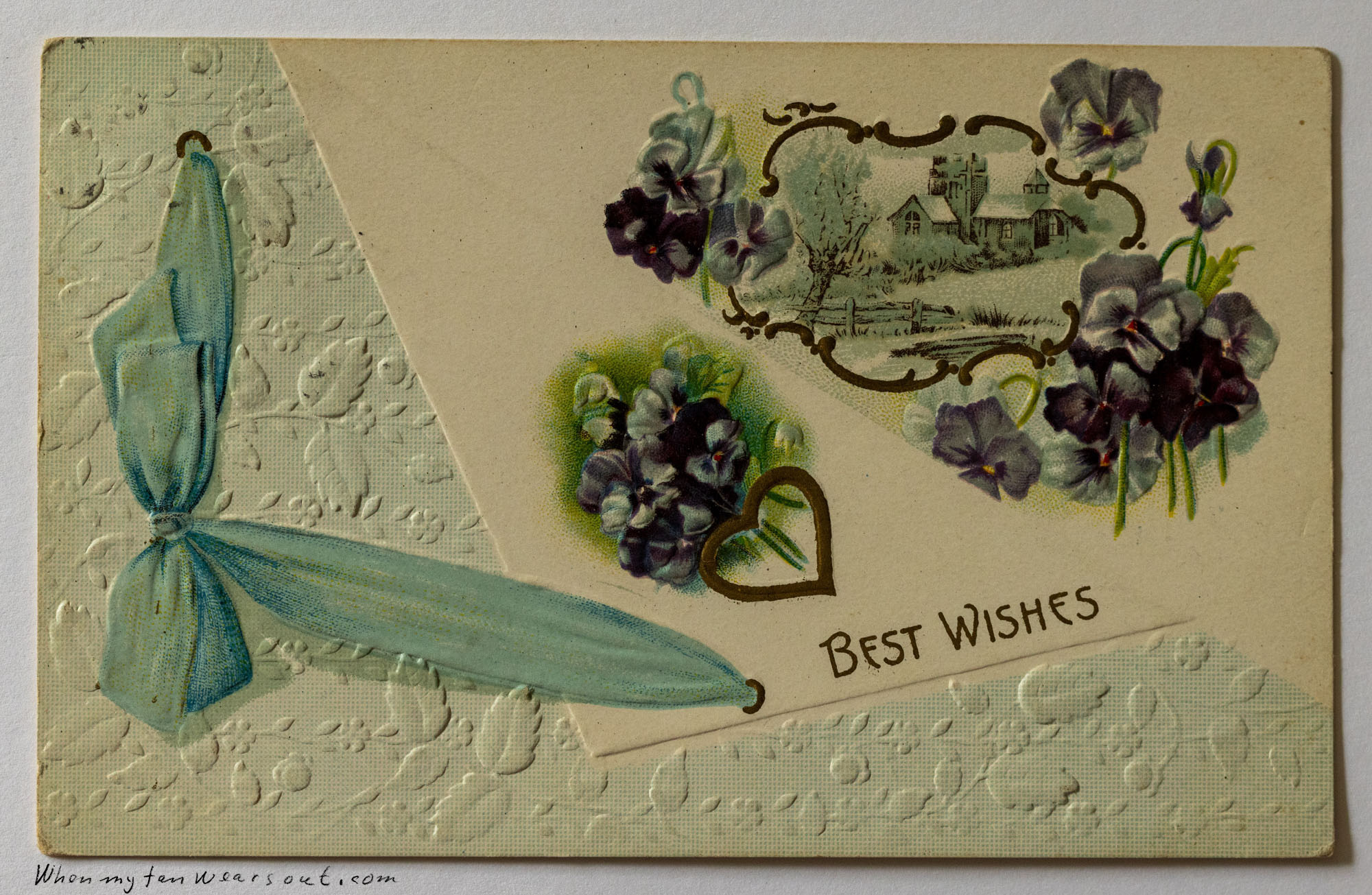
Front — A “Best Wishes” postcard featuring purple pansies, an embossed blue ribbon, and a framed rural farm scene.
Postcard Metadata
Postmarked: Carthage, Illinois — September 7, 1909
Sent From: Carthage, Illinois
Sent To: Mr. Harvey Sights, La Harpe Ill
Distance Traveled: Approximately 16 miles
Postage: U.S. Postage, One Cent (George Washington portrait)
Card Details: Divided Back postcard, popular from 1907 onwards, featuring embossed details.
Back — Correspondence from E.P.B. (Pearl Byers) to Harvey Sights
Transcription
Carthage Ill. Sept. 7-09. Rec’d card this morning as I came to work. Thanks “awfully.” It is dandy. E.P.B. Mr. Harvey Sights La Harpe Ill
Historical & Family Notes
This postcard offers a charming glimpse into the early courtship between Pearl Byers and Harvey Sights. Pearl, writing from Carthage, Illinois, expresses her thanks to Harvey for a card she received earlier that morning, playfully stating it was “dandy.” This exchange highlights their regular correspondence despite living a mere sixteen miles apart, indicating a blossoming romance through the daily ritual of postcard mail.
The sender’s initials “E.P.B.” are almost certainly Pearl Byers, aligning with the family’s identity rules and the ongoing narrative of their relationship. The card was sent on September 7, 1909, a significant period in their courtship before their eventual marriage and the birth of their daughter, Marnelle.
The message’s casual and affectionate tone—”Thanks ‘awfully'”—suggests a comfort and familiarity between Pearl and Harvey, showcasing a delightful snapshot of their everyday interactions and the simple pleasures of receiving mail from a loved one in the early 20th century.
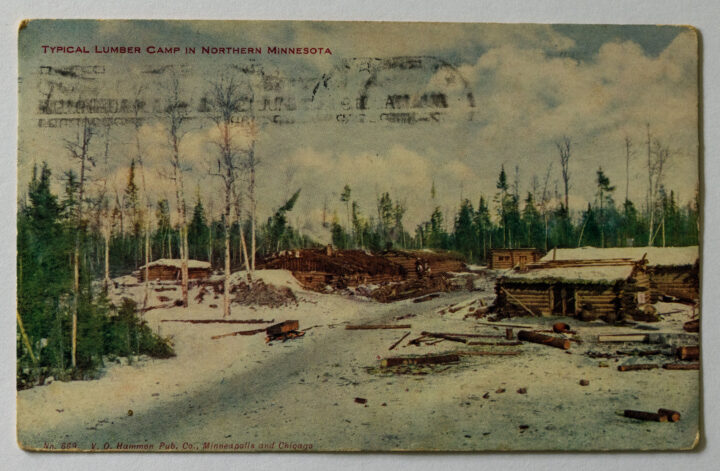
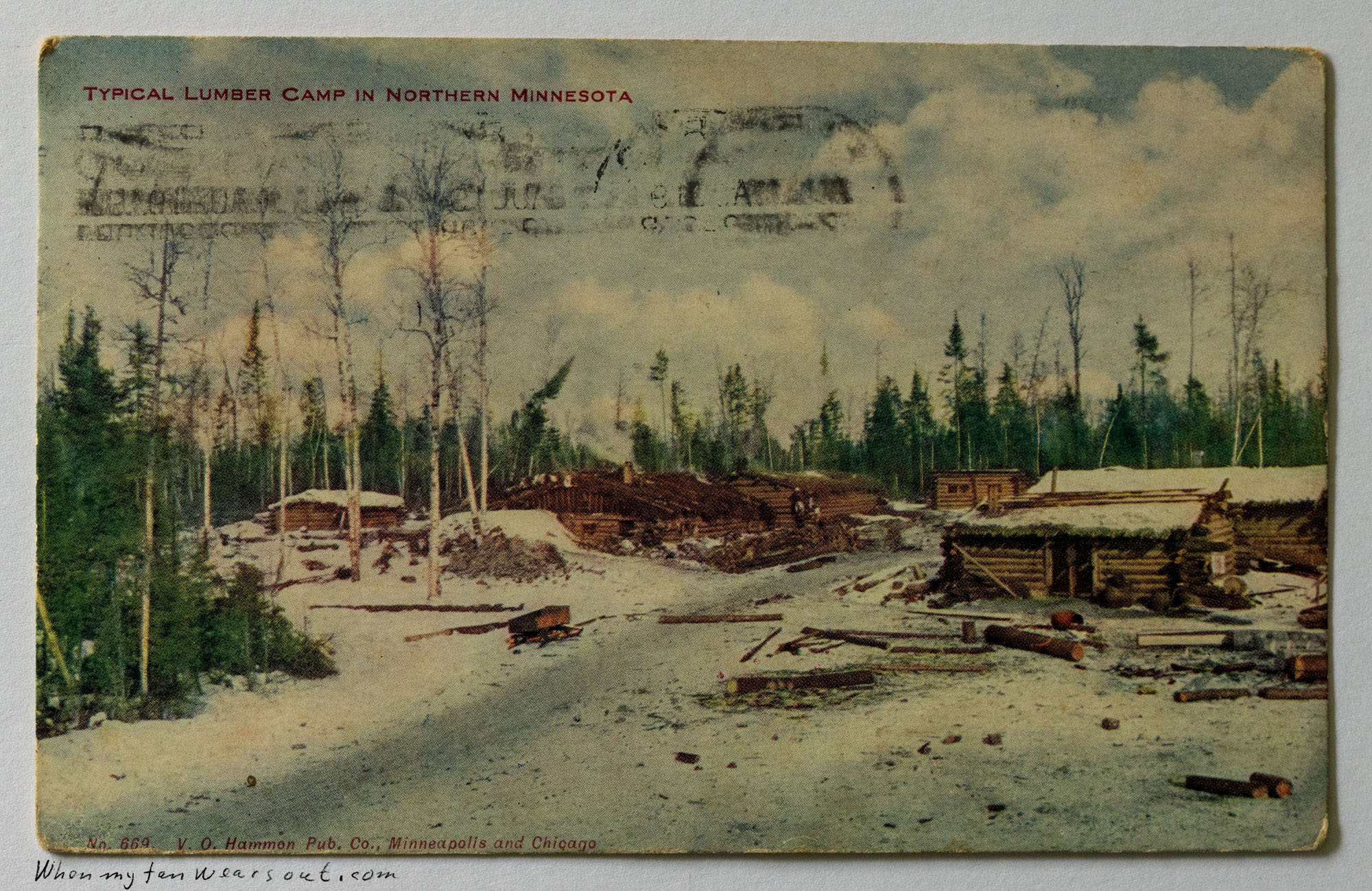
Front — A snowy scene of a typical lumber camp in Northern Minnesota with log cabins and felled trees.
Postcard Metadata
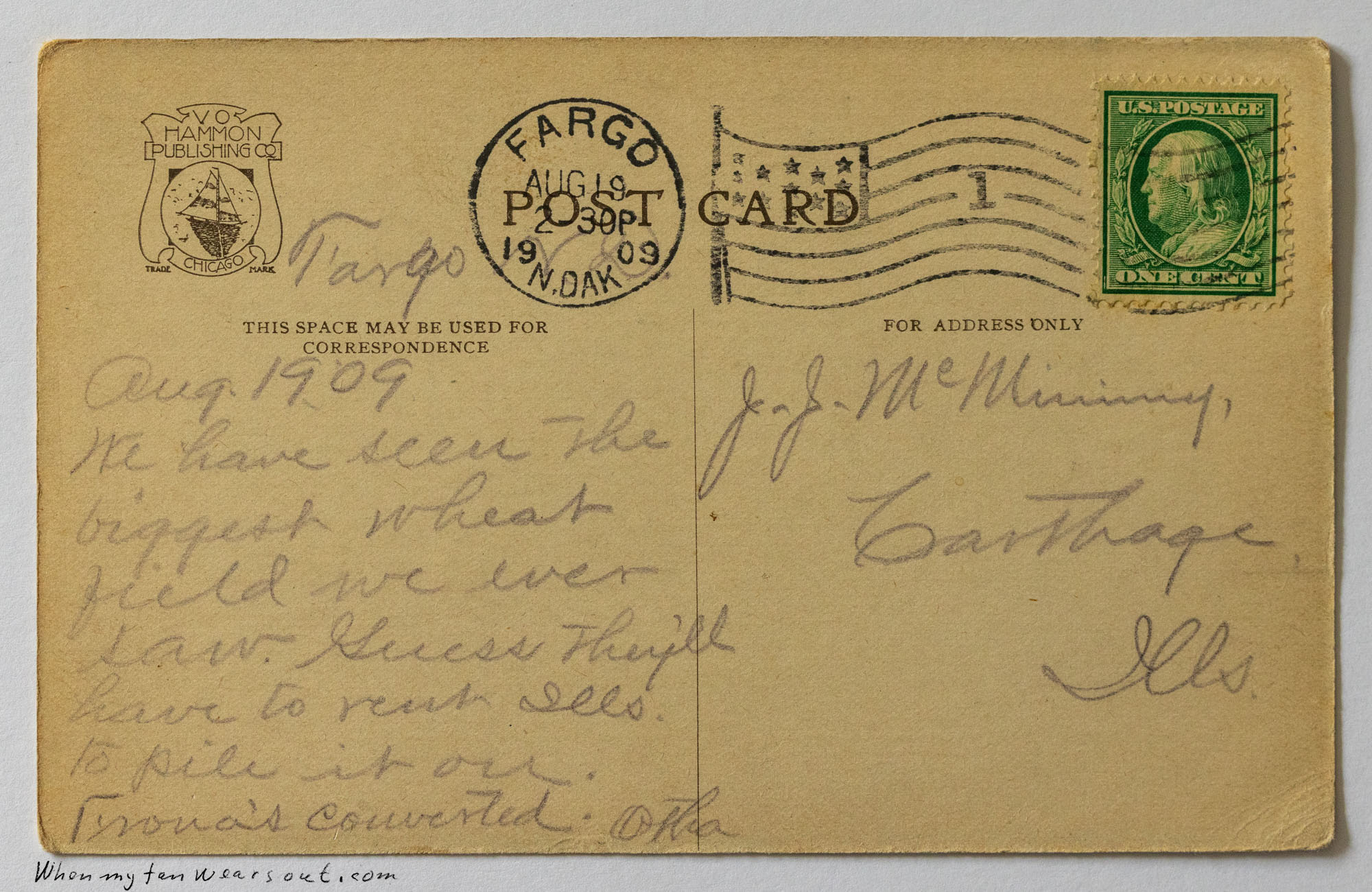
Postmarked: Fargo, North Dakota — August 19, 1909
Sent From: Fargo, North Dakota
Sent To: J. F. McMinnimy, Carthage, Ills.
Distance Traveled: Approximately 620 miles
Postage: One Cent U.S. Postage (Benjamin Franklin)
Card Details: Divided Back Era (post-1907)
Back — Correspondence from (unknown sender) to J. F. McMinnimy
Transcription
Aug. 19. 09. We have seen the biggest wheat field we ever saw. Guess they’ll have to rent silos to pile it on. Trona’s converted. O.K.
Historical & Family Notes
This postcard offers a glimpse into early 20th-century travel and industry, depicting a harsh winter scene from a Northern Minnesota lumber camp. While the postcard itself showcases an industrial snapshot, the message on the reverse speaks of agricultural abundance in North Dakota, noting an impressively large wheat field and the sender’s amusement at its size.
Notably, this particular postcard is not addressed to Pearl Byers or Harvey Sights, unlike many others in the collection. Instead, it is sent to J. F. McMinnimy in Carthage, Illinois, suggesting it was acquired into the family collection through means other than direct correspondence between Pearl and Harvey. This card likely entered the collection as an artifact of broader family connections or local historical interest.
The message’s casual tone, “Trona’s converted. O.K.”, hints at an ongoing personal narrative or shared understanding between the sender and recipient, a common feature of informal postcard exchanges of the era, conveying news that would have been significant to the immediate circle.
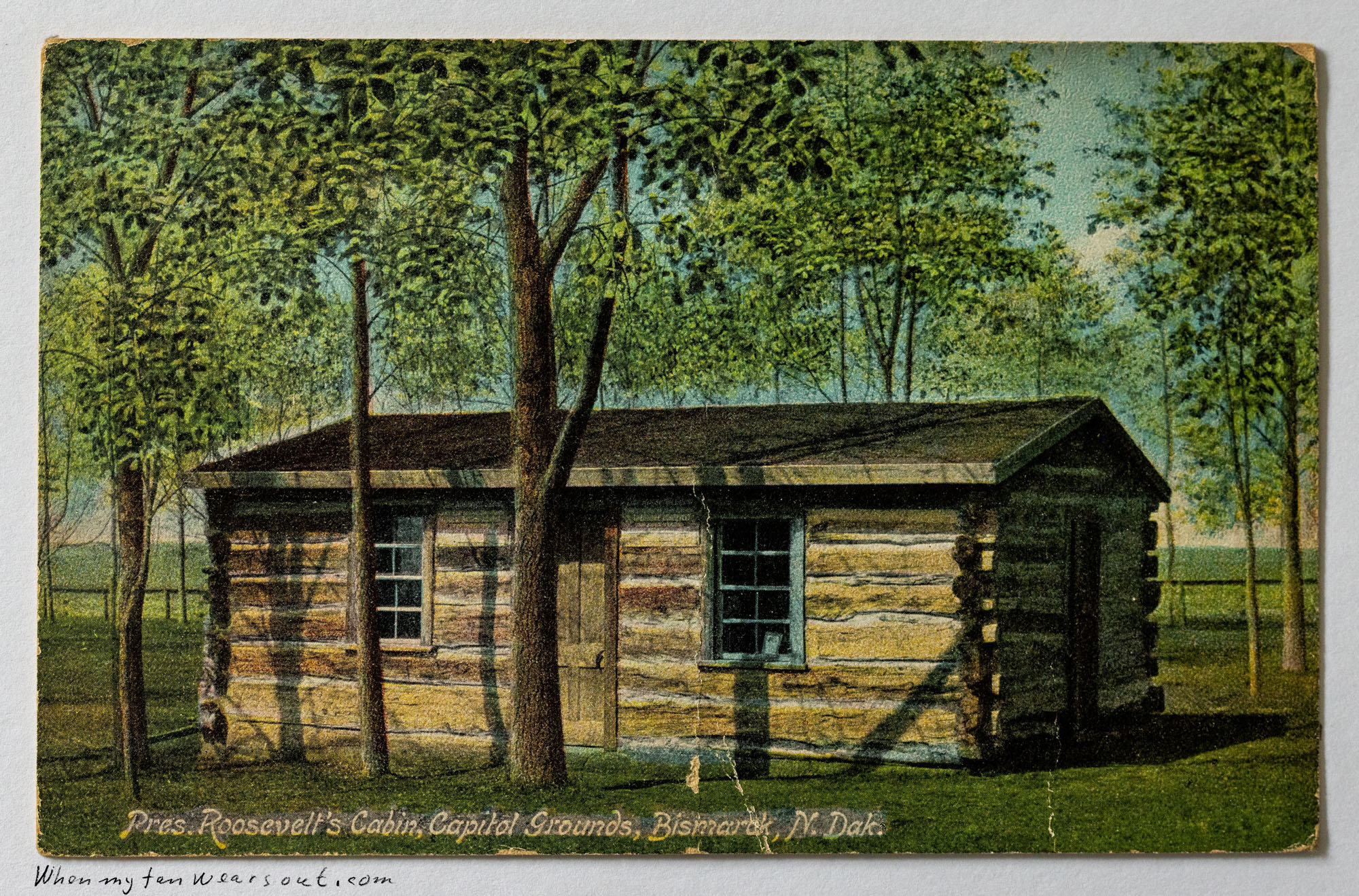
Front — A colorized postcard image of President Theodore Roosevelt’s log cabin on the Capitol Grounds in Bismarck, North Dakota, surrounded by trees.
Postcard Metadata
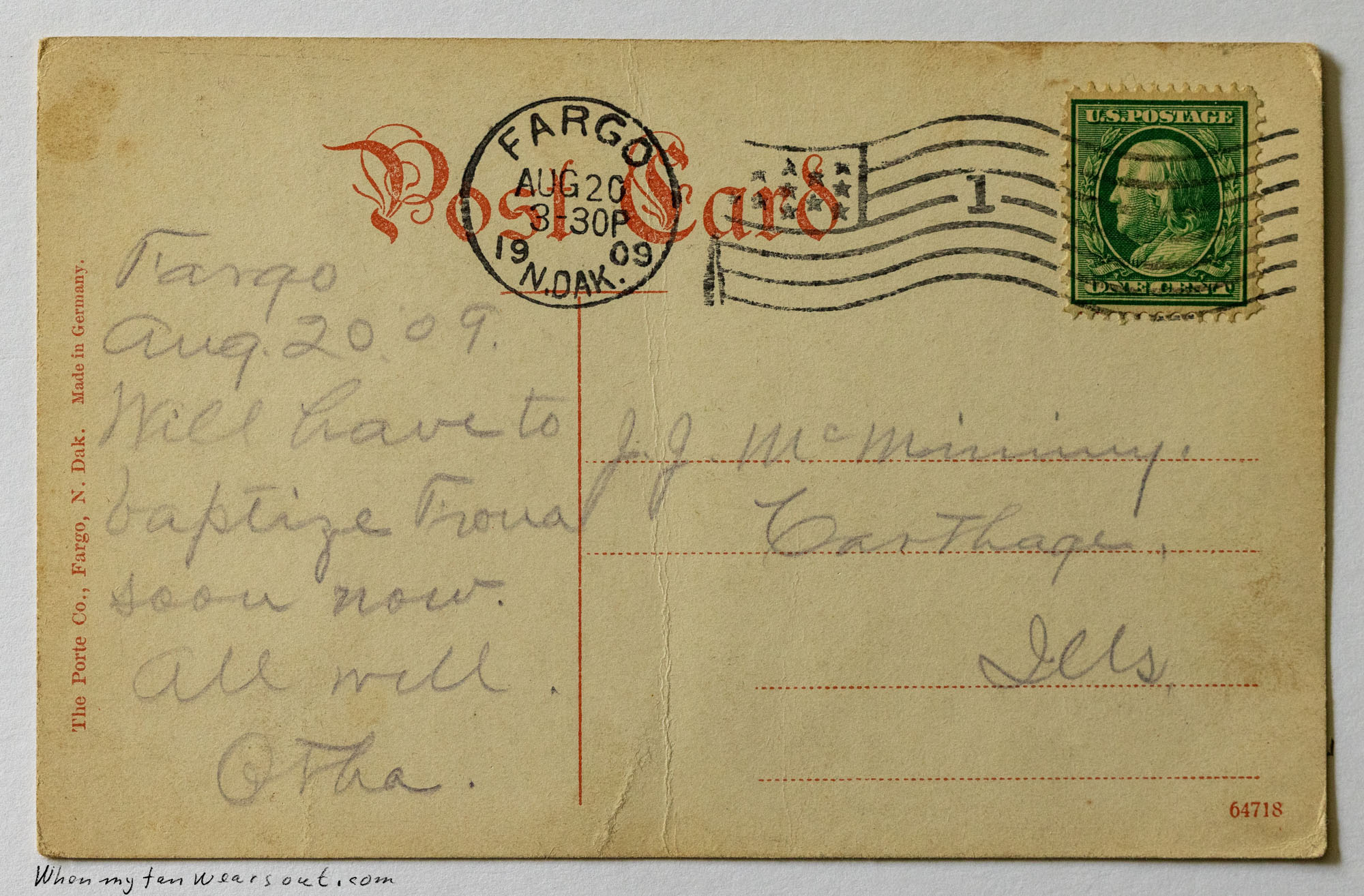
Postmarked: Fargo, N.Dak. — August 20, 1909
Sent From: Fargo, N.Dak.
Sent To: Miss J.D. McMinniny, Carthage, Ills
Distance Traveled: Approximately 820 miles
Postage: One Cent U.S. Postage stamp, green, depicting George Washington
Card Details: Divided Back era (1907-present), printed by The Porte Co., Fargo, N. Dak., Made in Germany.
Back — Correspondence from Otha to Miss J.D. McMinniny
Transcription
Fargo Aug. 20. 09. Will have to baptize Fronna soon now. All well. OTha.
Historical & Family Notes
This postcard, sent from Fargo, North Dakota, by “Otha” to Miss J.D. McMinniny in Carthage, Illinois, offers a snapshot of life in 1909. While the recipient is not Pearl Byers, the destination of Carthage, Illinois, links this card to Pearl’s hometown, suggesting a potential connection through extended family or shared acquaintances within her community. The brief message hints at an upcoming family event, stating, “Will have to baptize Fronna soon now,” indicating a significant personal or religious occasion.
The front of the postcard features a popular historical landmark, President Theodore Roosevelt’s cabin on the Capitol Grounds in Bismarck, North Dakota. Roosevelt’s deep ties to North Dakota through his ranching days made this a recognizable and popular image for early 20th-century postcards, showcasing the historical significance and natural beauty of the region.
The card’s “Made in Germany” notation underscores the global nature of postcard production at the time, with many high-quality, colorized cards being printed abroad for the American market. Such cards provided an efficient way for people to send quick updates and maintain connections across distances, as demonstrated by Otha’s concise but meaningful message.
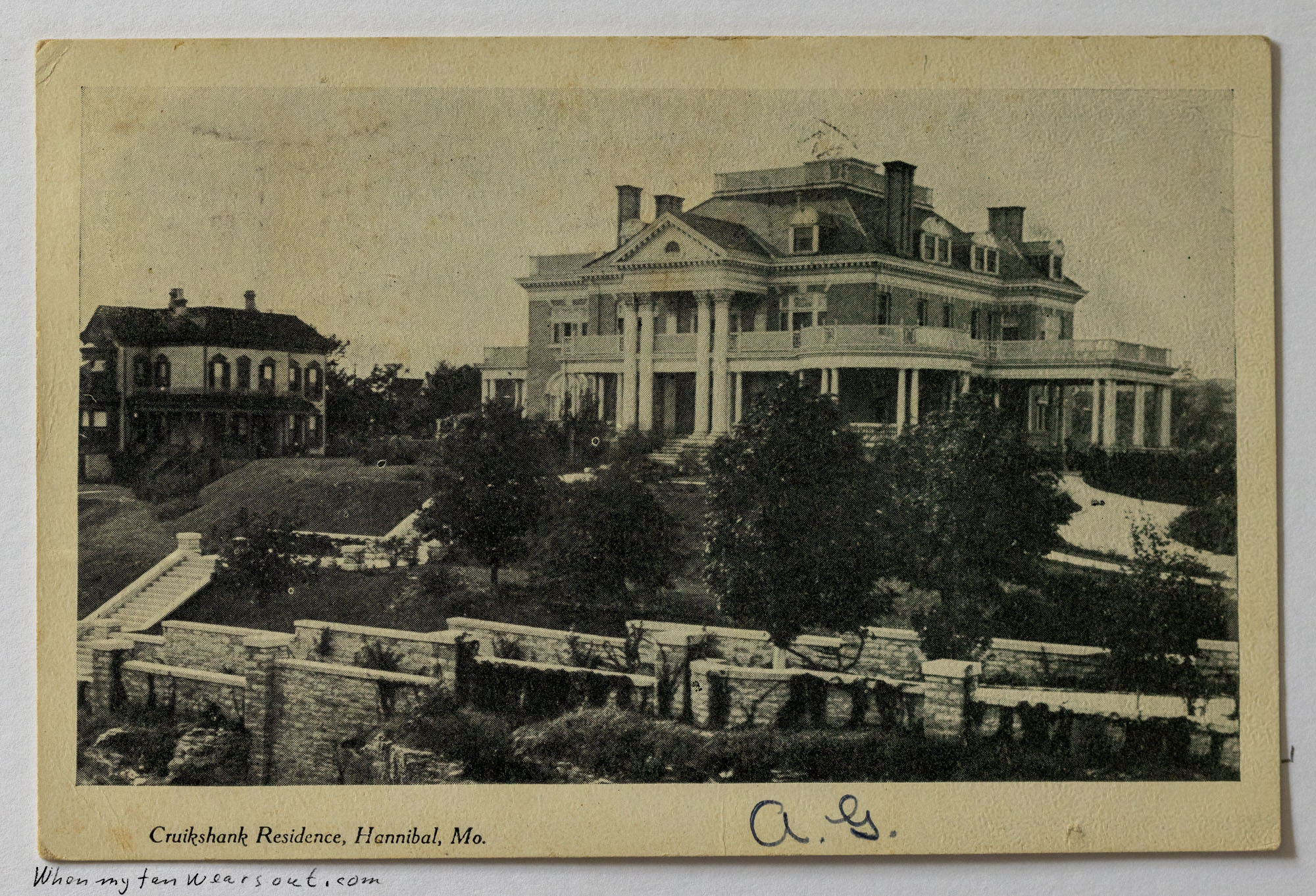
Front — A large, stately Cruikshank Residence mansion with a smaller house beside it, surrounded by manicured grounds.
Postcard Metadata
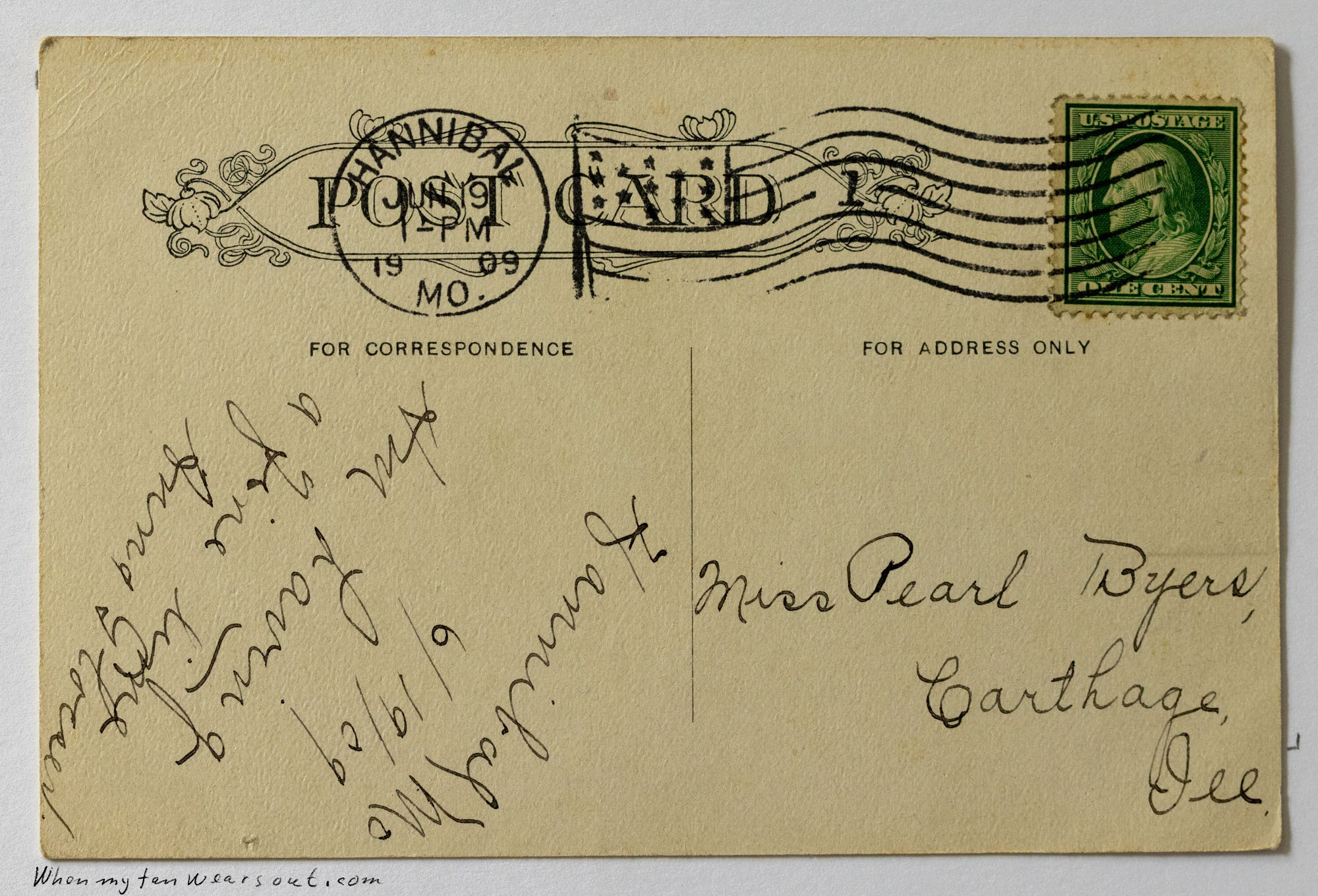
Postmarked: Hannibal, MO — Sep 9, 1909
Sent From: Hannibal, MO
Sent To: Miss Pearl Byers, Carthage, Ill.
Distance Traveled: Approximately 40 miles
Postage: U.S. POSTAGE ONE CENT (Green Benjamin Franklin)
Card Details: Divided Back era postcard
Back — Correspondence from Lavina Byrd to Miss Pearl Byers
Transcription
Am from Hannibal, Mo. 9/10/09 a fine time. Lavina Byrd. Miss Pearl Byers, Carthage, Ill.
Historical & Family Notes
This postcard offers a charming glimpse into Pearl Byers’ social life in 1909, years before her eventual marriage to Harvey Sights. Sent by her friend Lavina Byrd from Hannibal, Missouri—a city famously associated with Mark Twain and its Mississippi River heritage—it captures a simple update of enjoying a “fine time” during a visit. The image of the grand Cruikshank Residence speaks to the architectural prosperity of the era and the types of impressive landmarks travelers would share with friends back home.
The brief message reflects the common use of postcards for quick social connections, serving as a tangible record of Pearl’s friendships and daily interactions. These snippets from her past provide valuable context for her life before and during her early courtship, illustrating the social landscape she navigated as a young woman in the early 20th century. While Harvey Sights is not mentioned, this card rounds out the picture of Pearl’s world, highlighting her network of friends and their shared experiences.
The card’s details, from the postmark date of September 9, 1909, to the one-cent postage, are authentic markers of its time. It’s a small, personal artifact that connects Pearl to a broader historical moment, showcasing how friendships were maintained through the simple act of sending a picture and a few words across the Midwestern landscape.
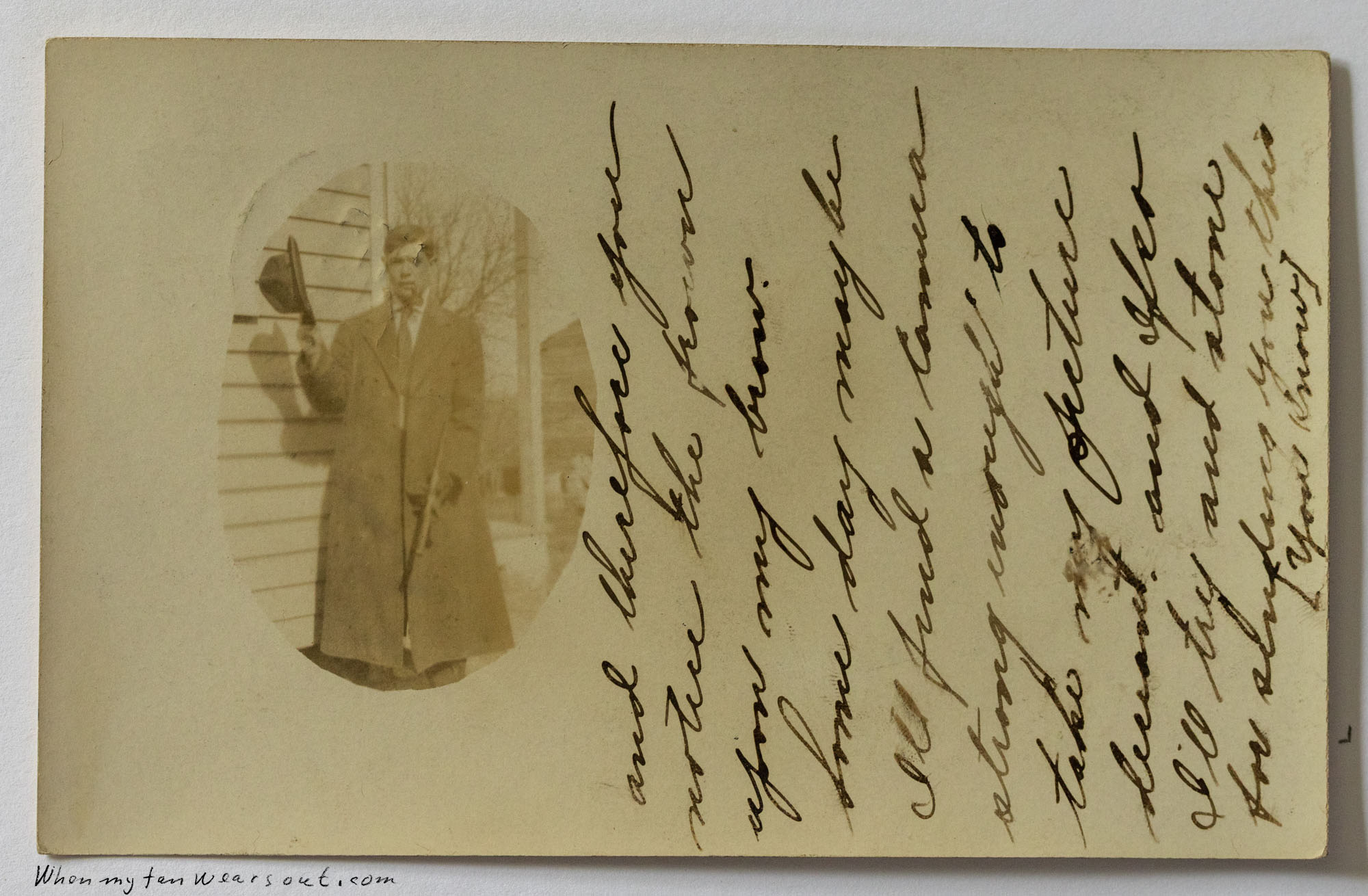
Front — Oval photographic insert featuring a young man in a long coat and hat standing on a porch, with bare trees in the background, next to a handwritten message.
Postcard Metadata
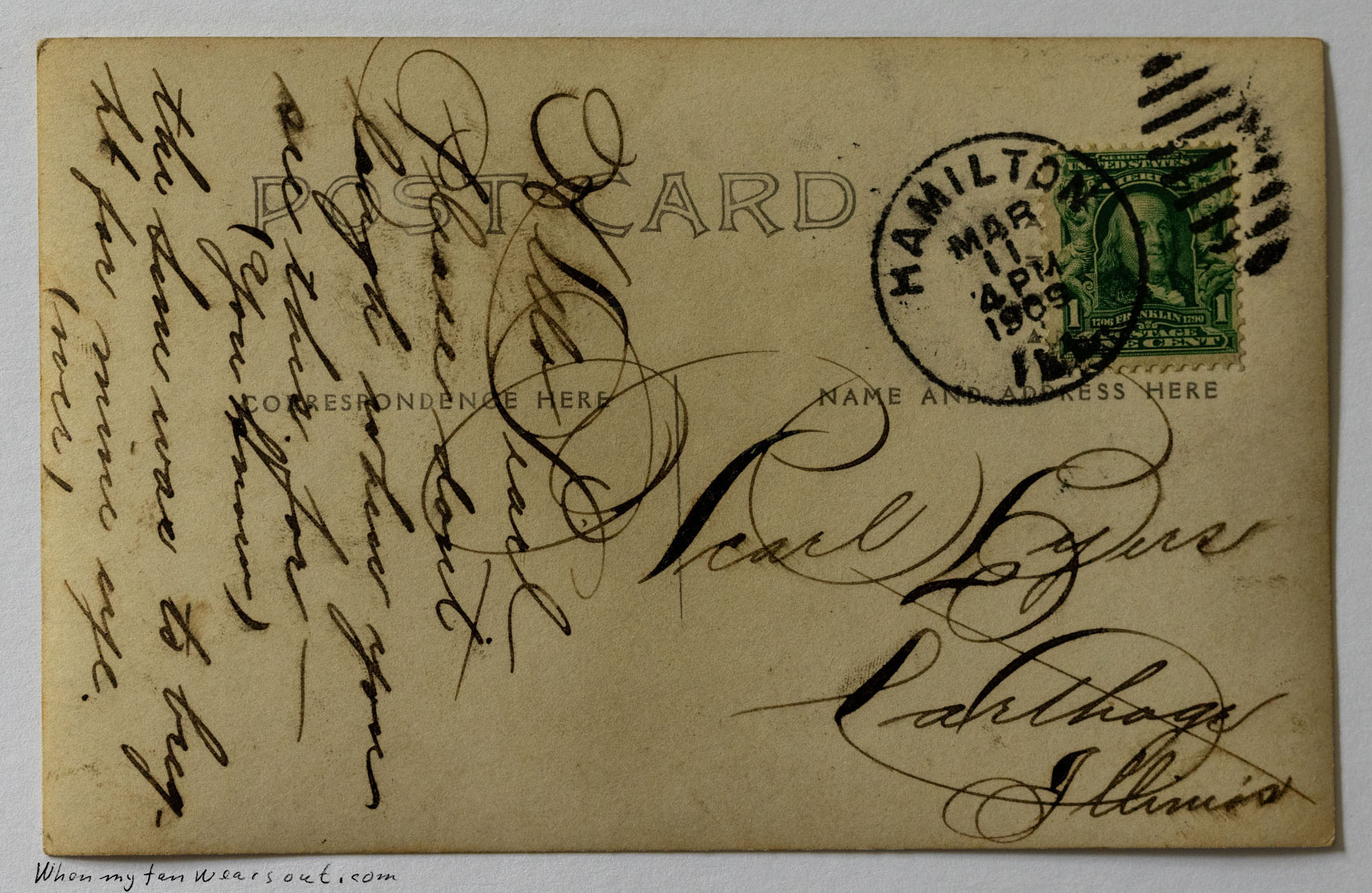
Postmarked: Hamilton, Illinois — March 11, 1909
Sent From: Hamilton, Illinois
Sent To: Miss Pearl Byers, Carthage, Illinois
Distance Traveled: Approximately 18 miles
Postage: One Cent U.S. Postage, Franklin profile (green stamp)
Card Details: Divided Back era (1907-1915)
Back — Correspondence from Harvey Sights to Pearl Byers
Transcription
and that is free and the broom since my May be I will find a camera along with me to take my picture I will try and after this for bring you to the dear your Bery Dear Pearl This leaves me very lonesome this after[text obscured by POST CARD graphic] Harvey
Historical & Family Notes
This postcard, sent by a young Harvey Sights to Pearl Byers, serves as a poignant artifact of their early courtship. Harvey sends a photographic image of himself, possibly his current appearance, and expresses a wish to either take another picture or visit Pearl, stating “I will try and after this for bring you to the dear.” This indicates his desire to see her and deepen their connection, which was common practice during this era of long-distance romance.
The message on the back, though partially obscured, reveals Harvey’s loneliness, starting with “Dear Pearl This leaves me very lonesome this after[…].” This personal touch underscores the emotional intensity of their correspondence. The relatively short distance between Hamilton and Carthage, Illinois, would have made visits plausible, adding anticipation to Harvey’s promise.
This card is a tender snapshot of their relationship before marriage, showing the efforts Harvey made to stay connected and express his feelings, using the popular medium of postcards to bridge the physical distance between them. The slight ambiguity in the sender’s signature on the front (“Bery”) further highlights the informal and intimate nature of their exchanges.
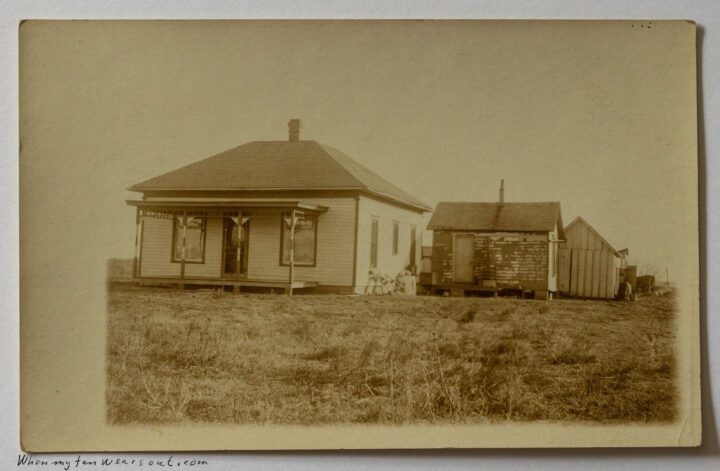
Front — A sepia-toned photograph of a rural home with a porch and two smaller outbuildings under a clear sky.
Postcard Metadata
Postmarked: Lebanon, Kansas — January 15, 1909
Sent From: Lebanon, Kansas
Sent To: Miss Pearl Byers, 318 N. Fayette Street, Carthage, Illinois
Distance Traveled: Approximately 410 miles
Postage: One-cent green Benjamin Franklin stamp (Scott #300, 1902-1908 Series)
Card Details: Divided Back Era (1907-Present)
Back — Correspondence from Mahala to Miss Pearl Byers
Transcription
Dear Pearl I will send you the picture of the place where we live and thank you for the pretty post cards you sent me. Goodby Mahala.
Historical & Family Notes
This postcard offers a glimpse into Pearl Byers’ wider network of friends and family beyond Harvey Sights, showing her engaging in the common practice of postcard exchange. The sender, Mahala, shares an image of “the place where we live,” indicating a personal connection and a desire to share her current surroundings with Pearl. The picture likely depicts Mahala’s home in Lebanon, Kansas, a simple but sturdy dwelling typical of rural Midwestern life in the early 20th century.
The message reveals Pearl herself was an active sender of postcards, with Mahala thanking her for the “pretty post cards.” This reciprocal exchange highlights the social role of postcards as a primary means of staying connected and sharing snippets of life across distances before the advent of more modern communication technologies. While this specific card is not from Harvey Sights, it nonetheless enriches the narrative of Pearl’s life by illustrating her connections with others during the period when her relationship with Harvey was developing.
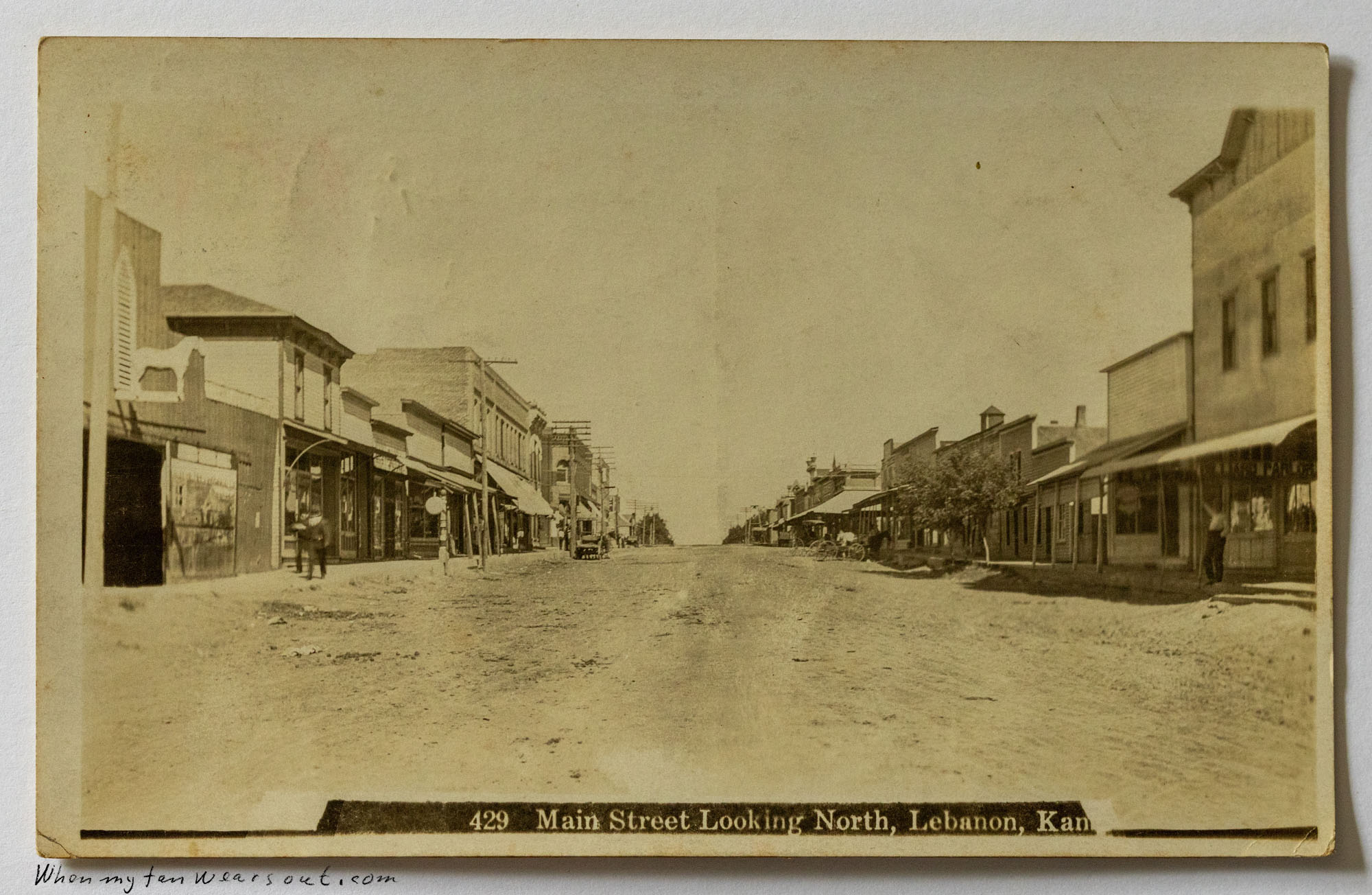
Front — A wide, unpaved Main Street in Lebanon, Kansas, looking north, lined with multi-story business buildings.
Postcard Metadata
Postmarked: Topeka, Kan. — Oct 27, 1909, 6PM
Sent From: Topeka, Kansas
Sent To: Miss Pearl Byers, Carthage, Ill.
Distance Traveled: Approximately 280 miles
Postage: U.S. Postage, One Cent, green stamp (Benjamin Franklin profile)
Card Details: Divided Back postcard, manufactured by M. L. Zercher Book and Sta. Co., Topeka, Kan.
Back — Correspondence from Leonard Timberlake to Miss Pearl Byers
Transcription
Well I guess you thought I was never going to write anything but I finally got around to it. I had swell trip home it rained severall the time after I left Quincy. Leonard Timberlake.
Historical & Family Notes
This postcard, sent to Pearl Byers from Leonard Timberlake, provides a glimpse into her social circle before her eventual marriage to Harvey Sights. The message details Leonard’s “swell trip home” despite rain after leaving Quincy, suggesting Pearl might have been visiting Quincy, Illinois, or that Leonard was visiting Pearl (or nearby) before heading back to his own home, likely in or near Topeka, Kansas, where the card was postmarked.
The existence of correspondence from other individuals like Leonard underscores that Pearl had a vibrant social life and various acquaintances, a common experience for young women of the era. These interactions form part of the broader narrative leading up to her relationship with Harvey Sights, showing the context of her world.
The card’s front, depicting Main Street in Lebanon, Kansas, is a generic scene often found on postcards of the period, chosen by the sender likely for its availability rather than any specific connection to Pearl or Leonard. It highlights the widespread use of postcards for casual correspondence and sharing snippets of daily life or travel.
Front — A vintage sepia-toned photograph of a cozy room corner with a wicker couch, a large bookshelf, and many framed pictures adorning the walls.
Postcard Metadata
Postmarked: Lea, Minnesota — August 7, 1909
Sent From: Lea, Minnesota
Sent To: Miss Pearl Byers Carthage Ills.
Distance Traveled: Approximately 375 miles
Postage: One Cent, Benjamin Franklin stamp (green)
Card Details: Divided Back
Back — Correspondence from G. S. Buch to Miss Pearl Byers
Transcription
this is a corner in my room here, how do you like it? write soon to your G. S. Buch. ad. letter to Hartland
Historical & Family Notes
This postcard offers a charming glimpse into a personal space from over a century ago, a common way to share life and surroundings with distant friends or family before the advent of widespread personal photography and social media. The room, with its wicker couch, overflowing bookshelf, and walls covered in an array of small pictures, suggests a comfortable, well-inhabited corner.
While the sender, G. S. Buch, is not Pearl Byers’ future husband, Harvey Sights, this card is part of Pearl’s collection, indicating her broader circle of acquaintances and friendships. The sender’s direct question, “how do you like it?”, suggests a familiar and perhaps intimate relationship, inviting Pearl’s opinion on their private environment.
The instruction “ad. letter to Hartland” (likely an abbreviation for “address letter to Hartland”) provides a more specific location for G. S. Buch at the time. Hartland, Minnesota, like Lea (the postmark location, likely near Albert Lea), is situated in Freeborn County, suggesting the sender was either staying in or had recently moved to this nearby community when sending the card to Pearl in Carthage, Illinois.
Front — A 1909 New Year greeting card featuring ornate numbers, pine branches, pine cones, and green shamrocks.
Postcard Metadata
Postmarked: Cairo, Illinois — December 30, 1908
Sent From: Cairo, Illinois
Sent To: Harvey Sights La Harpe Ills
Distance Traveled: Approximately 280 miles
Postage: 1 Cent United States of America, Benjamin Franklin stamp
Card Details: Divided Back Era (1907-1915), “Made in Germany”
Back — Correspondence from Aunt, Hattie, and Uncle Jo to Harvey Sights
Transcription
Happy new year to our dear Boy Harvey From Aunt Hattie and Uncle Jo Be good and that will bring you happiness Harvey Sights La Harpe Ills Made in Germany. Serie 75
Historical & Family Notes
This early New Year’s card provides a charming glimpse into Harvey Sights’ childhood, dating from December 1908, just before the turn of 1909. Addressed to “our dear Boy Harvey” from his Aunt, Hattie, and Uncle Jo, the message “Be good and that will bring you happiness” suggests he was still quite young, perhaps a pre-teen or early teenager, receiving guidance from his loving family members. This card predates his eventual courtship and marriage to Pearl Byers, offering a foundational look at his upbringing and family ties.
The postcard’s origin from “Made in Germany” highlights the significant role German printers played in the Golden Age of Postcards, known for their high-quality lithography and vibrant designs. Sent from Cairo, Illinois, in the southern tip of the state, to La Harpe in western Illinois, it demonstrates the widespread use of postcards for connecting families across distances, even relatively short ones, in the early 20th century.
This card is a valuable piece in understanding Harvey Sights’ family context before he embarked on his life with Pearl. It paints a picture of a well-loved young boy, receiving well wishes and gentle admonitions from his extended family, laying the groundwork for the man he would become.
Front — A serene green-bordered scene featuring five birds on tree branches against a bright yellow and green forest background with ‘Birthday Greetings’ text.
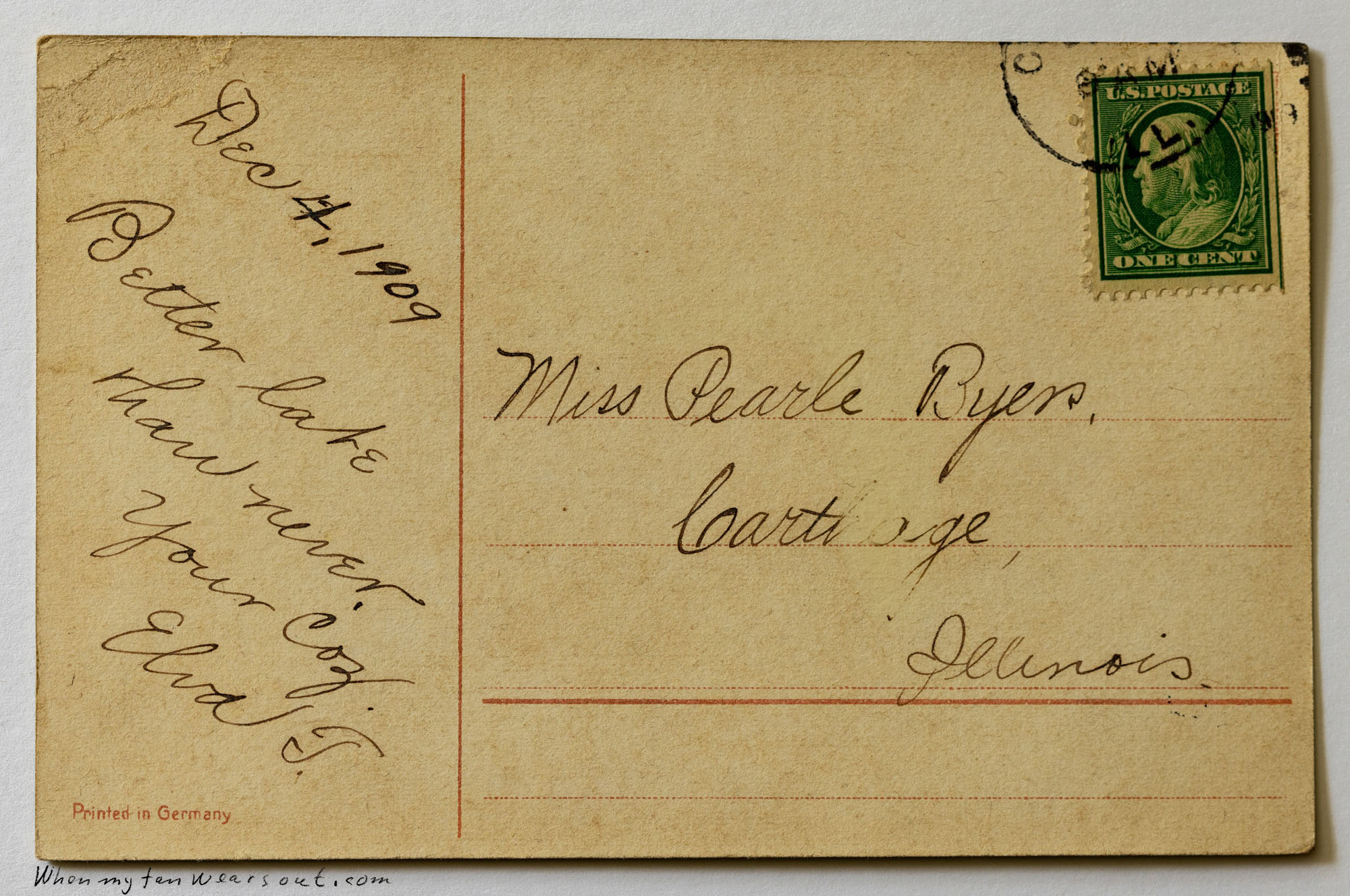
Postcard Metadata
Postmarked: Carthage, Illinois — December 4, 1909
Sent From: Carthage, Illinois
Sent To: Miss Pearle Byer, Carthage, Illinois
Distance Traveled: 0 miles
Postage: U.S. POSTAGE ONE CENT, green George Washington stamp
Card Details: Divided Back, Printed in Germany
Back — Correspondence from Elva J. Sights to Pearle Byer
Transcription
Dec 4, 1909 Better late than never. Your Cog. J. Elva J. S.
Historical & Family Notes
This charming postcard, dated and postmarked on December 4, 1909, delivers a direct birthday greeting to Pearle Byer, the future wife of Harvey Sights. The sender, “Elva J. S.”, can be identified as Elva J. Sights, given the distinctive cursive capital ‘S’ that mimics an ‘L’, consistent with the Sights family record’s unique handwriting characteristics. The card likely signifies a close familial or social bond already present between Pearle and the Sights family network even before her marriage to Harvey.
The message, “Better late than never,” playfully implies a slight delay in sending the birthday wishes, yet the postcard was postmarked on Pearle’s actual birthday, December 4th. This suggests Elva may have intended for it to arrive earlier, but ensured it was mailed on the day itself, perhaps for a local delivery in Carthage, Illinois. The card, with its cheerful birds amidst a vibrant natural scene, reflects a popular aesthetic for sentimental greetings of the era.
Printed in Germany, this postcard illustrates the global reach of printed goods at the turn of the 20th century, bringing a touch of international craft to the heartland of Illinois. As an early artifact in the WhenMyTanWearsOut.com collection, it offers a sweet glimpse into Pearle’s social connections and her developing role within the Sights family’s circle, long before her eventual marriage to Harvey Sights.