Postcard #006: Galesburg Court House and Plans to Return Home


A vintage colorized postcard showing the Galesburg Court House in Illinois, featuring a prominent clock tower and stone architecture against a blue and green sky, with the image printed upside down.
Front — A vintage postcard image of the Galesburg Court House with a prominent clock tower, depicted upside down.

Postcard Metadata


The back of a 1903 undivided back postcard with handwritten message in faded ink from Harvey Sights to Miss Pearl Byers, postmarked Galesburg, Illinois, with a green One Cent U.S. Postage stamp.
Back — Correspondence from Harvey Sights to Miss Pearl Byers

Transcription

8-11-03 Hello Pear. How is my little girlie. I am having a good time at my work and will be home Sat. by by. Need.

Historical & Family Notes

This early postcard, penned by Harvey Sights to his future wife Pearl Byers, offers a charming glimpse into their courtship in 1903. Sent from Galesburg, Illinois, where Harvey was likely for work or a visit, the message conveys an eagerness to return home to Carthage, underscoring the distance that often separated young sweethearts in the early 20th century. His affectionate salutation, “Hello Pear. How is my little girlie,” clearly demonstrates the intimate and tender nature of their burgeoning relationship.

The card’s front, featuring the impressive Galesburg Court House, serves as a geographical marker for Harvey’s temporary whereabouts, connecting his personal message to a tangible place in the Midwestern landscape. The use of an undivided back postcard, popular prior to 1907, highlights the primary mode of personal correspondence during this era, where brevity and directness were key, much like a quick text message today.

Harvey’s promise to be “home Sat.” and the affectionate “by by” not only signal his imminent return but also suggest a longing for reconnection. These small, daily communications formed the fabric of their long-distance relationship, laying the foundation for their eventual marriage and shared life together. The collection of these postcards traces the romantic journey that defined Pearl and Harvey’s early years.

Continue Reading

Postcard #003: A Birthday Greeting from Hallie, Featuring a Dutch Windmill Scene


Vintage sepia-toned postcard from 1909 depicting a woman with long, flowing hair looking down at a cluster of flowers, with a small Dutch windmill nestled among them, all within a circular frame. The circular image is flanked by two rectangular, abstract, darker panels. Above the central image, oriented vertically, is decorative script text that reads
Front — A sepia-toned postcard featuring a central circular vignette of a woman with flowing hair among flowers and a windmill, flanked by abstract rectangular designs, with Dutch text “A Hartelijk Welkom.”

Postcard Metadata


The back of a 1909 postcard featuring a split back for correspondence and address. The left side contains a handwritten birthday message in cursive ink:
Back — Correspondence from Hallie to Miss Pearle Byers

Transcription

Wishing you Many Happy Returns of the day. Hallie 12-4-09. Miss Pearle Byers City

Historical & Family Notes

This postcard offers a charming glimpse into Pearle Byers’ early life, marking her birthday on December 4th, 1909. The sender, Hallie, likely a close friend or family member also residing in Carthage, sent this brief but warm greeting locally, as indicated by the “City” address. Such local correspondence was common, strengthening community ties within small Midwestern towns like Carthage.

The front of the card, with its distinctly European theme featuring a windmill and the Dutch phrase “A Hartelijk Welkom” (A Hearty Welcome), reflects the era’s fascination with international imagery and diverse artistic styles. While the message is simple, the act of sending a birthday card was a meaningful gesture, especially for a young woman like Pearle.

This card, sent before her eventual marriage to Harvey Sights, captures a moment of personal celebration in Pearle’s life. It serves as a gentle reminder of the network of friends and well-wishers who acknowledged her special day, contributing to the rich tapestry of her personal history.

Continue Reading

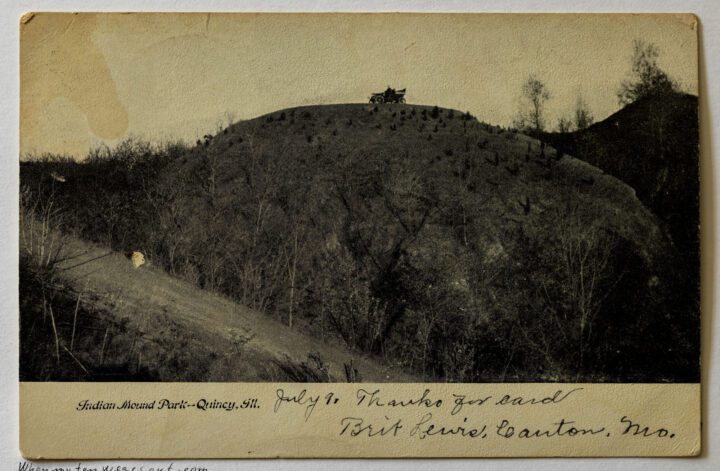
Postcard #001: Thanks from Indian Mound Park, Quincy


Sepia-toned postcard depicting Indian Mound Park in Quincy, Illinois, with an early 20th-century automobile parked on the summit of a tree-covered mound, overlooking a forested landscape.
Front — A sepia-toned image shows a dirt road winding up a large, tree-covered Indian Mound with an early automobile parked on top.

Postcard Metadata


Handwritten postcard back with a personal message dated July 19 from Brit Lewis in Canton, Missouri, to Miss Pearl Byers in Carthage, Illinois, postmarked Carthage, IL, July 19, 1916, with a one-cent Benjamin Franklin stamp.
Back — Correspondence from Brit Lewis to Miss Pearl Byers

Transcription

Indian Mound Park – Quincy, Ill. July 19. Thanks for card. Brit Lewis, Canton, Mo.

Historical & Family Notes

This early postcard sent to Pearl Byers by Brit Lewis captures a glimpse into her life before she met Harvey Sights. While the sender is not Harvey, the card establishes Pearl’s residence in Carthage, Illinois, a setting that would be central to her early adult life. The image of Indian Mound Park in Quincy, a nearby city, illustrates a regional landmark and popular destination, hinting at the shared experiences and local scenery common to young people in the Midwest at the time.

The casual nature of the message, “Thanks for card,” suggests an ongoing correspondence, painting a picture of Pearl’s social circle and the common practice of exchanging postcards to stay in touch. This card, dated July 19, 1916, precedes Pearl’s eventual marriage to Harvey Sights, offering a historical marker of her life during a period of significant social and technological change, reflected in the early automobile atop the mound.

Although a simple note, the postcard adds to the fabric of Pearl’s story, documenting her connections and the daily exchanges that shaped her world before the central chapter of her life with Harvey began. It grounds her in her community and time, showcasing the widespread use of postcards as a primary mode of communication for personal greetings and sharing visual experiences.

Continue Reading