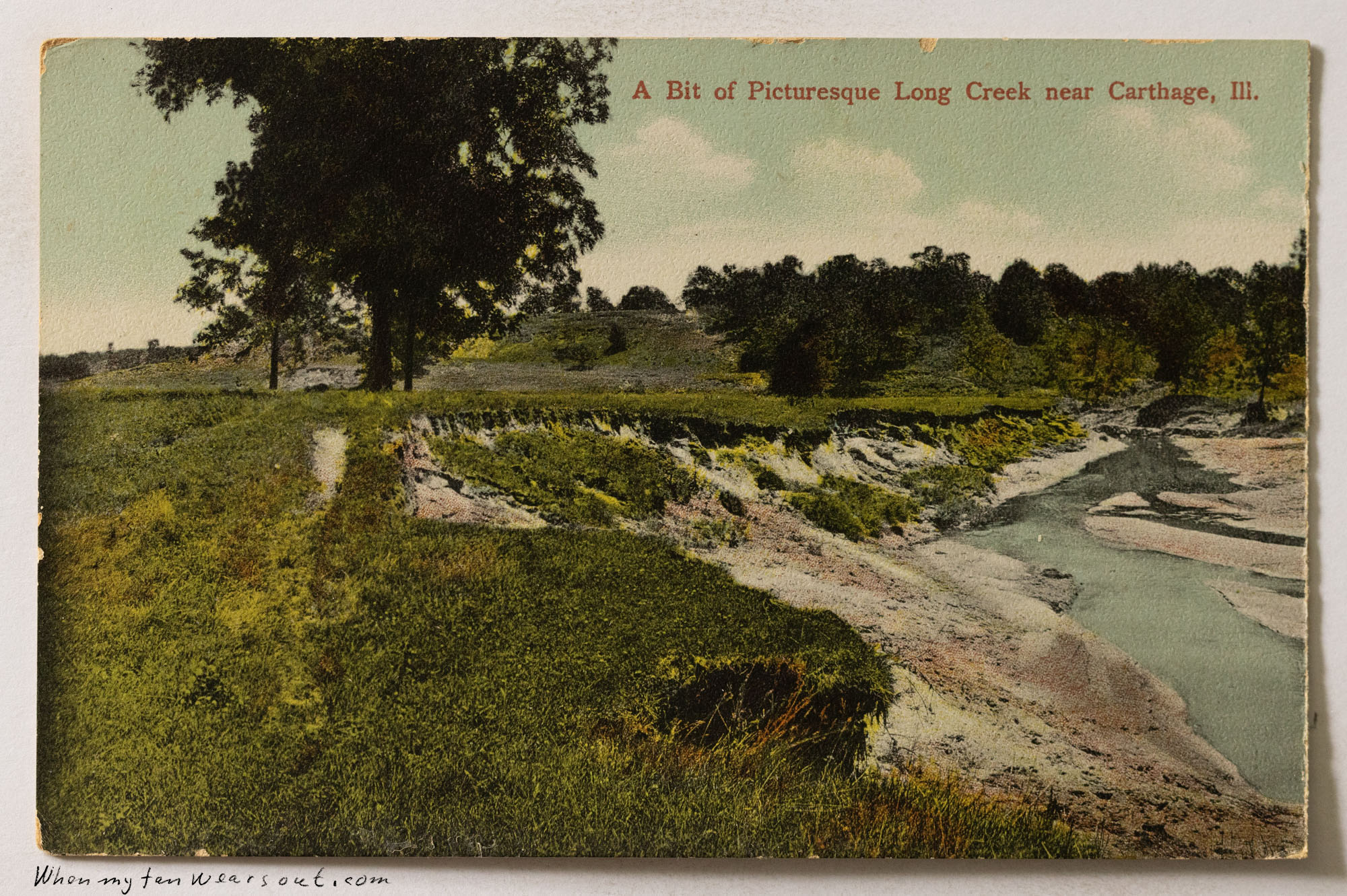
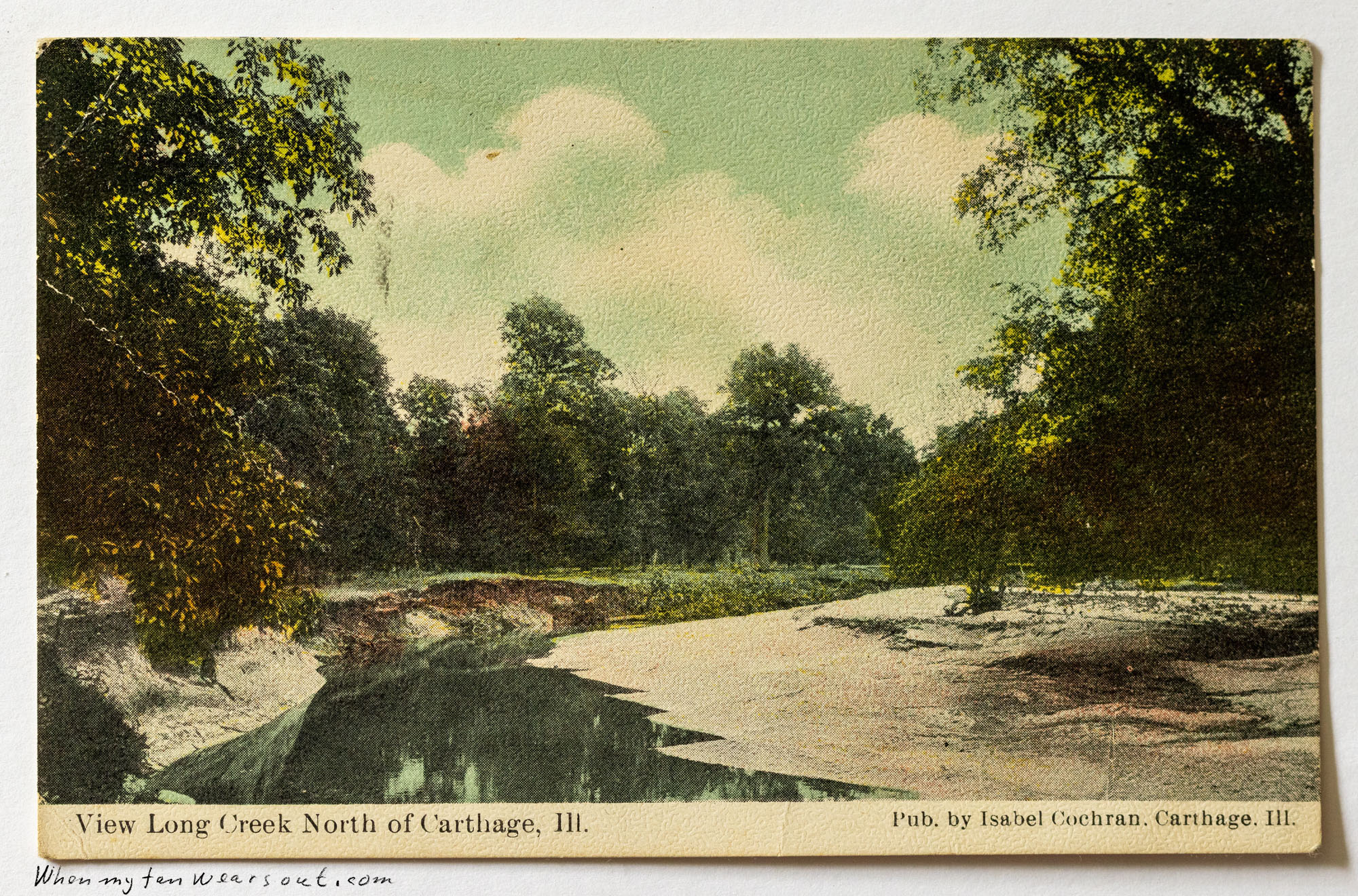
Postcard #1079: landscape view of Long Creek near Carthage, Carthage, IL — October 1909

Front of postcard #1079: Hand-colored landscape view of Long Creek near Carthage, Illinois. The image shows a wide, shallow creek bed with muddy

Transcription

Back — Before 1910

Back of postcard #1079

Postcard Information

  • Postmark: Carthage, ILL., OCT 20 1909
  • Sent To: Carthage IL
  • Era: Undivided Back (Pre-1907)
  • Publisher: Ed. Hoch, Importer and Publisher, Carthage, Ill.
  • Print Origin: Printed in Germany
  • Stamp: 1¢ — Two identical 1¢ stamps.
  • Distance Traveled: Local mail
  • Notes: Two 1¢ stamps used on a single card; card is an undivided back style design despite being mailed in 1909; contains a handwritten pencil note "Before 1910" at the top of the back which appears to be a later addition.

About This Card

Long Creek near Carthage appears in the collection multiple times across different decades — Harvey sending a card of it from La Harpe before their wedding, Pearl’s mother sending a view later, and now this hand-colored landscape postmarked from Carthage in the linen era. Long Creek was the natural feature closest to both of their hometowns: it ran through the farm country between Carthage and La Harpe, and it was the kind of creek people knew by name because they crossed it regularly. This unsigned card was sent by an unsigned sender — the creek speaks for itself.

Continue Reading

Postcard #0068: landscape depiction of a creek, La Harpe, IL — Harvey to Pearl, October 1909

Front of postcard #0068: Colored landscape depiction of a creek, identified as Long Creek, showing trees reflecting in the water on the left and

Transcription

Back — 10/28/09 Just a line to say I will be in C. about 9 or ten this morning. Hope you have had a fine time at the party. H.R.S.

Back of postcard #0068

Postcard Information

  • Postmark: LA HARPE, ILL., OCT 29 1909
  • Sent To: Carthage IL
  • Era: Golden Age (1907–1915)
  • Publisher: Isabel Cochran, Carthage, Illinois
  • Stamp: 1¢
  • Distance Traveled: ~15 miles

About This Card

Long Creek runs through the countryside near both Carthage and La Harpe in Hancock County, Illinois — it was familiar ground to Harvey, who grew up in La Harpe, and to Pearl, who lived in Carthage. Harvey signed this card “H.R.S.” — his initials — and sent it from La Harpe in October 1909, just over a year before their wedding on October 6, 1910. The note is brief and practical: he’ll be in Carthage around nine or ten in the morning. The creek in the illustration looks peaceful in autumn light.

Continue Reading

Postcard #0067: Warsaw, IL — alma to Pearl, August 1909

Front of postcard #0067: Hand-colored postcard showing a scenic overlook of the Mississippi River from the site of Fort Edwards in Warsaw, Illino

Transcription

Back — Hello Kiddo: How are you. well this is all good by alma Hows (—)?

Back of postcard #0067

Postcard Information

  • Postmark: Warsaw, Ill., AUG 24 1909
  • Sent To: Carthage IL
  • Era: Golden Age (1907–1915)
  • Publisher: W. J. Hartman Co., Chicago, Illinois
  • Stamp: 1¢
  • Distance Traveled: ~20 miles
Continue Reading

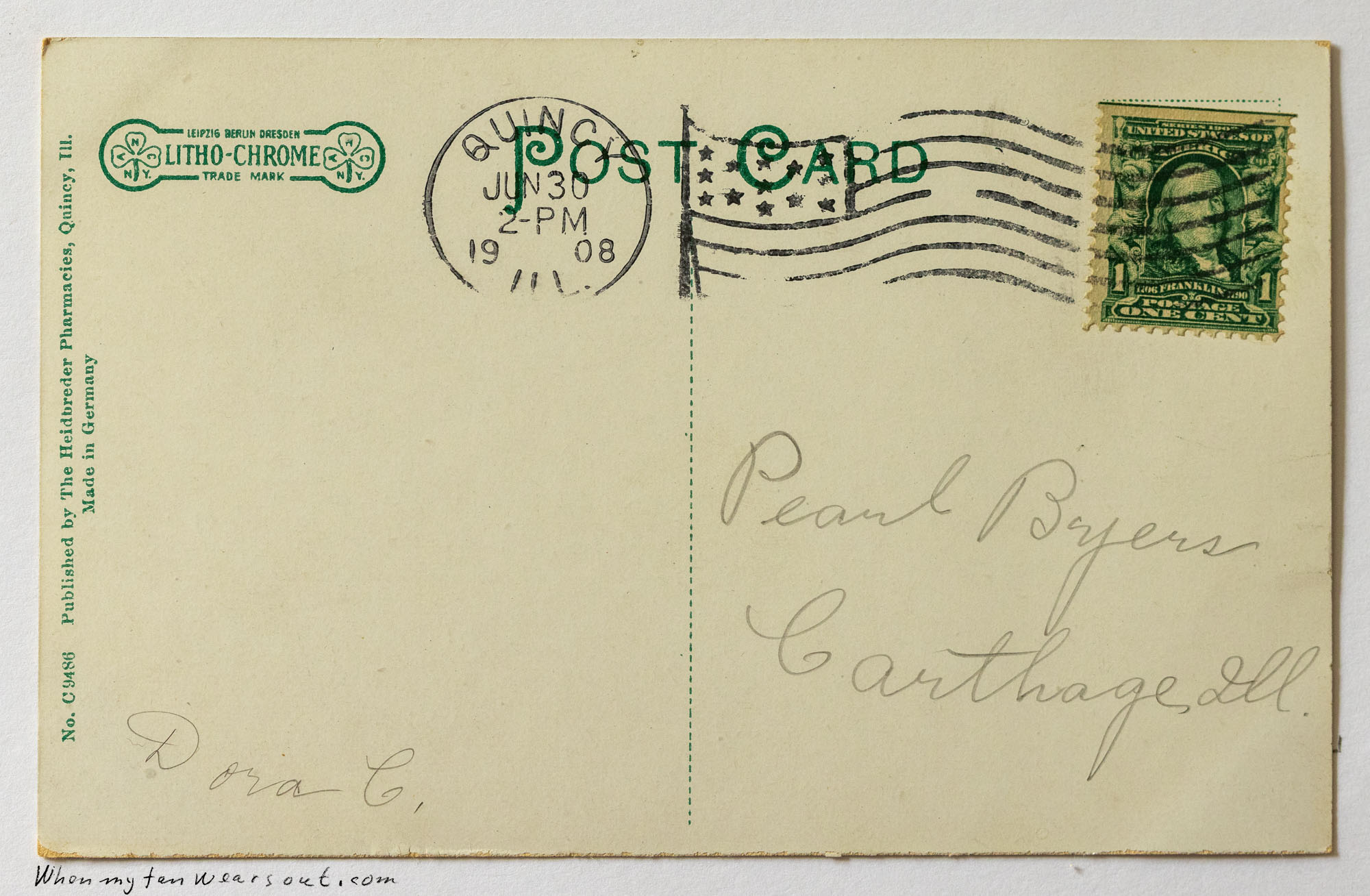
Postcard #0064: stone arch bridge over a stream in South Park, Quincy, IL — Dora C to Pearl, June 1908

Front of postcard #0064: Color lithograph showing a stone arch bridge over a stream in South Park, Quincy, Illinois, with lush green trees on bot

Transcription

Back — Dora C. ] D. H. C.

Back of postcard #0064

Postcard Information

  • Postmark: Quincy, Ill., JUN 30 1908
  • Sent To: Carthage IL
  • Era: Golden Age (1907–1915)
  • Publisher: The Heidbreder Pharmacies, Quincy, Illinois
  • Print Origin: Printed in Germany
  • Stamp: 1¢ — Canceled with a wavy US flag machine postmark.
  • Distance Traveled: ~40 miles

About This Card

South Park in Quincy runs along the bluffs above the Mississippi River, and the stone arch bridge shown on this card crossed one of its ravines. The park system was developed in the 1870s and 1880s when Quincy was prosperous enough to invest in civic amenities. Dora C. sent this card in June 1908 — early in Pearl’s correspondence years, when many of these cards were still finding their way from near and far.

Continue Reading

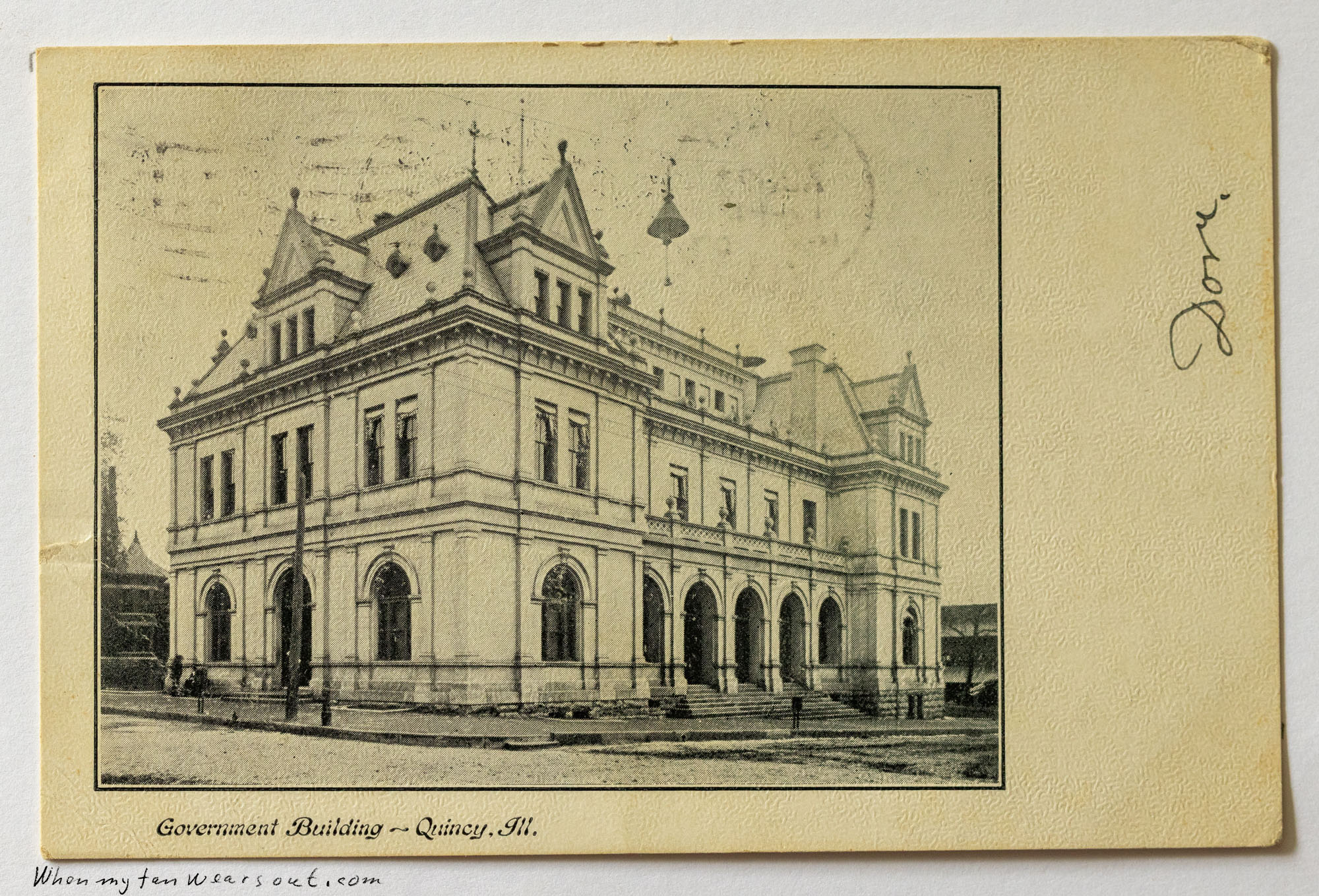
Postcard #0063: stone Government Building in Quincy, Quincy, IL — Dove to Pearl, August 1907

Front of postcard #0063: Black and white illustration of the stone Government Building in Quincy, Illinois, featuring prominent arched doorways o

Transcription

Front — Dove.

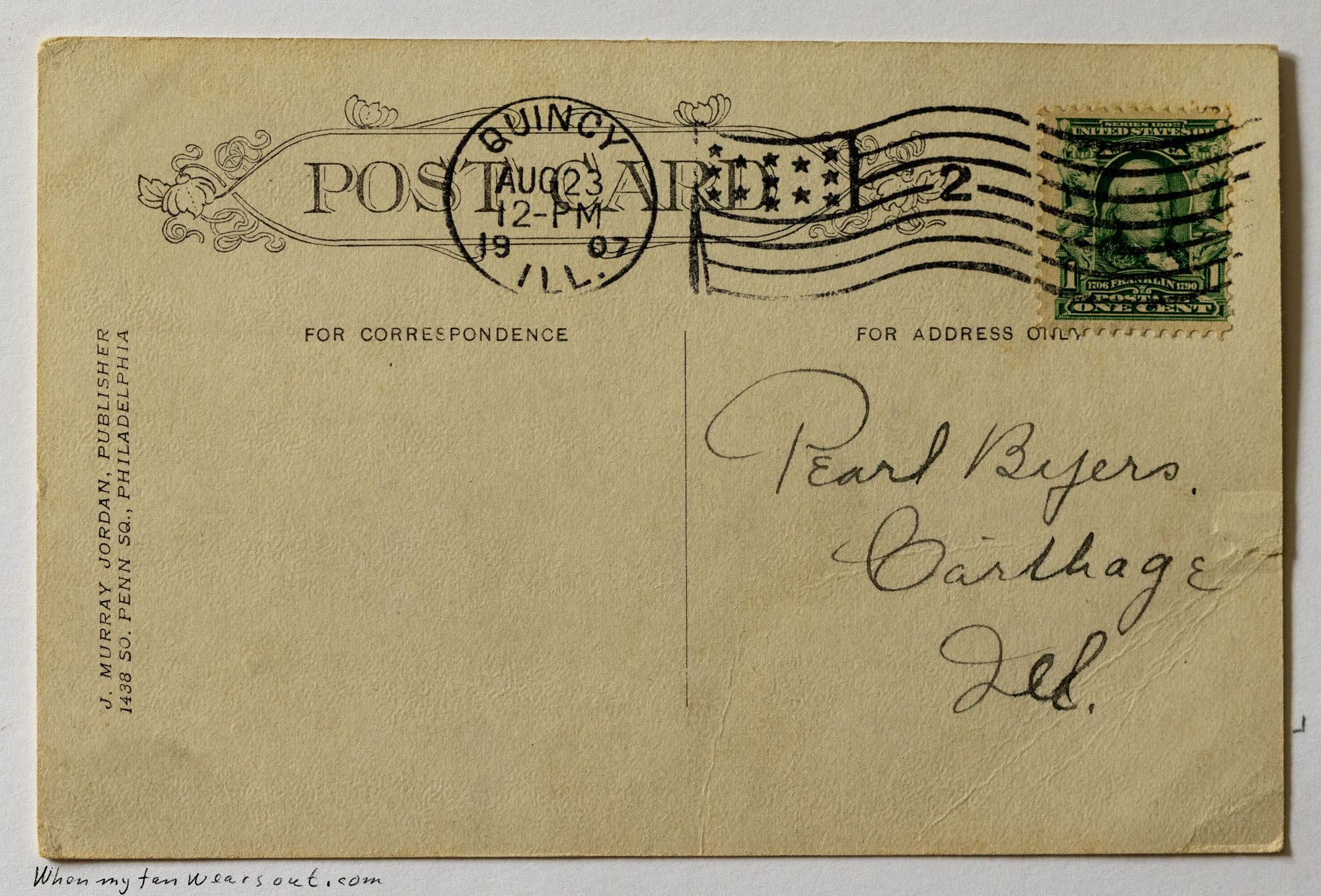
Back of postcard #0063

Postcard Information

  • Postmark: Quincy, ILL., AUG 23 1907
  • Sent To: Carthage IL
  • Era: Golden Age (1907–1915)
  • Publisher: J. Murray Jordan, Philadelphia, Pennsylvania
  • Stamp: 1¢
  • Distance Traveled: ~35 miles

About This Card

The Government Building on Maine Street in Quincy — serving as both post office and federal courthouse — was completed in 1888 and represented one of the most substantial federal investments in the region. Quincy’s position on the Mississippi River had made it an important commercial center since the 1840s, but by 1907 the railroads had long since reorganized traffic patterns and the city’s relative importance had begun to decline.

Continue Reading

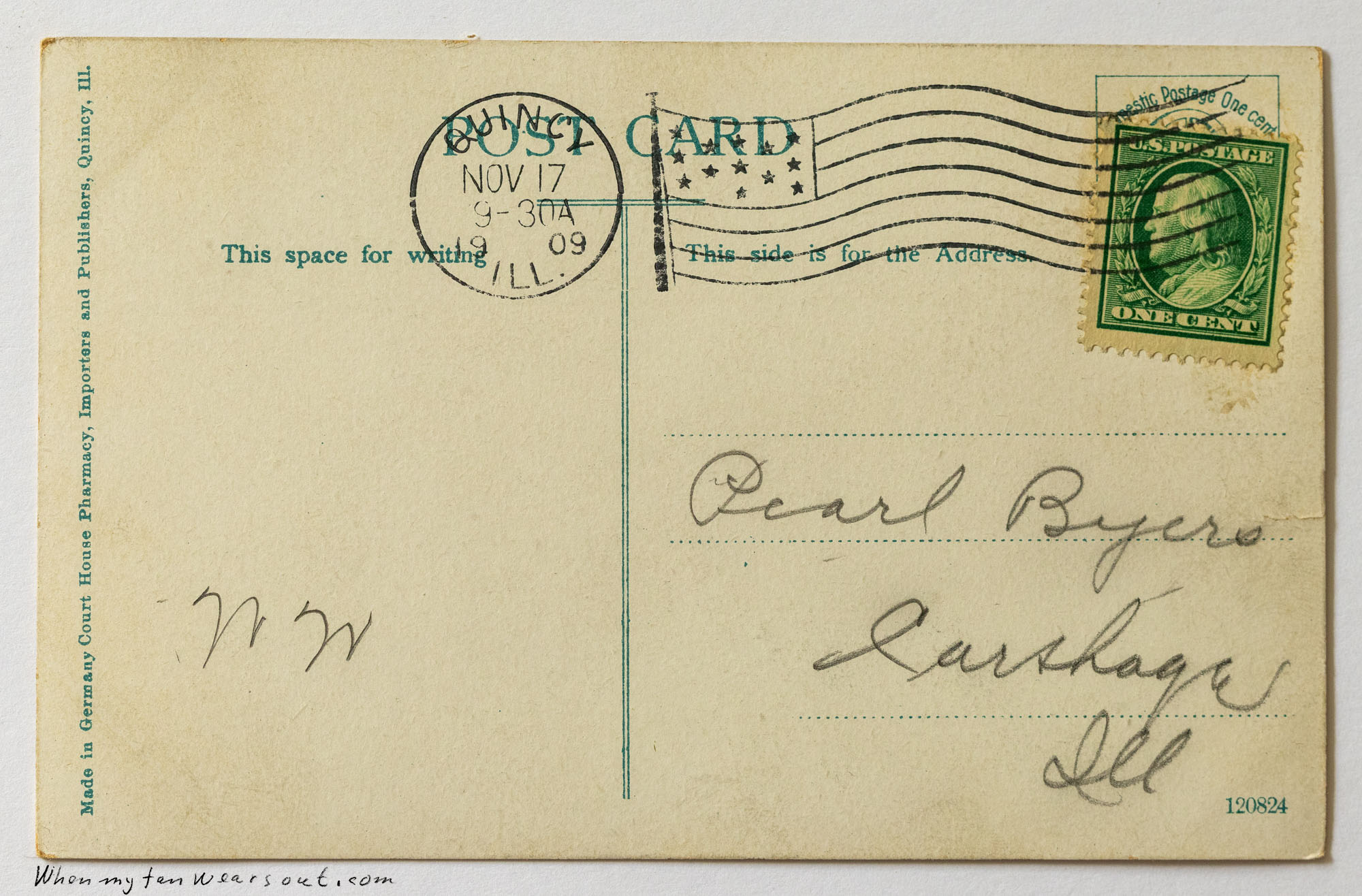
Postcard #0061: Quincy High School, Quincy, IL — M W to Pearl, November 1909

Front of postcard #0061: Color postcard illustration depicting the exterior of Quincy High School, a large multi-story red brick building with a

Transcription

Back — M W

Back of postcard #0061

Postcard Information

  • Postmark: Quincy, Ill., NOV 17 09
  • Sent To: Carthage IL
  • Era: Golden Age (1907–1915)
  • Publisher: Court House Pharmacy, Quincy, Illinois
  • Print Origin: Printed in Germany
  • Stamp: 1¢
  • Distance Traveled: ~35 miles
Continue Reading

Postcard #0060: Highland Park, Quincy, IL — Ada to Pearl, September 1909

Front of postcard #0060: Color postcard showing a scenic view of Highland Park in Quincy, Illinois. Lush green trees and grassy banks are reflect

Transcription

Back — 918 1/2 Bdwy, Quincy Ill Hello Noodles: you will be surprised to get this card but why shouldn’t you be. Just see who it is from. I kid you ought to be down here. I have been running all after noon. Well Dearie call me up some time, Ada,

Back of postcard #0060

Postcard Information

  • Postmark: Quincy, Ill., SEP 24 1909
  • Sent To: Carthage IL
  • Era: Golden Age (1907–1915)
  • Publisher: S. H. KNOX & CO.
  • Print Origin: Printed in America
  • Stamp: 1¢
  • Distance Traveled: ~35 miles
Continue Reading

Postcard #0059: Emma Carrol, Quincy, IL — Emma C to Pearl, May 1909

Front of postcard #0059: Colored photo-postcard showing the grand exterior of the Adams County Court House in Quincy, Illinois, featuring a large

Transcription

Front — ] Emma Carrol ] having lulu [?] time With [?] Love Emma C.

Back of postcard #0059

Postcard Information

  • Postmark: QUINCY, ILL., MAY 19 09
  • Sent To: Carthage IL
  • Era: Golden Age (1907–1915)
  • Publisher: C. U. Williams, Photœtte, Bloomington, Illinois
  • Stamp: 1¢
  • Distance Traveled: ~40 miles

About This Card

The Adams County Courthouse in Quincy, Illinois was completed in 1885 in a Romanesque Revival style, replacing an earlier structure. Quincy was one of the more significant cities on the upper Mississippi in the 19th century — large enough to host the sixth Lincoln-Douglas debate in October 1858, drawing an estimated crowd of twelve thousand people to Washington Park, a few blocks from the courthouse. Emma Carroll was writing from a city with a serious civic tradition, even if her note was brief.

Continue Reading

Postcard #1076: A Busy Day at the Store

Sepia-toned real photo postcard showing three women and four men posing in what appears to be a dry goods or department store, with a central display case featuring umbrellas for sale and a sign reading
Front — A group of store employees or proprietors pose with a display case of umbrellas.

Postcard Metadata

Sepia-toned real photo postcard back with
Back — A list of names

Transcription

Fred Peasley
Waldo Mason
Miss Erbroidt
Miss Osborn
Tom Roberts
Carrie Campbell
Maude Biggs
Mabel Roberto


Mason Dry Goods Store, La Harpe

Historical & Family Notes

This charming real photo postcard, likely dating to the early 20th century, captures a slice of small-town commerce, possibly the very store where Harvey Sights worked or visited. The image presents a bustling scene with employees, a counter, and umbrellas for sale, suggesting a dry goods or department store.

Continue Reading

Postcard #1075: Engraving of the Old Gittings Seminary in Laharpe, Illinois, after its 1889 Fire


A detailed black-and-white engraving on the left half of an off-white postcard depicts the
Front — An engraving depicts the Old Gittings Seminary in Laharpe, Illinois, noted as having burned on January 13, 1889.

Postcard Metadata


The back of an off-white postcard features the
Back — Correspondence from Unidentified to Implied Recipient: Pearl Byers

Transcription

Show where the present F. A. Nelson home is.

Historical & Family Notes

This postcard offers a glimpse into local Illinois history, featuring an engraving of the Old Gittings Seminary in Laharpe, a town approximately 20 miles north of Carthage. The front explicitly notes the seminary’s destruction by fire on January 13, 1889, placing the card’s publication sometime after this event. The Undivided Back design suggests it predates 1907, aligning with the early courtship years of Pearl Byers and Harvey Sights.

The back of the card, while lacking a clear sender or recipient address, contains a brief, almost enigmatic message: “Show where the present F. A. Nelson home is.” This laconic note implies a shared local knowledge between the sender and the intended recipient, characteristic of correspondence between friends or family members within a close-knit community. It’s easy to imagine a young Harvey or Pearl sending such a card to the other, perhaps during one of their brief separations, sharing a point of interest known only to them.

The card serves as a tangible piece of the era, illustrating how local landmarks and everyday observations found their way into personal communications. While not a direct love letter, its inclusion in Pearl’s collection suggests it held some personal significance, possibly marking a location they visited or discussed, further knitting the fabric of their early relationship within the familiar landscapes of Hancock County, Illinois.

Continue Reading

Postcard #0058: Casual Greetings from Indian Mound Park, Quincy


A vintage, hand-tinted postcard showing a verdant landscape of Indian Mound Park in Quincy, Illinois, with rolling grassy hills, a prominent mound with steps, and scattered trees under a light sky, overlooking the distant Mississippi River.
Front — A hand-tinted postcard featuring a scenic view of Indian Mound Park in Quincy, Illinois, overlooking the Mississippi River.

Postcard Metadata


The back of a 1908 divided-back postcard with a green one-cent U.S. Franklin stamp, featuring a handwritten message in dark blue ink from
Back — Correspondence from Elva to Miss Pearl Byers

Transcription

Hello kids! Got here p.m. sound. Have a dandy room. Will have to write before long. Elva 438 N. 8th st.

Historical & Family Notes

This postcard offers a glimpse into Pearl Byers’ social circle before her eventual marriage to Harvey Sights. The sender, Elva, is likely a friend or relative, providing a quick update from Quincy, Illinois. The casual tone and simple message, “Hello kids! Got here p.m. sound. Have a dandy room,” reflect the common use of postcards for brief, informal communication in the early 20th century, a time when such exchanges were cherished links between distant friends and family.

The card’s front depicts Indian Mound Park in Quincy, a notable local landmark with its historic earthworks and scenic views of the Mississippi River. Such picturesque views were popular subjects for postcards, allowing senders to share a bit of their travels or local attractions with recipients back home. Even a relatively short trip to a nearby town like Quincy would have been an occasion worth noting and sharing with friends like Pearl in Carthage.

While Harvey Sights isn’t directly mentioned in this particular correspondence, this postcard beautifully illustrates the rich tapestry of relationships Pearl maintained. These frequent, small exchanges kept her connected to a broad community of friends and family, forming the supportive network that would surround her as she eventually married Harvey and started her own family, enriching the Sights’ family legacy.

Continue Reading

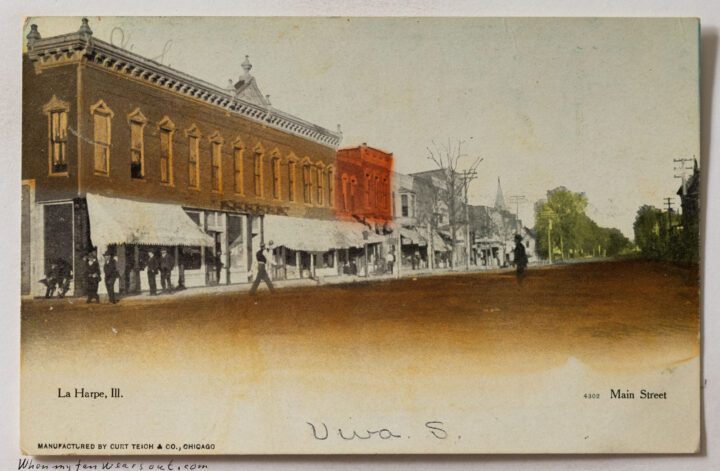
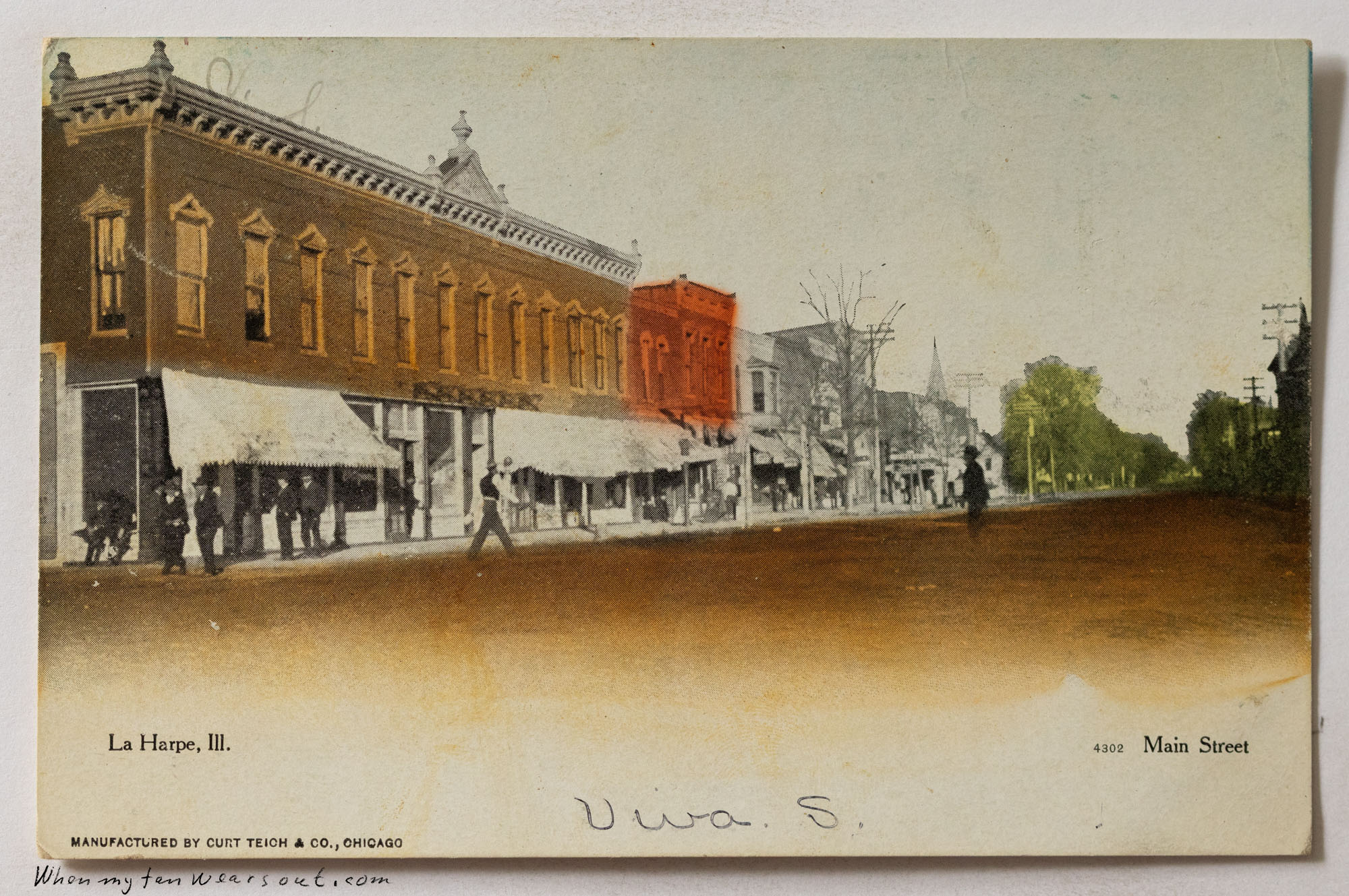
Postcard #1073: A Brief ‘Viwa. S.’ from La Harpe’s Main Street


A vintage postcard depicting a lively Main Street in La Harpe, Illinois, circa early 1900s. The street is lined with multi-story brick buildings, some featuring striped awnings over ground-level shops. People are visible walking on the sidewalks and in the street. A prominent three-story brick building, partially hand-colored in red, stands further down the street. The sky is light, and trees are visible in the distance. The bottom left corner reads
Front — A bustling view of Main Street in La Harpe, Illinois, featuring storefronts with awnings and a partially colorized brick building.

Postcard Metadata


The reverse side of the postcard features the standard
Back — Correspondence from Viwa S. to Miss Pearle Byers

Transcription

Viwa. S.

Historical & Family Notes

This early postcard, sent to the young Miss Pearle Byers, offers a quick glimpse into her social world during her formative years. The card features a common street scene of the era from nearby La Harpe, Illinois, a familiar type of imagery used for brief communications. The message, simply “Viwa. S.” on the front of the card, is characteristic of the concise messages exchanged on undivided back postcards where space for writing was limited.

Originating from Burnside, a mere 11 miles from Carthage, this card likely came from a local acquaintance or friend, Viwa S., whose brief greeting is preserved in this collection. These everyday interactions paint a picture of Pearl’s life before her marriage to Harvey Sights, highlighting the connections she maintained within her immediate community.

The postcard itself is an excellent example of the transitional period in postcard history. Though postmarked in June 1907, after divided backs were permitted, its layout with “NOTHING BUT THE ADDRESS ON THIS SIDE” firmly places it stylistically within the Undivided Back era, suggesting an older card still in circulation.

Continue Reading

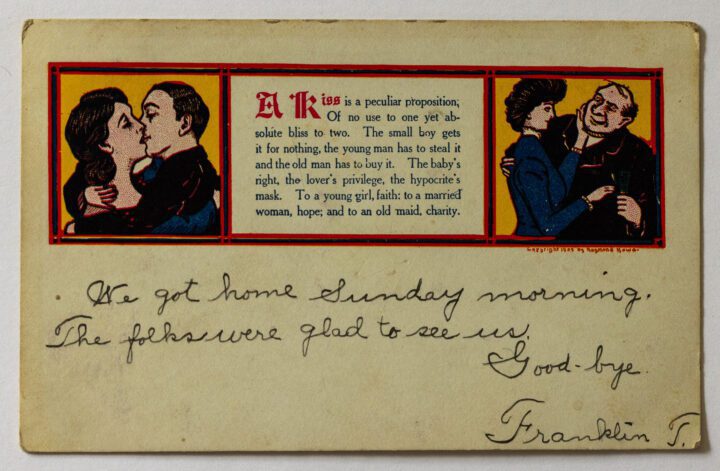
Postcard #0036: A Peculiar Kiss and a Sunday Morning Homecoming


Vintage postcard illustration depicting two couples kissing, one young and one older, with a poem titled
Front — An illustration featuring two panels of couples kissing and a humorous poem about the nature of a kiss.

Postcard Metadata


The back of a vintage postcard with a handwritten message in cursive script from Franklin T. to Miss Pearl Byers. It is postmarked Carthage, Illinois, October 3, 1905, and bears a green one-cent Benjamin Franklin postage stamp in the upper right corner.
Back — Correspondence from Franklin T. to Miss Pearl Byers

Transcription

We got home Sunday morning. The folks were glad to see us. Good-bye Franklin T.

Historical & Family Notes

This postcard offers a charming glimpse into the everyday social life of Pearl Byers in the early 20th century. While not from Harvey Sights, it illustrates the common practice of sending brief updates to friends and family through the mail, even for local news like a weekend trip. The sender, Franklin T., shares a simple message confirming their safe return home and the family’s happiness at their arrival.

The front of the card, with its humorous take on “A KISS,” adds a playful, slightly risqué touch, common for postcards of the era. It presents a lighthearted reflection on romance, from young love to the enduring affection of an older couple. This choice of card suggests a friendly and perhaps jovial relationship between Pearl and Franklin T.

Given that the postcard was sent and received within Carthage, Illinois, it highlights the role of the postal service in maintaining local connections. Even for messages that could easily be conveyed in person, postcards provided a quick and convenient way to share news, keeping individuals like Pearl Byers connected to their wider community before the advent of modern communication.

Continue Reading

Postcard #0033: Burlington’s Potter Memorial Arch and Pearl’s December Birthday


Vintage hand-tinted postcard illustrating the grand stone Potter Memorial Arch, the entrance to Aspen Grove Cemetery in Burlington, Iowa, under a bright sky with lush green trees.
Front — A hand-tinted postcard showing the Potter Memorial Arch at Aspen Grove Cemetery in Burlington, Iowa.

Postcard Metadata


The reverse side of the postcard features a handwritten message in cursive, addressed to Miss Pearl Byers in Carthage, Illinois, with a circular postmark from Biggsville, Illinois, dated December 31, 1908, and a green one-cent Franklin stamp.
Back — Correspondence from Mayme to Miss Pearl Byers

Transcription

Hello Pearl. How are you? Dim Mr Biggs-ville at present and having a fine time. Your Dec Birthday time do you get a letter? Mayme

Historical & Family Notes

This postcard offers a charming glimpse into Pearl Byers’ life before her marriage to Harvey Sights. Sent by a friend named Mayme, the message playfully references Pearl’s “Dec Birthday time,” confirming that her special day fell in December, aligning with family records that place it on December 4th. The casual tone and inquiry “do you get a letter?” suggest an ongoing correspondence between Pearl and her social circle.

The sender, Mayme, appears to be writing from “Biggs-ville,” which is likely Biggsville, Illinois, a small town not far from Carthage. This connection between nearby towns highlights the tight-knit social fabric of rural Illinois at the turn of the century, where friends and family might live just a short distance apart. The front image of Burlington, Iowa’s Potter Memorial Arch, a common subject for early postcards, suggests Mayme might have been visiting or simply chose an interesting card for her friend.

The postcard serves as a small but significant artifact, documenting Pearl’s connections and confirming details of her early life, an important foundation for understanding her personal story before she and Harvey Sights embarked on their shared journey, eventually welcoming their daughter Marnelle.

Continue Reading