Postcard #1097: A. KIRBY REAL ESTATE, Dallas, IL — S.H to Pearl, July 1909

Front of postcard #1097: Sepia-tone photograph of the First National Bank in Dallas City, Illinois. The three-story brick building features arche

Transcription

Back — Rec’d your card I am very sorry that you can not go to B. I had a fine trip in view for a crowd of four, H.B. and his girl and you and I, see. [sideways in blue ink:] Place marked X is Telephone office. Views of Dallas continued. Ever, S.H.

Back of postcard #1097

Postcard Information

  • Postmark: DALLAS, ILL., JUL 3 1909
  • Sent To: Carthage IL
  • Era: Golden Age (1907–1915)
  • Stamp: 1¢
  • Distance Traveled: ~15 miles
  • Notes: Message written in two colors of ink; handwritten "X" on front image marks the telephone office mentioned in the message.
Continue Reading

Postcard #1095: Dallas City, IL — V.H to Pearl, July 1909

Front of postcard #1095: Real photo postcard of a large stone high school building featuring gothic-style windows and a central tower with a cupo

Transcription

Back — Rec’d your card thanks for same. Where are you going to spend the 4th come up to Dallas & we will go to Burlington. V.H. ] This is where I spend many long and tiresome days.
Back of postcard #1095

Postcard Information

  • Postmark: DALLAS CITY, ILL., JUL 2 1909
  • Sent To: Carthage IL
  • Era: Golden Age (1907–1915)
  • Publisher: C. U. WILLIAMS, BLOOMINGTON, ILL.
  • Stamp: 1¢
  • Distance Traveled: ~15 miles

About This Card

Dallas City, Illinois sits on the Mississippi River in Hancock County, about twenty miles south of Carthage on the river road. The city was platted in 1836 and grew as a river landing serving the agricultural hinterland; by the early twentieth century it was a small brick-street town with a school, a bank, and the river commerce that sustained communities of its size along the upper Mississippi. V.H. sent this real photo postcard of the high school building. The stone Gothic-style windows on a prairie school building suggest civic ambition in a community that took its children’s education seriously.

Continue Reading

Postcard #1094: Hancock County Court House, Beardstown, IL — Mother to Pearl, September 1939

Front of postcard #1094: Hand-colored photograph of the Hancock County Court House in Carthage, Illinois. The building is a stately three-story s

Transcription

Back — Wed a. m. Ready to go to fair and a hard day of cleaning. Letter & money came yesterday Will write a letter if I can find time later Wont see Herb [?] unless accidentally. Wish I could send this thing [?] by him. Dont know when I’ll come home now. Cant figure out the phone call Ma.

Back of postcard #1094

Postcard Information

  • Postmark: BEARDSTOWN, ILL., SEP 6 1939
  • Sent To: Chicago IL
  • Era: White Border (1915–1930)
  • Publisher: PUBLISHED BY NICHOLS’ BOOK STORE, CARTHAGE, ILL.
  • Stamp: 1¢
  • Distance Traveled: ~220 miles

About This Card

The Hancock County Courthouse in Carthage was completed in 1907, replacing an earlier structure. Its classical revival architecture — the columns, the prominent dome — expressed the aspirations of a county seat that had been founded in 1833 and incorporated the memory of Joseph Smith’s murder at the nearby jail in 1844 into its civic identity. “Ma.” sent this hand-colored photograph from Beardstown, Illinois — she was traveling and sent a card of Pearl’s own county courthouse, the building that defined Carthage’s civic center.

Continue Reading

Postcard #1091: Denhart Hall

Front of postcard #1091: Hand-colored white border postcard of Denhart Hall, a three-story brick building with multiple dormer windows. The build
Back of postcard #1091

Postcard Information

  • Postmark: ILLEGIBLE
  • Sent To: Unknown
  • Era: White Border (1915–1930)
  • Publisher: NICHOLS’ BOOK STORE, CARTHAGE, ILL.
  • Stamp: NOT VISIBLE — Stamp missing but printed box visible.
  • Distance Traveled: Undetermined
  • Notes: Blank card.

About This Card

Denhart Hall — the building shown in this hand-colored white border postcard — appears to be an academic or institutional building of the type common to small Midwest college towns in the early twentieth century. The three-story brick construction with multiple windows suggests a dormitory or classroom building. Carthage College, founded in 1870 and located in Carthage, Illinois until it moved to Kenosha, Wisconsin in 1962, maintained several buildings in this style on its campus. The college’s presence made Carthage more than just a county seat.

Continue Reading

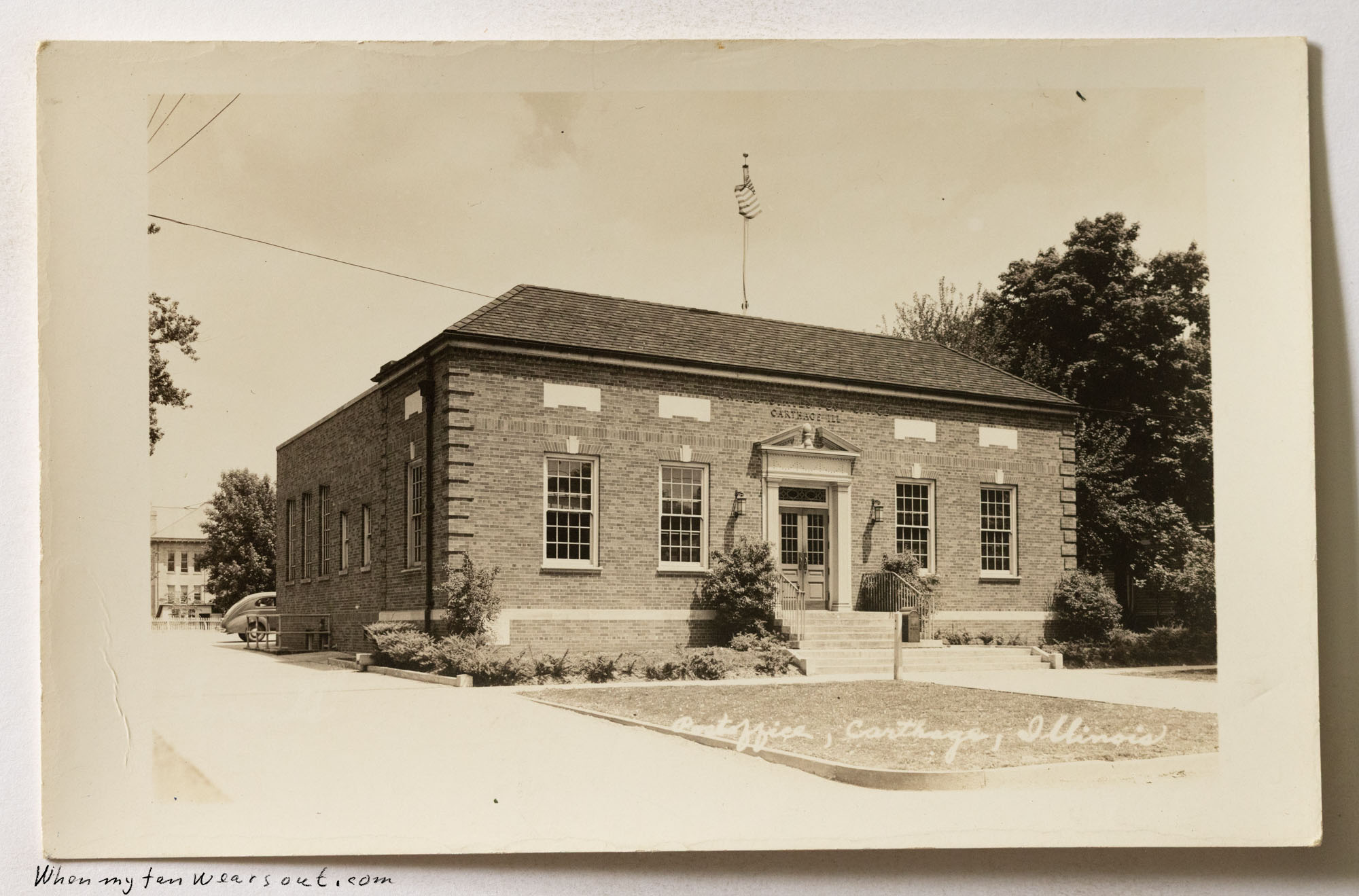
Postcard #1090: brick U

Front of postcard #1090: Real photo postcard of the brick U.S. Post Office in Carthage, Illinois. The building is a single-story structure with a
Back of postcard #1090

Postcard Information

  • Postmark: ILLEGIBLE
  • Sent To: Unknown
  • Era: Chrome (1945–present)
  • Stamp: NOT VISIBLE
  • Distance Traveled: Undetermined
  • Notes: Blank card. The Carthage Post Office building shown was completed in 1933.

About This Card

This second real photo postcard of the Carthage Post Office shows the building from a slightly different angle than card 1089, suggesting both cards were made at around the same time by someone systematically documenting the city’s public buildings. The Carthage post office was the hub of Pearl’s correspondence — every card in this collection passed through it at some point, either arriving or departing. It processed Harvey’s railroad postcards from Fort Madison, Elva’s cards from Hawaii, Marnelle’s cards from Chicago, and Frank McMinimy’s cards from France.

Continue Reading

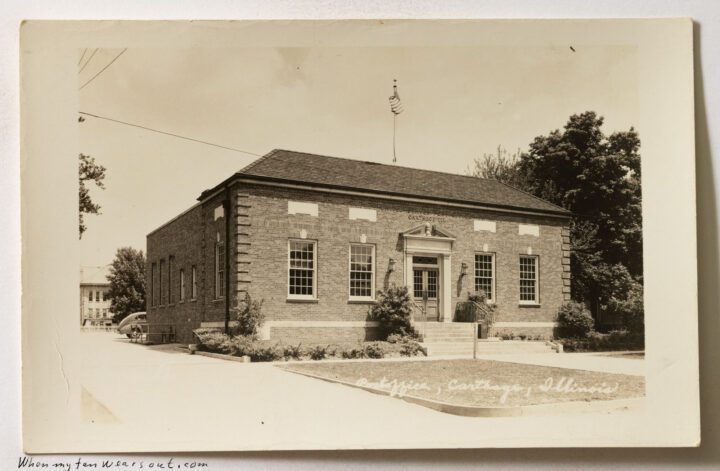
Postcard #1089: UNITED STATES POST OFFICE CARTHAGE ILL.

Front of postcard #1089: A real photo postcard showing the brick building of the Carthage, Illinois Post Office. The building has a flag flying f
Back of postcard #1089

Postcard Information

  • Postmark: ILLEGIBLE
  • Sent To: Unknown
  • Era: Golden Age (1907–1915)
  • Stamp: NOT VISIBLE — Stamp missing but printed box with EKC logo visible.
  • Distance Traveled: Undetermined
  • Notes: Blank card. Real Photo Postcard (RPPC). The car and architecture suggest a date in the late 1930s or 1940s, despite the Divided Back layout.

About This Card

The Carthage, Illinois Post Office occupied a brick building that served the city’s federal postal needs in the early twentieth century. As the county seat of Hancock County, Carthage received its federal buildings — courthouse, post office — through the same process of federal investment that gave small county seats their civic permanence. Pearl’s correspondence arrived and departed through this building for most of her life at 318 N. Fayette Street.

Continue Reading

Postcard #1087: Stone Inn, Carthage, IL — Love Harve to Pearl, May 1944

Front of postcard #1087: Real photo postcard (sepia tone) showing the "Stone Inn" in Carthage, Illinois. It is a two-story dark stone building wi

Transcription

Back — Just about time to hit the trail Have seen Docs. Harris & Ed Cutlers W. Nichols. Ran or Marnel & Neal just left Ray & E. Ethel got run over by a car and was in to see Dr. but he was not in they are coming back to morrow to pick up Mr. B. Horace is taking me to Guys to morrow Eve all are comfortable here well [?] but Lizzie is not any to good just now. tell you more when I get home. Love Harve

Back of postcard #1087

Postcard Information

  • Postmark: CARTHAGE, ILL., MAY 3 1944
  • Sent To: Carthage IL
  • Era: White Border (1915–1930)
  • Stamp: 1¢
  • Distance Traveled: ~15 miles
  • Notes: Real Photo Postcard (RPPC). Postmark date (1944) is much later than the typical Divided Back era. Message mentions daughter Marnelle ("Marnel") and mentions an acquaintance, Ethel, being run over by a car.

About This Card

The Stone Inn in Carthage, Illinois was a two-story stone building on or near the town square — one of the older commercial structures in the city, built from the local limestone that defined early Carthage construction before brick became the dominant material. Harvey sent this real photo postcard, signing it “Love Harve.” Harvey had grown up in La Harpe and moved to Carthage when he and Pearl married in October 1910; the Stone Inn was part of the commercial geography of the town he adopted. The building’s stone construction set it apart from the later brick commercial blocks that surrounded it.

Continue Reading

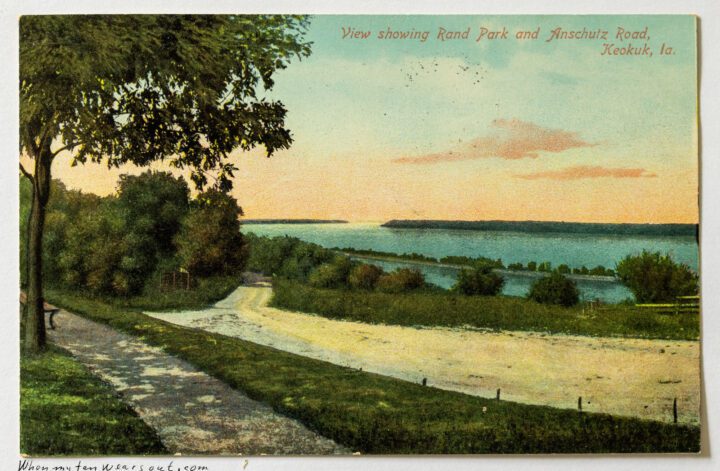
Postcard #0087: Rand Park, Keokuk, IA — Leota to Pearl, October 1909

Front of postcard #0087: Colored landscape illustration showing Rand Park and Anschutz Road in Keokuk, Iowa, overlooking the Mississippi River. A

Transcription

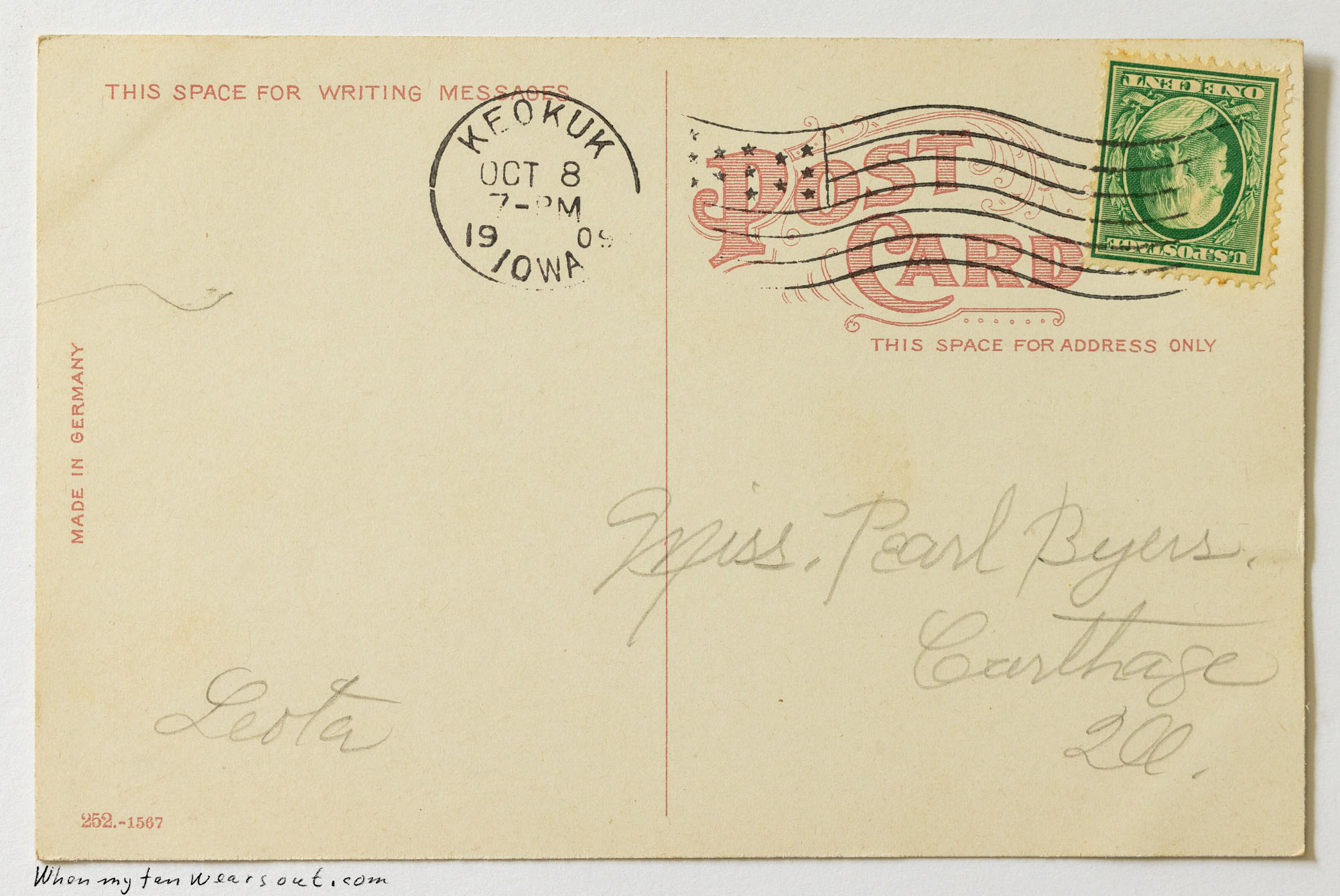
Back — Leota

Back of postcard #0087

Postcard Information

  • Postmark: KEOKUK, IOWA, OCT 8 1909
  • Sent To: Carthage IL
  • Era: Golden Age (1907–1915)
  • Print Origin: Printed in Germany
  • Stamp: 1¢
  • Distance Traveled: ~15 miles

About This Card

Rand Park in Keokuk, Iowa sits on the bluffs above the Mississippi River, looking out over the foot of the Des Moines Rapids — the stretch of river that made Keokuk strategically important for generations. The city was once among the most powerful on the upper Mississippi; Samuel Clemens piloted steamboats past these bluffs in the 1850s, and Keokuk was briefly considered as a possible capital of Iowa. By 1909, when Leota sent this card, Keokuk was still a substantial city, though the completion of the Keokuk Dam in 1913 would transform both the river’s character and the town’s identity.

Continue Reading

Postcard #0077: Lee County Court House, Fort Madison, IA — Caroline to Pearl, October 1920

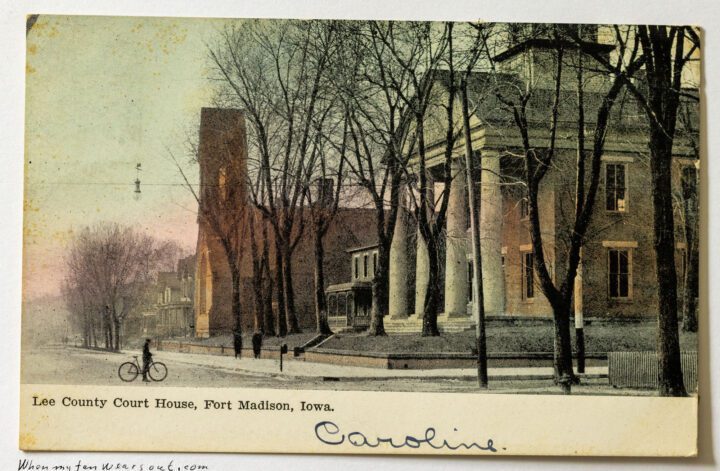
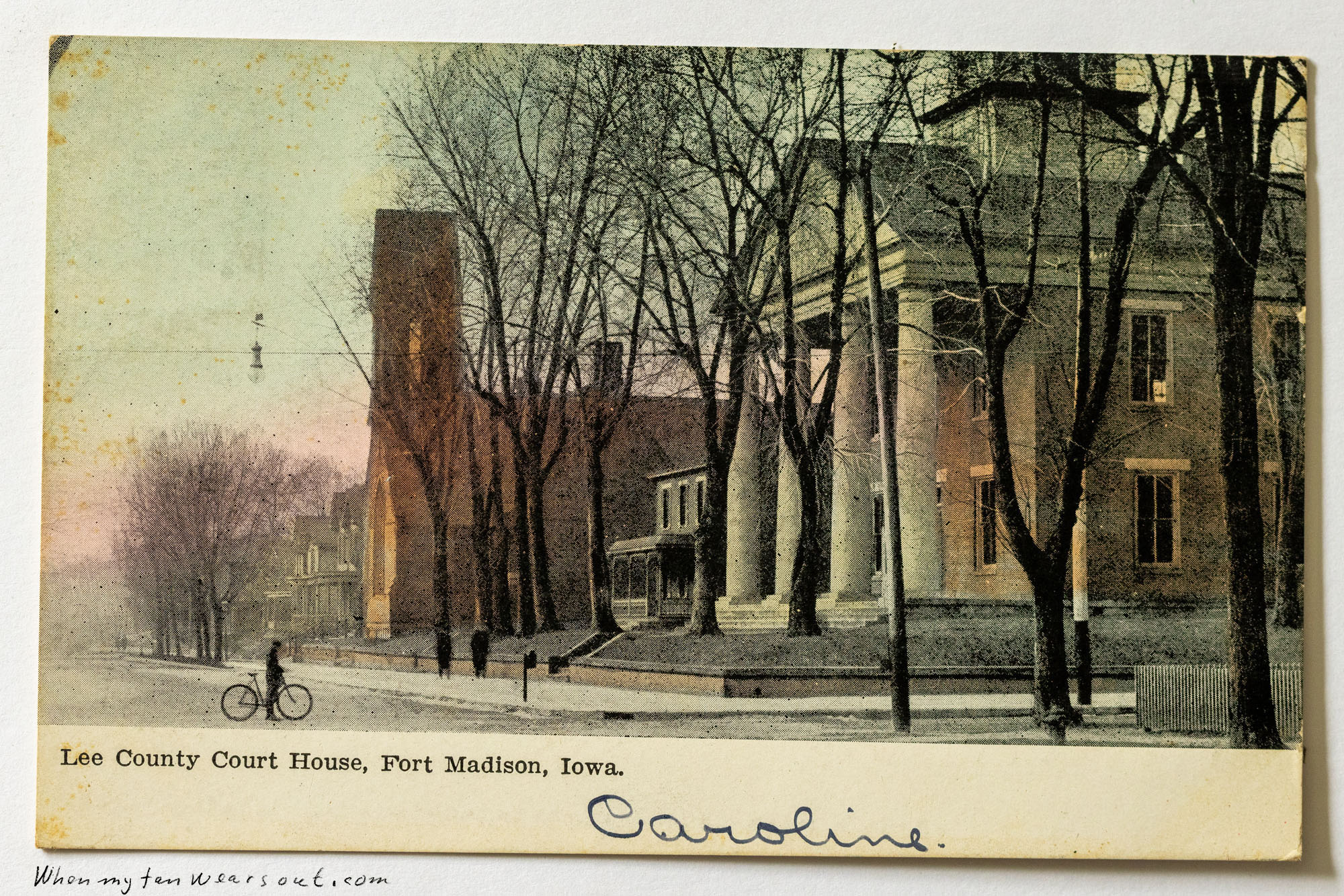
Front of postcard #0077: Colorized postcard depicting the Lee County Court House in Fort Madison, Iowa, featuring its prominent white columns. Ba

Transcription

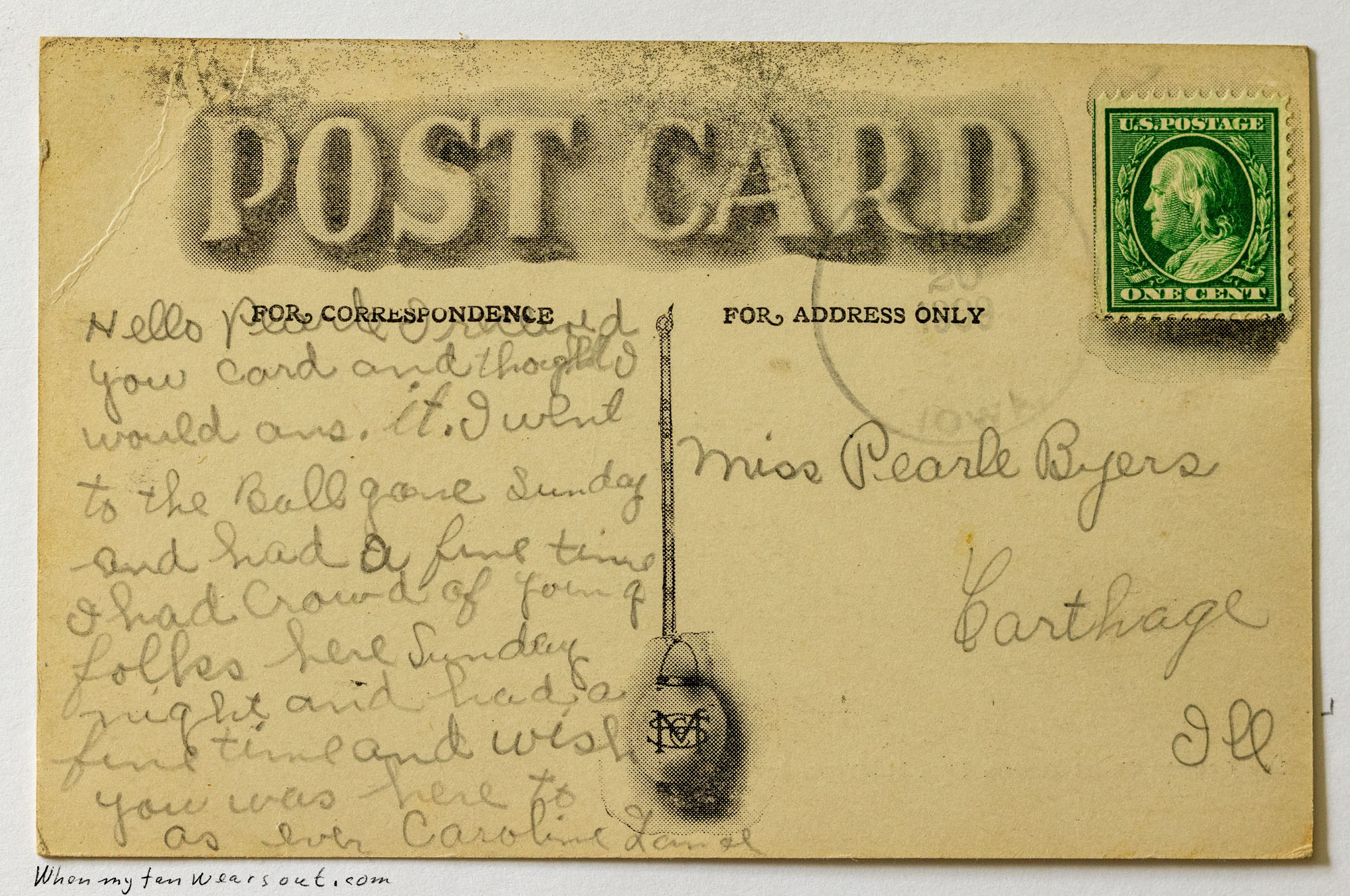
Back — Hello Pearl Received you card and thought I would ans. it. I went to the Ball game Sunday and had a fine time I had crowd of four of folkes here Sunday night and had a fine time and wish you was here to [?] as ever Caroline [illegible] ] Caroline.

Back of postcard #0077

Postcard Information

  • Postmark: Fort Madison, Iowa, OCT 20 [illegible]
  • Sent To: Carthage IL
  • Era: White Border (1915–1930)
  • Stamp: 1¢
  • Distance Traveled: ~25 miles

About This Card

The Lee County Courthouse in Fort Madison stands on a prominent corner downtown, its white columns visible for some distance along the approaches from the river. Fort Madison sits on a sharp bend of the Mississippi, and the view from the courthouse steps takes in a wide sweep of water. Caroline, writing from Fort Madison in autumn, doesn’t mention the courthouse — she’s writing about a ball game and promising to answer Pearl’s card. The building is background, not subject.

Continue Reading

Postcard #1082: two-story white clapboard schoolhouse with a cupola and bell, Bently, IL — From C.H to Pearl, June 1909

Front of postcard #1082: Sepia-toned photograph of a two-story white clapboard schoolhouse with a cupola and bell tower. Several tall, leafless t

Transcription

Back — How is Ferris? Have you got over that fit you had that Sunday eve? ] From C.H.

Back of postcard #1082

Postcard Information

  • Postmark: BENTLY, ILL., JUN 1 1909
  • Sent To: Carthage IL
  • Era: Golden Age (1907–1915)
  • Stamp: 1¢
  • Distance Traveled: ~15 miles
Continue Reading

Postcard #0071: High Bridge, Wever, IA — yours Ray. W to Pearl, 1908

Front of postcard #0071: Tinted color postcard depicting the High Bridge over the Mississippi River in Muscatine, Iowa. The perspective is from t

Transcription

Back — Hello Pearle I am watching for the rest of that set of cards and I hope you will not keep me waiting very long. When are you coming over here in this country to see me. anser soon yours Ray. W.

Back of postcard #0071

Postcard Information

  • Postmark: WEVER, IOWA, ILLEGIBLE 18 1908
  • Sent To: Carthage IL
  • Era: Golden Age (1907–1915)
  • Stamp: 1¢
  • Distance Traveled: ~30 miles
Continue Reading

Postcard #0070: Sepia-toned postcard showing the stone-built Public Library, Quincy, IL — Alley to Pearl, October 1908

Front of postcard #0070: Sepia-toned postcard showing the stone-built Public Library in Quincy, Illinois. The architecture features a Richardsoni

Transcription

Front — ] A.E.T.

Back — ] Dear Pearl: Could not find any card of the telephone office but will send you one when they get some more in. Everything perfectly lovely here. how is [crossed out] is sister? Write sooner. Alley.

Back of postcard #0070

Postcard Information

  • Postmark: QUINCY, ILL., OCT 15 1908
  • Sent To: Carthage IL
  • Era: Golden Age (1907–1915)
  • Stamp: 1¢
  • Distance Traveled: ~35 miles
Continue Reading

Postcard #0069: Grade School, Carthage, IL — E.P.B to Harvey, August 1909

Front of postcard #0069: Multi-view postcard featuring three color illustrations of schools in Carthage, Illinois: "Grade School" at top left (a

Transcription

Front — I wonder how many long, hot, tiresome days I have spent in each of these buildings

Back — Am looking for some occupation to keep me out of mischief. Please excuse pencil as I am too lazy to go to the desk. As ever E.P.B.

Back of postcard #0069

Postcard Information

  • Postmark: Carthage, ILL., AUG 24 1909
  • Sent To: La Harpe IL
  • Era: Golden Age (1907–1915)
  • Publisher: Ed. Hoch. Importer & Publisher, Carthage, Illinois
  • Print Origin: Printed in Germany
  • Stamp: 1¢
  • Distance Traveled: ~15 miles
Continue Reading

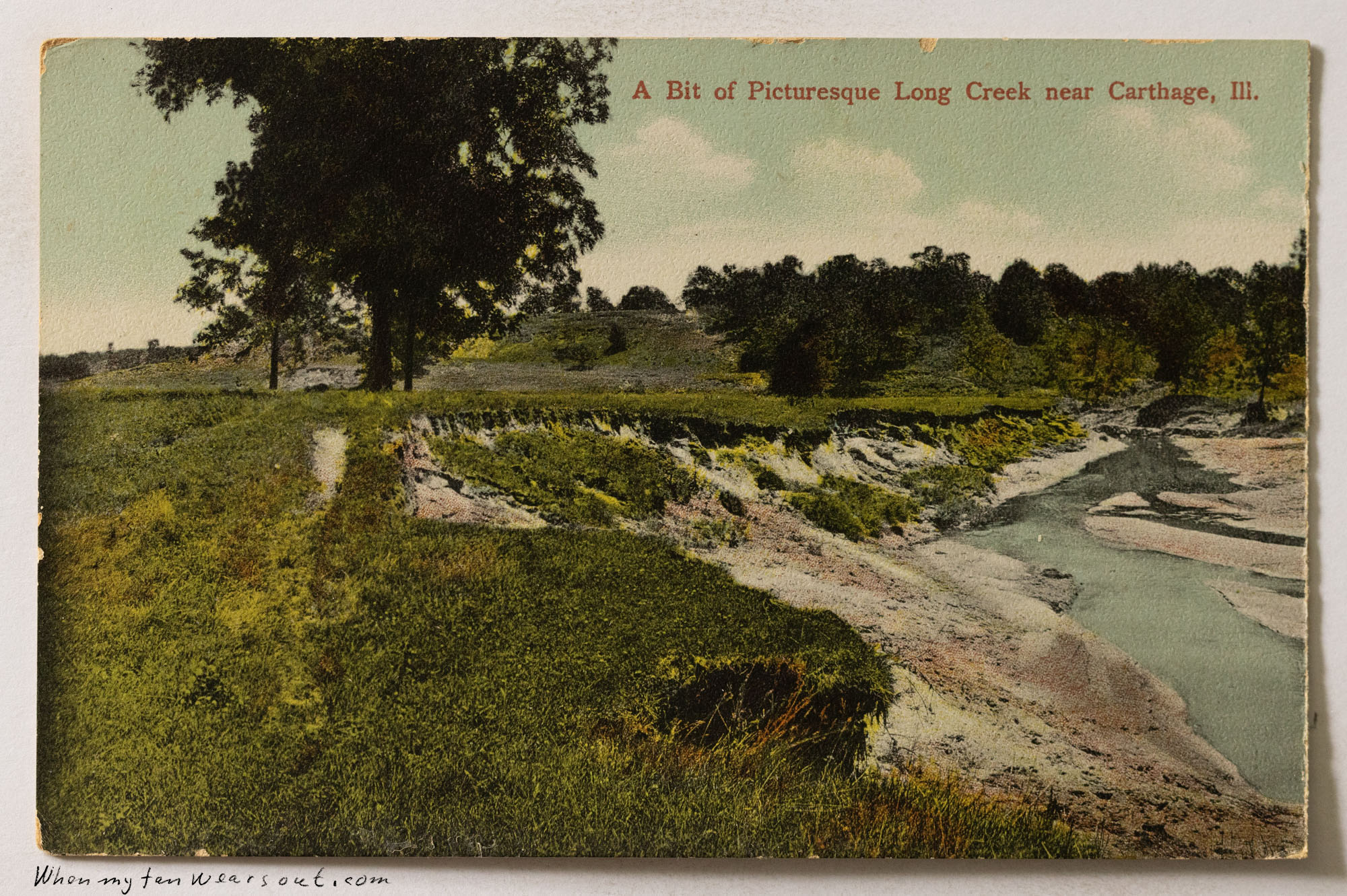
Postcard #1079: landscape view of Long Creek near Carthage, Carthage, IL — October 1909

Front of postcard #1079: Hand-colored landscape view of Long Creek near Carthage, Illinois. The image shows a wide, shallow creek bed with muddy

Transcription

Back — Before 1910

Back of postcard #1079

Postcard Information

  • Postmark: Carthage, ILL., OCT 20 1909
  • Sent To: Carthage IL
  • Era: Undivided Back (Pre-1907)
  • Publisher: Ed. Hoch, Importer and Publisher, Carthage, Ill.
  • Print Origin: Printed in Germany
  • Stamp: 1¢ — Two identical 1¢ stamps.
  • Distance Traveled: Local mail
  • Notes: Two 1¢ stamps used on a single card; card is an undivided back style design despite being mailed in 1909; contains a handwritten pencil note "Before 1910" at the top of the back which appears to be a later addition.

About This Card

Long Creek near Carthage appears in the collection multiple times across different decades — Harvey sending a card of it from La Harpe before their wedding, Pearl’s mother sending a view later, and now this hand-colored landscape postmarked from Carthage in the linen era. Long Creek was the natural feature closest to both of their hometowns: it ran through the farm country between Carthage and La Harpe, and it was the kind of creek people knew by name because they crossed it regularly. This unsigned card was sent by an unsigned sender — the creek speaks for itself.

Continue Reading