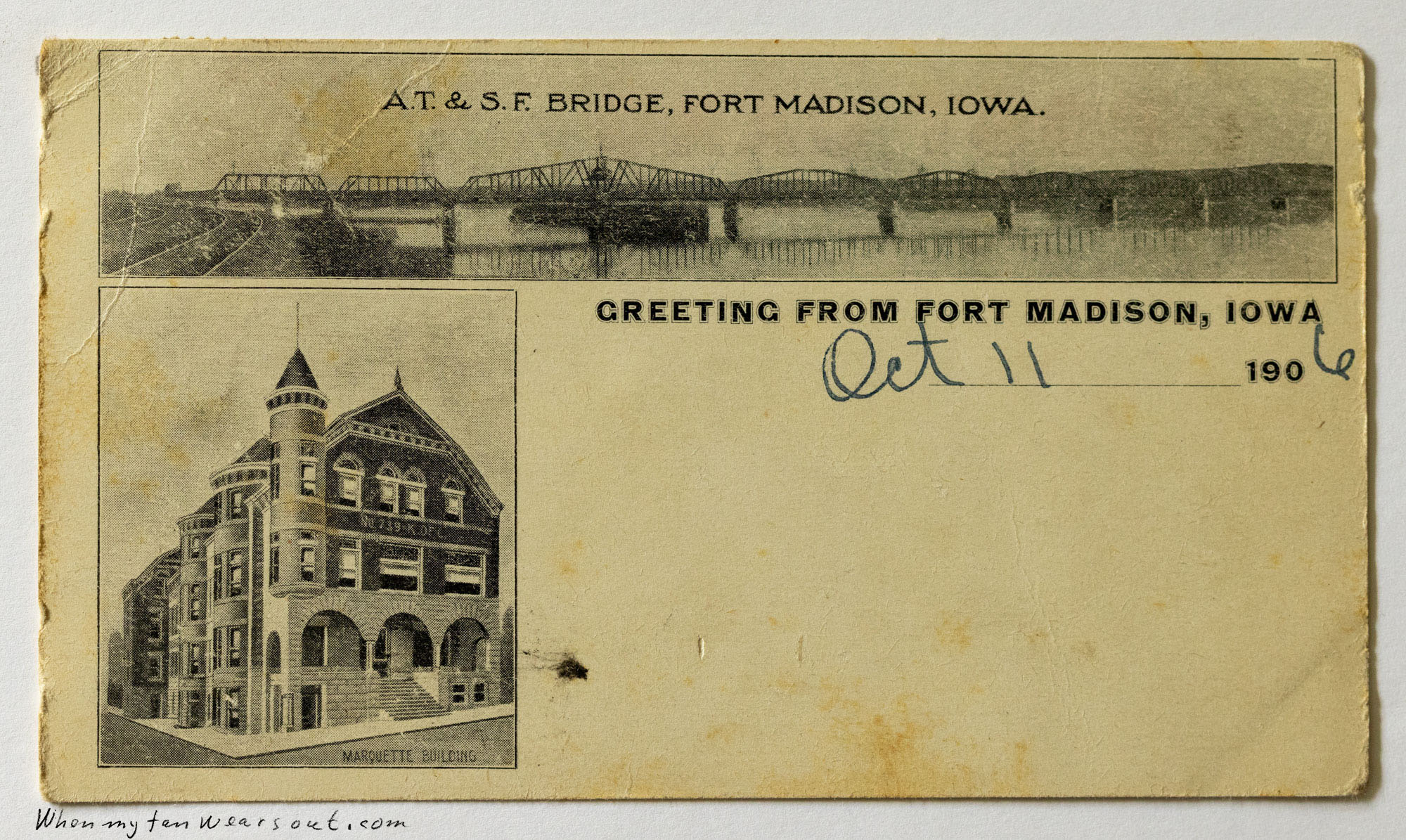
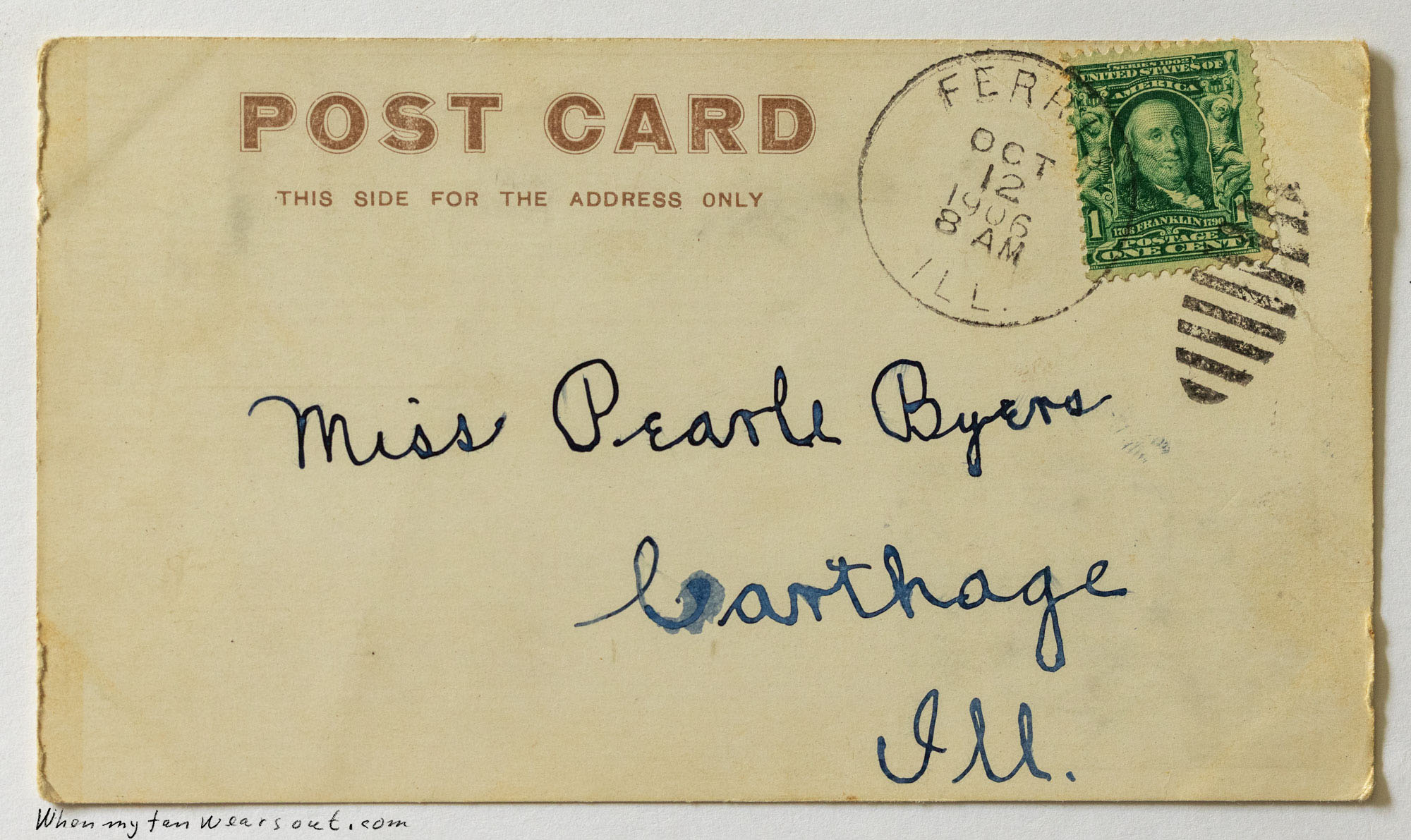
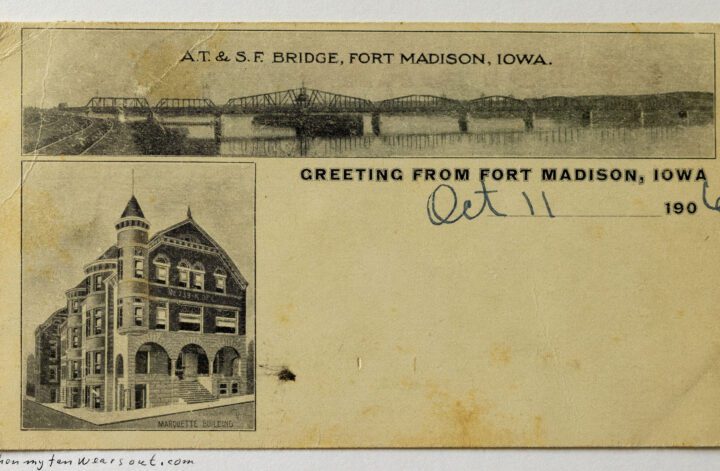
Postcard Information
- Postmark: FERRIS, ILL., OCT 12 1906
- Sent To: Carthage IL
- Era: Undivided Back (Pre-1907)
- Stamp: 1¢
- Distance Traveled: ~15 miles

An archive of over 1,100 early 20th-century postcards from one family. One new postcard every day.


Back — Carthage Ill. 10-13-09 Hello Pearle. What do you know about this? Hope you will get this card safe. am glad you are having a good time only wish the weather was better. never mind the weather. Ask Harvey if he Dares me. Better not. Hallie.

The interior of the Presbyterian Church in Carthage, Illinois shows the characteristic worship space of a mainline Protestant congregation in a small county seat: pale walls, wooden pews, a central pulpit, colored glass in the windows. Hallie sent this real photo postcard from Carthage — the kind of postcard a congregation member might send to a friend who had moved away, showing what the church looked like inside. Carthage’s Presbyterian congregation was established in the early years of the town’s settlement and remained one of the city’s significant institutions.


Front — ] mayme.
Back — ] "Better late than never" but I would have answered sooner if I’d had any cards. I haven’t as pretty a card to send as the one I rec’d from you, for that violet postal was certainly pretty. I liked it fine. Don’t you think all had a fairly good time yesterday afternoon, at least what we done kept us pretty busy. How is the Children’s Day exercises. I’ve got a job today I don’t like very well – helping Mamma pick up cherries. Ans. soon as ever. – Violet.

Pine Street in Fort Madison, looking south from this vantage, shows the kind of small-city commercial vitality that characterized river towns along the upper Mississippi in the early twentieth century. Fort Madison had grown up around an early American fort — the original Fort Madison, the first U.S. military post in what would become Iowa, was destroyed and abandoned in 1813 after repeated Sauk attacks during the War of 1812. The town that took its name later that century had no direct connection to the military installation; it simply kept the name. Five years after Violet sent this card, Walter Sheaffer would open his pen factory nearby, and Pine Street’s commercial character would begin to shift.
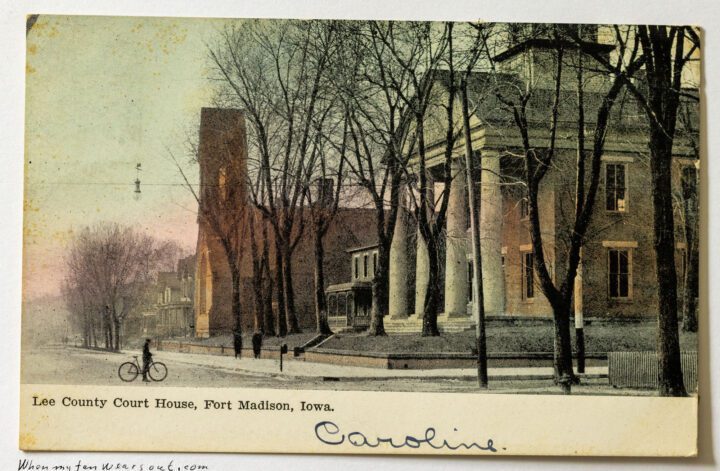
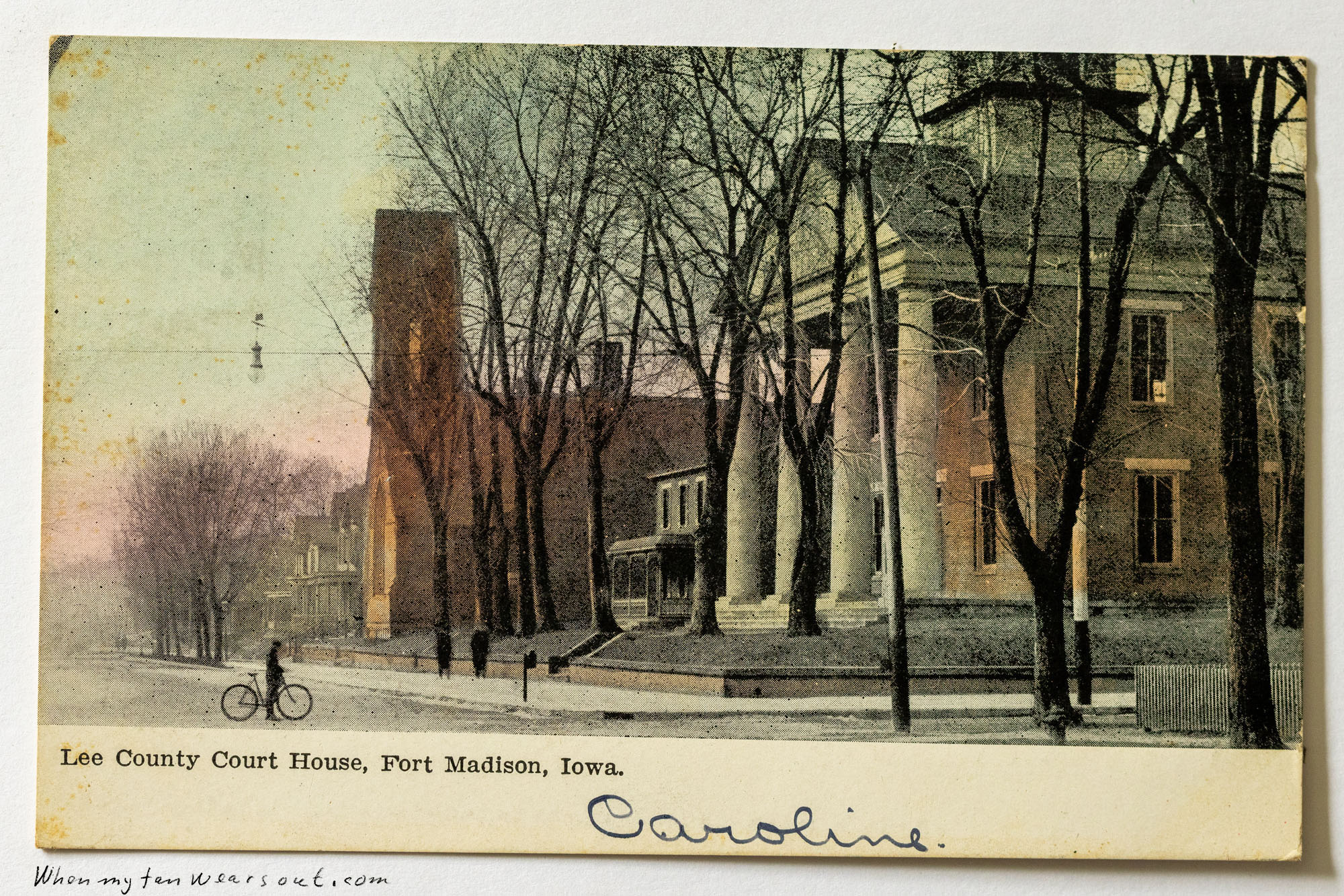
Back — Hello Pearl Received you card and thought I would ans. it. I went to the Ball game Sunday and had a fine time I had crowd of four of folkes here Sunday night and had a fine time and wish you was here to [?] as ever Caroline [illegible] ] Caroline.
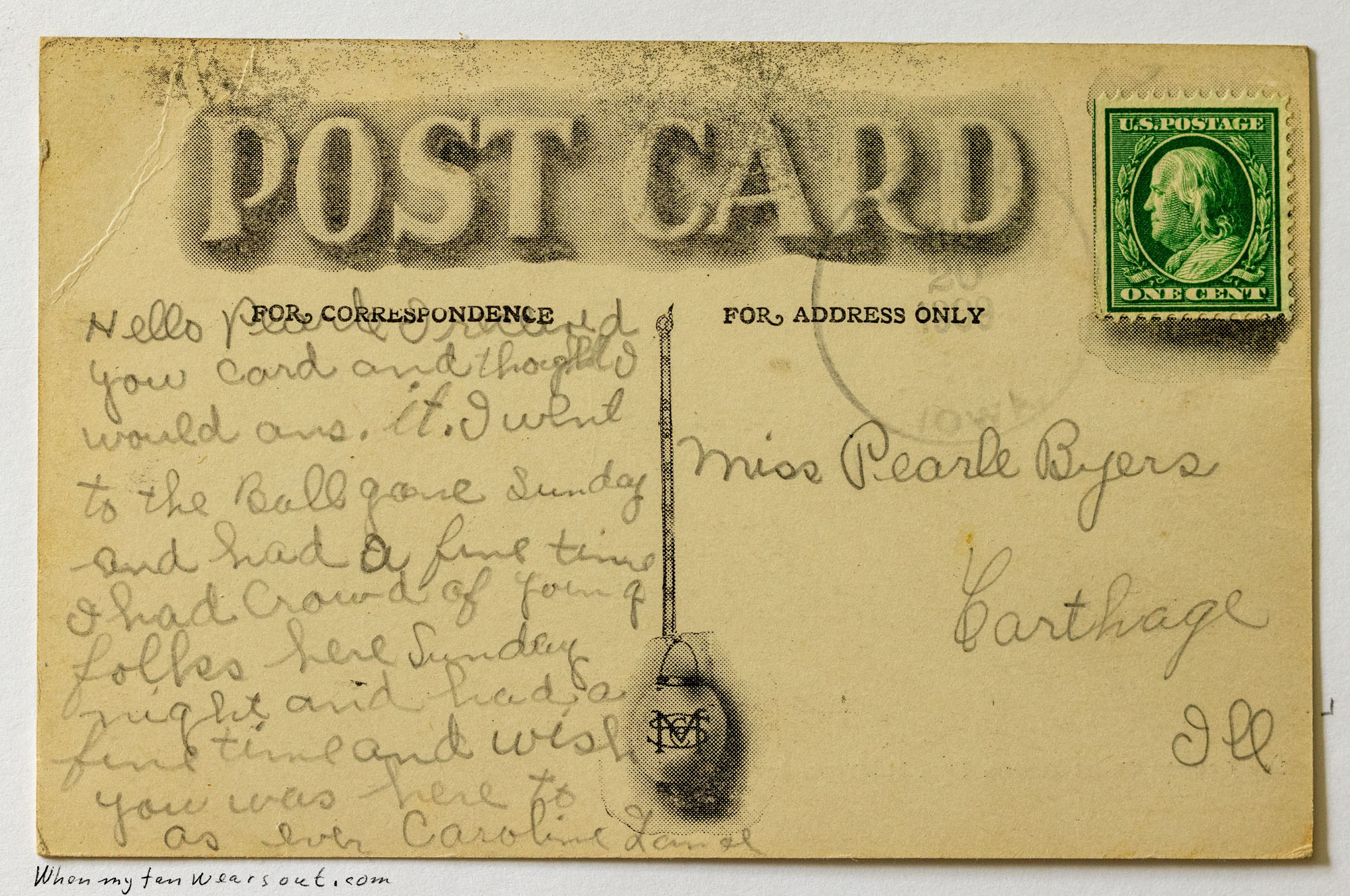
The Lee County Courthouse in Fort Madison stands on a prominent corner downtown, its white columns visible for some distance along the approaches from the river. Fort Madison sits on a sharp bend of the Mississippi, and the view from the courthouse steps takes in a wide sweep of water. Caroline, writing from Fort Madison in autumn, doesn’t mention the courthouse — she’s writing about a ball game and promising to answer Pearl’s card. The building is background, not subject.


Back — Hello Pearle, How many eggs did you eat Easter. I didn’t count mine. I didn’t have as good a time this Easter as I did last. Did you, How are you getting along. I am as mean as ever. As Ever Alda / ] Alda


Front — ] Bertha
Back — ] hello Pearle, how are you dear?. was in Ft. Madison today, wish you could have been there too. Saw the -and- -irons that belonged to Jo. Smith the morman who [continued on left edge and top:] was killed in Carthage jail, -also saw the chest in which he kept his Bible, they are owned by Mrs. Campbell.

The Iowa State Penitentiary in Fort Madison, Iowa was commissioned in 1839 — seven years before Iowa achieved statehood — making it the oldest continuously operating prison west of the Mississippi River. The stone walls and cell houses visible in this photograph defined the city’s eastern skyline for more than a century. Fort Madison would eventually take on a second identity connected to pens of a different kind: in 1913, a Fort Madison jeweler named Walter A. Sheaffer would patent a lever-fill mechanism for fountain pens and found the Sheaffer Pen Company a few blocks away, giving the city its durable nickname, Pen City.


Back — Hello Pearle Recd [?] your card a while Back and was glad to hear from you. there is a box supper and Ice cream social in Wever to night But I am not a going But would like to. as ever your friend Caroline


Back — How is Ferris? Have you got over that fit you had that Sunday eve? ] From C.H.


Front — July 8, 1907. Love no boys, except your brother If girls must love, love one another Jean. Hry[?]

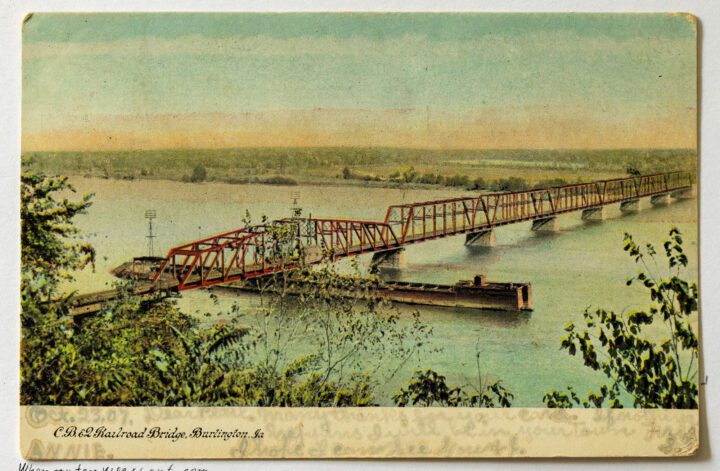

Front — Oct.23.07. Dear Pearl. many thanks for your card. If nothing prevents I will be in your town Friday I hope I can see you. ANNIE
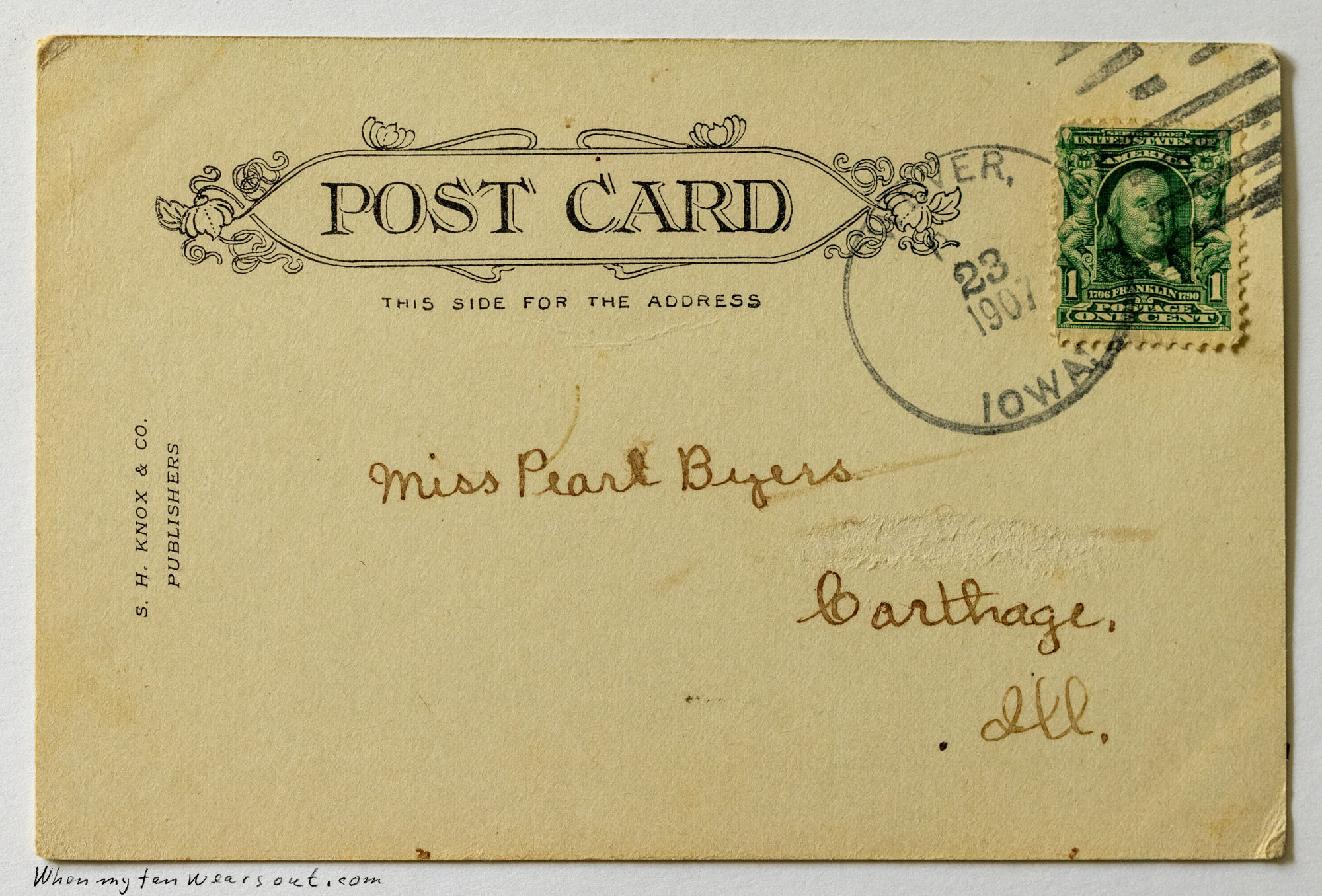


Back — Hello Pearle I am watching for the rest of that set of cards and I hope you will not keep me waiting very long. When are you coming over here in this country to see me. anser soon yours Ray. W.


Front — ] A.E.T.
Back — ] Dear Pearl: Could not find any card of the telephone office but will send you one when they get some more in. Everything perfectly lovely here. how is [crossed out] is sister? Write sooner. Alley.


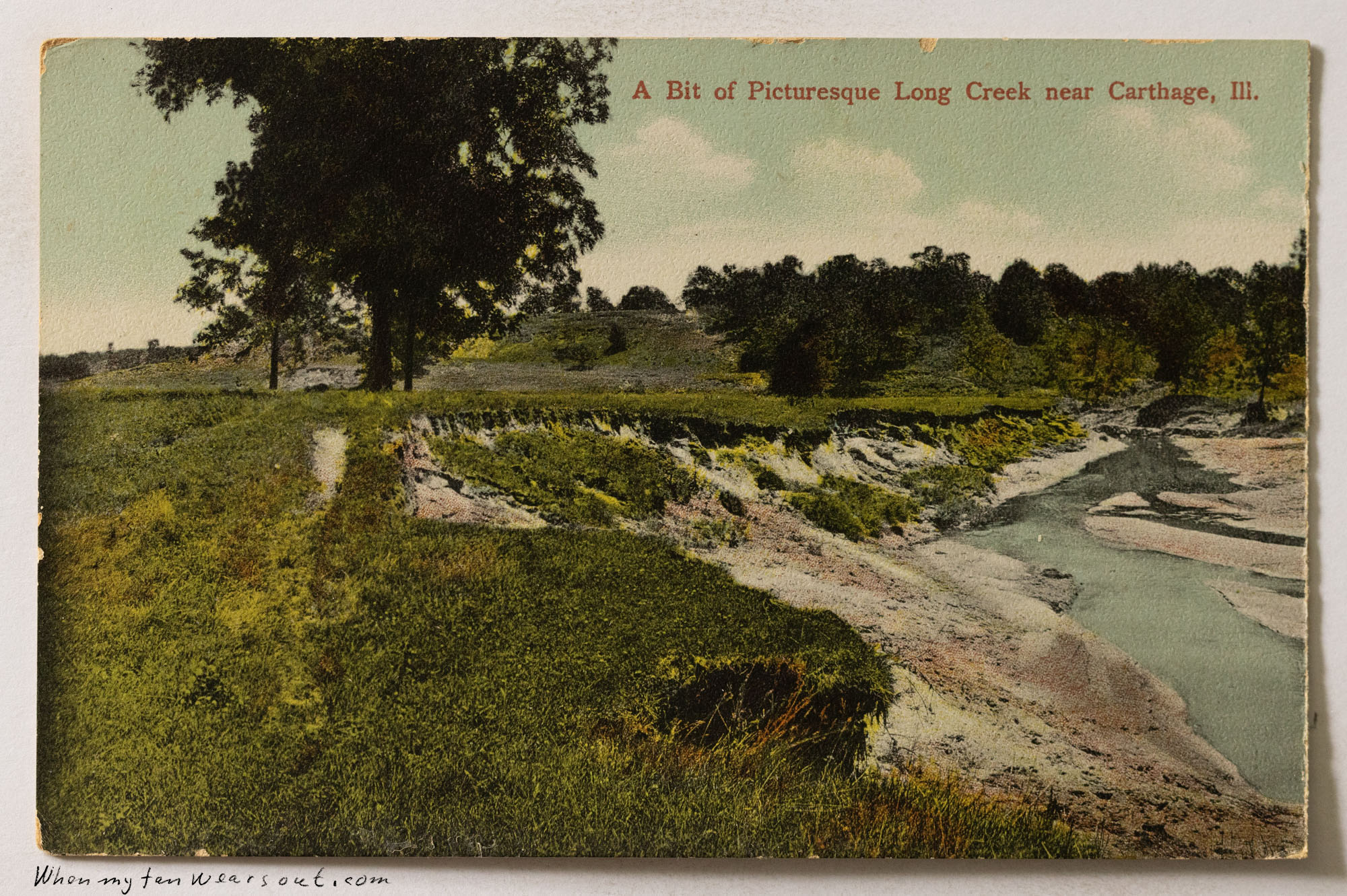
Back — Before 1910

Long Creek near Carthage appears in the collection multiple times across different decades — Harvey sending a card of it from La Harpe before their wedding, Pearl’s mother sending a view later, and now this hand-colored landscape postmarked from Carthage in the linen era. Long Creek was the natural feature closest to both of their hometowns: it ran through the farm country between Carthage and La Harpe, and it was the kind of creek people knew by name because they crossed it regularly. This unsigned card was sent by an unsigned sender — the creek speaks for itself.

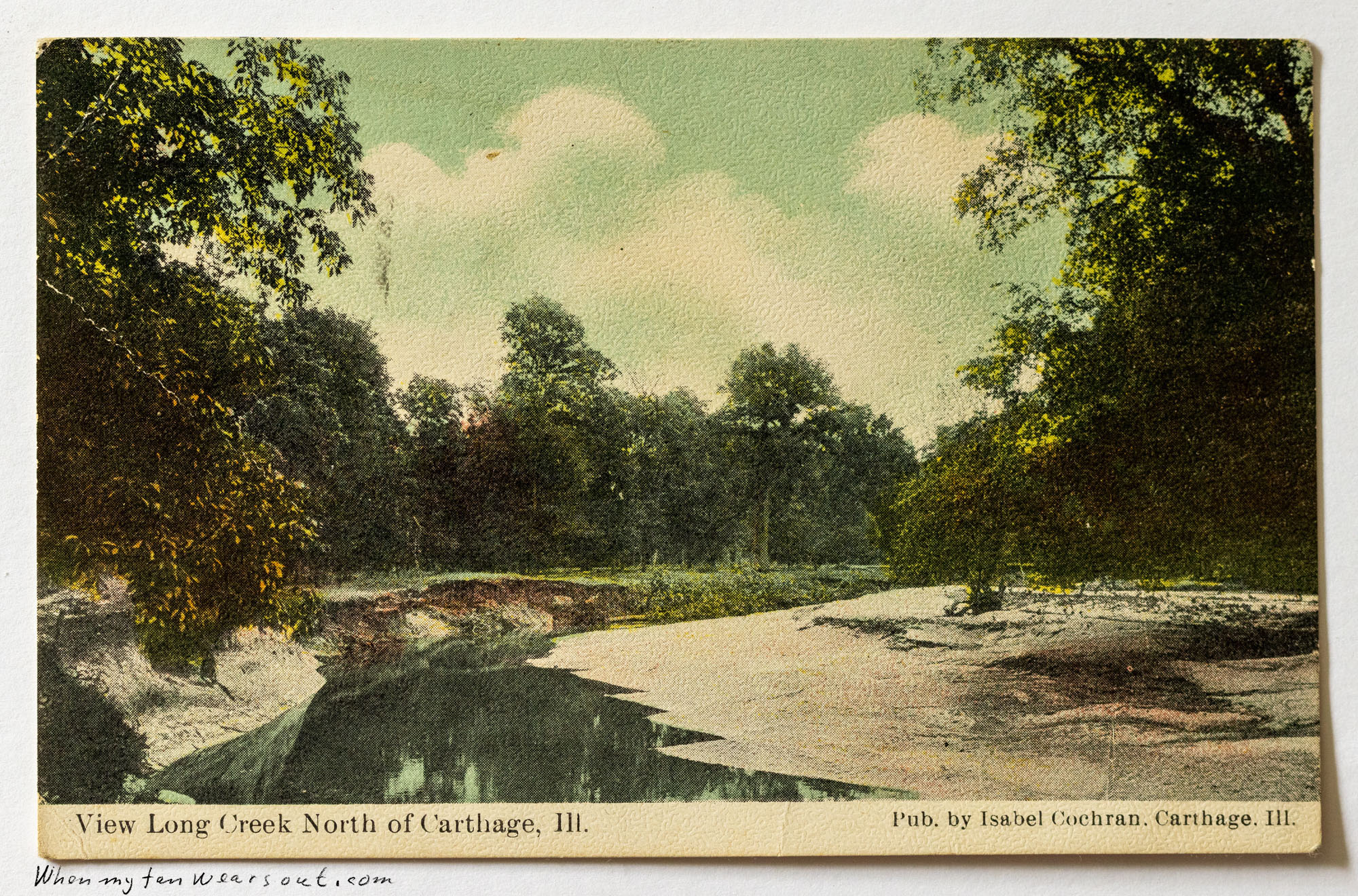
Back — 10/28/09 Just a line to say I will be in C. about 9 or ten this morning. Hope you have had a fine time at the party. H.R.S.

Long Creek runs through the countryside near both Carthage and La Harpe in Hancock County, Illinois — it was familiar ground to Harvey, who grew up in La Harpe, and to Pearl, who lived in Carthage. Harvey signed this card “H.R.S.” — his initials — and sent it from La Harpe in October 1909, just over a year before their wedding on October 6, 1910. The note is brief and practical: he’ll be in Carthage around nine or ten in the morning. The creek in the illustration looks peaceful in autumn light.