
Postcard #1073: A Brief ‘Viwa. S.’ from La Harpe’s Main Street


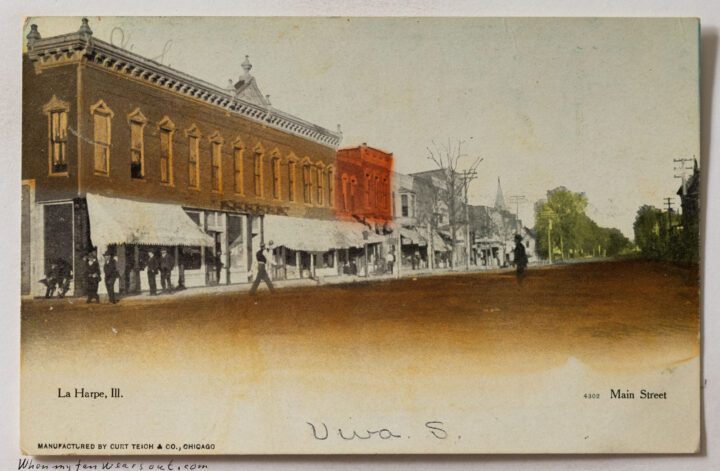
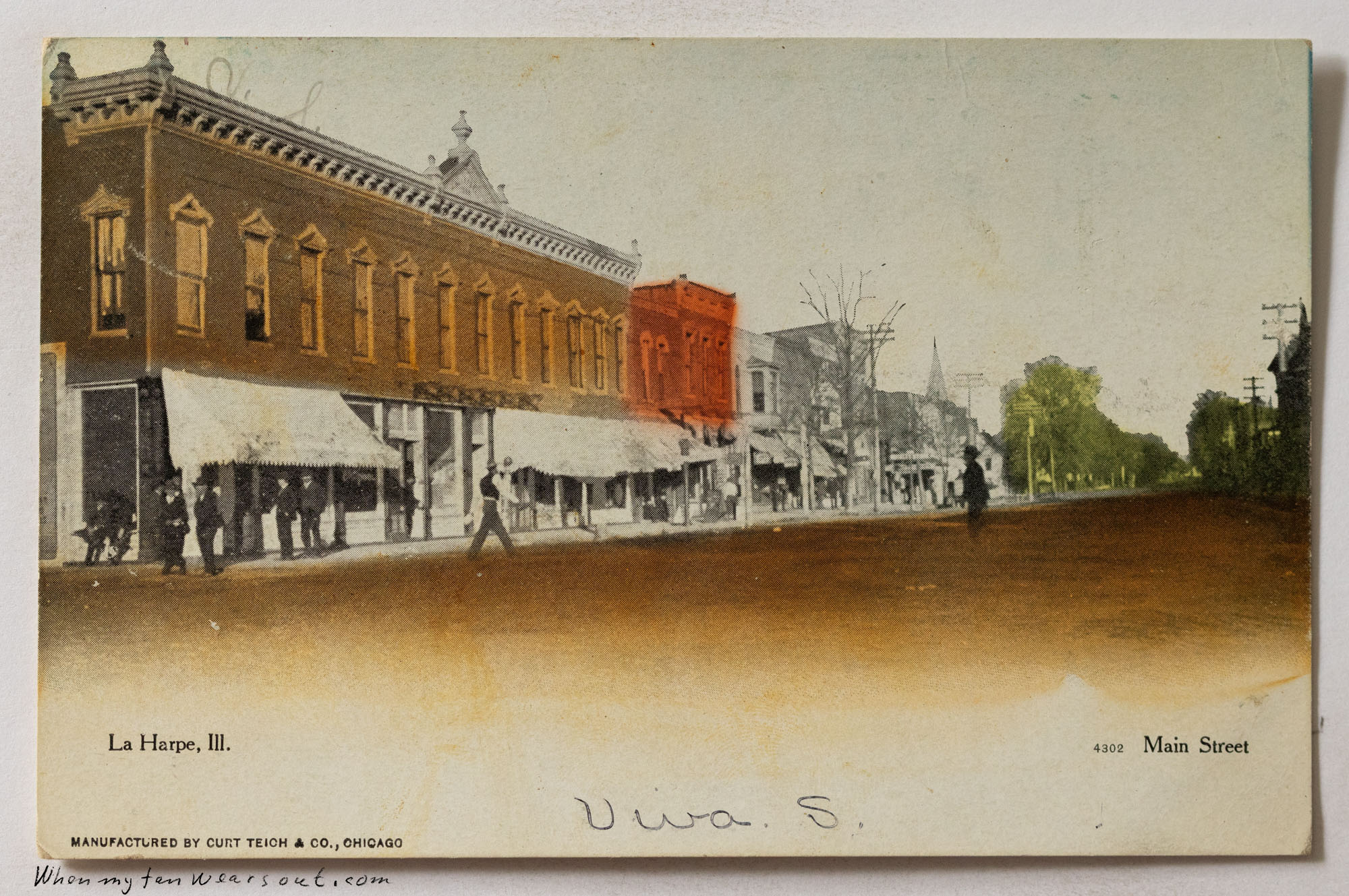
A vintage postcard depicting a lively Main Street in La Harpe, Illinois, circa early 1900s. The street is lined with multi-story brick buildings, some featuring striped awnings over ground-level shops. People are visible walking on the sidewalks and in the street. A prominent three-story brick building, partially hand-colored in red, stands further down the street. The sky is light, and trees are visible in the distance. The bottom left corner reads
Front — A bustling view of Main Street in La Harpe, Illinois, featuring storefronts with awnings and a partially colorized brick building.

Postcard Metadata


The reverse side of the postcard features the standard
Back — Correspondence from Viwa S. to Miss Pearle Byers

Transcription

Viwa. S.

Historical & Family Notes

This early postcard, sent to the young Miss Pearle Byers, offers a quick glimpse into her social world during her formative years. The card features a common street scene of the era from nearby La Harpe, Illinois, a familiar type of imagery used for brief communications. The message, simply “Viwa. S.” on the front of the card, is characteristic of the concise messages exchanged on undivided back postcards where space for writing was limited.

Originating from Burnside, a mere 11 miles from Carthage, this card likely came from a local acquaintance or friend, Viwa S., whose brief greeting is preserved in this collection. These everyday interactions paint a picture of Pearl’s life before her marriage to Harvey Sights, highlighting the connections she maintained within her immediate community.

The postcard itself is an excellent example of the transitional period in postcard history. Though postmarked in June 1907, after divided backs were permitted, its layout with “NOTHING BUT THE ADDRESS ON THIS SIDE” firmly places it stylistically within the Undivided Back era, suggesting an older card still in circulation.

Continue Reading

Postcard #0021: Lebanon Kansas Main Street and a Rainy Journey Home


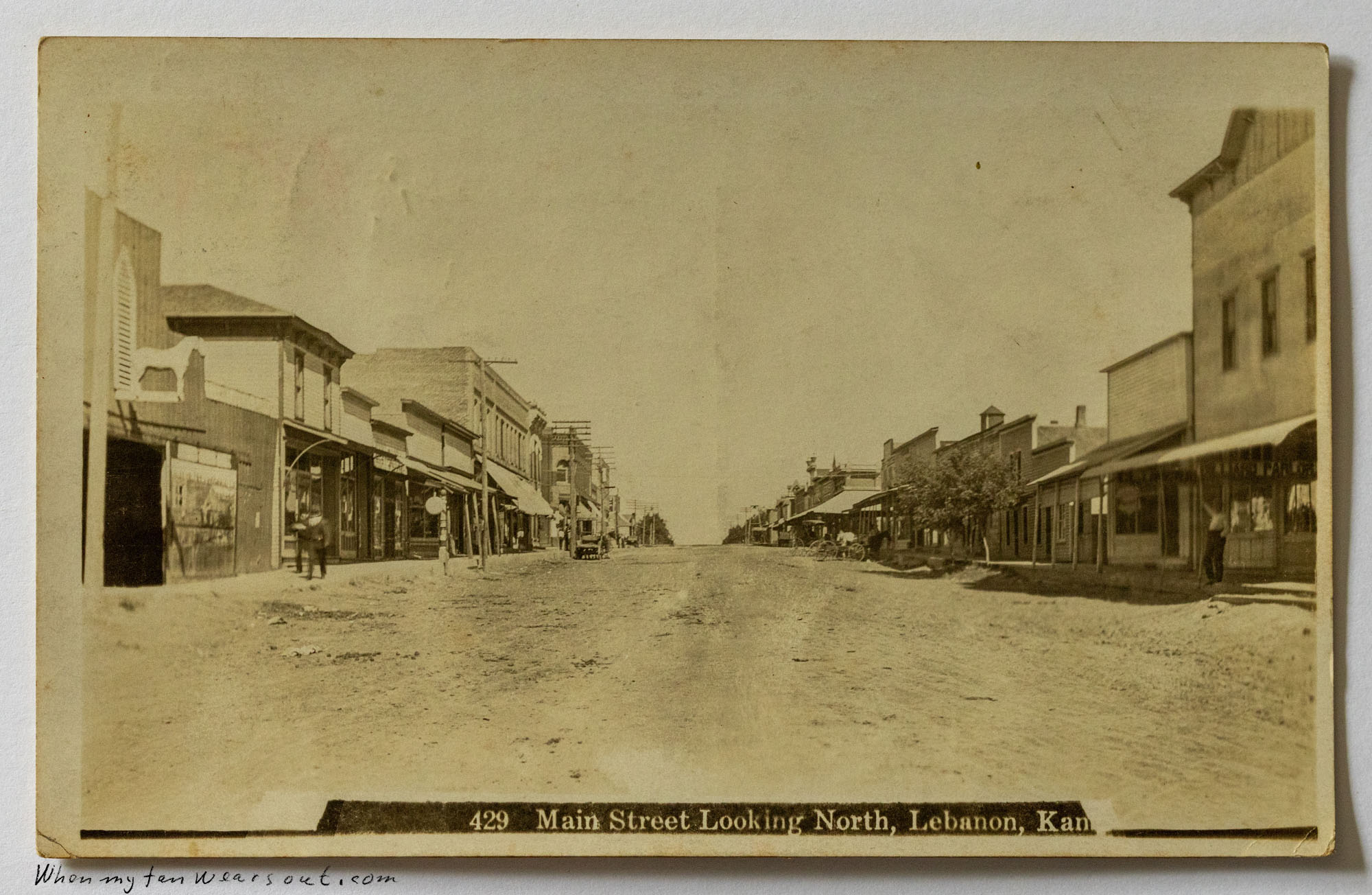
Sepia-toned historical postcard showing a wide, unpaved Main Street in Lebanon, Kansas, looking north. The street is lined with two-story commercial buildings featuring awnings, and a few indistinct figures walk along the dirt street and sidewalks under a bright sky. The caption
Front — A wide, unpaved Main Street in Lebanon, Kansas, looking north, lined with multi-story business buildings.

Postcard Metadata


Back of a sepia-toned postcard with a handwritten message in cursive from Leonard Timberlake to Miss Pearl Byers in Carthage, Illinois. The card is postmarked Topeka, Kansas, October 27, 1909, 6PM, and bears a one-cent green U.S. postage stamp featuring Benjamin Franklin. The manufacturer's details are visible on the left side.
Back — Correspondence from Leonard Timberlake to Miss Pearl Byers

Transcription

Well I guess you thought I was never going to write anything but I finally got around to it. I had swell trip home it rained severall the time after I left Quincy. Leonard Timberlake.

Historical & Family Notes

This postcard, sent to Pearl Byers from Leonard Timberlake, provides a glimpse into her social circle before her eventual marriage to Harvey Sights. The message details Leonard’s “swell trip home” despite rain after leaving Quincy, suggesting Pearl might have been visiting Quincy, Illinois, or that Leonard was visiting Pearl (or nearby) before heading back to his own home, likely in or near Topeka, Kansas, where the card was postmarked.

The existence of correspondence from other individuals like Leonard underscores that Pearl had a vibrant social life and various acquaintances, a common experience for young women of the era. These interactions form part of the broader narrative leading up to her relationship with Harvey Sights, showing the context of her world.

The card’s front, depicting Main Street in Lebanon, Kansas, is a generic scene often found on postcards of the period, chosen by the sender likely for its availability rather than any specific connection to Pearl or Leonard. It highlights the widespread use of postcards for casual correspondence and sharing snippets of daily life or travel.

Continue Reading