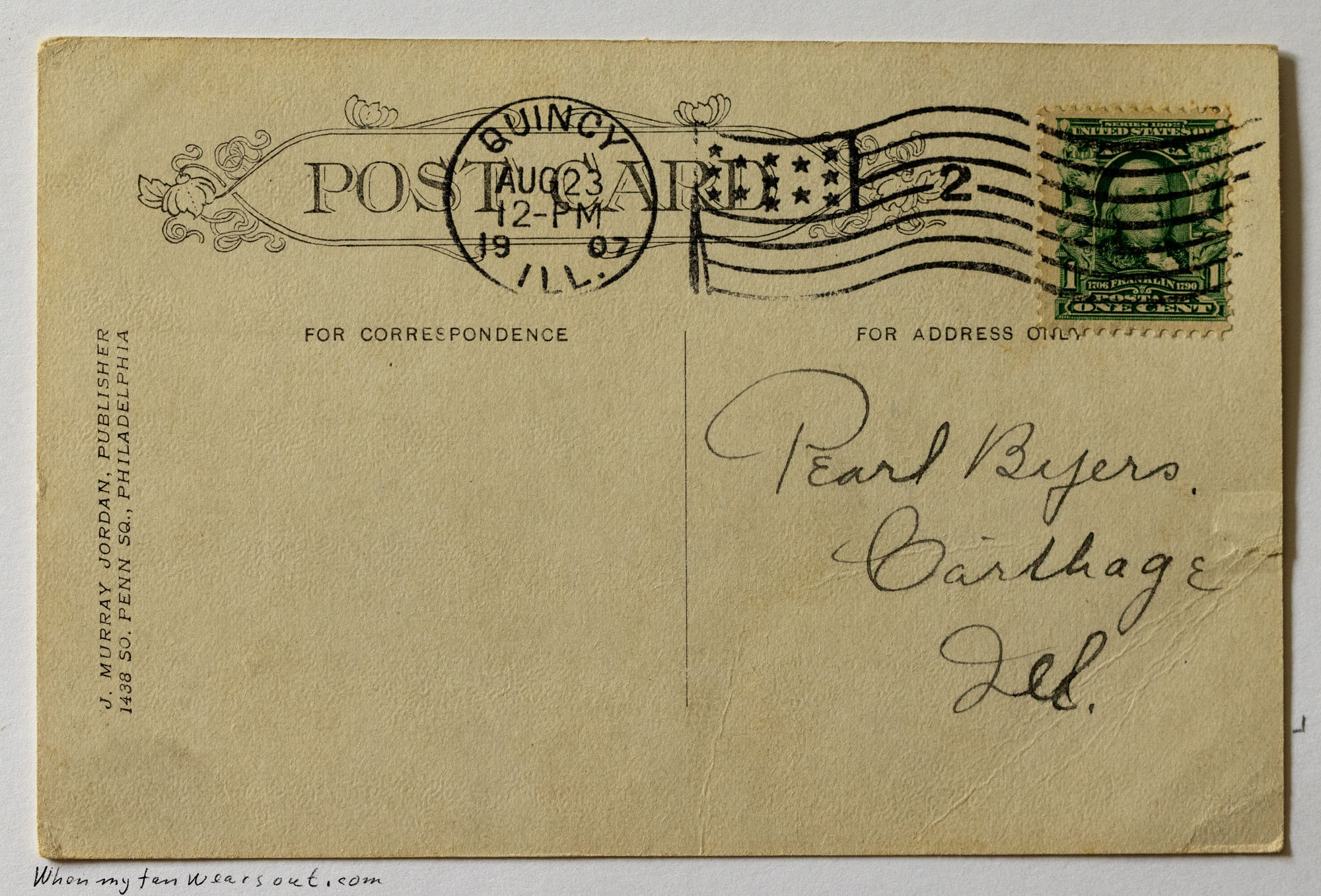
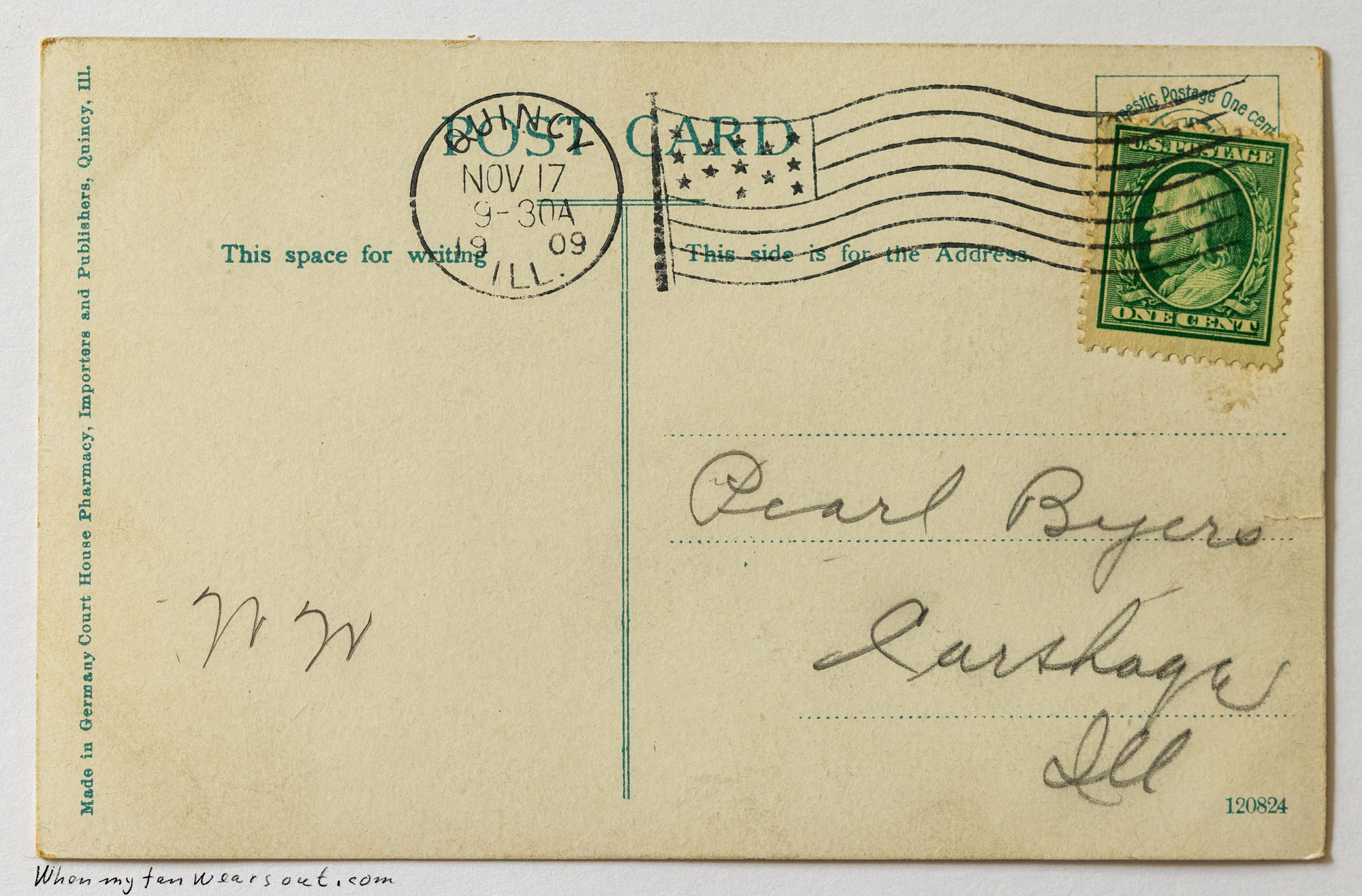
Back — The Plastics party has been definitely set for nov. 13. on mon. nite. all come that can. I think Mary wd like to come with you. John goes to school that nite. I think Arvetta may want to come with you too. not sure yet if she can come at all. but mary can talk to you all between now & starting time. Hope all can come Love Mae [?]
Publisher: Ed. Hoch, Importer and Publisher, Carthage, Ill.
Print Origin: Printed in Germany
Stamp: 1¢ — Two identical 1¢ stamps.
Distance Traveled: Local mail
Notes: Two 1¢ stamps used on a single card; card is an undivided back style design despite being mailed in 1909; contains a handwritten pencil note "Before 1910" at the top of the back which appears to be a later addition.
About This Card
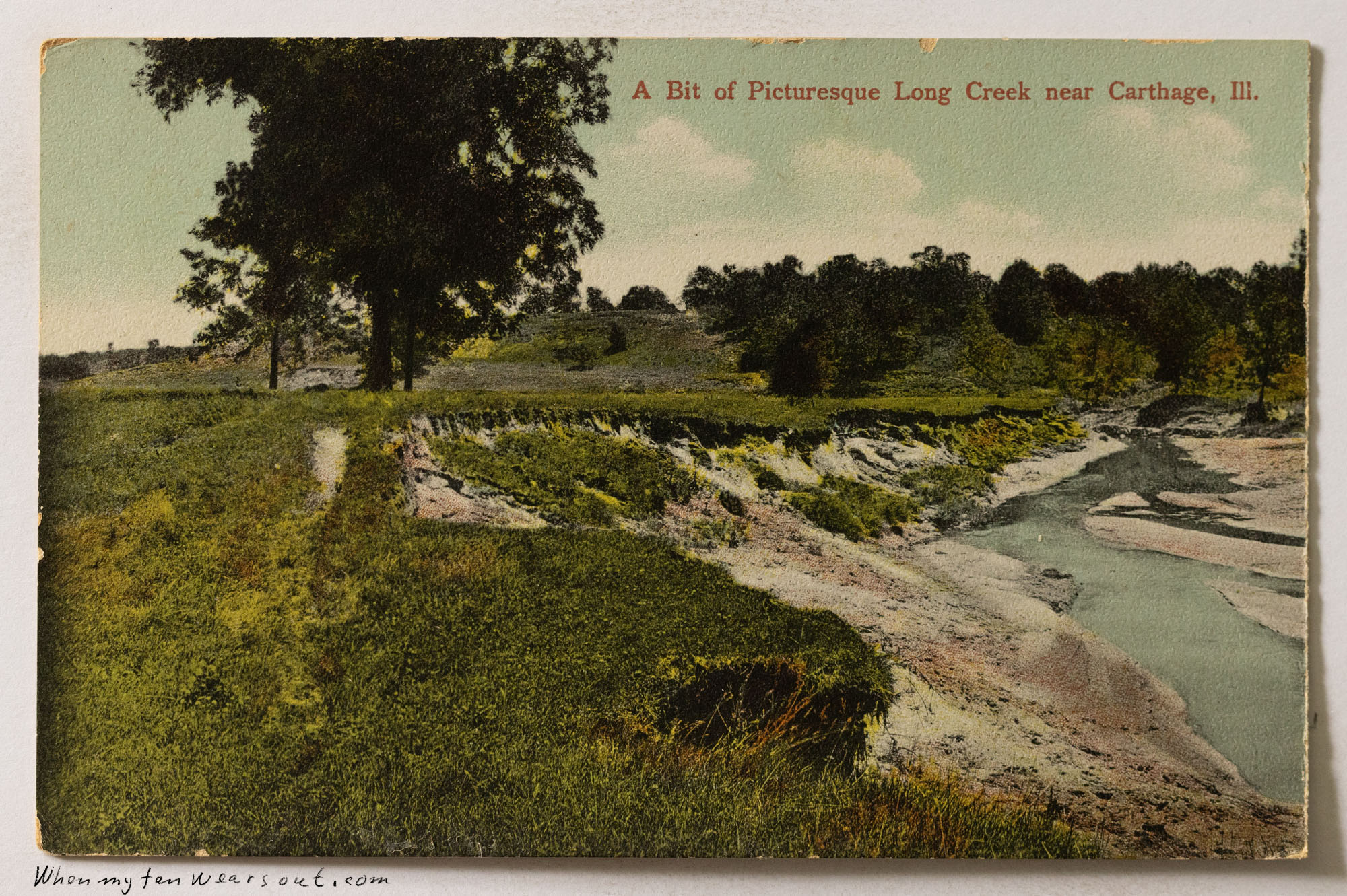
Long Creek near Carthage appears in the collection multiple times across different decades — Harvey sending a card of it from La Harpe before their wedding, Pearl’s mother sending a view later, and now this hand-colored landscape postmarked from Carthage in the linen era. Long Creek was the natural feature closest to both of their hometowns: it ran through the farm country between Carthage and La Harpe, and it was the kind of creek people knew by name because they crossed it regularly. This unsigned card was sent by an unsigned sender — the creek speaks for itself.
Back — 10/28/09 Just a line to say I will be in C. about 9 or ten this morning. Hope you have had a fine time at the party. H.R.S.
Postcard Information
Postmark: LA HARPE, ILL., OCT 29 1909
Sent To: Carthage IL
Era: Golden Age (1907–1915)
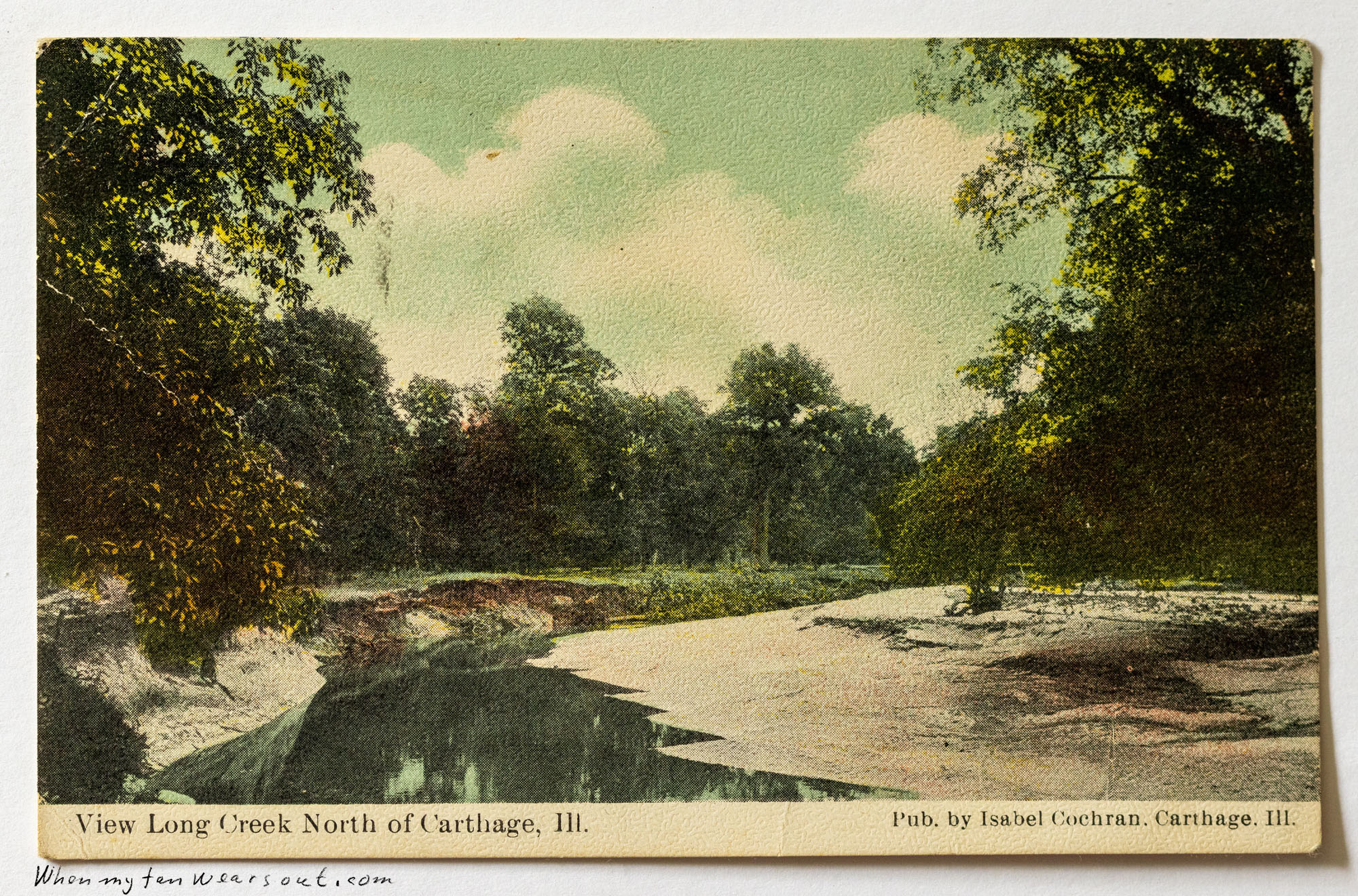
Publisher: Isabel Cochran, Carthage, Illinois
Stamp: 1¢
Distance Traveled: ~15 miles
About This Card
Long Creek runs through the countryside near both Carthage and La Harpe in Hancock County, Illinois — it was familiar ground to Harvey, who grew up in La Harpe, and to Pearl, who lived in Carthage. Harvey signed this card “H.R.S.” — his initials — and sent it from La Harpe in October 1909, just over a year before their wedding on October 6, 1910. The note is brief and practical: he’ll be in Carthage around nine or ten in the morning. The creek in the illustration looks peaceful in autumn light.
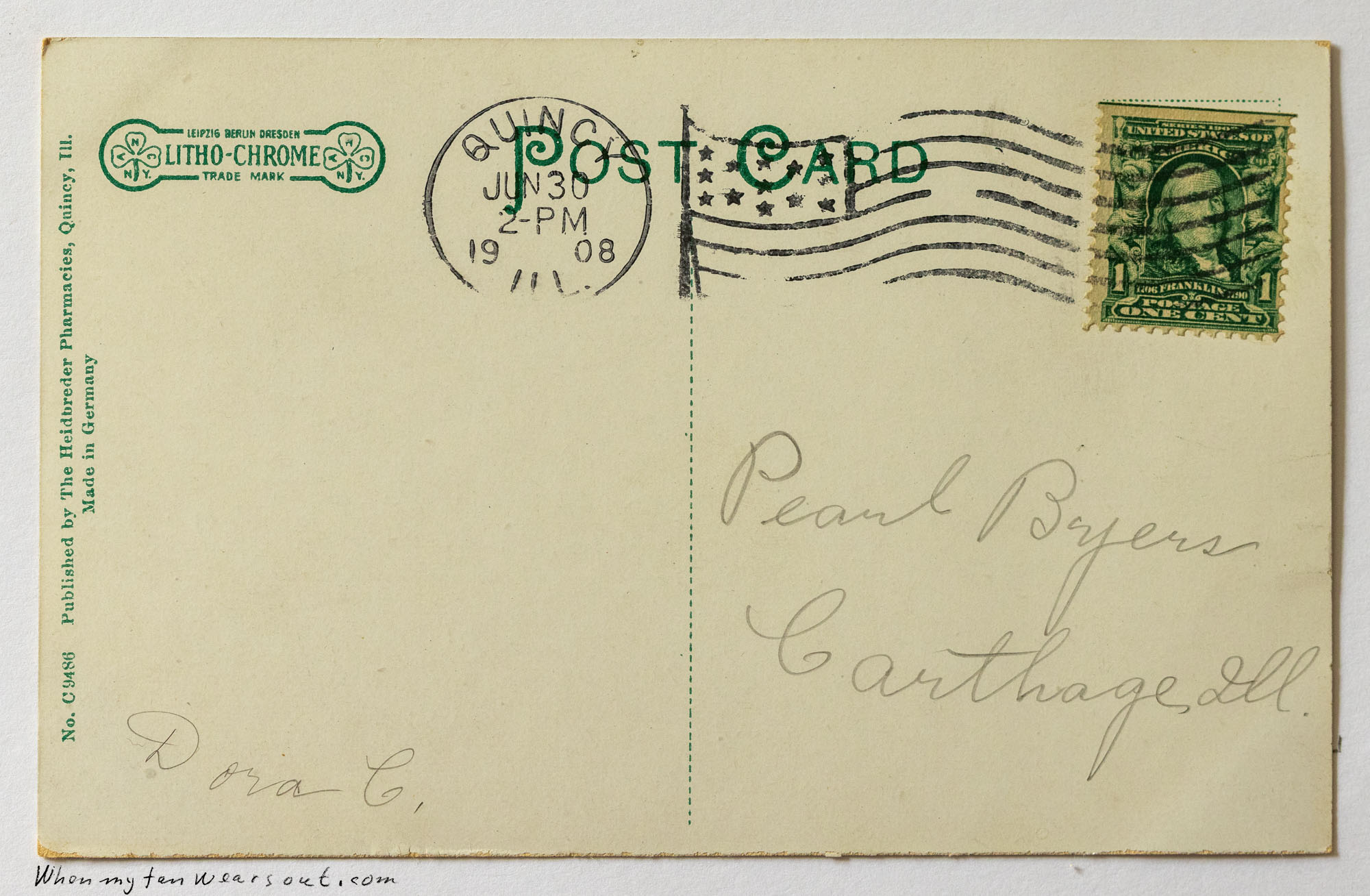
Publisher: The Heidbreder Pharmacies, Quincy, Illinois
Print Origin: Printed in Germany
Stamp: 1¢ — Canceled with a wavy US flag machine postmark.
Distance Traveled: ~40 miles
About This Card
South Park in Quincy runs along the bluffs above the Mississippi River, and the stone arch bridge shown on this card crossed one of its ravines. The park system was developed in the 1870s and 1880s when Quincy was prosperous enough to invest in civic amenities. Dora C. sent this card in June 1908 — early in Pearl’s correspondence years, when many of these cards were still finding their way from near and far.
Publisher: J. Murray Jordan, Philadelphia, Pennsylvania
Stamp: 1¢
Distance Traveled: ~35 miles
About This Card
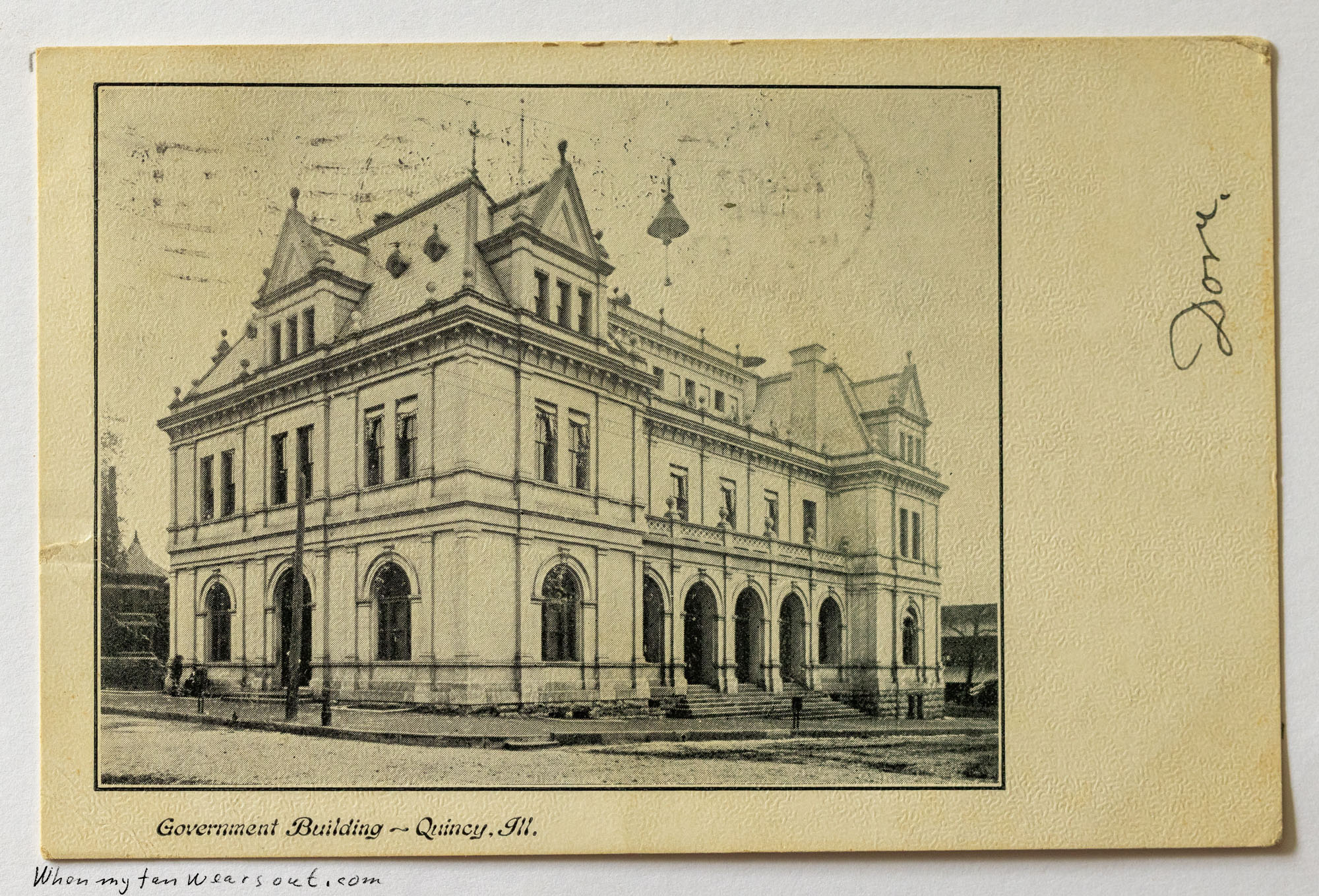
The Government Building on Maine Street in Quincy — serving as both post office and federal courthouse — was completed in 1888 and represented one of the most substantial federal investments in the region. Quincy’s position on the Mississippi River had made it an important commercial center since the 1840s, but by 1907 the railroads had long since reorganized traffic patterns and the city’s relative importance had begun to decline.
Back — 918 1/2 Bdwy, Quincy Ill Hello Noodles: you will be surprised to get this card but why shouldn’t you be. Just see who it is from. I kid you ought to be down here. I have been running all after noon. Well Dearie call me up some time, Ada,
Front — ] Emma Carrol ] having lulu [?] time With [?] Love Emma C.
Postcard Information
Postmark: QUINCY, ILL., MAY 19 09
Sent To: Carthage IL
Era: Golden Age (1907–1915)
Publisher: C. U. Williams, Photœtte, Bloomington, Illinois
Stamp: 1¢
Distance Traveled: ~40 miles
About This Card
The Adams County Courthouse in Quincy, Illinois was completed in 1885 in a Romanesque Revival style, replacing an earlier structure. Quincy was one of the more significant cities on the upper Mississippi in the 19th century — large enough to host the sixth Lincoln-Douglas debate in October 1858, drawing an estimated crowd of twelve thousand people to Washington Park, a few blocks from the courthouse. Emma Carroll was writing from a city with a serious civic tradition, even if her note was brief.
Front — A group of store employees or proprietors pose with a display case of umbrellas.
Postcard Metadata
Postmarked: Not Visible
Sent From: None
Sent To: None
Distance Traveled: None
Postage: Not visible (no stamp)
Card Details: Divided Back, Real Photo Postcard (RPPC) with “A Z O” stamp box (circa 1907-1920s).
Back — A list of names
Transcription
Fred Peasley Waldo Mason Miss Erbroidt Miss Osborn Tom Roberts Carrie Campbell Maude Biggs Mabel Roberto
Mason Dry Goods Store, La Harpe
Historical & Family Notes
This charming real photo postcard, likely dating to the early 20th century, captures a slice of small-town commerce, possibly the very store where Harvey Sights worked or visited. The image presents a bustling scene with employees, a counter, and umbrellas for sale, suggesting a dry goods or department store.
Front — An engraving depicts the Old Gittings Seminary in Laharpe, Illinois, noted as having burned on January 13, 1889.
Postcard Metadata
Postmarked: N/A
Sent From: N/A (Laharpe, Illinois implied by subject matter)
Sent To: (Address lines are blank on the card)
Distance Traveled: N/A (No addresses for calculation)
Postage: No stamp visible
Card Details: Undivided Back (common pre-1907), manufactured by A.T.F. Co. Chicago.
Back — Correspondence from Unidentified to Implied Recipient: Pearl Byers
Transcription
Show where the present F. A. Nelson home is.
Historical & Family Notes
This postcard offers a glimpse into local Illinois history, featuring an engraving of the Old Gittings Seminary in Laharpe, a town approximately 20 miles north of Carthage. The front explicitly notes the seminary’s destruction by fire on January 13, 1889, placing the card’s publication sometime after this event. The Undivided Back design suggests it predates 1907, aligning with the early courtship years of Pearl Byers and Harvey Sights.
The back of the card, while lacking a clear sender or recipient address, contains a brief, almost enigmatic message: “Show where the present F. A. Nelson home is.” This laconic note implies a shared local knowledge between the sender and the intended recipient, characteristic of correspondence between friends or family members within a close-knit community. It’s easy to imagine a young Harvey or Pearl sending such a card to the other, perhaps during one of their brief separations, sharing a point of interest known only to them.
The card serves as a tangible piece of the era, illustrating how local landmarks and everyday observations found their way into personal communications. While not a direct love letter, its inclusion in Pearl’s collection suggests it held some personal significance, possibly marking a location they visited or discussed, further knitting the fabric of their early relationship within the familiar landscapes of Hancock County, Illinois.
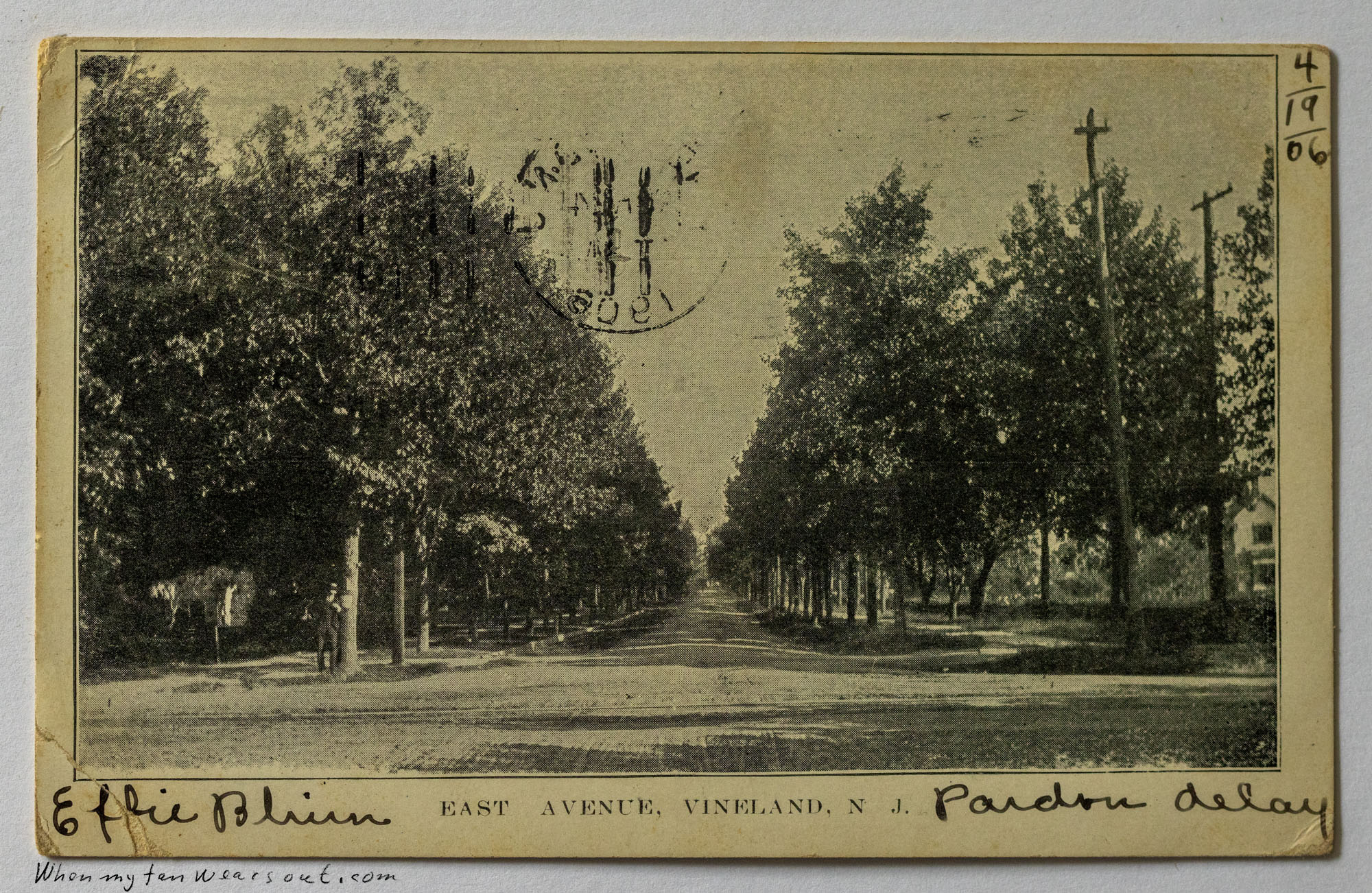
Front — A tree-lined East Avenue in Vineland, New Jersey, featuring a path flanked by utility poles.
Postcard Metadata
Postmarked: Vineland, New Jersey — April 24, 1906
Sent From: Vineland, New Jersey
Sent To: Effie Byers, 318 Fayette st, Carthage, Ill.
Distance Traveled: Approximately 830 miles
Postage: One cent US Postage stamp, George Washington
Card Details: An early example of a Divided Back card, predating the official March 1, 1907, postal regulation.
Back — Correspondence from Effie Blinn to Effie Byers
Transcription
Effie Blinn Pardon delay
Historical & Family Notes
This early 20th-century postcard captures a serene tree-lined street in Vineland, New Jersey, a common subject for postcards of the era. The brief message “Pardon delay” suggests a simple, informal exchange, perhaps between friends or family. The card is addressed to Effie Byers in Carthage, Illinois, indicating a connection to the Byers family collection, although it’s not directly addressed to Pearl Byers, the primary recipient of this archive. It’s plausible Effie Byers was a relative, such as a sister or mother, in Carthage, broadening the familial scope of the collection.
The sender, Effie Blinn, likely a friend or acquaintance, took 17 days for this postcard to travel from Vineland, New Jersey to Carthage, Illinois, arriving on May 11, 1906. This travel time was typical for mail delivery across states in the early 1900s. The card itself is noteworthy as an early example of a “divided back” postcard, a design that allowed both the address and a written message on the back, even though the official postal regulation permitting this for domestic mail began nearly a year later in March 1907.
While this specific card doesn’t directly feature Pearl Byers or Harvey Sights, its presence in the collection offers a glimpse into the broader network of friends and family connected to the Byers household in Carthage, Illinois. These small, everyday communications paint a picture of daily life and relationships that would eventually intertwine with Pearl and Harvey’s own story.
Front — A vibrant garden path lined with white and pink marguerite hedges in Santa Monica, California.
Postcard Metadata
Postmarked: Not visible
Sent From: Not specified by sender
Sent To: Miss Pearl Byers, Carthage, Ills.
Distance Traveled: Cannot calculate, sender’s location not specified.
Postage: Missing/Not applied (Domestic: One Cent specified)
Card Details: Divided Back era (post-1907), published by Edward H. Mitchell, San Francisco / Wellington, Kansas.
Back — Correspondence from W H Nelson to Miss Pearl Byers
Transcription
Dec. 4th 1909 Best wishes and many happy birth days yet to come. W H Nelson Miss Pearl Byers Carthage Ills.
Historical & Family Notes
This festive postcard, dated December 4th, 1909, marks a special occasion for Miss Pearl Byers: her birthday. The sender, W H Nelson, extends heartfelt “best wishes and many happy birth days yet to come,” highlighting the tradition of celebrating milestones through handwritten notes. The front features the picturesque Marguerite Hedge in Santa Monica, California, an intriguing choice for a sender likely from further east given Pearl’s Illinois residence, suggesting a souvenir from travel or a purchased scenic view.
While this card doesn’t explicitly involve Harvey Sights, it captures a glimpse into Pearl’s social circle and the importance of personal connections during her formative years. These early birthday wishes underscore a period of her life before her eventual marriage, emphasizing her individuality and the network of friends and family who celebrated her. It’s a reminder of the simple yet profound ways people connected across distances in the early 20th century.
Front — A scenic view of the American Falls at Niagara Falls, New York, with the Upper Steel Arch Bridge and tourists on Goat Island.
Postcard Metadata
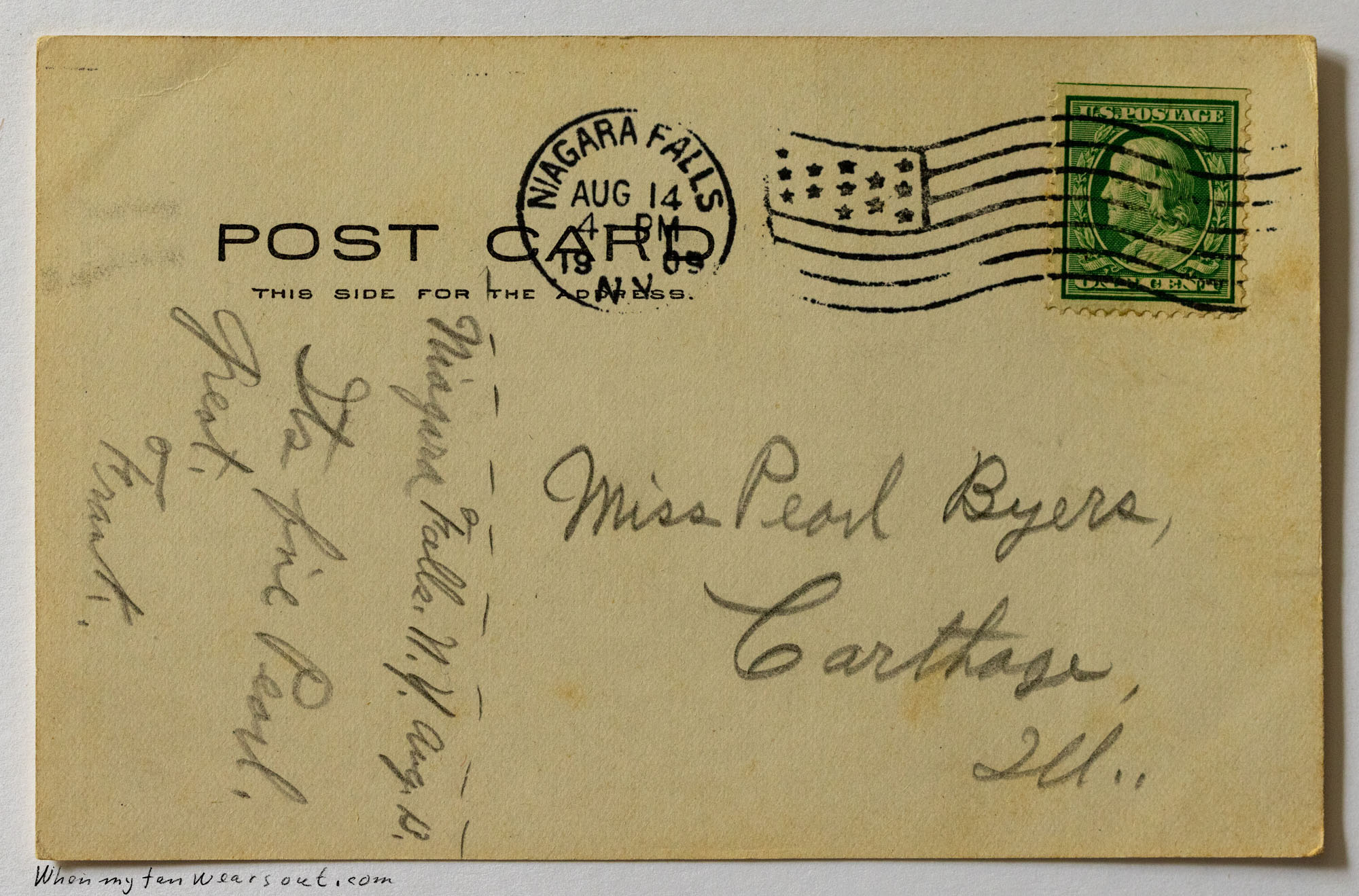
Postmarked: Niagara Falls, N.Y. — August 14, 1909
Sent From: Niagara Falls, N.Y.
Sent To: Miss Pearl Byers, Carthage, Ill.
Distance Traveled: Approximately 580 miles
Postage: U.S. POSTAGE ONE CENT green stamp, featuring a profile of George Washington.
Card Details: Divided Back era (1907-present), allowing separate sections for message and address.
Back — Correspondence from Frank to Miss Pearl Byers
Transcription
Niagara Falls, N.Y. Aug. 14. To fine Pearl, Great. Frank.
Historical & Family Notes
This postcard from Niagara Falls to Miss Pearl Byers in Carthage, Illinois, provides a glimpse into Pearl’s social circle before her eventual marriage to Harvey Sights. Sent by a sender simply identified as “Frank” on August 14, 1909, the brief message, “To fine Pearl, Great,” suggests a casual yet warm acquaintance. Niagara Falls, then as now, was a quintessential destination for scenic wonder, often associated with romantic getaways and honeymoons, though Pearl was still a young, unmarried woman at the time of this correspondence.
The simplicity of the message, a common characteristic of early 20th-century postcards, doesn’t reveal the nature of Pearl’s relationship with Frank. He could be a friend, a family member, or perhaps even a suitor before Harvey Sights entered her life more prominently. Regardless, the card serves as a charming piece of ephemera, documenting a moment in time when Pearl was receiving greetings from various individuals and locations, contributing to the rich tapestry of her personal history.