Back — ] "Better late than never" but I would have answered sooner if I’d had any cards. I haven’t as pretty a card to send as the one I rec’d from you, for that violet postal was certainly pretty. I liked it fine. Don’t you think all had a fairly good time yesterday afternoon, at least what we done kept us pretty busy. How is the Children’s Day exercises. I’ve got a job today I don’t like very well – helping Mamma pick up cherries. Ans. soon as ever. – Violet.
Postcard Information
Postmark: Wever, Iowa, JUN 8 1908
Sent To: Carthage IL
Era: Undivided Back (Pre-1907)
Publisher: Axt Drug Co., Fort Madison, Iowa
Stamp: 1¢
Distance Traveled: ~25 miles
Notes: Hand-drawn dividing line on back, message written on front margin
About This Card
Pine Street in Fort Madison, looking south from this vantage, shows the kind of small-city commercial vitality that characterized river towns along the upper Mississippi in the early twentieth century. Fort Madison had grown up around an early American fort — the original Fort Madison, the first U.S. military post in what would become Iowa, was destroyed and abandoned in 1813 after repeated Sauk attacks during the War of 1812. The town that took its name later that century had no direct connection to the military installation; it simply kept the name. Five years after Violet sent this card, Walter Sheaffer would open his pen factory nearby, and Pine Street’s commercial character would begin to shift.
Back — Hello Pearle I am watching for the rest of that set of cards and I hope you will not keep me waiting very long. When are you coming over here in this country to see me. anser soon yours Ray. W.
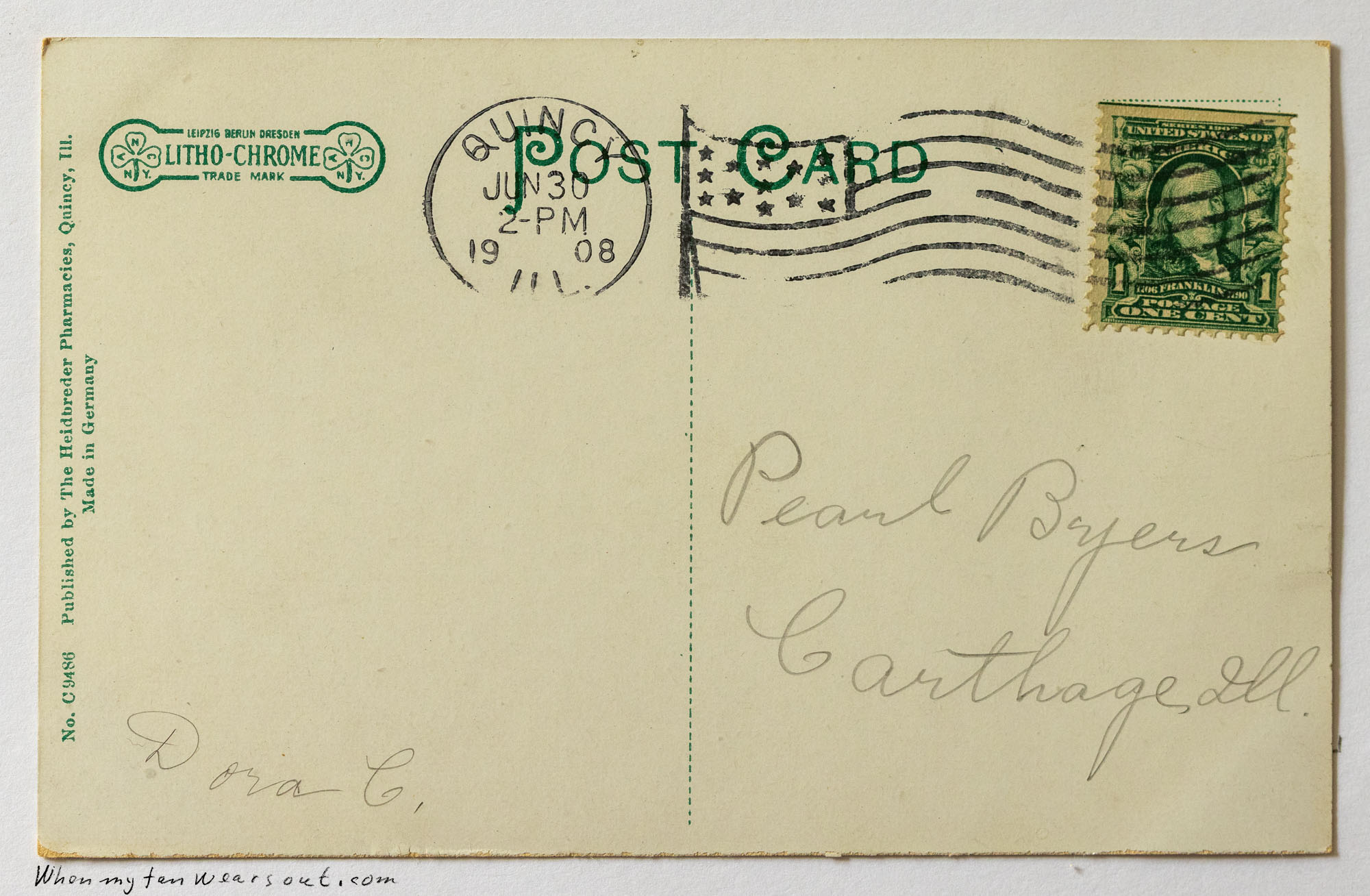
Back — ] Dear Pearl: Could not find any card of the telephone office but will send you one when they get some more in. Everything perfectly lovely here. how is [crossed out] is sister? Write sooner. Alley.
Publisher: The Heidbreder Pharmacies, Quincy, Illinois
Print Origin: Printed in Germany
Stamp: 1¢ — Canceled with a wavy US flag machine postmark.
Distance Traveled: ~40 miles
About This Card
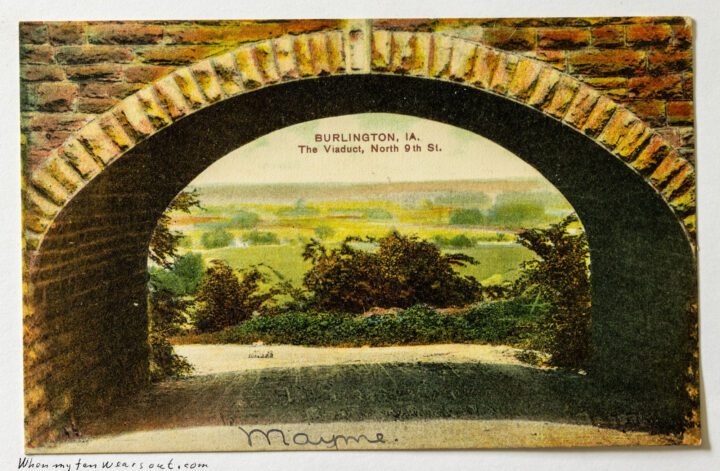
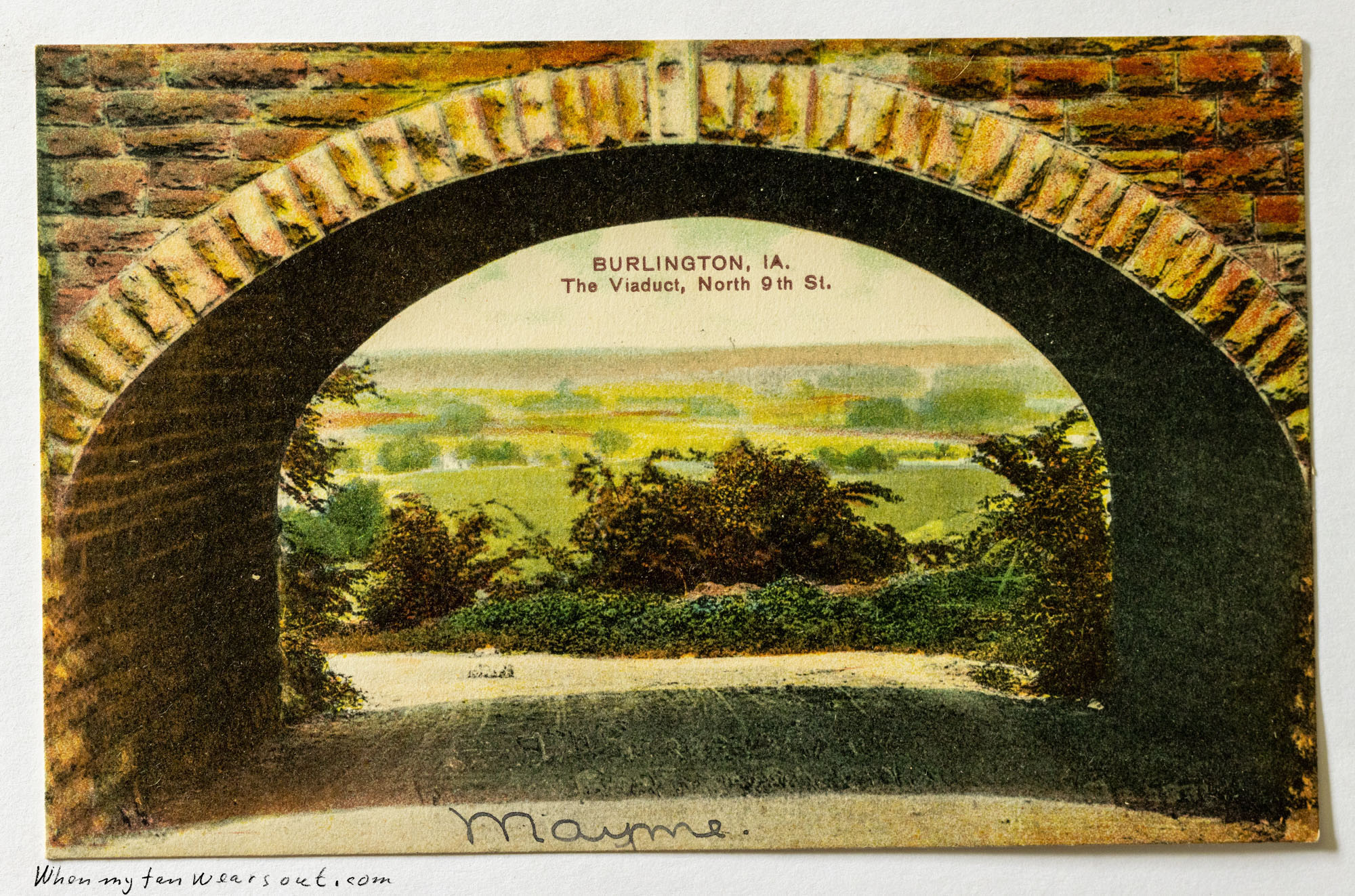
South Park in Quincy runs along the bluffs above the Mississippi River, and the stone arch bridge shown on this card crossed one of its ravines. The park system was developed in the 1870s and 1880s when Quincy was prosperous enough to invest in civic amenities. Dora C. sent this card in June 1908 — early in Pearl’s correspondence years, when many of these cards were still finding their way from near and far.
Back — We were good girls and went to S. S. this morning. The girl student from India is in our class. We have only two blocks to go to church. Saw Roy Coleman. Haven’t seen Wade. Allie.
Postcard Information
Postmark: QUINCY, NOT VISIBLE, AUG 31 1908
Sent To: Carthage IL
Era: Golden Age (1907–1915)
Publisher: S. H. Knox & Co. / T. C. Co. (Curt Teich), Quincy, Illinois / Chicago, Illinois
Stamp: 1¢
Distance Traveled: ~35 miles
About This Card
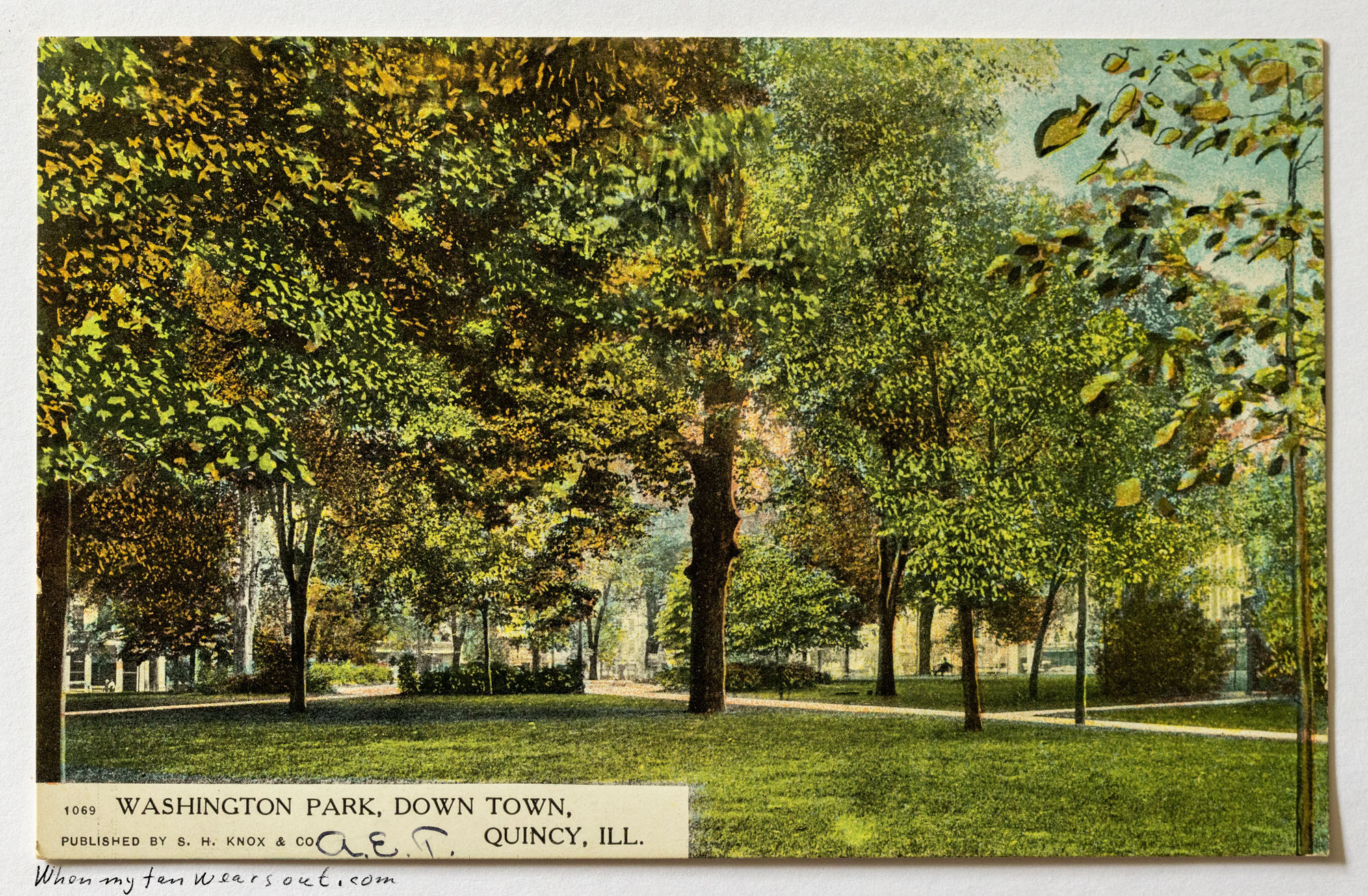
Washington Park in downtown Quincy, Illinois is where the sixth Lincoln-Douglas debate was held on October 13, 1858. An estimated 12,000 people gathered to hear Abraham Lincoln and Senator Stephen Douglas argue over slavery and the future of the Union — the largest crowd of any of the seven debates. Illinois voters returned Douglas to the Senate that November, but Lincoln won the Republican nomination for president two years later. The park has marked the debate site ever since.
Front — A hand-tinted postcard featuring a scenic view of Indian Mound Park in Quincy, Illinois, overlooking the Mississippi River.
Postcard Metadata
Postmarked: Quincy, Ill. — AUG 25 4 PM 1908
Sent From: Quincy, Illinois
Sent To: Miss Pearl Byers, Carthage, Ill.
Distance Traveled: Approximately 32 miles
Postage: One Cent U.S. Franklin stamp, green.
Card Details: Divided back postcard, printed by “Leipzig Berlin Dresden Litho-Chrome”, trademark indicates “Printed in Germany”.
Back — Correspondence from Elva to Miss Pearl Byers
Transcription
Hello kids! Got here p.m. sound. Have a dandy room. Will have to write before long. Elva 438 N. 8th st.
Historical & Family Notes
This postcard offers a glimpse into Pearl Byers’ social circle before her eventual marriage to Harvey Sights. The sender, Elva, is likely a friend or relative, providing a quick update from Quincy, Illinois. The casual tone and simple message, “Hello kids! Got here p.m. sound. Have a dandy room,” reflect the common use of postcards for brief, informal communication in the early 20th century, a time when such exchanges were cherished links between distant friends and family.
The card’s front depicts Indian Mound Park in Quincy, a notable local landmark with its historic earthworks and scenic views of the Mississippi River. Such picturesque views were popular subjects for postcards, allowing senders to share a bit of their travels or local attractions with recipients back home. Even a relatively short trip to a nearby town like Quincy would have been an occasion worth noting and sharing with friends like Pearl in Carthage.
While Harvey Sights isn’t directly mentioned in this particular correspondence, this postcard beautifully illustrates the rich tapestry of relationships Pearl maintained. These frequent, small exchanges kept her connected to a broad community of friends and family, forming the supportive network that would surround her as she eventually married Harvey and started her own family, enriching the Sights’ family legacy.
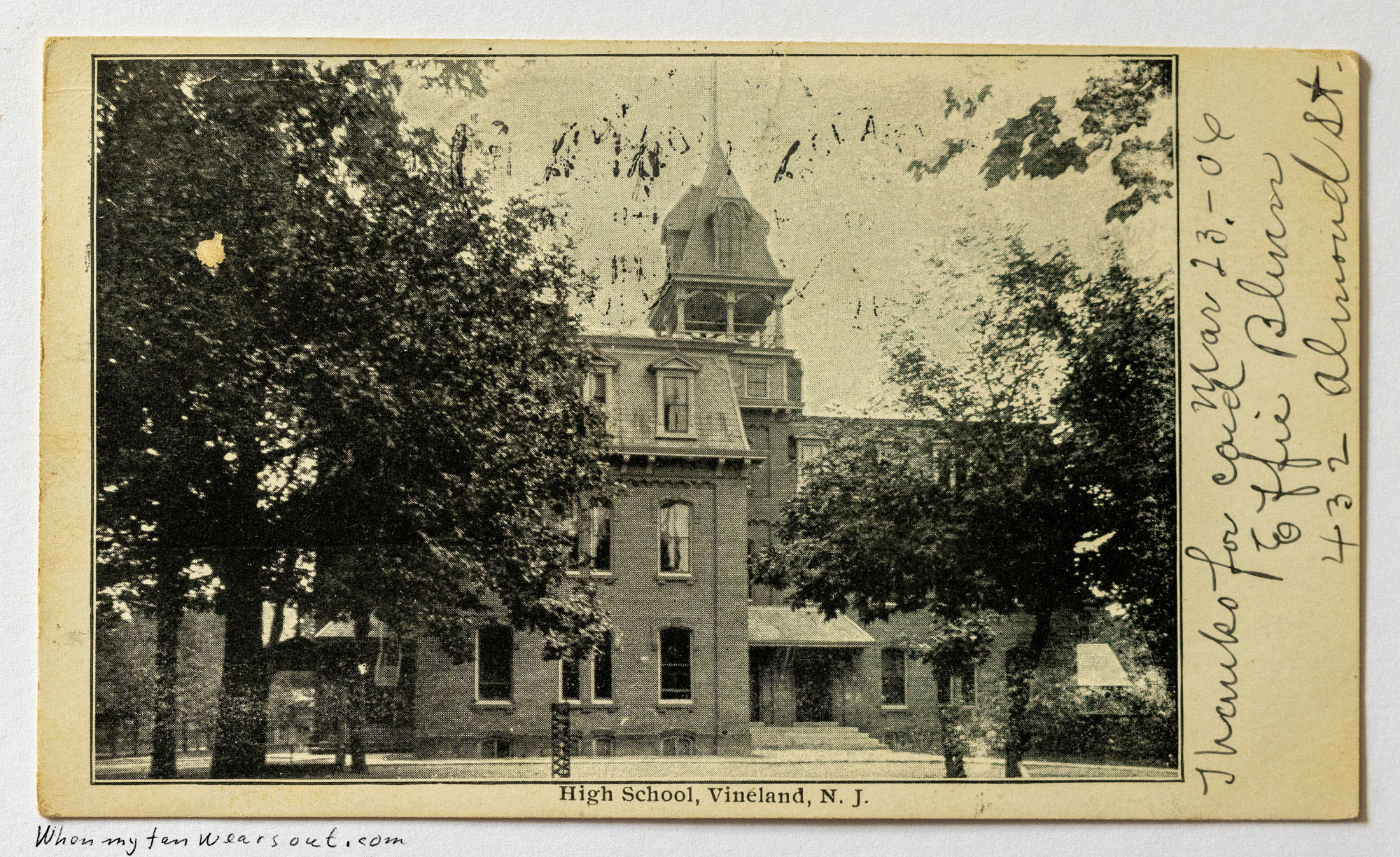
A brick high school building with a prominent central tower is surrounded by large, leafy trees in Vineland, New Jersey.
Postcard Metadata
Postmarked: Vineland, New Jersey — March 23, 1908
Sent From: Vineland, New Jersey
Sent To: Effie P. Byers 318 Lafayette St Carthage Ill.
Distance Traveled: Approximately 940 miles
Postage: One-cent green Franklin stamp
Card Details: Divided Back era (1907-1915)
Back — Correspondence from Effie Blinn to Effie P. Byers
Transcription
Thanks for card. Mar 23 – 08 Effie Blinn 433 Almond St
Historical & Family Notes
This postcard, sent from Vineland, New Jersey, captures a polite thank you note from Effie Blinn to Effie P. Byers, likely Pearl Byers’ mother or another close relative residing at the family home in Carthage, Illinois. The consistent address of 318 Lafayette Street in Carthage underscores the enduring family connection to this location, a central hub for the Byers family.
The communication, though brief, highlights the era’s common practice of using postcards for everyday greetings and short messages, predating more immediate forms of communication. The swift delivery, reaching Carthage the very next day, also showcases the efficiency of the early 20th-century postal service for cross-state mail.
While not directly featuring Pearl or Harvey, this card provides a glimpse into the broader family network surrounding Pearl Byers before her eventual marriage to Harvey Sights. It helps establish the social context and communication patterns within which their own courtship would unfold.
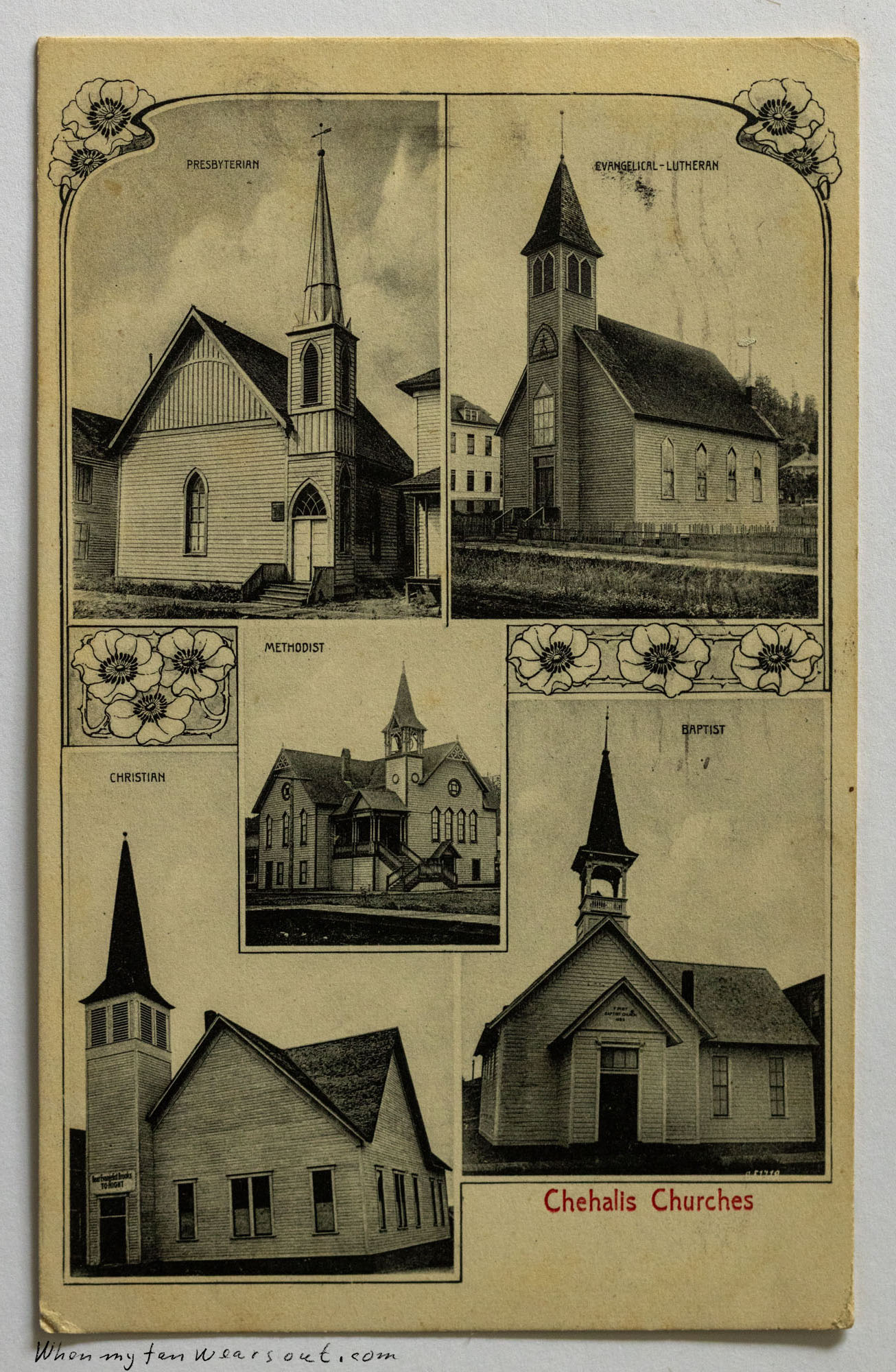
Front — A multi-panel collage showcasing five different church buildings in Chehalis, Washington, including Presbyterian, Evangelical-Lutheran, Methodist, Christian, and Baptist.
Postcard Metadata
Postmarked: Chehalis, Washington — May 2, 1908
Sent From: Chehalis, Washington
Sent To: Miss Pearl Rogers, Carthage Ill.
Distance Traveled: Approximately 1850 miles
Postage: One Cent Benjamin Franklin stamp
Card Details: Divided Back era postcard, Made in Germany
Back — Correspondence from Marguerite G. Lattler (likely) to Miss Pearl Rogers
Transcription
A friend Pearl, I believe one you an answer excuse me for the delay but I thought I had answered. How are you I wish I knew you personally. I have finished school and am working in the Bank in Chehalis. I like it fine.
Historical & Family Notes
This postcard, while part of the Pearl Byers collection, is explicitly addressed to “Miss Pearl Rogers.” Given the project’s primary focus on Pearl Byers of Carthage, Illinois, this discrepancy in the recipient’s surname presents an intriguing genealogical question. It may suggest a previous family name, a different recipient, or a common addressing variation of the era, inviting further research into its precise connection to Pearl Byers’ personal archives.
The sender, likely Marguerite G. Lattler from Chehalis, Washington, apologizes for a delayed reply, indicating a pre-existing correspondence between the two. Her message provides a snapshot of life in the early 20th century, sharing personal news of finishing school and beginning a new job at a local bank in Chehalis. The expression “I wish I knew you personally” suggests their relationship might have been primarily through letters or distant acquaintance, rather than close physical proximity.
The significant distance between Chehalis, Washington, and Carthage, Illinois, highlights the importance of postcards as a primary means of long-distance communication and maintaining social connections during this period. The card offers a glimpse into the sender’s new career path and general well-being, sharing a common theme of personal updates exchanged across vast geographical divides.
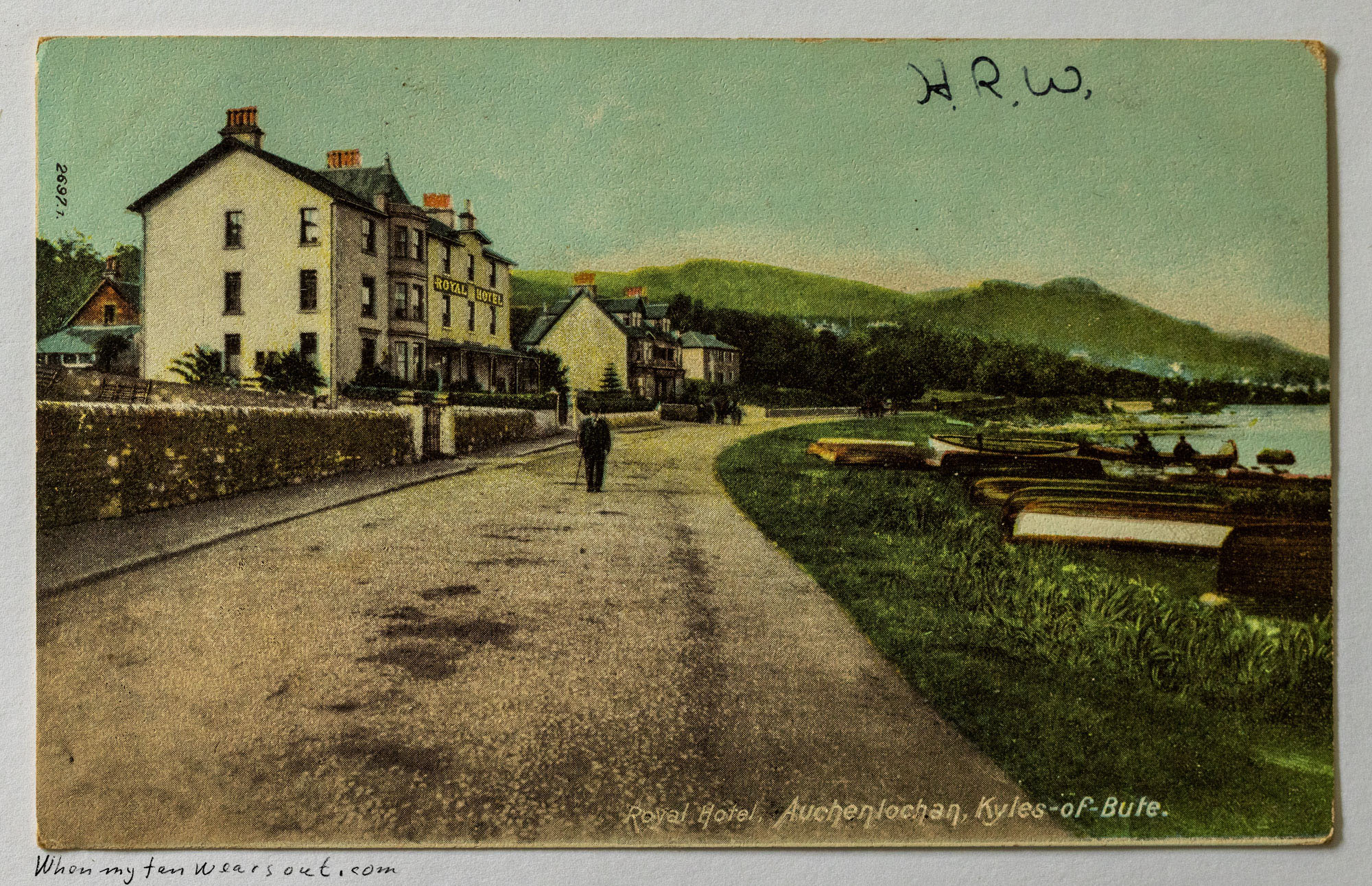
Front — A hand-tinted postcard depicting the Royal Hotel and a coastal road in Auchterlochan, Kyles-of-Bute, Scotland, with a lone figure walking and boats moored by the shore.
Postcard Metadata
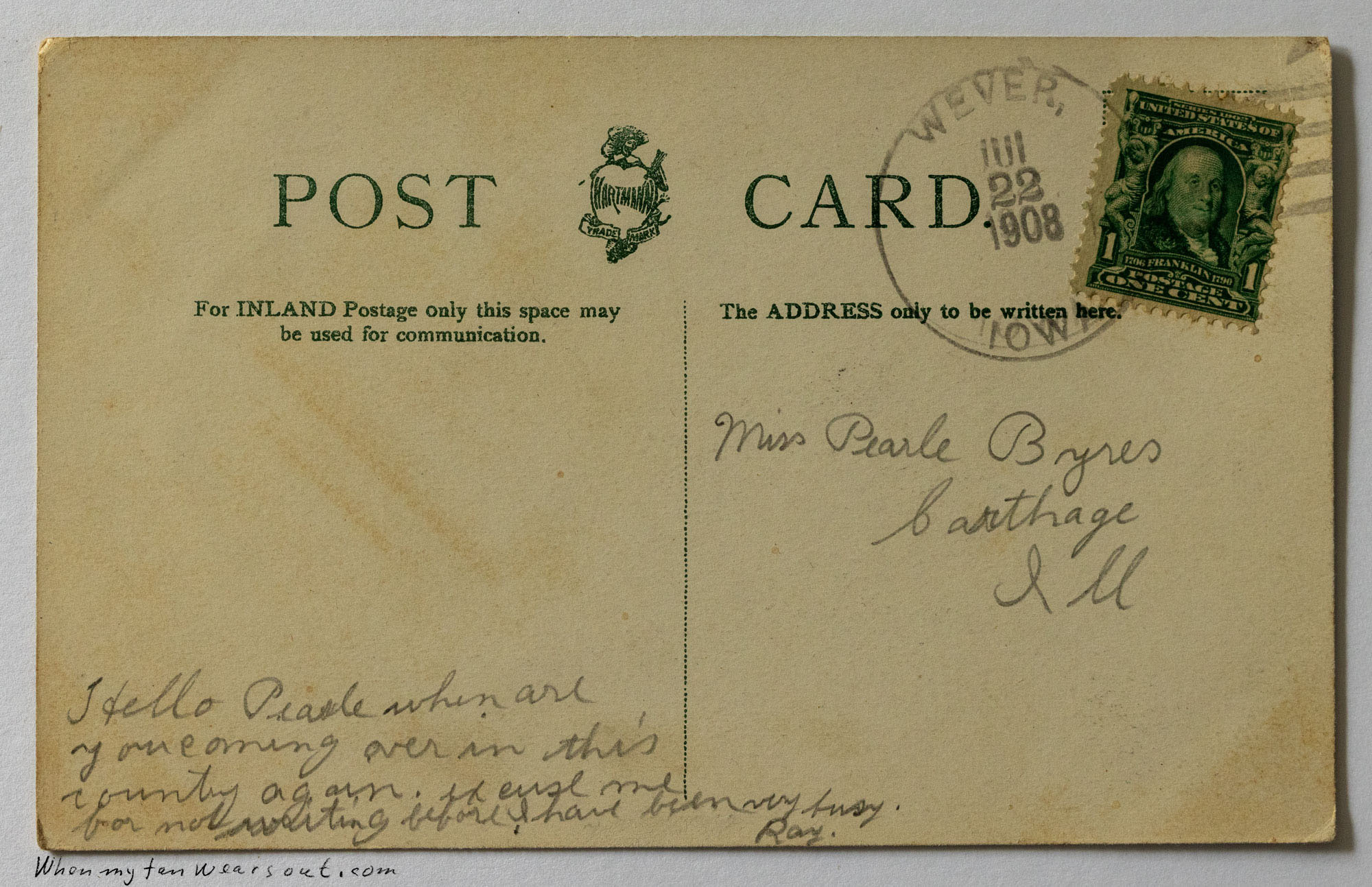
Postmarked: Wever, Iowa — JUL 22 1908
Sent From: Wever, Iowa
Sent To: Miss Pearle B. Byers, Carthage, Illinois
Distance Traveled: Approximately 23 miles
Postage: United States of America, One Cent (Benjamin Franklin stamp)
Card Details: Divided Back Era (post-1907)
Back — Correspondence from Ray to Miss Pearle B. Byers
Transcription
Hello Pearle when are you coming over in this country again. I expect me from not waiting before I have biansy two. Ray.
Historical & Family Notes
This postcard, featuring a picturesque scene of the Royal Hotel in Auchterlochan, Kyles-of-Bute, Scotland, offers a glimpse into Pearl Byers’ social connections prior to her marriage to Harvey Sights. Despite the Scottish imagery on the front, the card was postmarked from Wever, Iowa, and sent to Pearl in Carthage, Illinois. The sender, identified only as “Ray,” asks Pearl, “when are you coming over in this country again,” implying Pearl may have been traveling or was expected to visit Ray’s locale.
The message suggests a friendly, familiar relationship, possibly with a relative or close friend who lived a short distance away in Iowa. The casual nature of the message, despite the exotic foreign scene, highlights the common practice of using any available postcard stock for correspondence, regardless of its pictorial content, focusing primarily on the message itself.
This card is a small testament to Pearl’s life and relationships before she became Pearl Sights, showcasing her network of acquaintances and the broader world she navigated through correspondence, even as simple as a postcard sent across a short regional distance.
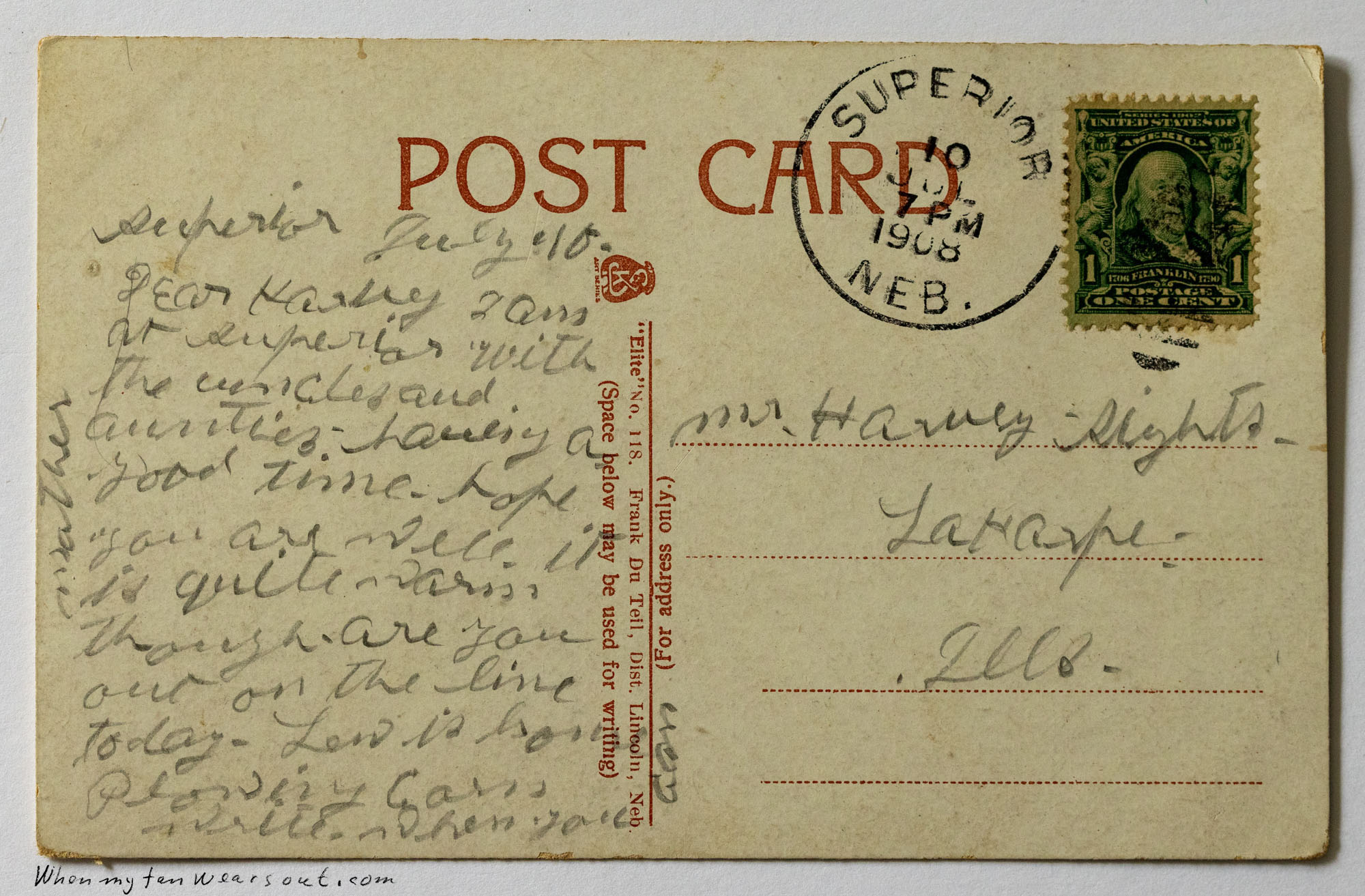
Front — A vintage postcard of the Nebraska State Capitol building in Lincoln with a prominent dome.
Postcard Metadata
Postmarked: Superior, Nebraska — July 22, 1908
Sent From: Superior, Nebraska
Sent To: Mr. Harvey Sights, LaHarpe, Ills.
Distance Traveled: Approximately 400 miles
Postage: United States of America, Benjamin Franklin, One Cent (green)
Card Details: Divided back postcard, featuring publisher details “Elite No. 118. J. Frank Du Toit, Dist. Lowell, Neb.”
Back — Correspondence from Carrie to Harvey Sights
Transcription
Superior July 20. Dear Harvey am at Superior with the uncles and aunties. Having a good time. Hope you are well, if it is still warm. Though are you out on the line today. Lew is here. Pleading Carrie.
Historical & Family Notes
This postcard offers a glimpse into Harvey Sights’ life and family connections before he married Pearl Byers. Sent by “Pleading Carrie” from Superior, Nebraska, it reveals that Harvey had family, specifically “uncles and aunties,” living or visiting there. The affectionate closing “Pleading Carrie” suggests a close relationship, possibly a sister or cousin, who misses him or wants him to visit.
Carrie’s question, “Though are you out on the line today,” hints that Harvey might have been traveling for work or had a regular route, perhaps as a salesman or in a similar profession that kept him “on the line.” This detail provides a valuable insight into Harvey’s early career or activities.
The card, addressed to Harvey Sights in LaHarpe, Illinois, from a family member in Superior, Nebraska, paints a picture of a young man with a life connected to extended family, even as he was potentially on the move for work. It helps contextualize Harvey’s experiences before he became a central figure in the Sights-Byers family arc.
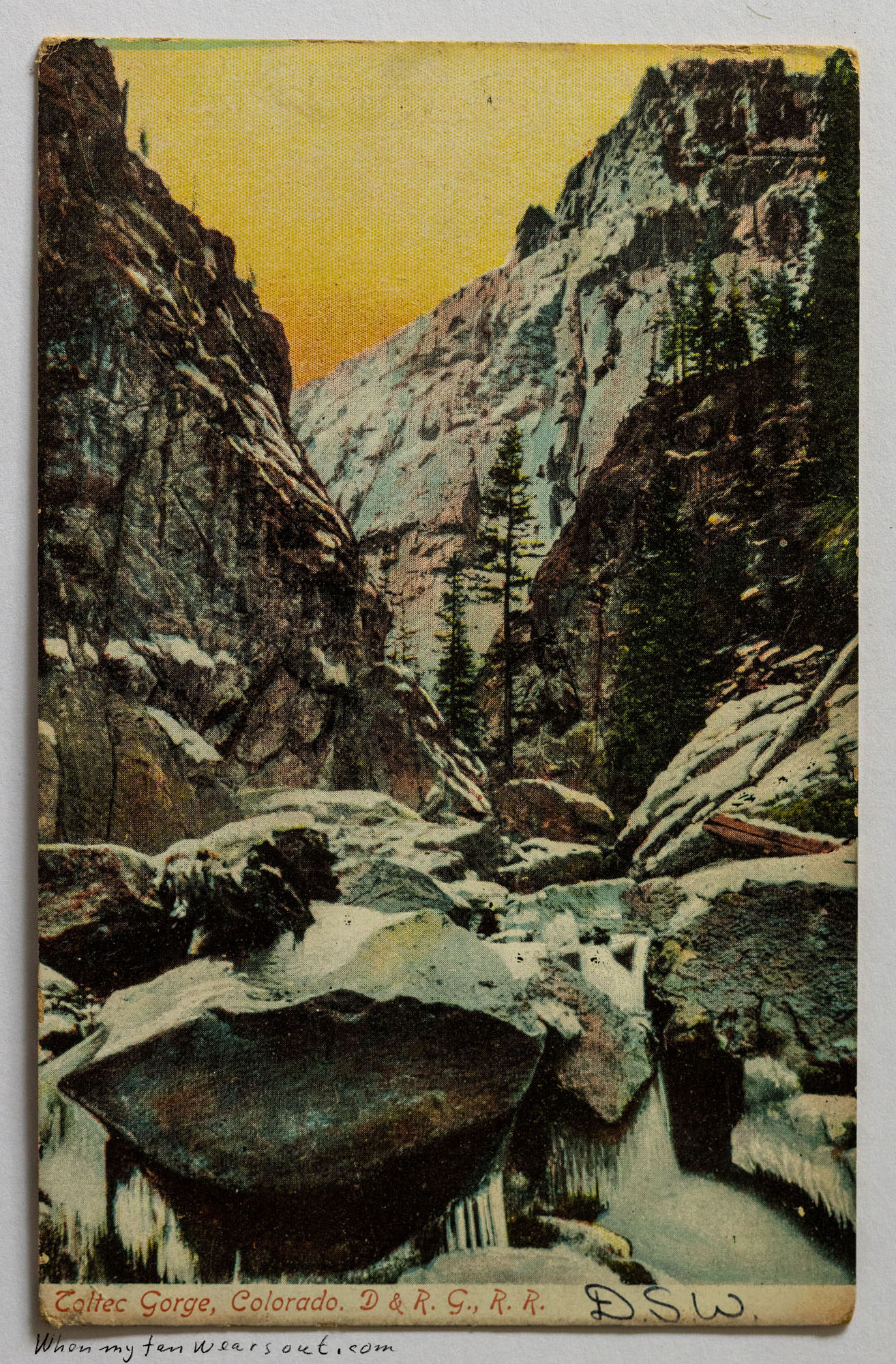
Front — A vibrant, hand-colored view of the Toltec Gorge in Colorado, with a river flowing through snow-dusted rocks and steep, pine-covered cliffs under a golden sky.
Postcard Metadata
Postmarked: S.A. Denver, Colo. — June 25, 1908
Sent From: Denver, Colorado
Sent To: Miss Pearl Byers, Carthage, Ill.
Distance Traveled: Approximately 715 miles
Postage: U.S. POSTAGE ONE CENT (Green George Washington stamp)
Card Details: Divided Back postcard, Litho-Chrome by Leipzig, Berlin, published by The Colorado News Company, Denver, Colo.
Back — Correspondence from D.S.W. to Pearl Byers
Transcription
June. 25.08 Miss Byers. Just returned from trips to mountains and was pleased to find card awaiting me, From july 1st I will have intern in the electric business in San Marciali. weather down here is too warm, & it is very dry for this time of year your friend D.S.W.
Historical & Family Notes
This postcard, sent to Pearl Byers in 1908, offers a glimpse into a potential early admirer or friend, D.S.W., before her eventual marriage to Harvey Sights. The sender shares news of recent mountain excursions and an upcoming “intern” position in the “electric business in San Marciali,” likely referring to San Marcial, New Mexico, a significant railroad town known for its engineering activities. The mention of the weather being “too warm” and “very dry” for the time of year provides a vivid, if brief, snapshot of the conditions in the American Southwest over a century ago.
While the sender is not explicitly Harvey Sights, this card is part of a collection leading to Pearl and Harvey’s story. It’s plausible that this correspondence represents a friendship Pearl maintained, or perhaps even an early professional contact for Harvey, who was known for his engineering work and travels. The timing predates much of the known extensive correspondence between Pearl and Harvey, suggesting a period when Pearl was cultivating various relationships.
The card’s front, depicting the dramatic Toltec Gorge, captures the adventurous spirit of the sender’s mountain trips. This kind of scenic postcard was very popular during the Divided Back era, allowing for both a picture and a personal message to be shared across vast distances, connecting people like D.S.W. and Pearl Byers, even as their lives unfolded in different regions of the country.
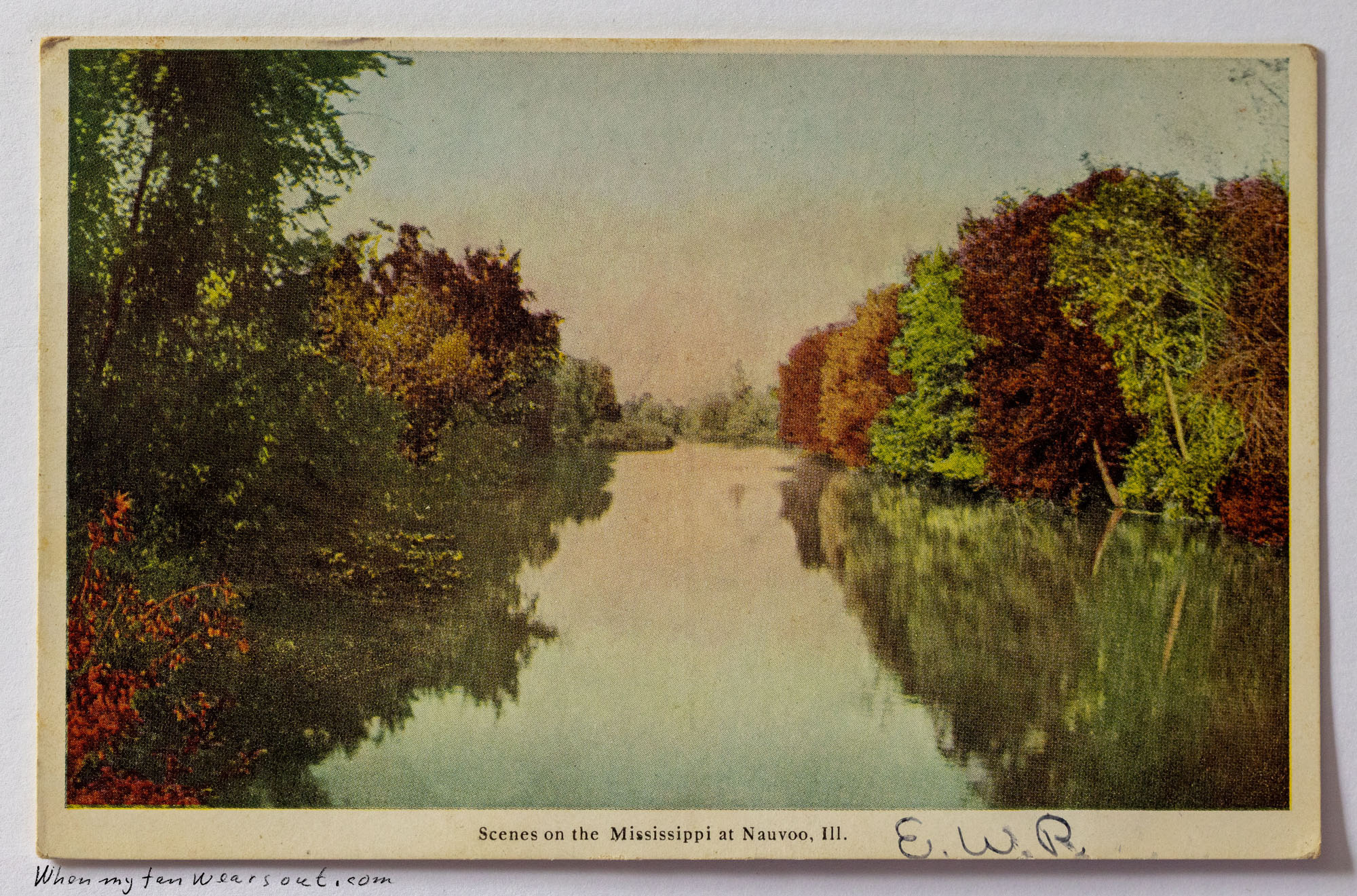
Front — Hand-colored view of the Mississippi River flowing past Nauvoo, Illinois.
Postcard Metadata
Postmarked: Wever, Iowa — August 20, 1908
Sent From: Wever, Iowa
Sent To: Miss Pearle Byers, Carthage, Ill.
Distance Traveled: Approximately 25 miles
Postage: One Cent, Benjamin Franklin (green)
Card Details: Divided back postcard (1907-present era)
Back — Correspondence from E.W.B. to Miss Pearle Byers
Transcription
Twas at Nauvoo Wednesday on an excursion. Had a good time. It is quite a nice place. It is a great place for grapes. E.W.B.
Historical & Family Notes
This postcard, sent to Pearle Byers, captures a pleasant “excursion” to Nauvoo, Illinois, a town known for its historical significance and scenic beauty along the Mississippi River. The sender, identified only by the initials E.W.B., was particularly impressed by the local produce, noting it as a “great place for grapes,” indicating a delightful day spent exploring.
While not from Harvey Sights, this card provides a glimpse into Pearle’s social life and the popular recreational activities of the era. Excursions, often involving steamboat trips or train rides to picturesque locations, were a common way for people to enjoy nature, escape daily routines, and socialize with friends and acquaintances.
This artifact contributes to the broader understanding of Pearle’s world before her marriage, showcasing the types of communications she received and the leisurely pursuits of her contemporaries. It paints a picture of a time when the simple pleasures of travel and local delights were cherished and shared through the mail.